Don’t Cheat — Choose a Nail and Discover What Your Choice Might Reveal About You
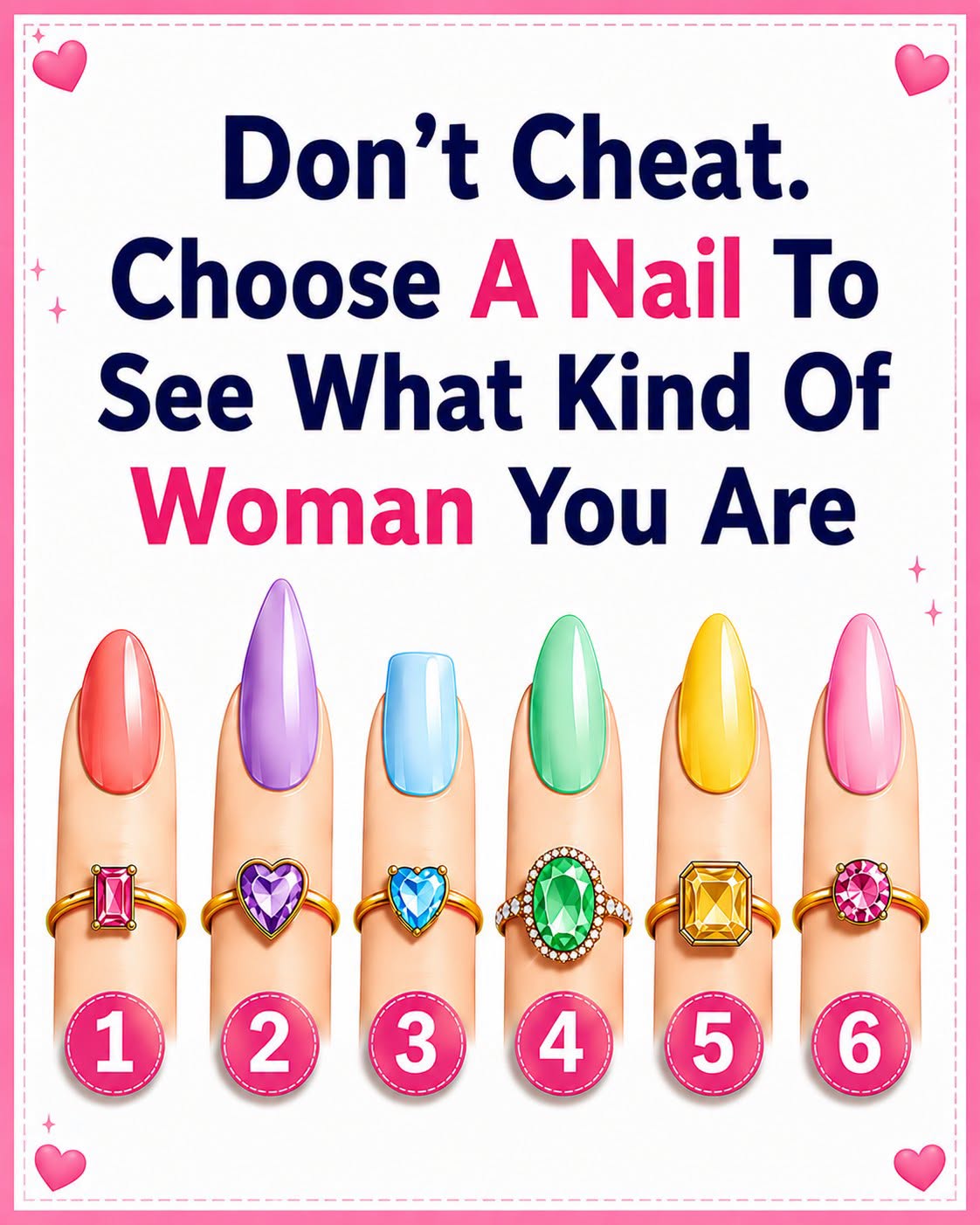
Sometimes the smallest choices can become surprisingly interesting conversation starters. A color, a piece of jewelry, a hairstyle, or even a nail design can reflect what catches our attention at a particular moment. The image featuring six purple nail designs invites viewers to look at the options and choose the one they find most appealing. Each nail has a noticeably different combination of shape, decoration, gemstone placement, and overall visual balance.
The exercise is meant to be entertaining rather than scientific, so the interpretations should be understood as symbolic descriptions, not psychological conclusions. Still, comparing the designs can be an enjoyable way to think about personal style, preferences, and the image someone wants to express. It is important to establish that choosing one of these nails cannot scientifically determine someone’s personality. Human personality is far more complicated than a preference for a particular manicure, color, gemstone, or shape.
Our choices can change according to the occasion, our work environment, current fashion trends, practical considerations, and even our mood on a particular day. Someone who normally prefers simple clothing might occasionally choose an extravagant manicure for a celebration. Another person who enjoys dramatic fashion may need practical nails for work. For that reason, the six interpretations below are best approached as playful reflections connected to the visual characteristics of each design.
Nail No. 1 — Simple, Structured and Understated
The first nail has a relatively simple and organized appearance, including a small rectangular decorative detail. Within this playful interpretation, the design is associated with qualities such as reliability, self-discipline, quiet confidence, and an appreciation for structure. Its attraction may come from the fact that it does not need excessive decoration to look complete. People who enjoy clean visual lines often appreciate designs that feel polished without becoming overwhelming. However, selecting this option does not prove that someone possesses any particular personality characteristic. A person could simply prefer the shape, find the design appropriate for work, or like the balance between decoration and simplicity.
There is something visually reassuring about designs that appear organized and symmetrical. In fashion, architecture, interior decoration, and graphic design, clean lines are frequently associated with order because they give the eye an obvious structure to follow. That visual association can help explain why a personality game might connect Nail No. 1 with dependability and discipline. The connection remains symbolic rather than diagnostic. Someone choosing it might be extremely adventurous in other areas of life while preferring understated nails. Style does not have to reproduce every aspect of someone’s character, and people regularly enjoy aesthetic choices that contrast with their everyday behavior.
This design could also appeal to someone thinking about practicality. Elaborate decorations may look beautiful but can require additional maintenance and may not be convenient in every environment. A smaller decorative element provides visual interest while preserving a relatively restrained appearance. Depending on a person’s job, hobbies, daily routine, and personal comfort, that balance can be particularly attractive. In that sense, the selection can tell us something much simpler than personality: it tells us which design the viewer likes at that particular moment. Even that small preference can be enjoyable to explore without turning it into a permanent label.
Nail No. 2 — Romantic and Expressive
The second design immediately stands out because of its heart-shaped element. Hearts are widely recognized as symbols connected with affection and romance, so it is easy to understand why a playful personality interpretation would associate this option with emotional openness, warmth, intuition, and romantic expression. The symbolism comes primarily from the design itself. When viewers see a heart, they already bring cultural associations with affection, relationships, friendship, celebration, and emotional connection. Those associations can influence the story they create around the person who chooses it. Nevertheless, liking a heart-shaped nail decoration does not demonstrate that someone makes decisions primarily through emotion.
A person could select this nail simply because the heart creates an attractive focal point. Another viewer might associate the design with Valentine’s Day, an anniversary, a wedding, or another special occasion. Someone else may choose it because the gemstone arrangement looks more interesting than the other five alternatives. These explanations demonstrate why visual preference should not automatically be treated as evidence about someone’s inner personality. Humans can arrive at the same choice for completely different reasons. Two people may select Nail No. 2 while having very different lifestyles, personalities, relationships, occupations, and attitudes toward fashion.
The romantic interpretation can still be enjoyable when treated as a creative exercise. If this nail immediately attracted your attention, you might ask yourself what specifically appealed to you. Was it the heart, the color, the amount of decoration, the symmetry, or simply the overall appearance? That question can be more meaningful than accepting a predetermined personality label. Personal style often works through small visual details that we notice before consciously analyzing them. Exploring those preferences can encourage reflection while leaving enough room for the obvious reality that one decorative choice cannot summarize an entire person.
Nail No. 3 — Balanced and Thoughtful
The third nail combines decoration with a comparatively balanced appearance. In the symbolic interpretation attached to the image, it represents thoughtfulness, stability, and controlled emotional expression. Those qualities fit the visual narrative because the design appears neither extremely minimal nor overwhelmingly elaborate. It occupies a kind of middle ground, allowing a personality story about balance to develop naturally around it. However, words such as “thoughtful” and “stable” are broad descriptions that many people can recognize in themselves. That makes them appealing in entertainment-oriented personality content but does not transform the nail choice into a psychological measurement.
Its position within the image may also matter more than viewers realize. When several options are displayed together, people do not evaluate every item under perfectly controlled conditions. Position, lighting, contrast, screen brightness, image quality, surrounding designs, and the order in which the eye moves across the picture can influence attention. A nail placed in a visually prominent location might receive additional consideration simply because viewers notice it quickly. If the same six designs were rearranged, resized, or displayed on different hands, some people could easily make another choice even though their personalities had not changed.
That does not make the exercise meaningless. It simply changes what the exercise can reasonably claim to reveal. Instead of asking, “What does this prove about my personality?” it can be more interesting to ask, “Why does this design appeal to me today?” Perhaps the balance feels elegant. Perhaps you like decoration but do not want something extremely dramatic. Maybe the proportions simply look satisfying. All of these explanations are legitimate. Fashion preferences can provide a window into what someone enjoys aesthetically without becoming evidence for fixed psychological characteristics.
Nail No. 4 — Bold and Attention-Grabbing
Nail No. 4 features a prominent central gemstone that immediately gives the design a stronger visual presence. The playful interpretation connects this option with ambition, boldness, confidence, and comfort with attracting attention. Visually, the connection makes sense because a large central decoration naturally draws the eye. Choosing a noticeable fashion element can sometimes be a deliberate way of making an outfit or manicure more expressive. However, it would be inaccurate to conclude that everyone who selects this nail must be ambitious, competitive, outgoing, or interested in being the center of attention.
Fashion often provides a safe way to experiment with appearances that differ from everyday behavior. A naturally reserved person may enjoy wearing dramatic jewelry, colorful clothing, or elaborate nails. An outgoing person may prefer an extremely simple manicure. People also change their appearance depending on the situation. Someone preparing for a wedding, birthday, holiday party, graduation, or another celebration might deliberately choose something more decorative than they would normally wear. In such circumstances, the design expresses the mood of the occasion rather than providing a reliable description of the person’s general character.
If Nail No. 4 was your immediate favorite, its strongest feature may simply match what you wanted to see. Perhaps you were looking for something glamorous, celebratory, or visually memorable. The large gemstone creates a clear focal point and distinguishes this design from subtler alternatives. That preference can be interesting without requiring a dramatic psychological explanation. A person can enjoy standing out through fashion while remaining quiet in conversation, just as someone can dislike flashy accessories while being extremely confident professionally. Human behavior rarely fits neatly into categories created from a single aesthetic decision.
Nail No. 5 — Geometric and Organized
The fifth design combines a square decorative element with a balanced overall shape. The original playful interpretation associates this option with practicality, intelligence, organization, and long-term thinking. Geometry often creates an impression of structure, which may explain why viewers connect square or rectangular shapes with order and precision. Similar visual associations appear throughout design, where symmetry and clearly defined shapes can make an object appear controlled and deliberate. Yet this remains an aesthetic association. Choosing a square gemstone cannot establish whether someone is more intelligent, practical, organized, or future-oriented than another person.
There are many simpler reasons why someone might prefer this nail. The square gem could complement jewelry they already own. The proportions might suit the shape of their fingers. They may enjoy geometric designs or prefer decorations that appear symmetrical. They could also choose it because the other options seem either too simple or too elaborate. These practical explanations demonstrate why personality claims based on fashion choices should always be treated cautiously. Preference is real, but the explanation behind that preference cannot be reliably determined from an image alone.
Still, Nail No. 5 offers an interesting example of how visual design influences interpretation. People naturally attach meanings to shapes, colors, and symbols based on experience and cultural associations. Straight lines may suggest structure, while softer curves may create a different emotional impression. Designers intentionally use these associations when creating everything from clothing and jewelry to packaging and logos. A personality game uses a similar mechanism by transforming visual characteristics into a story. The story can be entertaining and relatable, provided viewers remember that it is an interpretation rather than a factual assessment.
Nail No. 6 — Sleek and Independent
The sixth nail is comparatively sleek and less decorated than some of the more elaborate choices. Its symbolic description connects the design with independence, mystery, subtle confidence, and quiet influence. This interpretation grows naturally from the understated appearance. When something reveals fewer decorative details, viewers sometimes associate it with restraint or mystery. But once again, aesthetic symbolism should not be confused with evidence about personality. Someone could choose Nail No. 6 because it looks comfortable, because they dislike large gemstones, or because a simpler manicure works better with their daily routine.
Practical considerations are particularly important when discussing nail designs. Different professions and activities place different demands on the hands. Healthcare work, food preparation, childcare, sports, playing musical instruments, typing, crafting, and many other activities can influence which nail length or decoration is comfortable. Cost and maintenance also matter. Elaborate designs may require additional time, care, or salon visits. Therefore, someone who loves decorative nails in photographs might consistently choose simpler nails in everyday life. The reverse can also happen when a person who normally prefers minimal designs decides to experiment for a special occasion.
Selecting Nail No. 6 therefore does not mean that someone necessarily has a hidden or mysterious personality. The choice may reflect convenience as easily as personal style. If the design appeals to you, consider what attracted you first. Perhaps it was the clean silhouette, the reduced decoration, or the impression of elegance created by simplicity. Those reactions are genuine aesthetic preferences. They simply should not be stretched into claims that a single manicure can uncover characteristics that normally require much more information to understand.
Why Personality Results Can Feel Surprisingly Accurate
One reason entertainment personality tests can feel convincing is a psychological phenomenon commonly known as the Barnum effect. Broad descriptions can feel highly personal even when they could apply to many different people. Statements such as being caring but sometimes private, confident but occasionally uncertain, independent while still valuing relationships, or emotional while remaining strong are flexible enough for large numbers of people to recognize themselves in them. When someone first chooses an image and then receives a description, the sequence can make the result feel specifically tailored to that individual.
People also naturally search for connections between descriptions and their own experiences. If a result contains several characteristics, a reader may focus strongly on the statements that seem accurate while giving less attention to the ones that do not fit. This does not mean people are deliberately fooling themselves. Pattern recognition is a normal part of human thinking. We constantly interpret information by comparing it with our memories and experiences. Entertainment tests can take advantage of that tendency without necessarily intending to deceive anyone, which is another reason responsible presentation matters.
The safest and most accurate approach is therefore to make the entertainment nature of the exercise clear. None of these six nail designs can diagnose personality, emotional characteristics, intelligence, relationship behavior, or future success. They are decorative options accompanied by imaginative interpretations. Readers can enjoy seeing whether a description resonates with them, but they should remain free to disagree completely. A result that feels inaccurate is not a failure on the viewer’s part. It simply demonstrates the limitations of trying to describe a complex human being through one visual preference.
Your Choice Can Change With Context
Imagine seeing the same six designs before attending a formal celebration. You might choose the most glamorous option because it matches the occasion. Now imagine choosing again before beginning a busy workweek. A simpler design might suddenly become more appealing because practicality has become important. Your fundamental personality would not have transformed between those two situations. What changed was the context. This simple example demonstrates why fashion decisions are influenced by circumstances as much as by stable preferences.
Color can produce similar changes. The six nails in this exercise share a purple theme, but someone who does not normally wear purple might respond very differently if the same designs appeared in red, black, blue, pink, silver, or another color. Lighting can alter the appearance as well. Screen settings, brightness, contrast, and image quality may make certain gemstones look more attractive than others. Even the hand on which a design is displayed can influence perception because nail shape and finger proportions affect the overall appearance.
Price is another practical factor that personality games usually ignore. A person might admire the most elaborate design while choosing a simpler manicure because it costs less to create and maintain. Maintenance time matters too. Large gemstones and complicated decorations may require more attention than a minimal design. Nail health, allergies, comfort, workplace expectations, and personal routines can further influence the final decision. None of those considerations makes the preference less authentic. They simply remind us that real-world choices emerge from many interacting factors.
Fashion Is Expression, Not a Personality Verdict
Clothing, jewelry, hairstyles, makeup, and nail art allow people to experiment with different forms of self-expression. Sometimes appearance closely reflects someone’s usual taste. At other times, fashion provides an opportunity to try something completely different. A person who normally dresses conservatively might choose a dramatic manicure because it feels exciting. Someone known for colorful clothing might occasionally prefer a simple, neutral design. Neither choice creates a contradiction. Personal style is flexible because people themselves behave differently across situations.
This flexibility is one of the most enjoyable aspects of fashion. There is no requirement that every outfit, manicure, accessory, or hairstyle represent a permanent identity. People can change styles simply because they want variety. They can follow a trend for a few weeks and then lose interest. They can choose something unusual for a holiday and return to familiar styles afterward. Viewing fashion through this flexible perspective makes exercises such as the six-nail choice more enjoyable because there is no pressure to treat the result as a permanent definition.
The same principle applies to personality itself. People can be quiet in unfamiliar environments and extremely expressive among close friends. They can be cautious about financial decisions while adventurous when traveling. They can enjoy attention in professional situations while preferring privacy in their personal lives. Describing someone with one word such as “bold,” “romantic,” “practical,” or “mysterious” inevitably leaves out enormous amounts of information. Human beings contain combinations of characteristics that can appear differently depending on circumstances.
What Your Selection Really Tells You
At the most reliable level, choosing one of the six nails tells you one simple thing: among the options presented at that moment, one design attracted you more than the others. That is a genuine preference, but it does not require a larger claim. You may enjoy examining why it attracted you. Was it the gemstone? Was it the shape? Did you like the amount of decoration? Did the design remind you of jewelry, clothing, or an event? These questions turn a simple visual game into an opportunity for harmless self-reflection.
You can even repeat the exercise later and see whether your answer changes. If another design catches your attention tomorrow, that does not mean your personality changed overnight. Your mood, visual attention, or circumstances may simply be different. That possibility is part of what makes aesthetic preference interesting. Taste can remain stable in some areas while changing dramatically in others. People discover new styles, abandon old favorites, and occasionally return to designs they once disliked.
There is also no correct answer among the six designs. None represents a better personality, greater intelligence, stronger character, or more desirable type of person. The decorative differences simply allow different stories to be attached to each option. A viewer should therefore choose whatever genuinely catches their attention rather than trying to select the result they believe sounds most flattering. The exercise becomes much more enjoyable when there is nothing to prove and no personality category to achieve.
A Better Way to Enjoy Visual Personality Games
Visual personality games work best when they create curiosity without presenting entertainment as scientific certainty. Choose the design that catches your eye, read the symbolic interpretation, and decide whether any part of it feels familiar. If it does, consider why. Perhaps the description reflects something you already know about yourself. Perhaps the visual design influenced how you interpreted the words. Perhaps it is simply a broad statement that could describe many people. Any of those explanations is perfectly reasonable.
If the interpretation does not resemble you at all, there is no reason to force a connection. Disagreement can actually make the activity more interesting because it encourages you to describe yourself in your own words. Someone who selects the heart design may consider themselves highly analytical rather than romantic. Someone choosing the largest gemstone may dislike attention in everyday life. Someone selecting the simplest design may have an adventurous and spontaneous personality. These differences illustrate why personal experience is always richer than the categories offered by an entertainment image.
Ultimately, the six purple nail designs are best viewed as six different visual stories. One emphasizes simplicity, another uses romantic symbolism, another creates balance, another makes a dramatic statement, another highlights geometry, and the final option offers a sleeker appearance. Each design can inspire a playful personality interpretation because humans naturally associate visual features with ideas and emotions. Those associations can make the exercise engaging, but they should remain exactly what they are: interpretations inspired by design.
So, which nail would you choose first? Pick the one that genuinely catches your attention rather than searching for the “best” personality result. Then read its description as a playful reflection instead of a verdict about who you are. Your choice might say something about the style, mood, or visual expression you prefer today, but it cannot capture the complexity of your experiences, relationships,