A Four-Year-Old Walked Into a Biker Bar at Midnight… Then Asked for a Hero.
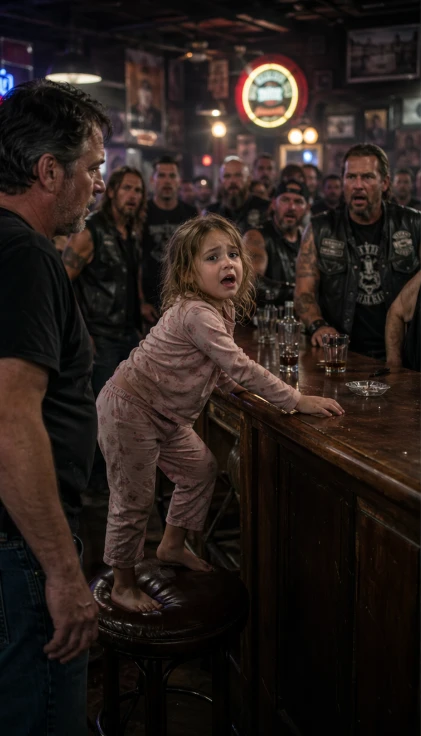
The music at the Iron Horse didn’t fade so much as it was strangled mid-breath. One moment the jukebox was tearing through ZZ Top, glasses rattling in rhythm, boots pounding against scarred wood floors. The next, there was nothing—no laughter, no shouting, no clink of bottles—only the tiny sound of ice collapsing inside half-empty drinks. In twelve years behind that bar, I had seen men bleed, marriages explode, cops drag bodies out by the heels, and drunks cry for mothers long dead. But nothing had ever frightened me the way that child did.
She stood in the doorway like something misplaced by the night itself—barefoot, four years old at most, wearing stained pink pajamas two sizes too big. Her hair was tangled, one sleeve hung off her shoulder, and her knees were smeared with dirt. She looked far too small for the room and far too serious for her age.
Then she marched straight through forty leather-clad bikers as if they were furniture.
No one moved to stop her. Men who would laugh in the face of a knife fight stepped aside without thinking. She climbed onto the nearest barstool, using all her weight to haul herself up, then planted both hands on the sticky mahogany and looked directly at me.
“My mommy needs help.”

Her voice was clear. Not crying. Not whining. Just urgent.
“She’s sleeping on the floor and there’s red stuff everywhere and she won’t wake up.”
The words hit the room harder than a shotgun blast.
I opened my mouth and found that my throat had gone dry. “What’s your name, sweetheart?”
“Lily.”
“Okay, Lily.” I leaned over the bar, trying to keep my hands from shaking. “Do you know where your house is?”
She turned and pointed east.
Everyone in that room knew what east meant. The old blocks. Burned-out porches. Streetlights smashed years ago and never replaced. Alleys where sirens took too long to arrive and people learned not to scream because no one came.
Rick, our sergeant-at-arms, was already dialing 911. He had a shaved head, a face cut from granite, and hands steady enough to fix a carburetor in the dark. I’d seen him snap pool cues over men’s backs. I’d also seen him rescue a stray cat from a storm drain and carry it inside his vest.
Hank, our vice president, crouched beside the stool. He was built like a freight train and scarred like old pavement, but when he spoke to children his voice always softened into something warm.
“Lily,” he said gently. “Did something happen before Mommy went to sleep?”
The girl’s lower lip trembled. Her fingers twisted in the fabric of her sleeves.
“The man,” she whispered. “The man with the loud voice.”
The temperature in the room seemed to drop.
“He was mad about the money. He hit the wall.” She swallowed hard. “Then he hit Mommy. She fell down and the red stuff came out.”
No one breathed.
“He ran away,” she finished. “So I came to find a hero.”
No one gave an order. No one asked permission. Chairs scraped back. Engines keys came out. Forty men rose in one motion like they had rehearsed it.
Rick snapped his phone shut after barking directions to dispatch. “They’re sending a unit, but they don’t know those streets. We do.”
That was the moment the bar stopped being a bar and became something else entirely.
Hank lifted Lily into his arms, careful as if she were made of glass. She tucked herself against his leather vest without hesitation.
“Can you show us the house?” he asked.
She nodded against his shoulder. “It has a yellow star in the window. Mommy put it there for my birthday.”
Three seconds later the Iron Horse emptied.
Outside, the night exploded into chrome thunder. Forty engines roared to life, their headlights cutting white tunnels through the dark. It should have sounded like chaos. Instead, it sounded like purpose.
I locked the register, grabbed my coat, and climbed onto the back of Rick’s bike. Hank settled Lily into the sidecar attached to his old Harley, wrapping her in a denim jacket so large it swallowed her whole. She looked like a child hiding inside a borrowed world.
Then we rode.
The city peeled past in streaks of neon and shadow. We tore through intersections, engines snarling, dogs barking behind fences as porch lights flicked on one by one. People came to windows, expecting trouble.
What they saw was forty outlaws escorting a little girl home.
We found the house six blocks into the East Side.
Row homes leaned shoulder to shoulder like exhausted men. Paint peeled from siding in long curls. Broken bottles glittered in gutters. In the front window of one crumbling house, lit by a weak kitchen bulb, hung a fading yellow paper star.
Hank didn’t slow down. He killed the engine, handed Lily to me, and crossed the porch in two strides.
The door was locked.
He kicked it once.
The frame split.
He kicked it again.
The whole thing crashed inward.
Inside smelled like copper and mildew.
The kitchen light flickered overhead, stuttering like it might die any second. A woman lay sprawled beside the table, one arm twisted beneath her, blood pooled dark around her hair. For a terrible heartbeat she looked already gone.
Rick dropped beside her so fast his knees hit the floor like hammer blows. He pressed fingers to her throat, then leaned close to listen.
“Pulse,” he barked. “Weak, but there. She’s still here.”
I exhaled so hard it hurt.
“Get the medics now!”
The paramedics were only blocks away, but those minutes stretched thin as wire. We moved without speaking. Two men cleared the hallway. Three checked every room. Others spread outside, forming a ring around the property.
No one was getting in.
No one was getting out.
I stood on the porch holding Lily while sirens wailed closer. She stared at the ambulance lights bouncing off windows and asked the question no child should ever have to ask.
“Is Mommy gonna wake up?”
I didn’t know how to answer.
Hank came out, his hands streaked with someone else’s blood. He knelt so their eyes were level and wiped dirt from her cheek with his thumb. Then he reached to his vest and removed the silver Road Captain pin he had worn for eight years.
He placed it in her palm and closed her tiny fingers over it.
“Your mama’s a fighter,” he said. “And you? You’re the bravest person I’ve ever met.”
Her chin trembled. “You promise?”
He nodded once. “We’re not leaving until we know she’s okay.”
The little girl believed him instantly. Every man there did too.
The ambulance doors slammed. They took her mother into the night, lights flashing red across broken brick walls. We stood in the street after they left, forty silhouettes beneath buzzing wires, listening to the engines cool.
No one suggested going home.
We stayed until dawn.
Somebody brought coffee from the gas station. Somebody else found Lily a blanket. Rick called the hospital every twenty minutes until a nurse finally said the woman had made it through surgery.
When he relayed the news, a cheer ripped through that ruined block loud enough to wake the dead.
Lily smiled for the first time.
The man with the loud voice was found two days later trying to leave town. A clerk at a bus station recognized him from the police alert and also recognized the motorcycles parked outside the diner across the street. Funny how fast courage spreads when people stop feeling alone.
The trial took months.
The healing took longer.
Three weeks after that night, sunlight spilled through the front windows of the Iron Horse. It was afternoon, the smoke had cleared, and the place smelled more like coffee than whiskey. A few of us were doing inventory. Hank sat at the end of the bar pretending to read paperwork he couldn’t stand.
The front door opened.
Conversation died again.
A woman stepped inside slowly, leaning on a cane. One side of her head was bandaged. Purple scars disappeared beneath her collar. She looked fragile in the way survivors sometimes do—thin, careful, carrying pain in every movement. But her eyes were bright, alive, and steady.
Beside her bounced Lily in a pair of glittering sneakers that flashed with every step.
For a second no one moved. Forty rough men simply stared.
Then Lily squealed and ran.
She sprinted the length of the bar, climbed onto Hank’s knees like she had always belonged there, and held out her hand.
Nestled in her palm was the silver pin.
“Mommy’s awake,” she announced proudly.
Hank tried to answer and couldn’t. His jaw worked once. Twice. Then he hugged her so gently it made my chest ache.
The mother looked around the room at the tattoos, the scars, the old bruised faces, the hands callused by engines and fists and years of hard living. Her own hands shook around the handle of the cane.
“The police told me what happened,” she said. “They said my daughter walked through the dark to find heroes.”
Her voice broke.
“I didn’t believe them.”
She looked past us to the line of bikes shining outside in the sun.
“Then I saw those motorcycles.”
No one knew what to do with praise. Men who could throw punches all night suddenly found the floor fascinating. Rick coughed into his fist. Somebody in the back muttered for someone else to shut up though no one had spoken.
I poured a glass of water and set it in front of her.
Then I made Lily the biggest Shirley Temple the house had ever seen, extra cherries, extra fizz, bright red like celebration instead of fear. She accepted it with both hands like treasure.
The mother took a slow sip of water. “I don’t know how to thank you.”
Hank finally found his voice.
“You already did,” he said, looking at Lily.
Silence settled over the room once more, but this time it wasn’t fear. It was reverence. The kind people carry in churches, hospitals, and funeral homes—the hush that comes when everyone present understands something sacred just happened.
I looked around the Iron Horse and hardly recognized it.
The same walls were there, scarred by years of smoke and fists. The same bar stools. The same jukebox. The same men the city crossed the street to avoid.
But the room had changed.
Maybe it was the little girl laughing with grenadine on her lip.
Maybe it was the woman still standing after nearly dying.
Maybe it was forty hardened men pretending not to cry.
Or maybe some places become holy for one simple reason: people choose, in a single unplanned moment, to be better than the names the world gave them.
For twelve years I had tended a biker bar.
That afternoon, for the first time, it felt like home.