A Man Told Me to Silence My Sick Baby in the ER—Seconds Later, the Doctor’s Reaction Shut Him Down
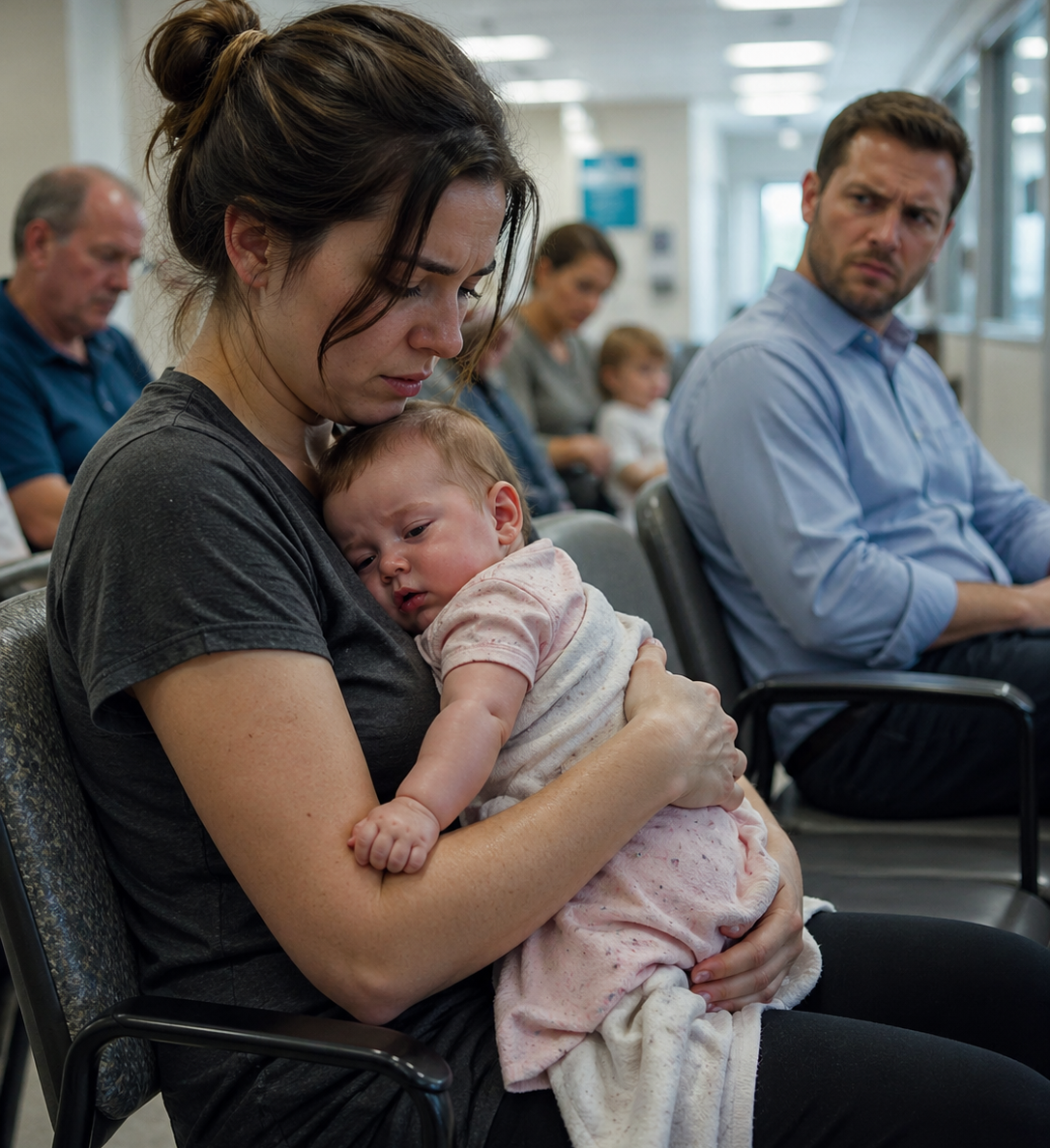
I brought my six-month-old daughter to the emergency room after she’d been running a fever for three days and barely eating. I already felt like I had failed her. Then a stranger made sure everyone else felt that way too.
My six-month-old daughter, Lily, had a fever for three days before I took her to the ER.
I know how that sounds.
But I had called her pediatrician twice. The second time, they told me that if she still wouldn’t take a bottle by morning, I should bring her in.
By morning, she was different.

Not just sick—but quiet.
Too quiet.
She barely cried. Barely looked at me. Barely reacted at all.
That terrified me more than the fever ever could.
Lily was always strong-willed. She used to protest everything—diaper changes, naps, even being burped. But now she just lay in my arms, her eyes half-open, like she didn’t even have the energy to cry.
That’s when I knew something wasn’t right.
I packed quickly—diapers, wipes, bottles, a spare outfit—and drove to the hospital, talking to her at every stoplight.
“Stay with me, Lily,” I whispered.
She made soft, weak sounds. Not even real cries.
By the time we arrived, I looked like I hadn’t slept in days. My shirt was stained with formula. My diaper bag—an old one my sister had given me—was worn and fraying.
At triage, they checked her vitals, asked questions, and told me they’d get us into a pediatric room as soon as possible. Then they asked us to wait.
So I sat there, holding her against my chest, trying not to fall apart.
Her cries were faint. Fragile.
I rocked her gently. “I’m here, baby. Mommy’s here.”
The waiting room was crowded.
An older man clutching his side. A teenager with a bandaged wrist. A woman holding a sleeping child.
And one man in a crisp shirt, tapping his foot impatiently.
At first, he just sighed loudly whenever Lily made a sound.
Then he said it.
“Can your baby be quiet?”
I turned, thinking I had misheard him.
“I’m sorry?” I said.
“She’s sick,” I added quietly.
“So is everyone else,” he replied, clearly irritated.
Lily whimpered again. I kissed her forehead. “It’s okay, sweetheart.”
He muttered under his breath, “Unbelievable.”
I tried to ignore him. Focused on Lily. Prayed someone would call us soon.
Instead, he raised his voice to a passing nurse.
“Excuse me—can you do something about this?”
The nurse stopped. “About what, sir?”
He pointed at me.
“The noise. Some of us are trying to sit here in peace.”
The nurse glanced at Lily, then back at him. “She’s an infant. In an emergency room.”
That should have ended it.
It didn’t.
“Then maybe she should be seen faster,” he snapped. “Or someone should calm her down.”
I felt heat rise up my neck.
Not anger.
Shame.
I know now I shouldn’t have felt that way—but exhaustion and fear do strange things. When your baby is burning with fever and someone is judging you out loud, it gets inside your head.
So I said the word I wish I hadn’t.
“I’m sorry.”
The nurse—Tasha—looked at me like she wanted me not to apologize.
But I already had.
That only made him bolder.
“Some of us have real emergencies,” he said, looking me up and down.
Tasha’s tone hardened. “Sir, that’s enough.”
But he kept going.
“I’ve been waiting over an hour, and now I have to listen to this? People think everything revolves around them.”
I looked down at Lily, trying to stay steady.
People were watching now.
A woman in the corner frowned at him.
An older lady across from me gave me a kind, sympathetic look that almost broke me.
Then he leaned slightly closer and said, just loud enough,
“Maybe if you’re this overwhelmed, you should’ve planned better before having a child.”
That one hurt.
Not because it was clever.
Because I was too tired to defend myself.
I held Lily tighter. “You’re okay,” I whispered, though my voice shook.
And then—
The doors opened.
A staff member stepped out, scanned the room, and walked straight toward me.
“Mia?” he said. “We need to take your daughter in right now.”
The room fell silent.
“My baby?” I asked.
He nodded. “Her assessment raised concerns. The pediatric team wants to see her immediately.”
For a moment, I couldn’t move.
Then Tasha was beside me with a wheelchair. “You’re okay. We’ve got you.”
I stood on shaky legs, still holding Lily.
“Is she…?” I couldn’t finish the question.
The staff member—Daniel—softened his voice. “You did the right thing bringing her in. Let’s go.”
Behind me, the man spoke again.
“Wait—what?”
Daniel turned to him, calm but firm.
“We treat patients based on medical need. Not noise. Not convenience.”
The man fell silent.
No one was looking at him anymore.
As they wheeled me away, the older woman gave me a small nod. I held onto that more than I expected.
Once we were inside, everything moved quickly.
Nurses took Lily to help her faster. I had to fight the instinct to pull her back, even though I knew they were helping.
Questions came rapidly.
“How long has she had the fever?”
“Three days.”
“Is she eating?”
“Almost nothing.”
“Wet diapers?”
“Less than usual.”
A pediatric doctor entered. Calm. Focused.
“I’m Dr. Reyes.”
He examined Lily carefully and ordered fluids and tests.
I answered everything I could, terrified I might forget something important.
At one point I whispered, “I should’ve brought her sooner.”
Without even looking up, he said, “You brought her when something felt wrong. That’s what matters.”
A nurse—Jenna—handed me water. “Drink.”
I hadn’t even realized how thirsty I was.
They worked quickly but calmly. Everything had purpose.
Still, my mind drifted back.
To the man.
To how he saw me.
My clothes. My bag. My exhaustion.
Jenna must have noticed because she crouched beside me and said quietly,
“You have nothing to be ashamed of.”
I looked at her.
“You brought your baby here,” she added. “That’s what a good mother does.”
That was it.
I broke.
Not loudly. Not dramatically.
Just quiet tears—the kind that come after holding everything in for too long.
“I thought maybe I was overreacting,” I whispered.
“You weren’t,” she said.
Later, Dr. Reyes returned.
“She’s responding,” he told me.
“Is she going to be okay?” I asked.
“We’re very hopeful,” he said gently. “She’s dehydrated, but we caught this in time. You did the right thing.”
I covered my mouth, crying again.
Lily looked so small under the hospital light—but her breathing was steadier now.
For the first time that day, I exhaled.
Hours passed.
No one judged me.
No one looked at my clothes or my worn-out bag.
They just treated me like I mattered.
Before his shift ended, Dr. Reyes said, “The man from the waiting room asked to apologize.”
My body tensed.
“No,” I said.
He nodded. “Understood.”
That was it.
No confrontation. No closure.
Just silence.
Later, Lily stirred.
I reached through the crib and touched her hand.
Her tiny fingers curled around mine.
And suddenly, everything became simple again.
Not my appearance.
Not what anyone thought.
Just this:
My baby needed me.
And I showed up.
Sometime after midnight, Jenna checked on us and smiled.
“She’s doing better.”
“Thank you,” I whispered.
By morning, Lily was stable.
Still sick. Still weak.
And I was still exhausted—in the same stained shirt, with the same old bag.
But I wasn’t ashamed anymore.
I was just a mother who got her child the help she needed.
And that was enough.