A Rich Customer Forced A Pregnant Waitress To Kneel In Spilled Soup—Then The Harley Engine Outside Roared, And The Restaurant Went Dead Silent
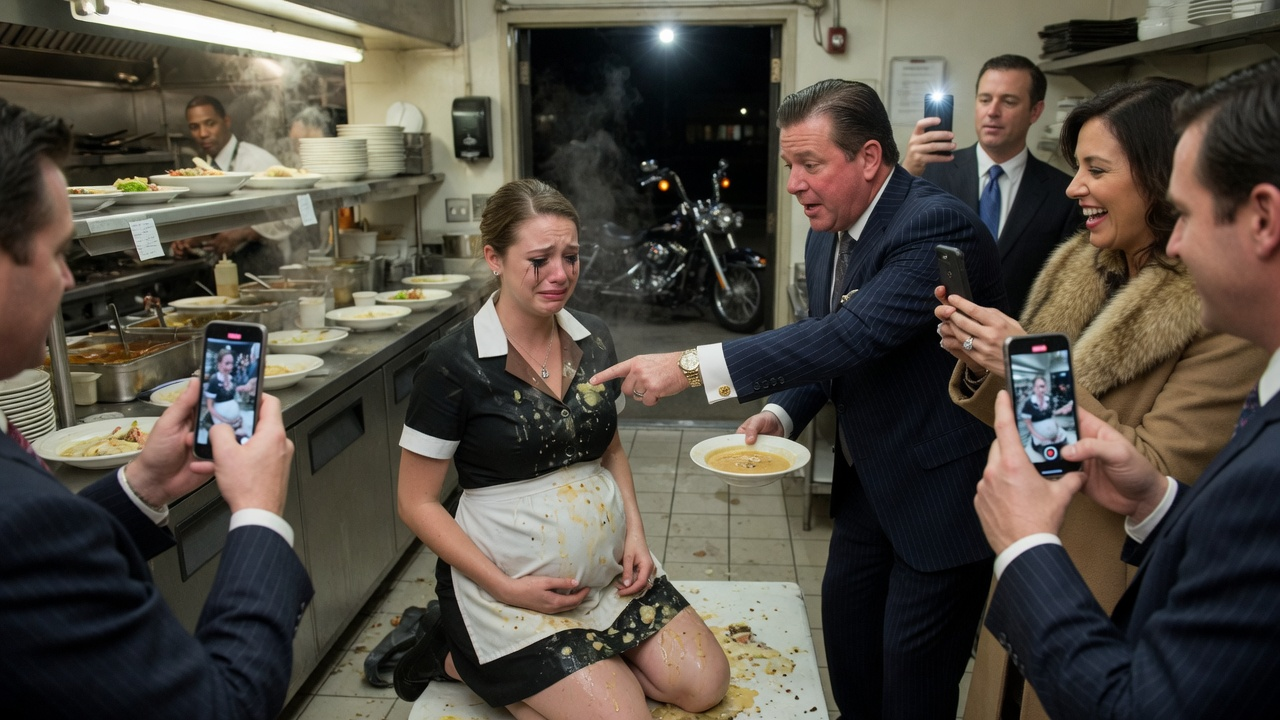
ank to my knees on the greasy tile of the kitchen floor, my hands trembling as I tried to wipe the mess. It was my last shift. Just four more hours, and I could finally go home, put my feet up, and rest the baby. I had been counting down the minutes since I clocked in at five.
“Look at this, everyone! Filthy, just like her service!”
The voice belonged to Mr. Henderson, a man who owned half the development firms in this town and thought that gave him the right to own the people in it. He stood over me, his designer shoes inches from my face, his phone raised high. Behind him, his friends were laughing, their own phones out, capturing the scene for their followers.
“Pick it up,” he sneered, nudging my shoulder with his leather-clad foot. “My suit is worth more than your entire life. You’re going to clean this, and you’re going to do it on your knees where you belong.”
I kept my head down, my breath coming in shallow, ragged gasps. I was twenty-two, pregnant, and terrified. I couldn’t afford to lose this job, but I also couldn’t take much more. My back ached, and my stomach felt tight with stress.

“I… I’m sorry, sir,” I whispered, the words barely audible over the clatter of the kitchen and the mocking laughter.
“Sorry doesn’t fix a five-thousand-dollar suit, sweetheart,” one of the women in his group chirped, recording me from a distance. “Make sure you get the stain out. We want a clear shot of her scrubbing.”
I felt a tear slip down my cheek, but I quickly wiped it away with the back of my hand. I felt so small. So powerless. The head chef stood by the pass, looking at his shoes. He knew I hadn’t done anything wrong—the soup had been sitting on the edge of the counter, and Henderson had bumped into it—but he wasn’t going to stand up to a man who tipped in hundred-dollar bills.
Henderson kicked my bucket over, sending cold, dirty water across the floor. “Do it again. Faster.”
I reached up, my fingers brushing the silver ring hanging on the chain around my neck. It was a heavy, old piece of jewelry—a skull with wings, the emblem of the Iron Reapers. It was all I had left of my brother, the man who had raised me after our parents died. He had told me, “If anyone ever makes you feel like you aren’t worth the space you take up, you remember who you are.”
I wasn’t a waitress. I wasn’t a servant. I was a Reaper.
But I was also alone. Or so I thought.
Suddenly, the air in the kitchen changed. It wasn’t a sound at first, but a vibration—a low, rhythmic thumping that seemed to rattle the heavy pots hanging from the ceiling.
Then came the roar. It started as a distant rumble, then swelled into a deafening thunder that drowned out the mocking laughter, the clinking of silverware, and the chatter of the dining room. Every person in the kitchen stopped. Mr. Henderson paused, his phone still held high, a confused frown replacing his smirk.
The sound was unmistakable. A dozen Harley-Davidson engines, idling in perfect, intimidating formation right outside the service entrance.
The heavy steel door at the back of the kitchen—the one the delivery trucks used—swung open with a bang that echoed like a gunshot.
The laughter died instantly.
Twelve men walked in. They were dressed in black leather vests, their faces obscured by dark sunglasses and thick, groomed beards. Each of them had the same patch on their back: a reaper, scythe in hand, wings spread wide.
They didn’t rush. They didn’t shout. They just moved with a coordinated, dangerous grace, forming a half-circle around me. The head chef went pale, backing away until he hit the walk-in fridge. Henderson’s phone wobbled in his hand.
The man in the center—the one with “President” stitched into his leather—stepped forward. His boots hit the tile with a sound like a hammer strike. He looked down at me, then at the soup on the floor, and finally at Henderson.
He took off his sunglasses. His eyes were cold, hard, and terrifying.
“You boys done filming?” he asked. His voice wasn’t loud, but it cut through the room like a blade. “Because I think you’re about to be the stars of a very different kind of show.”
I stared up at him, my heart hammering against my ribs. I knew that face. I hadn’t seen him in years, not since the funeral, but I knew him.
“Jax?” I whispered, my voice breaking.
The President’s eyes softened, just for a fraction of a second, before he turned his gaze back to Henderson. “Nobody talks to her like that. And nobody makes her kneel.”
CHAPTER 2
The silence that followed Jax’s words was heavy, suffocating. Henderson, the man who had been so arrogant a moment ago, looked at the dozen men standing in the back of his restaurant, then back at his own friends. He tried to puff out his chest, but his eyes were darting toward the exits. He knew he was out of his depth.
“Who do you think you are?” Henderson stammered, his voice lacking the sharp, biting edge it had held seconds ago. “This is private property. Get out, or I’ll call the police. I’ve got friends in high places, and they don’t take kindly to thugs like you.”
Jax didn’t blink. He took a slow, measured step forward. His boots sounded heavy on the tiles, a rhythmic count-down. “Call them,” Jax said, his voice terrifyingly calm. “I’d actually like to see the police report for this one. I’d like to see you try to explain to them why you were filming a pregnant woman on her knees.”
I scrambled backward, pressing my back against the cold metal of a prep table. I was shaking so hard my teeth were clicking together. I looked at the Reapers—these were the men my brother used to ride with. I remembered seeing them at the house when I was a child, always loud, always laughing, but never, ever like this. They weren’t laughing now.
One of the younger Reapers, the one the club called “Prospect,” looked like he wanted to jump in and grab Henderson by the throat. His hands were balled into fists, his knuckles white.
“Control, son,” a voice rumbled beside him. It was the Road Captain, a man named Miller with a thick, salt-and-pepper beard and a scar that ran from his temple to his jaw. He didn’t even look at the Prospect, but his hand rested firmly on the young man’s shoulder. “We protect. We don’t perform.”
The Prospect exhaled, a long, shaky breath, and lowered his fists. He looked at me, his eyes filled with a raw, protective fire. “You alright, miss?” he asked, his voice softer than I thought a biker could be.
“I… I think so,” I whispered.
Henderson didn’t like being ignored. He turned to the chef. “Do something! Get them out of here!”
The chef, a man who had known me for years and had watched me struggle to pay rent and afford prenatal vitamins, finally looked up. He looked at Henderson, then at the ring around my neck, then at the twelve men standing in his kitchen. He stood up straight, his face reddening.
“I think you’ve had enough of my restaurant, Mr. Henderson,” the chef said. His voice was trembling, but it was firm.
Henderson’s face turned a dangerous shade of purple. “You’re fired! You’re both fired! Do you know how much money I spend here? You’re nothing but a waitress and a line cook. You’re disposable!”
He stepped toward me, reaching out as if to shove me again, to prove he still had power. “Get up and get out!”
He didn’t even see the Sergeant-at-Arms move.
It was a blur. One second, Henderson was looming over me, and the next, the Sergeant-at-Arms—a massive man with a tattoo of a scythe covering his entire forearm—had him pinned against the stainless steel prep table. He didn’t punch him. He didn’t shout. He simply caught Henderson’s wrist in one hand and his shoulder in the other, locking him into a position where he couldn’t move.
Henderson gasped, his face pressed against the cold steel. “You… you can’t touch me!”
“I’m not touching you,” the biker said, his voice low and dangerous. “I’m keeping you from hurting her again. There’s a big difference.”
The restaurant went dead silent. The people who had been filming were standing perfectly still, their phones forgotten. The laughing, the mocking, the arrogance—it had all evaporated, replaced by the crushing weight of the truth. They weren’t watching a waitress get bullied anymore. They were watching a man get dismantled, not by violence, but by the sheer force of someone who refused to let him be cruel.
Jax, the President, walked over to me. He knelt down, not caring that he was staining his expensive leather chaps on the spilled soup. He reached out, his hand hovering for a second before he gently tucked a strand of hair behind my ear.
“You’re safe now,” he said. He looked at the necklace, at the Reaper ring. “Your brother would have been proud of how you handled this. But you shouldn’t have had to be this strong on your own.”
“He told me to never let anyone make me feel small,” I said, my voice barely a whisper. Tears were streaming down my face now, hot and fast. “I just… I just wanted to finish my shift.”
Jax stood up and turned to the crowd of diners. He didn’t look at them with anger; he looked at them with disappointment. “You all stood here,” he said, his voice echoing off the kitchen walls. “You all had your phones out. You all watched a woman in this condition be treated like an animal, and not one of you stepped up. Not one.”
The room was so quiet I could hear the hum of the refrigerator.
“That’s the real shame,” Jax continued, gesturing toward Henderson, who was still pinned to the counter. “He’s just a bully. But you? You’re the reason bullies feel like they can do whatever they want.”
Henderson was squirming, trying to find a way out of the Sergeant-at-Arms’ grip. “I’ll sue you! I’ll have your club shut down!”
“You can try,” Jax said, turning back to him. He leaned in close. “But while you’re thinking about your lawsuit, I suggest you think about what happens when you decide to bully a woman carrying a child. You didn’t just insult a waitress. You insulted a mother. And in our world, that’s the ultimate line.”
Jax looked at the chef. “Are we done here?”
The chef nodded, a slow, determined movement. “We’re done.”
“Good.” Jax gestured to his men. “Escort our guest out. And make sure he doesn’t forget his dignity. Oh, and Henderson? Take your friends. And tell your followers to check their facts before they hit upload. The internet has a long memory, and it’s going to love this video.”
The Reapers moved like a well-oiled machine. Two of them helped me to my feet, holding my arms gently, as if I were made of glass. They walked me through the kitchen, through the dining room where people were staring, their faces pale and ashamed, and out to the parking lot.
The cold air hit me, and for the first time that day, I felt like I could breathe. Outside, the line of Harleys stood like sentinels, their chrome glinting under the security lights.
The Prospect stepped forward and opened the door to his own truck—not a bike, but a sturdy, reliable vehicle. “I’m taking you home,” he said. “The President’s orders. No arguments.”
I looked at Jax, who was walking out behind us with Henderson in tow. The man looked broken. All the arrogance had been drained out of him, leaving behind only the scared, small person he really was.
“Jax?” I called out.
He stopped, turning to look at me. The harsh lines of his face seemed to soften.
“Thank you,” I said.
He just nodded. “Don’t thank us, kid. It’s what we do.”
As they drove me away, I looked back one last time. The other customers were flooding out of the restaurant, their phones out, but they weren’t filming me anymore. They were filming Henderson. He was standing in the parking lot, surrounded by the Reapers, his expensive suit stained with soup, looking for all the world like a child who had been caught doing something terrible.
The injustice that had consumed my entire day was gone, replaced by the sight of him realizing that his money, his status, and his power meant absolutely nothing when compared to a code he couldn’t even begin to understand.
But as the truck turned the corner, I felt a sharp, sudden pang in my stomach—the baby. I hadn’t told anyone, but the stress had triggered something. A dull, throbbing pain that didn’t feel right.
“Hey,” I said, my voice trembling. “I think… I think I need a doctor.”
The Prospect didn’t hesitate. He pulled the truck over instantly, his face turning pale. “Everything okay? Is it the baby?”
“I don’t know,” I said, clutching my stomach. “I just don’t feel right.”
He grabbed his radio, his voice urgent. “President, we’ve got a situation. She’s in pain. We need a medic, now!”
The response was immediate. “We’re on our way. Stay calm.”
Within minutes, the roar of the Harleys was back, closer this time, and the world seemed to tilt on its axis. My head started to swim, the lights of the parking lot blurring into long, white streaks. I didn’t know if the baby was okay, but I knew one thing—I wasn’t alone anymore.
The last thing I remember before the darkness took me was the sound of a heavy boot hitting the pavement and Jax’s voice, calm and steady, telling me to hold on.
CHAPTER 3
The air inside the hospital’s waiting area was sterile and heavy, a stark contrast to the roar of the engines that had escorted us here. I sat in one of the uncomfortable plastic chairs, my hands still trembling. Miller, the Road Captain, had insisted I stay in the lobby while Jax and the club medic, a man they called Doc, dealt with the staff. Doc wasn’t a doctor in the traditional sense, but he had spent twenty years as a field medic before finding his home with the Iron Reapers. He was the only person I trusted right now.
I watched the glass doors. Every time they swung open, I expected to see Henderson, or maybe the police, but it was just regular people—families, nurses, the tired faces of people living their ordinary lives. They didn’t know that three hours ago, I had been on my knees in a kitchen, scrubbing soup off a floor while a man tried to break my spirit.
Doc walked out, his leather vest looking out of place against the white walls. He saw me and nodded, a small, reassuring movement. “You’re going to be fine, kid. Baby’s fine, too. Just a bit of stress. You need rest, not drama.”
“Is he still here?” I asked, my voice thin.
“Who? Henderson? No,” Doc said, pulling up a chair. “The police arrived shortly after we got you loaded up. Jax stayed behind to talk to them. Don’t worry. We’ve got more than enough witnesses, and every single one of those diners who was filming ended up being a witness for us, not him.”
I let out a breath I felt like I’d been holding since that morning. “I didn’t think anyone would help.”
“That’s the problem with the world,” Doc said, his eyes scanning the room. “People like to watch, but they don’t like to act. That’s why we’re here. We don’t watch. We move.”
He stood up as Jax walked through the doors. Jax looked tired. The harshness from the restaurant was gone, replaced by a deep, weary kind of focus. He stopped when he saw me and walked over, his heavy boots making no sound on the linoleum.
“He’s been handled,” Jax said, his voice low. “The police took him in for harassment and assault. And the restaurant owner? He’s looking at a massive fine for unsafe working conditions and failure to prevent workplace bullying. Henderson won’t be bothering anyone for a long time.”
“Thank you,” I said, tears prickling my eyes. “I don’t even know how to thank you. Why did you come? How did you know?”
Jax glanced at the silver ring hanging around my neck. He reached out and touched it, his expression unreadable. “Your brother was the best Road Captain we ever had. When he died, we made a promise. We told him that if anything ever happened to you, we’d be there. We hadn’t heard from you in a while, and the club was starting to get worried. We’ve been keeping an eye out, quietly. When that video started circulating on the local social feeds, one of our prospects saw it and flagged it. He recognized the ring.”
I clutched the ring in my palm. It felt cold and solid, a piece of the brother I had lost so long ago. “He told me you guys were bad people,” I whispered. “That I should stay away.”
Jax smiled, a sad, slow expression. “He knew who we were. He knew we lived on the edge of the law. He wanted you to have a normal life, a safe one. He didn’t want you to have to see what we see. But he also knew that if the world ever turned its back on you, we’d be the only ones standing between you and the dark.”
I thought about the men I had seen in the kitchen—the way they stood, the way they moved, the silence they commanded. They weren’t bad people. They were just people who had seen the worst of the world and decided they wouldn’t let it win anymore.
“I need to get back to work,” I said, trying to stand up, but my legs felt weak.
“No,” Jax said, his voice firm. “You’re not going back there. You’re going to rest. We’ve arranged a place for you to stay, away from the city. Somewhere quiet, where you can think about what you want to do next. You have family, kid. You just forgot to call them.”
He signaled to the prospect who had driven me here. The young man stood up, looking eager to help.
“But what about my things? My rent?”
“Already taken care of,” Jax said. “Your brother saved a lot of lives in his time. The club has a fund for family. You’re taken care of.”
I felt a wave of relief so intense it almost knocked me over. I had spent so many nights wondering how I would survive, how I would raise a child alone in a world that seemed designed to crush people like me. And now, just like that, the weight was lifted.
We walked out of the hospital, the night air cool against my face. The Harleys were still parked out front, a row of black steel against the moonlit pavement. The sight of them didn’t scare me anymore. It made me feel invincible.
“Where are we going?” I asked, as we climbed into the truck.
“To the clubhouse,” Jax said, as he swung his leg over his bike. “It’s safe. It’s home.”
As we pulled out of the hospital parking lot, I looked back at the city lights. I was leaving behind the restaurant, the humiliation, and the man who thought he could own me. I was leaving behind the girl who had been afraid to speak, and I was stepping into a life where I didn’t have to be afraid.
The ride to the clubhouse was quiet. The road stretched out before us, lit by the headlights of the bikes in front of us. It was a procession, a guard of honor that I hadn’t realized I was part of.
When we pulled up to the clubhouse—a large, secure building on the edge of town, surrounded by tall fences—the atmosphere was different. Men were working on bikes in the garage, laughing, sharing stories. It was a family.
As I stepped out of the truck, a woman walked out of the main house. She was older, with graying hair and eyes that had seen everything, but she wore the Reaper patch with a pride that made me straighten my back. She walked up to me and took my hands in hers.
“I’m Sarah,” she said, her voice warm. “Jax told me you were coming. Come inside, get some tea. You’ve had a hell of a day.”
I followed her inside, feeling like I had stepped into another world. The house was comfortable, filled with books, pictures, and the sound of muffled voices from the other room. It was a home.
“They’re not what people say, are they?” I asked, looking toward the door where the bikers were still congregating.
Sarah laughed. “People see the leather, the tattoos, the noise. They see a threat. They don’t see the men who spend their weekends fixing up the playground down the street, or the men who drive three hours just to make sure a veteran gets his pension, or the men who spend their nights protecting girls like you. They’re not what people say. They’re something much, much better.”
I sat on the couch, the adrenaline finally starting to fade. I felt tired, but it was a good kind of tired. The kind that comes from knowing the fight is over.
“I don’t know how to repay you,” I said again.
“You don’t,” Sarah said, sitting beside me. “You just live. You raise that baby, you find your way, and you remember that you’re never alone again. That’s the only payment they want.”
I looked down at my hands. They were still shaking, but for a different reason now. I felt the stir of the life inside me, and for the first time, I felt hope.
Suddenly, there was a knock at the door. Jax walked in, his face serious. He looked at me, then at Sarah.
“The police just called,” he said, his voice grave. “Henderson’s friends… they’re trying to spin it. They’re saying we threatened them, that we staged the whole thing. And they’re dragging the news cameras to the courthouse tomorrow.”
My heart jumped into my throat. “What are we going to do?”
Jax looked at me, his eyes hard and clear. “We’re going to let them lie. We’re going to let them talk until they think they’ve won. And then, we’re going to show everyone the rest of the footage.”
“What footage?”
Jax pulled a small, silver drive from his vest pocket. “The restaurant had a security system. The police took the cameras, but our Sergeant-at-Arms managed to get a copy from the server before they even showed up. It shows everything, from the moment Henderson spilled that soup to the moment he started shouting. It’s all there.”
I felt a surge of triumph. “They can’t lie about that.”
“No, they can’t,” Jax said, his voice cold. “Tomorrow, the world is going to see exactly what kind of man he is. And they’re going to see who was standing in that kitchen. They’re going to see that he didn’t just bully a waitress—he tried to destroy a person who had done nothing but show him kindness.”
I realized then that the fight wasn’t over. It was just moving to a bigger stage. And for the first time, I wasn’t afraid. I was ready.
“I want to be there,” I said, looking Jax in the eye. “I want to be there when they see the truth.”
Jax looked at me, really looked at me, and nodded. “Okay. If that’s what you want, you’ll be there. But you’ll be there with us. You’ll be in the front row. And no one, and I mean no one, will say a word to you.”
I knew this was going to be the biggest day of my life. The whole town would be watching, the cameras would be rolling, and the truth would finally, finally come out. And I knew, standing there with the Reapers, that I was going to be just fine.
CHAPTER 4
The morning sun reflected harshly off the glass walls of the courthouse. A crowd had gathered—reporters, curious onlookers, and students from the school, many of whom had been present during the incident. Henderson’s lawyers, sharp-suited and smug, were already posing for the cameras, talking about how a “minor disagreement” had been blown out of proportion by “dangerous, intimidating thugs.”
They were waiting for the narrative to hold. They were waiting for the public to turn on us.
I stood on the courthouse steps between Jax and Sarah. My hands weren’t shaking anymore. I felt the weight of the Reaper ring on my necklace against my skin, and I knew exactly who I was. I was a survivor, and I was part of a family that didn’t know how to abandon their own.
“Are you ready?” Jax asked, his voice low.
“I am,” I said.
We walked up the steps. The flashbulbs were blinding. I heard the questions being shouted—about the “violence” of the bikers, about the “unfortunate misunderstanding” with the restaurant owner. They were painting Henderson as the victim of a coordinated assault.
Inside the courtroom, the atmosphere was thick. Henderson sat at the defendant’s table, looking bored. He probably thought his money had already bought him a way out. He hadn’t seen the footage yet.
His lawyer stood up, smooth and rehearsed. “Your Honor, my client was the victim of a targeted intimidation campaign by an organized group of radicals. There is no evidence of the abuse they claim. This is a fabrication designed to destroy a respectable businessman’s reputation.”
The judge looked over his glasses. “The prosecution has submitted new evidence. Counsel?”
Jax stepped forward. He didn’t speak. He simply placed the silver drive on the judge’s desk.
The courtroom was so quiet you could hear the hum of the air conditioning. The judge slotted the drive into the system. A large screen behind him flickered to life.
It was the kitchen, caught in crystal-clear detail. It was me, kneeling on the floor, the soup steaming on my apron. It was Henderson, looming over me, his face twisted in a mask of entitlement as he filmed me. The audio was crisp—every mocking word, every cruel insult, every demand for me to “clean it up” for his social media followers.
And then, the sound of the engines. The way the room went silent when the Reapers walked in. The way Henderson’s face went from arrogance to sheer, cowardly terror the second he realized he wasn’t the biggest man in the room anymore.
The lawyer for the defense went pale. Henderson stared at the screen, his mouth hanging open. He had lied to his lawyers. He had lied to the public. He had lied to himself.
“Your Honor,” Jax said, his voice ringing out across the courtroom. “We don’t start fights. We end threats. That man didn’t just bully a waitress. He abused his position of power to destroy the dignity of a woman he deemed beneath him. He thought he was untouchable because he had a bank account and a crowd to laugh along with him. But he forgot one thing: cruelty isn’t a game. And it doesn’t get to win.”
The judge looked at the video, then at Henderson. “Mr. Henderson, this courtroom is not a place for social media stunts. You are facing charges of assault, harassment, and severe professional misconduct. Bail is denied.”
The bailiffs moved forward. Henderson tried to stand, to protest, to call his lawyer, but he was silenced by the judge’s gavel. As they led him away, he looked back at the gallery—the same crowd that had been laughing and filming at the restaurant was now watching in stunned silence as he was taken into custody.
We walked out of the courthouse an hour later. The news crews were different now. They weren’t asking about “dangerous thugs.” They were asking about the code. They were asking why we did it.
“We do it because the world walks past,” Jax told them, his voice steady. “People love to watch a victim. They love to record a fall. But they don’t like to stop. We’re the ones who stop.”
I looked out at the street. The Reapers were there, standing by their bikes in a long, unbroken line. The Prospect was there, holding a sign that read: PROTECT THE WEAK.
I walked over to them. I wasn’t just a waitress anymore. I was a part of something that moved through the darkness of the world and shone a light on the people who had been forgotten.
A little girl, no older than seven, walked up to me. She was holding a small piece of paper. She looked at the Reaper patch on my vest—the one Sarah had given me—and then at me.
“Are you one of them?” she asked.
I knelt down, bringing myself to her eye level. I smiled, the first genuine smile I had felt in years. “I am. We look out for people who need a friend.”
She smiled back and handed me the paper. It was a drawing of a motorcycle. “Thank you,” she whispered.
I looked up at Jax. He was watching us, his arms crossed over his chest, his expression one of quiet pride. He didn’t say a word, he didn’t need to. The engines started up—a low, rhythmic thunder that seemed to rattle the very foundations of the city.
As we pulled away, the people on the sidewalk stopped. They didn’t pull out their phones to mock us. They didn’t look away in fear. They watched us pass, and for a moment, the world felt a little bit brighter, a little bit safer, and a little bit more just.
I looked at the road ahead. The path was long, and there would be more injustice, more bullies, and more people who thought they could own the world. But I wasn’t afraid. I was home. And as long as the Harleys were running, I knew that no one would ever have to stand alone again.
The thunder of the bikes drowned out the city noise, and we rode into the horizon, a line of steel, leather, and brothers, guarding the gate against the dark.
And we were just getting started.
END