At 79, I Walked Into My Own Store Dressed as a Beggar—And Found the Only Person Worthy of My Fortune
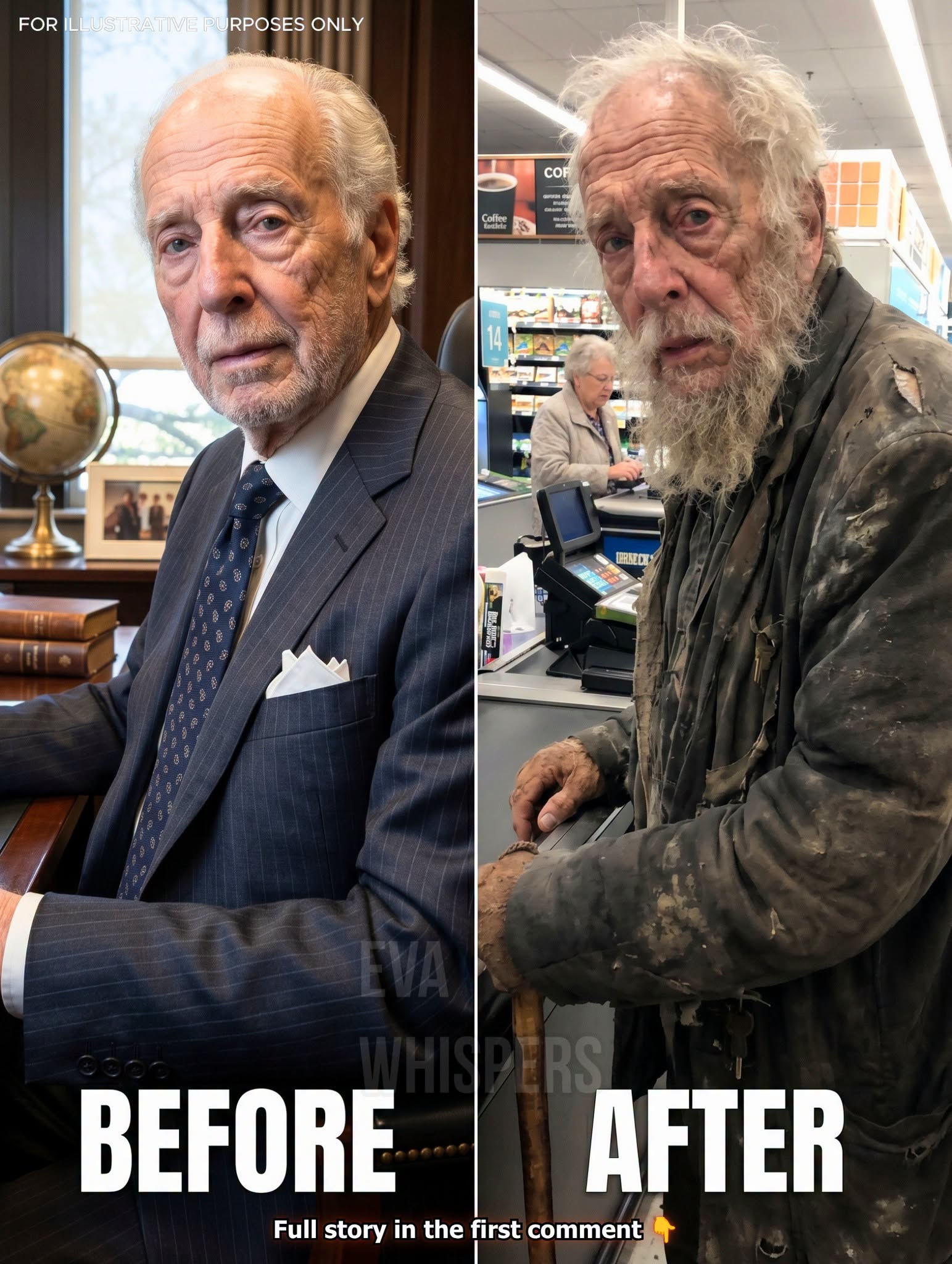
I pretended to be homeless and walked into one of my own stores to find my heir. What happened there nearly knocked me to my knees.
My name is Raymond Whitaker. I am seventy-nine years old, and in the 1970s, I built the largest chain of affordable goods stores in Texas. Back then, all I had was a small building with cracked floors, a hand-painted sign, and one simple belief: good people deserve good things at fair prices.
That belief turned into one store.
Then ten.
Then a hundred.
Eventually, my stores spread across Texas and five other states. People called me a genius. Newspapers called me a self-made billionaire. Business magazines printed my face on glossy covers and used words like “empire” and “legacy.”

But behind the mansion gates, behind the polished boardroom table, behind the tailored suits, I was just an old man eating dinner alone.
My wife, Anna, died in a car accident in 1989. We never had children. For years after she passed, I buried myself in work because work did not ask me how I felt. Work did not leave an empty chair at the breakfast table.
Then, three months before my seventy-ninth birthday, the doctors gave me the news.
Stage IV cancer.
Six months, maybe less.
I accepted it quietly. At my age, a man begins to understand that life is not about how long he stays, but what he leaves behind.
The problem was, everyone around me wanted what I had built, but almost no one cared why I had built it.
Executives smiled too widely in meetings. Distant relatives suddenly remembered my birthday. Lawyers hovered like birds over a battlefield. I even overheard two board members whispering outside my office one afternoon.
“He’s a walking bag of money,” one of them said.
The other laughed. “Let’s just hope he signs before he drops.”
That night, I sat alone in my study beneath Anna’s portrait and made a decision.
I would not leave my life’s work to greed.
I would leave it to kindness.
The Disguise
I had always liked playing by my own rules.
The next morning, I dismissed my driver, locked myself in the old storage room behind my garage, and did something my staff would have considered madness.
I hacked at my silver hair until it looked wild. I glued on a ragged gray beard from an old theater kit Anna had once bought for a charity play. I pulled on torn clothes from a donation bin, rubbed dirt into the lines of my face, and leaned on an old wooden cane.
Then, for good measure, I poured spoiled milk over my coat.
When I looked in the mirror, the billionaire was gone.
Staring back at me was a man most people would step around.
Not because he was dangerous.
Not because he had done anything wrong.
But because he looked poor.
Because he looked inconvenient.
Because he looked like someone no one wanted to see.
I chose a store in Waco, one of our busiest branches. I had opened it twenty-seven years earlier with Anna standing beside me, laughing as she cut the red ribbon crooked.
I remembered telling the staff that day, “No one who walks through these doors should feel small.”
I wanted to know if that promise still lived anywhere.
So I walked in.
No One Saw a Man
The automatic doors opened with a cheerful chime.
Warm air rolled over me. I smelled fresh bread from the bakery, detergent from the cleaning aisle, and roasted coffee from the little café near the front.
Customers moved around me like water moving around a stone.
No one made eye contact.
I shuffled toward the canned goods aisle and stopped beside a woman in a red coat.
“Ma’am,” I said softly, “could you help me find something cheap to eat?”
She turned, looked me up and down, and pinched her nose.
“You smell like rotten meat,” she hissed. “Stay away from me.”
She hurried off with her cart rattling behind her.
A man near the bakery muttered loudly enough for everyone to hear, “People like that shouldn’t be allowed in here.”
A mother pulled her little boy closer when I passed, as if poverty were something contagious.
I told myself to stay calm. This was an experiment. I had expected discomfort.
But expectation does not protect the heart.
When I asked a clean-cut teenage boy if he could buy me one can of beef stew, he burst out laughing.
He pulled out his phone and pointed it at me.
“I’m putting you on TikTok,” he said. “People will pay me just to see how awful you look.”
For a moment, I forgot I was wearing a disguise. I forgot I owned the roof above us and the shelves around us.
I just felt old.
Small.
Humiliated.
Then a young manager in a crisp shirt walked over, his name tag shining under the lights.
“Sir,” he said, wrinkling his nose, “customers are complaining about the smell. You need to leave.”
I almost laughed.
Under the spoiled milk, I was wearing Clive Christian cologne. The kind that cost more than some people’s monthly rent.
But no one smelled that.
They saw torn clothes, a dirty face, and a cane.
And they decided I was worth nothing.
I turned toward the exit, my little experiment already weighing on my chest like grief.
That was when someone grabbed my sleeve.
“Sir?”
The voice was small and trembling.
I turned around.
And what I saw nearly knocked me off my feet.
The Girl with the Blue Apron
She could not have been more than twenty-two.
She wore the store’s blue apron over a faded yellow sweater. Her dark hair was tied back in a messy knot, and there was a tiny bandage on one finger. Her name tag read: Clara.
Her eyes were wide, nervous, and full of something I had not seen all morning.
Concern.
“Please don’t go yet,” she said.
The manager frowned. “Clara, get back to register three.”
She ignored him, though I could see her hands shaking.
She looked at me instead.
“Are you hungry?”
The question was so simple that it nearly broke me.
I nodded.
She reached into the pocket of her apron and pulled out a folded five-dollar bill and a handful of coins.
“Come with me,” she said gently. “I know what’s good and cheap.”
The manager grabbed her arm.
“Clara,” he snapped under his breath, “don’t make this your problem.”
She pulled free.
“With respect, Mr. Dale,” she said, her voice still trembling but firm, “he is a customer if he needs food.”
The manager’s face reddened.
“He is disturbing customers.”
“No,” Clara said quietly. “People are disturbed because they don’t want to look at him.”
The aisle went still.
The teenage boy lowered his phone.
The woman in the red coat looked away.
Clara turned back to me as if none of them mattered.
She led me to the canned goods aisle and picked out two cans of beef stew, a small loaf of bread, a bottle of water, and a pair of thick socks from a clearance bin.
At the register, she paid with her own money.
I noticed the cashier whisper, “That was probably your bus fare.”
Clara gave a small smile.
“I’ll walk.”
A Meal in the Break Room
I expected her to hand me the bag and send me on my way.
Instead, she led me to a quiet corner near the employee break room.
“I’m not really supposed to bring anyone back here,” she admitted, “but you look tired. Sit for a minute.”
She warmed the stew in a paper bowl and placed it in front of me with a plastic spoon.
I stared at it.
I had eaten dinners prepared by private chefs. I had sat at tables with governors, CEOs, and people whose names appeared on buildings.
But that bowl of stew, bought with a young woman’s last few dollars, felt richer than any meal I had ever been served.
“Why are you doing this?” I asked.
Clara sat across from me, folding her hands.
For a second, I thought she would give me some cheerful answer about being raised right.
Instead, her face softened with pain.
“My dad died when I was sixteen,” she said. “He lost his job, then the house, then himself. For a while, he lived in his truck. People stopped saying his name. They just called him ‘that homeless guy’ like he had never been a father, never told jokes, never fixed my bike, never made pancakes on Saturdays.”
Her eyes filled, but she did not cry.
“One cold night, he sat outside a gas station for hours. Dozens of people walked past him. One woman finally stopped and called for help, but it was too late.”
She looked down at her hands.
“So when I see someone who looks like he has been forgotten, I remember that my father was somebody.”
My throat tightened.
For the first time since the diagnosis, I felt angry at how little time I had left.
Not because I feared dying.
But because there were still people like Clara in the world, and I had almost missed her.
The Manager’s Warning
The break room door swung open.
Mr. Dale stood there with his jaw clenched.
“That’s enough,” he said. “Clara, my office. Now.”
She stood immediately, but I saw fear flash across her face.
I rose too, leaning heavily on my cane.
“She was kind,” I said.
Mr. Dale barely looked at me.
“She violated store policy.”
“To feed someone?”
“To bring an unsanitary person into an employee area,” he snapped.
Clara lowered her eyes.
“I’ll clean everything,” she said.
“You won’t have to,” he replied coldly. “You’re done here.”
The words landed like a slap.
I stepped forward.
“You’re firing her?”
Mr. Dale gave me a look of disgust. “This does not concern you.”
Clara’s face went pale.
“Please,” she whispered. “I need this job. My grandmother’s medicine—”
“You should have thought of that before embarrassing the store,” he said.
Something inside me changed then.
All morning, I had let people insult me, film me, and push me away because I wanted to see the truth.
Now I had seen enough.
I reached into my coat pocket and pulled out my phone.
Mr. Dale smirked. “Who are you calling? The shelter?”
“No,” I said calmly.
My voice no longer shook.
“I’m calling my attorney.”
The Truth Revealed
Ten minutes later, the store’s regional director arrived.
Then the district supervisor.
Then two board members who happened to be in Dallas and came racing down after my attorney contacted them.
By then, the front of the store had gone silent.
Mr. Dale looked confused, then nervous, then terrified.
Clara stood beside me, still not understanding.
The regional director hurried through the doors, saw me, and stopped so suddenly he nearly tripped.
“Mr. Whitaker?”
A gasp moved through the crowd.
The teenage boy’s phone slipped from his hand.
The woman in the red coat covered her mouth.
Mr. Dale turned white.
I peeled off the ragged beard slowly. Then I wiped the dirt from my cheek with a napkin Clara had given me.
“Yes,” I said. “Raymond Whitaker. Founder and owner.”
Clara stared at me like the floor had disappeared beneath her.
“I don’t understand,” she whispered.
I looked around the store.
“This company was built for ordinary people,” I said. “Not perfect people. Not polished people. Ordinary people. Tired mothers. Hungry children. Workers stretching one paycheck to the next. Lonely old men. People who deserve dignity even when they cannot afford anything else.”
No one spoke.
I turned to Mr. Dale.
“And today, I watched this store forget its purpose.”
His mouth opened. No words came out.
I did not shout. I did not need to.
“Clear your office,” I said. “You are no longer employed by this company.”
Then I looked at Clara.
Her eyes were shining with tears.
“And you,” I said gently, “are coming with me.”
The Interview That Wasn’t an Interview
We went to my headquarters the next morning.
Clara arrived in her yellow sweater again, with her hair neatly brushed and her hands folded nervously in her lap.
She thought she was there to receive an apology and perhaps a small promotion.
She had no idea my attorney, my doctors, and the full board of directors were waiting in the conference room.
I asked her questions for two hours.
Not business questions.
Human questions.
What should a store do when someone cannot pay?
How should managers treat workers who are struggling?
What would she change if she had power?
At first, she answered carefully. Then her voice grew stronger.
She talked about employee emergency funds. Better training. Quiet meal cards for hungry families. A rule that no customer could be removed simply for looking poor. Partnerships with shelters and schools. A system where unsold food would be donated instead of thrown away.
The board members listened in stunned silence.
One of them finally said, “Miss Clara, you have no executive experience.”
Clara looked embarrassed.
“No, sir,” she said. “I only know what it feels like to need help and be ashamed to ask.”
I smiled.
“That,” I said, “is experience.”
My Heir
Three weeks later, I changed my will.
Not in secret.
Not quietly.
I called a press conference at the Waco store.
Clara stood beside me, wearing a simple navy dress and the same nervous expression she had worn that first day. Her grandmother sat in the front row, holding a tissue in both hands.
I told the cameras about Anna, about the company, about my diagnosis, and about the morning I had walked into my own store dressed as a forgotten man.
Then I told them the truth.
“I came looking for someone worthy of inheriting my business,” I said. “Not the richest person. Not the most educated person. Not the person with the sharpest suit or the loudest voice.”
I turned to Clara.
“I came looking for the one person who would see a human being when everyone else saw a problem.”
Clara began to cry.
I took her hand.
“Clara Ellis will not inherit my money to live above people. She will inherit my company to serve them.”
Reporters shouted questions.
The board looked stiff and uncomfortable.
But I felt peaceful for the first time in years.
Over the next months, I taught Clara everything I could. She learned quickly. She made mistakes, asked questions, apologized when she was wrong, and never once pretended to know more than she did.
The employees loved her because she listened.
Customers trusted her because she remembered names.
And I watched my company begin to breathe again.
What Remained
I lived longer than the doctors expected.
Nine months instead of six.
Long enough to see Clara launch the Anna Whitaker Kindness Fund, which helped employees through medical bills, rent emergencies, and funeral costs.
Long enough to see every store add a community shelf where people could take basic food without questions.
Long enough to see a handwritten sign placed near every entrance:
Everyone who walks through these doors deserves dignity.
On my last good afternoon, Clara wheeled me through the Waco store.
No disguise this time.
Just me.
Old, tired, and ready.
Near the canned goods aisle, a little boy asked his mother if they could buy soup for the community shelf. An employee helped an elderly man carry groceries to his car. A cashier quietly slipped a meal card into a woman’s bag when she thought no one was watching.
I looked at Clara.
“You did this,” I whispered.
She shook her head.
“No, Mr. Whitaker. You gave me the chance.”
I smiled.
“No, my dear. You earned it before you ever knew I had anything to give.”
That night, as the sun lowered over Texas, I sat beneath Anna’s portrait one last time and felt no fear.
For years, I had thought legacy meant buildings, money, and names carved into stone.
But I was wrong.
Legacy is the moment someone chooses kindness when cruelty would be easier.
It is a young woman spending her bus fare on stew and socks.
It is seeing the person beneath the dirt, the grief beneath the silence, the soul beneath the suffering.
I went looking for an heir to my fortune.
Instead, I found someone worthy of my heart.
And because of Clara, the stores I built would not simply sell affordable goods.
They would remember what Anna and I believed from the very beginning.
No one should ever walk through those doors and feel invisible.
Note: This story is a work of fiction inspired by real events. Names, characters, and details have been altered. Any resemblance is coincidental. The author and publisher disclaim accuracy, liability, and responsibility for interpretations or reliance. All images are for illustration purposes only.