Every Morning, a 6-Year-Old Girl Locked Herself in the Bathroom for Nearly an Hour — Until Her Grandmother Heard the Whisper That Exposed the Truth Behind Her Stepmother’s Smile
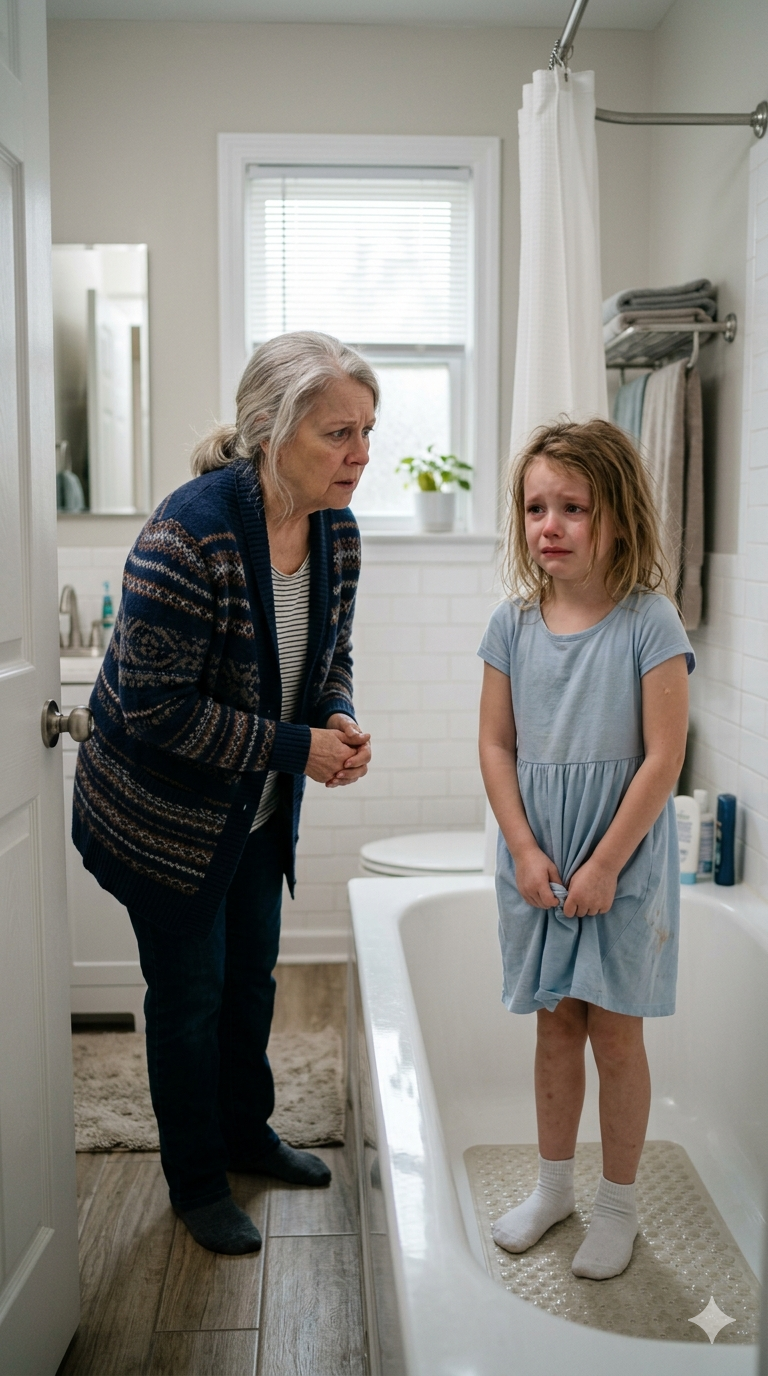
The Morning Her Grandmother Opened the Door
I always thought my six-year-old granddaughter, Maren, went into the bathroom every morning because she liked warm water.
Children do that. They turn simple things into little worlds. A sink becomes a pond. A bathtub becomes an ocean. A towel becomes a cape.
So when Maren stayed in the bathroom longer than usual, I told myself not to worry.
At first.
My son, Caleb, lived in a quiet neighborhood outside Raleigh, North Carolina, in a pale-blue house with white trim and a porch swing nobody used anymore. His first wife had passed from our lives years earlier, and when he married again, I tried hard to welcome his new wife, Tessa.

Tessa smiled softly. She spoke gently. She wore neat sweaters, kept the kitchen clean, and always knew what to say when other adults were listening.
People liked her.
I wanted to like her too.
I often came over in the mornings to help with Maren before school. I told Caleb it was because I did not want Tessa carrying every responsibility alone. But the truth was simpler than that.
I loved being needed.
And I loved Maren more than anything left in my world.
The Little Habit That Started to Feel Wrong
Maren had always been a bright child.
She used to run down the hallway in mismatched socks, carrying her stuffed rabbit under one arm, asking questions faster than anyone could answer them.
“Grandma, why do birds walk funny?”
“Grandma, do clouds get tired?”
“Grandma, if I whisper to the moon, can it hear me?”
But over the last few weeks, something had changed.
Her voice had become smaller.
Her laughter came less often.
And every morning, after breakfast, she would ask to use the bathroom.
Not quickly.
Not normally.
She would stay inside for fifteen minutes. Then twenty. Sometimes almost thirty.
When she came out, her face looked pale, her eyes too wide for a child who had simply washed her hands.
One Tuesday morning, I stood in the hallway holding a folded pink sweater and listened.
No splashing.
No humming.
No little songs.
Only silence.
That silence did not feel peaceful. It felt heavy.
I knocked softly.
“Maren, sweetheart? Are you okay in there?”
There was a pause.
Then her tiny voice answered.
“I’m okay, Grandma.”
But she did not sound okay.
The Door I Almost Didn’t Open
The next morning, I came earlier than usual.
Caleb had already left for work. Tessa was in the kitchen, moving around with a coffee cup in her hand, looking calm and polished.
“She’s in the bathroom again,” Tessa said lightly, as if it were nothing. “She likes to take her time.”
I gave a small smile, but my heart tightened.
After a few minutes, I walked down the hallway.
The bathroom door was not fully closed.
Just a narrow crack.
I should have knocked.
I should have waited.
But something inside me, something old and protective, told me to open the door.
So I pushed it gently.
And what I saw made my breath catch.
Maren was standing inside the empty bathtub.
She was not playing.
She was not washing.
She was gripping the edge of her little cotton dress with both hands, twisting it again and again, pulling at the fabric as if she were trying to scrub something invisible from it.
Her lips trembled.
Her eyes were glassy.
Her small shoulders were curved inward, like she was trying to disappear.
The Words No Child Should Believe
I stepped closer slowly, careful not to frighten her.
“Maren,” I whispered, “what are you doing, baby?”
She jumped like she had been caught doing something wrong.
For a second, she stared at me with pure fear.
Not surprise.
Fear.
Then she looked toward the door behind me, as if checking whether someone else had heard.
I lowered my voice.
“It’s just me. You’re safe.”
Her fingers tightened around the dress.
“I was trying to fix it,” she whispered.
“Fix what?”
She swallowed hard. Her face crumpled, but she fought not to cry.
Then she leaned close to me and said something so quietly I almost missed it.
“I’m dirty.”
The room seemed to stop around me.
I knelt beside the bathtub and held out my hand.
“No, sweetheart. You are not dirty. Who told you that?”
Maren shook her head quickly.
“I’m not supposed to tell.”
My chest went cold.
But I kept my voice steady.
“You can tell Grandma anything.”
She looked down at her dress.
Then the words began to come out, broken and small.
The Soup on the Dress
It had started with a bowl of soup.
That was what Maren told me.
One afternoon, after school, she had spilled soup on the front of her dress. It was an accident. A simple child’s accident. The kind of thing that should have ended with a towel, a clean shirt, and maybe a gentle reminder to sit closer to the table.
But Tessa had not treated it that way.
Maren said Tessa’s face changed.
Not in front of Caleb.
Only when they were alone.
“She said I was messy,” Maren whispered. “She said I ruin things.”
I closed my eyes for one second, just long enough to steady myself.
“What else did she say?”
Maren’s chin trembled.
“She said Daddy would get tired of me if I kept being hard to love.”
The bathroom blurred in front of me.
I wanted to stand up. I wanted to march into the kitchen. I wanted to say everything my heart was screaming.
But Maren needed calm more than she needed anger.
So I stayed on my knees.
“Listen to me,” I said gently. “You are not hard to love. You are very easy to love.”
She blinked at me as if no one had said that in a long time.
The Smile Everyone Believed
Tessa’s kindness had always looked perfect from the outside.
She packed lunches with little notes.
She kissed Caleb on the cheek when he left for work.
She told neighbors that being a stepmother was a blessing.
But Maren told me another version of the house.
She said Tessa used soft words when adults were near, but sharp ones when they were not.
Not loud.
Not dramatic.
Just quiet enough to be denied.
“You’re too clumsy.”
“Stop acting helpless.”
“Don’t make your father feel guilty.”
“Nobody likes a child who causes problems.”
Each sentence had landed somewhere inside Maren and stayed there.
A six-year-old does not know how to reject words from an adult.
She stores them.
She believes them.
She carries them into the bathroom and tries to scrub them away with trembling hands.
The Moment I Chose My Granddaughter
I helped Maren step out of the tub.
Then I wrapped her in a towel, though she was not wet, and held her close.
For the first time that morning, she cried.
Not loudly.
Just small, tired sobs against my shoulder.
“Please don’t tell her I told,” she whispered.
“I won’t leave you alone with this,” I said. “But I will be careful.”
When we walked into the kitchen, Tessa looked up from her coffee.
Her smile appeared immediately.
“Everything okay?”
I looked at her for a long moment.
There are moments in life when you understand that politeness can no longer be your first responsibility.
Truth must be.
“Maren and I are going to spend the day together,” I said.
Tessa’s smile tightened.
“She has school.”
“Not today.”
Maren held my hand so tightly her fingers hurt mine.
I welcomed the pain.
It told me she still trusted someone.
The Call Caleb Couldn’t Ignore
I took Maren to my house.
I made her pancakes for lunch because pancakes make more sense than rules when a child has been holding fear in her chest.
Then I called Caleb.
At first, he sounded distracted.
“Mom, I’m between meetings. Is everything all right?”
“No,” I said. “You need to come here.”
He arrived forty minutes later, still wearing his work badge, his face tense and confused.
Maren sat on my couch with her rabbit in her lap.
When she saw him, she looked down instead of running to him.
That broke him before I said a word.
“Maren?” he asked softly. “Honey, what happened?”
She did not answer.
So I told him carefully.
Not with anger.
Not with exaggeration.
Only the truth.
I told him about the bathroom. The dress. The words. The fear. The way his little girl had begun to believe she was a problem in her own home.
Caleb sat very still.
By the time I finished, his eyes were wet.
“Why didn’t I see it?” he whispered.
I placed my hand over his.
“Because some people only show their sharp edges when no one else is looking.”
The Quiet Truth Finally Came Out
That evening, Caleb asked Tessa to come over.
He did not bring Maren into the room.
He did not let the conversation become a performance.
Tessa tried to smile at first.
Then she tried to deny it.
Then she said Maren was sensitive.
Then she said children misunderstand things.
Then she said parenting was stressful.
Caleb listened.
But he did not fold.
“She is six,” he said. “She should not be afraid to make a mistake in her own kitchen.”
Tessa looked toward me.
“You’re turning him against me.”
I shook my head.
“No. Your own words did that.”
For the first time, Tessa’s perfect calm cracked.
And in that crack, Caleb finally saw what Maren had been living with.
Not a monster from a storybook.
Something quieter.
A home that looked warm from the street but felt unsafe to a child inside it.
The House Changed After That
Caleb made changes immediately.
Maren stayed with me for several days while he sorted through what needed to be done.
He spoke with a family counselor. He contacted the school. He made sure Maren had safe adults she could talk to.
He did not ask her to explain everything again and again.
He did not make her carry the burden of proving her pain.
He believed her.
That was the first step in giving her back her voice.
Weeks passed.
Slowly, Maren began to laugh again.
Not all at once.
Healing rarely arrives like a parade.
It comes quietly.
A little more food eaten at breakfast.
A little more singing from the hallway.
A little hand reaching for yours without shaking.
One morning, she came into my kitchen wearing the same dress she had once twisted in the bathtub.
I froze for a second.
She looked down at it, then back at me.
“Grandma,” she said, “it’s just a dress.”
I smiled through tears.
“Yes, sweetheart. It’s just a dress.”
Then she added:
“And I’m not dirty.”
I knelt in front of her and held her face gently in both hands.
“No,” I said. “You never were.”
What I Learned From a Six-Year-Old Girl
People often think harm has to be loud to be real.
But sometimes the deepest hurt comes in whispers.
A child can be surrounded by clean rooms, folded laundry, packed lunches, and polite smiles — and still feel completely alone.
That is why we must pay attention.
To the child who suddenly goes quiet.
To the child who apologizes too much.
To the child who stops asking questions.
To the child who hides in the bathroom and tries to fix something that was never wrong with them.
Maren taught me that love is not only hugs and bedtime stories.
Love is noticing.
Love is asking twice.
Love is opening the door when something in your heart says, “Do not ignore this.”
And love is making sure a child never has to carry an adult’s cruel words as if they are the truth.
A child may not always know how to explain what is hurting them, so the adults who love them must learn to notice changes in silence, behavior, fear, and the small habits that suddenly stop feeling normal.
Kindness in public does not always prove kindness in private, because some people know how to perform gentleness around others while saving their harshest words for the moments no one else can witness.
When a child says something that sounds too heavy for their age, do not dismiss it as imagination, because children often repeat the exact words that have already been planted inside their hearts.
The way adults speak to children can become the way children speak to themselves, so every careless sentence has the power to either build confidence or quietly break something tender.
Believing a child does not mean rushing into anger; it means creating safety, listening carefully, and making sure the child understands that telling the truth will not cost them love.
A home should never be judged only by how it looks from the outside, because clean counters, polite smiles, and perfect routines can still hide a child who feels unseen.
Sometimes protection begins with one uncomfortable question, one opened door, or one adult brave enough to admit that something does not feel right.
Children do not need perfect adults, but they do need adults who can apologize, listen, protect, and choose their well-being over appearances.
Healing does not happen in one dramatic moment; it happens slowly, through safe mornings, gentle voices, steady routines, and repeated reminders that the child was never the problem.
No child should have to earn love by being quiet, perfect, or easy to manage, because every child deserves to feel safe, valued, and deeply wanted exactly as they are.