FULL STORY: He Walked Into Her ER With His Daughter In His Arms, Then His Eyes Fell To Her Swollen Belly And The Room Went Silent
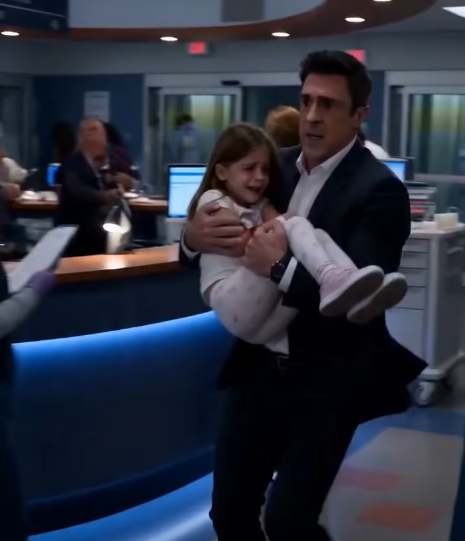
The double doors burst open at 9:47 PM.
I heard them before I saw him. That particular crash of emergency entrance doors — the kind that says someone is terrified, not just in a hurry. I had learned to read the difference in my three years of ER rotations. Terrified meant a child. Terrified meant someone’s whole world had just tilted sideways and they were running toward the one place they hoped could fix it.
I looked up from the intake chart I was reviewing.
And the breath left my body.
He was standing in the fluorescent wash of the ER entrance, and he was clutching a little girl to his chest the way you only hold something when you cannot afford to lose it. His hair was disheveled. His jacket was half-zipped. His eyes — those eyes I had once memorized in the dark — were scanning the room with a wild, desperate focus that broke immediately the second they found mine.

The world didn’t slow down. It stopped entirely.
Six months. Six months since the last time I had seen Nathan Calloway’s face. Six months since he had stood in my kitchen at midnight and told me, in a voice that was somehow both apologetic and final, that he couldn’t give me what I needed. Six months since the door closed behind him and I sat on the kitchen floor for twenty minutes before I allowed myself to cry.
Now he was here. In my ER. Holding a child I had only heard about in fragments — a daughter from a relationship that had ended years before us, a little girl who lived with her mother and visited on weekends. A child I had never met, but whose existence had always occupied the quiet corner of whatever it was Nathan and I were building.
The little girl whimpered. A small, broken sound.
And just like that, I was Dr. Clara Voss again.
My feet moved before my mind gave the order.
The Name That Once Meant Forever
I crossed the floor in eight steps, pulling on my professional composure the way you pull on a coat when the cold is too sharp to endure unprotected. My hands were steady. My voice, when I found it, was calm.
“I’m Dr. Clara,” I said, looking directly at the little girl first. “What happened?”
“Daddy, it hurts.” The girl’s face was pressed against Nathan’s collarbone, one arm dangling at an angle that made my stomach tighten with clinical concern. Her eyes were red and swollen. She had been crying for a while.
Nathan looked at me.
I looked back.
I watched the precise moment his eyes registered who I was. Not just a doctor. Not just a stranger in scrubs. The specific, irreversible recognition of someone you left behind — finding them somewhere you never imagined they would be.
His gaze dropped. Just for a second. One involuntary, unguarded second.
To my stomach.
Seven months. I was seven months pregnant, and there was no hiding it, no strategic positioning of a clipboard or a chart that would erase what his eyes had just seen and calculated and landed on with a weight I could feel across four feet of emergency room air.
He opened his mouth.
“Clara—”
Not Doctor. Not formal. Not safe. The name that once meant something specific — the name he used when it was just the two of us, when the city was quiet and he reached across the bed and said it like it was the only word he knew.
I turned my attention back to the child.
“What’s your name, sweetheart?”
“Chloe,” she sniffled. “I fell from the monkey bars.”
“At school?”
She nodded. “Daddy got really scared.” She said it with the unconscious candor of a six-year-old who doesn’t yet understand that adults prefer their fear to go unannounced. “He was shaking when he picked me up.”
“That’s because daddies love their little girls very much,” I said, and I meant it entirely for her, not for him. “I’m going to check you very gently, okay? Can you tell me where it hurts the most?”
She pointed to her left forearm with one small, trembling finger. “Here.”
“You’re very brave,” I said. “Can I hold your hand while we walk to the exam room?”
She reached for me immediately, the way children do when they decide to trust someone — fully and without negotiation. Her small fingers curled around mine, and something tightened in my chest that had nothing to do with Nathan and everything to do with the life I was growing, the child I was preparing to meet in two months, the tenderness that had been building in me since the moment I saw two lines on a test in a bathroom in February, alone.
Nathan fell into step behind us.
I didn’t look back.
“Sir,” I said, my voice carrying the professional distance I had learned to use as a scalpel, “I’m going to need you to step back slightly during the examination so we have room to work.”
A beat of silence.
Then: “Of course.” His voice was stripped of everything but compliance.
Good. That was what I needed from him right now. Compliance and distance. The two things he had failed to give me when they actually mattered.
What Six Months of Silence Costs
The exam room was small. In an ER, they always are. Designed for efficiency, not comfort, not privacy, certainly not for the particular hell of conducting a pediatric examination while the man who walked away from your pregnancy stands four feet behind you, breathing too carefully.
I focused on Chloe.
She was six years old, according to the intake information Nathan had provided to the triage nurse while I was pulling her chart. Healthy otherwise. No prior fractures. She had fallen from the top bar of a playground structure at her school’s after-care program, landed awkwardly on an outstretched arm — a classic fall mechanism for what I already suspected was a distal radius fracture.
I assessed her pupils. Equal and reactive. Good.
I checked her head for any tenderness. None. Good.
I moved to the arm, palpating gently along the bone, watching her face for the wince that would tell me where the pain was sharpest.
“You’re doing so well,” I murmured to her. “Almost done with this part.”
“You have a really soft voice,” Chloe observed, studying my face with the unblinking seriousness of a child who has decided to be interested in you. “Like a teacher I used to have.”
“Was she a good teacher?”
“She smelled like cookies.” Chloe considered this. “You smell like the hospital, but it’s not bad.”
I laughed. A real one. Small and involuntary. “That’s the nicest thing anyone has said to me all week.”
Behind me, I heard Nathan exhale — a sound halfway between a breath and something else. Something lodged.
“You’re really pretty,” Chloe said then, with the complete artlessness of someone who has not yet learned to keep observations to herself. “Are you having a baby?”
The question landed in the room like a stone in still water.
“Yes,” I said, keeping my voice even. “In about two months.”
Chloe’s face transformed. The pain retreated temporarily, replaced by pure, uncomplicated delight. “That’s so cool. I always wanted a little sister.” She paused, reconsidering. “Or a brother. Either. I’m not picky.”
Behind me.
The sound of his breath catching.
Quiet. Barely audible over the ambient noise of the ER. But I had spent fourteen months learning the specific geography of Nathan Calloway’s breathing — the way it changed when he was moved, when he was frightened, when something hit him in a place he hadn’t anticipated being hit.
I heard it.
I kept my eyes on Chloe.
“Let’s get imaging for that left arm,” I said to the nurse in the doorway, handing her the chart. “Standard two views.”
“On it, Doctor.”
The waiting that followed was the particular cruelty of medicine — the necessary pause while the machine does what the eyes cannot. Chloe was wheeled down for her X-ray. I used the window of time to update two other charts, to check on a patient three rooms over who had come in with chest pain, to do everything except stand still and let the silence of that exam room settle into something I would have to address.
Nathan found me anyway.
He appeared at the edge of the nurse’s station, hands in his jacket pockets, shoulders carrying the particular tension of a man who has been rehearsing something and knows, already, that the rehearsal was inadequate.
“Clara.”
I kept writing. “Chloe will be back in about fifteen minutes. The imaging is routine.”
“I’m not asking about Chloe right now.”
I set down my pen. I looked at him. I gave him exactly as much of my attention as I could afford, which was very little, because anything more and the seven months of holding myself together would compromise in front of a nurse’s station in a public emergency room, and I had too much pride for that.
“Then you’re asking the wrong questions in the wrong place,” I said. “Your daughter needs you focused.”
His jaw worked. “Is it mine?”
The words arrived with a crack I hadn’t expected from him. Not because they were cruel — they weren’t, not exactly — but because the rawness in them suggested he had been standing there calculating months, doing the arithmetic of absence, and had arrived at a number that terrified him.
My hand went to my stomach. An instinct. A protective instinct I had developed without noticing when it started.
“Your daughter needs you right now,” I said. “Focus on her.”
“Clara—”
“No.” My voice didn’t rise. It didn’t need to. “You don’t get to do this here. Not after six months of nothing. Not like this.”
His expression fractured. “I didn’t know.”
“You didn’t look,” I said. Every word was precise. Every word had been waiting. “There’s a difference.”
The Earthquake Beneath Still Hands
The scans came back at 11:20 PM.
Torus fracture of the distal radius. Incomplete. Clean. The kind of break that heals well in children because their bones are still growing, still generous with recovery. I felt a private, deep relief move through me as I reviewed the images — the specific relief of a doctor who was also, privately, catastrophizing from the moment she saw a six-year-old cradling her arm.
I went to tell Chloe first.
She was in the exam room with a nurse, holding a small stuffed bear someone had retrieved from the pediatric supply closet. She looked up when I walked in, her eyes still puffy but steadier now that the worst of the pain had been managed.
“Good news,” I said, sitting on the edge of the exam table beside her. “Your arm has a little crack in it — kind of like a green twig when it bends but doesn’t break all the way through. Does that make sense?”
She nodded seriously.
“That means it’s going to heal really well. But you’ll need a cast for a few weeks so the bone can rest and fix itself.”
“What color?” she asked immediately.
I blinked. Then smiled. “You can usually pick.”
“Purple,” she decided, without hesitation. “Definitely purple.”
“An excellent choice.”
Nathan had appeared in the doorway. I gave him the clinical summary — the fracture type, the treatment plan, the cast, the follow-up with an orthopedic specialist within the week. I spoke to him the way I spoke to all parents in this situation: clearly, completely, without editorial. Professional. Safe.
He nodded through all of it.
And when I was done, when there was nothing left to say about Chloe’s arm that required his attention, the space between us filled with everything that wasn’t about medicine at all.
Chloe was settled into a short-stay room upstairs around midnight — standard protocol for pediatric fracture cases with a parent in the building. I finished two more charts. I responded to a consult request from cardiology. I stood at the vending machine at 12:30 AM and stared at a row of granola bars without seeing them.
A hand appeared beside me, pressing a button.
The granola bar dropped.
I turned.
Nathan held it out to me. “You used to forget to eat when you were working nights,” he said quietly. “You’d come home at 7 AM and realize you hadn’t eaten since noon the day before.”
I took it. Because I was hungry and because refusing felt like a performance I didn’t have the energy for.
“Chloe is asleep?” I asked.
“Finally.” He exhaled slowly. “She asked for you. Before she went down.” He paused. “She said the pretty doctor with the baby had nice hands.”
Something pressed against my sternum from the inside. I unwrapped the granola bar and took a bite and looked at the vending machine instead of him.
“She’s wonderful,” I said. And I meant it entirely.
“Clara.” His voice was stripped down to nothing. The way it got when there was no performance left, no armor, no defense. The voice I had only ever heard at 2 AM, in the dark, when he forgot to be careful. “I need to ask you something and I need you to let me finish before you answer.”
I turned. Because there was no other reasonable thing to do.
“I was a coward,” he said. “I know that. I’ve known it since the night I left and I have had six months to understand exactly what kind of coward, what specific, unforgivable variety of coward I chose to be.”
“Yes,” I said. The truth required nothing else.
“I thought you wanted me gone.” He pressed on, and I could see it cost him. “I convinced myself that was what you were saying. That you needed more than I could give, which meant — in my head, the way I was thinking then — that I was doing you a favor. Giving you the clean break.”
“I wanted you to fight,” I said. The words came out quieter than I expected. Not anger. Something beyond anger. Something closer to the truth of what that night had actually been. “I wanted you to be scared and stay anyway. That’s all I ever wanted from you.”
He stared at me. And in his eyes I saw something I hadn’t seen the night he left — the full weight of a mistake finally recognized for what it was. Not a misunderstanding. A choice. A failure of courage at the exact moment courage was required.
“Is it mine?” he asked again. And this time the question was not a demand. It was a man standing in front of a consequence he had created and asking to be allowed to understand the full shape of it.
I held his gaze for a long moment.
“Yes,” I said.
The word landed between us like something irrevocable. Because that’s what it was.
The Conversation Six Months Too Late
He didn’t move for several seconds after I said it.
I watched him process it — the way you watch someone absorb a fact that reorganizes everything around it. His chest rose and fell. His hand gripped the edge of the vending machine. His eyes, for a fraction of a moment, closed.
“Clara—”
“Don’t.” I stepped back. Not cruelly. With the self-preservation of a woman who has spent six months learning how much she is capable of carrying alone and does not intend to drop any of it now, here, in a hospital hallway at 12:45 in the morning. “I’m not doing this tonight. Not like this.”
“Then tell me when,” he said. Steady. More steady than I expected. “Tell me where. I’ll be there.”
“You’ll be there.” I couldn’t keep the edge out of my voice entirely. “You understand how that sounds to me.”
“Yes,” he said. “I understand exactly how that sounds. And I’m not going to argue it or explain it away or ask you to recalibrate your response based on my intentions. I know what I did. I’m asking what I can do now.”
The honesty of it disarmed me in a way I hadn’t prepared for. I had prepared for defensiveness. For excuses. For the specific kind of rationalization that attractive, intelligent men sometimes deploy when confronted with their own failures. I had not prepared for this — for him standing there without armor, offering nothing but accountability and the question of what came next.
“My shift ends at seven,” I said finally. “There’s a diner on Meridian. I’ll be there at 7:30.”
He nodded once. Like he didn’t trust himself to say more.
“But tonight,” I said, “you go back upstairs to your daughter. She needs her father present and steady, not standing in a hallway doing—” I gestured vaguely at the space between us. “This.”
“Right.” He straightened. Something in his posture shifted — the deliberate effort of a man calling himself back to what was immediately necessary. “You’re right.”
He turned to go.
He stopped.
Without looking back: “Thank you. For Chloe. For how you were with her.” A pause. “She doesn’t trust easily. But she trusted you immediately.”
I didn’t answer.
Because there was nothing safe to say to that.
I went back to the nurse’s station and finished my charts and at 1:15 AM, my friend Priya slid into the booth across from me in the cafeteria and looked at my face and said, “You look like you’ve seen a ghost.”
“Something like that,” I said.
She opened her mouth to push further — Priya always pushed further, it was both her defining quality and her most exhausting one — when my phone buzzed on the table between us.
I looked at the screen.
Nathan.
Priya watched my face change. “Who is it?”
I read the message.
Chloe keeps asking for the pretty doctor with the baby. She won’t sleep. Would you — I know this is too much to ask. But she’s scared and she keeps saying your name. I’ll understand completely if you can’t.
Priya was still watching me. “Clara. Who is that?”
I set the phone down. I pressed my palm flat against the cafeteria table. I looked at the city lights beyond the glass — cold, distant, entirely indifferent to the specific convergence of people and time and consequence happening twelve floors above them.
Then I picked up the phone and typed: Five minutes.
Priya caught my arm as I stood. “Clara—”
“It’s a child,” I said. “She’s frightened and she asked for me.” I picked up my coffee. “That part, I know what to do with.”
What Stays and What Grows Back
Room 418 was quiet when I pushed the door open.
The lights were low — the specific blue-tinged dimness of a pediatric overnight room, designed to be soothing without being dark. Nathan was in the chair beside the bed, elbows on his knees, looking at his daughter. He looked up when I came in. Something in his expression shifted — not relief, exactly. Something more complicated than relief.
Chloe’s eyes found me the moment I stepped close enough to the bed.
“You came,” she said, in the hushed, reverential tone of someone who was genuinely surprised.
“I came,” I confirmed. I pulled the second chair closer and sat down beside her. “I heard someone wasn’t sleeping.”
“The noises are weird,” she explained, very seriously. “Hospitals make sounds.”
“They do,” I agreed. “Lots of beeps and footsteps and things rolling past in the hallway. It takes some getting used to.”
“Do you get used to it?”
“After a while.”
She considered this. Her left arm was wrapped and resting, the purple cast already applied by the orthopedic resident an hour earlier — she had been extremely pleased about the color. “Can you tell me something?” she asked.
“If I can.”
“Does it hurt? Having a baby?”
I heard Nathan shift in his chair.
“Sometimes,” I said honestly, because children deserve honest answers to honest questions. “But there are good things too. Like feeling the baby move. Like knowing that something completely new is coming into the world.”
Chloe looked at my stomach with the focused interest of a scientist observing a phenomenon. “Can it hear you?”
“Yes, actually. Babies can hear from around twenty-five weeks.”
Her eyes went wide. “What do you say to it?”
I paused. The question opened something in my chest that I hadn’t planned to open here, in this room, with Nathan three feet away watching me with that expression I couldn’t fully read.
“I tell her things will be okay,” I said quietly. “That I’m going to figure it out. That she’s already loved.”
Her.
The word left my mouth before I could retrieve it.
I felt Nathan go very still.
Chloe beamed with sudden, sleepy delight. “It’s a girl?”
“Yes,” I said.
“I knew it,” Chloe said, as if she had predicted this personally. “I just knew.” Her eyes were getting heavy, the conversation doing what stories and soft voices do at the end of difficult nights. “What’s her name going to be?”
“I haven’t decided yet,” I said. “I’m still thinking.”
“You should name her something strong,” Chloe advised, her voice dropping toward sleep. “My teacher says you should always give girls strong names.”
“Your teacher sounds very wise.”
“She smells like coffee though. Not cookies.” A pause. A slower blink. “You smell better.”
I sat with her until her breathing steadied into the deep, unconscious rhythm of a child who has decided the world is safe enough to leave for a while. It took eleven minutes. I counted them without meaning to.
Then I stood, carefully, and Nathan stood with me, and we stepped out into the hallway together without speaking because there was a specific kind of quiet that exists after a child falls asleep that neither of us wanted to break.
In the hallway, under the fluorescent lights, we stood facing each other, and for a moment neither of us said anything at all.
“A girl,” he said finally. His voice was barely above a whisper.
“Yes.”
He pressed the heels of his hands against his eyes for a moment. A gesture I remembered. The one he made when something was too large to hold without physical compression.
“I want to be there,” he said. “Whatever that looks like. Whatever you’ll allow. I’m not asking for anything specific tonight — I know I don’t have the right to ask for specific things yet. But I want you to know that I’m not going anywhere. Not this time.”
I looked at him for a long moment.
I thought about the kitchen floor. The two lines on the test. The seventeen weeks I spent figuring out what alone was going to look like, building the scaffolding of a life for two that didn’t include him, learning to find the shape of it. I thought about the nights I had talked to my stomach in the dark and said we’ll be fine and meant it, fully, without him.
I thought about Chloe’s face when I walked into that room.
You came.
“7:30,” I said. “Meridian Diner. Don’t be late.”
Something crossed his face — not a smile, exactly. Something quieter and more careful than a smile. Something that understood it was not a forgiveness but a beginning. A door opened one inch, not swung wide.
“I won’t be late,” he said.
I turned and walked back toward the elevator.
I pressed the button and waited, and while I waited I placed one hand against the round, firm reality of my stomach and felt the small shifting movement that had become the most reliable thing in my life over the past several months — the proof of something growing, stubbornly and with great intention, in the space that grief and shock and solitude had somehow still kept warm.
“We’re okay,” I said quietly. To her. The way I always did.
The elevator arrived.
I stepped in.
And somewhere behind me, in room 418, a little girl with a purple cast slept peacefully through the rest of the night, entirely unaware that she had walked — or rather fallen — directly into the center of a story that was not over yet. A story that, it turned out, still had a chapter neither of us had written.
The city was still glittering beyond the windows when I reached the ground floor. Cold. Distant. But not, I thought, entirely unreachable.
Some things break clean.
Some things fracture — like a green twig bending but not snapping all the way through — and heal back stronger, if you give them enough time and the right conditions and the willingness to stay still long enough to mend.
I wasn’t sure which this was yet.
But at 7:30, I was going to find out.