I Constantly Used My Pocket Money to Buy Lunch for a Difficult Boy in My 3rd-Grade Class – The Package He Sent Me 30 Years Later Was Something I Never Expected in a Million Years
My husband’s medical crisis had already pushed me to the edge of what I thought I could carry. Then something showed up on my porch that pulled me backward through time—back to a classroom, a paper lunch bag, and a quiet choice I barely remembered making. By the time I opened it, I understood something I hadn’t before: the past doesn’t stay still. It waits.
I’m 39, and three months ago, I thought I was about to lose my husband.
Mark and I had built a steady, uneventful life—the kind people sometimes call boring, but only because they’ve never needed stability to survive. Then one Tuesday, everything split open.
He dropped his mug.
It shattered against the tile, coffee spreading across the floor, but he didn’t even look at it. He gripped the counter like it was the only thing keeping him upright.
“Mark?”
He tried to answer, but the words didn’t come out right. His face had drained of color so quickly it scared me more than anything he could have said.
The ambulance came. The hospital swallowed us whole.
From that point on, time stopped behaving normally. Everything was fluorescent light, clipped voices, and information delivered faster than I could process. A cardiologist explained that Mark had a structural defect in his heart—something rare, something serious.
They could stabilize him.
Fixing it was another story.
“We’ve sent his case to a specialist,” she said. “A cardiac reconstruction surgeon.”
That sounded like hope—for about two seconds.
Then came the meeting that changed the shape of everything.
The financial counselor sat across from me, calm in a way that made it worse. She walked me through numbers that didn’t feel real—line items for procedures, ICU stays, imaging, rehabilitation.
Then she turned the paper toward me.
$420,000.
I laughed.
It came out sharp and wrong, like something breaking.
“That’s not possible,” I said.
“I’m sorry,” she replied.
I went back to Mark’s room afterward and sat beside him while machines tracked every beat of his heart. I held his hand and made a promise I had no idea how to keep.
“I’ll figure it out,” I told him. “I don’t care what it takes.”
And I meant it.
That night, I drove somewhere I had been avoiding in my mind all day, already rehearsing the decisions I might have to make—what to sell, what to give up, what parts of our life I could dismantle to buy him more time.
But when I got home, something else was waiting.
A small package sat on the porch.
Brown paper. No return address.
Ordinary—until it wasn’t.
Because it wasn’t just wrapped in paper.
It was wrapped in an old lunch bag.
Not a replica. Not something decorative.
A real one.
Soft from age. Creased at the top. The kind schools used to use before everything became plastic and disposable.
I stared at it for a long moment before I saw the name.
Miles.
And underneath it—
my handwriting.
It wasn’t the name that hit me first. It was the way I used to form my letters as a child—the uneven curves, the exaggerated lines.
Then the name landed.
Then the memory.
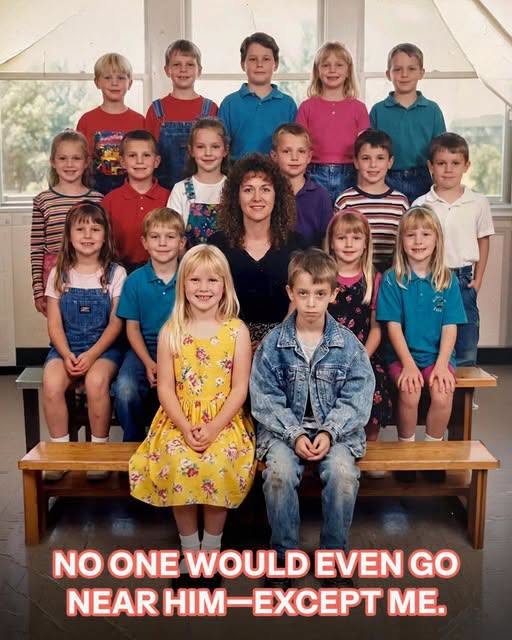
Miles sat in the back of my third-grade classroom.
He wore the same jacket every day. The zipper didn’t work. His shoes were too small, the toes pressing outward like they’d given up trying to fit.
He didn’t talk much.
At lunch, he often didn’t have anything.
One day, I saw him near the trash cans, staring at food other kids had thrown away.
That image stayed with me longer than I expected.
So I went home and told my mom I was suddenly “really hungry all the time.” She laughed and handed me extra lunch money.
The next day, I bought two lunches.
I placed one on his desk before lunch started.
“That’s yours,” he said.
“Not today,” I replied.
It was a flimsy lie, but it worked.
After that, I did it again. And again.
Not dramatically. Not for attention. I didn’t tell anyone. I didn’t even think of it as something meaningful.
It was just… something I could do.
Sometimes he said thank you.
Sometimes he didn’t.
Then one day, he was gone.
No explanation.
No goodbye.
Just an empty desk.
And now, decades later, his name was sitting on my porch.
My hands were shaking when I brought the package inside.
Inside was a note.
A hospital statement.
And a check.
I looked at the statement first.
PAID IN FULL.
I read it three times, waiting for the numbers to rearrange themselves into something that made sense.
They didn’t.
Then I read the note.
“You fed me when I was hungry. I hope you’ll forgive me for taking so long to return the favor.”
I sat down hard.
At the bottom of the page:
Miles.
Cardiac surgeon.
It felt impossible.
But the note explained everything.
He had been one of the doctors reviewing Mark’s case. When he saw my name, something about it stayed with him. He didn’t act on it right away—he verified, carefully, professionally.
Once he knew, he moved quietly.
He waived his surgical fee.
He worked through the hospital foundation.
He found donors.
And when there was still a gap, he covered it himself.
The check included in the package wasn’t for the surgery.
It was for everything around it—the hidden costs no one warns you about until you’re already drowning.
Gas. Food. Prescriptions. Time off work.
In the memo line, it said:
“Lunch money, with interest.”
I barely slept that night.
The next morning, I met him.
He looked nothing like the boy I remembered—and yet, something about him hadn’t changed at all.
His eyes.
Still careful. Still quiet.
“Hi,” he said.
And that was enough to undo me.
We talked for a long time.
He told me he had kept that lunch bag all these years—rescued it when his family moved.
“Because it mattered,” he said.
When I asked why he hadn’t said anything at the hospital, he answered simply:
“Because your husband needed a doctor, not a story.”
When I tried to thank him, really thank him, he shook his head.
“There were days that was the only real meal I had,” he said. “You didn’t make it a big deal. You didn’t make me explain myself. You just… helped.”
The surgery was the next day.
Seven hours of waiting that felt like a lifetime stretched thin.
When he finally walked out, exhausted, he looked at me and said:
“He’s okay.”
That moment didn’t feel real. It felt like something borrowed—like relief I wasn’t sure I was allowed to keep.
But it held.
Mark came home.
He’s healing now. Slowly, stubbornly. Complaining about food, making terrible jokes, finding his way back into himself.
Miles came over for dinner not long ago.
The three of us sat around the same table, sharing stories that somehow spanned thirty years and a thousand different versions of our lives.
After he left, Mark got quiet.
“You changed his life,” he said.
I thought about that.
About a little girl sliding a lunch tray across a desk without understanding what it might mean.
About a boy who remembered anyway.
About how something small had traveled all that distance through time and come back when everything else was falling apart.
“No,” I said finally. “I think he gave mine back.”
I still don’t fully understand it—the timing, the scale, the way one moment can echo into another decades later.
But I know this now in a way I didn’t before:
Kindness doesn’t disappear.
It doesn’t fade the way we think it does.
It settles somewhere.
It becomes part of someone’s story.
And sometimes—when you least expect it, when you need it most—it finds its way home.