I grabbed the muddy kid by the collar for stealing milk—then I saw the infant in his arms. When he knelt, I saw his back… I’ve seen war, but I wasn’t ready for what that boy was hiding.
Chapter 1
The Arizona sun was baking the asphalt of Route 66 into a black, sticky mess. Out here, fifty miles from nowhere, the heat didn’t just make you sweat; it made you mean.
I’m Mack. I did two tours in Fallujah, got the ink to prove it, and now I run this rusted-out gas station in the middle of God’s blind spot. I’ve seen drifters, junkies, and folks running from shadows. I thought I’d seen it all.
Then the bell above the door jingled.
I looked up from the cash register, wiping a bead of sweat from my brow. Standing in the doorway was a kid. He couldn’t have been more than seven years old.
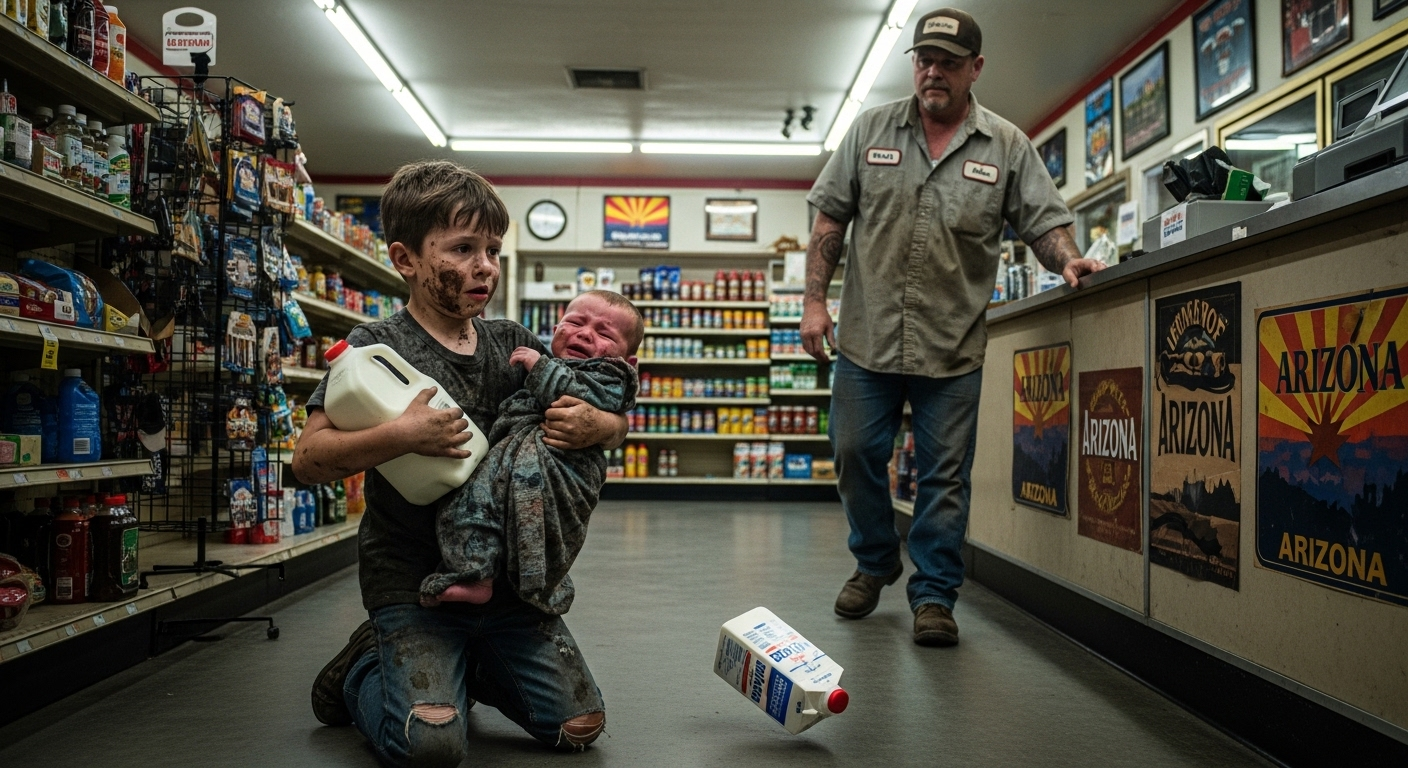
He looked like he’d been dragged behind a pickup truck for a solid mile. His clothes were shredded to ribbons, coated in a thick, wet paste of red desert clay, engine oil, and sweat.
But that wasn’t what caught my eye. It was the bundle he was awkwardly clutching to his chest with his left arm.
A baby. A tiny thing, screaming its lungs out, its little face red and smeared with dirt.
The boy darted his eyes around the store like a cornered animal. The place was mostly empty, save for a couple of truckers sipping bad coffee in the corner booth and a middle-aged tourist buying lottery tickets.
I watched him over the top of my reading glasses. He shuffled down the dairy aisle, his steps uneven, limping heavily on his right leg.
I know a thief when I see one. The desperation gives them away. It’s an electric hum they carry.
Sure enough, he stopped by the refrigerated section. With lightning speed, his free hand darted out. A bottle of milk. A plastic-wrapped loaf of cheap white bread.
He didn’t even try to run. He just shoved them frantically under his oversized, filthy t-shirt, making his stomach bulge like a tumor against his tiny ribs.
“Hey!” I barked, my voice sounding like gravel in a blender.
I rounded the counter fast. My heavy boots slammed against the linoleum. The truckers in the corner stopped talking instantly.
The kid froze, but he didn’t drop the goods. He just tightened his grip on the wailing infant.
I reached him in three strides. I reached out and grabbed him firmly by the scruff of his collar, lifting him almost onto his tiptoes. He weighed absolutely nothing. Just bones, rags, and raw terror.
“You think you can just waltz in here and rip me off, kid?” I growled, feeling the anger spike. “I should call the sheriff right now and let him sort out exactly where you belong.”
Usually, they cry. Or they fight back. Or they spit.
This boy didn’t do any of that.
He didn’t beg for mercy. He didn’t offer a half-baked excuse about forgetting his wallet.
Instead, he completely collapsed, dropping straight to his knees on the dirty floor. The sudden, dead-weight movement pulled the collar right out from my grip.
He carefully set the screaming baby down on his jacket, then pulled the stolen milk and bread from under his shirt.
But he didn’t push them toward me. He raised the milk up with both trembling hands, lifting it toward my face like an offering to a higher power.
“Please, sir,” the boy whispered. His voice was hoarse, cracking terribly from severe dehydration. “Please let my sister drink. I don’t care what you do to me. You can call the cops. But she needs it.”
I stared down at him, my heart doing a strange stutter-step. The tough-guy act I’d perfected over twenty years started to crack. “Where are your parents, boy?”
Tears finally broke through the thick layer of grime on his face, leaving pale, clean tracks down his cheeks.
“My mom is trapped,” he choked out, his eyes locking onto mine with an intensity that burned right through my soul. “Down in the ravine. The car flipped over. It just kept rolling and rolling in the dark.”
A dead silence swept through the gas station. The truckers had left their booth. They were standing a few feet away, their faces turning ghost-pale.
“She told me to take her,” the boy pointed to the infant with a violently shaking finger. “She said I had to climb up. She told me I had to find life.”
I took a step back, the air suddenly knocked clean out of my lungs.
As the boy bowed his head, sobbing uncontrollably into his dirty hands, his torn shirt slipped down his shoulders.
A loud, piercing gasp echoed through the store. It was the tourist woman. She was pointing at the boy, her hand covering her mouth in sheer horror, her eyes wide with panic.
I looked down at the boy’s exposed back.
It was a nightmare. A mass of deep, jagged lacerations tore across his spine. The blood had dried into dark, crusty streaks, but fresh crimson was still seeping steadily through the deepest gouges.
It hit me like a physical punch to the gut.
Those weren’t just scratches from a clumsy fall. They were brutal friction burns and deep rock gouges. He had used his own tiny body as a human shield. He had dragged himself up a jagged Arizona rock face, scraping his own back against the canyon wall so his baby sister wouldn’t suffer a single scratch.
My military training kicked in, but my hands were shaking. This wasn’t just a shoplifter looking for a free meal.
This was a seven-year-old soldier who had just crawled out of hell.
FULL STORY
Chapter 2
The air in the station felt like it had been sucked out by a vacuum. The only sound was the rhythmic, desperate wailing of the infant and the heavy, ragged breathing of the boy on the floor. I’ve seen men in the desert with their limbs blown off who looked less shattered than this child.
“Bill, get the first aid kit! Now!” I roared at one of the truckers.
Bill didn’t move for a second—he was paralyzed, staring at the raw meat that used to be the boy’s back. “Now, damn it!” I barked again, and he finally scrambled toward his rig.
I knelt down, my old knees popping like gunfire. I didn’t care about the milk anymore. I didn’t care about the bread. I reached out, my hands—hands that had held rifles and steered tanks—trembling as I hovered them near the boy’s shoulders. I was afraid that if I touched him, he’d simply turn to dust.
“Hey, kid. Look at me,” I said, my voice dropping to a low, steady hum. “What’s your name?”
“Caleb,” he whispered, his head still bowed. “I’m Caleb. My sister… she’s Lily. She’s only four months. She’s hungry, sir. She hasn’t had anything since yesterday.”
Yesterday. My stomach did a slow, sick roll. If they had been out there since yesterday, that meant he had spent a night in the Arizona desert—a place where the temperature plunges forty degrees the moment the sun dips, where the coyotes howl and the shadows have teeth.
“Caleb, listen to me,” I said, grabbing the milk bottle from his shaking hands. I twisted the cap off, the plastic seal snapping with a sharp crack that made the boy flinch. “I’m Mack. I’m an army vet. You’re safe now. Do you hear me? You’re safe.”
I handed the milk to the woman tourist who had been standing frozen by the lottery machine. “You,” I snapped. “You look like a mother. Get some of this into that baby. Use a straw, a spoon, whatever we’ve got. Just get her quiet.”
The woman, her eyes streaming with tears, nodded frantically. She scooped up the infant with a tenderness that made my chest ache. She sat on the floor right there, in the middle of the aisle, and began to drip milk into the baby’s mouth.
Caleb watched her with the intensity of a hawk. Only when he saw Lily stop crying and begin to swallow did he let out a long, shuddering breath. His eyes rolled back in his head, and he started to slump sideways.
I caught him before his face hit the linoleum.
He was burning up. A fever was already setting in from the infections starting in those deep back wounds. Bill came sprinting back in with a heavy-duty medical kit from his truck. We laid Caleb out on his stomach on the counter, right next to the cash register where I usually ring up cigarettes and beer.
“Call 911!” I yelled at the other trucker. “Tell them we have an MVA—Motor Vehicle Accident—location unknown, somewhere in the ravines off Route 66. We have a child in critical condition and a woman trapped in a wreck.”
As I started to cut away the remnants of Caleb’s shirt with medical shears, the full scale of what this boy had done became clear. There were thorns embedded in his thighs. His fingernails were broken and bleeding, worn down to the quick from clawing at the shale and sandstone.
“Caleb,” I said, leaning close to his ear as I began to swab the dirt from his wounds. He groaned, a sound of pure agony that he tried to suppress. “I need you to stay with me, buddy. Where is your mom? Can you tell me exactly where the car went off the road?”
“The big curve,” he wheezed. “The one with the yellow sign that fell over. We… we saw a deer. Mom swerved. Then it was just… spinning. The glass was everywhere. It sounded like thunder.”
I knew that curve. It was four miles back west. A sharp, treacherous horseshoe bend where the shoulder was nothing but loose gravel and a five-hundred-foot drop into a jagged wash. If they were down there, they were invisible from the road.
“How did you get out, Caleb?” Bill asked, his voice thick with emotion as he handed me sterile gauze.
“The window broke,” Caleb said, his voice fading. “I crawled out. Mom… she was stuck. Her legs… she couldn’t move. She pushed Lily through the gap to me. She told me to run. She told me don’t look back, just find the lights. I saw your sign, sir. The big blue star. I just kept walking toward the star.”
He had walked four miles. Four miles through the desert, at night, carrying a ten-pound infant, with his back shredded and his spirit breaking. He was seven.
“You’re a hero, Caleb,” I told him, pressing the gauze down to stop a fresh flow of blood. “You’re the bravest man I’ve ever met.”
“Is Mom okay?” he asked, his voice barely a ghost of a sound. “She was screaming for a long time. Then she stopped. Why did she stop, Mack?”
I didn’t have an answer for him. I just looked at the vast, uncaring desert through the front window and prayed to a God I hadn’t spoken to in years.
Outside, the distance began to wail. Not the wind, but sirens. A lot of them.
But as the first ambulance pulled into the lot, Caleb’s hand reached out and gripped my forearm. His grip was surprisingly strong, the grip of someone who refused to let go of life.
“Don’t let them take Lily,” he whispered. “I promised Mom.”
“I’ve got you both,” I promised him, looking at the blood on my hands. “I’ve got you.”
The doors burst open, and the paramedics flooded in, but my mind was already on that ravine. I grabbed my keys and my heavy-duty flashlight. If that boy’s mother was still breathing down there, she was going to see another “star” coming for her.
FULL STORY
Chapter 3
The paramedics moved with a surgical, frantic grace, but to me, everything felt like it was happening underwater. They loaded Caleb onto a gurney, his small body nearly swallowed by the white sheets. They took Lily, too, who was now drifting into a milk-drunk sleep, blissfully unaware that her world had ended and begun again in the span of twelve hours.
“I’m going with them,” the woman tourist declared, her voice steelier than I expected. “I’m a nurse from Chicago. I’ll stay with the kids at the hospital.”
I nodded to her, a silent thank you, but my eyes were on the sheriff’s deputy who had just slid his cruiser into the gravel lot, kicking up a cloud of red dust. It was Miller, a guy I’d shared a few beers with at the VFW.
“Mack, what the hell is going on?” Miller asked, stepping out and adjusting his belt. “Dispatch said something about a kid and a cliff?”
“No time for the long version, Miller,” I said, grabbing him by the shoulder and pointing west. “The ‘Dead Man’s Horseshoe.’ Four miles back. There’s a car at the bottom of the wash. A woman—Caleb’s mother—is still down there.”
Miller’s face went grim. That section of Route 66 was a graveyard of bad decisions and worn-out tires. “The terrain down there is a mess, Mack. If she went over the edge at speed, we’re looking at a recovery, not a rescue.”
“The kid said she was talking to him when he left,” I countered, my voice rising. “He’s been walking since last night. If she was alive then, she might still be hanging on. But we’re losing light soon, and the coyotes are already circling.”
I didn’t wait for his permission. I hopped into my beat-up ’94 Silverado, the engine roaring to life with a defiant growl. Miller followed in his cruiser, sirens wailing, as we raced against the setting sun.
The desert at dusk is beautiful in a way that feels like a threat. The shadows stretch out like long, purple fingers, hiding the jagged edges of the world. We reached the horseshoe bend in minutes. I slammed on the brakes, my tires skidding on the gravel shoulder right where the yellow warning sign lay face down in the dirt—just like Caleb said.
I jumped out, my heavy-duty Maglite already in hand. Miller joined me at the edge. We peered over.
It was a black maw. The cliff face dropped nearly vertical for sixty feet before sloping into a nightmare of boulders and twisted mesquite trees.
“There!” Miller shouted, pointing his spotlight.
About three hundred feet down, caught in a cluster of massive rocks, was a glint of silver. A sedan, or what was left of one. It looked like a discarded soda can, crushed and twisted beyond recognition.
“I’m going down,” I said, already reaching into the bed of my truck for my tow rope and climbing harness.
“Mack, wait for the Search and Rescue team! They’ve got the gear—”
“By the time they get here, she’ll be gone, Miller! Look at the angle of that car. It’s perched on a ledge. If the wind picks up or the dirt shifts, she’s going the rest of the way down to the floor of the wash. That’s another two hundred feet.”
I tied off the rope to my truck’s heavy-duty winch. I’d done rappels in the mountains of Afghanistan under sniper fire; a desert cliff in Arizona wasn’t going to stop me. I felt a phantom pain in my own back, a sympathetic ache for the boy who had done this without ropes, without lights, and with the weight of a life in his arms.
I went over the side.
The descent was a blur of sliding shale and the smell of burnt rubber and sagebrush. Every time a rock kicked loose, my heart skipped. Caleb did this in the dark, I kept thinking. He did this with a shredded back.
When I reached the ledge, the smell of gasoline hit me—thick and sweet and dangerous. The car was wedged nose-down between two boulders. The roof was flattened.
“Hello?” I yelled, my voice echoing off the canyon walls. “Can anyone hear me?”
A faint, wet cough came from the wreckage.
I scrambled to the driver’s side. The door was gone, sheared off during the roll. Inside, pinned by the steering column and a mountain of twisted metal, was a woman. Her face was masked in blood and dust, her hair matted.
She opened one eye—the other was swollen shut. She looked at me, but she didn’t see a rescuer. She saw a ghost.
“Caleb?” she rasped. “Did he… make it?”
“He made it,” I said, reaching in to check her pulse. It was thready, like a flickering candle. “He made it to my station. He’s safe. Lily is safe. They’re with the paramedics right now.”
A single tear tracked through the blood on her cheek, leaving a clean line of pale skin. “He’s… such a good boy,” she whispered. “He promised… he promised me.”
“He kept his promise, ma’am. Now you have to keep yours. You have to stay awake.”
I looked down at her legs. They were pinned deep under the dashboard. I realized then why she hadn’t been able to follow him. The metal was wrapped around her like a vise. And then I saw the puddle beneath the seat. It wasn’t just oil. It was a dark, spreading pool of red.
The car shifted. A groan of metal on stone vibrated through the ledge.
“Mack!” Miller yelled from above. “The wind is picking up! Get out of there! The ledge is unstable!”
I looked at the woman. Her name was Sarah—I saw it on a discarded mail envelope on the floorboard. She was looking at me with a terrifyingly calm expression.
“Take care of them,” she breathed. “If I don’t… if I can’t…”
“Shut up with that,” I snapped, trying to find a leverage point. “You’re going to tell them yourself.”
But as I reached for my crowbar, the ground beneath the car gave a sickening, hollow thud. The boulders holding the car in place weren’t anchored. They were sitting on a bed of loose sand.
And the sand was moving.
FULL STORY
Chapter 4
The sound of shifting earth is something you never forget once you’ve heard it in a war zone. It’s a low, guttural growl that vibrates in your teeth before it moves your feet. The car groaned again, the front bumper dipping another two inches toward the abyss.
“Mack! Get back! The whole shelf is going!” Miller’s voice was frantic, barely audible over the rising wind that whipped through the canyon.
I didn’t listen. I couldn’t. I looked at Sarah. Her eyes were drifting shut, the blood loss finally winning the tug-of-war with her consciousness. If I left her now to wait for a winch team, she wouldn’t just die—she’d be buried in a tomb of glass and Arizona dirt.
“Sarah! Look at me!” I screamed, grabbing a heavy-duty ratchet strap from my belt. “Think about Caleb! He’s at the station right now, asking for his mom. Do you want me to tell him you gave up?”
Her eyelids fluttered. That did it. The mention of the boy brought a spark back into those clouded eyes. It was the same fire I’d seen in Caleb’s eyes when he handed me that milk—a primal, stubborn refusal to let the dark win.
“I’m… trying,” she choked out.
The car shuddered again. A shower of pebbles cascaded over the edge, tinkling into the darkness below. I had maybe sixty seconds. I jammed my crowbar into the gap between the crumpled door frame and the steering column. I put every ounce of my two-hundred-pound frame into it, my muscles screaming, my own old injuries flaring like white-hot needles.
“Come on, you piece of junk!” I roared.
With a sickening screech of protesting metal, the column shifted just enough. I didn’t wait. I reached in, grabbed Sarah under the arms, and hauled.
She let out a scream that tore through the night—a sound of pure, unadulterated agony as her pinned legs were wrenched free. I tumbled backward onto the sliding dirt, pulling her weight onto my chest.
Two seconds later, the ledge gave way.
It didn’t go all at once. It was a slow-motion nightmare. The boulders tilted, the sand turned to liquid, and the silver sedan slid nose-first into the void. It disappeared into the blackness, followed by a thunderous crash and a plume of dust that billowed up like a mushroom cloud.
I lay there on the remaining narrow strip of solid ground, gasping for air, Sarah’s limp body draped over me. My heart was hammering against my ribs like a trapped bird.
“Mack! Mack, talk to me!” Miller was shining his spotlight down, the beam dancing erratically.
“I’ve got her!” I coughed, spitting out grit. “Send down the litter! She’s bleeding out fast!”
The next hour was a blur of adrenaline and exhaustion. The Search and Rescue team arrived with the precision of a clockwork mechanism. They lowered a basket, strapped Sarah in, and hauled her up. I followed on the rope, my hands raw and my spirit drained.
When I climbed over the guardrail and stood on the firm asphalt of Route 66, I slumped against the side of my truck. Miller handed me a bottle of water. His hands were shaking too.
“You’re a crazy old bastard, Mack,” he said, but he said it with a respect I hadn’t seen in years.
“I’m just a guy who owes a kid a favor,” I muttered.
I watched the ambulance pull away, its lights painting the desert sagebrush in rhythmic pulses of red and blue. Sarah was alive, but the paramedics’ faces told me she was far from safe. She’d lost too much blood, and the internal damage from the steering column was a giant question mark.
I didn’t go home. I didn’t close the station. I drove straight to the county hospital in Kingman.
When I walked into the waiting room, I looked like a monster. My clothes were torn, my face was masked in red dust and grease, and I had Sarah’s blood dried on my forearms. The receptionist started to call security until she saw the look in my eyes.
“The boy,” I said. “Caleb. Where is he?”
“He’s in Pediatrics, Room 402,” she said, her voice softening. “But he won’t sleep. He’s been waiting for news.”
I walked down the sterile, fluorescent-lit hallways, my heavy boots echoing. When I reached the door, I slowed down. Through the small glass window, I saw him.
Caleb was sitting upright in a hospital bed, his back heavily bandaged. He looked even smaller in the oversized gown. In a bassinet next to his bed, Lily was sleeping, tucked under a fleece blanket.
The nurse from Chicago—the tourist—was sitting in a chair by the window. She saw me and stood up, her face a mask of exhaustion and hope.
I stepped into the room. Caleb’s head snapped toward me. His eyes were wide, searching my face for the verdict.
“Mack?” he whispered.
I walked over to the bed and sat on the edge. I didn’t say anything at first. I just put my hand on his small, uninjured shoulder.
“We found her, Caleb,” I said, my voice thick. “She’s in surgery right now. The doctors are working on her, but she’s a fighter. Just like you.”
The tension left his body so suddenly it was like a string had been cut. He leaned forward, burying his face in my chest, and he finally cried. Not the silent, desperate tears of a survivor, but the heavy, racking sobs of a child who finally felt safe enough to let go.
I held him there, looking at the sleeping baby and the flickering monitors. I had spent years trying to forget the things I’d seen in the war, trying to wall myself off from the world in that lonely gas station.
But as I felt Caleb’s small heart beating against mine, I realized that the desert hadn’t just brought me a tragedy. It had brought me a reason to wake up tomorrow.
“Is she gonna die, Mack?” he asked into my shirt.
I looked at him, and for the first time in a decade, I didn’t give a cynical answer. “Not if I have anything to say about it, kid. Not if I have anything to say about it.”
But as I looked out the window at the dark Arizona night, I knew the real battle was just beginning. Because while Sarah was in surgery, a man in a sharp suit was standing at the nurse’s station, holding a clipboard and asking questions about “unattended minors.”
The system was moving in, and it didn’t care about heroes. It only cared about paperwork.
FULL STORY
Chapter 5
The hospital smell—bleach and stale coffee—always reminded me of the field hospitals in Iraq. It was the smell of holding your breath, waiting for a doctor to tell you if your best friend was going home in a seat or a box.
Caleb had eventually fallen into a restless sleep, his hand still clutching the sleeve of my jacket. I didn’t have the heart to move. I just sat there, watching the rhythmic rise and fall of his chest. Across the room, Lily stirred in her sleep, letting out a tiny, soft sigh.
“Mr. Mack?”
I looked up. A woman in a charcoal gray pantsuit stood in the doorway. She had a lanyard around her neck that read Department of Child Safety. Behind her stood a man in a cheap suit with a clipboard. This was the threat I had sensed.
“I’m Mack,” I said, my voice a low growl. “And he’s sleeping. Keep it down.”
The woman, whose badge said Vicky Reynolds, stepped into the room, her heels clicking softly on the linoleum. She looked at Caleb, then at the baby, then at me. Her expression was practiced—neutral, professional, and entirely devoid of the raw emotion currently vibrating through the air.
“We’ve been briefed on the situation, Mr. Mack,” she said. “It’s an incredible story. Truly. But we have a protocol for children involved in traumatic accidents where the legal guardian is incapacitated.”
“Protocol,” I whispered, the word tasting like copper in my mouth. “The kid walked four miles through a rattlesnake-infested wash with a shredded back to save that baby. You want to talk to me about protocol?”
“We need to move the children to a state-certified facility,” the man with the clipboard added. “Since there’s no immediate family contact available in the vehicle’s records, and the mother is currently in a medically induced coma following surgery, they fall under our jurisdiction.”
I felt my jaw tighten. I stood up slowly, gently prying Caleb’s fingers from my sleeve. I was a head taller than the man with the clipboard, and I made sure he felt every inch of it.
“They aren’t going anywhere,” I said.
“Sir, don’t make this difficult,” Vicky said, her voice rising slightly. “You aren’t family. You’re a bystander. A helpful one, yes, but you have no legal standing here.”
“I’m the one who pulled their mother out of a car that was five seconds away from being a pancake,” I said, stepping closer. “I’m the one who promised that boy he wouldn’t lose his sister. You take them now, you put them in separate foster homes, and you’ll break what’s left of that kid. I won’t let you do it.”
“You don’t have a choice,” the man snapped. “We have a court order signed by the night judge. It’s for their protection.”
The argument was cut short by a sudden, sharp gasp from the bed. Caleb was awake. His eyes were wide, darting between me and the strangers in suits. He’d heard enough.
“Mack?” Caleb’s voice was trembling. He scrambled to sit up, wincing as the movement pulled at the stitches in his back. “Are they taking Lily? You said… you promised.”
He reached out for the bassinet, his small hand shaking.
Vicky Reynolds looked at the boy, and for a split second, her professional mask slipped. She saw the raw, naked terror in a seven-year-old who had already faced death and was now facing something much scarier: the system.
“Caleb, honey, we just want to make sure you’re taken care of while your mommy gets better,” she said, her voice softening into a “social worker” tone that made my skin crawl.
“No!” Caleb yelled. It wasn’t a tantrum; it was a battle cry. He swung his legs over the side of the bed. “I’m not leaving her! I carried her! I saved her!”
“Caleb, stay down, you’ll pull your stitches,” I urged, rushing to his side.
But he ignored me. He stood up on shaky legs, stumbling toward the bassinet. He put his body between the social workers and his sister. It was the same stance he’d taken in my gas station, holding that milk. Defiant. Unbreakable.
“You have to go through me,” Caleb wheezed, his face pale as a sheet.
The man with the clipboard sighed and reached for his phone. “I’m calling security. This is getting out of hand.”
“Wait,” I said, my voice booming. I looked at Vicky. “There’s a provision in the Arizona code for ‘Emergency Kinship Placement.’ It allows a known, stable figure to take temporary custody if removing the children would cause further psychological trauma. I’ve got a clean record, I’m a business owner, and I’m a veteran. Check my background. It’ll take you ten minutes.”
Vicky paused. She looked at the boy, who was now leaning heavily against the bassinet, breathing hard. Then she looked at me.
“The mother might not make it through the night, Mack,” she whispered so Caleb wouldn’t hear. “If she dies, they go into the system anyway. Why prolong it?”
“Because he needs to know somebody is in his corner,” I snapped. “He’s been fighting alone all night. Let him have a teammate for once.”
Vicky looked at her colleague, who was already huffing in annoyance. Then she looked back at me and nodded slowly. “Ten minutes. If your record isn’t spotless, they leave. And Mack? If you take them, you’re responsible for everything. Every bill, every nightmare, every tear. You sure you’re ready for another tour of duty?”
I looked at Caleb. He was watching me, his eyes pleading, his small hand resting on his sleeping sister’s head.
“I never retired,” I said. “I just moved my post.”
The next ten minutes were the longest of my life. I sat in that plastic chair, listening to the hum of the hospital, praying that the mistakes of my youth wouldn’t come back to haunt me now.
When Vicky came back into the room, she wasn’t alone. She was with a doctor—the surgeon who had operated on Sarah.
My heart stopped. The look on the doctor’s face wasn’t the one I had been praying for.
FULL STORY
Chapter 6
The surgeon, a tall man with deep circles under his eyes and a mask hanging loosely around his neck, took a long breath. He didn’t look at me; he looked at Caleb. The boy had frozen, his hand still resting on Lily’s bassinet, his small face tightened into a mask of pure, agonizing anticipation.
“Caleb,” the doctor said softly, kneeling so he was at the boy’s eye level. “My name is Dr. Aris. I just spent a very long time working on your mom.”
“Is she…” Caleb’s voice broke. He couldn’t finish the sentence.
“She’s a very tough woman,” Dr. Aris said. “She had a lot of injuries inside, and she lost a lot of blood. But about ten minutes ago, she opened her eyes. The first thing she did was whisper a name. She said ‘Caleb.’”
The sound that came out of the boy wasn’t a cry; it was a sob of pure, soul-shattering relief. He collapsed back onto the edge of the bed, his shoulders shaking. I felt a weight lift off my own chest that I didn’t realize I’d been carrying—a weight I’d been lugging around since the mountains of the Middle East.
“She’s not out of the woods yet,” the doctor cautioned, looking up at me. “She’s going to be in the ICU for a week, maybe more. And the recovery… it’s going to be months. She’s had surgery on her spine and her legs.”
Vicky Reynolds, the social worker, cleared her throat. She held a printed sheet of paper in her hand. “Mack’s record came back,” she said, her voice neutral but her eyes softened. “Bronze Star. Honorable discharge. Not so much as a speeding ticket in twenty years.”
She looked at me, then at the doctor. “I’m authorizing an emergency kinship placement. Mack will take the children tonight. We’ll check in tomorrow to start the formal temporary guardianship paperwork while the mother recovers.”
The man with the clipboard looked like he wanted to argue about “liability,” but Vicky gave him a look that could have curdled milk. He shut his mouth and stepped back.
“Come on, Caleb,” I said, standing up. My joints ached, and I was covered in the dust of a near-tragedy, but I felt stronger than I had in a decade. “Let’s get your sister. We’re going home.”
“Home?” Caleb asked, looking confused. “To the gas station?”
I laughed, a dry, rusty sound. “No, kid. I’ve got a small house behind the shop. It’s got a spare room I’ve been using for storage. We’ll clear it out. It’s got a porch where you can see the stars without having to climb any cliffs to find them.”
As we walked out of the hospital, the first hint of dawn was bleeding over the Arizona horizon—a pale, bruised purple that promised a new day. I carried Lily’s car seat in one hand and held Caleb’s small, bandaged hand with the other.
We stopped at the station first. The “Open” sign was still buzzing, its neon blue star flickering in the early light. Bill, the trucker, was still there, sitting on the bumper of his rig. He’d stayed the whole night, guarding my shop.
“They okay?” Bill asked, jumping down.
“They’re okay,” I said.
Bill reached into his cab and pulled out a stuffed bear he’d probably bought at a truck stop three states away for a niece or a daughter. He handed it to Caleb. “For the hero,” he said quietly.
The next few weeks were a whirlwind. My quiet, dusty life was invaded by the smell of baby formula and the sound of Saturday morning cartoons. I learned how to change a diaper—a task more stressful than disarming an IED—and I learned how to cook something other than canned chili.
Every day, I took Caleb to the hospital. He would sit by his mother’s bed and read to her from the books the nurse from Chicago had left behind. And slowly, Sarah started to come back to us. The first time she saw me holding Lily, she laughed, a weak, beautiful sound.
“You’re a natural, Mack,” she whispered.
“Don’t tell the guys at the VFW,” I grunted, but I couldn’t hide the grin.
Six months later, the desert heat had returned, but the “Dead Man’s Horseshoe” had a new guardrail—one Miller and I had lobbied the county to install.
I was standing outside the station, pumping gas for a tourist, when a silver SUV pulled into the lot. Sarah was driving. She still walked with a cane, but she walked with her head high. Caleb jumped out of the back seat, wearing a brand-new backpack. He was taller, the color back in his cheeks, though the scars on his back would always be there—a map of the night he became a man.
“Hey, Mack!” Caleb shouted, running up and giving me a high-five. “I got an A on my history project! I wrote about the old Route 66.”
“Good job, kid,” I said, ruffling his hair.
Sarah hopped out, carrying a healthy, babbling Lily. They weren’t just passing through anymore. They’d moved into a small rental in town. Sarah was working the books for my station, turning my disorganized mess into an actual business.
“You coming over for dinner?” she asked, leaning against the pump. “I made that brisket you like.”
I looked at the three of them—the woman I’d pulled from the wreckage, the boy who had taught me what courage really looked like, and the baby who had slept through the end of the world.
I looked at the dusty road, the long, lonely stretch of Route 66 that had taken so much from so many people. But for me, it had finally given something back.
“Yeah,” I said, hanging up the pump and flipping the sign to ‘Closed’ for the evening. “I’ll be there. I just gotta lock up the star.”
The desert was still hot, and the wind still smelled of sage and ancient secrets. But as I walked toward my truck, I realized I wasn’t a lonely vet in a ghost town anymore. I was a man with a family.
And all it took was a seven-year-old boy, a bottle of stolen milk, and the kind of heart that refuses to break.
THE END.