My 4-Year-Old Daughter Packed Her Suitcase and Tried to Flee Our House at Dusk. When She Whispered Why She Couldn’t Live With “My Wife” Anymore, I Thought I Had Married a Monster—Until I Learned the Truth Was Even Worse for Me.
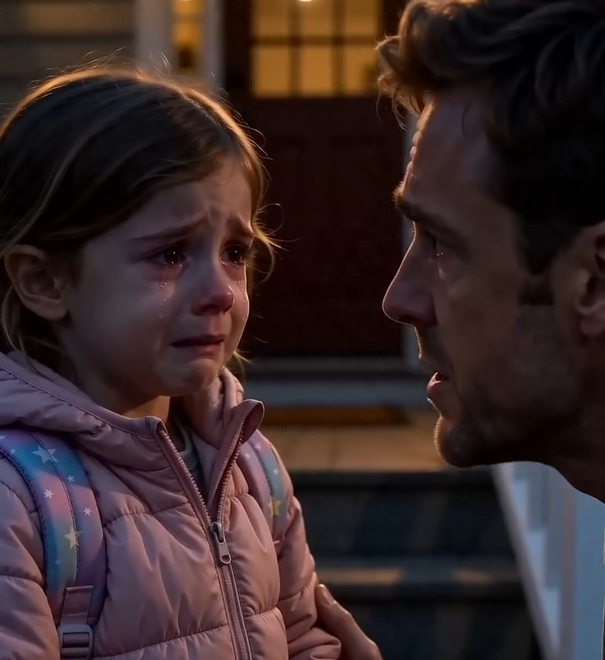
The sun had just dipped below the tree line when I pulled into the driveway, and the whole house was sitting there in that strange purple half-light that makes familiar things look wrong. After a ten-hour shift at the plant, I wanted exactly three things: to get my boots off, to hear cartoons blaring from the living room, and to eat whatever Sarah had probably left warming on the stove because she knew I never remembered lunch and always came home half-starved.
Instead, the first thing I saw was my daughter standing on the porch like a child waiting for a bus to another life.
Lily was four.
She was small for her age, all soft cheeks and bright eyes and hair that never stayed where it was pinned. But that evening she did not look soft. She looked determined in a way no little kid should. She had on her pink coat—the one with the heart-shaped buttons she insisted was her “travel coat”—zipped all the way up to her chin even though the air wasn’t cold. Her kindergarten backpack bulged on her back like she had stuffed her whole bedroom into it. Beside her stood the little rolling suitcase with faded unicorns on the side, the one we usually only took out for beach trips or long weekends at my sister’s.
The engine of my truck ticked as it cooled.
The house behind her was silent.
That silence hit me first.
Then the suitcase.
Then her face.
Her eyes were swollen and red, the skin beneath them blotchy from crying. Not the quick crying kids do when they skin a knee or get told no. This had been hard crying. Scared crying. The kind that leaves a child too emptied out to keep sobbing.
I got out so fast I forgot to shut the driver’s door.
“Lily?”
She didn’t run to me.
She didn’t smile.
She stood her ground.
“Sweetheart, what are you doing out here?”
I climbed the porch steps in two strides and crouched down in front of her. The porch light flicked on overhead with that little electrical buzz it always made, and it lit up the tear tracks on her cheeks so clearly that my stomach went cold.
“Where’s Mommy?”
Lily looked past me for one second, toward the driveway and the darkening yard, as if checking whether it was safe to speak. Then she looked back at me.
“Daddy,” she whispered, and her voice cracked in the middle of the word. “I’m leaving.”
I actually froze.
Not metaphorically. My body locked. My hands hovered stupidly in midair between wanting to touch her and being afraid to startle her.
“What do you mean, you’re leaving?”
She tightened her grip on the little suitcase handle until her knuckles showed white.
“I packed my bag,” she said. “I have my bear. I have socks. I have toothpaste.” Her lip trembled violently. “I can’t do it anymore.”
Every bad possibility exploded through my head at once.
A stranger came to the house.
She saw someone in the yard.
There was a fire.
There was a gas leak.
Someone called.
Someone touched her.
Something happened in that house while I was at work and I hadn’t been there to stop it.
“Honey, you’re scaring me,” I said, trying so hard to keep my voice even that I could hear the strain in it. “Talk to me. Why are you out here with your suitcase?”
She glanced toward the front door again.
That look did something terrible to me.
Children look at closed doors in very particular ways. Sometimes with annoyance. Sometimes with expectation. Sometimes with excitement because they know what’s behind them. Lily looked at ours the way people look at rooms where something bad is waiting.
Then she leaned toward me, close enough that I could smell the strawberry shampoo in her hair.
“I can’t live in that house anymore,” she whispered.
The words crawled over my skin.
“Why?”
She swallowed. Her mouth pressed into a tiny, grim line.
“I can’t live with your wife anymore.”
For one second I stopped hearing the evening altogether. No ticking engine. No distant barking dog from somewhere down the street. No wind in the sycamore tree by the mailbox.
Your wife.
Not Mommy.
Not Mom.
Your wife.
My blood went cold so fast I almost felt dizzy.
“You mean… Sarah?”
Lily nodded once, very hard, like she wanted to be absolutely clear.
“Yes,” she said. “I don’t love her anymore.”
The sentence was so adult in its construction and so little in its voice that it nearly broke me on the spot.
“What happened?” I asked.
Lily let go of the suitcase handle, and it fell sideways with a clatter against the porch boards.
“She’s a monster!” she burst out, the words finally ripping free. “A real monster, Daddy! She’s ruin-ing my life!”
Her small voice cracked so badly on the last word that I had to stand up because if I stayed crouched there one second longer, I might collapse in front of her.
I turned and looked at the front door.
Same wreath Sarah had hung in September because she loved pretending every season deserved a handmade decoration. Same chipped blue paint near the bottom where Lily rode her tricycle into it last summer. Same narrow glass pane catching the last of the evening light.
And suddenly it looked like the mouth of a trap.
I took Lily’s hand.
“A monster?” I said, trying to speak slowly, clearly, like I was standing near live explosives. “Did she hurt you?”
“Yes!” Lily wailed. “She hurt my heart!”
My fingers tightened around hers.
I should tell you this now: until that moment, I believed my wife was the gentlest person I had ever known.
Sarah did not yell.
Sarah did not spank.
Sarah baked banana bread for neighbors after surgeries and still sent my mother birthday cards even when my mother forgot hers. She was patient with everyone. Me. Lily. The dog we had before he died. The cashier who once cried in line at the grocery store because the card machine crashed and six customers started shouting.
That woman.
That wife.
That mother.
And yet here was my daughter, shaking on the porch with a suitcase packed for permanent exile, calling her a monster with the kind of conviction children only have when something inside their little world has already cracked.
“Get in the truck,” I said.
Lily blinked.
“Really?”
“Yes.”
Relief and panic flashed across her face at the same time.
I opened the passenger-side door and lifted her up, backpack and all. She climbed in clutching her stuffed bear—God help me, I hadn’t even noticed it tucked under her arm until then. Mr. Pickles, one ear hanging loose from years of too much love. I fastened her seatbelt with hands that were no longer steady.
Then I leaned against the truck door and looked at her.
“Tell me exactly,” I said. “What did she do?”
Lily drew in one long, shaky breath.
Then she told me.
And for thirty terrible seconds, I thought I had married a woman capable of breaking my child on purpose.
I was wrong.
But not in the direction I expected.
The Monster in the Kitchen
“She makes me eat vegetables,” Lily whispered.
I stared at her.
The panic in my chest didn’t disappear. It just changed shape so abruptly my body couldn’t keep up. I blinked once, then again, certain I had misheard her through the roar of blood in my ears.
“What?”
“She makes me eat vegetables,” she repeated, and now fresh tears rolled down her cheeks. “All of them. Even the scary green trees.”
Broccoli.
I just stood there with one hand on the truck door, letting the full absurdity of the sentence collide with the sheer terror that had led up to it.
Inside the house, I could see movement now through the narrow glass panel. A shadow. Then Sarah’s face, confused and worried, appearing in the entryway window as she finally realized my truck was in the driveway but I hadn’t come inside.
I looked back at Lily.
The red eyes.
The packed suitcase.
The whispered your wife like she was naming a villain in a fairy tale.
The declaration that she could never live in the house again.
All because Sarah had made her eat vegetables.
“Lily,” I said carefully, “that’s why you packed your suitcase?”
She gasped as if I had deliberately insulted her intelligence.
“No, Daddy. That’s not all.”
The cold returned to my body.
“Okay,” I said. “Tell me the rest.”
Her little face crumpled further.
“She says I can’t just eat noodles and crackers forever.”
I closed my eyes for one second.
When I opened them, Sarah was on the front porch barefoot, looking from me to Lily to the fallen suitcase and then back to me with the strained expression of someone who knew she was entering the middle of a scene but had no clue which scene it was.
“Tom?” she called softly. “What’s going on?”
Lily recoiled against the seat.
That movement did something ugly to me all over again.
It didn’t matter that the reason now appeared to involve vegetables and not violence. A child who recoils from her mother with that much fear doesn’t do it for nothing. Maybe not physical danger. But real danger, in her own small world.
I held up a hand to Sarah without taking my eyes off Lily.
“Keep talking,” I said.
Lily sniffed hard, wiping her nose with the sleeve of her coat.
“She said if I don’t eat my dinner, I won’t grow and then my bones will be sad.”
I heard Sarah inhale sharply from the porch.
“Lily—”
“And she hid ketchup!” Lily cried, voice climbing. “She knows I need ketchup for emotional support!”
My hand went over my mouth.
Not because this was funny.
Not yet.
Because the emotional swing from terror to confused relief was so violent it felt almost dangerous.
Sarah stepped off the porch and came down the driveway slowly, like approaching a frightened deer.
“Tom,” she said, now looking mortified, “I think she’s upset about dinner.”
I turned to stare at my wife.
Her hair was in a loose knot. One sock on, one sock off. Apron flour-streaked because apparently the woman I had briefly imagined as a hidden monster had been baking something when I got home. Her eyes looked tired. Not sinister. Just tired in the very specific way mothers of four-year-olds get tired when they have spent forty minutes arguing over three bites of broccoli and a world war erupts over ranch dressing.
I looked back at Lily.
Then at the suitcase.
Then at Sarah again.
“Dinner,” I repeated.
Sarah exhaled. “Dinner.”
I should tell you that the story could have ended there in a harmless, almost funny domestic misunderstanding. Child refuses vegetables. Child escalates conflict to evacuation-level response. Father misreads apocalypse. Mother explains. Everyone laughs later.
But it didn’t end there.
Because something about the way Sarah said dinner bothered me.
Not the word itself.
The exhaustion underneath it.
The defeat.
The brittle edge of someone who had not just fought over broccoli for one evening, but had been losing some larger, quieter battle for longer than I knew.
And suddenly, standing there in the driveway with my daughter half-fleeing home and my wife in a flour-streaked apron, I realized something else that scared me in a deeper way.
Not that Sarah was secretly cruel.
That I might have stopped really seeing either of them.
The War of Small Things
We brought Lily inside eventually, but only after a negotiation that would have impressed the United Nations.
She refused to cross the threshold until I promised, hand over heart, that no green vegetables would touch her plate “for the rest of the evening.” Sarah, to her credit, looked like she wanted to laugh and cry at the same time but held it together. She even retrieved Mr. Pickles from where he’d fallen behind the truck seat and presented him like a peace offering.
Lily accepted him with the grave dignity of an exile considering terms of return.
Inside, the kitchen smelled like roasted chicken, garlic, and fresh bread.
Normal.
Almost offensively normal.
One pot still steamed gently on the stove. The salad bowl sat untouched on the counter. A little ranch cup had been placed beside Lily’s plate with the kind of obvious strategic optimism only a mother still trying can summon.
I stood there taking all of it in while Lily planted herself on the farthest barstool from the salad and Sarah moved around the kitchen in a silence that was too careful to be casual.
That was when the second feeling came.
Not relief.
Shame.
Because I had just spent five minutes outside half-convinced my wife had hurt our daughter, and in those same five minutes I had also learned something else: my child was desperate enough over dinner rules to stage an escape, and my wife was strained enough by motherhood to sound like a stranger in her own kitchen.
And I, the father, the husband, the provider who worked long shifts and came home assuming cartoons and dinner meant the house was functioning, had apparently missed all of it.
I sat down at the table.
“Start from the beginning,” I said.
Lily looked suspicious. “Am I in trouble?”
“No.”
Sarah gave a tired, almost invisible shake of her head. “No, baby.”
Lily glanced between us, deciding whether she believed the ceasefire.
Then she began.
Apparently, the battle had started forty-three minutes earlier when Sarah placed broccoli beside the mac and cheese.
Lily objected.
Sarah insisted.
Lily declared that broccoli looked like “tiny cursed trees” and informed her mother that she would not be eating curse food in her own home.
Sarah, who had spent the day cleaning, doing laundry, working a freelance bookkeeping gig from the dining room table, and managing a four-year-old’s energy without me there, had responded with less softness than usual.
No dessert without vegetables.
No cartoons after dinner if the plate came back full.
No substitute meal.
Lily escalated immediately.
Sarah thought it was another routine standoff.
Then came the fatal sentence.
“People who love me don’t make me eat things that smell like backyard.”
I watched Sarah’s face while Lily repeated that line.
She flinched.
Not dramatically.
But enough.
“What happened after that?” I asked.
Lily looked down at her little hands.
“I told her she was mean.”
Sarah folded her arms tighter over her chest.
“And?” I prompted gently.
“I told her she was the worst mommy in the universe.”
“Lily—” Sarah whispered.
“I told her I wished I lived in a hotel with room service and pancakes.”
I very nearly laughed.
Sarah did not.
There were tears standing in her eyes now.
Lily noticed that too, and for the first time since I came home, her righteous fury dimmed a little.
Then she said the sentence that changed the whole thing from funny to painful.
“And then she said if I didn’t stop being ugly, she was going to cry in the pantry where I couldn’t see.”
The kitchen went dead still.
Sarah looked away.
I stared at her.
“Did you say that?”
She nodded once, ashamed already.
Not because she had threatened our daughter.
Because she had told the truth.
The ugly, exhausted truth.
Lily kept going in a much smaller voice now.
“So I thought maybe I broke her heart forever,” she said. “And then I thought if I stayed, maybe she would be sad forever and keep making vegetables because sad people do strange things.”
I actually had to put a hand over my eyes.
Sarah made a sound halfway between a laugh and a sob.
And there, finally, under the absurdity of the suitcase and the broccoli and the ketchup betrayal, I saw the real thing.
My daughter had not packed to flee abuse.
She had packed because her little four-year-old mind believed she had become so unbearable to her mother that the only loving solution left was self-deportation.
And my wife, exhausted and frayed and too honest for one disastrous second, had accidentally let our child see more of her struggle than a four-year-old could possibly know how to carry.
That realization hurt in a more complicated way than the fear I’d felt outside.
Because fear gives you a target.
This gave me a mirror.
The Mother I Had Left Alone in the House
After Lily finally agreed to eat half a bread roll and three bites of chicken under a newly negotiated “vegetables will be revisited by a committee tomorrow” treaty, I carried her upstairs.
She fell asleep curled around Mr. Pickles with one hand still fisted in the front of my shirt like she was afraid I might vanish if she loosened it. I sat with her longer than I needed to, watching her breathing slow and smooth out in that damp-haired, vulnerable way children sleep after a storm of feelings they weren’t built to survive gracefully.
When I came back downstairs, Sarah was standing at the sink with both hands braced on the counter.
The kitchen was cleaned.
Too cleaned.
That’s how I knew she’d been crying properly while I was upstairs.
I stood there for a second, not sure how to begin.
“You thought I hurt her,” she said quietly, before I managed a word.
There are accusations you can deny.
There are truths you can only admit.
“Yes,” I said.
She nodded without turning around. “For a second, when I saw your face out there, I realized that’s what you thought.”
“I didn’t know what to think.”
“You thought monster.”
The word sat between us.
I moved closer.
“I heard our daughter say she couldn’t live with my wife anymore,” I said. “I saw a suitcase, Sarah.”
She let out a short, broken laugh.
“Yeah. I know how that looked.”
When she turned to face me, her face was blotchy and exhausted in a way I had not really let myself see in months. Maybe longer. There were flour streaks still on her shirt. Hair escaping from the knot. Tiny half-moons under her eyes from sleep she clearly had not been getting enough of.
And on top of all that, there was something I recognized too late.
Loneliness.
Not dramatic, tragic loneliness.
The domestic kind.
The kind that accumulates while one parent becomes “the fun arrival” and the other becomes infrastructure. Meals, socks, reminders, emotional regulation, boundary enforcement, cleanup, bedtime, negotiations with tiny irrational dictators over produce.
I sat down at the table.
“So tell me the truth,” I said. “How bad has it been?”
Sarah stared at me for a long moment, and then I watched her make the decision to stop protecting me from the answer.
“She has been impossible for three weeks.”
Not because our child was bad. Because she was four. Testing. Expanding. Learning power. And because apparently every long shift I took at the plant had slowly turned me into a guest star in my own home.
Sarah listed it quietly.
Lily refusing lunch but eating crackers hidden in the playroom.
Lily demanding a different dinner every night the moment it touched the table.
Lily saving all her biggest meltdowns for the hours before I came home so she could become angelic by the time I walked in.
Lily telling Sarah, twice in one week, “Daddy likes me more when you’re not bossing.”
Lily asking why Daddy gets to be tired from work but Mommy doesn’t.
That last one cut.
Hard.
Because children are devastatingly observant when no one wants them to be.
“She’s not scared of me,” Sarah said, sitting down across from me at last. “She’s mad at me. And I’m tired, Tom. I’m so tired I said something stupid about crying in the pantry because I actually wanted to cry in the pantry.”
I dropped my eyes to the table.
In the silence that followed, I could hear the refrigerator hum and the faint murmur of Lily’s sound machine upstairs.
“This isn’t just about tonight, is it?” I asked.
“No.”
The answer came fast.
“It’s about me being here all day carrying the friction and then you coming home to the cleaned-up version,” she said. “It’s about you getting the hugs because you walk in after all the no’s have already happened.”
That was true.
Painfully true.
I had thought I was carrying the hard weight because my shifts were long and the work was brutal and the bills were paid because my body ached for them. But I had also been walking into a home where the emotional mess had already been half-managed by someone else.
I got bedtime cuddles.
Sarah got the war over pants.
the fight over lunch.
the fourth demand for a different cup.
the tears over boundaries.
the consequence enforcement.
And then, on top of that, the silent accusation of being the less adored parent.
“I didn’t know,” I said.
She laughed again, with no humor in it. “That’s kind of the problem.”
The Night We Stopped Pretending It Was Fine
It is humiliating how many marriages don’t break in spectacular ways.
They erode through tiny wrong assumptions.
One person thinks working longer means loving harder.
Another thinks holding everything together means not asking for rescue.
A child learns where the softer parent is and runs there with every complaint, every wound, every performance.
Everyone still loves each other.
And still the house starts warping.
That night, Sarah and I sat at the kitchen table until almost midnight.
No phones.
No television.
No pretending we were too tired.
Just the whole ugly inventory.
I admitted things first because I had more to confess.
I admitted that I liked being the favorite parent more than I should have.
That I secretly enjoyed coming home to Lily lighting up at the sound of my truck.
That I had told myself Sarah was “better at the home stuff” instead of seeing that what I really meant was I had let her become the default adult for every invisible task.
That I had not once in the last month asked, with real attention, “How are you doing today?” and waited for a real answer.
Sarah admitted her own failures too, because love and exhaustion had both made us meaner in private than we wanted to be.
She admitted that lately she had started seeing Lily not as a child, but as an opponent by five in the afternoon.
That she sometimes delayed dinnertime because she dreaded the fight.
That the pantry line wasn’t the first thing she’d said in frustration that Lily was too young to hear properly.
That she had been feeling herself disappear into motherhood in a way that scared her.
That last one changed the room.
Because the suitcase on the porch had made one thing obvious: Lily was not the only person in that house who felt trapped.
“When was the last time you had a day to yourself?” I asked.
Sarah stared at me like the question was in another language.
“I don’t know.”
That answer shamed me worse than anything else that night.
Not because she never complained.
Because she didn’t.
She just kept going.
Laundry. meals. preschool forms. birthday gifts for cousins. dentist appointments. screen-time battles. grocery budgets. emotional triage. all the invisible architecture that makes a home function enough for a man like me to walk into it and think the house is simply “running.”
And while she did all that, I had apparently let our daughter begin to believe that Mommy was the villain and Daddy was the escape hatch.
That dynamic isn’t cute.
It’s corrosive.
We made a plan right there.
Not the kind couples make to feel better for one night.
A real one.
I would take over dinner every Tuesday, Thursday, and Sunday. Not “help.” Take over.
Saturday mornings were Sarah’s, no negotiation, no “unless something comes up.”
Bedtime became shared.
Discipline became shared.
I would no longer swoop in at six-thirty and undermine the parent who had held the line since breakfast.
And most importantly, we would stop treating Lily’s behavior as isolated little incidents instead of what it actually was—a system that responded to all three of us.
When we finally went upstairs, Sarah stopped halfway down the hall and leaned against me in the dark.
“I’m glad she packed a suitcase,” she said quietly.
I looked down at her.
“Why?”
“Because if she’d just cried and we’d all moved on, nothing would’ve changed.”
That was exactly right.
The suitcase had been ridiculous.
And necessary.
The Child Who Thought Leaving Was Love
The next morning Lily woke up as if she had not nearly emigrated from the family.
That’s one of the cruelest and funniest things about young children. They can detonate a household emotionally by sundown and wake at six-thirty requesting waffles in a perfectly cheerful voice, as though the previous evening did not involve exile planning and accusations of maternal monstrosity.
Except Lily was not quite cheerful.
Not all the way.
She padded into the kitchen in footie pajamas with Mr. Pickles under one arm and paused at the sight of both me and Sarah standing there.
That pause mattered.
Children remember rupture, even when they don’t have language for it.
I crouched to her level.
“Morning.”
She looked at me first, then at Sarah, then at the fruit bowl as though breakfast might still involve a trap.
“Am I still in trouble?” she asked.
Sarah’s face broke a little.
“No, baby.”
Lily swallowed.
Then, in a much smaller voice: “Are you still sad forever?”
Sarah went down to both knees on that kitchen floor.
“No,” she said, holding out her arms but not forcing the hug. “I was tired and I said something wrong. I should not have said I wanted to cry where you couldn’t see. That made you feel like you broke something.”
Lily nodded, lower lip starting to tremble again.
“I thought maybe if I left, you would feel better.”
That sentence hit with the full force of truth because that had been the real terror hidden under all the vegetable drama.
She wasn’t just angry.
She had believed she herself was the problem.
That her leaving was an act of love.
Sarah pulled her close then, and this time Lily went willingly.
“No,” Sarah whispered into her hair. “You never have to leave to make me feel better.”
I stood there uselessly holding a waffle mix box and feeling like the least important and most responsible person in the room at the same time.
A minute later Lily peered over Sarah’s shoulder at me.
“Even if I don’t eat tiny cursed trees?”
I laughed so hard I had to sit down.
Sarah did too, though she was still crying while it happened.
And somehow that became the first honest family moment we’d had in months: tears, relief, absurdity, all of it mixed together over cold tile and unfinished breakfast.
We told Lily the new rules.
Not just for her.
For us.
Daddy would be home for dinner more.
Daddy would help say no.
Mommy would get alone time.
No one would pack a suitcase without telling another human first.
And if feelings got so big they made the house feel scary, we would use words like overwhelmed, mad, tired, sad, trapped, instead of monster whenever possible.
Lily agreed solemnly to most of it.
She objected only to the clause about discussing suitcases with adults before departure.
“What if it’s an emergency?” she asked.
I looked at Sarah.
Sarah looked at me.
Then she said, “If it’s a broccoli emergency, we can review it together.”
That bought peace for the morning.
But the change didn’t come because one emotional kitchen conversation fixed us.
It came because, for once, we kept paying attention after the fear was over.
The Things I Started Seeing
When you have nearly mistaken your wife for a child abuser over broccoli and burnout, you become very alert to what you have not been seeing.
I noticed things immediately.
By day three of the new plan, I realized Lily’s dinner protests were about far more than vegetables. Dinner had become the daily arena where she tested whether the grown-ups in her world were aligned or divisible.
When I started taking over some evenings, she tried the same tricks with me.
The dramatic sighs.
The noodles-only demands.
The heartbreaking eyes.
The sudden declaration that she was “too delicate for carrots.”
And because Sarah was there, sitting beside me rather than across from me as the opposing force, Lily learned something children hate and need at the same time: the wall had no weak spot.
Not because we became harsh.
Because we became consistent.
I also noticed Sarah moving through the day differently once she had room to breathe.
The first Saturday she took for herself, she didn’t go anywhere glamorous. She sat in a coffee shop with a book and came home looking like someone who had briefly remembered her own name. The second week she took a long bath while I battled Lily over bedtime and discovered firsthand that our daughter could negotiate like a union lawyer and collapse like a fainting Victorian whenever pajamas were mentioned.
That night I apologized again.
Sarah kissed my forehead and said, “I know.”
Not because I had fixed it.
Because I was finally in it.
And Lily changed too, though more slowly.
The suitcase stayed in her closet for two weeks untouched.
Then one afternoon I found her pulling clothes out of it and folding them back into drawers.
“What are you doing?” I asked.
She shrugged.
“I think I live here again.”
That sentence nearly took me out at the knees.
A four-year-old should never have to decide whether she lives in her own house.
And yet there it was, that same brutal little truth children drop into the room and leave adults bleeding around for days.
I started making note of the phrases she used.
Not to pathologize her.
To understand her.
When she said “You’re ruin-ing my life,” she often meant “This feeling is too big for my body.”
When she said “You’re a monster,” she often meant “I feel powerless and scared.”
When she said “I’m leaving,” she sometimes meant “Please show me that I still belong here.”
Those translations sound obvious now.
They were not obvious when I was tired and flattered by being the easy parent.
That was the hardest lesson in the whole thing.
Not that Sarah needed more help.
Not that Lily needed more structure.
That I needed less ego in my own fatherhood.
I had loved being the soft place to land.
I had not noticed that Sarah had been made, by my absence and by our habits, into the surface everybody collided with first.
What the Suitcase Saved
A month later, I found the suitcase again.
This time it was in the living room, open on the rug, full of crayons, stuffed animals, one banana, and a paperback picture book about sea turtles.
I stopped dead.
Lily looked up from zipping the side pocket and saw my face.
“Don’t worry,” she said quickly. “This is not an escape. This is a picnic.”
Sarah, from the couch, laughed so hard she snorted.
I sat down on the floor and let the relief wash through me.
“Good,” I said. “Because I don’t think we can survive another international incident.”
Lily grinned and shoved Mr. Pickles into the bag with unnecessary force.
What struck me then was not the humor of it.
It was the shift.
A suitcase had stopped meaning exile.
It could mean play again.
Home had become home again.
Not perfect.
Not effortless.
Not without broccoli disputes or tears or the occasional declaration that both parents were “against freedom.”
But stable.
Safe.
Shared.
That night, after Lily was asleep, Sarah and I sat on the porch with two beers and watched the summer bugs throw themselves at the porch light.
“She really thought leaving was the solution,” I said.
Sarah nodded.
“So did I, a little.”
I looked at her.
“You never packed a suitcase.”
“No,” she said. “But I definitely packed it in my head.”
That honesty was harder to hear than Lily’s accusations had been.
Because that was the quiet version adults do.
Children drag luggage to the porch.
Adults keep performing and disappear inside themselves.
I reached for her hand.
“I’m sorry I left you alone in it.”
She squeezed back once.
“You’re not now.”
That was enough.
Not a grand speech.
Not absolution.
Just enough.
If you ask me now what happened that night, I could tell the short version.
My four-year-old daughter packed a suitcase because her mother made her eat vegetables and admitted she wanted to cry in the pantry. I came home, panicked, misunderstood everything, and nearly confronted my wife like she was a criminal when really she was just drowning in ordinary motherhood while I floated above it.
That version is funny enough to retell at family holidays.
But it isn’t the truest version.
The truest version is this:
My daughter stood outside alone in the dark because, in her tiny mind, she had become too much for the people she loved. My wife was exhausted enough to let that thought bloom by accident. And I was absent enough—despite living in the same house—to miss how close we all were to becoming strangers to one another.
The suitcase didn’t reveal a hidden monster.
It revealed a quiet failure.
Mine.
And maybe that’s why I’m grateful for it now.
Because some families don’t get a dramatic warning.
They just drift.
Ours rolled a unicorn suitcase onto the porch and waited under the flickering light until I finally paid attention.
So yes, my daughter thought she couldn’t live with “my wife” anymore.
And yes, when she told me why, I froze in terror.
But the thing that should have scared me most wasn’t the thought that Sarah had become a monster.
It was how easily I believed I could tell what was happening in my own home without truly listening to the two people living there all day without me.
I listen now.
At dinner.
At bedtime.
In the spaces after the tantrum.
In the stupid little phrases that sound funny until you hear the fear or loneliness underneath them.
And every once in a while, when Lily gets dramatic over carrots or declares that our family is “emotionally complicated,” Sarah and I catch each other’s eye across the table and think the same thing:
Thank God for the suitcase.