My newborn daughter would not stop crying at midnight when my mother-in-law suddenly slapped me, and my baby slipped from my arms, hit the floor, and went silent. Then she said, “Shut her up, or get out of the house.” At the hospital, the doctor’s words shattered me, and I called the police right away.
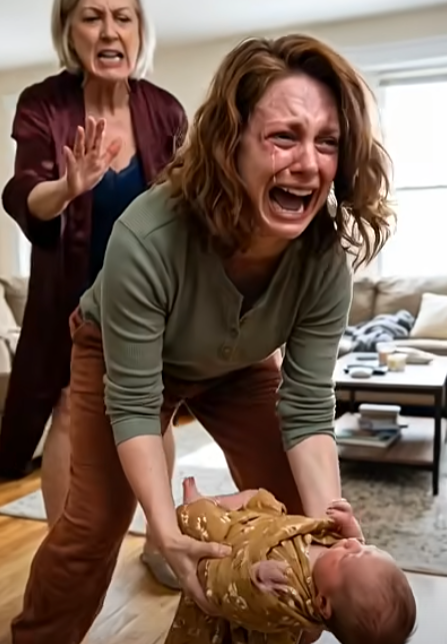
At 12:17 a.m., the apartment on the south side of Chicago was already trembling with noise. Not from music, not from traffic, but from the piercing cries of a six-week-old baby who had been fighting sleep for nearly an hour. Emily Carter stood in the narrow living room, her arms aching, her hair falling loose from a rushed ponytail, rocking her daughter against her shoulder while whispering, “It’s okay, Lily. Mommy’s here. Mommy’s here.”
But Lily would not settle.
The baby’s cries cut through the dark like a siren, bouncing off the kitchen tile and the old walls of the two-bedroom unit owned by Emily’s mother-in-law, Margaret Hayes. Emily’s husband, Daniel, was away on a trucking route to Missouri, leaving Emily alone in the apartment with Margaret for the third night in a row. Margaret had never wanted Emily there. She had made that clear from the day Daniel lost his job the previous winter and they had been forced to move into her place “temporarily.”
“Make her stop,” Margaret shouted from her bedroom.
Emily tightened her hold on Lily and paced faster. “I’m trying.”
“You’ve been trying for an hour!”
Emily glanced at the clock again, panic prickling up her neck. Lily had a mild fever earlier that evening. Emily had wanted to take her to urgent care, but Margaret had called her dramatic and wasteful. Now the baby felt hot and restless, her tiny fists jerking against Emily’s chest.
Margaret’s bedroom door flew open so hard it struck the wall. She stormed out in a wrinkled robe, her face sharp with fury. “I said shut her up.”
“She’s sick,” Emily said. “I think she needs a doctor.”
Margaret laughed once, cold and ugly. “What she needs is a mother who knows what she’s doing.”
Emily turned away, trying to shield Lily. “Please, don’t start.”
That was when Margaret stepped forward and slapped her.
The crack filled the room. Emily’s head snapped sideways. Pain exploded across her cheek. Her body lurched, and in that fraction of a second her exhausted arms lost their grip.
Lily slipped.
Emily saw the blanket slide first, then the tiny body. There was a horrible, small thud against the hardwood floor, far softer than it should have been, yet terrifying enough to freeze the whole room. The crying stopped instantly.
For one impossible second, there was silence.
Then Emily dropped to her knees. “Lily? Lily!”
The baby lay on her back, limp, one arm twisted under the blanket. Her eyes were closed. She did not cry. She did not move.
Margaret took one step back. “Get her up.”
Emily scooped Lily into her arms, shaking. “Call 911!”
Margaret’s expression hardened again, as if fear itself offended her. “Shut her up, or get out of the house.”
Emily stared at her, unable to understand what she had just heard. Then instinct took over. She grabbed her phone, her keys, and ran barefoot down the apartment stairs with Lily against her chest, begging, “Please, baby, please, please wake up.”
At Northwestern Memorial Hospital, a trauma nurse took Lily from her arms and disappeared through double doors. Emily stood in the emergency corridor in borrowed socks and a blood-specked T-shirt, unable to feel her legs. Twenty-two minutes later, a gray-faced doctor approached.
“I’m sorry,” he said quietly. “Your daughter is already gone.”
The words did not sound real. Emily’s knees nearly buckled.
Then the doctor added, “We also found signs that suggest this may not have been the first injury.”
Emily looked up slowly, her grief splitting open into something colder, sharper, and far more dangerous.
With trembling hands, she pulled out her phone and dialed 911.
“I need the police,” she said. “My mother-in-law killed my baby.”
The first detective arrived before Emily had stopped shaking.
His name was Detective Ryan Bennett, a broad-shouldered man in his early forties with a tired face and the controlled calm of someone who had spent years listening to people on the worst night of their lives. Beside him stood Detective Lena Ortiz, younger, watchful, carrying a small notebook she barely needed because her eyes missed nothing.
They led Emily into a private consultation room just off the pediatric emergency wing. Someone brought her water. She did not drink it.
Bennett spoke gently. “Mrs. Carter, I know this is hard, but I need you to tell us exactly what happened tonight. Start from the beginning.”
Emily told them everything. Daniel being out of town. Margaret’s temper. The fever. The shouting. The slap. Lily falling. The order to “shut her up, or get out of the house.” Emily repeated the sentence twice, as if saying it again might make it less monstrous. It did not.
Ortiz asked, “Has Margaret ever hurt Lily before?”
Emily hesitated, then answered with shame that made her voice crack. “I don’t know. I didn’t see her hurt Lily before. But sometimes Lily cried after Margaret insisted on holding her. And… there were bruises once. Very faint. On her upper arm. Margaret said I was imagining things.”
Bennett and Ortiz exchanged a glance.
That was when the pediatric forensic specialist entered the room. Dr. Sarah Klein was precise, direct, and careful not to soften facts that mattered. “The baby suffered a fatal head injury consistent with a fall,” she said. “But there are also older injuries. Healing rib fractures. A bruise pattern on the left thigh. And a small, older subdural bleed.”
Emily stared at her. “Older injuries?”
“Yes.”
The room turned cold.
Emily’s mind began racing backward through the last three weeks. The times Margaret had snatched Lily from her arms and said, “You’re too soft with her.” The sharp way Lily would scream when Margaret adjusted her blanket. The day Emily came back from the shower and found Lily red-faced and gasping while Margaret muttered, “She has to learn not to be spoiled.” The little marks Emily had noticed and then doubted because she was tired, because Daniel said his mother was difficult but “not dangerous,” because everyone kept telling new mothers they worried too much.
Ortiz asked quietly, “Did your husband know about any of this?”
Emily wiped her face. “He knew his mother hated me. He knew she yelled. But he always said she was all talk.”
Bennett stepped outside to place a call. Ten minutes later he returned. “Uniforms are on their way to the apartment now.”
Before 2:00 a.m., they had Margaret Hayes in custody.
She did not go quietly.
At the station, according to Ortiz, Margaret first denied touching Emily. Then she admitted to “disciplining” her. Then she blamed Emily’s “clumsiness.” By dawn, her story changed again: Lily had “slipped on her own.” When detectives confronted her with the doctor’s preliminary findings of prior injuries, she snapped that babies “bruise all the time” and accused Emily of trying to destroy the family.
Meanwhile, detectives contacted Daniel Carter and ordered him back from Missouri. He arrived at the hospital shortly after sunrise, still wearing his work jacket, eyes red from six hours of hard driving and shock. When he saw Emily outside the family grief room, he collapsed into a chair and whispered, “No. No, no, no.”
Emily wanted to hate him. Part of her did. But what she felt first was numbness.
“She slapped me,” Emily said. “Lily fell. Ryan says there were older injuries too.”
Daniel looked up as if he had been struck. “Older injuries?”
“You left me there with her.”
His face changed then, not into anger, but into the hollow look of a man watching every excuse he had ever made for someone collapse at once. “I didn’t know,” he said.
Emily answered, “You didn’t want to know.”
That line stayed with him. Later, it would come out in court.
By the second day, the case had spread beyond a simple arrest. Child protective investigators reviewed hospital records and found that Lily had been taken to a clinic two weeks earlier for unusual fussiness and feeding trouble. The symptoms, a consulting pediatrician now believed, could have matched an earlier head injury. Emily had brought Lily in; Margaret had insisted on coming too and answered half the doctor’s questions herself.
Neighbors also began talking.
One woman from the apartment downstairs reported hearing Margaret scream at the baby nearly every afternoon. Another recalled seeing Emily on the back steps crying while Margaret stood over her, saying, “You can leave, but the baby stays with my son.” A teenage neighbor said he once heard a loud slap followed by Emily yelling, “Don’t touch her!”
The prosecution’s theory hardened quickly: Margaret had been abusing Lily in escalating bursts of frustration and control, and the fatal incident was not an accident in any ordinary sense. It was the foreseeable result of violence.
Three days after Lily’s death, prosecutors charged Margaret Hayes with second-degree murder, aggravated battery, and felony domestic assault.
News cameras appeared outside the courthouse by Friday.
Emily, still moving like someone underwater, gave no statement. She held Lily’s hospital bracelet in her hand until the plastic edges cut into her palm.
That night, Detective Ortiz visited Emily with one more piece of evidence recovered from the apartment building hallway camera. The footage had no sound, but it showed Emily bursting out the stairwell barefoot, clutching Lily, face wild with panic. Ten seconds later, Margaret appeared at the top landing and simply watched her go.
“She never called for help,” Ortiz said.
Emily closed her eyes.
For the first time since the doctor’s words, grief gave way to clarity.
Margaret had not lost control for one second.
She had chosen every one of them.
The trial began eleven months later in Cook County.
By then, Emily Carter looked like a different woman. Thinner, steadier, stripped down to essentials. The softness that had once made her easy to dismiss was gone. She had moved out of Chicago, filed for divorce from Daniel, and rented a small apartment in Madison, Wisconsin, near her sister. She worked remotely for an insurance claims company and attended therapy twice a week. She slept with a lamp on. She still woke at 12:17 some nights.
Margaret Hayes entered the courtroom in a navy blazer, hair set neatly, expression arranged into offended dignity. She did not look like the kind of woman television viewers imagined when they heard the words child abuse and homicide. That, Emily had learned, was part of the danger. Violence rarely announced itself in a dramatic costume. Sometimes it wore reading glasses and complained about grocery prices.
The prosecution built its case with patience and precision.
Dr. Sarah Klein explained the medical timeline to the jury in language plain enough to be devastating. Lily’s fatal injury came from the fall. But the healing rib fractures had occurred at least ten days earlier. The older head bleed suggested prior trauma. Bruising patterns were inconsistent with routine infant handling. In Dr. Klein’s expert opinion, Lily had been physically abused before the final night.
Detective Bennett testified next. He described Margaret’s shifting statements and how each version changed when confronted with new evidence. He read from her recorded interview:
“I barely touched Emily.”
Then later:
“Well, maybe I slapped her, but she was hysterical.”
Then later:
“She dropped the baby because she’s incompetent.”
The prosecutor paused after each line and let the contradictions breathe.
The hallway camera footage was shown to the jury. Emily could not bear to watch it again. She stared at the wood grain of the witness stand while jurors saw her running for help and Margaret standing above, motionless.
Then came Emily’s testimony.
She spoke for nearly two hours.
She described moving into Margaret’s apartment after Daniel’s layoffs. She described the insults that were so constant they became background noise: lazy, weak, stupid girl, unfit mother. She described being isolated, criticized, corrected in front of neighbors, denied small choices like when Lily should feed or sleep. Margaret had called it “teaching discipline.” Emily now called it what it was: control.
When the prosecutor asked what happened that night, Emily’s voice nearly failed. But she said it all.
“She slapped me hard enough to turn my head. I lost my grip. Lily fell. I begged her to call 911, and she told me, ‘Shut her up, or get out of the house.’”
In cross-examination, Margaret’s defense attorney tried to turn the case toward reasonable doubt. He suggested Emily, exhausted and emotional, might have mishandled Lily on earlier occasions. He implied postpartum stress had distorted her memory. He emphasized that the fatal injury came from the fall, not from a direct blow by Margaret to the child.
Emily met every question without theatrics.
“You’re saying this was all Margaret Hayes’s fault?” the attorney asked.
“I’m saying,” Emily replied, “that my daughter would be alive if Margaret Hayes had not hit me.”
The courtroom went silent.
Daniel testified on the fourth day. He was the prosecution’s most complicated witness. He admitted he had minimized his mother’s behavior for years. He admitted Emily had complained that Margaret was rough with Lily. He admitted he did nothing meaningful to stop it.
“Why not?” the prosecutor asked.
Daniel looked toward the jury but seemed to be speaking to no one but himself. “Because my mother always made cruelty sound normal. And because I was a coward.”
The defense did not call Margaret to testify.
In closing arguments, prosecutors did not claim Margaret intended to kill Lily in some premeditated, cinematic way. They argued something more believable and, therefore, more powerful: Margaret had created a house ruled by fear, had repeatedly abused a defenseless infant, and on the final night committed an act of violence that directly caused the child’s death. The law did not require a monster from a movie. It required proof. And proof was everywhere.
The jury deliberated for seven hours.
Emily sat in a waiting room with Detective Ortiz, her hands locked together so tightly they ached. Outside the courthouse windows, late autumn rain streaked the glass. Nobody said much. There was nothing left to explain.
At 4:42 p.m., the bailiff called them back.
Margaret stood as the verdict was read.
On count one, second-degree murder: guilty.
On count two, aggravated battery to a child: guilty.
On count three, domestic assault: guilty.
Margaret’s face finally changed. Not to grief, not to remorse, but to naked disbelief that consequences had reached her at all.
At sentencing six weeks later, Emily gave a victim impact statement. She did not cry. Her voice was low and even.
“You took my daughter’s entire life before she had learned to hold up her own head. You took her because you needed power in every room you entered. This sentence will not return Lily to me. But it will tell the truth about what you did.”
The judge sentenced Margaret Hayes to thirty-four years in state prison.
When it was over, reporters shouted questions outside the courthouse. Emily ignored them and walked down the steps into the winter air. For the first time in nearly a year, she did not feel numb. The pain was still there. It would always be there. But beneath it was something firmer than hope.
The truth had survived.
And in the end, that was what Margaret had failed to destroy.