Part 2: A 5-Year-Old With Terminal Cancer Asked for One Harley Ride Before She Died — Fifty Bikers Showed Up. Then One of Them Didn’t Leave.
Part 2:
Hank rode first.
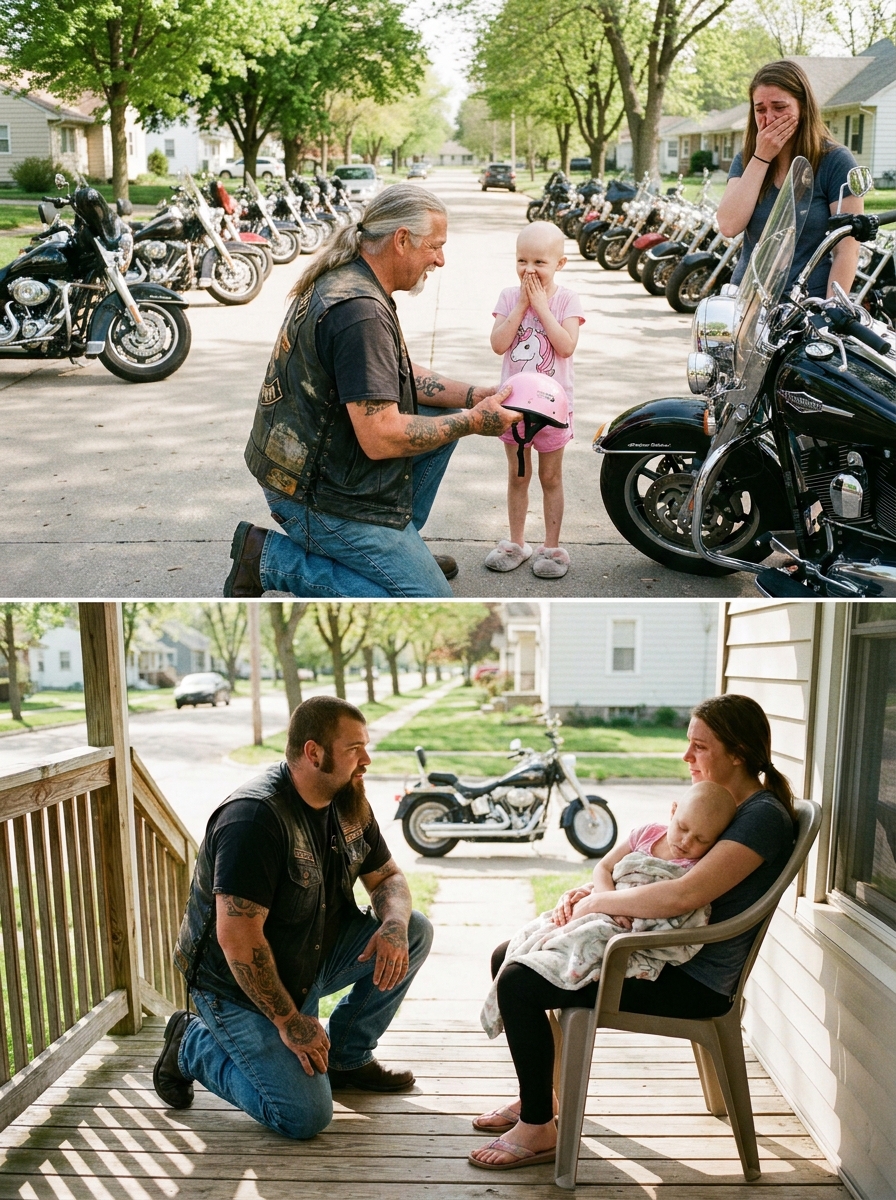
He’d brought a custom child seat his nephew welded for him on Thursday night — bolted to the rear of his Road King, padded, with a five-point harness like a race car. He’d brought a pink helmet two sizes too small that he’d found at a swap meet in Waterloo. He’d brought knee pads in case she had any balance issues from the chemo.
Rachel buckled Sophie in. Her hands were shaking so bad she had to do the chest strap twice.
Sophie was grinning.
Hank put one big leather-gloved hand on Sophie’s helmet and said: You ready, little lady? We don’t go fast. We don’t go far. You tell me if you want to stop and we stop right now. Deal?
She gave him a thumbs up.
He started the engine.
That V-twin came alive low and steady, and Sophie’s whole body went stiff for one second — eyes huge — and then she laughed. Just laughed. Loud, real, alive. She turned her head to look at her mom on the porch and she yelled: MOMMY I’M ON IT.
Hank pulled away from the curb at maybe eight miles an hour.
They went one block down, around the corner, up to the elementary school, around the cul-de-sac, and back. Four minutes. He pulled up to the curb where Rachel was standing and he killed the engine and Sophie said:
Again.
Hank looked at the line of forty-nine other bikes behind him.
He said: Honey, you get to ride forty-nine more times today. Different bike each time.
She blinked at him. She did the math the way a five-year-old does math.
And she screamed.
Pure joy. The kind of sound that makes grown men look at the ground.
I want you to picture this for a second. Picture a little bald girl in a pink helmet getting unbuckled from one Harley, lifted by her mother and a giant tattooed stranger, walked four steps, and buckled into the next one. Fifty times. Four hours. From 8:30 in the morning to 12:42 in the afternoon.
She rode behind Hank. Behind Diesel. Behind a Vietnam vet named Pop who hadn’t smiled at anyone outside the club in eight years and who came off that block with tears running into his beard. She rode behind a woman named Margie who runs a bakery in Waterloo and brought cupcakes for Sophie that Sophie was too excited to eat. She rode behind a deaf biker named Quinn who communicated with Sophie entirely in thumbs-up.
The neighbors brought folding chairs out and set them up on lawns. Somebody made a cooler of lemonade. A man across the street brought out his garden hose to wash bird droppings off bikes between rides because he didn’t know what else to do.
The local police chief — a guy named Burrell — drove past three times and didn’t say a word about the noise ordinance.
Sophie waved to her mother on every single pass. Every single one. Fifty waves.
By ride number thirty her cheeks were pink for the first time in eight months.
By ride number forty she was so tired she was leaning her helmet against the back of the biker in front of her — and the biker was a six-five ironworker named Crash who reached one hand back the whole loop to make sure she didn’t slide.
The fiftieth ride was a man named Booger who has the worst name and the kindest hands in the whole state of Iowa. He pulled up at 12:42 PM. Sophie was asleep against his back. Rachel walked out to the curb and unbuckled her daughter and carried her up the porch and the whole street — fifty-one bikers, twenty neighbors, four kids on bicycles — clapped quietly so they wouldn’t wake her up.
That should have been the end of the story.
It wasn’t.
Diesel didn’t leave.
His real name was Derek Vossler. Thirty-five years old. Union welder out of Local 577. Six-three. Two hundred and forty pounds. Sleeve tattoos both arms. Goatee like a steel brush. He’d ridden Sophie around the block forty minutes earlier — ride number twenty-three — and when his loop was done he’d parked his Fat Boy at the end of the block and walked back to the porch and stood there.
He stood there for the next two hours. Watching.
He had a daughter at home in Cedar Falls. Name was Mila. Five years old. Healthy. Loved horses and chocolate milk. Diesel’s wife had sent him a photo that morning of Mila eating waffles at the kitchen table, and Diesel had looked at the photo, then looked at Sophie laughing on the back of a Road King, and something in him had gone very, very quiet.
When the last bike pulled away, Diesel walked up the porch steps.
Rachel was sitting in a plastic chair with Sophie asleep in her lap. She had not slept more than three hours a night in seven months. Her hair was unbrushed. Her eyes were red.
Diesel knelt down on the porch so he wasn’t looming over her.
He said: Ma’am. My name is Derek. The guys call me Diesel. I have a little girl Sophie’s age. She is healthy. I cannot imagine what you are carrying. I want to help. Not with a ride. With money. Tell me what you need.
Rachel started crying before he finished talking.
She told him.
The hospice care alone was twelve thousand a month. Sophie’s previous treatment had buried her in a hundred and forty-three thousand dollars of medical debt. The pediatric oncology team had been pushing for an experimental palliative protocol that insurance refused to cover — sixty-two thousand dollars out of pocket. Rachel had sold her car two months earlier. Her mother had taken out a second mortgage. They were three weeks from losing the house.
She had not told anybody this. She had not even told Hank.
Diesel listened to all of it on his knees on her porch.
Then he stood up. He walked back to his Fat Boy. He sat on the curb. He pulled out his phone.
He called Hank first.
The Iron Vale Riders raised eighty thousand dollars in seven days.
Diesel pulled fourteen thousand out of his own savings before he asked anybody else. Hank put in eight. Pop — the Vietnam vet — put in fifteen, which was almost everything in his retirement account, and refused to tell anybody. The club passed a bucket at every bar within forty miles. They did a poker run the next Saturday — three hundred and eleven bikes showed up. The Cedar Falls Hy-Vee, where Rachel worked, took up a collection at every register for two weeks. A welding shop in Waterloo donated five thousand. A church Diesel had never set foot in donated three.
Eighty thousand dollars. Cash and checks. In a brown envelope.
Diesel and Hank brought it to Rachel’s house on a Tuesday night.
Rachel sat at her kitchen table and looked at the envelope and could not open it.
Hank opened it for her.
She covered her face with both hands and she sat like that for a long time. Sophie was asleep down the hall. Diesel was looking at the linoleum floor. Hank was staring out the kitchen window like he was somewhere far away — and I know now he was, because his daughter Marisol had died at the U of I Hospitals on a Tuesday night just like that one, in 2009, and he had never told Rachel.
He told her that night.
He told her: Ma’am, this money won’t fix it. You know that. I know that. But it means she gets to be home. With you. Not in a hospital bed. Not under fluorescent lights. Home. For whatever time she has.
Rachel nodded. She still couldn’t speak.
Sophie came home from her last hospital stay three days later.
She lived four more months.
She did not die in a hospital. She died in her own bed, in her unicorn pajamas, with her mother holding one hand and a worn-out stuffed bear in the other, on a Wednesday afternoon in September while sunlight came through her window and the curtains moved in a slow breeze.
She was five years and seven months old.
Diesel had come over every Wednesday afternoon for those four months.
Sometimes he brought Mila. The two girls — one healthy, one dying — would sit on the living room rug and color pictures of horses. Mila gave Sophie her favorite stuffed bear, a brown one with a missing eye named Bartholomew. Sophie kept it on her pillow until the end. It was in her hands when she died.
Diesel never missed a Wednesday. Not one. Even after.
He came to the funeral in his cut. So did all fifty other Iron Vale riders. So did sixty-four bikers from three other clubs across Iowa. They lined up outside the small Lutheran church on East 5th Street and they stood with their helmets in their hands while the pallbearers brought Sophie’s white casket out.
Rachel asked if any of them wanted to say something at the gravesite.
Diesel did.
He said exactly twelve words.
He said: She rode with us once. She rides with us every time now.
Then he walked back to his bike and he did not start the engine for ten minutes.
The next May — one year to the day after fifty bikes had parked on Rachel’s street — Diesel organized the first Sophie’s Ride.
A hundred and forty bikes showed up. They rode the same figure-eight route through Sophie’s old neighborhood, low and slow, and then they rode out to a fairground in Black Hawk County for a barbecue and a fundraiser. They raised forty-one thousand dollars for the pediatric oncology unit at U of I Hospitals.
Rachel was there. She cut the ribbon.
The second year, they raised seventy-eight thousand.
The third year, a hundred and twelve thousand.
The seventh year, Sophie’s Ride was the largest single-day motorcycle charity event in the state of Iowa. Eight hundred and sixty-three bikes. Two hundred and ninety-one thousand dollars.
This past May was the tenth anniversary.
Diesel is forty-five now. Mila is fifteen. Hank retired from sheet metal three years ago and now spends most of his free time coaching kids’ soccer. Pop passed in 2022. Booger and Crash still ride every Sophie’s Ride. So does Margie from the bakery in Waterloo, who brings two thousand cupcakes every year.
Rachel speaks at the opening every year. Same five sentences. She has not changed them in ten years.
My daughter lived five years. She wanted one Harley ride. She got fifty. And because of a group of bikers who saw a Facebook post and decided to show up, she keeps helping children long after she is gone. Thank you for coming.
That’s it. Then she sits down. Then Diesel starts the engines.
There is a small headstone in Greenwood Cemetery in Cedar Falls.
It says: Sophie Anne Mendel. 2010 — 2015. She rode with the wind.
Diesel goes there once a month. He brings a small Iron Vale Riders patch in his pocket and he sets it on top of the headstone for the length of his visit, and then he puts it back in his pocket and he leaves.
The patch is the same one he had on his cut the day she rode behind him. He hasn’t replaced it. The threads are coming loose. The patch is fading.
He plans to be buried with it.
He told Hank that once. They were sitting on the curb outside the garage on Center Street, and Diesel said it quietly, and Hank just nodded.
Some things you don’t need to say twice.
If this one stayed with you, follow the page. There are more like it. Real bikes. Real kids. Real reasons we ride.