Part 2: A 6-Year-Old Girl Was Walking Down a Mississippi Highway Alone at 1 AM in Pajamas — Eight Years Later, the Biker Who Stopped Sent Me a Three-Line Email
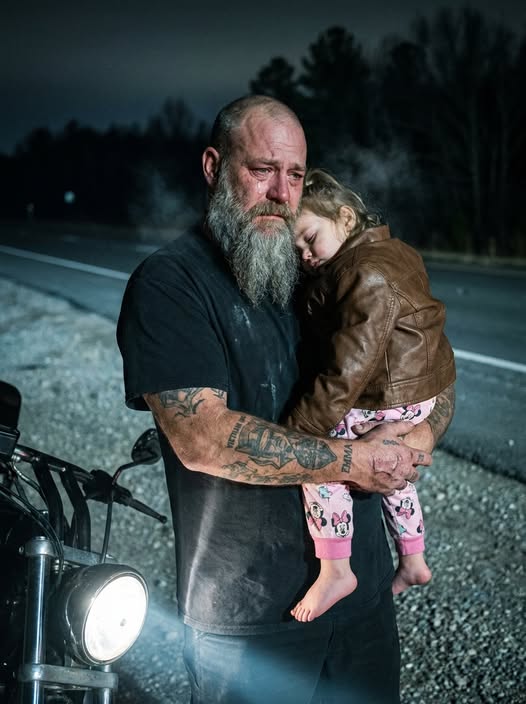
Tessa Galloway had walked four-tenths of a mile down the shoulder of Highway 49 by herself.
The house she had left was a single-wide trailer on County Road 318, set back about two hundred feet from the highway behind a stand of loblolly pines. Her parents — I will not name them, because the case file is sealed and because their names are not the point of this story — had been screaming at each other in the kitchen for over two hours that night. Tessa had been hiding under her bed listening. At some point, when something in the kitchen broke and her mother screamed in a way she had not screamed before, Tessa had climbed out the window of her bedroom in her pink mouse pajamas, walked across the front yard barefoot in the cold October grass, walked down the gravel driveway, and turned right onto the highway shoulder.
She did not know where she was going. She told me later she had been walking toward the lights of a gas station she could see in the distance — about a mile and a half north, near the next exit. She told me she had thought maybe there would be a phone there. She told me she had thought maybe there would be somebody nice there. She told me, in the voice of a fourteen-year-old being very honest, that she had been planning to never go back to the house.
She had been walking for about twelve minutes when she saw the headlight of Briar’s Harley coming up behind her.
She told me she had not tried to wave it down. She had not been thinking about flagging anyone. She had been six. She had been cold. She had stopped on the shoulder to rest. She had stood there and watched the headlight grow bigger.

She told me she remembered the sound of his motorcycle.
She remembered it because it was loud and warm in the cold dark, and she said it sounded like a big animal sleeping.
She watched the bike pass her. She watched the taillight shrink in the distance. She told me she had felt a small, sharp moment of giving up.
Then she saw the brake light flare. She heard the engine throttle down. She watched the taillight stop. And she watched the dim outline of a man — backlit by his own headlight — get off the bike and start walking back up the shoulder toward her.
She told me she had not been scared. She said this twice during our interview, looking me straight in the eye both times: I was not scared. I do not know why I was not scared.
She thinks it was because she had used up all her fear on the trailer.
Briar walked the eighty feet back to her with his hands held a little ways out from his body, the way you walk toward a deer you don’t want to spook. As he got close enough to see her clearly in his headlight, he slowed down. He stopped about ten feet away.
He told me he did not want to scare her by getting too close.
He said: Hey, sweetheart. My name’s Briar. I’m not going to hurt you. Are you okay?
She looked up at him. She did not answer for a moment.
Then she said: I’m tired.
That was the only thing she said.
Briar told me — sitting in his shop, eight years later, with his hands wrapped around a coffee cup — that those two words almost put him on his knees right there on the highway shoulder. He said he had been riding bikes since he was sixteen years old. He said he had pulled people out of car wrecks. He said he had been in two combat tours in Iraq with the 155th Armored Brigade out of Tupelo and had seen things on the side of foreign roads that he was not going to repeat to a reporter. He said nothing in his life had hit him the way that two-word answer from a six-year-old in pink pajamas on the shoulder of Highway 49 hit him.
I’m tired.
He took one slow step forward. He took another. He got down on one knee on the gravel so he was lower than she was.
He said: Can I pick you up, sweetheart? I’m not going to take you anywhere. We’re just going to stand together. Okay?
She nodded.
He picked her up. He told me he was careful about it — one arm under her knees, one arm behind her shoulders, the way you lift a child who might be hurt. He said the second he had her off the ground, her whole body went limp. She put both her arms around his neck. She put her cheek against the lapel of his leather jacket. She closed her eyes.
He stood there on the shoulder with her in his arms.
He pulled out his cell phone with the hand that wasn’t holding her up — his fingers were shaking, he told me — and he dialed 911.
The 911 call was recorded. I have heard the entire recording. It was given to me by the Forrest County Sheriff’s Office under a public records request after Briar gave me a signed waiver allowing them to release it.
The call lasted four minutes and seventeen seconds.
The dispatcher’s name was Loretta. She was twenty-six years old. She had been on the job for nine months.
Briar’s voice on the call is low and very calm. He gives his name first. He gives his location — Highway 49 northbound, approximately one-half mile north of County Road 318, west shoulder. He says he has a small child with him. He says she is six years old and she is barefoot and she is wearing pajamas and she does not appear to have any obvious injuries but she is very cold and she should be checked out by a paramedic. He says he is going to stay on the line with Loretta until officers arrive.
Loretta asks him several times if the child can speak to her.
Briar relays this to Tessa, quietly. Tessa shakes her head against his jacket without opening her eyes.
Briar tells Loretta: Ma’am, she’s pretty checked out. She’s tired. I’m going to let her rest. I’m not going to push her.
Loretta does not push.
For four minutes Briar stands on the shoulder of Highway 49 in the dark holding a six-year-old child in his arms and giving Loretta extremely calm answers to every question she asks him. He tells her what direction he was going when he saw her. He tells her about the mouse pajamas. He tells her the child’s feet appear to be cut in a couple of places from the gravel but no major bleeding. He tells her he is going to take off his leather jacket and wrap it around her in a moment because her hands are very cold against his neck.
He does, in fact, do this on the call. You can hear, very faintly, the rustle of the leather. You can hear him say to Tessa, very quietly: Here you go, sweetheart. This is going to be warm. You can hear, even more faintly, a small sleepy thank you from a small voice.
Then Loretta tells him a cruiser is two minutes out.
Briar thanks her. He stays on the line until he sees the headlights of the Hattiesburg PD vehicle come around the curve.
The whole call, he is holding the child against his chest with one arm. The whole call, his voice does not crack. The whole call, you can hear his breathing get slightly more shallow toward the end — the only sign that this six-foot, two-hundred-and-forty-pound man with sleeve tattoos and a salt-and-pepper beard is breaking inside his own chest while he holds a stranger’s daughter in the dark on the side of a Mississippi highway.
The officer who arrived first was a deputy named Dontrelle Marston. He has since been promoted to detective. He was, when I interviewed him this past spring, the one who walked me through what he found when he pulled up on that shoulder.
He found Briar standing in the gravel with Tessa in his arms. The child was asleep against the biker’s neck. The biker had wrapped his leather jacket around her so completely that only her bare feet and her face were visible. The bike was parked fifty feet up the shoulder with its hazards on.
Dontrelle told me: I have been a peace officer in Forrest County for eleven years. I have never seen a man hold a child the way that man was holding that child.
Dontrelle approached slowly. He identified himself. He asked Briar’s name. Briar told him. Dontrelle asked if he could take a look at the child. Briar said yes.
Dontrelle saw what he needed to see in about four seconds.
The cuts on the bottom of Tessa’s feet were one thing. The cold was another. But what Dontrelle saw — what every officer who responds to children sees within seconds — were the marks on Tessa’s arms and on the back of her neck where the leather jacket had ridden up. Old marks. Newer marks. Marks consistent with what the courts would later document.
Dontrelle radioed for an ambulance and for a second unit. He turned to Briar. He told Briar that the child was going to need to go with him. He told Briar that the parents were going to be located and questioned. He told Briar that what he had done that night was likely going to save this child’s life.
Briar nodded.
He did not let go of Tessa right away.
Dontrelle told me he gave Briar a moment. He waited. He did not rush him.
After about thirty seconds, Briar gently shifted Tessa in his arms so he could look at her face. She was still asleep. He whispered something to her that Dontrelle could not hear and did not ask about.
Then he handed her — leather jacket and all — to Dontrelle.
He told Dontrelle to keep the jacket on her.
He told Dontrelle: Make sure somebody takes care of this little girl. Please.
Dontrelle promised.
Briar walked back to his bike. He stood there for a long time with his hands on the handlebars and his head down. Then he got on. He started the engine. He turned around on the shoulder and rode back south, the wrong direction from his own home.
Dontrelle told me he watched the taillight in his rearview for almost a full minute before he started his cruiser and drove Tessa to the hospital.
The leather jacket went with her.
It went with her to the ER at Forrest General Hospital. It went with her to the child advocacy center the next morning. It went with her to her first foster placement two days later — a temporary group home in Petal. It went with her to her second foster placement six weeks later, when a long-term foster mother named Marlowe Beasley took her in.
Marlowe is fifty-eight years old. She is a retired elementary school librarian. She had been licensed as a foster mother for fourteen years when Tessa came to her. She has fostered, over her career, thirty-one children. Tessa was her twenty-second.
When Tessa arrived at Marlowe’s house, she was carrying a small backpack the state had given her with a change of clothes and a toothbrush in it. She was also clutching a brown leather Harley-Davidson Street Glide jacket that was four sizes too big for her.
Marlowe told me that she had asked Tessa about the jacket on the second night Tessa was in her house. Tessa had been sitting on the rug in front of the couch wearing the jacket like a robe.
Marlowe had said: Honey, where did you get that?
Tessa had said: A man on a motorcycle gave it to me. He held me when I was tired.
Marlowe told me she had not pushed for more. She knew enough not to.
Tessa wore the jacket to bed for the first three months she lived at Marlowe’s. Then less often. Then only on cold nights. Then only on days when something had happened at school. Now, at fourteen, she keeps it folded on a chair in the corner of her bedroom. Marlowe told me Tessa still wears it on the bad days. There are fewer bad days now, but they come.
The Forrest County DA prosecuted Tessa’s biological parents. Both pled out. Both served time. Tessa’s parental rights were terminated when she was seven. Marlowe formally adopted her when she was nine. Tessa Galloway became Tessa Beasley-Galloway on a Wednesday afternoon in March 2020 in a small courtroom in downtown Hattiesburg with a judge who cried during the order.
Marlowe has the photograph from that day framed in the hallway.
Tessa is wearing the leather jacket in the photograph. She is nine years old and the jacket goes past her knees and her hands disappear inside the sleeves and she is smiling so wide her eyes are almost closed.
When I drove out to Marlowe’s house with Briar’s email saved on my phone, I was not sure how I was going to bring it up.
I sat at Marlowe’s kitchen table for about an hour first. We drank coffee. We talked about Tessa’s grades. We talked about the youth academy. We talked about a teacher Tessa loved at Hattiesburg High. Marlowe had known I was coming to ask about something specific. She had not pushed.
When Tessa got home from cross-country practice, she came into the kitchen in sweatpants and a Hattiesburg High t-shirt, hair in a wet ponytail. She said hi to me politely. She poured herself a glass of milk. She sat down at the table.
I told her I had something to read to her.
I read her Briar’s email. Out loud. All three lines.
Then I waited.
Tessa was quiet for about fifteen seconds. She looked down at her glass of milk. Her hand on the glass got very still.
Then she said: Yes. I remember him.
She said: He picked me up when I was too tired to stand. His jacket was warm. I learned to be a police officer because I want to do for somebody what he did for me.
She said this in the matter-of-fact voice of a fourteen-year-old. The voice of a person who has already done the crying about something a long time ago. The voice of a person who has been waiting, in some small back corner of her mind, for somebody to come ask her this question.
Marlowe was crying at the counter. I was not crying because I was a reporter on a job and I was not allowed.
Tessa said one more thing. She said: Can you tell him I still have his jacket?
I said: I will tell him.
I sent Briar an email that night. I wrote what Tessa had said. I wrote it word for word, in quotes, the way I had written it in my notebook. I included the part about the jacket. I told him that Tessa was a freshman at Hattiesburg High. I told him she was in the police youth academy. I told him she had been adopted by a wonderful woman. I told him she remembered him very clearly.
Briar wrote back the next morning at 5:47 AM.
His reply was four lines this time.
He said: Ma’am. Thank you. That is more than I had any right to hope for. Please tell her the jacket is hers. It was hers the moment I put it on her. I am very proud of her, and tell her this from a stranger who is not really a stranger: she is going to be one hell of an officer. Briar.
I drove back out to Marlowe’s house that Sunday and I read Briar’s reply to Tessa at the same kitchen table.
When I got to the line about her being one hell of an officer, Tessa put her head down on the table on her crossed arms and cried for about three minutes without making a sound.
When she sat up, she wiped her face on her sleeve. She said: Can you tell him thank you?
I said: Yes.
She said: And can you tell him I want to meet him. Not now. When I graduate from the academy. The real one. When I’m twenty-one. I want him to be there.
I told her I would tell him.
I emailed Briar that night.
He emailed back at 11:14 PM. The reply was two lines.
It said: Tell her I will be there. Tell her I will bring the bike. — Briar.
Briar Coleridge is fifty-one years old. Tessa Beasley-Galloway is fourteen.
If everything goes according to plan, they will see each other again in seven years at the graduation ceremony of the Mississippi Law Enforcement Officers’ Training Academy in Pearl, Mississippi, on a date neither of them has set yet.
Tessa keeps a small calendar on her bedroom wall with seven Octobers marked on it.
Briar keeps a sticky note on the workbench of his shop on Old Highway 11 that says, in his slow handwriting, Tessa. 2032.
I asked Briar one question at the end of our last interview that I am going to share with you. I asked him about the tattoo on the inside of his right wrist. The one I had noticed during our second meeting when his sleeve rode up while he was pouring coffee.
It was a small one. Cursive. Four letters.
It said EMMA.
He was quiet for a moment.
Then he told me. Emma had been his little sister. She had been five years old when she had drowned in a neighbor’s pool in 1981. Briar had been seven. He had not been able to get to her in time.
He had been carrying Emma in some form for forty-three years when he had pulled over on Highway 49 in October 2017.
He said to me, looking down at the tattoo: I think that’s the only reason I saw her. I think most people would have ridden past. I had the eyes for it.
He took a sip of his coffee.
He said: Maybe that’s what Emma was for. Maybe she was for me being awake enough that one night.
He looked up at me.
He said: I hope she’d be okay with that.
I think she would, Briar.
I really do.
If this one stayed with you, follow the page. There are more like it. Real eyes that see. Real arms that lift. Real reasons we keep riding past midnight.