Part 2: A Foster Girl Had No Dad to Take Her to Prom — So the 58-Year-Old President of a Biker Club Shaved His Beard and Borrowed a Car
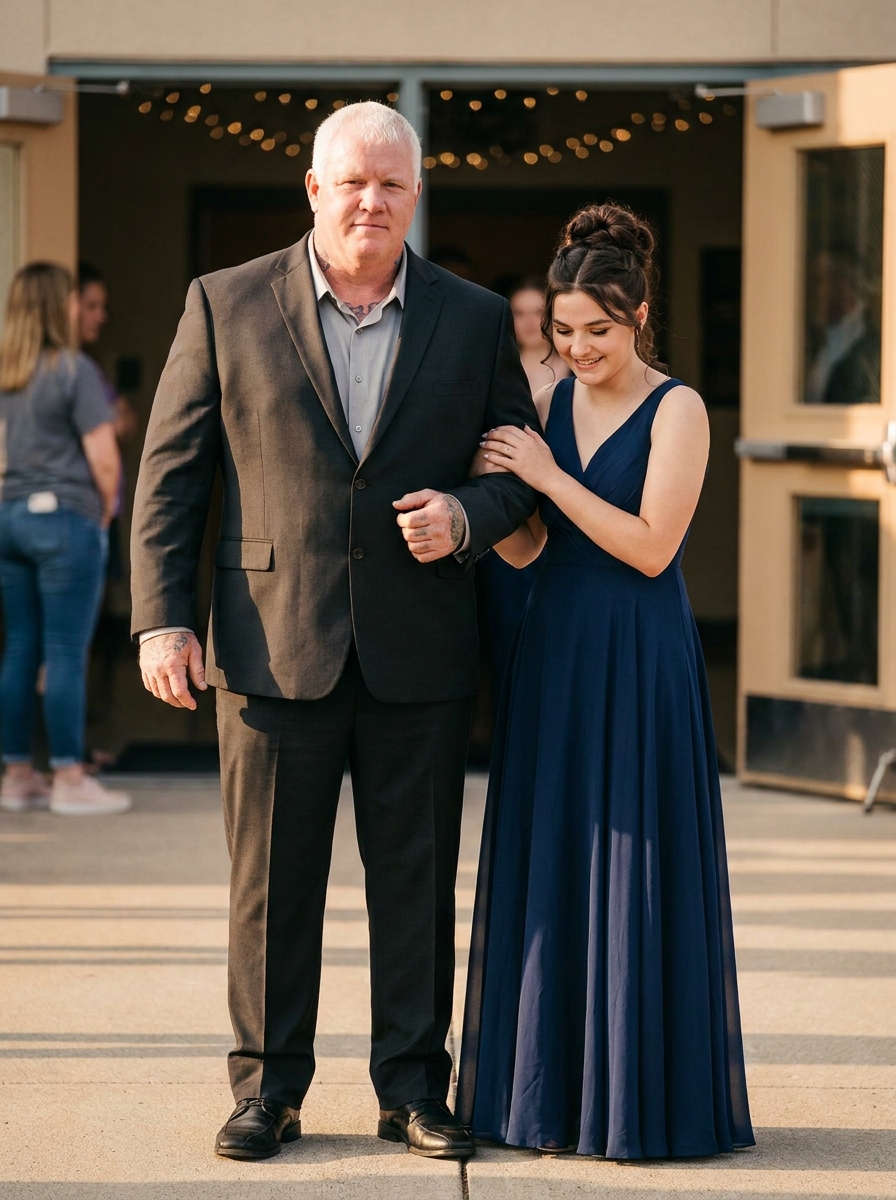
His name is Mike Dolan, but for thirty years almost nobody’s called him anything but Prez. He’s the president of the Warlocks, a motorcycle club in a working-class stretch outside Cleveland, Ohio. Fifty-eight years old. He’s been riding since he was eighteen and running that club for most of his adult life. He is, by every external measure, exactly the man the world has trained you to be afraid of.
I got this story from the foster home’s case worker, from a parent who chaperoned that night, and from Mike himself — who is not a man who talks about his feelings, and who agreed to let this be told only because, he said, “if it gets one of these kids a dad for a night, it’s worth me lookin’ soft.”
The girl’s name is Destiny. She’s sixteen. And to understand the night, you have to understand how she came into the orbit of a biker club in the first place.
The Warlocks aren’t the kind of club that makes the bad news. Mike’s spent twenty years steering them toward the other thing — the toy runs, the funeral escorts for veterans, the fundraiser rides for kids in the hospital. Two years ago, the club adopted a local foster home as one of their causes. They’d show up at holidays. Fix things around the property. Take the kids on supervised little outings — a barbecue, a day at a park, the kind of thing a lot of those kids had never had.
That’s how they met Destiny. She’d landed in the system young and bounced through it the way too many of them do — placement after placement, never quite belonging anywhere, learning early not to get attached because nothing lasts. By the time the Warlocks came into the picture, she was fourteen, guarded, and convinced down to her bones that she was the kind of kid nobody keeps.

Mike took to her. He won’t fully explain why — these things don’t always explain — but he did. Maybe because Destiny, under all that armor, had the same thing Mike had under his: a kid who’d decided long ago that needing people just gets you hurt, so you stop letting yourself need them. He recognized her. She recognized him. They didn’t talk about it. They just became, over two years, something like family. She started calling him Uncle Mike. He started showing up to things — her school stuff, the small milestones nobody else came to. He never missed one.
In two years, she never once saw his face without the beard. He was just Uncle Mike: the big scary one with the grey beard and the leather who, it turned out, would drive across the city in the rain to watch a foster kid get a certificate at a school assembly.
Prom came up the way it does. The other girls at school talking about dresses for months. Dates, limos, the whole machine of it. And Destiny, the case worker said, had gone quiet about the whole subject in the particular way she went quiet about things she wanted and had decided she couldn’t have.
Because she couldn’t. There was no money for a gown — foster kids don’t have a few hundred dollars for a dress they’ll wear once. There was no date she trusted. And most of all, there was the thing nobody says out loud about prom for a kid like her: all the other girls had a dad to take pictures, to see them off, to make a fuss. To do the whole ritual of it. Destiny had no one. The plan, as far as anyone knew, was that she just wasn’t going to go, and she was going to pretend she didn’t care, the way she’d pretended about everything she couldn’t have her whole life.
The Warlocks found out. I’m not sure exactly how — a case worker mentioned it, or Mike asked, or it just came up. But once they knew, the club did what that club does. They took up a collection. Hard men emptying their pockets at a club meeting so a foster kid could have a gown. They raised more than enough — for the dress, the shoes, the hair appointment, all of it.
But money was the easy part. The collection solved the dress.
It didn’t solve the bigger question, the one that hung over the room once the hat had been passed: who was going to take her? Who was going to do the dad part? Who was going to show up at the door with the corsage and walk her in and be the person in the photos, the person seeing her off, the someone that every other kid there would have and Destiny wouldn’t?
The room got quiet. And then the fifty-eight-year-old president of the Warlocks said, “I’ll do it.”
I want you to understand what that cost him, because the dress collection gets the attention but this is the real thing.
Mike Dolan had been clean-shaven last sometime in the 1980s. The beard wasn’t grooming; it was identity. It was thirty years of who he was. He shaved it off for Destiny. Sat in a barber’s chair — the first time in three decades — and had his hair cut neat and his face shaved smooth, and the brothers who saw him after said they barely knew him, that he looked like a different man, a softer and older and somehow more naked man without the grey beard he’d hidden behind his whole adult life.
He bought a suit. He’d never owned one. A man who’d worn the same leather cut for thirty years stood in a department store letting a kid with a tape measure tell him his shoulders were too big for everything off the rack. He got it tailored. He bought dress shoes that pinched.
And he did not ride his Harley. This is the detail that gets the bikers in the comments, because they understand what it means. Mike Dolan does not own a car. He rides. He’s ridden for forty years. But you do not take a young lady to her prom on the back of a motorcycle in a floor-length gown, so Mike borrowed a car from a brother — sat behind a steering wheel he wasn’t used to — because the night was about her, and what she needed was a dad with a car and a corsage, not a club president on a bike.
He gave up the beard, the leather, the bike, and thirty years of armor. For one night. For a kid the world had thrown away. Without being asked twice.
So now you know who knocked on that door, and why Destiny didn’t recognize the clean-shaven giant in the stiff suit holding a corsage.
When he said “It’s me, sweetheart, it’s Uncle Mike, I shaved,” and her face broke open — the case worker said it was one of the best things she’s seen in fifteen years of this work. Destiny laughed and cried at the same time. She’d never seen his face. She kept touching her own cheek and pointing at his, in disbelief, this man she’d known two years suddenly revealed.
He’d brought the corsage. He fumbled it onto her wrist with those huge hands, terrified of crushing it, and she helped him, and they both laughed at how badly he was doing it.
Then he walked her out to the borrowed car, and he opened the passenger door for her — held it, the way you do for someone who matters — and she gathered up her navy gown and got in like a queen, and the case worker took a photo of the two of them by the car that I’m told Destiny now has framed: a beaming sixteen-year-old in her first formal dress, and a clean-shaven mountain of a man in a borrowed suit, looking prouder than any father in the history of fathers.
He drove her to the school. Parked the unfamiliar car. Came around and opened her door again. And when she stepped out into the evening in her long gown with her hair up, he offered her his arm — this old outlaw, formal as a gentleman from another century — and she took it. And the two of them walked across the school lawn and through the doors of that gym together, arm in arm, the foster girl and the biker club president, into a sea of teenagers and chaperones who all turned to look.
And here’s where the night turned into the thing nobody saw coming.
The plan, as far as Mike understood it, was simple. Drop her off. Be the dad at the door. Take the photos. Hand her off to her night. Go home, or go sit in the car, or go wait somewhere out of the way until it was time to pick her up. He’d done the hard part. He’d gotten her there with dignity. That was the gift.
But just inside the doors, in the noise and the lights and the crowd of strangers, Destiny stopped. And the case worker, who was there as one of the supervising adults, saw it happen. The girl turned around and looked up at Mike, and all the bravado she wore like a second skin just fell away, and underneath it was a kid who had walked into a room full of people who all had somewhere to belong and didn’t have that herself.
“Uncle Mike,” she said. “Can you stay? I don’t — I don’t really know anybody here.”
A foster kid who’d changed schools and homes too many times to count. Who’d never had the years it takes to build the friendships these other kids had. She’d been dropped into prom with a beautiful dress and no tribe, and the only person in the entire building who was hers was the giant in the borrowed suit.
Mike Dolan, fifty-eight years old, president of the Warlocks, looked down at her and said, “Course I can, sweetheart. I’m not going anywhere.”
And he meant it more than she knew.
So he stayed.
He went and found the parent volunteers’ table along the wall — the chaperone table, fifty suburban moms and dads — and he lowered his enormous frame into a folding chair among them, this clean-shaven biker in a too-tight suit, and he settled in. The parents eyed him. He didn’t try to make conversation; he wouldn’t have known how. He just sat there, at the edge of a high school prom, and he watched Destiny.
She found her footing fast, the way kids do once they’re not alone. Some girls from her grade pulled her into a group. She danced. She laughed. And every so often — the chaperone parent noticed this and it’s what eventually undid her — Destiny would look back across the gym to the parent table, to make sure he was still there.
And every time she looked, he was. Watching. He’d give her a small nod. She’d grin and turn back to her friends.
He sat there for four hours. He drank soda after soda. He didn’t dance, didn’t mingle, didn’t check his phone, didn’t leave. Twice he got up, refilled her water cup, and carried it across the gym to her at the edge of the dance floor, the most attentive father in the building, then went back to his post. Other than that, he just sat among strangers and watched a foster kid have the night of her life, with an expression the chaperone described as pure, astonished joy.
She said by hour three she couldn’t stop watching him watch her. There was something in it she couldn’t name. The man looked like he’d won something. Like he couldn’t believe his luck.
She didn’t understand it yet. She would.
When the night wound down and the lights came up, Destiny came back to the table, flushed and happy and exhausted in the way you only are after the best kind of night. She flopped into the chair next to Mike, and the chaperone was close enough to hear what she said.
“Uncle Mike,” she said. “This was the best night of my life.”
And Mike — this hard old man who’d given up his beard and his bike and his armor and four hours of silence among strangers — looked at her and said, simple and quiet:
“This was the best night of mine, too, kid.”
And here is the part that’s broken the internet, and broke the chaperone in the parking lot, and is the whole reason Mike let this story be told.
He wasn’t being kind. He wasn’t saying it to make her feel good. He meant it, completely, literally. Because in fifty-eight years of life — fifty-eight years of being the president, the protector, the enforcer, the man people called when they needed somebody big and scary to stand beside them — no one had ever, not once, asked Mike Dolan to come with them. To something good. To something happy. People had needed him to guard them, to intimidate for them, to show up when there was trouble. Nobody had ever needed him simply to be there. To sit at a table and witness their joy. To be present, not as muscle, but as family.
Destiny was the first person in nearly six decades who needed Mike Dolan beside her for no reason except that she didn’t want to be alone in a happy room. Not to fight. Not to protect. Not to threaten. Just to be there. Just to belong to her.
So when he said it was the best night of his life, he was telling the plain truth. A sixteen-year-old foster kid had given a fifty-eight-year-old outlaw the one thing no one had ever given him: a seat at the table of someone’s happiness. Somewhere to simply, gladly, belong.
I want to be careful about what this story is.
It isn’t a story about a scary man with a soft side, like that’s the surprise. And it isn’t really about a dress, or a borrowed car, or even a prom.
It’s about two people who’d both decided, long ago and for the same reasons, that they were the kind nobody keeps. A foster kid who’d been left too many times to risk needing anyone. An old biker who’d been useful to everyone and wanted by no one. Two people armored against the same wound, who found in each other the thing they’d both stopped believing existed: someone who would simply show up, and stay, and be glad to.
Destiny needed a dad for a night. What she didn’t know was that Mike needed, just as badly, to be needed that way. They saved each other a little, in that gym, and neither of them fully understood it until he said seven true words at a parent table.
That was a while ago now.
Destiny’s still with the Warlocks’ orbit — more than orbit now. Mike and the club have stayed in her life the way they stay in things, which is to say permanently and without making a speech about it. He didn’t grow the beard back right away; Destiny said she liked seeing his face, so he kept it short for a good while, which the brothers gave him endless grief about and which he endured without complaint.
She’s got the framed photo from prom on her wall — the beaming girl, the clean-shaven giant, the borrowed car. She tells people, when they ask, that the big scary biker in the picture is her uncle, and she watches their faces when she says it, and she loves it.
Mike doesn’t talk about that night much. But the case worker said he keeps something in the inside pocket of his cut now — the leather one, back in rotation, beard regrown eventually. It’s a photo from the prom, a candid one a chaperone took without him knowing: Mike at the parent table, alone among strangers, watching Destiny dance across the gym, with the most unguarded, astonished, happy look on his face. A man who waited fifty-eight years to find out what it feels like to be asked to come along.
He carries it over his heart. He won’t admit it’s there. The brothers know.
And these days, when the Warlocks roll up to that foster home for the holidays and the barbecues, the kids come running, and Mike gets down to their level the way he learned to, and the toughest man any of them will ever meet asks each one of them about their lives like the answers are the most important thing in the world. Because he found out, late and by accident, what he’s actually for.
Not to protect. Not to threaten. Not to guard.
Just to show up. And stay. And be glad he was asked.
The Harley still rumbles up that gravel drive. The kids still run to meet it. And the man who spent fifty-eight years being feared finally knows what it’s like to be wanted in the room — and he will, for the rest of his life, say yes to every kid who asks him to come along.
Best night of his life. He wasn’t lying.
A biker who spent fifty-eight years being needed only as muscle gave up his beard, his bike, and his armor to take a foster girl to prom — and discovered that being asked to simply be there was the gift he’d waited his whole life for. Somebody out there just needs you to show up and stay. Go.
Follow the page for more stories from the road and the people who ride it. Not to protect. Just to be there. 🖤