Part 2: The Fight From The Chair
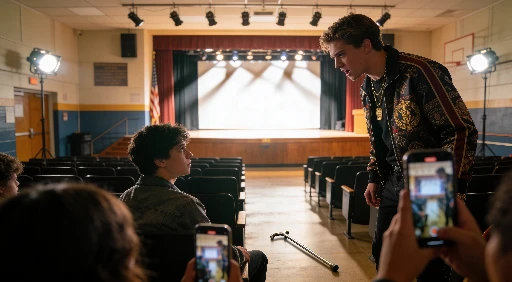
The Rich Bully Kicked His Cane Across The Stage—Then Threw A Punch, And The Disabled Teen Answered With A Seated Jiu-Jitsu Arm Lock.
The auditorium lights were blinding, the phones were already recording, and my medical cane was skittering across the polished wood stage. Julian stood over my chair with a cruel, untouchable smirk, his expensive designer jacket rustling as he raised a fist to finish the joke. The drama teacher turned her back, the crowd held its breath for the punch, and I kept my posture still for a reason nobody in that room understood.
My left leg has been mostly useless since the accident, making me the easiest target at Oakridge Prep. For months, Julian and his wealthy lacrosse friends treated my scholarship status and my limp like a daily comedy show. Today was the dress rehearsal for the spring play, and Julian decided my presence on the stage crew was an eyesore. He intentionally tripped me, watched me collapse into a prop chair, and then kicked my cane clear across the stage.
“Stand up and get it, charity case,” Julian sneered, stepping directly into my personal space. “Or are you going to cry to the dean again?”
The auditorium rows erupted into harsh, mocking laughter. Dozens of screens flashed in the dim seating area, capturing my helplessness from every angle. Mrs. Gable, the theater director, suddenly found something incredibly interesting to look at on her clipboard at the back of the room. She always did that—ignoring the subtle shoves and the cruel nicknames because Julian’s father practically funded the entire fine arts department.
I didn’t move. My hands stayed flat on the armrests of the heavy wooden chair. I could feel the intense heat of the stage lights burning into the back of my neck, and the suffocating weight of a hundred classmates waiting to watch me break. Julian took my silence as total submission, his chest puffing out as he leaned in closer.
He didn’t know about the mats in the small garage down by the docks. He didn’t know about the endless, grueling hours I spent learning how to leverage my upper body strength from a seated position. He thought a kid who couldn’t walk right couldn’t fight back.
Julian pulled his right hand back, his fingers curling into a tight fist. “I said, look at me when I’m speaking to you.”
The fist came flying toward my jaw with absolute certainty.
— CHAPTER 2 —
The path that led me to that stage didn’t start with Julian’s boot kicking my cane across the floor. It started exactly six months earlier, on a rainy Tuesday morning in late October, when the acceptance letter from Oakridge Prep finally arrived at our cramped, two-bedroom apartment. My mother had wept over the kitchen table, her hands shaking as she touched the gold-embossed seal at the top of the parchment. For a woman who worked two jobs—twelve hours a day at a local dry cleaner and four hours cleaning office buildings downtown—that letter wasn’t just a piece of paper. It was a golden ticket out of the neighborhood we had spent my entire childhood trying to survive. It was a full-ride academic scholarship to the most prestigious private academy in the state, a place where the tuition alone cost more than her entire annual income.
“You’re going to be someone, Leo,” she whispered that night, her tired eyes shining with a mixture of pride and profound relief. “You’re going to sit in those beautiful classrooms, and you’re going to look at the world from the top. You just have to keep your head down, do your work, and don’t let anything distract you.”
I promised her I would. I promised her because I knew the physical toll she took every single day just to keep food on our table. But neither of us understood the invisible geography of Oakridge Prep. We didn’t understand that a full-ride scholarship didn’t make you an equal; it made you a target. It marked you as an outsider before you even set foot inside the building.
My first day at the academy was a lesson in silent alienation. While the parking lot was choked with brand-new European sports cars, luxury SUVs, and private town cars dropping off students in tailored blazers, I arrived on the city bus, walking the last three blocks through the iron gates with a noticeable, heavy limp. My left leg was a map of surgical scars, the permanent reminder of an oncoming vehicle that had jumped the curb when I was six years old. The doctors had managed to save the leg, but the muscle tissue never fully recovered, leaving me dependent on a lightweight aluminum cane to keep my balance over long distances.
I was wearing a plain, unbranded black hoodie from a department store clearance rack, a pair of faded jeans that had already been washed a hundred times, and worn-out sneakers. Within ten minutes of walking through the grand stone archway of the main building, I felt the weight of a thousand eyes adjusting to my presence. It wasn’t an aggressive stare at first. It was a cold, clinical assessment. They looked at my clothes, they looked at my cane, and they immediately calculated my net worth.
Julian Vance was the first one to vocalize what everyone else was thinking.
He was a junior, a year older than me, but he possessed the kind of casual, supreme confidence that only comes from generational wealth and absolute social security. His father was a billionaire real estate developer whose name was carved into the marble plaque of the school’s new athletic pavilion. Julian was tall, broad-shouldered, and effortlessly handsome, with perfectly styled blonde hair and a smile that seemed designed for political campaigns. He was the golden boy of the academy, protected by a tight inner circle of varsity lacrosse players and wealthy legacy students who hung on his every word.
The initial encounter happened in the grand cafeteria during lunch on my third day. The room was a sea of round tables, bustling with the noise of privileged teenagers discussing weekend trips to the Hamptons and upcoming ski vacations. I was carrying my plastic tray, carefully balancing it with my right hand while my left hand relied heavily on my cane to navigate the crowded aisles between tables. I was looking for any empty seat, any quiet corner where I could eat my sandwich without bothering anyone.
As I passed Julian’s table, he casually extended his leg.
It wasn’t a sudden, violent movement. It was slow, deliberate, and perfectly timed. The toe of his expensive leather loafer caught the tip of my cane. The sudden resistance sent a jolt of panic through my nervous system. My weak left leg buckled instantly under my weight. The plastic tray flew from my hand, sending a plate of pasta and a carton of milk crashing onto the pristine tile floor.
I hit the ground hard, my right knee absorbing the brunt of the impact, while my cane clattered loudly against the metal base of a nearby table. The entire cafeteria went dead silent for a fraction of a second, the sudden clatter of breaking dishes drawing every eye in the room toward the center aisle.
Then, the laughter started.
It began at Julian’s table—a sharp, collective bark of amusement from his lacrosse friends. Within seconds, the ripples of laughter spread through the room like a contagion. Dozens of students looked over, smiling, whispering, and nudging their friends to look at the scholarship kid sprawled on the floor surrounded by spilled food.
“Watch the step, charity case,” Julian said, his voice carrying clearly over the rising noise of the room. He didn’t even look down at me as he spoke; he simply went back to cutting his steak, his face completely calm, as if he had just corrected a minor inconvenience. “Some of us are trying to eat here. Try not to ruin the floors.”
I sat there on the cold tiles, my face burning with a deep, suffocating heat that seemed to radiate from the very center of my chest. The shame was a physical weight, pressing down on my shoulders until I could barely breathe. I could see the reflection of the overhead lights in the puddle of milk next to my hand. I reached out, my fingers trembling slightly as I picked up my cane, using it to slowly, painfully lever myself back into a standing position.
None of the students moved to help me. A few girls at a nearby table turned their heads away, looking uncomfortable but refusing to meet my eyes. A group of boys further down the row immediately pulled out their phones, their screens glowing as they captured my clumsy attempts to stand up. I could see the green recording dots blinking on their cameras.
Mr. Harrison, the assistant dean of students, walked into the cafeteria a moment later, his sharp eyes scanning the scene. He saw the spilled food, he saw me holding my cane, and he saw Julian sitting calmly at his table.
“What happened here?” Mr. Harrison asked, his voice laced with annoyance as he walked over to the mess.
“He just slipped, sir,” Julian replied instantly, offering the assistant dean a flawless, respectful smile that seemed entirely genuine. “The floors are a little slick from the rain outside. We were actually just about to get some napkins to help him clean it up.”
Mr. Harrison looked at Julian, then looked at me. He knew exactly who Julian’s father was. He knew about the massive donation that had just paid for the school’s new library. He let out a short, tired sigh and shook his head.
“Let’s keep the drama to a minimum, please,” Mr. Harrison said to me, his tone dry and dismissive. “Leo, go see the janitor and get some paper towels. Boys will be boys, but we don’t need these kinds of disruptions during lunch hour. Both sides need to be more careful.”
Both sides. The words felt like a slap across my face. I hadn’t done anything except walk across a room, yet the administration was already splitting the blame down the middle to avoid crossing the most powerful family in the school.
That afternoon, the first video appeared on the school’s anonymous student forum. It was a five-second clip of my leg buckling, edited with a slow-motion effect and set to a ridiculous, circus-style soundtrack. The caption underneath read: The Scholarship Stumble. Someone get this kid some training wheels.
By the time I reached my locker before the final period, the post already had over two hundred likes and dozens of comments from accounts I didn’t recognize. I stood in front of my locker, my hands shaking so badly I could barely turn the dial on the combination lock. The digital world had taken my public humiliation and locked it into a permanent loop, ensuring that every time I walked down the hallways, the people around me weren’t seeing Leo the student—they were seeing the boy from the video.
Over the next three months, the isolation became absolute. Julian and his group created a systematic, daily routine designed to remind me exactly where I stood on the Oakridge hierarchy. They didn’t need to use constant physical violence; they used the terrifying power of social exclusion and psychological pressure.
Every morning when I walked into homeroom, someone would have placed a small plastic toy cane on my desk. If I sat down in the library to study, Julian’s friends would occupy the tables surrounding me, whispering loudly about “welfare checks” and “ghetto standards” until the environment became too hostile to endure. They started a rumor in the junior group chat that my mother was a maid who stole clothes from the houses she cleaned, a lie that spread through the student body within forty-eight hours.
The most painful part wasn’t the bullying itself; it was the total silence of the bystanders. There was a boy in my chemistry class named Ethan, a quiet kid who often looked at me with a strange expression of sympathy. Once, when Julian was making fun of my shoes outside the laboratory, Ethan had taken a step forward as if he wanted to speak up. But Julian had simply turned his cold, calculating gaze toward him, and Ethan had instantly frozen, his face turning pale as he dropped his eyes to the floor and walked away. The fear of becoming the next target was a powerful sedative that kept the entire school compliant.
I kept all of it from my mother. Every single day, I would come home, look at her exhausted face as she collapsed onto our old sofa after a sixteen-hour shift, and force myself to smile. I would tell her that classes were wonderful, that the teachers were brilliant, and that I was making friends with the other scholarship kids. I lied to protect her, because I knew that if she found out what was happening, the guilt would crush her. She would think her dream for my future was destroying my present.
But every night, after she went to sleep, I would sit in the darkness of my room, staring at the ceiling, listening to the distant sound of sirens outside our window. My hands would clench into tight fists beneath the blankets, the sheer weight of the unearned hatred I faced every day threating to tear me apart from the inside out. I felt like an animal trapped in a very expensive, very beautiful cage, surrounded by predators who knew that no one was coming to open the gate.
They mistook my silence for absolute weakness. They thought that because I never yelled back, never argued, and never complained to the office after that first day, I was completely broken. They didn’t understand that my silence wasn’t a sign of surrender. It was the only thing keeping me anchored to the earth. It was the absolute restraint that had been hammered into my soul since I was seven years old, a discipline that was about to be tested in a way that none of us could have ever anticipated.
— CHAPTER 3 —
The heavy stench of damp canvas and wintergreen liniment always hung in the air of Master Miller’s garage. It wasn’t a modern, brightly lit martial arts academy with glossy mats, air conditioning, and parents sipping lattes in a glass-walled waiting room. It was a detached, double-wide concrete garage behind a small, weathered house near the industrial train tracks on the edge of the city. The roof leaked slightly when it rained, the concrete floor was covered in mismatched, taped-up wrestling mats that had turned a dull shade of grey, and the only heat came from a rusted iron woodstove that popped and hissed in the corner.
This was where I spent every Tuesday, Thursday, and Saturday evening since I was seven years old. While other kids from the neighborhood were playing video games, wandering the mall, or joining little league teams, I was on those taped mats, learning how to breathe through pain and how to keep my balance when the world was trying to tear me down.
Master Miller was a retired Marine Corps Master Sergeant and a veteran combatives instructor who had spent over twenty-five years teaching close-quarters survival to young men heading into the most dangerous places on earth. He was a broad, compact man in his late sixties, with short-cropped grey hair, skin that looked like worn leather, and a deep, gravelly voice that didn’t need to shout to command absolute obedience. He had a severe limp of his own, the result of a mortar fragment in his hip from a conflict long before I was born, but his movement on the mats was still as precise and unstoppable as a hydraulic press.
My mother had brought me to him after my third leg surgery, when the local public school kids had started pushing me off the sidewalk for amusement. She couldn’t afford the fees at the franchise karate schools in the strip malls, but someone at the dry cleaners had told her about the old veteran who helped neighborhood kids for free, provided they were willing to work.
I still remember that first evening. I was seven years old, clutching my small aluminum cane, terrified of the stern-looking man who stood with his arms crossed over a faded green sweatshirt.
“You think that cane makes you weak, son?” Master Miller had asked, his sharp blue eyes looking directly into mine, not with pity, but with a cold, analytical focus.
“The kids at school say it does,” I whispered, looking at the floor.
“Look me in the eye when I speak to you,” he commanded softly, waiting until I raised my chin. “A cane is just a tool. Your body is the weapon. If you rely on the tool to keep you upright, you’ll fall the moment someone kicks it away. We’re going to build a foundation inside your spine so that it doesn’t matter what they take from your hands. But you need to understand something right now, before you put a single foot on my mat.”
He walked over to the rusted woodstove, his own bad hip causing a heavy, rhythmic thump on the concrete. “I do not train fighters. I do not train boys who want to go out and prove how tough they are because someone called them a name. The techniques I’m going to teach you were designed to end a threat quickly and permanently. They are dangerous. Because of that, the discipline must be absolute. The first, most important rule in this room—the one you will carry into the street, into your school, and into your life—is this: you never strike first.”
He leaned down, his face inches from mine, his voice dropping to a low, intense rumble. “You leave if you can walk away. You keep your hands open, and you offer peace first. You don’t swing out of anger, you don’t swing out of pride, and you don’t swing because your feelings are hurt. Silence is not weakness, Leo. It is the ultimate form of restraint. You only move when there is no safe way out, when the threat is immediate, and when your life or your safety is backed completely into a corner. And the exact millisecond the danger is controlled, you stop. Do you understand me?”
“Yes, sir,” I nodded.
For the next eight years, that philosophy was hammered into my muscle memory alongside the physical movements. Training didn’t begin with spectacular high kicks or aggressive punches. It began with balance. Because my left leg lacked the explosive power of a normal limb, Master Miller focused entirely on leverage, center of gravity, and ground control.
“If a man wants to throw a punch at you, he has to shift his weight,” Master Miller would remind me during our grueling private sessions. “He has to commit his balance to that attack. A big, strong boy who thinks he’s untouchable will always throw his weight forward because he expects you to run or cower. He doesn’t expect you to absorb the space. He doesn’t expect you to use his own momentum against him.”
We spent thousands of hours working on seated and low-line self-defense. Master Miller would purposely force me into a chair, or trip me onto the mats, and then attack me from above, teaching me how to protect my head with a tight, structural guard while utilizing wrist locks, elbow manipulation, and joint levers to immobilize an opponent without ever having to stand up. He taught me the fundamentals of catching a swinging limb, sliding off the line of force, and locking a larger attacker’s arm in a position where their own weight would break the bone if they continued to struggle.
“The human skeletal system has flaws, Leo,” he would say, casually demonstrating a seated arm lock that left me completely pinned to the mat with only a tiny fraction of his strength. “It doesn’t matter how much money a boy’s father has, or how many weights he lifts in the varsity gym. An elbow joint only bends one way. If you control the wrist and isolate the shoulder, his size becomes his own trap. But remember: control the danger. Stop the moment he is no longer a threat. If you use this to punish him, you’ve broken your discipline, and you’ve failed me.”
That discipline was the only reason I had survived the last three months at Oakridge Prep without cracking. Every time Julian Vance called me a cripple in front of the varsity team, every time his friends posted a humiliating video to the student forum, and every time the administrators turned their heads to look at the ceiling, I would hear Master Sergeant Miller’s gravelly voice echoing in my ears: For months, they mistook my restraint for fear.
I wasn’t avoiding the fight because I was terrified of Julian’s fists. I was avoiding the fight because I knew exactly what would happen if I let go of my restraint. I knew that the moment I engaged, the fragile, pristine illusion of Oakridge Prep would be shattered, and the academic future my mother was destroying her body to secure would be thrown into jeopardy. My silence was a shield, a calculated choice to protect my mother’s dream rather than my own pride.
But sitting there on that prop chair under the burning glare of the auditorium lights, watching Julian’s fist driving toward my face with the full weight of his arrogance behind it, I realized that the safe exits had officially vanished. There was no hallway to walk down, no teacher willing to step between us, and no corner left to retreat into. Julian had taken my cane, he had blocked my space, and he had initiated a physical assault in front of a hundred witnesses.
The time for walking away had ended. The danger was immediate, and the corner was absolute. As his knuckles cleared the final few inches of air between us, the years of quiet discipline in the damp garage didn’t turn into rage—they turned into absolute, ice-cold clarity.
The crowd was still cheering for my destruction, their voices a chaotic roar in the background, entirely unaware that the quiet scholarship boy they had spent months laughing at was no longer there.
Julian’s fist was a split second from impact, his face twisted in a confident sneer of victory, completely oblivious to the fact that his momentum was already carrying him into a trap he couldn’t possibly understand.
— CHAPTER 4 —
The digital echo of a reputation being shredded is something you can actually hear if you listen closely enough in the hallways of Oakridge Prep. It isn’t a loud noise; it’s a constant, rhythmic tapping of thumbs on glass screens, the brief muffled giggles behind open locker doors, and the sudden, freezing silence that drops over a cluster of students the exact millisecond you walk past them. By the second week of January, that silence had become my shadow. The video of the cafeteria incident had been shared, copied, and archived into the permanent memory of the student body, but Julian Vance wasn’t satisfied with a single viral moment. A boy like Julian, who had spent his entire life watching his father buy compliance and command rooms, understood that real dominance required constant, repetitive maintenance. He needed to ensure that my status as the school’s subhuman outsider remained completely absolute.
The environment inside the academy began to sour in a way that made every single day feel like walking through a minefield with a blindfold on. The bullying evolved from casual, random acts of cruelty into a highly structured, community-driven spectacle. Julian didn’t even have to initiate the harassment himself anymore; he had created an ecosystem where other students did the work for him just to earn a nod of approval from the lacrosse table. It became a twisted form of social currency at Oakridge Prep. If you could find a new, creative way to humiliate the scholarship kid and capture it on camera, you were granted a temporary pass into the outer rings of the popular crowd.
It started with the morning arrivals. The city bus always dropped me off at the corner of Elm and modern-day Lincoln Avenue, exactly three blocks from the school’s wrought-iron gates. In the past, those three blocks were my quiet transition zone, a place where I could brace myself for the day ahead. But as the winter freeze set in, Julian’s circle turned that walk into a spectator sport. A group of four or five juniors, usually led by his defensive line partner, a massive, thick-necked kid named Garrett, would park their luxury pickup trucks along the curb near the bus stop. The moment my worn-out sneakers hit the pavement, the car horns would start blaring in a synchronized, mocking rhythm.
They wouldn’t get out of their vehicles. They didn’t need to. They would simply roll down their heated, tinted windows, point their smartphones at my left leg, and yell comments into the freezing morning air.
“Hey Leo, forgot your training wheels today?” Garrett would bellow, his voice echoing off the brick faces of the brownstone houses. “Make sure you don’t scuff the sidewalk with that cheap metal stick. Our parents’ taxes pay for those stones!”
The surrounding students who were walking from the student parking lot would hear the shouting and immediately look over. They didn’t frown. They didn’t yell at Garrett to shut up. Instead, their hands would instinctively dive into their coats, pulling out their own phones to see what was happening. By the time I cleared the iron gates, there would be a dozen students walking ten feet behind me, their cameras tracking the heavy, uneven hitch of my hips, waiting for me to slip on a patch of black ice so they could upload it to the school’s anonymous media stream before the first bell rang.
The social pressure was immense, but the absolute lack of a safety net within the school administration was what made the trap feel truly inescapable. The teachers and staff at Oakridge Prep weren’t monsters; they were simply employees of a system that knew exactly who signed the paychecks. One morning, the harassment spilled directly into the hallway right outside the main guidance office. I was trying to navigate through a dense crowd of students between second and third period when Garrett intentionally jammed his heavy leather lacrosse gear bag between my feet. The strap tangled around the base of my cane, and I went down sideways, my shoulder slamming violently into the metal locker vents. My books scattered across the linoleum, pages tearing as fifty pairs of feet stepped over and around them.
Mrs. Albright, the head guidance counselor, stepped out of her office at the exact sound of the impact. She looked down at me on the floor, then looked up at Garrett, who was standing there with a look of theatrical innocence on his face.
“Oh, man, I’m so sorry, Mrs. Albright,” Garrett said smoothly, his voice dripping with practiced manners. “My bag slipped off my shoulder. The straps on these new team bags are way too long. It was a complete accident.”
Mrs. Albright looked at Garrett’s varsity jacket, then looked at my faded black hoodie. Her face didn’t soften with sympathy. It tightened with an expression of deep, administrative weariness. She leaned down, not to help me up, but to pick up one of my scattered binders so the hallway traffic wouldn’t be blocked.
“Let’s clear the hallway, please,” she said, her voice completely flat, addressing both of us but keeping her eyes locked on me. “Leo, you need to be more aware of your surroundings when you’re moving between periods. Carrying all these loose papers is a safety hazard. Garrett, go get to class before the late bell.”
“Yes, ma’am,” Garrett smiled, giving me a quick, triumphant look before turning the corner.
When I finally managed to stand up, my left knee throbbing with a dull, familiar ache, Mrs. Albright handed me the binder. She didn’t ask if I was hurt. She didn’t ask Garrett why his bag had landed three feet out into the walking lane. She just looked at me and said, “Don’t make this bigger than it is, Leo. High school is tough for everyone. You just need to focus on your studies and try to blend in a little better. Drama doesn’t help anyone on a scholarship.”
Blend in. The advice was a cruel joke. How was a boy with a permanent limp and an aluminum cane supposed to blend into a hallway where everyone was actively shining a spotlight on his deformity? The school didn’t want to solve the problem; they wanted to bury it. They wanted me to absorb the humiliation silently so that no waves would disturb the pristine surface of their donor lists.
The only person who seemed to see the reality of what was happening was Ethan, the quiet kid from my chemistry class. Ethan wasn’t poor, and he wasn’t an outsider; his father was a prominent corporate attorney in the city, but Ethan lacked the aggressive, predatory nature that defined Julian’s circle. He was a small, pale boy who spent most of his time looking down at his desk, trying to remain as invisible as possible.
The closest anyone came to helping me happened during a laboratory section in mid-February. We were supposed to be measuring chemical reactions in glass beakers, and Julian had spent the entire forty-five minutes deliberately bumping into our lab station, making loud whistling noises every time I reached for a glass rod, trying to make my hand shake. The teacher, Mr. Gable, was at his desk at the front of the room, completely buried in grading papers, his headphones firmly over his ears.
At one point, Julian leaned across the black stone table and whispered, “Hey Leo, does your mom know you’re a freak, or does she just try to pretend you died in that car crash too?”
The cruelty of the words was so sharp it felt like a physical blade entering my ribs. My father had passed away in the hospital three days after that accident, a fact that was buried deep in my confidential financial aid files. Julian had clearly used his family’s influence to get someone in the office to look at my records.
Next to me, I heard a sharp, sudden gasp. I looked over and saw Ethan. His knuckles were white where he was gripping the edge of the lab table. His face had gone completely bloodless, and his lips were trembling. He took a long, ragged breath and turned his head toward Julian, his voice cracking slightly as he spoke.
“Julian… come on, man,” Ethan whispered, his eyes wide with a terrifying mixture of fear and moral outrage. “That’s… you can’t say that. Just leave him alone for five minutes.”
The entire laboratory table went dead silent. Julian stopped leaning forward. He slowly stood up to his full height, his broad chest expanding beneath his fitted polo shirt. He didn’t look angry; he looked amused, like a scientist observing an interesting bug that had suddenly decided to make a sound. He turned his head slowly toward Ethan, his blue eyes narrowing into two slits of cold, absolute certainty.
“What did you just say to me, Ethan?” Julian asked, his voice dropping to a calm, conversational tone that was infinitely more terrifying than a shout.
Ethan flinched as if he had been struck. He looked around the room, looking for any sign of support from the other twenty students who were watching. But every single student at the surrounding tables immediately dropped their gaze. They looked at their lab manuals, they looked at their shoes, they looked at the ceiling—they vanished into themselves. They knew what happened to people who crossed Julian Vance.
Ethan’s chest heaved. He looked at me, his eyes filled with a desperate, silent apology, and then his courage completely failed him. His shoulders slumped, his chin dropped toward his collarbone, and he stepped back three inches, effectively removing himself from the space.
“Nothing,” Ethan muttered to the floor, his voice completely broken. “I didn’t say anything.”
“That’s what I thought,” Julian said, his smile returning like a predator resuming its territory. He reached out and casually knocked over Ethan’s plastic beaker of distilled water, watching the liquid pool across our lab notes. “Make sure you clean that up. We don’t want anyone slipping.”
Mr. Gable chose that exact moment to remove his headphones and look up from his desk. He saw the water on the table, he saw Ethan standing with his head down, and he saw me holding my cane.
“Is there a problem back there?” Mr. Gable called out, his tone thoroughly irritated. “If you boys can’t handle simple laboratory equipment without creating a mess, I’ll start deducting participation points from the entire row. Stop the drama and clear the table.”
“All good, Mr. Gable,” Julian called back cheerfully, his voice full of that effortless charm the adults loved. “Just a minor spill. We’ve got it under control.”
That night, when I walked into Master Miller’s garage, the temperature inside was below freezing. The woodstove hadn’t been lit yet, and the concrete walls felt like blocks of solid ice. I didn’t care. I dropped my backpack on the floor, took off my coat, and walked onto the grey mats without saying a single word. My teeth were chattering, but inside my chest, a dark, heavy heat was beginning to simmer. The discipline that had sustained me for months was starting to feel like a shroud. I didn’t want to walk away anymore. I didn’t want to bear the silence of the bystanders or the calculated blindness of the teachers. I wanted the world to stop pushing me.
Master Miller didn’t look up from where he was chopping kindling for the stove. He didn’t ask me how my day was. He didn’t look at the dark bruise that had formed on my right shoulder where I had hit the lockers that morning. He just swung his small hand-axe, splitting a piece of pine with a clean, explosive crack.
“You’re breathing like a man who’s carrying wet sand in his boots, Leo,” the old Marine said, his gravelly voice cutting through the cold stillness of the room. He tossed the wood into the stove and closed the iron door, the latch clicking shut with a heavy, definitive metallic ring. “Your shoulders are up around your ears. Your jaw is locked. You’ve brought the hallway into my garage.”
“They’re never going to stop, Master Miller,” I said, my voice shaking with a raw, unedited emotion that I hadn’t allowed myself to feel in weeks. “It doesn’t matter what I do. It doesn’t matter how quiet I am. They have everything. They have the money, they have the teachers, they have everyone too scared to look at them. I’m just a ghost to them. A ghost they get to kick whenever they’re bored.”
Master Miller walked over to the edge of the mat. He didn’t offer me a comforting hand. He didn’t tell me that things would get better or that high school was just a temporary phase. He stood there, his bad hip giving him that stern, offset posture, his arms crossed tightly over his chest.
“A ghost can’t be hurt, son,” he said softly. “You’re not a ghost. You’re a young man who’s letting his pride do the thinking for his spinal cord. You think those boys have power because they have a crowd behind them? You think that school protects them because their names are on the walls?”
He took a slow step onto the mat, his eyes locking onto mine with the intensity of an instructor who had seen hundreds of young men face real, life-or-death terror. “That crowd isn’t power, Leo. It’s a crutch. A boy who needs fifty people to watch him humiliate a disabled kid is the weakest thing on God’s green earth. He’s terrified of what happens when the lights go out and he’s left alone in a room with nothing but his own hollow chest. He relies on that crowd the same way you used to rely on that aluminum stick in your hand.”
He raised his hands, keeping his palms open and loose at chest level. “They are trying to force you to play their game. Their game is anger. Their game is reaction. The moment you swing out of hatred, the moment you let them see that they’ve broken your discipline, they’ve won. They don’t even need to hit you then; you’ve already given them your mind.”
He tapped his own temple with a thick, calloused index finger. “Your mind belongs to me and this mat. When you are in the world, your restraint is your fortress. You hold that ground until the space is completely gone. You don’t react to words, you don’t react to videos, you don’t react to their little plastic toys. You wait. You watch. You protect the line. And if the day ever comes where they force you across that line—where there is no hallway left, no door to open, and no adult to call—you don’t fight them with anger. You handle them with the truth of your balance. Now get into position.”
We worked for three straight hours that night. Master Miller didn’t spare me because I was tired or because my heart was heavy. He pushed me harder than he ever had in my life, launching himself at my chair from different angles, grabbing my wrists, trying to pull me off balance, forcing me to utilize every ounce of core strength and skeletal leverage I possessed to maintain my position. By the time the clock on the wall hit nine, my body was soaked in sweat and my muscles were trembling with exhaustion, but the dark, chaotic heat inside my chest had been replaced by something else. It had been distilled into a cold, dense weight. It was the weight of readiness.
The winter months began to blur into March, and the tension at Oakridge Prep reached a boiling point that everyone could feel but nobody dared to name. The student forum had become a toxic ledger of my daily movements, but I kept my chin up and my hands open. I walked those three blocks from the bus stop every single morning, the blaring horns and the mocking laughter washing over me like water over stone. I didn’t look at Garrett. I didn’t look at Julian. I held my fortress.
Then came the announcement for the spring play rehearsal.
The fine arts department had decided to perform an old American classic, and because I needed to maintain my extracurricular hours for my scholarship compliance, I had volunteered for the stage crew. It was quiet, physical work—moving heavy wooden backdrops, painting scenery, adjusting the overhead spots after hours when the theater was empty. It was the one place in the school where I felt somewhat safe, tucked away in the shadows behind the thick black velvet curtains while the popular kids memorized their lines on the stage.
But Julian Vance was the lead actor. Of course he was. A boy like that didn’t stay in the wings; he demanded the center stage, the applause, and the admiration of the front rows.
The dress rehearsal was scheduled for the final week of March, a Tuesday afternoon when the rain outside was coming down in thick, gray sheets that turned the academy grounds into a swamp. The auditorium was packed with over a hundred junior and senior students who had been let out of their final elective classes to watch the run-through. The atmosphere was loud, chaotic, and thick with the restless energy of teenagers waiting for the school day to end.
I was standing on the stage right wing, adjusting a heavy wooden prop chair that was supposed to be used in the second act. My cane was resting against my hip as I worked on the latch of the chair’s armrest.
From behind me, I heard the sound of expensive leather boots walking slowly across the polished stage floor. The footsteps were heavy, confident, and perfectly spaced. I didn’t need to turn around to know who it was. The air in my lungs instantly grew cold, but my hands remained completely steady as I finished tightening the screw on the prop.
“Hey, charity case,” Julian’s voice echoed out from the center of the stage, amplified slightly by the acoustics of the empty fly loft above us. “This backdrop looks crooked. Come out here and fix it.”
I looked out through the curtain gap. The backdrop he was pointing to was perfectly straight. It had been leveled by the stage manager an hour ago. Julian was standing in the very center of the stage, right under the brilliant, thousand-watt glare of the main spotlight. His lacrosse friends were sitting in the front row of the auditorium, their phones already raised, their screens glowing like tiny, expectant eyes in the darkness.
Mrs. Gable, the theater director, was standing seventy feet away at the back of the house, looking down at her production notes, her thumb flipping through pages with rapid, nervous movements. She saw Julian standing there. She saw me standing in the wings. She knew exactly what was about to happen, and she chose that exact second to step behind the light control console, completely removing herself from the scene.
I took a breath, gripped my cane, and walked out onto the stage. I didn’t walk fast, and I didn’t walk slow. I maintained the rhythmic, uneven pace that my body required. Every single eye in that auditorium tracked my movement as I crossed from the dark wings into the blinding, white circle of the spotlight.
The moment I reached the center of the stage, Julian didn’t look at the backdrop. He didn’t even pretend that this was about the play. He took a sudden, aggressive step forward, his shoulder slamming hard into my chest. The impact was unexpected, and because my left leg couldn’t adjust in time, my balance fractured instantly.
I went down backwards, my body crashing heavily into the wooden prop chair I had just been fixing. The chair slid back two feet against the stage floor, the legs screeching loudly against the wood before coming to a sudden halt. My aluminum cane flew from my left hand, skittering across the polished stage before coming to a stop ten feet away, right near the edge of the orchestra pit.
The auditorium erupted. A massive, unified wave of laughter and mocking cheers rolled over the stage from the dark rows of seats.
“The Scholarship Stumble, live on stage!” Garrett shouted from the front row, his phone held high as he zoomed in on my face. “An absolute masterpiece!”
I sat there in the low prop chair, my hands flat on the wooden armrests, my left leg extended uselessly in front of me. The heat of the spotlight was blinding, turning the rest of the room into a black void, except for the tiny, flickering lights of thirty recording devices. Julian stood over me, his broad shoulders blocking the light, a look of pure, untouchable malice written across his handsome features. He looked down at me like an emperor looking at a beggar, entirely confident that he was completely safe behind his father’s money and the school’s total compliance.
He raised his right foot and casually kicked my cane. He didn’t just move it; he kicked it hard, sending the lightweight metal stick spinning off the stage entirely, where it dropped into the deep, dark gap of the orchestra pit with a hollow, echoing clank.
“Oops,” Julian sneered, leaning down until his face was less than two feet from mine. The smell of his expensive cologne was sickeningly strong. “Looks like you lost your leg, cripple. What are you going to do now? Are you going to crawl down there and get it, or do I need to help you out of my chair?”
The crowd cheered louder. The phones were shaking with excitement. The space had completely disappeared. There was no hallway left to walk down, no teacher willing to look, and no exit available to a boy who couldn’t stand without his tool. My fortress had been breached, and my back was pressed firmly into the final corner.
Julian pulled his right hand back, his fingers locking into a heavy, rigid fist as he stepped into the space between my knees, preparing to finish the spectacle with a blow that would cement his legacy forever.
The time for waiting had officially reached its timestamp. My hands remained flat on the wooden armrests of the chair, my fingers perfectly loose, my eyes tracking the slight shift of his weight as his shoulder pivoted forward. Master Sergeant Miller’s final words echoed through the absolute center of my soul: Handle them with the truth of your balance.
Julian’s fist left his hip, driving directly toward my face with the full force of his unchecked arrogance behind it, entirely unaware that the chair he had trapped me in was about to become his own witness.
— CHAPTER 5 —
The blinding glare of the thousand-watt center stage spotlight was a solid, white wall that completely severed me from the rest of the auditorium. It felt like standing inside a burning furnace, the heat radiating off the overhead metal lamps and sinking deep into the fabric of my faded black department-store hoodie. Beyond that rim of white light lay a vast, echoing cavern of total darkness, a black void where over a hundred junior and senior students sat tucked away in their plush velvet seats. I couldn’t see their faces, but I could feel the intense, crushing weight of their collective attention pressing against the edges of the stage. I could hear the rhythmic tapping of their thumbs against glass screens, the low, wet snickers shared between friends, and the rustle of tailored school jackets as people leaned forward to get a better view of the upcoming execution.
I was sitting completely motionless in the low, wooden prop chair, my disabled left leg extended awkwardly across the polished oak floorboards. Ten feet away, right near the dark, yawning drop-of the orchestra pit, my lightweight aluminum cane lay flat on its side. Julian Vance had kicked it with the full force of his leather boot, and the hollow clack-clack-clack of the metal tube spinning across the stage was still echoing through the high, dark rafters of the fly loft above us. Without that piece of metal, I was entirely anchored to the chair. My structural foundation was gone, my physical mobility was zero, and the entire room knew it.
Julian stood directly over me, his massive, athletic frame completely blotting out the light from the stage right wings. He had stepped so deep into my personal space that his shadow swallowed my lap, the heavy, expensive scent of his designer cologne filling my nose until it felt difficult to take a clean breath. His hands were tucked casually into the pockets of his custom-fitted lacrosse warm-up jacket, his broad chest rising and falling with a slow, arrogant rhythm. He wasn’t breathing hard; he wasn’t angry. He had the calm, serene expression of a cat that had finally managed to trap a small, broken mouse behind a kitchen appliance.
“I asked you a question, charity case,” Julian said, his voice dropping to a low, conversational tone that carried perfectly through the acoustic design of the theater. He leaned down slightly, his bright blue eyes narrowing into two slits of pure, untouchable authority. “Are you going to crawl down into that pit to get your stick, or are you going to apologize to my friends for ruining the dress rehearsal?”
From the very front row, right below the lip of the wooden stage, a sharp voice cut through the darkness. It was Garrett, Julian’s thick-necked defensive line partner, his face illuminated by the bright blue glare of his iPhone screen as he held the camera steady at chest level.
“Make him crawl, Julian!” Garrett shouted, his deep bark of laughter triggering a fresh wave of giggles from the lacrosse players sitting in the rows behind him. “Get the whole thing on video! The scholarship kid needs to learn how to walk on his knees anyway!”
The crowd in the dark rows erupted into a coordinated chant, a low, rhythmic stomping of feet against the carpeted floor that vibrated through the wooden stage beneath my seat. Crawl! Crawl! Crawl! The sound was a physical pressure, a suffocating wall of noise designed to break whatever tiny scrap of dignity I had left after three months of systematic isolation. They wanted the video. They needed the permanent digital receipt of my absolute submission to ensure that the hierarchy of Oakridge Prep remained completely unchallenged.
Seventy feet away, behind the massive black iron housing of the main light control console at the back of the house, Mrs. Gable remained entirely invisible. She had completely stepped away from the glass viewing window, her shadow gone from the doorway, her silence a perfect, legal shield for the boy whose father had just purchased the theater’s new digital sound system. She didn’t see the cane on the floor; she didn’t hear the chanting; she didn’t see the billionaire’s son cornering a disabled teenager on her stage. If it wasn’t recorded by an adult, it simply didn’t exist in the administrative ledger.
I didn’t answer him. I kept my chin up, my back pressed firmly against the rigid wooden slats of the prop chair, and my eyes locked onto the bridge of Julian’s nose. My hands stayed flat and loose on the armrests, my fingers uncurled, my palms completely open.
To the hundred people watching in the dark, my absolute stillness looked like the paralysis of pure terror. They thought my brain had finally short-circuited under the weight of the public humiliation, that I was simply waiting for the blow to land because I had no other options left. They didn’t see the tight, structural alignment of my spine. They didn’t realize that my right foot was planted firmly at a ninety-degree angle against the floor, my heel dug deep into a small groove between the oak boards to create a solid, immovable anchor for my hips. They didn’t know that my breathing had shifted away from the rapid, shallow panic of a victim and into the slow, four-count metric of the concrete garage by the train tracks.
The space is gone, Leo, Master Sergeant Miller’s voice whispered through the back of my mind, cool and clean as mountain water. The hallway is gone. The door is closed. You are in the final corner. Stop looking for an exit that isn’t there and look at his weight.
Julian’s smile slowly faded, his upper lip curling into an expression of deep, aristocratic irritation. My refusal to blink, my refusal to beg or look down at the floor, was a sudden flaw in his perfect script. A boy like Julian didn’t tolerate variables. He didn’t tolerate a scholarship kid looking at him as if he were made of glass instead of gold.
“You really don’t know when to break, do you?” Julian muttered, his left hand snapping out of his jacket pocket.
He didn’t swing immediately. Instead, he reached down and grabbed the thick fabric of my department-store hoodie right at the collar, his knuckles burying hard into the skin beneath my jaw. He pulled upward with a sudden, violent jerk, trying to drag my weight off the seat, trying to force me to stand on my useless left leg so I would collapse forward onto his shoes. The fabric strained, the cheap stitching around my neck popping with a sharp, dry sound that carried clearly over the first few rows of seats.
“Stand up,” Julian ordered, his teeth clenched, his breath hot against my forehead. “Look at me when I’m breaking you, cripple. Stand up and say ‘I’m sorry, sir’ so we can finish this joke.”
The auditorium went dead silent. The chanting stopped instantly, replaced by a sharp, collective intake of breath from a hundred pairs of lungs. The phone screens in the dark remained frozen, their little green recording dots tracking the sudden escalation from verbal torment to direct physical assault. Nobody moved to stop it. In the third row, I caught a brief, fleeting glimpse of Ethan’s pale face, his hands gripped around his backpack straps, his eyes wide with horror, but his body remained completely paralyzed by the terrifying authority of the room.
I didn’t resist his upward pull. I let my torso slide forward two inches, absorbing the kinetic energy of his grip rather than fighting against it. My hands remained open, floating exactly three inches above the wooden armrests, my center of gravity perfectly balanced over my hips.
“This is your last chance, Leo,” Julian whispered, his right hand slowly withdrawing from his pocket, his fingers curling into a tight, heavy fist that caught the hard white light of the center spotlight. “Kneel down and get the stick, or I swear to God I’ll put you in a wheelchair for the rest of the year.”
He didn’t wait for an answer. He couldn’t. His own momentum, his own pride, and the silent pressure of the hundred people watching him through their phone screens had backed him into a corner of his own creation. He had to strike. He had to deliver the physical payoff that his entire audience was waiting for.
Julian shifted his entire center of mass onto his left foot, his hip pivoting backward as he pulled his right fist to his ribs. It was a classic, heavy backyard punch—powerful, aggressive, and completely undisciplined. He threw the entire weight of his athletic, lacrosse-trained torso behind the blow, his knuckles driving on a straight, violent trajectory toward the left side of my jaw.
The fist cleared the first six inches of air between us, a blur of white skin and gold legacy rings under the glare of the spotlight.
To the crowd in the dark, it was the final second of the story. To me, it was the exact timestamp Master Miller had spent eight years preparing me to meet. The restraint that had held me together through months of cafeteria slights and hallway shoves didn’t shatter—it simply converted into motion. I didn’t strike first. I didn’t swing out of anger. I simply opened the gate and let his own weight become his cage.
The fist came driving in, and the world on that stage suddenly became completely quiet.
— CHAPTER 6 —
The fist was moving along a clean, heavy trajectory under the blinding white glare of the spotlight. It didn’t look slow, and it didn’t look fast; it looked completely committed, backed by every single ounce of Julian Vance’s athletic weight and the absolute certainty that I would let it hit me. In the concrete garage near the train tracks, Master Sergeant Miller had spent thousands of hours teaching me how to see that specific moment of commitment. He had thrown thousands of heavy, unguided punches at my head from chairs, from the floor, and from corners, forcing my eyes to stay completely open while my body calculated the line of force.
“The moment a boy commits his balance to a punch, Leo, he gives you his alignment,” Master Miller’s voice would rumble through the cold evening air of the garage. “He isn’t a solid tower anymore. He’s a falling wall. If you try to run backwards, the wall lands on you. If you try to match his power with your own anger, the wall crushes you. You don’t fight the wall. You slip inside the structural gap he left open when he threw his shoulder forward.”
I didn’t swing back. I didn’t curl my fingers into a fist, and I didn’t let a single drop of rage enter my bloodstream. The discipline that had been hammered into my spine since I was seven years old took complete control of my muscles, translating the threat into a series of small, precise, structural adjustments.
As Julian’s knuckles cleared the final three inches of space before my jaw, I leaned my head slightly off the center line. It wasn’t a panicked jerk; it was a tight, controlled slip, just deep enough to let the wind of his punch brush against the fabric of my hoodie. The heavy fist sailed past my left ear, the gold legacy rings on his fingers catching a brief, metallic glint under the spotlight lamps as his forward momentum carried his chest directly over my lap.
Julian’s eyes widened in sudden, chaotic confusion. He had expected the heavy sound of a fist breaking skin, the satisfying snap of a scholarship kid’s head bouncing off the wooden backrest, and the immediate cheers of the crowd. Instead, his knuckles had struck nothing but empty air, and his own athletic power was now pulling him off-balance, his broad shoulders tilting forward into the empty space between my knees.
But he didn’t stop. A boy like Julian didn’t know how to stop. His entire life had been a series of uninterrupted successes, and the sudden failure of his first strike didn’t teach him caution; it drove him into a frantic, immediate panic. He let go of my collar with his left hand, his teeth bared in a wild, unedited snarl of frustration as he pulled his left arm back to deliver a short, vicious hook toward my ribs.
“Hold still, you freak!” Julian roared, his voice cracking slightly under the intense heat of the spotlight.
He launched the second punch, his weight shifting aggressively onto his front foot as he tried to trap me against the wooden frame of the prop chair. I raised my left guard, my forearm forming a rigid, defensive shield against my side. Julian’s left fist slammed heavily into the thick bone of my forearm, a dull, wet thud echoing across the open stage floorboards. The impact was immense, the sheer physical size of the varsity athlete sending a sharp jolt of pressure through my shoulder, but my right foot remained completely locked into the small groove between the oak planks, absorbing the force and grounding it directly into the stage structure.
Before he could pull his arm back for a third strike, I moved into the space he had abandoned.
I didn’t strike his face. I didn’t throw a punch at his ribs. My left hand shot upward from its defensive position, my palm sliding smoothly over the fabric of his sleeve until my fingers locked like a vice around his left wrist. At the exact same microsecond, my right hand reached behind his elbow joint, my thumb digging firmly into the nerve cluster just above the bone to isolate the shoulder rotation.
“What the—” Julian muttered, his arm freezing mid-motion as he realized he could no longer pull his arm back.
He tried to use his superior weight to crush me back into the seat, his large frame driving forward with a frantic, animalistic push. But I didn’t fight his weight. I let my torso sink backward into the chair, using his forward pressure to accelerate his own momentum. I slid my right foot deep between his ankles, my heel hooking the back of his right heel in a tight, mechanical trip, while my upper body executed a crisp, internal rotation.
Julian’s balance vanished completely. His massive, lacrosse-trained frame didn’t land on me; it rolled over the side of my right thigh like a heavy sack of grain. His feet left the floorboards, his expensive leather boots kicking uselessly at the air as his own weight dragged him sideways onto the hard, polished wood of the stage.
He hit the floor with a massive, booming thud that vibrated through the entire structure of the auditorium.
The sound was a total shock to the system of the room. It wasn’t the clean, theatrical fall of a stage combat routine; it was the heavy, ungraceful impact of a large body losing its relationship with gravity. Julian rolled onto his side, his face flushed red with a mixture of dust and panic, his left arm still firmly trapped inside the double-grip of my hands.
He scrambled to his knees, his broad shoulders heaving as he tried to wrench his wrist free from my fingers, his right fist swinging wildly back toward my knee in a desperate attempt to force me to let go.
“Let go of me! Let go of me, you charity piece of trash!” Julian screamed, his voice no longer possessing that calm, aristocratic charm. It was high, ragged, and terrified.
I didn’t let him swing again. From my seated position in the prop chair, I pivoted my hips forty-five degrees to the right, sliding my right leg over his shoulder line to pin his posture to the floor boards. I kept his left wrist pulled tightly against my chest, my elbows tucked deep into my ribs, while my hips levered upward against the back of his tricep.
It was the classic, seated jiu-jitsu arm lock that Master Miller had forced me to execute ten thousand times against his own massive limbs in the concrete garage. It wasn’t a move built on muscle power; it was an absolute law of physics. An elbow joint only bends one way. If you isolate the shoulder and apply leverage to the wrist, the largest athlete in the state becomes completely helpless.
Julian’s entire body went rigid the exact millisecond the lever engaged. His right fist froze three inches from my knee, his fingers uncurling as a sharp, sudden gasp of pure, agonizing shock tore out of his throat. His face went from a deep, angry red to a pale, bloodless white under the brilliant glare of the center spotlight.
“Stop! Stop! Stop!” Julian whimpered, his forehead pressing hard against the dust of the stage floor, his left hand tapping frantically against the woodboards in a rapid, desperate gesture of absolute surrender. “My shoulder… it’s going to pop! Stop, Leo, please!”
I held the position. I didn’t pull the lever any further. I didn’t apply the extra two pounds of pressure that would have dislocated his joint or torn his ligaments. I didn’t look at him with hatred, and I didn’t smile. I kept my breathing steady, my eyes tracking the absolute stillness of his body, waiting until the final ounce of resistance had completely drained out of his muscles.
“The danger is controlled, Leo,” Master Miller’s voice echoed in my head, soft and definitive. “The moment he stops being a threat, your hands open. If you hold on one second longer to punish his pride, you’ve broken the line.”
I waited for one cold, silent beat, ensuring that his posture was completely broken, and then I simply let go of his wrist.
I slid my right leg back into a resting position against the prop chair, my hands returning to the wooden armrests, my palms open and loose. I sat there, my disabled left leg extended in front of me, my breathing completely level, as if I had just finished reading a book in the library rather than dropping the school’s most powerful student to the floor.
Julian didn’t jump up. He didn’t turn around to launch another attack. He stayed on his knees for several long seconds, his left arm cradled tightly against his stomach, his chest heaving as he let out a series of dry, ragged sobs into the dust of the stage. His hair was completely ruined, his expensive designer jacket was streaked with grey stage grime, and his gold legacy rings were smudging the tears on his cheeks. He looked incredibly small under that thousand-watt lamp—just a scared, hollow boy whose expensive shield had vanished into thin air.
The auditorium did something it had never done since the day I entered Oakridge Prep.
It went completely, terrifyingly silent.
The low, rhythmic stomping of feet had stopped the exact millisecond Julian’s body had hit the floorboards. The mocking laughter, the cruel whispers, the low snickers—all of it was gone, swallowed by a deep, suffocating stillness that seemed to stretch into the furthest corners of the dark rows.
The hundred pairs of eyes behind the spotlight weren’t looking at a viral joke anymore. They were looking at a reality that none of them could comprehend. The quiet scholarship kid, the boy who couldn’t walk three blocks without a metal stick, the kid who had spent three months absorbing their insults without a single word of complaint, was still sitting perfectly calm in his chair. And the golden boy of the academy, the billionaire’s son who owned the building, was weeping on his knees at his feet.
In the front row, Garrett’s phone was still raised, but his arm had dropped six inches, his camera tracking the floor instead of my face. His mouth was wide open, his thick neck frozen in a posture of complete, unedited disbelief. The lacrosse players behind him were staring at Julian’s ruined jacket, their faces pale under the blue glare of their screens, none of them moving to step onto the stage to help their captain. The social contract that made them feel untouchable had just been torn to pieces in less than ten seconds.
I looked down into the dark row and caught Ethan’s eyes. The quiet kid from chemistry was standing up, his hands resting on the back of the seat in front of him, his face staring at the stage with an expression of pure, unadulterated awe. He wasn’t looking at the floor anymore. He wasn’t trying to be invisible. He was looking at me like a person who had just seen a ghost stand up and walk.
From the back of the house, a sudden, rapid clatter of footsteps broke the silence.
Mrs. Gable came rushing down the center aisle, her production clipboard forgotten on the control console, her face a mask of absolute, administrative panic. She climbed the side wooden stairs of the stage, her high heels clicking loudly against the oak floorboards as she sprinted toward the center spotlight circle. She didn’t look at the empty space where my cane used to be; she didn’t look at Garrett’s recording phone. She dropped to her knees directly next to Julian, her hands hovering over his shaking shoulders with an expression of desperate, protective terror.
“Julian! Oh my God, Julian, are you okay?” Mrs. Gable cried out, her voice cracking with a high, hysterical edge that carried clearly through the silent room. She turned her head toward me, her features twisting into an expression of intense, defensive rage as she pointed a trembling finger at my chest. “Leo! What did you do? What did you do to him? You’re on a scholarship at this academy! You can’t just attack our students! This is an absolute outrage!”
I looked at her. I didn’t flinch, and I didn’t raise my voice. I stayed in my chair, my hands loose on the wood, my face completely calm.
“I didn’t attack anyone, Mrs. Gable,” I said, my voice quiet but perfectly steady, cutting through her panic like a cold blade. “Julian kicked my cane into the pit, grabbed my collar, and threw a punch at my face. I was defending my own safety. You can check the cameras.”
Mrs. Gable froze, her face turning a strange, blotchy shade of purple under the spotlight lamps as my words registered in her head. She looked at the dark rows of students, she looked at the thirty glowing phone screens that were still capturing every single second of the aftermath, and she suddenly realized that the script had completely spun out of her control. The crowd that had been brought there to witness my destruction had just recorded something that no donor list could ever erase.
— CHAPTER 7 —
The immediate aftermath of the auditorium incident was characterized by a heavy, mechanical kind of silence that I had never experienced before within the walls of Oakridge Prep. It wasn’t the natural silence of an empty building or the quiet of a library; it was the tense, frozen stillness of a room full of people who had just witnessed an absolute rupture in the social fabric of their world. As Mrs. Gable hovered over Julian Vance on the dusty floorboards, her voice echoing frantically into the high rafters, nobody in the audience moved. Nobody whispered. The lacrosse players in the front row remained completely paralyzed, their smartphones still gripped in their hands, their glowing screens capturing the exact moment their untouchable captain began to weep into the sleeve of his ruined designer jacket.
I didn’t stay on the stage to watch them clean up the mess. My left leg was throbbing with a deep, systemic ache from the sudden, intense strain of the leverage, but the skeletal structure had held perfectly. I reached down over the edge of the stage, using the low wooden lip to steady my weight, and retrieved my aluminum cane from where it had fallen into the narrow gap of the orchestra pit. The cold metal handle felt familiar and grounding against my palm. I turned my back on the burning white glare of the spotlight, walked slowly through the dark velvet wings, and left the auditorium through the heavy rear exit before the assistant dean could even clear the building’s main office.
The real battle, however, didn’t end on that stage. It simply migrated from the physical world into the invisible, digital architecture of the school.
By the time the city bus dropped me off near my apartment building that evening, the Oakridge student forum was already entering a state of total structural collapse. For months, that private network had been used as a digital ledger to document my daily isolation, a place where Julian’s circle could post videos of my limp with impunity. But tonight, the narrative had completely spun out of their control.
Garrett’s phone video—the one he had started recording with the explicit intention of capturing my total public submission—had been uploaded automatically to a shared group drive before he could even think to delete it. It was a flawless, high-definition recording with an unedited audio track. It didn’t just show the seated arm lock; it showed the full three minutes of escalation that led up to it. It showed Julian deliberately tripping me into the prop chair. It showed him kicking my cane across the floorboards. It showed his face twisted in a sneer as he ordered me to crawl on my knees. And most importantly, it captured the exact, indisputable moment his right fist left his hip, driving straight toward my jaw while my hands were still flat and open on the armrests.
The video spread through the student body like wildfire, breaking through the barriers of the popular cliques and reaching the hundreds of quiet, invisible students who had spent the entire year watching Julian’s cruelty from a safe distance. By midnight, the post had over six hundred comments. For the first time in the history of the academy, those comments weren’t mocking jokes or circus music emojis. They were filled with a sharp, collective shock.
“He didn’t even swing back until Julian tried to break his jaw,” one junior wrote from an anonymous account. “Look at his hands. He kept them completely open the whole time.”
“Julian asked him to crawl,” another student commented. “The school has been protecting a monster all year.”
The digital receipt was absolute. The crowd that Julian had assembled to witness his ultimate victory had become the single greatest archive of his destruction. The video stopped being a piece of social media entertainment and became something infinitely more dangerous to the structure of Oakridge Prep: it became un-ignorable evidence.
At seven-thirty the next morning, my mother’s phone rang. It was the personal line of Dr. Charles Albright, the headmaster of the academy. His voice over the speaker didn’t contain any of that dry, administrative arrogance that I had grown accustomed to hearing from the guidance staff. It was tight, strained, and laced with a profound, systemic panic. He requested—demanded—that my mother and I report to the main conference room in the administrative wing before the first period bell rang.
My mother sat next to me in the high-backed leather chairs of the conference room, her small, worn handbag clutched tightly in her lap. She was still wearing her grey dry-cleaner uniform, having left her early shift two hours ahead of schedule to catch the cross-town bus with me. Her eyes were wide with a terrifying mixture of confusion and anxiety. She knew nothing about the training in Master Miller’s garage; she knew nothing about the videos or the hallway shoves. She only knew that her scholarship son had been involved in a “physical altercation” with the son of the school’s largest financial benefactor.
Across the polished mahogany table sat Dr. Albright, Assistant Dean Harrison, and Mrs. Gable, the theater director. Their faces were uniformly pale, their legal folders laid out in a neat, defensive row between us. Beside them sat Julian Vance and his father, Richard Vance.
The billionaire real estate developer looked exactly like his son, but twenty years older, his tailored navy suit costing more than my mother earned in six months of manual labor. His face was a deep, furious shade of crimson, his heavy gold signet ring tapping against the wood with a rhythmic, intimidating click. Julian sat next to him, his left arm encased in a stark white medical sling, his eyes locked firmly on the surface of the table, entirely refusing to look in my direction. The supreme, casual confidence that had defined his presence in the hallways for three months had vanished, replaced by the hollow, rigid posture of a child hiding behind his parent’s ledger.
“Let’s be completely clear about the parameters of this meeting,” Richard Vance began, his voice booming through the quiet room, instantly cutting off Dr. Albright before the headmaster could even open his mouth. “My son is an elite athlete with a division-one lacrosse future. He has an unblemished academic record at this institution. Yesterday afternoon, on a school-sanctioned stage, he was physically assaulted by a scholarship student using unauthorized, dangerous combat techniques. His shoulder is severely sprained, his season is in jeopardy, and his reputation has been systematically defamed by an illegal video circulating on your school’s private server.”
He leaned forward, his heavy hands flattening against the mahogany table as he stared directly at my mother. “If this boy is not expelled by noon today, and if that video is not wiped from every server under your jurisdiction, my attorneys will file a formal civil suit against this academy and your family for damages before the courthouse closes. My family built the library your son sits in, ma’am. We will not tolerate this kind of ghetto violence in a private institution.”
My mother flinched, her fingers tightening around her purse straps until her knuckles turned white. She looked over at me, her lower lip trembling slightly, the absolute terror of a low-income parent facing a billionaire’s legal apparatus written across every line of her face. She opened her mouth to speak, to apologize, to beg for my future, but I reached over and gently placed my hand over her wrist. The touch was firm, cool, and disciplined.
“We don’t need to guess about what happened, Mr. Vance,” I said, my voice completely flat, lacking any trace of anger or fear. I reached into my backpack, pulled out an old, cracked tablet that Master Miller had given me for my studies, and slid it across the polished wood toward Dr. Albright. “The entire auditorium was recording. And the school’s hallway security system has a camera angled directly through the stage right double doors.”
Dr. Albright looked down at the tablet screen. On the display was a saved, un-downloadable copy of Garrett’s original video, timestamped and synchronized with a secondary file that Ethan had sent me through an encrypted link at two in the morning: a high-resolution export from the school’s internal security network that captured Julian deliberately kicking my cane into the orchestra pit from three different angles.
The headmaster clicked play.
The audio filled the quiet conference room. Julian’s voice echoed out from the small speaker, clear and indisputable: “Stand up and get it, charity case… Or are you going to crawl down there and get it, or do I need to help you out of my chair?” Then came the sudden, violent rustle of fabric as his left hand grabbed my hoodie collar, followed by the heavy, unmistakable arc of his right fist driving toward my head.
The room went completely, suffocatingly quiet.
Richard Vance’s mouth remained half-open, his next legal threat dying in his throat as the video reached the exact moment where my hands remained flat, open, and loose on the armrests while his son launched a full-weight physical assault. The billionaire looked down at his son. Julian didn’t move. He didn’t deny it. He simply pressed his chin deeper into his collarbone, his face turning a deep, humiliated shade of purple.
Dr. Albright slowly closed the tablet screen, his fingers trembling slightly as he leaned back in his leather chair. He looked at Mrs. Gable, who was suddenly staring intensely at her own shoes, her face completely drained of color. The administrative shield that had protected Julian all year had just been turned into a legal liability. They could no longer call it “drama.” They could no longer use lines like “boys will be boys” or “both sides were wrong.” The truth had a definitive timestamp, a high-definition video track, and over a hundred student witnesses who had already archived the file on their personal devices.
“Dr. Albright,” I said, looking the headmaster directly in the eye, my posture perfectly straight. “Julian Vance broke the school’s code of conduct regarding physical assault, targeted harassment, and cyberbullying over a period of three months. Mrs. Gable stood at the back of the theater and intentionally turned her back while it happened. If my scholarship is revoked for defending my own physical safety against an active punch, this video won’t just stay on the student forum. It will be on every local news network in the city by the afternoon.”
The headmaster looked at me, then looked at the billionaire across the table, and for the first time since I had entered Oakridge Prep, I saw the absolute terror of a bureaucrat who realized that his gold plaques could no longer buy him out of reality.
— CHAPTER 8 —
The resolution of my time at Oakridge Prep didn’t take place with a dramatic announcement over the public address system or a theatrical scene in front of the lockers. It happened quietly, through the clinical, irreversible grinding of administrative gears that had no choice but to protect the school’s public license from a catastrophic legal scandal.
By the following Monday, the changes were visible to anyone who knew where to look. Julian Vance’s name was quietly scrubbed from the program of the spring play, his role recast with a senior student who had spent the entire year sitting in the back row of the theater crew. The white medical sling he wore for his sprained shoulder became his final social uniform at the academy, but he no longer used it to command attention. He didn’t walk through the center of the grand hallway anymore. He arrived twenty minutes before the morning bell, accompanied by a private security guard hired by his father, and spent his lunch hours sitting entirely alone in the empty guidance office, his legacy friends having vanished the exact millisecond they realized his name could no longer protect them from disciplinary action.
Garrett and the three other lacrosse players who had spent the winter blaring their truck horns at the bus stop were placed on permanent athletic suspension for their documented involvement in the shared media harassment. Their phones were confiscated by the dean’s office as part of an internal investigation into the school’s anonymous student forum, a process that eventually led to the permanent deletion of the network that had been used to track my movements for months.
Mrs. Gable, the theater director who had turned her back during the dress rehearsal, submitted her formal resignation to the board of trustees effective at the end of the semester, citing “personal family reasons” that fooled absolutely nobody in the building.
The absolute peak of the payoff, however, occurred on a crisp, clear Thursday afternoon in early April. I was sitting at my usual small table in the very back corner of the grand library, my books laid out neatly on the oak surface, my aluminum cane resting securely against my chair leg.
The heavy double doors of the room swung open, and Dr. Albright walked inside, accompanied by a woman I had never seen before—a representative from the state’s regional academic scholarship board. They walked down the long center aisle between the rows of tables, drawing the immediate, curious eyes of dozens of students who were studying for their midterm exams.
Dr. Albright stopped exactly in front of my table. He looked older, his tailored suit seeming a little too large for his shoulders, his face tight with a forced, humble smile that looked entirely unnatural on his features.
“Leo,” the headmaster said, his voice carrying clearly through the quiet rows of books. He reached into his coat pocket and pulled out a formal, gold-embossed envelope, placing it gently on the table next to my binder. “On behalf of the board of trustees and the administration of Oakridge Prep, I want to personally present you with this formal letter of commendation for your outstanding academic performance and your resilience this semester. The academy is extending your full-ride scholarship through your senior year, completely independent of any future administrative reviews.”
He paused, clearing his throat nervously as the state representative watched him with a sharp, critical eye. “We also want to offer our deepest, most sincere apologies for the… discrepancies in your student experience over the past few months. The school has updated its safety protocols, and we want to assure you that your place at this institution is completely secure. You are a valued member of the Oakridge community.”
I looked at the gold envelope on the table. I didn’t smile, and I didn’t say thank you. I reached out, my fingers sliding over the paper, and casually placed it inside my worn-out backpack without opening it. I knew the letter wasn’t a gift; it was a white flag. It was the absolute proof that the truth, when backed by discipline and unyielding balance, was more powerful than a billionaire’s checkbook.
“Thank you, Dr. Albright,” I said quietly, keeping my eyes locked onto his until he was the one who had to look away, his chin dropping slightly as he nodded and walked toward the exit.
As the administrators cleared the room, the library returned to its regular quiet. I went back to my notes, my pen moving steadily across the white paper, completely focused on the work that my mother was sacrificing her body to secure for me.
From two tables down, I heard the sound of a chair sliding back against the carpet. I looked up and saw Ethan. The quiet kid from chemistry was walking toward my table, his backpack slung over one shoulder, his face nervous but completely resolved. He didn’t look around the room to see who was watching him; he didn’t check the popular tables to see if it was safe. He walked straight to the empty chair across from me and sat down, pulling out his own laboratory manual with a small, genuine smile.
“Hey, Leo,” Ethan said softly, his voice clear and open. “Do you mind if I study back here today? I was thinking we could partner up for the next chemistry project if you’re looking for someone.”
“Sure, Ethan,” I nodded, sliding my notebook over to make room for his books. “That sounds perfect.”
That evening, the city bus dropped me off at the corner of Elm and modern-day Lincoln Avenue at exactly six o’clock. The air was cool, the spring breeze carrying the faint, metallic scent of the train tracks from the lower edge of the city. I walked those three blocks toward our small apartment building, my aluminum cane clicking rhythmically against the concrete sidewalks, the sound no longer carrying any echo of shame or isolation.
When I opened the door to our kitchen, the apartment was warm. My mother was sitting at the table, a plate of chicken and rice waiting in the center, her tired face lighting up with that beautiful, protective smile the moment she saw my face. She didn’t ask me about the headmaster, and she didn’t ask me about the wealthy boys who had tried to break her dream. She simply reached over, touched my hand, and asked how my classes were.
“They were great, Mom,” I said, sitting down across from her, my heart feeling completely light and stable inside my chest. “Everything is completely under control.”
Later that night, after she had gone to sleep, I walked down the dark gravel alleyway behind the industrial tracks and entered Master Sergeant Miller’s garage. The old veteran was standing by the iron woodstove, a cup of black coffee in his hand, his sharp blue eyes looking over the grey, taped mats as I dropped my backpack by the door. He didn’t ask me about the letter of commendation; he didn’t ask me about the lacrosse captain’s sling. He knew exactly what had happened because he had built the foundation that survived it.
“Your shoulders are down today, Leo,” Master Miller said, his gravelly voice a low rumble in the quiet concrete room. He took a slow sip of his coffee, his bad hip giving him that stern, offset posture that I had grown to respect more than any title in the world. “Your jaw is loose. The hallway is completely gone.”
“I held the fortress, Master Miller,” I said, walking onto the edge of the mats, my hands open and free at my sides. “I didn’t strike first. And I stopped the exact millisecond the space was controlled.”
The old Marine looked at me for a long, silent beat, his stern leather face softening into the tiniest, almost imperceptible nod of absolute approval. He set his coffee cup down on the wooden workbench and raised his hands, keeping his palms open and ready at chest level.
“Then you’ve earned your balance, son,” he said softly, his voice full of a quiet, disciplined pride that no private academy could ever purchase. “They spent months trying to teach you how to kneel, but they forgot that a man who knows how to control his own center of gravity can never be broken by an unearned weight. Now get into position. We have work to do.”
I stepped into the center of the grey mats, my feet finding their natural anchor against the taped seams, my hands rising with absolute readiness, entirely secure in the knowledge that no matter how loud the crowd cheered or how hard the world pushed, I would never have to kneel again.
END