Part 2: The Hallway Cameras Showed Exactly Who Started It
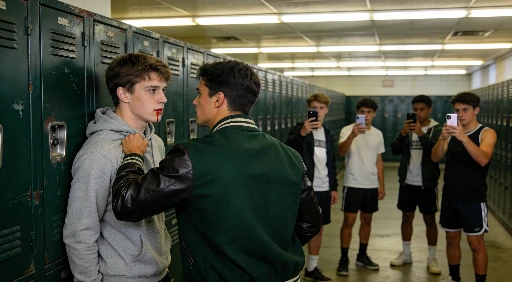
They Thought The Quiet Girl Would Cry When The Rich Girls Dragged Her By The Hair—Instead, She Seized The Ringleader’s Arm, Spun Her Around, And Pinned Her To The Lockers By The Wrist.
The hallway was already recording when Chloe’s hand twisted into the back of my hair. Her designer sneakers squeaked on the tile as she yanked me backward, expecting me to crumble into tears like everyone else. Thirty phones were up, waiting for my humiliation. But I didn’t cry.
My back slammed against the cold metal lockers. The stinging pain in my scalp was sharp, but my breathing stayed slow. Chloe, the untouchable queen of the junior class, stood over me with her expensive perfume mixing with the sour smell of cafeteria floor wax. Her three best friends flanked her, giggling behind their manicured hands.
“Look at her,” Chloe sneered, tightening her grip on my ponytail. “The charity case can’t even afford a decent haircut, so I’m doing her a favor.”
A crowd had formed a tight circle around us, trapping me. Flashes went off. People pushed forward to get a better angle for their group chats. A few lockers down, Mr. Harrison, the history teacher, peeked out of his classroom. He saw Chloe. He saw me pinned. Then, he quietly pulled his door shut and pretended he had seen nothing. Just school girl drama. Just another day at Oakridge Prep.

For months, I had taken their abuse in silence. I wore my faded thrift-store hoodies, kept my head down, and let them spill my lunches. I ignored the cruel videos they made sure I saw. I did it because my scholarship was the only thing keeping me at this school. I did it because Master Hale, my instructor since I was seven, taught me that silence is discipline, not weakness.
But today, Chloe wanted a show.
“Are you going to cry?” she taunted, yanking my hair harder, trying to force me to my knees. “Beg me to let go. Do it.”
The laughter around me grew louder. A girl in the front row chanted for me to kneel. Chloe leaned in close, her eyes wide with the thrill of having complete control. She shifted her weight, preparing to yank me down to the floor for the grand finale of her video.
She broke Master Hale’s most important rule. She gave me no safe way out.
— CHAPTER 2 —
Oakridge Preparatory Academy was a fortress of glass, brick, and old money. I never belonged there, and the school made sure I knew it from the moment I stepped off the city bus on the first day. My acceptance letter had called it a “prestigious opportunity for gifted youth.” In reality, it was a shark tank where the minimum price of admission was a luxury car and a trust fund. I had neither of those things. I just had my academic scholarship, a worn-out backpack, and a mother working double shifts just to keep the lights on in our apartment.
The wealth gap at Oakridge wasn’t just visible. It was loud, aggressive, and suffocating. Students drove imported SUVs to zero-period classes, tossing their keys to friends with careless ease. They wore limited-edition sneakers that cost more than our monthly rent. I showed up in a faded gray hoodie, jeans that had seen better days, and unbranded shoes. I tried to blend into the painted cinderblock walls, keeping my head down and hoping my grades would be my only legacy.
But invisibility is a luxury you don’t get when you stand out for being poor. Chloe saw me on the second day of school, and I immediately became her new favorite project. It happened in AP English, a class she treated like her own personal talk show. The teacher was a timid woman who never dared to interrupt Chloe when she was speaking. Chloe’s family practically funded the athletic department, and everyone in the building knew it.
I had taken a seat in the middle row, hoping to just take my notes and survive the hour. Chloe walked in five minutes late, flanked by her three closest friends, holding a massive iced coffee. She stopped right next to my desk and stared down at me. She didn’t say a word at first, just let her eyes slowly drag from my frayed collar down to my scuffed shoes. The whole room went dead silent, waiting for her verdict.
“You’re in my seat,” she finally said, her voice dripping with bored entitlement.
There were no assigned seats in AP English. The room was half empty, with plenty of open desks closer to her friends. But this wasn’t about a chair. This was a territorial dispute, and I was the trespasser.
I looked at the empty desk next to me, then back up at her perfectly manicured nails tapping against her plastic cup. Master Hale’s voice echoed in the back of my mind, reminding me that ego is the enemy of safety. Leave if you can, he always said. A fight avoided is a fight won. So, I didn’t argue. I quietly gathered my notebooks, stood up, and moved to a desk in the far back corner.
Chloe smirked, sliding into the desk I had just vacated. “That’s what I thought, Charity Case,” she whispered loudly enough for the front row to hear.
That was the exact moment the target was painted permanently on my back. The nickname stuck instantly. By the end of the week, I wasn’t a student at Oakridge anymore; I was just “The Charity Case.” The bullying started as a low, persistent hum of exclusion. When I walked down the hallway, groups of girls would suddenly stop talking and stare until I passed. When I sat down in the library, people would immediately pack up and move to another table.
It was psychological warfare designed to make me feel like a disease. They wanted me to shrink, to apologize for breathing their air. But they didn’t know about the hours I spent in a dusty, un-air-conditioned gym across town. They didn’t know I had spent my entire childhood learning how to breathe through panic and ignore intimidation. Master Hale had trained me to endure discomfort without breaking focus.
Because I didn’t cry or react to the whispers, Chloe started escalating her tactics. September bled into October, and the cafeteria became a daily minefield. The lunchroom at Oakridge was a massive, naturally lit atrium where social status dictated exactly where you were allowed to sit. I always chose a small table near the emergency exit, facing the room so I could see everyone. It was a habit born from years of self-defense training—never put your back to a crowded room.
One Tuesday, I was eating a sandwich my mom had packed, reading a history textbook. Chloe and her group walked by my table on their way to the courtyard. One of her friends, a tall blonde named Jessica, “accidentally” tripped over absolutely nothing. She stumbled forward, and her entire tray of hot soup and soda went flying. It splashed across my textbook, my jeans, and my only pair of decent sneakers.
The cafeteria went completely quiet. The clatter of plastic trays and silverware stopped. Everyone turned to look at the mess dripping off the edge of my table.
Jessica gasped, pressing a hand to her mouth in mock horror. “Oh my god, I am so clumsy,” she squealed, though her eyes were completely dead and entirely amused. “I hope I didn’t ruin your… well, whatever it is you’re wearing.”
Chloe laughed. It wasn’t a hidden chuckle; it was a loud, clear, echoing laugh that signaled to the rest of the room that it was okay to join in. A wave of giggles rippled through the surrounding tables. Several students pulled out their phones, snapping photos of me sitting there covered in lukewarm chicken noodle soup.
My heart hammered against my ribs. My fists clenched under the table, my knuckles turning white. The adrenaline spiked hard and fast, telling me to stand up, grab the remaining tray, and smash it into the wall. I could feel the mechanics of a counter-attack running through my muscles. I knew exactly how to step into Jessica’s center of gravity and sweep her legs out from under her.
Keep your hands open first. Master Hale’s strict, gravelly voice cut through the red haze in my mind. Do not swing out of anger.
I took a slow, deep breath through my nose. I forced my hands to uncurl and lay flat on my thighs. I didn’t look at Jessica, and I didn’t look at Chloe. I calmly reached into my bag, pulled out a napkin, and started wiping the liquid off my ruined textbook. I didn’t say a word. I just sat there, accepting the humiliation because it was the only way to avoid escalating the violence.
Chloe seemed visibly annoyed by my lack of reaction. She scoffed, rolling her eyes. “She doesn’t even care,” Chloe muttered to Jessica. “She’s used to living in garbage.” They walked away, leaving me to clean up the mess while the rest of the cafeteria whispered and pointed.
When physical intimidation failed to break me, they moved the war to the digital front. November was the month of the group chats. I didn’t have an expensive smartphone, just a cracked older model, but the school’s Wi-Fi network made it easy for them to hunt me. They started taking photos of me when I wasn’t looking. A picture of me waiting for the city bus in the rain. A picture of my frayed backpack sitting on a desk. A zoomed-in photo of my scuffed shoes.
They would take these pictures, add cruel captions, and AirDrop them to everyone in the vicinity. I would be sitting in study hall, trying to focus on a math worksheet, when thirty phones around me would simultaneously ping. I would watch as students glanced at their screens, snickered, and looked directly over at me. The worst part was knowing exactly what they were laughing at, but being entirely powerless to stop it.
One afternoon, a photo of my mom’s beat-up sedan dropping me off a block away from the school circulated. The caption read: The Charity Express. Runs on food stamps and desperation.
That one hurt. It felt like a physical blow to my chest. They weren’t just attacking my clothes or my quiet nature anymore; they were attacking my mother. They were mocking a woman who worked until her feet bled just so I could have a better education. I spent the entire afternoon in the library bathroom, staring at the mirror, trying to force the tears back down. I couldn’t let them see me cry. If I cried, Chloe won.
I realized I couldn’t survive this entirely on my own. I needed an adult to intervene before I lost my grip on my own discipline. The next morning, I went to the counseling office to speak with Mrs. Gable. She was a polished woman with too much jewelry and a fake, practiced smile. I sat in her plush leather chair and explained what was happening. I told her about the cafeteria incident, the endless whispers, and the AirDropped photos.
Mrs. Gable listened, nodding slowly while making notes on a pristine legal pad. When I finished, she sighed heavily and took off her reading glasses. She looked at me not with sympathy, but with mild exhaustion, like I was a problem she didn’t want to deal with today.
“High school is a high-pressure environment,” Mrs. Gable said softly, leaning across her desk. “Oakridge is very demanding, and sometimes students use sarcasm or teasing as a way to blow off steam. It’s just a phase of adolescence.”
I stared at her, stunned. “They took pictures of my mother’s car. They call me a charity case. That isn’t sarcasm.”
Mrs. Gable held up a hand to stop me. “Now, I know it feels very personal to you,” she continued, her tone patronizing. “But you have to understand the culture here. Chloe’s family is under a lot of stress. They do a lot for this school. They donated the new science wing. Sometimes, girls like Chloe just don’t realize how their banter comes across to someone from a… different background.”
She was protecting her. She was sitting in a school office, drawing a salary to protect students, and she was actively choosing the girl with the wealthy parents over the girl with the faded hoodie.
“So, what are you saying?” I asked, my voice dangerously flat. “You’re not going to do anything?”
“I’m saying that both sides need to show some grace,” Mrs. Gable replied smoothly. “Maybe if you tried to engage with them more, tried to fit into the community, you wouldn’t feel so isolated. Don’t make this bigger than it is. Just ignore the drama, and it will go away.”
I left her office feeling colder than I ever had in my life. I realized in that hallway that the adults weren’t blind to the bullying. They saw it clearly, but they had calculated the cost of stopping it and decided I wasn’t worth the price. The teachers looked the other way because it was easier. The administration minimized it because Chloe’s last name was engraved on a bronze plaque in the main lobby.
I was completely on my own. The hallway didn’t just watch me suffer; it sanctioned it.
Master Hale’s training became my only armor. Every afternoon at the gym, I would hit the heavy bags until my knuckles bruised through the wraps. I would practice my footwork, my blocks, my grappling escapes, channeling all my frustration into perfect, controlled technique. Master Hale would watch me from the corner, his old military eyes missing nothing. He knew I was angry. He knew the school was testing me.
“They are trying to find your breaking point,” Master Hale told me one evening as I swept the gym mats. “They want you to lash out so they can call you the aggressor. The moment you strike first, you give them permission to destroy you completely. You hold your ground, but you do not start the fire.”
I took his words back to Oakridge with me. I built a fortress inside my own mind. Let them whisper. Let them AirDrop their stupid photos. Let them spill their drinks. I would be a ghost. I would graduate, take my scholarship to college, and never look back at these miserable, entitled people again.
But my silence was driving Chloe insane. Bullies don’t want a punching bag that doesn’t swing back; they want a victim who breaks. They feed on the tears, the apologies, and the fear. Because I refused to give her any of those things, her frustration began to curdle into genuine rage. She started looking at me differently. It was no longer just about teasing the poor girl; it was about punishing me for defying her social order.
The week before winter break, the tension in the school felt different. The air was thick and heavy, like the moments right before a thunderstorm. Chloe’s group stopped laughing when I walked by. Instead, they just stared, their eyes hard and calculating. They were tired of the games. They wanted a definitive victory.
It started on a Thursday. I was at my locker, quickly swapping out my biology textbook for my math binder. The hallway was packed with students rushing between periods. The noise was a chaotic roar of slamming metal doors and shouting teenagers. I just wanted to get my books and get to class.
Then, the noise abruptly shifted. The casual chatter died down, replaced by a low, eager murmur that swept through the corridor like a wave. I felt a sudden, sharp change in the air pressure behind me.
I didn’t need to turn around to know she was there.
“Close your locker,” Chloe’s voice hissed right next to my ear.
I took a breath. I didn’t close it. I reached for my math binder, keeping my movements slow and deliberate.
A hand slammed hard against the metal door of my locker, forcefully shoving it shut inches from my face. The loud bang echoed sharply down the corridor. My lock rattled against the painted steel. I froze, my hand still raised in the empty air.
Slowly, I turned my head. Chloe was standing inches away from me, her chest heaving slightly. Jessica and the others formed a tight wall behind her, blocking my path to the stairwell. I glanced over Chloe’s shoulder. A dozen students had already stopped walking. Phones were slipping out of pockets. The green light of a camera app reflected off the glossy tile walls.
They were ready for the show. And this time, Chloe wasn’t going to let me walk away.
— CHAPTER 3 —
Master Hale’s gym wasn’t a place for fitness enthusiasts or people looking to tone their muscles before summer. It was a concrete box tucked behind a row of abandoned warehouses, smelling permanently of sweat, old rubber mats, and engine oil. The windows were too high to see through, and the door didn’t have a sign, just a rusted heavy-duty deadbolt. To anyone driving by, it looked like a place where things went to be forgotten. To me, it was the only sanctuary I had ever known.
I started training there when I was seven years old. My mom had found out about the gym through a neighbor who worked in social services. She was terrified that living in our neighborhood would turn me into a target, or worse, a participant in the violence that haunted our streets. She didn’t want me to learn how to be a thug; she wanted me to be able to walk home without looking over my shoulder every three seconds.
Master Hale had been a different breed of man. He was a retired Army combatives instructor, a veteran who had spent decades teaching soldiers how to survive in environments where the rules didn’t exist. He had thick, calloused hands, a face mapped with deep lines of discipline, and a voice that sounded like gravel grinding against steel. He didn’t care about trophies, belts, or flashy movies. He cared about one thing: survival.
The first day I walked in, I was a scared, small kid who couldn’t even look an adult in the eye. Master Hale didn’t start me on punches or kicks. He started me on standing still. He made me stand in the center of the mat, hands at my sides, and told me to breathe while he walked around me, shouting at me to stay centered.
“The fight happens in your head before it ever reaches your hands,” he told me, his eyes piercing through my fear. “If you panic, you’ve already lost. Your breath is your tether. You lose your breath, you lose your mind. You lose your mind, you lose your life.”
Over the next eight years, that gym became my classroom, my church, and my home. I spent countless hours learning the mechanics of balance and space. Master Hale didn’t teach me how to be a warrior; he taught me how to be a master of my own physical reality. He drilled the basics into my muscle memory until they were as natural as breathing.
He taught me that every movement requires an exit. He would set up chairs in the gym to mimic a crowded hallway or a bus aisle, forcing me to navigate around obstacles while keeping my hands up and my chin tucked. He taught me to read the weight distribution of an opponent’s body, showing me how to see a strike coming before the person even decided to throw it.
But more than the technique, he drilled the philosophy of restraint into my bones. This was the part that the kids at Oakridge couldn’t comprehend, and honestly, the part that probably saved me from becoming a monster.
“Most people think fighting is about power,” Master Hale would say, pacing the mats as I did my conditioning. “They think it’s about who is stronger, who is faster, or who is meaner. They are fools. A fight is a failure of communication. It is a failure of environment. If you find yourself in a fight, you have already failed to manage the situation.”
His most important rule—the one he repeated until I could hear it in my sleep—was simple: never strike first.
It wasn’t just a rule of engagement; it was a test of character. He explained that the person who strikes first is the one who has lost control. They are acting out of fear, or anger, or ego. They are slaves to their own impulses. If I struck first, I wasn’t any better than the bullies who made my life miserable. I was just another person escalating violence to satisfy a wounded ego.
“If you ever use what I’ve taught you to hurt someone because your pride was stung, you have failed me,” he told me one night after I had finally managed to escape a complex grappling hold he had pinned me in. “True power is not in the ability to break someone else. True power is in the ability to keep your own peace while the world around you tries to force you into a state of chaos.”
He taught me how to be a wall. He showed me how to use an attacker’s own momentum against them—to deflect, to redirect, and to neutralize. He taught me that if I was cornered, I should keep my hands open, palms facing outward, not to fight, but to signify that I didn’t want the conflict. It was a silent plea for sanity that, if ignored, became the first layer of my defense.
Those years in the gym were grueling. I would come home with bruises on my ribs, sore muscles, and lungs burning from the air conditioning that never worked. My mom would look at me with concern, but she knew that this training was the only thing giving me the confidence to walk into that private school every morning with my head held high.
I kept my training a secret from everyone. At Oakridge, I was just the quiet scholarship kid. I didn’t brag about my background. I didn’t talk about Master Hale. I didn’t show off any skills. When Chloe or her friends would shove me, or call me names, I would feel that old instinct from the gym flare up—the muscle memory of how to take them down—but I would shove it back down, deep into my gut, and remember the rule.
Never strike first.
I knew that if I used my training, I wouldn’t just be defending myself; I would be validating everything they said about me. I would be the “violent scholarship kid” who didn’t belong in their refined, high-society school. The school administration would use my own skills to justify expelling me, proving that they were right to look down on me all along.
So, I stayed silent. I took the abuse. I internalized the humiliation. I waited for the day that Master Hale warned me about—the day when there would be no safe way out.
But as the months went by, the bullying wasn’t just about my ego anymore. It was becoming a test of my very soul. They were pushing me, measuring me, trying to see how much I could take before I snapped. Chloe’s eyes, during those moments in the cafeteria or the hallways, were hungry. She was a hunter who was getting bored because the prey refused to run.
I remember the last conversation I had with Master Hale before the school year started. I told him about the scholarship, about the pressure, and about the fear of being targeted for being poor. He had looked at me for a long time, his gaze steady and calm.
“People like that, they don’t value the quiet,” he said, tapping his chest where his heart was. “They fear it. Your discipline will be the thing they hate the most. They’ll try to drag you down to their level, because if they can make you like them, they don’t have to feel bad about who they are. Do not let them change you. Stand your ground, keep your silence, and protect your dignity. But remember: the moment you choose violence for its own sake, you lose the battle.”
His words were my anchor. During those long hours when I wanted to scream, or cry, or hit back, I thought about that gym. I thought about the thousands of hours I spent learning to control my breath and my body. I thought about the difference between a fighter and a master.
The bullies at Oakridge thought they were the ones in control because they had the phones, the cameras, and the social status. They thought I was a victim because I didn’t fight back. They had no idea that my silence wasn’t a sign of weakness. It was a sign of a restraint so powerful, so deep, that it was actually the most dangerous thing in the room.
But as I sat in the cafeteria that day, watching Chloe walk away with a smirk, I realized that my restraint was nearing its limit. The world was shrinking around me. Every path to leave was being blocked, and every request for help was being met with indifference.
The threat wasn’t just physical anymore; it was an existential attempt to strip me of my humanity. I was the scholarship boy with the secret training, and they were the predators who thought they owned the hallway.
I didn’t know then that the showdown was already being choreographed. I didn’t know that the phones were already recording my life in anticipation of my fall. All I knew was that I was still holding the line, still breathing, and still waiting for the moment when I would finally have to defend the only thing that really mattered: myself.
Every chapter of my life at Oakridge was leading to a single, inevitable point. The pressure was building in the hallway, in the classrooms, and even in the quiet of my own home. I was a pressure cooker, and Chloe was holding the lid down, unaware that if she kept pressing, she was going to be the one to get burned.
I looked down at my hands. They were steady. They had been trained since I was seven to be instruments of defense, not destruction. But I could feel the change in the air. The threshold was approaching. And when it finally arrived, I wouldn’t be striking out of anger. I would be moving because I had no other choice.
My past was my armor, and my restraint was my weapon. And they were about to find out that a scholarship boy with nothing to lose is the most dangerous person you can ever encounter.
The silence of the hallway suddenly felt different. It wasn’t the silence of peace; it was the silence of anticipation. Someone was watching, waiting, and hoping to see me shatter.
I just needed to make sure that when I finally moved, it would be a memory they would never be able to erase.
— CHAPTER 4 —
The school was beginning to feel less like a place of learning and more like a prison designed by people who didn’t want me there. The atmosphere at Oakridge had shifted from passive exclusion to active, coordinated hostility. It wasn’t just Chloe and her inner circle anymore. The entire junior class seemed to have received the memo that I was the designated target, the person whose humiliation was a communal sport.
I felt the pressure in every hallway transition. Students would part like the Red Sea when I walked by, only to close ranks behind me, their hushed whispers following me like a cold draft. I saw the way people looked at me—not as a peer, but as a curiosity, a glitch in their perfect, expensive social matrix. Some of them watched with genuine malice, others with a detached, bored curiosity, but almost none of them looked at me with anything resembling empathy.
The filming had become constant. I couldn’t go to the cafeteria, the library, or even the restroom without seeing someone pull out a phone. It was as if I were living inside a reality show where the only plot point was my eventual collapse. I saw it on their faces: they weren’t just waiting for me to break down; they were rooting for it. They wanted to be the ones to capture the “moment” when the charity case finally lost it.
I spent most of my breaks in the library, hiding behind the stacks in the back. Even there, I wasn’t safe. I’d be trying to study, and I’d hear the distinctive ping of an AirDrop notification on someone’s phone nearby. Then, the inevitable snickers would start. I knew what it was. Another photo of me sitting alone. Another meme about my backpack. Another cruel joke about my home life. It was exhausting to constantly maintain my composure, to force my heart to keep a steady rhythm when every fiber of my being wanted to stand up and scream at the cruelty of it all.
One afternoon, during an assembly in the gymnasium, I was sitting on the bleachers when a freshman boy, a quiet kid who usually sat near me in Algebra, leaned over. He looked terrified. His hands were shaking, and he didn’t even look at me, keeping his eyes glued to the floor.
“You should probably stay out of the north hallway tomorrow,” he whispered, his voice barely audible over the sound of the gym announcer. “I heard them talking. They’re planning something big. They’re going to make sure… well, they’re going to make sure you can’t ignore them anymore.”
I looked at him, my gut clenching. He was scared for me, but he was also clearly scared for himself. He didn’t want to be associated with me, didn’t want to be the next target on their list. Before I could ask him what he meant, he stood up and hurried away, merging into the crowd of students like he had never spoken to me at all.
I knew he was right. The air at Oakridge was too thick for this to end naturally. I could see the way the teachers were acting, too. They weren’t just ignoring the bullying anymore; they were actively facilitating it. Coach Miller, the head of the football department, walked past me in the hallway that afternoon. Chloe was right beside him, laughing about something. As they passed me, Miller gave me a look of pure, unadulterated disgust. He didn’t stop, didn’t say anything, but the look was a clear message: You don’t belong here, and I’m not going to stop anyone who decides to remind you of that.
It was clear that the school’s administration had made its choice. Chloe’s family’s influence was a shield that made her untouchable, and my lack of status made me invisible. They wouldn’t stop the bullying because they didn’t see me as a student worthy of protection. I was an inconvenience, a reminder of the wealth disparity that they preferred to keep hidden behind a glossy, polished exterior.
The isolation was the hardest part. It’s one thing to know you’re being bullied; it’s another thing entirely to realize that the entire system around you has decided that your pain is acceptable collateral damage for the sake of the school’s image. Every time I stepped onto that campus, I felt the weight of that reality. I was alone, truly and completely alone, in a building full of people.
That night, in the gym, I was hitting the bag harder than I ever had before. My hands were wrapped tightly, and I could feel the sting of the impact all the way up to my shoulders. Master Hale stood in the shadows, his presence a silent, grounding force in the room. He didn’t tell me to slow down. He didn’t tell me to breathe. He just watched, his eyes tracking every movement of my feet, every turn of my hips.
“They’re coming for you, aren’t they?” he asked, his voice cutting through the sound of the leather bag hitting the post.
I stopped, my breath coming in sharp, ragged gasps. I nodded, wiping the sweat from my forehead. “They’re planning something for tomorrow. In the north hallway.”
Master Hale stepped into the light. He looked at me with a mixture of sadness and pride. “And you know what you have to do?”
“I know,” I said, my voice steady for the first time in weeks. “I don’t strike first. I don’t start the fight. I protect myself. I hold the line.”
He nodded. “They want you to be the aggressor. They want to justify their cruelty by pointing at you and saying, ‘Look, he’s just as bad as we said he was.’ If you give them that, you lose everything. But if you hold your ground, if you refuse to surrender, you force them to reveal who they really are. That is the only victory that matters.”
I left the gym that night feeling a strange, hollow sort of peace. I knew that tomorrow would likely be the breaking point. I knew that the hallway would be full of cameras and laughter and the cold, hard eyes of people who wanted to see me ruined. But for the first time, I wasn’t afraid. I had my training, I had my discipline, and I had the one thing that Chloe and her group would never have: the truth of my own character.
I walked to the bus stop in the quiet of the night, watching the streetlights flicker above me. The city was still, and for a few minutes, the pressure of Oakridge felt a million miles away. But I knew the reality was waiting for me. I knew that the next day, I would walk back into that lion’s den. I knew that when I reached those lockers, everything was going to change.
I thought about the freshman boy, and about all the other kids at school who were watching and filming and laughing. I wondered how many of them were secretly terrified, how many of them were just waiting for someone else to stand up so they could feel brave enough to do the same. I wondered if, by standing my ground, I could show them that there was another way.
I realized then that this wasn’t just about me anymore. It was about the silence of the bystanders, the complicity of the adults, and the crushing weight of a culture that prioritized power over people. I was the scholarship boy with the secret training, and tomorrow, I was going to be the mirror that would force them to see exactly what they had become.
I went home, put on my simple gray hoodie, and sat at my desk to finish my homework. I wouldn’t let them take my education, either. I wouldn’t let them ruin my future. That was the final, most important layer of my resistance. I would be perfect in class, I would be respectful to the teachers who hated me, and I would be the most disciplined person in that entire school.
The sun came up earlier than I wanted. I got dressed, packed my bag, and headed for the bus stop. As the school bus pulled into the lot, I looked out the window at the familiar brick building. It looked the same as it had every other day, but I knew it was a battlefield. I took a deep, steadying breath, felt the weight of my training in my muscles, and stepped off the bus.
The north hallway was waiting. The phones were already being readied, the groups were forming, and the air was charged with an anticipation that made my skin prickle. I walked toward my locker, my steps measured and calm. I felt like a ghost, walking through a world that thought it knew me, unaware that the version of me they saw was a carefully constructed mask.
They thought I was a victim. They thought I was a target. They had no idea that the person walking into that hallway was the only thing standing between them and the truth. And as I turned the corner and saw Chloe standing there, the center of her own little universe, I knew the time for waiting was over.
I reached my locker, my hand reaching for the dial. I could feel them all around me, the crowd, the cameras, the anticipation. I didn’t look at them. I didn’t look for an exit. I just stood there, and for the first time, I let myself really look at Chloe.
She looked small. She looked insecure, wrapped in her designer clothes and her carefully cultivated reputation. She looked like someone who had never had to fight for anything in her life, and who was terrified of ever having to start. I felt a surge of pity for her, which was the last thing I expected.
But pity wouldn’t save me, and it wouldn’t save her. I had to be ready for whatever was coming. I had to be the wall. I had to be the discipline. I had to be the person who refused to break, even when the entire world seemed to be cheering for my destruction.
And then, just as I reached for my book, she made her move.
— CHAPTER 5 —
I stood there, my breathing steady despite the chaos in my chest, and watched as Marcus—the football captain, the pride of Oakridge Prep—closed the distance between us. He was a mountain of a kid, his varsity jacket stretched tight across his shoulders, his face twisted into that familiar, arrogant sneer that I had seen in every hallway for the last six months. Behind him, the crowd was already humming. Phones were held up like jagged pieces of glass, capturing every flicker of my expression, waiting for the moment I would finally crack.
“I told you to kneel,” Marcus growled, his voice low, designed to be heard only by me and the camera lenses pointed at our faces. He reached out and shoved me, his hand catching my shoulder and driving me backward until my spine hit the lockers with a dull, sickening thud. The sound of my impact was immediately drowned out by a burst of laughter from the group standing nearest to us. They were chanting now, a rhythmic, cruel beat that felt like a pulse in the room.
I didn’t move. I didn’t reach for him, and I didn’t lower my head. My feet were planted, my center of gravity low and balanced, just as Master Hale had drilled into me for years. Every instinct in my body was screaming to move, to dodge, to end this, but I kept my hands open, palms facing outward—the international sign of peace, or for those who were watching, the sign of a victim who was too scared to fight back.
“Are you deaf, Charity Case?” Marcus stepped in closer, his face mere inches from mine. He could smell my fear, he thought. He could see the way my muscles were tense and ready. He didn’t know that my tension wasn’t from fear; it was from the extreme, concentrated effort of keeping my rage on a very short leash. He leaned in, his hand moving toward my collar, and I felt the air go out of the hallway. This was it. The point of no return.
I looked past him, toward the door of the history classroom. Mr. Harrison was standing there, his hand on the handle, his eyes meeting mine for a split second. He looked tired. He looked like a man who just wanted to get through his shift without having to fill out a disciplinary report. He saw Marcus grabbing my collar. He saw the crowd. And then, he turned his head, pulled the door shut, and disappeared into his room.
He had effectively signed off on whatever happened next. The message was clear: at Oakridge, the football captain wasn’t just a student; he was a protected asset, and I was just the trash that needed to be taken out. The laughter in the hallway intensified, emboldened by the teacher’s exit. A girl in the front row, someone I didn’t even know, shouted, “Just drop him, Marcus! Let’s see if he can actually cry!”
Marcus laughed, a sound that lacked any real humor. “I’m going to make this a classic, everyone. Make sure you get the angle right.” He tightened his grip on my shirt, his knuckles whitening, and he jerked me forward, clearly intending to spin me around and force me to my knees in front of everyone. He was confident. He was arrogant. He was completely, utterly focused on his own power.
And that was his mistake.
He didn’t realize that in his rush to dominate me, he had stepped into my space, his balance shifted entirely toward his own forward momentum. He didn’t realize that I had been practicing this exact moment for eight years, in a dark, cold gym where the only reward for failure was a hard fall on the mats. I knew exactly where his center of gravity was. I knew exactly how he would move before he even initiated the action.
My breath was perfectly controlled. Never strike first. He hadn’t struck yet, but he had grabbed me. He had shoved me. He had blocked the only exit I had. He had crossed the line, and in the language of the training I had received, the situation was no longer a negotiation. It was an emergency.
I waited until the very last millisecond, the moment his muscles committed to the shove. I didn’t resist his pull. Instead, I moved with it. I stepped off the line, a small, subtle adjustment of my foot, and let his own momentum carry him past me. I didn’t swing. I didn’t lash out. I simply used his own weight, his own anger, to guide him exactly where he couldn’t keep hurting me.
The crowd gasped. The chanting stopped mid-beat. For one singular, suspended second, the hallway was completely silent, the only sound the rustle of our clothes as we shifted. Marcus’s face went from smug arrogance to genuine, confused shock as he realized that the boy he had spent all year tormenting wasn’t kneeling—he was standing, and he was completely, perfectly in control.
But Marcus wasn’t done. He was embarrassed, and in the world of high school, embarrassment is a more potent motivator than anything else. He scrambled to regain his balance, his face reddening, his eyes narrowing with a new kind of intensity. He reached for me again, this time with both hands, his movements erratic, desperate, and dangerous.
The phones were still clicking. The laughter had turned into a frantic, excited chatter. I could see the reflection of the hallway lights in the screens held up around me. I had successfully countered his first attempt, but he wasn’t going to let me walk away. He was going to escalate this, and I had to be ready for the next move, because I knew he wouldn’t stop until he forced me to give him the reaction he wanted.
I took another breath, my hands still open, my heart still steady. I didn’t want this fight, but it was here, and there was no way out. The hallway was watching, and they were about to see something they would never be able to forget. Marcus lunged again, and this time, there was no hesitation. The real test of my training was about to begin.
— CHAPTER 6 —
The air in the hallway was vibrating. Marcus had lunged, his fingers clawing for my hoodie, but he was overextended, his weight fully committed to the aggression. In that fraction of a second, the years of drilling in the dusty gym took over. My body moved before my conscious mind even had time to process the threat.
I didn’t swing. I didn’t reach out to grab his jacket or shove him back. I pivoted. My left foot stepped off the line of his charge, turning my body just enough to let his momentum carry him past me. As he flew by, I reached out—not to strike, but to guide. I caught his wrist with one hand and placed my other hand lightly on his shoulder.
With a simple, fluid rotation of my own hips, I redirected his energy. I wasn’t fighting his strength; I was using the force he had generated himself to place him exactly where I needed him to be. He stumbled, his feet tangling, and he went down to one knee, his hand scraping against the cold, hard floor.
The silence that followed was deafening. The chanting stopped instantly. It was as if someone had pulled a plug on the entire hallway. Phones were still held up, but the hands holding them were frozen in mid-air. Marcus was on the floor, looking up at me, his eyes wide with disbelief and a flash of genuine, unadulterated shock. He looked smaller than he had five seconds ago.
I stood perfectly still, my hands open, palms facing toward him. I didn’t step in to loom over him. I didn’t throw a punch, and I didn’t say a word. I just waited. I was the wall. I was the discipline. I was the person who had finally, unequivocally, stopped the danger.
“Get up,” I said, my voice quiet but steady, echoing clearly in the still hallway.
He didn’t move. He just stared at me, his chest heaving, his pride clearly shattered. The students standing around us were looking from Marcus to me, their expressions shifting from anticipation to a confused, hesitant awe. They had come for a show, and they had gotten one—but not the one they had paid to see.
I turned my head toward the group of students who were still filming. “Check the cameras,” I said, my voice even. “You have the footage. You have the truth. You saw who started it.”
A girl in the front row, someone who had been laughing just moments before, slowly lowered her phone. She looked at Marcus, then at the locker he had slammed, and then back at me. She looked like she was seeing me for the first time. The mask of the “Charity Case” had been ripped away, and in its place was someone who had refused to play their game.
Marcus finally scrambled to his feet, his face a mask of rage and humiliation. He looked like he wanted to lunge at me again, to prove to everyone that he was still the king of the hallway, but he stopped. He looked at the phones. He looked at the crowd. He realized that if he attacked me now, while I was standing perfectly still and refusing to engage, it would be the final, irreversible end of his reputation.
He turned and pushed his way through the crowd, his friends scrambling to follow him. He didn’t look back. He didn’t say a word. He just disappeared into the sea of students, leaving the north hallway in a state of stunned, heavy silence.
I walked toward my locker, opened it, and grabbed my binder. My hands were perfectly steady. I didn’t feel a rush of victory, or a desire for revenge. I felt a profound, deep-seated sense of relief. I had held the line. I had been tested, and I had passed. I hadn’t become the thing that had been trying to destroy me.
As I walked toward my classroom, I could hear the whispers starting up again, but they were different now. They weren’t the cruel, mocking whispers of people who thought they had a victim. They were the hushed, nervous whispers of people who had just witnessed something they didn’t know how to categorize.
I had been the quiet boy, the scholarship kid, the charity case. And in the space of a few seconds, I had become the person who had forced them to see the truth. I had forced the hallway to stop watching and start witnessing. I had forced them to understand that there was a difference between silence and weakness.
But I knew this was only the beginning. The real battle was just starting—the battle for the narrative, the battle for the truth, and the battle to ensure that this would never happen to anyone else again. I walked into my class, sat at my desk, and opened my book. I was ready for whatever came next.
The cliffhanger wasn’t whether I would survive the school day—it was whether the school would have the courage to acknowledge what had actually happened. I knew the administration was watching, and I knew that the cameras weren’t just in the hands of the students anymore.
Everything was about to change.
— CHAPTER 7 —
The aftermath of the hallway confrontation was not an immediate explosion of justice. It was a slow, agonizing process of dismantling the lies that had protected Marcus for so long. For the first two days after the incident, the school administration went into complete lockdown. Marcus was absent, citing a “family emergency,” and the teachers—including Mr. Harrison—suddenly developed a mysterious case of amnesia whenever someone brought up the north hallway.
The silence from the office was deafening, but it couldn’t stop what was happening on the school’s private network. While the administration tried to bury the incident, they couldn’t control the thousands of digital footprints left behind. Dozens of students had recorded the entire thing. They had captured Marcus lunging, they had recorded me standing my ground, and they had documented the exact moment his arrogance met the reality of my training.
The videos didn’t stay private. By the end of the first day, the footage had migrated from private group chats to public platforms. It wasn’t just a video of a fight; it was a video of a boy who had been pushed to the edge and refused to break. The viral nature of the footage forced the school’s hand. When the video started gaining thousands of views from parents, alumni, and local community members, the administration’s narrative of “just another student drama” started to crumble.
I was sitting in my room on the third night, trying to focus on my history essay, when my mom called me into the kitchen. She was sitting at the table, her phone open, her face pale. She told me the principal had called. They wanted us in the office the next morning at eight o’clock sharp.
Walking into that office was the most surreal experience of my life. The room was sterile, the air thick with the smell of old coffee and nervous energy. The Principal, a man who had spent the last six months looking right through me, was now sitting with his hands clasped, looking uncomfortably at the desk. Beside him sat the school’s legal consultant and, to my surprise, a representative from the school board.
They didn’t start by yelling at me. They didn’t start by asking why I had “engaged in a physical altercation.” Instead, they started by playing the video.
The security footage from the hallway was projected onto a large wall monitor. It was grainy, silent, and undeniable. It showed Marcus stalking toward me, cornering me against the lockers, and initiating the physical contact. It showed me standing still, my hands open, trying to create space. It showed him lunging, and it showed me—my movements captured in slow motion—simply stepping out of the way and guiding him to the floor.
“We’ve reviewed the footage,” the principal said, his voice strained. “We’ve also interviewed several dozen students who witnessed the event. We’ve seen the group chats, and we’ve been made aware of the… recurring patterns of behavior that preceded this incident.”
He paused, looking at me. For the first time, he didn’t look through me. He looked at me with a kind of fearful respect. “We made a mistake, and we failed to protect a student. We are currently reviewing the school’s policy on bullying and student conduct. Marcus will not be returning to Oakridge Prep.”
The words hit me like a physical wave. He was gone. The boy who had spent half a year trying to destroy my spirit was being removed from the school. But the justice didn’t stop there.
“The students who participated in the filming and the distribution of the videos are also being held accountable,” the legal consultant added. “We have a zero-tolerance policy regarding cyberbullying, and the evidence we have collected is, unfortunately, quite damning.”
I felt a massive weight lift off my shoulders—not a weight of vengeance, but a weight of validation. They weren’t just apologizing because they were forced to; they were admitting that the system had been fundamentally broken. The truth had finally been given a timestamp.
As we walked out of that office, the hallways felt different. The students I passed didn’t whisper or stare. They looked down or quickly turned away. The aura of the north hallway had changed. It wasn’t a place of fear anymore; it was a place of accountability.
But the most satisfying part of the payoff wasn’t the principal’s apology, or Marcus’s expulsion, or the students who had to answer for their actions. It was the realization that I had never lost. I had stayed true to Master Hale’s teachings. I had never struck first. I had never surrendered my dignity. And I had proven that, even in a system designed to protect the powerful, the truth cannot be hidden forever.
The journey wasn’t over. I still had to finish the school year, and I still had to deal with the aftermath of becoming a public figure in a tiny, elite world. But the battle for my own soul—the battle for the person I was—that was a battle I had already won.
I went back to the gym that evening, just as I always did. The air was still thick with the smell of rubber and engine oil, and the gym was just as quiet as it had ever been. Master Hale was sitting on the bench, watching the door. He didn’t ask me what happened. He didn’t ask me about the principal or the expulsion. He just looked at me, and he saw the stillness in my eyes.
“You did well,” he said, his voice barely a whisper. “You stood your ground, and you didn’t let them turn you into them. That is the only victory that lasts.”
I nodded, feeling a peace I hadn’t known since before I stepped into Oakridge. I wasn’t the charity case anymore. I was just me. And that was finally enough.
— CHAPTER 8 —
The finality of Marcus’s absence felt strange at first, but it quickly settled into a new, quiet normal at Oakridge Prep. The school had been forced to drop its facade of perfection, and in doing so, it had inadvertently created a space where the truth was actually allowed to exist. The principal’s public letter to the student body—a vague but unmistakable apology regarding “the recent events and our commitment to fostering a safe environment”—wasn’t the grand gesture I had hoped for, but it was enough to end the reign of terror.
The students who had been the most vocal, the ones who had spent their lunch breaks filming and their evenings crafting cruel group chat narratives, were the ones who seemed the most shaken. They had been exposed, not just to the administration, but to each other. When you pull the curtain back on a culture of cruelty, you find that the participants are often just as afraid of each other as they are of being targeted. The hallway culture shifted from one of aggressive mockery to a cautious, watchful neutrality.
I returned to the cafeteria three days after Marcus was officially removed from the student roster. It was the same atrium, the same tables, and the same students, but the energy was unrecognizable. As I walked toward my usual spot near the emergency exit, I felt eyes on me. I didn’t keep my head down this time. I walked with my chin up, my stride relaxed and deliberate.
A girl from my math class, one of the students who had been in the front row the day of the confrontation, stood up as I passed her table. For a second, I thought she might say something, but she just sat back down, a look of profound discomfort on her face. She didn’t look at me with malice; she looked at me with the kind of recognition that only comes when someone’s entire worldview has been shifted by an uncomfortable truth.
I sat at my table, pulled out my sandwich, and opened my history book. I wasn’t the Charity Case anymore, and I wasn’t the victim. I was just a student, finishing his lunch, preparing for his next class. I realized then that the power they had held over me was never real; it was a ghost I had been taught to fear. Once I had stood my ground, once I had refused to participate in the cycle of their violence, the power evaporated.
My mother called me that evening, her voice lighter than it had been in months. She had heard about the school’s apology from a neighbor, and she was crying with relief. “I’m so proud of you,” she said, her voice trembling. “I’m so proud of how you handled yourself.” I didn’t tell her about the gym or the years of training. I just told her that things were better, and that I was safe.
Master Hale wasn’t surprised when I told him the news. I visited him at the gym one last time before the end of the school year. He was sitting on the bench, his gaze fixed on the heavy bags that had been my only confidants during the hardest months of my life. He didn’t offer any grand congratulations. He just looked at me with that same steady, piercing calm.
“You could have hurt him,” he said, not as a question, but as a statement of fact. “You could have broken his nose, or worse. You had the skill to destroy him.”
“I know,” I replied.
“And yet,” he continued, “you chose the hardest path. You chose the path of restraint. You chose to be the person who could control the fire, rather than the person who let it burn everything down. That is the only thing that matters. You didn’t just win a fight; you won the battle for your own character.”
I looked around the gym, at the worn-out mats and the rusted deadbolt on the door. It had been the most important place in my life, and yet I knew I wouldn’t be coming back here for a long time. I didn’t need to. I had learned everything I needed to know, not just about self-defense, but about the world and my place in it.
I walked out into the cool evening air, feeling the weight of the last year finally slipping away. I thought about the hallway, the cameras, the laughter, and the fear. I realized that the greatest lesson wasn’t how to handle an attacker; it was how to maintain my own peace when the world was trying to force me into chaos.
I would never kneel again—not because I was stronger than them, but because I had finally learned that my dignity wasn’t something they could take from me. It was something I carried, built on discipline, fueled by restraint, and tested by the very fire they had tried to burn me with. I walked toward the bus stop, the city lights shimmering in the distance, ready to face whatever came next with a steady heart and a clear mind.
The silence I carried now wasn’t the silence of fear; it was the silence of someone who knew exactly who they were. I was a scholarship boy, I was a student, and I was the master of my own self. And as I stepped onto the bus, I didn’t look back at the school, or the football field, or the memories of the hallway. I just kept moving forward, into a life that was finally, truly, my own.