Part 2: The Locker Room Secrets and the Unseen Truth
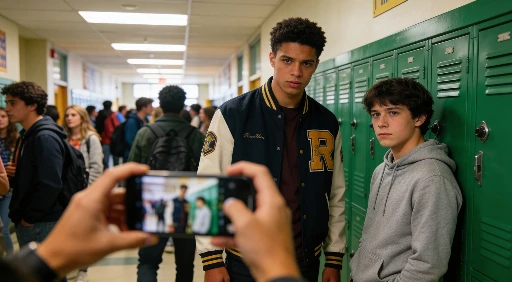
The Football Captain Thought The Quiet Scholarship Boy Would Kneel Like Always—He Had No Idea The Boy Had Trained Since Age Seven Under A Retired Military Master Who Taught Him Never To Strike First.
The school’s most untouchable athlete had my worn canvas backpack in his fist and half the crowded hallway waiting for me to drop to my knees. The vice principal saw it from his office door and just turned away, the phones were already up, and I kept my hands open for a reason nobody there understood.
“Kneel down and pick up the papers, Ethan,” Blake sneered, his massive varsity jacket blocking out the hallway lights. “Let’s see if that scholarship money bought you any manners, or if you’re just as trash as your neighborhood.”
The crowd erupted into a low, mocking chant, their smartphones raised like miniature shields.
I didn’t answer him. I didn’t reach for the scattered homework sheets soaking up puddles of melted snow on the linoleum floor.

My back was pressed hard against the cold metal lockers, the heavy scent of his expensive cologne filling the narrow gap between us. I could hear the rhythmic clicking of phone cameras, the familiar faces of my classmates blurring into a wall of eager spectators.
They wanted a show.
They wanted to watch the quiet kid from the East Side get broken before the first period bell even rang.
Blake leaned closer, his chest pressing against mine, his grip on my collar tightening until the cheap fabric of my thrift-store hoodie began to tear.
“I’m talking to you, garbage,” he muttered, his eyes narrowing when I refused to look down at his clean white sneakers. “You think because you get straight A’s you’re special? You’re nothing here. Now kneel.”
Out of the corner of my eye, I saw Mr. Henderson, the history teacher, step out of his classroom, glance at Blake’s towering frame, and immediately look down at his clipboard, walking the other way. “Keep moving to class, boys, let’s keep the hallways clear,” he called out half-heartedly, not turning around.
The crowd laughed, knowing the rules of this school.
Blake was the son of the state senator. He brought home trophies. I was just the statistical charity case that kept their diversity quota alive.
I let my breath out slowly, my fingers uncurling, hanging loose at my sides.
My mind flashed for a fraction of a second to a small, drafty garage on the edge of town, to the smell of old canvas mats and the steady, gravelly voice of a man who had survived three tours in Fallujah.
“Restraint isn’t weakness, kid,” the voice echoed in my head. “The world is full of loud men who want to see you break. You look them in the eye. You don’t invite the storm, but if it comes, you become the anchor.”
“Last chance, scholarship,” Blake whispered, drawing his right fist back, his knuckles whitening as the hallway went completely dead silent.
— CHAPTER 2 —
The humiliation didn’t start in the varsity locker room, and it didn’t start with a thrown gym bag. It began exactly three months earlier, on a rainy Tuesday morning in November, when the school administration announced the mid-year transfer placements over the public address system. Oakridge Prep wasn’t the kind of school that welcomed outsiders. Nestled in a wealthy historic district of the city, its hallways were lined with oak paneling, bronze athletic trophies, and oil portraits of donors who had graduated decades ago. It was a private institution built on generational wealth, family legacies, and an unspoken social hierarchy that kept everyone in their designated places.
I remember sitting in the back row of my honors chemistry class, trying to blend into the shadows of the lab counters. My worn canvas backpack—the one with the frayed straps my mother had carefully resewn with heavy fishing line—rested between my worn, generic sneakers. I was acutely aware of how out of place I looked among the rows of pristine leather satchels, designer fleece jackets, and brand-new smartphones resting carelessly on polished black-top lab desks. I had spent the previous year at a struggling public high school across town, surviving on grit and perfect test scores until a local community foundation sponsored a single, full-ride academic scholarship to Oakridge. It was supposed to be my golden ticket, the opportunity that would get me into an elite college and pull my family out of our cramped, two-bedroom apartment near the railyards.
Instead, it felt like a target painted directly onto my back.
The intercom crackled to life, and the principal’s assistant cleared her throat. “We would like to formally welcome our new winter-term scholarship recipient, Ethan Vance, who joins us from the public district. We expect all Oakridge students to show him our traditional community spirit.”
A heavy, suffocating silence fell over the classroom. I felt twenty pairs of eyes slowly turn toward the back row. Some were merely curious, but others carried a distinct, cold detachment. To my left, sitting behind a pristine mahogany desk with a customized school laptop, was Chloe Vance—no relation to me, though she made it clear from day one that sharing a last name with a “charity case” was an insult to her family heritage. Chloe was the cheer captain, a junior whose family name was literally carved into the stone archway of the school library. Her mother was the head of the parent-teacher association, and her older brother was currently playing quarterback for an Ivy League university. At Oakridge, Chloe wasn’t just popular; she was an institution. She was protected by a network of faculty who adored her perfect grades, wealthy donors who golfed with her father, and a loyal circle of friends who mimicked her every move, dress style, and laugh.
Chloe didn’t say anything immediately. She didn’t have to. She simply turned her head, looked at my faded, generic hoodie, and let out a quiet, scoffing chuckle that carried perfectly across the silent room. Within seconds, her best friend, Harper, laughed too. Then the boys in the row ahead joined in, a low ripple of amusement that made my face burn with a sudden, intense heat. I kept my eyes fixed on my open textbook, my fingers gripping the edge of the pages so tightly the paper crinkled under my touch.
“Alright, settle down, class,” Mr. Harrison, the chemistry teacher, said with a dismissive wave of his hand. He didn’t look at me, and he didn’t address the laughter. He just adjusted his glasses and turned back to the whiteboard, writing out chemical equations as if nothing had happened. To the faculty, the subtle ostracization wasn’t bullying; it was just the natural social order of the school settling into place. They didn’t see the harm in a laugh, a look, or a whispered comment. They didn’t have to live through the isolation that followed.
By the time the lunch bell rang, the invisible walls had already been built around me. I walked into the cafeteria, holding a brown paper bag containing a homemade peanut butter sandwich and an apple. The Oakridge cafeteria looked more like a university dining hall, complete with a salad bar, a wood-fired pizza oven, and long, crowded tables where students congregated in clearly defined cliques. As I stepped into the room, the noise level seemed to dip slightly near the entrance. I looked for an open seat, my heart hammering against my ribs.
I spotted an empty chair at the end of a long table where a few junior varsity soccer players were sitting. As I walked toward it, Harper—who was sitting across the aisle at the main cheerleading table—conspicuously nudged the girl next to her. She didn’t yell or make a scene. She simply reached out with her foot and slid the empty chair away from the table, anchoring her designer purse on the seat.
“Seats taken, public school,” Harper said, her voice dripping with an artificial sweetness that was sharper than an insult. “This section is reserved for the athletic department families. The library is down the hall if you need a quiet place to eat your… whatever that is.”
A few of the soccer players smirked, looking away to avoid making eye contact with me. I stood there for three long, agonizing seconds, holding my brown paper bag in the middle of the crowded aisle. The social pressure was a physical weight, a suffocating force that made me want to drop my head and run out the double doors. I could feel the heat rising in my neck, the familiar sting of shame that comes when you realize you are entirely, completely alone in a room full of people.
I didn’t argue. I didn’t get angry. I turned around and walked out of the cafeteria, finding a secluded concrete stairwell near the old boiler room where the air smelled of dust and damp stone. That became my sanctuary for the next two months. Every day at 12:15 PM, while the rest of the school laughed and socialized in the warmth of the dining hall, I sat on the cold concrete step, eating my sandwich in the dark, listening to the distant, muffled echoes of a community that wanted nothing to do with me.
But the exclusion was only the first phase. When a bully realizes that their initial attempts to alienate you don’t result in tears or public outbursts, the tactics escalate. They need the reaction. They need the satisfaction of seeing you break to justify their own sense of superiority.
By mid-December, the bullying moved into the digital space. It started with a specialized group chat created on an encrypted messaging app that half the junior class used. They called it “The Oakridge Clean-Up Crew.” I wasn’t added to the chat, but a quiet, soft-spoken sophomore named Toby—a kid who survived by staying entirely invisible—showed me his phone one morning behind the library stacks. His hands were shaking slightly as he scrolled through the messages.
The chat was a relentless, cruel stream of memes, photos, and comments entirely dedicated to documenting my poverty. Someone had taken a high-resolution photo of my sneakers while I was working at a lab station, zooming in on the worn rubber soles where the tread had completely vanished. The caption underneath, posted by Chloe’s account, read: “Looks like the charity funding ran out before they reached the footwear department. Can we get a GoFundMe for some actual soles, or do we need to scrub the linoleum after he walks?”
There were photos of me sitting in the stairwell, taken through the small glass window of the fire door. There were mock academic profiles suggesting I was stealing answers from the wealthy students to keep my scholarship status. The comments underneath were a chorus of laughing emojis, clapping hands, and encouraging remarks from some of the most prominent students in the school. The honor society president, the track captain, the student council treasurer—they were all there, laughing along, validating the cruelty because it came from Chloe, the girl who held the keys to the school’s social gate.
I handed the phone back to Toby. “Thanks for showing me,” I said, my voice flat, betraying none of the cold, heavy knot tightening in my stomach.
“You should show the dean, Ethan,” Toby whispered, looking around nervously as if the very walls had eyes. “They can track who made the chat. It’s cyberbullying. It’s against the student handbook.”
I shook my head slowly. I knew exactly what would happen if I took that phone to Dean Caldwell’s office. I had already tried talking to him once before, after my gym locker had been vandalized with a permanent marker that read “TRASH” across the gray metal door.
The dean had sat behind his massive mahogany desk, sipping coffee from a mug with the school crest, looking at me with a mixture of polite boredom and mild irritation. “Look, Ethan,” he had said, leaning back in his leather chair. “Oakridge is a high-pressure environment. These kids have grown up together since kindergarten. They have tight bonds, and sometimes their humor can be a bit… robust. It’s a transition for someone from your background. We can’t police every private joke or minor disagreement in the hallways. My advice? Don’t make this bigger than it is. Focus on your studies, ignore the schoolyard drama, and let things settle naturally. Both sides usually contribute to these misunderstandings when there’s a cultural gap.”
“Both sides.” The phrase burned into my memory. It was the ultimate shield for kids like Chloe. It reframed deliberate, organized cruelty as a simple “misunderstanding” between two equal parties, ignoring the massive imbalance of power, money, and social capital that allowed one person to crush another without ever raising a finger. The school didn’t want the scandal. They didn’t want to tell a state senator or a major corporate donor that their perfect, Ivy-League-bound child was a predator in a designer skirt. It was easier to look at the scholarship kid and ask him to be more resilient, to carry the burden in silence so the pristine surface of the school wouldn’t show a single crack.
As the winter weeks dragged on, the atmosphere inside the school grew increasingly hostile. The digital mockery spilled back into the physical world, turning into an organized game of psychological warfare. If I walked down the English corridor, a group of Chloe’s friends would suddenly stop talking, clear their throats loudly, and step out of the way as if I carried a contagious disease, pulling their expensive coats tight against their bodies. If I left my notebook on a desk during break, I would return to find the corners soaked in water or the pages scribbled over with mocking nicknames like “Charity Case” or “The East Side Ghost.”
I learned to adapt. I developed a hyper-awareness of my surroundings that had nothing to do with schoolwork. I mapped out the hallways, learning which stairwells were high-traffic zones during class changes and which routes allowed me to move from the science wing to the history building without passing the main student lounge where Chloe and her inner circle held court. I arrived at school exactly six minutes before the first bell, and I left the property the very second the final dismissal announcement concluded. I became a ghost in the machine, an anomaly that the student body was actively trying to delete.
But you can only hide for so long in a closed system. The pressure cooker of high school demands a confrontation; the spectators want their resolution, and the bullies need their definitive victory to maintain their throne.
The tipping point arrived during the last week of January, just as the mid-term grades were finalized. The school newspaper published the Dean’s List on the main bulletin board outside the administrative offices. I had secured the highest grade point average in the entire junior class, a fraction of a point ahead of Chloe, who had held the top spot since her freshman year. To the wealthy parents who funded the school, academic ranking was more than just a report card; it was a currency used to buy entry into the elite universities. For Chloe, losing that top spot to a public school transfer who wore the same faded hoodie three days a week wasn’t just a disappointment—it was a public humiliation that threatened her entire identity.
The whispers in the hallway changed that morning. They weren’t just mocking anymore; they carried a sharp, bitter edge of resentment. I could feel the collective hostility of the crowd as I walked toward my locker before the final gym period. The students who had previously just watched or laughed were now looking at me with open disgust, as if I had stolen something that legally belonged to one of their own.
I reached my locker at the far end of the athletic corridor, away from the main common areas. The hallway was unusually quiet, the low hum of the afternoon sun filtering through the high, arched windows, casting long, dramatic shadows across the polished concrete floor. I dialed my combination, my mind focused entirely on getting through the next forty-five minutes of physical education so I could take the city bus home and leave this place behind.
I pulled the metal latch open, and that was when I heard the rhythmic, synchronized clicking of hard-soled shoes approaching from behind. It was a sound I had learned to recognize with an instinctive, somatic dread.
I didn’t turn around immediately. I kept my eyes fixed on the interior of my locker, watching the long shadow of Chloe Vance stretch across the gray metal door, followed closely by the shadows of Harper, Avery, and two large varsity lacrosse players who served as her permanent entourage.
“Well, look who it is,” Chloe’s voice broke the silence, cold, sharp, and entirely devoid of her usual artificial sweetness. “The academic thief.”
I slowly closed my locker door, turning around to face her. My back was against the cold steel, my canvas backpack gripped firmly in my right hand.
Chloe was standing less than three feet away, her arms crossed tightly over her blue and gold cheer captain jacket. Her perfect, manicured features were twisted into a look of absolute contempt. Behind her, Harper already had her smartphone raised, the black lens of the camera pointed directly at my face, the small green light indicating that the recording had already started. The two lacrosse players stood like stone walls on either side of the narrow exit, blocking the path toward the main gymnasium.
“You think you’re smart, don’t you, Ethan?” Chloe whispered, stepping closer until I could see the sharp reflection of the fluorescent lights in her narrowed eyes. “You think you can come into our school, take our resources, and look down on us? You don’t belong here. You never did. And it’s time someone reminded you exactly what your place is.”
I looked past her shoulder, seeing a few sophomore students freeze at the end of the corridor. They saw the confrontation happening, they saw the camera recording, and they immediately stepped backward, disappearing around the corner to avoid being caught in the crossfire. No one was coming to help. The system was locked, the stage was set, and the crowd was waiting for the final act of my destruction.
Chloe reached down, her hand moving with a sudden, vicious speed, and snatched my worn canvas backpack right out of my grip. Before I could react, she spun around, hoisted the bag over her shoulder, and kicked it with all her might straight across the polished concrete floor of the locker room entrance.
The heavy bag skidded thirty feet through the dust, hitting the base of the opposite wall with a loud, hollow crash that echoed like a gunshot through the silent corridor. My notebook split open, my carefully preserved text documents and assignment sheets scattering across the floor into a puddle of dirty water left behind by the maintenance crew’s mop bucket.
Chloe turned back to me, a cruel, triumphant smile spreading across her face as she looked down at the mess she had created.
“Oops,” she laughed, a high, mocking sound that Harper immediately echoed into the recording phone. “Looks like your little scholarship project just took a hit. Now, why don’t you be a good little boy, get down on your knees, and clean up your garbage before someone slips on it?”
The lacrosse players shifted their weight, their massive frames leaning forward, their eyes dare-challenging me to move, to speak, to show even a single spark of resistance. The camera was rolling, the evidence of my absolute submission was being recorded for the entire school to see, and the cold metal of the lockers was pressing hard into my spine.
I looked at the scattered papers soaking in the dirty water, then I looked back at Chloe’s smiling face. For three long months, I had run. For three long months, I had hidden in stairwells, swallowed insults, and let them believe that my silence was the result of a broken spirit. They had entirely mistaken my absolute restraint for paralyzing fear.
They had no idea that my hands were open for a reason that was about to change everything.
— CHAPTER 3 —
My mother didn’t know about the locker room corridor, the scattered homework papers soaking in dirty water, or the digital group chats where my worn-out shoes were picked apart by teenagers who drove luxury SUVs to school. She couldn’t know. Every night when she came home from her double shift at the municipal laundry facility, her hands were swollen from the steam and her lower back was so stiff she could barely manage the three flights of stairs to our apartment. She would sit at our small laminate kitchen table, counting out the crumpled dollar bills from her tips, and look at me with an exhausted, hopeful smile that made my chest ache. She thought Oakridge Prep was our ticket out. She believed that if I just kept my head down, maintained my perfect grades, and stayed out of trouble, the world would finally treat us fairly. If I told her that the scholarship was turning into a daily exercise in survival, she would have broken down. She would have blamed herself for our poverty, or worse, she would have gone to the school board to plead my case, an act that would have only made me a bigger target for kids like Chloe Vance.
So, I kept my mouth shut. I washed the faint marker stains out of my gray hoodie in the bathroom sink while she slept, and I lied about why I preferred eating my lunch in the stairwells instead of the cafeteria. But I wasn’t entirely defenseless, and I wasn’t truly alone.
Every Tuesday and Thursday evening, after the city bus dropped me off near the old industrial railyards on the East Side, I didn’t go straight home. I walked three blocks past the abandoned warehouses to a low, flat-roofed concrete building sandwiched between an auto body shop and a scrap metal yard. There was no neon sign out front, no commercial branding, and no polished glass windows. The only indicator that the building was occupied was a small, faded wooden plaque mounted beside a heavy steel security door. It bore a single, hand-painted emblem: a simple black anchor intertwined with a pair of open palms.
This was the personal garage and private training space of Thomas Miller.
To the few neighbors who lived on our side of the tracks, Mr. Miller was just a quiet, sixty-year-old veteran who lived alone, kept his lawn perfectly edged, and walked with a slight, rhythmic limp from an old injury he never talked about. They knew he had spent nearly thirty years in the military, retiring as a senior master instructor in close-quarters combatives for elite Marine infantry and specialized government units. But they didn’t know what went on behind the thick concrete walls of his garage. They didn’t know that inside that drafty, unheated space, laid out with heavy canvas mats that smelled of canvas, oil, and decades of sweat, Mr. Miller kept a small group of neighborhood kids from falling apart.
My mother had brought me to him when I was seven years old, shortly after my father left us with nothing but a mountain of past-due notices and a broken front door. I had been a small, anxious child, terrified of my own shadow, constantly flinching whenever a car backfired in the alleyway or a loud voice echoed through the thin walls of our apartment complex. My mother couldn’t afford traditional martial arts schools or expensive sports leagues, but she knew Mr. Miller from the local church food pantry. She had approached him in the parking lot one afternoon, her voice cracking with shame, and asked if he could teach her boy how to not look so scared all the time.
Mr. Miller had looked down at me that day, his eyes a piercing, slate-gray color that seemed to read everything I was trying to hide. He had reached out, his massive, scarred hand gently gripping my shoulder, and looked at my mother. “I don’t teach kids how to fight, ma’am,” he had said in his low, gravelly voice. “I teach them how to carry themselves so they don’t have to. Bring him by on Tuesday. Tell him to wear clothes he can move in.”
For the next eight years, that garage became my true home. While the kids at Oakridge Prep were taking private tennis lessons, attending elite soccer camps, or traveling to Europe over winter break, I was on Mr. Miller’s canvas mats, learning how to breathe through panic, how to anchor my weight into the earth, and how to read the subtle skeletal shifts of a human body before a blow was ever delivered.
The training wasn’t like the flashy, commercialized martial arts you see on television or in local strip malls. There were no colored belts, no tournaments, no plastic trophies, and no choreographed forms designed to look impressive. Mr. Miller didn’t care about aesthetic perfection. He cared about structural efficiency, absolute spatial awareness, and psychological dominance over one’s own fear. He taught a modified, highly disciplined system of military self-defense rooted in leverage, structural alignment, and anatomical control. It was a style designed for a single purpose: to survive an unexpected assault in the tightest, most chaotic spaces imaginable, neutralize the threat with minimal expenditure of energy, and exit the situation immediately.
But far more rigorous than the physical conditioning was the philosophical discipline he drilled into my mind every single day. From the very first hour of my training at age seven, Mr. Miller made me repeat a code that was more important than any sweep, block, or pressure point.
“What is the first line of defense, Ethan?” he would bark, standing over me while my legs trembled in a deep, agonizing stance on the cold mats.
“An open exit, Master Miller,” I would answer, my chest heaving, sweat dripping from my chin onto the canvas.
“And what do you do if the exit is clear?”
“I take it. I walk away.”
“Why?”
“Because an unnecessary fight is a failed defense. Anger is a flaw in the armor.”
“And if they pursue? If they lay hands on you? What is the absolute law?”
“Never strike first,” I would say, locking my eyes onto his steady gaze. “I hold the line. I absorb the force. I move only when there is no safe way out, and I stop the very second the danger is controlled.”
Mr. Miller would nod once, a cold, approving expression on his weathered face. “The world is full of fragile, insecure people who carry their power in their fists, Ethan,” he told me when I turned twelve, sitting on the edge of the mats after a grueling two-hour session on wrist control and body mechanics. “They use noise, status, and physical size to make themselves feel large because inside, they are hollow. They want to provoke you. They want your anger because your anger makes you predictable. The moment you strike someone out of pride, the moment you swing first to prove how tough you are, you’ve let them dictate the terms of your life. You’ve become exactly like them. Your silence isn’t fear, kid. It’s an evaluation. You give them every opportunity to make the right choice. You let them exhaust their words, their threats, and their posturing. But if they cross that final line—if they close the space and attempt to cause you physical harm—you don’t hesitate. You don’t fight them with emotion; you handle them like a mechanical problem. You dismantle their balance, you secure their limbs, and you shut the danger down. Then you walk away.”
That lesson was tested every single day at Oakridge Prep. For three long months, while Chloe Vance and her circle treated me like a social experiment, Mr. Miller’s voice was the anchor that kept me from breaking. When Harper slid the chair away from me in the cafeteria, I didn’t yell or throw my lunch bag because I could hear Mr. Miller whispering in my ear: “An ego is an expensive thing to maintain, Ethan. Let them have the chair. It costs you nothing.” When the digital group chat filled with pictures of my worn-out sneakers, I didn’t confront them in the hallways because I knew my value wasn’t determined by a manufacturing label. I held my breath, kept my hands open, and gave them every possible opportunity to tire themselves out.
For months, the entire student body mistook that deep, military-grade restraint for paralyzing fear. They thought my downcast eyes meant I was too terrified to look at them, when in reality, I was tracking their foot placement, evaluating their balance, and noting the structural vulnerabilities in their arrogant, relaxed postures. I knew within three days of entering that school that the varsity athletes who ran the hallways had zero foundational structure. They were heavy, aggressive, and entirely reliant on their physical size and the intimidation of their social status. If you took away their crowd and their psychological edge, they were just clumsy, top-heavy teenagers who swung from their shoulders when they were angry.
But I had no intention of ever showing them that truth. I was determined to fulfill my promise to my mother. I was going to get my diploma, maintain my GPA, and leave Oakridge without ever causing a single ripple on the surface of their privileged world. I was willing to let them think they had won. I was willing to let them believe I was a coward if it meant keeping my mother’s dream alive.
But on that freezing afternoon at the entrance of the locker room corridor, as my scattered homework documents dissolved into the gray, chemical-scented water of the janitor’s mop bucket, the parameters of the situation shifted entirely. Chloe Vance wasn’t just laughing anymore. She wasn’t just playing a high school prank. She had blocked the only exit from the narrow hallway using her two massive lacrosse players. She had confiscated my property, destroyed my academic records, and was now demanding a public, physical act of submission on a camera that would distribute my humiliation to thousands of people within minutes.
I looked down at the linoleum floor. The dirty water was slowly creeping toward my generic sneakers, the ink on my history essay beginning to run, turning the crisp white paper into an unreadable blue blur.
“I’m waiting, scholarship,” Chloe’s voice cut through the silence, sharper now, her patience wearing thin as she realized I wasn’t immediately dropping to the floor like she expected. “The camera is rolling. Pick up your garbage or I’ll have Landon and Trent throw the rest of your locker into the dumpster behind the gym. Let’s see how smart you are without your books.”
Behind her, Harper shifted the angle of her smartphone, her face twisted into a grotesque grin of pure anticipation. “Do it, Ethan,” she teased, her voice hushed but eager. “Just clean it up. It’s what you’re here for, right? To clean up after us.”
The two lacrosse players, Landon and Trent, took a coordinated step forward. Their heavy athletic shoes squeaked loudly against the floor, their broad shoulders squaring as they closed the gap to less than two feet. They were deliberately crowding my personal space, an old infantry tactic Mr. Miller had warned me about—using physical mass to induce claustrophobia and panic before the physical strike even begins.
I felt the familiar, cold sensation down my spine, the sharp surge of adrenaline that usually signals a dangerous escalation. My heart rate didn’t spike; instead, it dropped into a slow, steady, rhythmic beat, exactly the way Mr. Miller had conditioned me to respond when a perimeter was breached. The noise of the distant gymnasium—the squeak of basketball shoes, the shouts of the coaches, the echo of whistles—seemed to recede into a profound, heavy silence.
I didn’t reach for the papers. I didn’t look down at the floor again.
I slowly shifted my weight, sinking my heels into the linoleum, lowering my center of gravity by a fraction of an inch until my hips were perfectly aligned over my feet. I let my right hand drop loose by my side, while my left hand rose slightly, my fingers uncurling, hanging open and relaxed at chest level. To an untrained eye like Chloe’s or Harper’s, it looked like a defensive gesture of confusion or mild compliance—a scared kid raising his hands to beg for mercy.
But thirty miles across town, in a cold concrete garage near the railyards, that specific posture had a completely different name. It was the open-guard stance of an anchor that had no intention of moving.
“I asked you a question, trash,” Landon growled, his patience completely evaporating as he saw the steady, unblinking focus in my eyes. He reached out with a massive, heavy hand, his thick fingers aiming directly for the collar of my gray hoodie, intending to force me down toward the floor by brute mass alone.
He had crossed the final line. There was no exit behind me, no adult coming to intervene, and no safe way out of the corridor. The storm had finally arrived at my door, and the first hand had been thrown.
— CHAPTER 4 —
The worst part about the school ecosystem wasn’t Chloe Vance or her massive lacrosse enforcers. It was the suffocating layer of protection that surrounded them, a invisible fortress built out of money, family prestige, and systemic indifference that made them entirely untouchable. When you are a scholarship student from the East Side at a school like Oakridge Prep, you quickly realize that the rules written in the student handbook apply only to those who cannot afford to rewrite them. The institution was designed to protect its investments, and its investments were the children of senators, corporate executives, and generational donors who kept the endowment funded. I was merely a guest, a line item under the school’s community outreach quota, and guests were expected to tolerate the local customs without causing a scene.
The morning after Chloe posted the high-resolution photo of my worn-out sneakers to the “Oakridge Clean-Up Crew” group chat, the shift in the hallway was immediate. It was as if a silent broadcast had gone out to all five hundred students, granting them permission to escalate the hostility. I walked through the main rotunda toward my honors pre-calculus class, my head down, my canvas backpack gripped tightly by the straps. Everywhere I looked, smartphones were raised. Some students didn’t even try to hide it; they held their devices openly at chest level, their eyes darting between their screens and my feet, waiting to see if I would flinch, run, or cry.
I saw the popular track runners standing near the trophy case, nudging each other and whispering behind their hands. I saw a group of sophomore girls pulling their designer handbags away from the edge of the benches as I walked past, giggling as if I carried some sort of financial contagion. The air was thick with a collective, malicious energy—the thrill of an entire community uniting to ostracize a single outsider. It was a crowd dynamic that Master Miller had warned me about during our long sessions on psychological resilience.
“A crowd doesn’t have a conscience, Ethan,” his gravelly voice would echo in my mind while I practiced breathing exercises on the canvas mats. “When people are in a pack, they lose their individual morality. They absorb the cruelty of their leader because it makes them feel safe, like they’re part of the inner circle. They want to see you react. They are begging for you to show anger, shame, or despair. The second you give them an emotional response, you validate their power. You show them that their digital stones hit the target. You hold your posture, you keep your breathing even, and you look at them not with anger, but with an evaluation. They are testing your perimeter. Don’t let the perimeter leak.”
So I didn’t look at them. I kept my stride steady, my shoulders square, and my gaze fixed on the door of my classroom. But the isolation was expanding, pushing away the few decent people who might have otherwise spoken to me.
There was a girl in my English literature class named Maya. She was a quiet, artistic junior who spent most of her time sketching in a leather-bound notebook and stayed completely clear of Chloe’s popular clique. On several occasions earlier in the term, we had partnered for reading assignments, and she had always been kind, offering to share her notes when I missed a session due to my mother’s doctor appointments. She was one of the few people at Oakridge who looked me in the eye when she spoke, treating me like a human being rather than a charity case.
On that Wednesday afternoon, as the class was dismissed, I walked past Maya’s desk. Her leather notebook was open, and I saw that she had sketched a remarkably accurate drawing of a small bird trapped inside a massive, ornate birdcage. As I slowed my pace, she looked up, her eyes wide and full of an intense, visible conflict. Her lips parted slightly, as if she wanted to say something—to offer a word of comfort, or perhaps to apologize for the cruelty of her peers.
But before she could speak, Harper walked past the desk, deliberately dropping her heavy hydro-flask water bottle onto Maya’s desk with a loud, metallic clatter that made both of us jump.
“Hey, Maya,” Harper said, her voice dripping with that manufactured, dangerous sweetness. “Chloe and the girls are planning the spring formal decorations in the lounge during free period. We need some artistic people to help with the banners. You should come. Unless, of course, you’re busy with… other projects.”
Harper’s eyes drifted slowly toward me, a cold, explicit warning flashing in her gaze. It was a textbook display of social coercion. Maya looked at the water bottle, then at Harper, and finally down at her sketch. The color drained from her cheeks, and she flinched, her shoulders sinking into a protective posture. She knew exactly what that invitation meant. If she associated with the scholarship boy, if she showed even a shred of human empathy toward the designated target, she would be cast out next. Her digital footprint would be targeted, her social life would vanish, and she would find herself sitting in the dark concrete stairwells right alongside me.
Maya slowly closed her leather notebook, her knuckles turning white. She didn’t look back at me. “Sure, Harper,” she whispered, her voice barely audible over the noise of the clearing classroom. “I’ll come down to the lounge. I don’t have any other plans.”
I walked out of the room before Harper could say anything else. I didn’t blame Maya. She was fifteen years old, living in a world where social survival was everything, and she didn’t have the training to withstand the weight of Chloe Vance’s disapproval. It took an incredible amount of internal armor to stand against a pack, and Maya was just a kid trying to get through the year without being broken. But the interaction reinforced a bitter, hard truth: at Oakridge Prep, I was completely on my own.
The systemic protection of the bullies became even more blatant during the final period of that week, when Coach Callahan, the varsity football and physical education instructor, called me into his office. The physical education office was a cluttered, windowless room located right off the main gym floor, smelling heavily of old sweat, laundry detergent, and leather footballs. The walls were covered in framed photographs of championship teams from the past three decades, with the Vance family name appearing beneath at least five of them.
Coach Callahan was a broad-shouldered, red-faced man in his late late-forties, wearing a grey Oakridge athletic pullover and a silver whistle around his neck. He was sitting at his desk, reviewing a play-sheet, when I stepped through the door. He didn’t ask me to sit. He let me stand there for a full minute, intentionally establishing his authority through a long, uncomfortable silence before he finally looked up.
“Ethan,” he started, leaning back in his squeaking leather chair and crossing his thick arms over his chest. “Take a seat.”
I sat down on the hard plastic folding chair across from him, keeping my canvas bag resting against my knees.
“I’ve been hearing some things from the student leadership,” Callahan said, his voice dropping into a stern, paternal tone that was meant to sound reasonable but felt incredibly predatory. “Some of the junior class officers, including Chloe and Landon, mentioned that you’ve been carrying a bit of an… attitude around the corridors lately. They say you’re being uncooperative during group labs, and that you’re acting resentful toward the kids who have been trying to welcome you to the campus.”
I stared at him, my expression completely flat. “An attitude, sir?”
“Don’t play dumb with me, kid,” Callahan snapped, his brow furrowing with immediate irritation. “Look, I know where you come from. I know the public school district is a different environment—more aggressive, more chaotic. You’re used to having to fight for your space over there on the East Side. But this is Oakridge. We have a culture of respect, tradition, and community here. These kids have known each other since they were in diapers. Their families built this school. When a scholarship transfer comes in and starts walking around like he’s got a chip on his shoulder, refusing to engage with the student body, it creates friction.”
“Coach,” I said, my voice quiet and measured. “My locker was vandalized with permanent marker. My shoes and clothes are being mocked daily in an encrypted group chat with over two hundred students. I spend my lunch periods in the boiler room stairwell because I am excluded from the cafeteria tables. I am not the one creating friction.”
Callahan waved his hand dismissively, as if my words were nothing more than an annoying buzz of a fly. “That’s exactly what I’m talking about,” he sighed, leaning forward and resting his elbows on the desk. “You’re taking things too personally, Ethan. It’s just schoolyard drama. High school kids tease each other; it’s a rite of passage. They see you hiding away in the corners, looking defensive, and they poke at you to see what you’re made of. It’s an initiation. If you just laughed along with them, showed some humility, and stopped acting like you’re better than everyone else because of your test scores, the teasing would stop. Instead, you’re walking around with this silent, intense look, making people uncomfortable.”
He leaned back, his eyes narrowing as he delivered his final perspective. “Let me give you a piece of free advice, Vance. Chloe’s mother is the head of our PTA, and her father sits on the board of trustees that approves your scholarship funding every single semester. Landon’s family just paid for the entire renovation of the weight room you’re about to use. These families are the pillars of this institution. If you start making accusations of bullying or creating problems for our student leaders, the administration is going to look at the total contribution of both sides. And right now, you’re the one who isn’t fitting into our community. Both sides have to make an effort here, but as the guest, the burden is on you to adapt. Do you understand what I’m telling you?”
“I understand completely, sir,” I replied.
I understood that he was telling me to accept the humiliation. He was telling me that my safety, my dignity, and my emotional well-being were entirely secondary to the comfort and social dominance of the wealthy students who funded his salary and the athletic department. He was telling me that if I complained, my scholarship would be revoked, my family would be discredited, and the system would protect itself by deleting me from the ledger.
“Good,” Callahan said, his face relaxing into a dismissive, satisfied smile as he picked his dry-erase marker back up. “I’m glad we have an understanding. Go get changed for gym. And remember—keep the drama out of my locker room. Boys will be boys, and girls will be girls, but we don’t have room for troublemakers at Oakridge.”
I stood up, walked out of his office, and entered the main corridor of the athletic wing. The conversation hadn’t broken my spirit; it had simply cleared away any remaining illusions I had about the adult leadership of this school. They weren’t neutral observers. They were the guards of the fortress, trained to ensure that the hierarchy remained intact. If a rich kid decided to use me as a footstool, the school would simply provide the polish and tell me to be grateful for the opportunity to shine their shoes.
As I walked toward the junior locker room, the afternoon sun was beginning to dip, casting long, sharp beams of amber light through the high, arched windows of the old brick building. The air was cool, carrying the faint scent of winter and wax from the recently buffed floors. The school was empty of most teachers now, the administration offices locked down for the weekend as the final physical education period of the week commenced.
I knew, with an absolute, somatic certainty, that the situation was approaching its final, volatile escalation. The whispers had grown too loud, the pack had grown too confident, and the system had explicitly told me that no adult would intervene to save me. Chloe Vance had been handed a license of absolute impunity by Dean Caldwell and Coach Callahan, and she was eager to use it before the weekend began. She needed a definitive, public victory to cement her dominance after losing the top academic spot to a scholarship boy from the East Side.
I reached my locker, my fingers steady as I entered the combination. I could hear the distant, hollow echo of basketballs bouncing in the main gym, the occasional sharp blast of Callahan’s whistle, and the rowdy shouts of the varsity players down the hall. But my specific corridor—the narrow, dead-end section reserved for the junior transfer students and the overflow lockers—was completely isolated, surrounded by old equipment cages and concrete walls.
The door of my locker clicked open. I reached inside to grab my standard-issue gym shorts, and that was when the heavy oak fire doors at the end of the hall swung shut with a loud, definitive slam that cut off the noise of the main gymnasium entirely.
The silence that followed was heavy, deliberate, and pregnant with danger. I didn’t turn around immediately. I kept my eyes fixed on the interior of my locker, watching the shadows lengthen across the gray metal. The stage had been set, the crowd had moved into position, and the fortress walls had been closed from the inside.
I could hear the slow, confident footsteps approaching from the darkness of the corridor—the sharp click of Chloe’s designer shoes, the quiet shuffle of Harper’s sneakers, and the heavy, synchronized tread of Landon and Trent’s size-twelve athletic sneakers. They were moving with a slow, leisurely pace, like predators who knew their prey was entirely cornered in a blind alleyway and had nowhere left to run.
“Hey, charity case,” Harper’s voice echoed down the concrete walls, accompanied by the familiar, high-pitched chime of a smartphone screen activating. “Don’t go getting changed just yet. We have a little graduation ceremony for you before the weekend starts.”
I slowly closed my locker door, turning my back against the steel, my canvas backpack gripped firmly in my right hand as I looked at the group blocking my path.
Chloe Vance stood at the center of the formation, her blue and gold cheer jacket open, her hands resting confidently on her hips. Her face was a mask of cold, triumphant malice, her eyes locked onto mine with a look of absolute ownership. To her right, Harper held her iPhone raised at eye level, the recording indicator light glowing a steady, vibrant green as she adjusted the frame to capture both Chloe and my face in a single, high-definition shot. Landon and Trent stood on either side of them, their massive, athletic frames completely filling the narrow six-foot width of the corridor, their arms crossed tightly over their chests, their expressions full of an eager, thuggish anticipation.
“You’ve had a very loud mouth this week, Ethan,” Chloe whispered, her voice dropping into a low, menacing register that carried perfectly in the dead hallway. “Walking around here like you own the place. Thinking you can look down on us just because you got a higher score on a math test. My dad bought the computers you took that test on. My family paid for the roof over your head right now. And you think you’re better than me?”
I didn’t answer. I didn’t let my expression change by a single millimeter. I kept my breathing slow, deep, and rhythmic, my weight sinking into my heels, my mind clearing away the noise of the school, the warnings of the coach, and the fear of the scholarship.
“Landon,” Chloe commanded, never taking her eyes off my face. “Show him what we do with trash that doesn’t know its place.”
Landon let out a short, mocking laugh and took a massive step forward, his heavy hand reaching out to snatch my canvas bag right out of my hand. The confrontation had finally reached its boiling point, the first hand was being thrown, and the video was recording every single second of my impending destruction.
— CHAPTER 5 —
The heavy oak fire doors at the end of the corridor didn’t just shut out the noise of the basketball whistles and squeaking sneakers; they sealed off any remaining delusion that help was coming. Landon stood less than two feet from me, his massive size-twelve athletic shoes squeaking slightly as he shifted his weight. His breath smelled of sour energy drinks and spearmint gum, his chest rising and falling with an aggressive, predatory rhythm. To his left, Harper kept her iPhone perfectly steady, the small green recording light reflecting like a tiny, malicious eye in the polished surface of the gray metal lockers behind me.
“I’m not going to ask you again, scholarship,” Chloe said, her voice dropping into a razor-thin whisper that carried clearly in the dead air of the hallway. “Get down on the floor and start gathering your papers. If you don’t, Trent and Landon are going to make sure your face cleans the linoleum instead.”
I didn’t answer her. I didn’t let my gaze drop to the ruined history papers soaking in the dirty janitor’s water, and I didn’t look at the massive fists Landon was slowly clenching at his sides. Instead, I focused entirely on his center of mass, my vision widening to take in the positioning of his feet, the tilt of his shoulders, and the subtle lean of his hips. My heels sank deeper into the floor, my weight dividing evenly between both legs as my knees unlocked by a fraction of an inch. My left hand remained loose at chest height, palm open and relaxed, while my right hand hung naturally by my thigh.
To Chloe and Harper, it looked like the universal posture of a terrified kid preparing to beg for mercy. They had seen that look on a dozen other targets over the years—the widening eyes, the raised, trembling hands, the frozen posture of a scholarship outsider who knew his place in the Oakridge food chain. They thought my three months of total silence meant the armor had finally cracked, and they were eager to broadcast the exact moment of my breakage to the entire junior class before the final bell rang.
“He’s freezing up, Chloe,” Harper giggled, her thumb tapping the screen to zoom in closer on my face. “Look at his hands. He’s shaking. He knows he’s done.”
“He’s just pathetic,” Trent muttered from the left, his broad shoulders leaning against a utility cage, blocking the only alternative route out of the locker room wing. “Hey Landon, help him find his knees. Coach wants us back on the floor in five minutes.”
Landon let out a short, guttural grunt, his jaw tightening as he took the final step into my immediate perimeter. He didn’t lead with a traditional punch; he did exactly what Master Miller had trained me to expect from an untrained, physically dominant brawler. He reached out with both of his massive, heavy hands, his thick fingers aiming directly for the collar of my gray hoodie, intending to use his sheer body weight to slam my spine back into the steel lockers and drag me down to the floor by force alone.
He moved with the clumsy confidence of a boy who had never encountered resistance in his entire life. His chin was completely exposed, his weight was leaning too far forward onto his toes, and his lungs were entirely unprotected as his arms reached wide to grab me. If I had been tracking with anger, if I had been letting the three months of accumulated humiliation dictate my movements, I could have driven a straight palm strike directly into his sternum or caught him with a rising knee before his fingers ever touched my cotton hoodie.
But Master Miller’s voice was a physical barrier in my mind, louder than the pounding of my own pulse, firmer than the concrete floor beneath my feet.
“Never strike first, Ethan. You let them exhaust their intention. You give them every single inch of space until they prove beyond a shadow of a doubt that their only goal is to cause you physical harm. Only when the exit is gone, only when the hand is thrown, do you become the anchor.”
Landon’s thick fingers gripped the fabric of my hood, his knuckles digging into my collarbone as he let out a harsh, triumphant laugh. “Got you, you little piece of trash,” he growled, preparing to pull his weight backward and launch me into the opposite wall.
The first hand had been laid. The exit was entirely gone. The parameters of the situation had officially shifted from a schoolyard intimidation game into a direct physical assault, and my training took over before my brain could even form a conscious thought.
— CHAPTER 6 —
The silence in the narrow corridor felt thick, heavy, and hot. It was the kind of silence that happens right before a lightning strike, when the air pressure drops so fast your ears pop. Landon’s fingers were knotted tightly into the worn fabric of my gray hoodie, pulling me forward so his face was inches from mine. I could see the tiny burst capillaries in his nose, the slick sheen of sweat on his forehead, and the absolute certainty in his eyes. He thought he had already won. He thought that because I hadn’t moved, because I hadn’t yelled, because I hadn’t tried to tear his hands away, I was just waiting for the final blow to land.
“Say it,” Chloe whispered from behind him, her voice razor-sharp, cutting through the dead space of the hallway. “Tell him you’re sorry for existing in our school, Ethan. Tell him you’re a nobody. Say it to the camera.”
Harper shifted her weight, leaning in closer with her smartphone, the small green recording light glowing steadily on the black glass. “Get his face in the light, Landon. It’s too dark by the lockers. We want everyone to see the look on his face when he cries.”
Landon let out a short, wet grunt of agreement. He didn’t just hold me; he pulled his right arm back, his shoulder pivoting, his massive fist clenching until his knuckles turned a dull, chalky white. He was leaning all his weight onto his front foot, using his size to anchor me against the steel lockers. It was the classic, telegraphed movement of a varsity athlete who had spent his life relying on mass instead of mechanics. He wasn’t thinking about balance. He wasn’t thinking about foot placement. He was entirely consumed by the simple, thuggish pleasure of crushing someone smaller than him in front of an audience.
In that fraction of a second, my mind didn’t process fear. It didn’t process the three months of isolation, the dirty water soaking into my history papers, or the cruel memes in the group chat. My brain shifted completely into the cold, mechanical reality of Mr. Miller’s garage. I could hear the steady, gravelly rhythm of his voice echoing over the sound of my own heartbeat.
“When the space is gone, Ethan, the talking is over. You don’t look at his fist. You look at his collarbone. You look at his hips. A man cannot throw a punch without moving his center of gravity. If he shifts his weight forward, he is giving you his balance. You don’t fight the force. You become the conduit that lets the force destroy itself.”
Landon threw the punch. It was a heavy, looping right hook aimed directly at my jaw, delivered with enough momentum to crack the plaster walls behind me.
I didn’t flinch. I didn’t step backward into the lockers.
As his fist left his shoulder, I executed a subtle, three-inch shift of my hips, sinking my weight lower into my heels and slipping my head to the inside of his trajectory. My left hand, which had been hanging open and relaxed at chest level, shot upward with explosive precision. I didn’t strike him. I used the hard, meaty base of my palm to parry the inside of his forearm, redirecting the momentum of his punch over my left shoulder. The force of his own swing carried his fist past my ear, the wind of it whistling loudly in the narrow corridor.
The heavy impact of his arm against my palm made a sharp, hollow smack that echoed down the concrete walls like a firecracker. Landon’s eyes widened in sudden, jarring confusion. He had expected his fist to connect with soft tissue; instead, he had hit an iron frame that wasn’t where it was supposed to be. His momentum carried him forward, his chest slamming against my left shoulder as his balance faltered.
“What the—” Landon muttered, his breath catching in his throat.
But he was an athlete, and his instincts told him to recover by doubling down on his aggression. He didn’t reset. He immediately tried to use his massive left arm to wrap around my neck, intending to drag me into a rough headlock and use his weight to crush me down to the linoleum. He lunged forward, his upper body tilting over his knees, his chin extended, his entire structural alignment completely broken by his own anger.
He rushed me again, his boots squeaking violently against the floor as he tried to bear-hug me into submission.
That was when the years of training took over completely. I didn’t strike him. I didn’t swing a fist.
As he lunged, I stepped my right foot entirely off-line, pivoting forty-five degrees on the ball of my left foot. I caught his rushing left wrist with my right hand, my thumb locking around his radial bone with the precise, crushing grip Mr. Miller had made me practice until my fingers bled. Simultaneously, I shot my left open palm straight under his chin, not to hit him, but to drive his head upward and backward, instantly disrupting his line of sight and breaking his spinal posture.
Landon’s entire body went rigid as his center of mass was torn away from his feet. He was suddenly completely top-heavy, his legs flailing as he tried to find purchase on the slick floor.
Before he could recover his balance, I dropped my weight even lower, executing a swift, controlled low sweep with my left leg, catching the back of his right heel. It wasn’t a violent kick; it was a simple, mechanical lever. I pulled his wrist down while driving his chin up and sweeping his heel out from under him in one continuous, fluid, circular motion.
The transition took less than two seconds.
Landon’s massive six-foot-two frame flew through the air, his legs lifting off the floor before gravity took over. He came down with a massive, deafening thud that shook the entire row of metal lockers, his back slamming flat against the hard linoleum floor. The impact tore the air right out of his lungs, a loud, wet wheeze escaping his lips as his eyes rolled back toward the ceiling in absolute shock.
He didn’t move. He lay there on his back, his arms splayed wide, his mouth open like a fish gasping for air, the entire wind knocked out of his muscular body.
I didn’t chase him. I didn’t jump on top of him to deliver a barrage of blows. I didn’t let out a yell of victory or look at Chloe with an arrogant smile. I stood exactly where I had pivoted, my knees slightly bent, my hands open and raised at waist level, my breathing as calm and regular as if I were standing in the checkout line at the grocery store. My face was entirely expressionless. I was the anchor, and the storm had just broken itself against my base.
The silence that followed was unlike anything I had ever experienced at Oakridge Prep. It wasn’t just quiet; it was a vacuum.
Harper’s smartphone lowered slowly, her hand trembling so violently that the screen tilted toward the floor, the little green recording light now capturing nothing but the scuffed baseboards and Landon’s motionless sneakers. Her mouth was wide open, her perfect, manicured face twisted into an expression of raw, unadulterated terror. She looked at Landon, then looked up at me, stepping backward until her spine hit the heavy utility cage at the end of the hall. She looked like she had just seen a ghost rise out of the floor.
Chloe Vance had entirely stopped laughing. The cruel, triumphant smile that had been plastered on her face for three months had vanished completely, replaced by a pale, sickly hollow look. Her skin turned a dull, chalky gray, her breath coming in short, ragged gasps as she stared down at her untouchable varsity enforcer lying defeated at my feet. The absolute security of her world—the money, the legacy, the social protection that made her feel like a god in these hallways—had just been dismantled in less than ten seconds by a kid wearing a twenty-dollar thrift-store hoodie.
At the far end of the corridor, the heavy oak fire door creaked open by a few inches. Toby, the quiet sophomore who had shown me the group chat, was standing there. He had been tracking the confrontation from a distance, terrified of what they would do to me. He was staring through the gap in the door, his eyes wide, his hands gripping the wood so tightly his knuckles were white. He wasn’t moving. He wasn’t breathing. He just stared at me, his face full of an unbelievable, silent awe. The quiet kid from the East Side hadn’t run. He hadn’t broken. He had just handled the school’s largest predator like a routine piece of math homework.
Then, a sharp, heavy step echoed from the main gym entrance.
Coach Callahan stepped through the door, his silver whistle swinging against his chest, his face red with his usual athletic authority. He had heard the massive crash of Landon’s body hitting the floor and had come to investigate, likely expecting to see me curled into a ball on the linoleum while his varsity stars laughed.
“What the hell is going on in here?” Callahan barked, his voice booming down the concrete walls. “I told you boys to keep the drama out of my—”
His voice died instantly in his throat.
He froze three feet into the corridor, his eyes darting from Landon’s groaning form on the floor to my open hands, and finally to Chloe’s terrified face. His dry-erase marker slipped from his fingers, clattering loudly against the floor and rolling into the puddle of dirty water where my papers were still soaking. The annoyed, dismissive look on his face vanished, replaced by an expression of pure, unmitigated shock. He looked at me as if he had never seen me before in his life, his jaw slack, his chest heaving under his Oakridge athletic pullover.
I slowly lowered my hands, letting them drop back to my sides. I didn’t look at Callahan’s shocked expression, and I didn’t look at Chloe’s trembling shoulders.
I walked past Landon’s prostrate body, my generic sneakers stepping carefully around his outstretched arm. I reached the far wall, knelt down with an deliberate, unhurried calm, and began picking up my ruined history documents one by one from the dirty water, my fingers steady as the hallway remained completely paralyzed around me.
— CHAPTER 7 —
The sound of Coach Callahan’s dry-erase marker clattering against the linoleum floor was the only noise left in the athletic wing. It rolled three inches before stopping at the edge of the puddle where my history paper was turning into a blue smear. Landon was still flat on his back, his fingers twitching slightly against the floor, his chest heaving as his lungs desperately tried to reclaim the oxygen my low sweep had taken from them. He didn’t look like the untouchable varsity football star who ruled the junior class anymore; he looked like a boy who had suddenly realized the ground was much harder than his social status.
Chloe Vance didn’t move. Her hands were still hovering near her waist, frozen in the exact position they’d been in when she was cheering for my destruction. The color hadn’t just left her face; it had drained out of her entire posture. She looked at Landon, then looked at me, her lips parting slightly but no sound coming out. The small, expensive silver necklace around her throat caught the dull fluorescent light as her chest rose in short, panicked gasps. For three months, her power had been absolute because it was backed by the threat of Landon’s size and her family’s bank account. In less than ten seconds, the physical half of that empire had been completely dismantled.
“Vance,” Callahan finally choked out, his voice cracking slightly as he looked at me. He wasn’t looking at me like the scholarship charity case he’d lectured in his office twenty minutes ago. He was looking at me with a deep, unsettling confusion. “What… what did you just do?”
“I defended myself, sir,” I said. My voice was level, my breathing entirely under control. I didn’t look down at Landon, and I didn’t look at Harper, who was still backed against the utility cage, her phone hanging limply in her right hand. “Landon crossed the perimeter. He laid hands on my collar and attempted to strike me. I neutralized the threat and stopped. Just like the security camera above your head recorded.”
Callahan’s eyes flicked instantly to the small black dome mounted on the concrete ceiling intersection twenty feet down the hall. A tiny red LED light was blinking inside the plastic housing, recording the exact layout of the corridor. His face shifted from shock to a dark, defensive panic. He knew what that camera meant. He knew that if the footage got out, his earlier lecture about “both sides” and “schoolyard drama” would look like a deliberate attempt to protect a violent predator because of his family’s donations.
“Get to the office,” Callahan muttered, his voice shaking as he pointed a thick finger down the hall. “All of you. Right now. Harper, turn that damn phone off. Chloe, help Landon up.”
The walk to the administrative wing was a silent procession. Landon was on his feet now, leaning heavily against Trent, his shoulder drooping and his face fixed entirely on the floorboards. He wouldn’t look at me. The thuggish confidence had evaporated, replaced by the raw, exposed shame of a bully who had been handled with absolute, clinical restraint. Chloe walked three paces behind them, her designer shoes clicking softly on the tile, her head tucked into her varsity collar as if she could hide from the reality of what had just happened.
When we reached the main lobby, the final dismissal bell rang, its loud, mechanical buzz echoing through the brick building. Within minutes, the hallways filled with hundreds of students, their voices a rising tide of weekend plans and locker slams. But as our group crossed the threshold into the main office, a strange, infectious silence began to spread through the crowd. Toby had already left the corridor, and I could see him standing near the water fountain, his phone in his hand, his head nodding quickly as he whispered to two junior track runners. The wire had already been tripped. The story was already leaving the locker room.
Dean Caldwell didn’t look happy to see us. He was sitting behind his massive oak desk, a stack of mid-term reports open in front of him, his glasses resting on the bridge of his nose. When Callahan stepped in first, his face pale and his pullover soaked in sweat from the gym, Caldwell’s expression shifted from professional boredom to immediate alertness.
“What is this, Callahan?” Caldwell asked, his eyes sweeping over Landon’s dirt-streaked uniform and my damp hoodie. “I thought you were finishing up the winter evaluations.”
“There was an incident in the overflow corridor, Dean,” Callahan said, his voice tight, choosing his words with extreme caution. “An altercation between Landon and Ethan. It… it escalated quickly. I brought them straight here.”
Chloe stepped forward before the coach could finish, her voice returning with a sudden, desperate surge of her family’s authority. “Ethan attacked him, Dean Caldwell! We were just walking down the hall to get our gym bags, and Ethan started a fight. He threw Landon onto the floor. Harper has it on her phone. He’s dangerous. He doesn’t belong in this school.”
Caldwell looked at Chloe, his expression softening with that familiar, protective deference he always showed her family. Then he turned his eyes toward me, the warmth vanishing instantly, replaced by a cold, prosecutorial glare. “Is this true, Ethan? After our conversation this morning, you decided to resort to physical violence against a class officer?”
“No, sir,” I said. I stood straight, my hands loose at my sides, my canvas bag resting against my leg. “Harper does have it on her phone. She started recording before any words were spoken. I suggest we look at her device, and then we look at the security feed from the athletic corridor.”
“We don’t need to look at school cameras for a simple hallway dispute,” Caldwell said quickly, his hand moving toward his desk phone. “Harper, hand over the device. Let’s see what happened.”
Harper stepped forward, her fingers trembling as she unlocked her iPhone and handed it across the mahogany desk. Caldwell leaned forward, Chloe positioning herself over his shoulder, her eyes wide with a frantic anticipation. They expected the video to show a chaotic scramble—something they could label as “mutual combat” or “public disturbance” to justify revoking my scholarship and sweeping the entire mess under the rug.
The video started playing. The audio was remarkably clear in the quiet office.
Chloe’s voice bounced out of the phone’s speakers: “Get down on the floor and start gathering your papers. If you don’t, Trent and Landon are going to make sure your face cleans the linoleum instead.”
Caldwell’s hand froze on the edge of his blotter. The political shield he’d built for the Vance family didn’t cover explicit, recorded extortion.
The video continued. It showed Landon taking the final step into my perimeter. It showed his thick fingers grabbing the collar of my gray hoodie, his knuckles whitening as he pulled me away from the lockers. It showed his right arm drawing back, his shoulder pivoting into a heavy, looping right hook aimed directly at my jaw. And then, it showed the shift. It showed my left palm parrying his forearm, my foot pivoting off-line, and my left hand driving under his chin before his heel was swept cleanly out from under him. The camera tilted wildly as Landon hit the floor with a hollow, deafening crash, ending with the image of me standing with my hands open, completely still, while Chloe and Harper screamed in the background.
The office went completely silent. The audio loop finished, the screen going black, leaving only the reflection of Caldwell’s pale face in the glass. He didn’t look at Chloe. He didn’t look at Callahan. He sat there for five long seconds, his fingers tapping a slow, nervous rhythm on his desk organizer.
“This… this video doesn’t show the full context,” Chloe stammered, her voice rising an octave as she realized the weapon she’d built had just fired backward. “Ethan has been provoking us for weeks. He’s been acting superior because of his grades. He wanted this to happen.”
“Chloe, be quiet,” Caldwell said, his voice surprisingly quiet, devoid of its usual administrative weight. He rubbed his temples, his eyes fixed on the black screen of the phone. He knew exactly what he was looking at. It wasn’t schoolyard drama. It was a recorded assault by a wealthy legacy student against a scholarship minor, followed by a textbook display of non-violent self-defense that left no marks, no blood, and no legal grounds for retaliation.
“Dean,” Callahan started, leaning over the desk. “Maybe we can handle this internally. A temporary suspension for both boys to let things cool down before the weekend—”
“We can’t handle this internally, Coach,” a new voice broke the conversation from the doorway.
We all turned around. Maya was standing in the entrance of the office, her leather-bound notebook tucked tightly under her arm. Her face was flushed, her chest rising and falling as if she’d run all the way from the English wing. Behind her, three other students from our honors chemistry class were standing in the lobby, their phones held tightly in their hands.
“What is the meaning of this, Miss Lin?” Caldwell asked, his brow furrowing with a desperate attempt to regain control of his room. “This is a private disciplinary matter. Return to the buses.”
“It’s not private anymore, sir,” Maya said, her voice shaking but remarkably firm. She stepped into the room, ignoring Chloe’s furious glare. “Harper’s phone wasn’t the only one recording. The group chat—the ‘Oakridge Clean-Up Crew’—someone leaked the login credentials to the main student forum ten minutes ago. The pictures of Ethan’s shoes, the stairwell photos, the threats from this afternoon… the whole school is looking at them right now. My dad is a lawyer, Dean Caldwell, and he says that when an encrypted app is used for targeted harassment on school property, it’s a state compliance issue.”
One of the students in the lobby held up his screen. A video was playing on a local social media story—not Harper’s footage, but a secondary angle taken by Toby through the small glass window of the oak fire door. It showed the entire exchange from a wider perspective: my open, defenseless hands, Landon’s aggressive lunge, the flawless, mathematical sweep, and the absolute restraint that followed. The caption underneath, written in bold white letters, read: The Charity Case Just Cleared the Field.
Caldwell looked at the student’s phone, then at Maya, and finally at Chloe Vance. The systemic protection had dissolved. The fortress walls hadn’t just cracked; they had been completely flattened by the single thing the school administration feared more than anything else: an undeniable, timestamped digital record that they couldn’t control.
“Coach Callahan,” Caldwell said, his voice dropping into a flat, professional drone that signaled the total abandonment of his legacy players. “Take Landon to the nurse’s station to ensure there are no injuries. Harper, your device will remain with the administration as evidence. Chloe, go back to the common room and call your parents. Tell them they need to come in for an emergency board review on Monday morning.”
“Dean!” Chloe cried, her perfect features twisting into a look of absolute betrayal. “You can’t do this! My mom is the—”
“Your mother will need to be present for the discussion, Chloe,” Caldwell cut her off, his voice cold and entirely detached. “The digital records indicate a sustained pattern of cyberbullying that violates our charter. We have a zero-tolerance policy for safety liabilities when they are documented on the public network. Move along.”
The group slowly filed out of the office, Landon leaning on Callahan’s shoulder, his head still down, his face completely pale under the fluorescent lights. Chloe followed him, her fingers gripping her designer purse so tightly the leather was creaking, her eyes fixed on the linoleum as she realized the social capital she’d used to rule this school for three years was officially worth nothing.
I stayed in my seat. Caldwell didn’t look at me until the door closed behind them, leaving only the two of us in the quiet, mahogany-paneled room. He reached over, picked up Harper’s phone, and slid it into his desk drawer, locking it with a small brass key.
“Ethan,” he said, his tone shifting into that careful, artificial neutrality that administrators use when they are trying to avoid a lawsuit. “It appears there was a significant oversight regarding the environment you were experiencing here at Oakridge. The school will be issuing a formal apology to your mother tonight via email. Your scholarship status is entirely secure, and we will ensure that a designated counselor is assigned to your schedule on Monday to prevent any further… friction.”
“Thank you, sir,” I said. I stood up, adjusting the straps of my canvas backpack. “But I don’t need a counselor. I just need my history paper replaced.”
I walked out of the office, stepping through the glass double doors into the main lobby. The afternoon sun was completely gone now, the sky through the high, arched windows a deep, bruised violet color that signaled the start of the winter weekend. The common areas were mostly empty, the yellow school buses already pulling out of the gravel driveway, their exhaust pipes sending white plumes of steam into the freezing air.
But as I reached the main exit, I saw Maya standing by the trophy case, her leather notebook still tucked under her arm, her fingers tracing the edge of the bronze frame. She looked up as my sneakers clicked against the tile, her eyes clear and full of a quiet, relieved respect.
“Hey, Ethan,” she said softly, stepping out into the middle of the hall.
“Hey, Maya,” I replied, slowing my pace.
“I’m sorry,” she whispered, looking down at the floor between us. “I’m sorry I didn’t say anything on Wednesday when Harper dropped the bottle. I was… I was scared of what they’d do.”
“You don’t have to apologize for surviving, Maya,” I said. My voice was quiet, carrying the same steady, disciplined rhythm I’d learned on the canvas mats. “An ego is a very expensive thing to maintain. You didn’t have the armor for it. I did.”
She looked up, a small, genuine smile breaking through the tension on her face. “Toby told me about the stance you took before Landon hit you. He said you looked like you were waiting for a train to hit you, but when it did, the train was the thing that broke. Where did you learn to move like that?”
I looked past her shoulder at the great oil portrait of the school’s first donor hanging over the rotunda. The gold frame looked incredibly heavy, but the canvas underneath was already starting to yellow at the edges.
“My master,” I said, my hand tightening around the fishing-line stitches on my backpack strap. “He taught me that the first person who swings usually loses more than the fight. He taught me to let the storm finish its words before I show it where the anchor is.”
“Are you coming to the library tomorrow for the honors study group?” she asked, walking with me toward the heavy glass exit doors. “The tables in the back wing are usually empty on Saturdays.”
“Yeah,” I said, pushing the door open and stepping out into the crisp, biting cold of the winter evening. “I’ll be there. I have a lot of history homework to rewrite.”
The city bus was already idling at the corner of the boulevard, its orange destination sign blinking through the dark mist. I walked down the stone steps of Oakridge Prep, my shoulders square, my chin up, my generic sneakers gripping the icy concrete with an absolute, unwavering stability. The digital world was still buzzing with the video of the quiet kid from the East Side, but as I stepped onto the rubber stairs of the bus and paid my fare, the noise dropped away entirely.
I sat in the back row, looking out the scratched window as the lights of the wealthy historic district faded into the gray, industrial lines of the railyards. I knew Monday morning would be different. I knew the cafeteria tables would slide open when I walked past, that the track captains would look at my faded hoodie with a careful, defensive respect, and that the teachers would no longer look away when my name was called over the intercom.
But I wasn’t going back there to rule their hierarchy. I wasn’t going back to be their new varsity star or their digital hero. I was going back to finish my work, to collect my grades, and to honor the promise I’d made to the woman whose hands were currently swollen from the laundry steam. I had held the line, I had absorbed the force, and I had proven exactly what happens when you mistake a master’s discipline for a coward’s fear.