Part 2: The Silent Girl From Gym Class
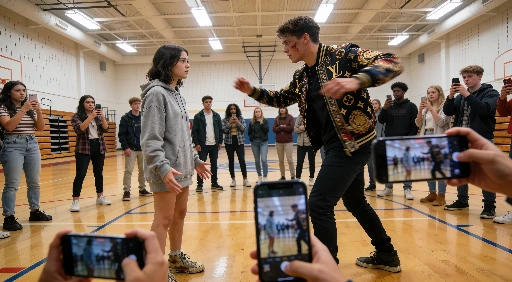
The Senator’s Son Thought The New Girl Was Easy Prey—Until His First Slap Missed, Her Elbow Found His Chest, And The Gym Learned She Was Raised In A Fight Camp.
The gym floor was freezing, thirty phones were pointed at my face, and Julian was laughing as he raised his hand. The coach turned his back to look at the scoreboard, the crowd cheered for my humiliation, and I kept my hands open for a reason nobody in that room understood.
My back was pressed against the cold bleachers, the heavy scent of sweat and floor wax filling my lungs. Julian stepped into my personal space, his expensive designer jacket rustling as he sneered down at me. To him, I was just the quiet new girl from out of state, the scholarship kid who wore thrift-store hoodies and never spoke up during gym class. For three weeks, his crew had dropped stolen items into my locker, left cruel notes on my desk, and whispered behind my back while the teachers conveniently looked the other way. Today, Julian decided whispers weren’t enough. He wanted a show, a video to post to his private group chat to prove that nobody could cross a senator’s son.
“You think you can just ignore me?” Julian hissed, his voice echoing off the high ceiling of the gym. “You don’t belong in this school, and you’re going to apologize to my friends on your knees right now.”
Around us, the circle of students tightened, their eyes glued to the screens of their raised smartphones. Nobody stepped in. Nobody told him to stop. Even Mr. Garrity, the gym teacher, was suddenly deeply interested in a stack of clipboards at the far end of the facility, completely ignoring the chanting crowd. I could feel the collective weight of their anticipation, the hunger for drama, the absolute certainty that I was about to break into tears. They didn’t see the way my feet shifted into a solid stance, or how my breathing remained perfectly steady despite the thumping in my chest. They only saw easy prey.

Julian took another step forward, his chest puffed out, fully expecting me to cower or beg like everyone else did when his family’s name was dropped. He didn’t know about the dusty, unheated warehouse in Ohio where I had spent every evening since I was seven years old. He didn’t know about the bruised shins, the endless conditioning drills, or the strict, unyielding rules of the fight camp where my uncle raised me. Most importantly, he didn’t know the first rule drilled into my head before I was ever allowed to lace up a pair of gloves.
Julian pulled his right hand back, his face twisting into a smug grin as he launched a fast, cruel slap aimed directly at my jaw.
— CHAPTER 2 —
The truth about Oakridge High was that the hierarchy wasn’t built on grades, talent, or character. It was built entirely on social insulation, and Julian Vance sat at the absolute apex of it. When my mom and I moved across the state line four months ago, following a bitter winter that saw her hours cut at the regional textile plant, Oakridge felt less like a public school and more like a private country club funded by municipal bonds. My mom had stayed up until two in the morning ironing a faded button-down shirt she’d found at a local charity shop, her hands trembling slightly as she smoothed out the collar. “You just keep your head down, Logan,” she’d whispered, wiping a stray strand of hair from her tired eyes. “You’re there for the curriculum. That school has a direct pipeline to the state university system. We can’t afford to waste this scholarship.”
I took those words to heart. On my very first morning, I walked through the double glass doors of the main entrance wearing an oversized dark blue hoodie, a pair of generic canvas sneakers, and a backpack with a slightly frayed shoulder strap. I didn’t want to be noticed. I didn’t look up at the massive glass trophy cases lining the foyer or the custom-designed banners celebrating the school’s three consecutive state football championships. I just wanted to find my homeroom, memorize my locker combination, and maintain the quiet, steady rhythm that had kept me safe my entire life.
But in a place like Oakridge, trying to look invisible is like throwing blood into a shark tank. The social predators here didn’t just target the vocal kids; they actively hunted the ones who walked with a soft stride, the ones whose parents didn’t show up to the booster club meetings in luxury SUVs, and the ones who spent their lunch hours sitting alone near the back wall of the cafeteria with a brown paper bag.
Julian Vance noticed me during third-period civics class on my second day. He didn’t look like a typical movie villain; he had a perfectly symmetrical face, expensive highlights in his carefully styled hair, and a varsity jacket with leather sleeves that smelled like wealth and privilege. His father was a prominent state senator who served on the education appropriations committee, meaning the school administration treated Julian not as a student, but as an irreplaceable asset. When Julian walked down the hallways, teachers smiled warmly and asked about his throwing arm. When Julian forgot his homework, it was treated as an administrative oversight rather than a disciplinary issue.
During that civics class, the teacher, Mrs. Albright, asked me to stand up and introduce myself to the room. I stood by my desk, my hands loosely at my sides, and said my name, keeping my voice level and brief. As I sat back down, I heard a low, deliberate snicker from the row behind me.
“Hey, New Girl,” Julian whispered, his voice just loud enough for the surrounding desks to hear. “Did your dad buy that backpack at a garage sale, or did you find it in a dumpster behind the state line?”
A ripple of quiet laughter echoed through the back of the classroom. My chest tightened for a fraction of a second, the familiar heat of human cruelty rising toward my neck, but I kept my eyes fixed squarely on the blackboard. I didn’t turn around. I didn’t glare. I just pulled out my notebook and began writing down the definitions of legislative branches. That silence, I would later realize, was my first mistake in Julian’s eyes. He didn’t just want to mock people; he wanted a reaction. He wanted the sudden look of panic, the stuttering defense, or the tearful glance toward the teacher. By denying him that satisfaction, I had inadvertently challenged his authority.
Within a week, the casual mockery transformed into an organized campaign of exclusion. It started in the cafeteria, a vast, noisy room with floor-to-ceiling windows that overlooked the pristine synthetic turf of the football stadium. The first time I tried to sit at an empty table near the vending machines, Julian’s tight end, a massive junior named Tyler, walked over and dropped a half-empty carton of chocolate milk right onto the center of the table, the dark liquid splashing across the clean plastic surface.
“Table’s reserved for varsity support,” Tyler said, leaning his heavy frame forward, his eyes blank and malicious. “Maybe try eating outside by the loading docks. Seems more your speed.”
When I picked up my paper bag and walked toward another table, I could feel the eyes of fifty different students tracking my movement. Nobody spoke up. Nobody offered me a seat. The popular girls at the cheerleading table covered their mouths with manicured hands, whispering into each other’s ears while glancing at my worn shoes. Even the kids who looked like they knew exactly what it felt like to be targeted—the quiet ones, the ones with thick glasses or mismatched clothes—deliberately turned their heads away, terrified that any association with me would drag them down into the same social gutter.
By the third week, the bullying moved into the digital space, where the real damage was done. It began with an anonymous group chat on Snapchat called “The Oakridge clean-up crew,” which quickly grew to include over two hundred students from my grade. Someone had taken a surreptitious photo of me from behind while I was standing at my locker, focusing on the small patch where the fabric of my backpack had started to split. The caption underneath read: Scholarship trash. Let’s see how many days she wears the same thrift-store hoodie before she realizes she’s a charity case.
The notifications didn’t just stay on my phone; they echoed in the physical world. Walking down the English hallway became a gauntlet of muffled laughter and whispered remarks. Kids I had never spoken to would deliberately bump into my shoulder as they passed, only to turn around and mockingly apologize to the “scholarship girl.” I could feel the invisible walls closing in around me, the intense social pressure designed to make me feel completely alone, completely unprotected, and completely worthless. Every morning, the knot in my stomach grew tighter as the school bus neared the Oakridge campus, but I never told my mom. I knew how hard she was working, pulling twelve-hour shifts just to make sure our rent check didn’t bounce, and I refused to burden her with the ugly reality of my daily life.
The turning point that led directly to the incident in the gym occurred on a rainy Tuesday morning in mid-October. I had walked into the girls’ locker room before gym class, expecting the usual cold shoulders and silent stares. Instead, as I opened the metal door to locker 114, a heavy stench of rotten eggs and locker room mildew hit me squarely in the face. Someone had pried open the vents at the top of my locker and poured a carton of sour cream and old eggs directly inside, soaking my gym uniform, my spare shoes, and the notebook containing three weeks of biology diagrams.
A chorus of giggles erupted from the corner of the room where Julian’s girlfriend, Chloe, was sitting on a wooden bench with three other varsity cheerleaders. They all had their phones out, the small green recording indicators glowing on their screens as they waited for my breakdown.
“Oh look,” Chloe said, her voice dripping with fake sympathy. “Looks like someone left their lunch in there too long. Maybe the charity office can buy you a new binder, Logan.”
My hands shook slightly as I reached into the locker, the cold, slimy residue coating the tips of my fingers as I pulled out my ruined notebook. The pages were completely translucent from the moisture, the ink of my careful handwritten notes running into illegible blue streaks. For a single, dangerous second, the discipline I had spent years cultivating threatened to slip. I wanted to turn around, grab the heavy metal combinations lock in my hand, and throw it straight through the screen of her phone. The anger was a physical weight in my chest, hot and demanding.
Instead, I closed my eyes, took a deep, rhythmic breath through my nose, and counted to four, just as my uncle had taught me during the grueling conditioning sessions in Ohio. Control the breath, control the room, he would always say. The moment you let them see your anger, you’ve handed them the keys to your house.
I pulled a few paper towels from the dispenser, wiped my hands cleanly, and walked out of the locker room to find Mr. Garrity, the head gym coach and athletic director. He was standing near the equipment shed, blowing his whistle to assemble the class for fitness testing.
“Mr. Garrity,” I said, keeping my voice as calm and professional as possible. “Someone vandalized my locker. My books and uniform are ruined.”
Mr. Garrity didn’t even look up from his clipboard. He clicked his pen twice, his eyes scanning the names of the varsity football players who were currently joking around near the basketball hoops. “Look, Logan,” he said, his tone flat, laced with deep irritation that I was interrupting his schedule. “I don’t have time to police locker room drama. Girls are always bickering about something. Just go get a spare penny from the bin and line up for the shuttle run. Let’s not make a mountain out of a molehill here.”
“It wasn’t bickering, sir,” I replied, standing my ground, my voice dropping an octave. “It was property damage.”
He finally looked at me, his eyes narrowing with a stern, warning glare that clearly told me to drop the subject if I wanted to survive the semester. “I said drop it, kid. Boys will be boys, girls will be girls. Both sides always have a story, and I don’t care to hear either of them. Move it.”
Behind him, standing near the three-point line, Julian Vance was watching the entire exchange. When he saw Mr. Garrity dismiss me with a wave of his hand, a massive, triumphant grin spread across his face. He looked at his friends, tapped Tyler on the shoulder, and pointed directly at me. He had just received absolute confirmation from the highest authority in the room that I was completely fair game. The school wouldn’t protect me. The teachers wouldn’t save me. In their eyes, I was a temporary outsider who didn’t matter, and Julian was royalty.
As I walked toward the equipment bin to pull out a stained, oversized mesh pinney, Julian caught my eye and mouthed four distinct words across the hardwood floor: You’re next, charity case.
— CHAPTER 3 —
The ride home from school on that rainy Tuesday afternoon felt entirely detached from reality. I sat in the fifth row of the yellow bus, my forehead pressed against the cold, vibrating window pane as the heavy raindrops smeared across the glass, obscuring the familiar, sterile suburban landscape of Oakridge. In my lap, wrapped securely in two plastic grocery bags I’d salvaged from the cafeteria garbage bin, lay the damp, smelling ruins of my biology binder. My fingertips still felt sticky from the sour cream and curdled eggs that Julian Vance’s inner circle had poured through the vents of my locker. I didn’t open my phone. I didn’t look at the screen because I already knew what was waiting for me on the network. The group chat would be buzzing with the video Chloe had taken, each notification a digital brick thrown at a wall designed to keep me completely isolated.
When the bus finally squeaked to a heavy halt at the corner of Elm Street and 4th, nearly two miles away from the manicured lawns of the country club district, I stepped down into the grey, humid air. Our neighborhood didn’t have sidewalks or custom stone entryways. The small, single-story ranch houses were built in the late fifties for factory workers, their aluminum siding faded by decades of harsh Midwestern winters and humid summers. Many of them had chain-link fences that had rusted at the base, and overgrown patches of crabgrass that poked through the cracks in the asphalt driveways. It was a neighborhood of night-shift mechanics, retail clerks, and people who measured their lives by the proximity of their next utility bill.
I walked down the narrow gravel driveway toward our house—a small, weathered white structure with peeling paint around the window frames that my mother rented from an out-of-town landlord who never answered his phone. As I stepped onto the small wooden porch, the screen door groaned on its rusted hinges.
The interior of the house was quiet, smelling faintly of lavender floor cleaner and the cheap, instant coffee my mother drank to stay awake during her double shifts at the regional textile plant. She wasn’t home. Her shift didn’t end until eight in the evening, which meant I had exactly four hours to clean my clothes, hide the damaged school supplies, and scrub the smell of public humiliation off my skin before she walked through the front door with her shoulders slouched from fatigue. I could not let her see what was happening at Oakridge High. She had spent the last three years scrimping, saving, and working herself into early arthritis just so we could move into this school district, convinced that the high graduation rate and university pipeline would guarantee me a life outside the factories. If she knew that her sacrifice had dropped me directly into a social meat grinder, it would break her heart. And I refused to be the reason she broke.
After throwing my ruined gym uniform into the old washing machine in the basement and using a wet rag to carefully separate the salvageable pages of my notes, I walked out the back door. The rain had cleared into a heavy, low-lying mist that hung over the small backyard. At the very edge of our property, right against a thick line of overgrown maples, stood an old, detached garage. Its wooden double doors were warped from age, held together by a heavy iron latch and a brass padlock that had lost its shine years ago.
This garage didn’t contain a car, lawnmowers, or boxes of holiday decorations. It belonged to my uncle, Thomas Hale, though everyone in our old town simply called him Master Hale.
My uncle was a retired Marine Corps veteran who had spent twelve years as a lead combatives instructor at Camp Lejeune before a piece of stray shrapnel in a forgotten valley overseas took a portion of his left calf and forced him into an early retirement. He was a broad, quiet man with short-cropped grey hair, eyes the color of a winter sky, and a voice that never needed to rise above a conversational murmur to command absolute, immediate obedience. When my father passed away when I was six, leaving us with nothing but a mountain of medical debt and a stack of unpaid bills, Uncle Thomas had moved into the spare room of our old apartment. He didn’t offer empty words of comfort or soft reassurances. Instead, on the morning of my seventh birthday, he walked me out into the small yard, handed me a pair of plain canvas hand wraps, and pointed at the dirt.
“Logan,” he had said, his voice level and steady as a heartbeat. “The world is full of people who think that because you are quiet, you are empty. They will think your silence is an invitation to take what is yours. I am going to teach you how to hold your ground, but you need to understand something before we ever begin: force is a ledger. You only open it when there is no other way to balance the room.”
For eight years, that detached garage became my sanctuary and my crucible. The concrete floor was covered in thick, interlocking high-density foam mats that smelled permanently of pine disinfectant, leather, and dried sweat. There were no mirrors on the walls, no high-tech training equipment, and no modern athletic branding. The only decorations were a heavy, sixty-pound canvas punching bag hanging from a reinforced central rafter, two wooden training posts wrapped in thick hemp rope, and a small, framed black-and-white photograph of my uncle’s old Marine detachment standing in the dust of a foreign base.
When I pushed the heavy wooden door open, the old hinges let out a low metallic scrape. Uncle Thomas was already there, sitting on a low wooden stool near the back wall, carefully cleaning a set of leather focus mitts with an oil-soaked cloth. He didn’t look up immediately when I entered, but his eyes tracked the way I moved, noting the slight stiffness in my shoulders and the way my chin stayed tucked slightly lower than usual.
“You’re carrying weight, Logan,” he said softly, his deep voice cutting through the quiet hum of the old refrigerator in the corner. “Change your clothes. Put on the wraps.”
I didn’t argue. I went into the small corner alcove, changed into a plain white t-shirt and a pair of worn black athletic shorts, and began winding the long, coarse cotton wraps around my knuckles, weaving them carefully between my fingers and securing them tightly around my wrists. Every movement was a ritual I had performed thousands of times. The rough texture of the fabric against my skin always had a grounding effect, pulling my mind away from the chaotic noise of Oakridge High and focusing it entirely on the physical reality of the mat.
When I stepped onto the foam surface, Uncle Thomas stood up. Despite his permanent limp, he moved with an incredible, fluid efficiency that made him seem completely unburdened by his injuries. He didn’t pick up the focus mitts. Instead, he walked over to the center of the mat, stood directly in front of me, and tucked his hands loosely behind his back.
“Square up,” he commanded.
I dropped into my base stance—feet shoulder-width apart, knees slightly flexed, weight distributed perfectly balanced fifty-fifty between the balls of my feet. My hands came up instinctively, not clenched into aggressive fists, but held open at chest height, palms facing forward in a natural, non-threatening posture that looked to an untrained eye like a gesture of submission.
“What is the first rule of the camp, Logan?” he asked, his blue eyes locking onto mine with an intensity that made the walls of the garage seem to disappear.
“Never strike first, sir,” I replied instantly, the words drilled into my subconscious through years of repetition.
“Why?”
“Because anger is a blindfold, sir. The person who swings first out of pride or malice has already lost control of their balance, their breathing, and their situational awareness. They are fighting the image in their head, not the reality in front of them.”
Uncle Thomas nodded once, a slow, deliberate movement. “And what do you do when the environment changes? When the exit is blocked, and the pressure becomes physical?”
“De-escalate first, keep the hands open to map the distance, absorb or redirect the initial momentum, and only apply enough leverage to neutralize the immediate threat. The moment the threat stops moving forward, the ledger is closed.”
“Show me,” he said.
Without another word, Uncle Thomas stepped forward. Despite his age, his movement was explosive. He lunged with a heavy, open-handed left hook aimed directly at the side of my head, simulating a wild, aggressive street sweep. I didn’t flinch. My eyes didn’t track his hand; they stayed fixed on his chest, reading the subtle shift of his shoulders before the blow ever traveled halfway.
I slipped inside the trajectory, ducking my chin and raising my right forearm to absorb the residual impact while my left hand automatically checked his hip, disrupting his forward balance. My movement wasn’t flashy or cinematic; it was a tight, compact displacement that left him swinging through empty air while I occupied the space he had just vacated.
“Again,” he muttered, turning on his good leg and coming at me with a rapid combination—a straight right jab followed by an attempt to grab my collar.
I stepped off the central line of attack, my feet moving in precise diagonal angles. I parried the jab with the heel of my palm, twisting my torso to let the force glance harmlessly past my shoulder. When his large hand reached out to grip my t-shirt, my fingers wrapped instantly around his wrist, using a simple, leverage-based spiral technique that used his own reaching momentum to turn his arm outward, locking his elbow out for a fraction of a second without breaking the joint. I didn’t follow up with a strike. I didn’t try to trip him. I simply held the position, keeping him balanced on his toes until he relaxed his frame.
He stepped back, releasing the tension, his face completely expressionless. “Your hands are moving well, Logan. But your mind is cluttered. You’re thinking about something that happened outside this room. The technique is clean, but the intent is defensive out of fear, not defensive out of discipline. Who was it today?”
I looked down at the blue foam mats, the blue ink stains from my ruined biology notes flashing in my mind’s eye. “A kid named Julian Vance. He’s the senator’s son. He… he had his friends ruin my books today. The gym teacher told me to drop it because it was just school drama.”
Uncle Thomas walked over to the wooden stool, picked up his oil cloth, and sat down. He didn’t offer a lecture on the unfairness of the world. He didn’t tell me he was going to go to the principal’s office to complain. He knew exactly how systems worked; he had spent a lifetime dealing with officers who had titles but no dirt on their boots.
“A man who relies on his father’s name to build a wall around his behavior is an insecure man, Logan,” Uncle Thomas said quietly. “He builds that wall because he knows that if he stands on the bare earth by himself, he has no weight. He uses a crowd to make himself feel large. He will keep pushing you because your silence makes him feel like he’s winning.”
“He told me I was next,” I whispered, the shame of my silence in the gym room finally leaking into my voice. “He told me I’m going to kneel in front of his friends during the fitness testing tomorrow. Everyone has their phones out, Uncle Thomas. They’re all waiting for it. They want to see me crawl.”
Uncle Thomas looked up, his eyes cold and hard as flint. “You don’t crawl for anyone, Logan. But you don’t fight for pride either. If he comes at you tomorrow, you remember where you were raised. You remember the hundreds of hours on these mats. You keep your hands open, you give him every opportunity to walk away, and you look for the exit. But if he blocks that door, and if he puts his hands on you first, you close the ledger. Do you understand me?”
“Yes, sir,” I said, my voice hardening as the lingering fear from the afternoon began to transform into something solid, calm, and deliberate.
“Good,” Uncle Thomas said, standing back up and raising the leather focus mitts. “Now, give me fifty straight repetitions on the slip-and-counter. Focus on the footwork. If your heels touch the ground, you’re dead in the water. Move.”
For the next three hours, the small garage echoed with the rhythmic, explosive thwack of canvas and leather. My muscles burned, my lungs screamed for air, and sweat poured down my face, stinging my eyes, but I didn’t stop. With every repetition, the image of Julian’s smug face, the sound of Chloe’s laughter, and the dismissive wave of Mr. Garrity’s hand were systematically systematically dismantled and replaced by the raw, unyielding physics of self-defense. I wasn’t training to hurt anyone. I was training to survive the environment they had created.
When we finished, the sky outside the small garage windows had turned a deep, bruised purple. My arms felt like lead, and my hand wraps were soaked through, but the knot that had occupied my stomach for the last three weeks was completely gone. In its place was a quiet, cold clarity.
Uncle Thomas handed me a clean white towel and a bottle of water. As I walked toward the door, his voice caught me just as my hand touched the brass handle.
“Logan,” he said softly. “The most difficult part of the training isn’t the physical impact. It’s the restraint. When a small man attacks you, he wants to drag you into his chaos. He wants you to become angry like him. You stay calm. You control the distance. And when it’s over, you walk away. That is where the power lives.”
I nodded, stepping out into the cool, damp night air. As I walked back toward the dark house, my canvas sneakers crunching softly on the gravel driveway, I could feel the invisible weight of the upcoming morning waiting for me at Oakridge High. The school thought I was an easy target because I had spent weeks absorbing their insults without a word. They thought my poverty meant weakness, and they thought my isolation meant I had no backup. They had absolutely no idea that I was carrying the discipline of a fight camp into their arena, and that the quiet girl they had been hunting was about to show them exactly what happens when the prey refuses to run.
— CHAPTER 4 —
By Wednesday morning, the atmosphere inside the brick hallways of Oakridge High had shifted from an undercurrent of casual hostility to an overt, thick tension that felt almost suffocating. The rain had cleared, leaving behind a crisp, biting autumn chill that frosted the windows of the school buses as they pulled into the drop-off lane. I walked through the double glass doors of the main entrance with my backpack slung over one shoulder, my hood pulled down low, and my eyes fixed securely on the worn tiles beneath my feet. I didn’t need to look up to know that the trap was already being set. The digital trail left by Chloe’s video from the previous afternoon had done its job with terrifying efficiency. My phone, which sat entirely muted and dark in my front pocket, had vibrated continuously against my thigh during the bus ride, a steady pulse of anonymous notifications from the “Oakridge clean-up crew” group chat.
As I made my way toward my locker, the students standing in front of the rows of metal doors didn’t just whisper; they openly stared, stepping back to create a wide, mocking perimeter around me. It was the classic mechanics of a high school exile. To them, I wasn’t just a quiet scholarship student anymore; I was a marked target, a charity case who had dared to complain to an administrator about the sacred inner circle of the varsity athletic program. By asking Mr. Garrity to address the property damage in my locker, I had committed the ultimate sin in the Oakridge social hierarchy: I had broken the unwritten code of silent submission.
“Look, there she is,” a junior varsity soccer player muttered to his friend as I passed the trophy case, his voice entirely unbothered by the proximity of my ears. “The snitch. Let’s see if she cries to the principal today when Julian catches up with her.”
“She won’t have time to cry,” his friend replied, letting out a low, cruel chuckle. “Chloe said Julian’s got something special lined up for the third-period fitness block. The whole team’s already tracking it.”
The social pressure didn’t just come from the athletes or the popular girls; it permeated every single layer of the student body. As I neared the junior hallway, I saw Sarah standing near her locker. Sarah was a quiet sophomore who wore thick, wire-rimmed glasses and always kept a heavy stack of advanced placement textbooks clutched against her chest like a shield. She had been the only person to offer me a spare pen on my first day of school, and for a few brief moments during those initial weeks, I thought we might find a quiet, shared solidarity in our mutual desire to remain completely invisible.
As our paths crossed in the crowded hallway, Sarah’s eyes locked onto mine for a split second. I saw the sudden flash of genuine sympathy in her expression, the slight, involuntary movement of her hand as if she wanted to reach out and warn me about what was coming down the hall. But before she could make a sound, Tyler, the massive varsity tight end, walked past, his heavy leather varsity jacket brushing against her shoulder. Sarah instantly flinched, her shoulders dropping as she pulled her textbook closer to her chin and deliberately fixed her gaze onto the floor, utterly terrified that a single nod of recognition toward me would paint a permanent target on her own back. She didn’t dare help. In a school like Oakridge, survival meant watching the execution without ever looking the executioner in the eye.
The true source of Julian Vance’s absolute impunity, however, became blindingly clear during the ten-minute homeroom period before the morning bells rang. I was sitting at my desk near the windows, staring out at the grey athletic fields, when the heavy oak door opened and Mr. Henderson, the vice principal, walked into the room. He didn’t look like a traditional disciplinarian; he was a tall, smooth-talking man in a tailored grey suit who spent most of his time organizing high-dollar charity galas and school booster auctions. He walked straight toward the back row where Julian was sitting surrounded by three of his starting linemen.
“Julian, son,” Mr. Henderson said, his voice carrying a warm, booming familiarity that was completely different from the sharp, accusatory tone he used when speaking to the scholarship students. “I just got off the phone with your father. The Senator mentioned that the new stadium expansion bill is moving into the final committee vote this Friday. He wanted me to remind you that the local news crew will be down here during the afternoon practice to do a profile on your scholarship nomination.”
“Thanks, Mr. Henderson,” Julian replied, his voice smooth, perfectly polished, and filled with the absolute certainty of a kid who knew his family’s financial footprint practically owned the foundation of the building. “My dad said he’s making sure the capital grant includes the new training facility for the varsity squad. We’re going to make sure the school looks great on camera.”
Mr. Henderson beamed, reaching down to clap a heavy, supportive hand onto Julian’s shoulder. “That’s exactly what we like to hear, Julian. You’re a leader in this community, both on and off the turf. If you ever have any… distractions or minor issues here at school that might interfere with that profile, you just come straight to my office. We know how to handle the noise around here.”
As he spoke the word “distractions,” Mr. Henderson’s eyes traveled slowly across the classroom, his gaze landing directly on me for three long, chilling seconds. There was no warmth in his expression, no sense of administrative justice or pastoral care. It was a cold, deliberate warning. The school didn’t care about property damage, cyberbullying, or the systematic torment of a low-income outsider. To them, I was a statistical anomaly, a line-item entry on a state diversity report that could be easily erased if I threatened the multi-million-dollar capital campaigns funded by Senator Vance’s political allies. The protection Julian enjoyed wasn’t because he was a good student or an innocent kid; it was because his existence was a valuable commodity to the institution.
When the homeroom bell finally rang, signaling the transition to the mid-morning blocks, the hallway felt like an active trap. I walked toward the gymnasium for the third-period physical education class, my heart maintaining a slow, deliberate cadence that had nothing to do with the anxiety around me and everything to do with the rhythm Uncle Thomas had beaten into my muscle memory. When the perimeter tightens, you don’t panic, his voice echoed in my head, clearing out the clutter of the whispering voices. You map the exits, you find the corners, and you keep your weight over your center.
As I crossed the threshold into the main gym, the heavy double doors clicked shut behind me with a solid, metallic finality. The vast room was already alive with the sounds of squeaking sneakers and echoing shouts, but as soon as my canvas shoes touched the polished hardwood, a sudden, unnatural quiet ripple began to spread through the stands. Over thirty students were already gathered near the western wall where the heavy leather fitness mats had been dragged out for the state-mandated physical testing.
Mr. Garrity was standing near the scorer’s table, his metal whistle dangling from a black lanyard around his neck, his eyes buried in a stack of performance charts. He didn’t look up when I approached the equipment bin, entirely content to let the social dynamics of the room resolve themselves without his interference.
Julian Vance was already standing in the center of the primary testing circle, his varsity jacket dropped onto the bench, revealing his broad, athletic build beneath a custom training shirt. He was tossing a heavy medicine ball between his hands, his eyes locked onto the gym entrance the exact moment I stepped inside. Beside him, Chloe had her smartphone already raised to chest level, the screen angled perfectly toward my position, her fingers resting lightly on the record button. The inner circle had formed a loose, impenetrable semi-circle around the bleachers, effectively cutting off the direct path back to the locker room exits.
“Alright, listen up,” Mr. Garrity yelled, his voice echoing off the steel rafters as he blew a short, sharp blast on his whistle. “We’re running the high-performance shuttle drills and the baseline compliance testing today. I want full effort from everyone. No slacking, no drama. Let’s get through the list.”
He began reading off the names from his clipboard, his voice flat and monotonous. With every name called, a student would step forward, complete the drill, and step back into the crowd, but nobody was actually watching the athletic performance. The entire room was tracking the distance between Julian and me. I stood near the edge of the wooden bleachers, my hands resting loosely inside the front pocket of my oversized grey hoodie, my fingers uncurled, soft, and completely relaxed.
As the list neared the letter L, Julian dropped the medicine ball with a heavy, deliberate thump that vibrated through the floorboards. He walked directly toward the center of the main mat, his eyes fixed on me with a predatory intensity that made the surrounding crowd instantly pull out their phones. A low, excited murmur swept through the bleachers as students began jockeying for a clear line of sight, their screens raised like digital shields to record the impending spectacle.
“Logan,” Mr. Garrity called out, his eyes still fixed entirely on his paperwork. “You’re up for the baseline compliance drill. Get to the line.”
I stepped forward, my stride even, measured, and entirely unhurried. As I reached the edge of the blue mat, Julian stepped directly onto the white boundary line, his massive frame completely blocking the path to the testing marker, his chest puffed out as he looked down at me with an expression of pure, unadulterated malice. The trap was sprung, the exit was closed, and the entire gymnasium was waiting for the first tear to fall.
— CHAPTER 5 —
The high ceiling of the Oakridge High gymnasium seemed to trap the heat of thirty bodies, condensing the humid, nervous energy of the room into something thick and heavy. The overhead fluorescent tubes hummed a low, erratic note, casting a cold, institutional glare across the polished maple floorboards. Julian Vance stood directly on the white boundary line of the main testing circle, his boots planted wide, his broad shoulders squared, and his leather-sleeved varsity jacket tossed carelessly onto the bench behind him. He looked like an apex predator who had spent his entire life being told that the forest belonged to him. Beside him, Chloe kept her smartphone raised at chest level, her manicured fingers steady against the case, the green recording light reflecting in her cold, expectant eyes. The circle of students had tightened into an absolute, unyielding semi-circle, their boots and sneakers forming a human wall that completely blocked the direct path back to the safety of the locker room exits.
“Get on your knees, Logan,” Julian said, his voice dropping into a low, jagged whisper that was perfectly designed to carry to the front rows of the bleachers but remain below the official radar of the teacher’s desk. “You think you can just wander into this school, stink up our hallways, and then go crying to the athletic director about your little notebook? You’re going to apologize to Chloe, and you’re going to do it right now where everyone can see it.”
I stood exactly two feet away from him, my hands resting loosely inside the front pocket of my oversized grey hoodie. My fingers were uncurled, soft, and completely relaxed against the fabric. I could feel the cold draft from the ventilation ducts hitting the back of my neck, but my core remained perfectly still. I didn’t pull my hands out. I didn’t clench my fists. I didn’t let my chin drop into a defensive tuck yet. I just looked at him, my eyes fixed squarely on the small V-notch where his collarbones met his throat—the precise anatomical anchor point Uncle Thomas had taught me to watch to read a man’s balance before he ever commits to a movement.
Around us, the room was a symphony of digital anticipation. I heard the distinct, rhythmic click-click-click of smartphone lenses adjusting their focus. I heard the muffled, eager snickers of the varsity linemen who stood shoulder-to-shoulder behind Julian, their heavy frames casting long, distorted shadows across the hardwood floor.
“Do it, charity case,” Tyler muttered from the back, his voice laced with the casual cruelty of someone who had never been held accountable for his weight. “We don’t have all morning. Kneel down so we can get this on the feed.”
To my left, about ten feet away near the water fountains, I caught a brief glimpse of Sarah. Her hands were wrapped so tightly around her advanced placement textbooks that her knuckles had turned a stark, bloodless white. Her lower lip was trembling slightly, her chest heaving with a shallow, terrified rhythm. She wanted to yell for help. I could see it in the frantic movement of her eyes, the way her torso leaned slightly toward the main corridor doors. But she stayed frozen. She knew that if she opened her mouth, if she shattered the silence of the crowd, the multi-headed beast of the Oakridge social hierarchy would simply turn its teeth toward her next. She stayed silent, a passive witness to an execution she hated but lacked the power to stop.
At the far end of the facility, near the equipment storage cages, Mr. Garrity was systematically checking the pressure on a rack of black basketballs. He was less than forty yards away. The echoing acoustics of the gymnasium meant he could undoubtedly hear the unnatural stillness of the student body, the rhythmic chanting of the linemen, and the thick, confrontational weight of Julian’s voice.
But he didn’t turn his head. He clicked his metal pen against the clipboard with a slow, deliberate cadence, his back turned firmly to the blue mats. He had already checked the athletic booster donations for the upcoming season; he knew exactly whose names were stamped on the bottom of the multi-million-dollar fieldhouse grant. To him, this wasn’t an assault; it was just a localized pocket of “high school drama” that would resolve itself the moment the quiet kid submitted to the natural order of the building.
“I’m not kneeling for you, Julian,” I said, my voice remarkably flat, devoid of any anger, fear, or theatrical bravado. It was the simple statement of a physical fact, like describing the color of the walls or the temperature of the floorboards. “Step aside so I can complete the baseline compliance drill.”
A sharp, collective intake of breath rattled through the bleachers. The crowd hadn’t expected a response; they had expected a collapse. Julian’s face instantly flushed a deep, dangerous crimson, the veins along his temple bulging against his pristine skin as the social insulation he had relied on his entire life suddenly felt a hairline crack. To be questioned by an outsider in front of his entire support structure was a mortal sin.
“What did you just say to me?” he hissed, stepping so close I could smell the expensive mint gum on his breath, his large hand reaching out to grab the thick cotton fabric of my hoodie, his fingers bunching the material tightly against my throat as he prepared to force me downward by raw, uncoordinated mass. “You don’t tell me what to do. You’re nothing here.”
The physical contact was the official opening of the ledger. The perimeter had vanished, the exits were blocked, and the primary threat had initiated physical confinement. As his fingers tightened around the cloth, the chaotic noise of the Oakridge gymnasium simply ceased to exist in my mind. The whispering students, the glowing smartphone screens, and the dismissive back of the gym coach were all washed away, replaced by the cool, geometric clarity of the blue foam mats in my uncle’s garage. The training didn’t make me angry; it made me hyper-aware. I felt the precise direction of Julian’s forward momentum, the unstable distribution of his weight over his heels, and the volatile, reckless rage that guided his hands. He thought he was starting a humiliation video; he had no idea he had just walked directly into a controlled environment managed by a fight camp discipline that had been refined since I was seven years old.
— CHAPTER 6 —
The high ceiling of the gym seemed to trap the collective breath of thirty people as Julian’s hand bunched the fabric of my grey thrift-store hoodie. The cold metal of his heavy state-championship ring pressed hard against the side of my collarbone, a sharp, biting reminder of the absolute social insulation that backed him up. The green recording indicator on Chloe’s phone screen was steady, hovering just four feet away to capture every line of agony on my face. Behind Julian, the solid line of varsity offensive linemen shifted their weight, their heavy athletic sneakers squeaking on the polished maple floorboards with a wet, rhythmic sound that resembled a countdown.
“I told you to get down on the floor, charity case,” Julian hissed, his grip tightening until the cheap cotton fibers began to strain against my throat. “You don’t get to speak to me like a person. You’re a guest in this school, and your mother is a guest in this town. Apologize to my girlfriend before I make you look like a complete joke on every feed in this state.”
My hands remained open, floating exactly at chest height inside the loose pouch of my front pocket. My thumbs were uncurled, my palms soft, mapping the exact trajectory of his shoulders through the loose fabric of his training shirt. The heat of his anger radiated off him in waves, an unstable, violent pressure that had no core, no balance, and no discipline. For eight years in that damp, unheated Ohio garage, Uncle Thomas had thrown heavy, leather focus mitts at my skull while shouting commands designed to break my focus, teaching me to look through the noise of the room and read the physical grammar of human motion. An angry man is a blind man, Logan, his voice echoed through the hollow spaces of my skull, completely drowning out the rhythmic chanting of the varsity players behind the boundary line. He doesn’t see the floor, he doesn’t see the corners, and he doesn’t see his own weight. He only sees the target. Let him fall into his own hole.
“Take your hand off my jacket, Julian,” I said, my voice maintaining a flat, level cadence that lacked even a trace of fear, bravado, or theatrical defiance. It was a simple statement of legal and physical boundaries, spoken with the quiet authority of a person who knew exactly where the bare earth met the soles of her shoes.
A low, collective murmur of disbelief rippled through the front row of the bleachers. The students who had been jockeying for a better recording angle shifted their devices, their faces twisting into expressions of deep, dark curiosity. They hadn’t come to see a contest; they had come to watch a public execution, a standard Oakridge ritual where the poor kid from the industrial district dropped to her knees to preserve the comfortable status quo of the booster club. By refusing to follow the script, I was forcing them to witness something unpredictable, and in a building governed by manufactured social certainty, the unpredictable was terrifying.
Julian’s eyes narrowed into tiny, dark slits of pure, unadulterated malice, his face flushing a dangerous, dark violet as the hairline crack in his authority suddenly split wide open. “You’re done,” he growled, his knuckles turning a bloodless white as he pushed his weight forward, using his raw, uncoordinated athletic mass to drive me backward against the wooden support structures of the bleachers.
He didn’t just push. He pulled his right hand back, his fingers curling into a heavy, unscientific fist aimed directly at my jaw—a fast, cruel sweep designed to break my jaw and end the resistance in front of his friends.
The physical impact was the official opening of the ledger, the precise moment the environment became completely hostile and all safe avenues of retreat were entirely closed. As his fist traveled through the humid air of the gym, the chaotic noise of the room—the chanting linemen, the whirring ventilation fans, the distant click of Mr. Garrity’s pen—simply ceased to exist. The world slowed down to the precise, rhythmic tempo of the blue foam mats. I didn’t swing back. I didn’t react out of anger, pride, or a desire for retaliation. I shifted my weight forty-five degrees off the central axis of his attack, my left foot slipping back into a deep, grounded diagonal stance that used his own forward momentum against him.
I raised my right forearm in a tight, compact defensive frame, absorbing the residual shock of his punch against the thick muscle of my outer arm rather than letting it connect with my bone. The impact was heavy, smelling of sweat and leather, but it didn’t disrupt my center. Before his hand could recover its trajectory, my left palm shot forward, checking the heavy muscle of his hip to disrupt his balance and halt his forward drive.
Julian stumbled slightly, his heavy cross-training shoes slipping on the slick varnish of the hardwood floor as his center of gravity drifted dangerously over his toes. He looked stunned, his breath coming in a short, ragged gasp as his brain struggled to process the fact that the quiet girl in the oversized hoodie hadn’t fallen to the floor.
“What are you doing?” he roared, spinning his torso around with a wild, desperate lunging movement, both of his large hands reaching out to grab my hair or tackle my waist to drag me down into the dirt by sheer physical force.
He rushed forward again, his heavy boots pounding against the maple boards, creating a real, violent exchange that left no room for hesitation. This was the moment the training took over completely—not as a weapon of cruelty, but as a system of absolute, unyielding restraint. I didn’t back up into the bleachers. I kept my hands high and open, my fingers tracking his wrists as he lunged.
As his right hand reached for my shoulder, my fingers wrapped instantly around his wrist with a tight, leverage-based spiral grip. I twisted my torso to the left, using his heavy, rushing momentum to turn his arm outward, locking his elbow extension out for a fraction of a single beat without breaking the joint. At the same instant, my right foot slipped behind his heel, creating a solid, immovable physical barrier.
It wasn’t a cinematic kick or a dramatic strike. It was a compact, geometric displacement of mass. I leaned my shoulder into his chest, applying just enough targeted leverage to redirect his forward energy over my extended leg.
Julian’s feet left the floorboards with a heavy, ungraceful sweep. His large, athletic frame traveled through the air for a brief, frozen second before coming down against the blue fitness mat with a massive, hollow thud that vibrated through the floorboards all the way to the scorer’s table. The force of the impact knocked the wind clean out of his lungs, leaving him flat on his back, his mouth open like a fish out of water as he gasped for air, his expensive highlights disheveled against the dusty vinyl.
I didn’t follow him down. I didn’t drop my knee into his chest, I didn’t clench my fists, and I didn’t stand over him with a triumphant, mocking glare. I stepped back two feet, clearing the boundary line of the mat, and dropped my hands back into the loose, open pocket of my grey hoodie. My breathing remained perfectly steady, my pulse quiet, my center completely unbothered by the violence he had tried to bring into the room. The ledger was closed. The threat had stopped moving forward, and the balance of the room had been restored through the simple, indisputable physics of self-defense.
A heavy, suffocating silence dropped over the Oakridge High gymnasium like a lead weight. The rhythmic chanting of the varsity linemen died instantly in their throats, their large mouths hanging open in various states of unpolished shock as they looked from the quiet scholarship girl to their captain lying helpless on the floor.
To my left, Chloe’s smartphone lowered slowly, her manicured fingers trembling against the plastic case as she realized that the video she had been recording for the group feed wasn’t a record of my humiliation, but an explicit, undeniable archive of Julian’s complete failure. The green light was still blinking, but the power had entirely shifted.
Across the circle, near the water fountains, Sarah was staring at me with her eyes wide behind her thick glasses, her advanced placement textbooks completely forgotten in her grip. For the first time in four months, the terrified, slouched posture of her shoulders vanished, replaced by a sudden, sharp look of disbelief that slowly bloomed into a quiet, tentative sense of awe. She wasn’t looking at a victim anymore. She was looking at someone who had stood on the bare earth and held her ground against the heaviest weight the school could throw at her.
At the far end of the facility, the sharp, metallic sound of a clipboard hitting the floorboards echoed off the steel rafters. Mr. Garrity had turned around. His face had transformed from a state of practiced, professional irritation to an expression of absolute, unmitigated shock. His whistle hung uselessly from his lanyard, his mouth twitching slightly as his eyes tracked the blue mat where his star quarterback was still struggling to draw a clean breath. He could no longer call it locker room drama. He could no longer pretend both sides were equally wrong, because he had seen the exact moment Julian Vance swung his fist, and he had seen the exact moment the quiet girl stopped him without ever swinging back.
Julian slowly rolled onto his side, his breath returning in ragged, painful wheezes as he used the edge of the bleachers to pull his heavy frame up. His designer shirt was covered in white dust from the mats, his face pale, his eyes completely hollowed out by the sudden, terrifying realization that his family’s name, his father’s title, and his sports status had no physical weight against the discipline of a fight camp. He looked up at me, his lip trembling slightly with an expression that was no longer malicious, but deeply, profoundly frightened.
“I was defending myself,” I said, my voice echoing clearly through the silent gym, every word crisp and deliberate as I looked straight into Mr. Garrity’s stunned eyes. “Check the security cameras. They have a timestamp.”
— CHAPTER 7 —
The atmosphere inside the main administrative corridor of Oakridge High at two o’clock that afternoon was entirely different from the noisy, chaotic energy of the morning transition blocks. The long, carpeted hallway that led to the executive offices was lined with dark wood paneling and framed portraits of past board members, the quiet punctuated only by the rhythmic, muffled ticking of a large grandfather clock near the reception desk. I sat on a low, vinyl bench outside the vice principal’s office, my hands folded loosely in my lap, my oversized grey hoodie still smelling faintly of the floor wax and old vinyl from the gymnasium mats. I wasn’t shaking. I didn’t look at the floor. My chin was held level, my eyes fixed squarely on the frosted glass door that bore the name of Mr. Henderson in neat, gold lettering.
Inside that office, the voices were loud, jagged, and increasingly desperate. Through the thick wood of the door, I could distinctly hear the booming, aristocratic tones of Senator Vance, who had arrived on campus forty minutes ago in a black luxury sedan with government plates, his personal attorney trailing closely behind him with a leather briefcase clutched in his hand.
“This is an administrative failure, Henderson!” the Senator roared, his voice rattling the glass panels of the door. “My son is a prospective division-one athlete. He has a national profile review scheduled for this Friday. You let some… some scholarship vagrant from out of state assault him in the middle of a mandatory fitness class? I don’t care what the internal reports say; I want her out of this building by sunset!”
“Senator, please, keep your voice down,” Mr. Henderson’s voice replied, his usual smooth, polished confidence completely replaced by a high-pitched, stuttering panic. “We are doing everything we can to manage the… the public relations aspect of this situation. But the circumstances are… they’re more complicated than the initial text messages indicated.”
The door suddenly clicked open, and Mr. Henderson stepped out into the hallway, his face pale, beads of sweat glistening along his receding hairline. He didn’t look at me with the stern, warning glare he had used during homeroom. His eyes were wide, frantic, and entirely unanchored.
“Logan,” he muttered, wiping his neck with a linen handkerchief. “The principal and the legal counsel are ready for you now. Step inside. And please… keep your answers brief.”
I stood up, smoothing down the front of my sweatshirt, and walked into the large, air-conditioned room. The space felt like a corporate boardroom; a massive mahogany table occupied the center of the floor, surrounded by high-backed leather chairs. Senator Vance was standing near the windows, his expensive tailored suit immaculate, his jaw clenched into a tight, aggressive line as he glared down at me like I was an administrative error that needed to be shredded. Julian sat in the corner chair, his varsity jacket missing, a large, dark bruise already forming along the left side of his jaw where my forearm had deflected his momentum. He didn’t look at me when I entered. He kept his eyes fixed entirely on his own shoes, his shoulders slouched in a way that made him look remarkably small despite his physical size.
Sitting at the head of the table was Principal Vance—no relation to the Senator—and the school district’s lead attorney, a sharp-faced woman named Ms. Carter who had a massive, heavy laptop open in front of her, its screen glowing with the blue-and-white interface of the school’s internal security network.
“Logan,” Ms. Carter said, her tone crisp, professional, and entirely devoid of the country-club warmth that usually characterized the administration’s interactions with the Vance family. “We have spent the last two hours reviewing the incident that occurred during the third-period physical education block. We have also received a digital data dump from an anonymous source regarding a specific Snapchat group chat called ‘The Oakridge clean-up crew.’”
She turned the massive laptop around, sliding it across the polished mahogany table until the screen faced the center of the room.
“Senator,” Ms. Carter continued, her voice dropping into a cold, legally precise register that made Mr. Henderson visibly flinch. “I suggest you and your counsel look at this footage before we discuss any further disciplinary recommendations. This is the raw feed from the gym’s western security camera, captured at exactly 10:14 AM.”
The video clip began to play in a continuous, high-definition loop. The footage was unedited, carrying the official digital timestamp in the upper right-hand corner. On the screen, the geometry of the bullying campaign was indisputable. The camera clearly showed the loose semi-circle of students forming a human wall, blocking the exit lines. It showed Julian stepping directly into my personal space, his fingers bunching the fabric of my hoodie, his frame driving me backward into the bleachers while Chloe raised her phone to record.
Most importantly, the footage captured the exact micro-second Julian pulled his right hand back and launched a heavy, aggressive fist aimed directly at my face. The camera didn’t lie. There was no translation needed, no room for administrative interpretation or country-club spin. The video explicitly proved that I had remained entirely passive, my hands open, my posture defensive, until the physical assault was initiated by the senator’s son. The subsequent exchange—the parry, the step off-line, the controlled leverage that sent Julian to the mat—was over in less than four seconds. The footage showed me stepping back immediately, my hands dropping back into my pockets the moment the threat stopped moving forward.
“This is absurd!” Senator Vance slammed his hand down onto the mahogany table, the wood letting out a sharp, echoing crack. “That girl obviously provoked him! She was resisting an administrative instruction from the gym coach! My son was simply trying to enforce the discipline of the athletic squad!”
“Senator,” Ms. Carter interrupted, her voice cutting through his outburst like a razor through paper. “Your son is not a member of the faculty. He does not have the authority to enforce discipline, and he certainly does not have the right to commit physical battery on a scholarship student. Furthermore, we have pulled the logs from the Snapchat server that were routed through the school’s public Wi-Fi network.”
She clicked a key on her laptop, bringing up a series of high-resolution screenshots. The screen was filled with hundreds of lines of text from the group feed—the surreptitious photos of my frayed backpack, the cruel jokes about my mother’s factory shifts, the coordinated plan to force me onto my knees during the fitness test, and the explicit text messages from Julian stating that the gym coach would ‘look the other way’ because his dad owned the funding bill.
“This isn’t ‘school drama,’ Senator,” Ms. Carter said, leaning forward, her eyes locking onto his with an intensity that made the politician’s jaw drop slightly. “This is an organized, documented campaign of cyberbullying and physical intimidation that has been active on this campus for over three weeks. The school district is currently looking at significant institutional liability because an administrator—specifically Mr. Garrity—was explicitly informed of property damage yesterday morning and chose to minimize the incident as ‘girls’ bickering.’”
Mr. Henderson looked like he was about to faint, his hand trembling so violently he dropped his linen handkerchief onto the carpet.
The room went completely silent, the absolute authority the Vance family had wielded for decades dissolving under the weight of a digital timestamp. The truth was no longer a matter of opinion, status, or sports potential. It was an objective physical record, stamped with a school logo and a security code, and it was entirely impossible to deny.
Julian looked up from his shoes for a single second, his eyes meeting mine across the wide mahogany table. There was no crowd to cheer for him now. There were no smartphones recording his victory, and there was no vice principal waiting to clap him on the shoulder. He was just a fifteen-year-old kid who had built a wall out of his father’s title, and he was finally realizing that when the wall falls down, the earth beneath it is cold, bare, and entirely indifferent to who your family is.
— CHAPTER 8 —
The following Monday morning brought the first true autumn frost to Oakridge, leaving a thin, silver crust over the synthetic turf of the football stadium and the long rows of yellow buses parked in the drop-off lane. I walked through the main glass doors of the entrance at exactly seven-thirty, my backpack slung securely over both shoulders, the frayed strap carefully mended with thick, black nylon thread my mother had brought home from the plant. I didn’t pull my hood down over my eyes. I didn’t look at the floor tiles. My head was held high, my face clear, my stride maintaining the slow, deliberate cadence that had been drilled into my muscle memory on the blue foam mats of the Ohio garage.
The atmosphere inside the main hallway had undergone a massive, structural transformation. The students standing near the lockers didn’t create a mocking perimeter around me. They didn’t whisper, snicker, or drop stolen items into my path. As I passed the trophy case, several members of the junior varsity soccer team looked up, their expressions neutral, almost respectful, as they quickly cleared a wide, unobstructed path for me to walk through. The digital feed of “The Oakridge clean-up crew” group chat had been permanently deleted by the network administrators over the weekend, replaced by an official, mandatory system-wide notification regarding the school’s zero-tolerance policy on harassment and cyberbullying.
The social insulation that had protected Julian Vance for three years had been systematically dismantled within forty-eight hours. On Friday afternoon, while the local news crews were setting up their cameras near the fieldhouse for the varsity athlete profile, the superintendent’s office issued a formal administrative order. Julian was placed on an immediate, two-week out-of-school suspension for his participation in the organized cyberbullying campaign and the physical battery in the gym.
But the real justice payoff was structural, hitting the family where their social currency mattered most. The athletic board pulled Julian’s nomination for the state championship scholarship, citing a direct violation of the district’s code of student conduct. Without that nomination, his direct pipeline to the state university system was completely frozen, leaving his father’s political allies scrambling to manage the public fallout of a senator’s son being suspended for targeting a scholarship student.
The institutional protection was gone. Mr. Garrity had been officially stripped of his title as athletic director and placed on administrative leave pending a full board review of his handling of the locker room vandalism. The lines had been redrawn, and the multi-million-dollar capital grant could no longer buy the silence of the faculty.
When the bell rang for the mid-morning block, I walked into the crowded cafeteria for the lunch hour, carrying my plain brown paper bag in my right hand. The vast, noisy room was alive with the sound of clattering trays and shouting voices, the bright autumn sunlight streaming through the floor-to-ceiling windows, highlighting the clean, polished surface of the tables.
As I stepped onto the linoleum floor, I didn’t head for the back wall near the vending machines or the isolated loading dock doors. I walked straight toward a middle table near the center of the room.
Sarah was already sitting there, her advanced placement textbooks stacked neatly beside her tray, her wire-rimmed glasses catching the light as she looked up. She didn’t turn her head away. She didn’t look down at the floor in terror. A broad, genuine smile spread across her face, and she deliberately moved her backpack off the adjacent wooden bench, patting the clean plastic surface with an open hand.
“Hey, Logan,” she said, her voice clear, confident, and entirely unbothered by the surrounding crowd. “I saved you a seat. Tell me about that biology chart you were working on.”
I sat down beside her, opening the paper bag and pulling out my sandwich. As I looked across the vast cafeteria, I saw Tyler and the remaining varsity players sitting at the far corner table near the windows. They were quiet, their eyes fixed on their food, their heavy leather varsity jackets looking remarkably ordinary in the bright, natural light of the afternoon. They didn’t stare. They didn’t point. They had finally learned the ultimate lesson that my uncle had drilled into my head since I was seven years old.
Real power doesn’t live in a crowd, a title, or a leather jacket. It doesn’t live in the ability to force another human being onto their knees or turn their pain into a video for a digital feed. True power lives in the quiet restraint that allows a person to stand on the bare earth, face the heaviest pressure without ever losing her center, and close the ledger with absolute dignity the moment the danger is controlled. I had spent four months hiding in the shadows of Oakridge High, letting them mistake my discipline for fear, but as I sat at that center table surrounded by the normal noise of a high school morning, I knew that the quiet girl they had tried to hunt would never have to run again.
END