Part 2: The Silent Restraint of a Broken Girl
“You’re Too Weak To Touch Me,” The Bully Smirked—Until The Bullied Girl Bowed Once And Put Her On The Floor.
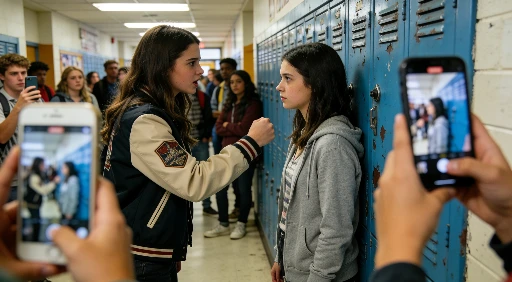
The school’s most untouchable influencer had her hand locked in my hair, her phone recording my face, and a hundred kids cheering in the hallway. The vice principal stood twenty feet away, deliberately checking his watch, while everyone waited for me to break. But I kept my hands completely open for a reason nobody in that crowded corridor understood.
My spine pressed hard against the cold metal locker, the sharp edge digging right between my shoulder blades. Taylor’s face was inches from mine, her expensive perfume smelling like sweet vanilla mixed with pure malice. She didn’t just want to hurt me; she wanted to destroy whatever dignity a scholarship kid like me had left. Behind her, a wall of smartphones formed a glowing semicircle, every single screen reflecting my wide, silent eyes.
“Look at this charity case,” Taylor said, her voice dripping with artificial sweetness as she turned her head slightly toward her friend’s recording lens. “She thinks because she got a free ride to Oakridge, she actually belongs here. Say it, Chloe. Tell the camera you’re nothing.”
The crowd chuckled, a low, cruel rumble that filled the narrow space between the lockers and the classroom doors. Mr. Vance, the history teacher who always complained about student drama but never did a thing about it, walked right past the edge of the crowd. He glanced over his shoulder, saw Taylor’s hand twisting the collar of my faded oversized hoodie, and immediately accelerated his pace toward the faculty lounge. He didn’t want the paperwork. He didn’t want to cross Taylor’s wealthy family, who practically funded the new science wing.

“I asked you a question, rat,” Taylor hissed, her grip tightening until the fabric cut deep into the skin of my throat. She shoved me backward, cracking the back of my head against the locker door.
A sharp, stinging pain flared across my scalp, but I didn’t let a sound escape my lips. My hands remained flat against the metal sides, palms completely flat, fingers spread wide. For months, I had taken the ruined notebooks, the spilled milk in the cafeteria, and the horrific anonymous comments on my social media posts. They all thought my quietness was a white flag. They thought the poor girl from the edge of town was just waiting to be crushed.
“Kneel down and fix my shoe,” Taylor commanded, pointing a manicured finger at her designer sneaker. “Maybe then I won’t post your pathetic crying face to the school story.”
The circle closed in, the heat of a hundred eager bodies pressing against me, their phones held high like digital torches. My heart hammered against my ribs, not from fear, but from the memory of a gravel floor and an old man’s voice telling me exactly when a boundary had been crossed.
— CHAPTER 2 —
The path that led me to that suffocating corridor didn’t start with Taylor’s hand in my hair, or the wall of glowing smartphones recording my public degradation. It began four months earlier, on a crisp Tuesday morning in late October, with a simple white piece of paper. It was an official letter from the administration office confirming my mid-term transfer to Oakridge Academy. To my mom, that letter was a golden ticket, a hard-earned miracle that meant her daughter was finally getting out of the underfunded public system and into a school that could actually open doors for her future. She spent three weeks’ worth of tips from her double shifts at the diner to buy me two pairs of plain khaki pants and three solid-color polo shirts from a discount outlet, making sure I met the strict dress code of the elite private institution. I still remember the way her hands shook with pride as she ironed those cheap shirts on our kitchen table, telling me that this was our family’s turning point.
But the moment I walked through the heavy oak doors of Oakridge, I realized that the dress code wasn’t an equalizer; it was a roadmap that exposed exactly where everybody belonged. The other girls didn’t wear discount outlet khakis. They wore tailored wool skirts, custom-fitted blazers, and designer leather loafers that cost more than our monthly rent. My plain, unbranded canvas sneakers and faded blue backpack practically screamed my financial status before I even opened my mouth. I tried to blend into the woodwork, keeping my head down, moving quietly along the margins of the hallways, and slipping into my seat at the very back of each classroom before the first bell rang. For the first two days, my plan seemed to work perfectly, mostly because the student body treated me like a ghost—an invisible, irrelevant entity that didn’t deserve a second glance.
That brief, quiet grace period shattered into a million jagged pieces during Thursday lunch period. The Oakridge cafeteria was less of a dining hall and more of a highly structured social court, organized by unspoken rules that everyone understood implicitly. The long, polished wooden tables near the floor-to-ceiling windows were reserved exclusively for the school’s elite—the varsity athletes, the legacy students whose names were engraved on the campus buildings, and the inner circle of Taylor Vance. Taylor wasn’t just a popular girl; she was the daughter of a prominent corporate defense attorney who sat on the school’s board of trustees, and her mother was a former high-society model who frequently hosted charity galas on their sprawling estate. Taylor carried herself with the absolute, unquestioned authority of a girl who had never heard the word “no” in her entire life. She was beautiful in a cold, symmetrical way, with long blonde hair that looked like it belonged in a salon commercial and an expensive smartwatch that constantly buzzed with notifications from her fifty-thousand social media followers.
I didn’t know anything about the table hierarchy that day. I was just looking for a quiet, empty spot near the back exit so I could eat the peanut butter sandwich my mom had packed for me and study for my upcoming geometry quiz. The only open space was at the end of a long, sunlit table where three junior varsity cheerleaders were sitting, laughing at something on a tablet screen. As I pulled out the chair and began to sit down, the laughter at the table died instantly, replaced by a heavy, icy silence that seemed to radiate outward through the entire room.
“Um, excuse me?”
The voice was sharp, high-pitched, and filled with a casual, aristocratic disdain that made my stomach drop instantly. I looked up, my hands freezing on the zipper of my backpack, to find Taylor Vance staring down at me from three feet away. She was holding a plastic tray with a pristine organic salad and an expensive imported bottle of sparkling water, her perfectly manicured eyebrows arched into a look of genuine amusement.
“Did someone tell you that this was the financial aid section?” Taylor asked, her voice carrying clearly across the quieted section of the room. “Because this table is actually for people who pay tuition. Real tuition. Not food stamps.”
A smattering of quiet giggles erupted from the surrounding tables. My face burned with an immediate, intense heat that crawled from my neck all the way to my hairline. I could feel the eyes of at least fifty students locking onto me, watching to see how the new girl would react to being publicly dissected by the school’s undisputed ruler.
“I’m sorry,” I whispered, my throat dry as dust as I began to gather my things. “I didn’t know the seats were assigned.”
“They’re not assigned,” Taylor’s closest friend, a tall girl named Chloe who always held Taylor’s gym bag, chimed in with a cruel smirk. “They’re just earned. And honestly, your shoes look like they came from a dumpster behind a dollar store. You’re tracking dirt onto the rug.”
“Leave her alone, Chloe,” Taylor said, though her tone wasn’t defensive—it was the tone of an apex predator playing with its dinner before the kill. “She doesn’t know any better. Look at her. She probably thinks a capsule wardrobe means living in a trailer. What’s your name again? Charity? Or is it just Welfare?”
The entire section of the cafeteria broke into open laughter now, a wave of mocking noise that felt like a physical blow against my chest. I didn’t say another word. I pulled my backpack over my shoulder, grabbed my crushed sandwich bag, and walked out of the cafeteria with my chin tucked tightly against my collarbone. Behind me, I could hear Taylor’s voice ringing out, finalizing my new identity before the lunch period was even over.
“Let’s just call her ‘The Shadow,’” Taylor announced to her court. “Because she’s dark, she’s poor, and she’s always lingering where she doesn’t belong.”
By the next morning, the nickname had stuck with the terrifying, viral speed that only a modern high school ecosystem could facilitate. It started small—whispers in the hallway as I walked past, people moving their bags off empty chairs when I approached, and snickers from the back row of my English literature class. But within forty-eight hours, the isolation transformed into an active, coordinated campaign designed to make my presence at Oakridge completely unlivable.
It moved to the digital world first. On Sunday night, my phone buzzed with an invitation to a public Instagram page titled Oakridge_Shadow_Watch. When I clicked the link, my heart stopped. The page was entirely dedicated to candid, mocking photos of me taken without my knowledge over the previous three days. There was a picture of me sitting alone on the concrete stairs behind the gym during break, captioned: The stray looking for scraps. There was a close-up photo of the frayed stitching on the bottom of my faded backpack, with a poll asking followers to guess how many years it had been since my family bought something new. The comments section was a toxic wasteland of privilege and cruelty, filled with laughing emojis and wealthy students joking about how my poverty might be contagious if they sat too close to me in homeroom.
The physical harassment escalated right alongside the cyberbullying. On Monday afternoon, as I was opening my locker between third and fourth period, Chloe and two other girls from Taylor’s inner circle walked past. With a casual, practiced flick of her wrist, Chloe emptied her half-filled cup of iced coffee directly into my open backpack, soaking my library books and my carefully written history notes in sticky, dark liquid.
“Oh my gosh, I am so incredibly sorry,” Chloe said, her hands flying to her mouth in a theatrical display of fake remorse that wouldn’t have fooled a toddler. “My hand just totally slipped. You know how clumsy I am. But hey, look on the bright side—at least your bag finally has some flavor now.”
They walked away laughing, leaving me standing alone in the crowded hallway as the dark coffee dripped steadily out of the bottom of my bag and onto my worn sneakers. Dozens of students walked right past me, their eyes darting to the puddle on the floor and then away, completely indifferent to the scene. Nobody offered me a tissue. Nobody said a word of comfort. They looked at me the way people look at an annoying obstacle on the sidewalk—something to be stepped around and forgotten.
The worst part of the system wasn’t the cruelty of the students, though; it was the deliberate, calculated blindness of the adults who were paid to protect us. Later that same week, after Taylor deliberately tripped me in the main hallway, sending my textbooks sliding across the linoleum floor under the feet of a dozen oncoming seniors, I finally reached my breaking point. I gathered my scattered papers, went straight down the administrative corridor, and knocked on the door of Vice Principal Henderson.
Mr. Henderson was a soft, balding man who spent most of his day adjusting the golf trophies on his windowsill and ensuring the school’s public relations remained pristine. He listened to me speak for nearly ten minutes, his face completely expressionless as I described the Instagram page, the coffee in my backpack, the constant name-calling, and the deliberate tripping in the hallway. I didn’t cry—I didn’t want to give him the impression that I was just a sensitive girl overreacting—but my voice was tight with months of repressed humiliation.
When I finally finished, Mr. Henderson sighed heavily, leaned back in his leather executive chair, and laced his fingers together over his stomach. He looked at me with a mixture of mild annoyance and patronizing exhaustion.
“Listen to me, young lady,” Mr. Henderson said, his tone dripping with the smooth, dismissive corporate language that schools use to avoid liability. “You have to understand that Oakridge is a highly competitive, fast-paced environment. Students here come from very prominent backgrounds, and sometimes, there’s a bit of cultural friction when a new student joins us mid-year. Teenagers can be exclusionary. It’s a natural part of social development.”
“It’s not friction, Mr. Henderson,” I said, my hands tightening into fists inside my pockets. “It’s targeted harassment. They created a web page specifically to mock my clothing and my family’s income. Taylor Vance tripped me in front of fifty people today.”
Mr. Henderson’s eyes narrowed slightly at the mention of Taylor’s name, a subtle shift in his posture revealing the immediate political calculations happening inside his head. Taylor’s father had just donated forty-thousand dollars for the school’s new digital arts lab two months prior.
“Let’s not make mountains out of molehills,” Mr. Henderson replied quickly, his voice hardening just a fraction. “Taylor is an honors student, a student council representative, and a leader in our community. I’m sure whatever happened in the hallway was an accident—a crowded corridor, people rushing to class. As for the online posts, we have no definitive proof of who created that account, and frankly, the school cannot police what happens on private social media networks outside of school hours.”
“So you’re not going to do anything?” I asked, the sheer injustice of his words burning like acid in my throat.
“What I am going to do is advise you to focus on your academics,” Mr. Henderson said, standing up to signal that our meeting was officially over. “Don’t be so sensitive. Kids will be kids, and both sides usually play a role in these types of peer conflicts. Just ignore them, stay out of their way, and stop looking for drama where there is none. If you don’t make yourself a target, the teasing will stop on its own. Let’s just keep this between us and avoid making a big deal out of standard teenage growing pains, okay?”
I stood up slowly, realizing with absolute clarity that there was no help coming from the office. The administration didn’t see a victim and a bully; they saw a scholarship student who didn’t contribute to the endowment fund creating an inconvenient problem regarding the daughter of a major donor. To them, my silence wasn’t a choice—it was a requirement for my continued enrollment.
As I walked out of the administrative wing and back toward the lockers, I saw Taylor and Chloe standing near the water fountains. They were watching the office door, and the moment they saw me step out, Taylor held up her phone, tapped the screen, and flashed me a cold, triumphant smile. She didn’t even have to ask what happened inside; she already knew the rules of the game at Oakridge. The school belonged to her family, the hallways belonged to her friends, and I was completely, utterly alone in the dark.
I walked home that afternoon through the biting autumn wind, my hands buried deep in the pockets of my cheap hoodie, the weight of the entire school’s rejection pressing down on my shoulders like a lead vest. My mom was already at her second job, leaving the small, two-bedroom apartment quiet and dark. I sat on the edge of my bed, staring at the floor, the mocking laughter of the cafeteria echoing through my ears until my head throbbed with a dull, persistent ache. For months, they had mistaken my quietness for helplessness. For months, they believed that because I didn’t fight back, I didn’t know how. They had absolutely no idea that every single day, after the school doors locked and the wealthy kids went home to their mansions, I walked three miles down to the industrial district to enter a completely different world—a world where the rules of survival were taught not by politicians in suits, but by an old man who had survived things that would make Taylor Vance’s worst nightmares look like a fairytale.
— CHAPTER 3 —
The heavy iron gate of the salvage yard groaned as I pushed it open, the familiar scent of rust, damp earth, and motor oil immediately filling my senses. It was nearly five o’clock by the time I made the three-mile walk from Oakridge Academy down to the industrial canal district. My shoulders still ached from the impact against the locker, and my mind was a chaotic blur of Taylor’s cruel laughter and Vice Principal Henderson’s dismissive, corporate voice. Out here, the pristine brick facades and manicured lawns of the wealthy suburbs felt like a distant, alien planet. This was a landscape of corrugated metal warehouses, stacked shipping containers, and gravel lots where weeds fought their way through the cracks in the asphalt. At the far end of the yard, beneath a sagging aluminum awning attached to a converted brick machine shop, a lone figure stood beside a rusted iron drum filled with burning scrap wood.
Sergeant Marcus Hale didn’t look like a martial arts master from a movie. He didn’t wear a traditional white robe or a pristine black belt. He wore a grease-stained canvas field jacket, heavy steel-toed boots, and a faded olive-drab ball cap pulled low over eyes that had seen things most people only encountered in historical documentaries. A retired Marine Corps infantry veteran and a former lead combatives instructor at Fort Moore, Sergeant Hale had a thick, jagged scar running from his left temple down to his jawline—a permanent reminder of a roadside ambush in a desert thousands of miles away. His posture was as straight and unyielding as an iron pillar, despite a severe limp in his right leg caused by shrapnel that the military surgeons could never fully remove. He was sixty-two years old, his hands were calloused and rough like sandpaper, and he was the only person in the world who truly understood what lay beneath my quiet, guarded exterior.
“You’re late, kid,” Sergeant Hale said without turning his head, his gravelly voice cutting through the crackle of the burning wood. He tossed a heavy pine log into the drum, sending a small shower of bright orange sparks drifting up into the gray autumn sky. “Bus delay, or did you let the pavement catch your attention again?”
“I walked,” I muttered, setting my faded backpack down on an overturned plastic milk crate near the awning. I pulled my hands out of my hoodie pockets, trying to hide the slight tremor in my fingers, but nothing ever escaped his observation.
Sergeant Hale turned around slowly, his sharp, steel-gray eyes locking onto my face with the intensity of a radar sweep. He didn’t ask me what happened. He didn’t ask if someone had hurt my feelings or if I was having a bad day at my new, fancy school. Instead, he reached down, picked up a worn, unpolished wooden staff from a rack against the brick wall, and tossed it directly at my chest without warning.
My instincts, drilled into my nervous system through thousands of hours of repetition since I was seven years old, took over instantly. My right foot stepped backward into a deep, stable stance, my left hand snapping up to catch the center of the spinning staff while my right hand instantly covered my jawline. The wood smacked into my palm with a sharp, echoing crack, but my body didn’t waver. My weight was perfectly centered, my breathing remained even, and my eyes stayed locked entirely on his shoulders, watching for the next movement.
“Good balance,” Sergeant Hale observed, his face completely expressionless as he leaned slightly against his good leg. “But your mind is noisy. I can hear your thoughts from across the yard, Chloe. When the mind is noisy, the body is slow. A noisy mind looks for a fight because it wants validation. A quiet mind looks for an exit because it already knows its own worth.”
“They’re making it impossible to look for an exit, Sergeant,” I said, the words slipping out before I could stop them, my voice cracking slightly under the weight of the afternoon’s humiliation. “The hallways are crowded. The doors are blocked. Every time I try to just walk away, they follow me with their phones out. They want me on my knees, and the teachers just look the other way because the girl doing it has a dad who buys them new computers.”
Sergeant Hale walked over to me, his heavy boots crunching rhythmically on the gray gravel. He stopped exactly two feet away, standing so close I could smell the faint aroma of black coffee and gun oil that always clung to his clothes. He didn’t offer a gentle pat on the shoulder or a soft word of sympathy. He reached out and placed one massive, calloused index finger directly against the center of my forehead, pushing just hard enough to force me to maintain my balance.
“Let me tell you something about people who need a crowd to make them feel big,” the old soldier said softly, his voice dangerously calm. “They are fragile glass structures built on a foundation of sand. They use noise, status, and cruelty because they are absolutely terrified of what happens when the lights go out and they have to look at themselves in the mirror alone. They want you to anger. They want you to strike first. Why do you think I made you swear the oath before I ever showed you how to close a fist?”
I looked down at the gravel, the memory of my seventh birthday flashing vividly through my mind. On that morning, while other kids were receiving bicycles or video game consoles, my mom had brought me to this exact yard because she couldn’t afford a traditional after-school program, and Sergeant Hale—an old friend of my late father—had agreed to watch me. But before he ever taught me how to throw a punch, how to execute a joint lock, or how to redirect an opponent’s weight, he had made me sit cross-legged on the cold concrete floor of his workshop for three straight weeks just learning how to breathe.
He had placed a single glass bowl filled to the brim with water on the floor in front of me and told me to strike the air beside it without spilling a single drop. If the water rippled from the wind of my movement, it meant my action was driven by aggression rather than control, and I had to start over.
“Never strike first,” I whispered, repeating the absolute commandment that had been carved into my soul over the last eight years. “The first person who swings has already lost control of the situation. Aggression is a confession of weakness.”
“Exactly,” Sergeant Hale said, nodding slowly as he stepped back. “The military combatives system I taught for twenty-four years wasn’t designed to make bullies look tough in a parking lot. It was designed to keep people alive when everything around them was collapsing into chaos. It is about survival, efficiency, and absolute restraint. If you use what I gave you to punish someone out of pride, or because your feelings are hurt, then you aren’t a martial artist. You’re just another variation of the garbage that’s currently occupying that high school hallway.”
He raised his hands, palms open, facing me in a relaxed, non-threatening posture that looked entirely defenseless to an untrained eye. “Show me the third sequence. No anger. No ego. Just space and control.”
I took a deep breath, letting the freezing autumn air fill my lungs, forcing the image of Taylor’s smirking face out of my mind. I dropped the wooden staff onto the crate, stepped into the center of the gravel clearing, and raised my hands in the exact position I had held against the locker—palms open, fingers relaxed, elbows tucked in to protect my ribs.
Sergeant Hale moved with surprising speed despite his heavy limp. He lunged forward, his massive right hand shooting out to grab the collar of my hoodie in an exact simulation of the physical intimidation I had faced earlier that afternoon. But this time, I didn’t freeze. I didn’t let my back hit a wall.
As his hand came within inches of my chest, my left hand flicked upward like a striking snake, the blade of my palm deflecting his wrist inward just enough to alter the trajectory of his reach. Simultaneously, my right foot stepped off the centerline of his attack, my body pivoting ninety degrees into his blind spot. Before he could reset his balance, my right hand slid under his armpit, my hip checking his thigh in a perfectly timed leverage point that used his own forward momentum against him.
It wasn’t a violent throw; it was a fluid, seamless redirection of mass. Sergeant Hale’s boots left the gravel for a split second, his massive frame shifting through the air before he landed cleanly on his left foot, stumbling back two paces before regaining his stance. He didn’t fall—I had intentionally withheld the final pressure on his knee—but the demonstration of absolute control was undeniable. The entire exchange took less than two seconds, performed in absolute, chilling silence.
The old Marine straightened his jacket, a tiny, almost imperceptible trace of approval flickering in the corner of his rough eyes. He wiped a streak of gray dust from his sleeve and looked at me with a solemn seriousness that made my chest tighten.
“The physical part is easy for you now, Chloe,” he said, walking back over to the burning iron drum. “Your muscle memory is locked in. Your technique is sharp. But the real test isn’t going to happen in this yard with an old man who wants you to succeed. The real test is going to happen when the pressure is real, when the humiliation is burning your throat, and when a hundred fools are screaming for your blood with cameras in your face.”
He leaned forward, the firelight casting long, dancing shadows across the deep scars on his face. “When that moment comes, and it will come very soon, they are going to push you until there is no safe way out. They are going to give you no choice but to defend your physical safety. And when they do, you must remember that your job isn’t to break them. Your job is to stop the danger, secure the perimeter, and let the truth do the rest of the work. Can you do that, kid? Or are you going to let that girl turn you into a monster just like her?”
I looked at my open palms, feeling the cool wind biting at my skin. I thought about my mom’s tired eyes at the kitchen table, the coffee dripping out of my ruined backpack, and the absolute certainty Taylor had that I was nothing more than a punching bag for her social circle.
“I won’t strike first, Sergeant,” I said quietly, my voice finally finding a steady, unbreakable core of confidence that had nothing to do with arrogance. “But I won’t kneel either.”
“We’ll see,” Sergeant Hale replied, turning his back to me to stare into the dying embers of the fire. “Go home and help your mother with dinner. The wind is shifting, and tomorrow is going to be a long day.”
I picked up my backpack, the weight of the soaked textbooks feeling strangely lighter now, and walked out of the salvage yard into the gathering dusk. The lesson was over, but as the heavy iron gates closed behind me with a loud, metallic clang, a cold knot of dread began to tighten in the pit of my stomach. Sergeant Hale was right; the wind was shifting, and the storm that had been brewing in the corridors of Oakridge Academy was about to break wide open.
— CHAPTER 4 —
The terrifying speed at which a rumor travels through the corridors of Oakridge Academy is something you can only fully appreciate when you are the one running from it. By Monday morning, the digital stain of that Instagram page had seeped into every single corner of my daily life, transforming the school from a place of academic pressure into a psychological minefield. The harassment was no longer just a series of isolated incidents carried out by Taylor Vance and her immediate circle; it had become an organized, community-driven sport. The student body didn’t just watch the bullying anymore—they participated in its curation, distribution, and amplification, turning my daily survival into entertainment for their smartphones.
It started the moment I hopped off the public transit bus two blocks away from the campus gates. Usually, the walk down the tree-lined avenue was the only peaceful part of my morning, but today, three sophomore boys on bicycles rode slowly alongside the curb, their phones balanced precariously on their handlebars as they recorded me walking. They didn’t say anything to me directly. They just laughed among themselves, whispering the nickname Taylor had coined, ensuring I knew that even my morning commute was being monitored. When I passed through the main iron gates, the atmosphere grew significantly heavier. Students who used to simply ignore me now actively pointed me out to their friends, nudging each other as I hurried up the concrete steps with my chin tucked deep into the collar of my faded grey hoodie.
Inside the building, the social pressure felt almost atmospheric, like the heavy, static-charged air right before a severe thunderstorm. Every time I opened my locker, someone would have slipped a mocking note through the ventilation slats—photocopies of my mom’s diner menu with my name scribbled across the top, or printouts of the Instagram page with cruel captions written in red marker. In the hallways between periods, the surrounding people formed a permanent, shifting wall of hostility. If I walked down the center of the corridor, the crowd would parted widely around me, exaggeratedly pulling their expensive designer jackets away from my clothes as if poverty were a contagious disease they could catch through casual physical contact. If I tried to squeeze along the edge of the wall, someone would inevitably stick their foot out, forcing me to stumble while a chorus of quiet, practiced snickers erupted from the onlookers.
The filming bystanders had become the most exhausting part of the entire ecosystem. It seemed like every third person I passed had their phone raised at chest level, the camera lens tracking my movements with a cold, unblinking focus. They weren’t even trying to hide it anymore. They held their devices out openly, waiting for me to trip, waiting for me to cry, waiting for me to finally lose my temper so they could capture the exact moment the scholarship kid broke down on video. The modern high school bully doesn’t need to throw punches in an alleyway when they can use a hundred digital lenses to slowly dismantle a person’s sanity in broad daylight.
Yet, amid that sea of cruel amusement and absolute indifference, there was one tiny fracture in the wall of solidarity. Her name was Maya, a quiet, petite girl who sat next to me in AP European History. Maya didn’t belong to Taylor’s wealthy elite, but her family was comfortable enough that she wasn’t an outright target either. For weeks, I had noticed the way she looked at me when Taylor and Chloe would mock my clothes or knock my binders off the desk. She didn’t laugh. In fact, every time the crowd started chanting or giggling, Maya’s face would go pale, her hands tightening around her pencil until her knuckles turned white, her eyes darting around the room with a look of profound, agonizing guilt.
On Tuesday afternoon, during a brief window when the teacher left the classroom to fetch a projector from the media center, Taylor walked past my desk and deliberately swept her heavy leather purse across my workspace, sending my laptop and my notebook crashing hard onto the linoleum floor. The plastic casing of my old, refurbished computer cracked tightly along the hinge, a small piece of black plastic bouncing across the floorboards. The surrounding students clapped instantly, a few boys in the back row letting out appreciative whistles as Chloe immediately raised her phone to capture my expression.
I sat completely frozen in my chair, my hands flat on the desk, palms open, focusing entirely on the slow, rhythmic breathing Sergeant Hale had taught me. Inhale for four seconds, hold for four, exhale for four. I didn’t look down at the broken computer. I didn’t look at Taylor. I just stared straight ahead at the green chalkboard, keeping my expression as flat and unreadable as stone.
Maya, sitting just thirty inches away, flinched violently when the computer hit the floor. I saw her knees twitch, her body leaning forward instinctively as if she were about to stand up, reach down, and help me gather my ruined things. Her hand actually extended an inch toward the floor, her fingers trembling with a sudden, brave impulse to break the unspoken rule of the school.
But before she could leave her seat, Taylor turned her cold, calculating gaze slightly to the left, her eyes locking onto Maya with the precision of a hawk spotting a field mouse. Taylor didn’t say a word to her. She just raised one eyebrow, a faint, menacing smile touching the corners of her lips as she casually tapped her fingernails against the edge of Maya’s desk. It was a silent, terrifying demonstration of absolute social leverage. The message was clear: If you help the rat, you become the rat.
I watched the courage drain out of Maya’s face in real-time. Her shoulders slumped backward, her hand retracted into her lap like it had been burned, and she immediately looked down at her textbook, her long hair falling forward to shield her eyes. A single, silent tear dropped from her cheek onto the open page of her notebook, but she remained completely still, paralyzed by the absolute certainty of what Taylor’s wrath would mean for her own life. She wanted to help me, she wanted to do the right thing, but she simply did not dare to cross the line. I didn’t blame her. When the entire system is built to protect the tormentor, survival becomes a matter of keeping your head down and praying the monster doesn’t look at you next.
The reason Taylor operated with such absolute, terrifying freedom was that the school itself had constructed a legal and social fortress around her. Oakridge Academy wasn’t just an educational institution; it was a business supported by the massive financial contributions of its alumni and board members. Taylor’s father, Harrison Vance, wasn’t just a wealthy lawyer; he was the head of the school’s legal advisory committee and the primary donor for the new athletic complex currently under construction. The administration didn’t just tolerate Taylor; they were fundamentally incapable of punishing her without jeopardizing the very financial lifeblood of the institution.
This institutional protection became undeniable during third-period gym class on Wednesday. We were out on the athletic field, practicing soccer drills in the damp, chilly autumn grass. The gym teacher, Coach Miller—a loud, whistle-happy man who spent most of his time flirting with the admissions staff or chatting with the varsity captains—stood near the equipment shed, fifty yards away from the actual activity.
During a scrimmage drill, Taylor intentionally ran directly into my path, her shoulder striking my chest with full force well after the ball had been passed downfield. The impact knocked the wind out of my lungs, sending me tumbling backward into the cold, muddy turf. As I lay there, trying to regain my breath, Taylor stood over me, her cleats dug into the grass just inches from my face, while her friends gathered around in a tight, protective circle that blocked the view from the rest of the field.
“Get up, Shadow,” Taylor whispered, her voice low so it wouldn’t carry toward the coach. “You look so pathetic rolling around in the dirt. Honestly, it’s where you belong, but you’re ruining the grass for the rest of us.”
Chloe was already recording from behind her jersey, her phone held discreetly at waist level. Two other girls laughed loudly, making sure their voices drowned out any sound of distress I might make. I pushed myself up slowly, my hands covered in wet mud, my plain white polo shirt stained with dark, ugly streaks of turf.
Coach Miller finally walked over, his whistle dangling from his fingers, an expression of profound irritation on his face. He hadn’t seen the initial shoulder check, but he had certainly seen the circle of girls hovering over a student on the ground.
“Alright, what’s going on over here?” Coach Miller barked, stopping at the edge of the circle. “Vance, why is Chloe on the ground? We’re running a drill, not hosting a social hour.”
“It was just an accident, Coach,” Taylor said instantly, her voice instantly shifting from a cruel hiss to the sweet, innocent tone of a perfect honors student. She offered a bright, helpful smile that had been practiced in front of mirrors for years. “We both went for the ball at the same time, and she just lost her balance. The ground is really slick today. I was actually just trying to help her up.”
“She didn’t go for the ball, Coach,” I said, my voice steady despite the ache in my ribs as I stood up, wiping the mud from my palms onto my khakis. “The ball was twenty yards away. She checked me into the dirt on purpose.”
Coach Miller looked at me, his eyes instantly tracking the mud on my clothes, the faded unbranded sneakers, and the quiet, intense look in my eyes. Then he looked at Taylor, the daughter of the man whose name would be carved into the limestone lintel of the new stadium next spring. He let out a short, dismissive breath and blew his whistle twice, cutting off any further discussion.
“Alright, that’s enough drama from both of you,” Coach Miller said, turning his back on me before I could even finish my sentence. “Boys will be boys, and girls aren’t much different on the field. It’s a contact sport, Chloe. If you can’t handle a little physical play without making it a personal issue, maybe you should spend the rest of the period walking laps on the track. Both sides need to stop the bickering. Move the ball, let’s go!”
“Yes, Coach,” Taylor said dutifully, her eyes twinkling with absolute delight as she watched him walk away. The moment his back was entirely turned, she leaned into my space, her breath warm against my ear. “See that? Nobody cares about you here. You’re just a speck of dirt on their nice, clean floor. Tomorrow, we’re going to make sure you finally remember your place.”
She walked away, her laughter joining Chloe’s as they trotted back to the center of the field. I stood alone in the damp grass, the cold wind cutting straight through my wet clothes, watching the entire class move away from me like I was a ghost. The school had made its decision. The adults had drawn their lines. The surrounding people had prepared their cameras.
The stage was set, the trap was laid, and as I walked home that night through the darkening streets, I knew that the next morning would bring the final, inevitable confrontation. They thought they were preparing a public execution for my dignity, but they had absolutely no idea that the quiet girl they were pushing into a corner had spent eight years learning how to survive the dark.
— CHAPTER 5 —
The heavy fluorescent lights of the senior hallway buzzed with a dull, low-voltage hum that seemed to vibrate directly inside my skull. It was exactly 3:15 PM, the final bell of the day still echoing through the concrete walls, but nobody was moving toward the exit doors. The crowded corridor had locked up completely, a hundred teenage bodies pressing tightly into a suffocating, human wall that sealed off the stairwell and the main lobby. At the absolute center of that wall stood Taylor Vance, her designer leather backpack slung casually over one shoulder, her fingers lazily twirling a strand of her perfectly ironed blonde hair. She was smiling—not a smile of happiness, but that sharp, predatory grin that meant she was about to validate her entire social existence by completely dismantling someone else’s.
“I told you yesterday morning, Shadow,” Taylor said, her voice cutting through the thick, static-filled silence of the hallway like a razor blade through silk. “I told you we were going to make sure you finally remembered your place in this school. But you just couldn’t stay in the corner, could you? You had to go down to the office and try to get me in trouble with Henderson.”
I stood perfectly still, my worn canvas sneakers glued to the linoleum floor, my back exactly three inches away from the cold metal face of locker 214. The weight of my faded grey hoodie felt like a suit of iron armor, the frayed fabric at the cuffs damp with the cold sweat of my palms. For months, I had spent every morning and every afternoon calculating my movements, mapping out the widest possible paths around her circle, and accepting the ruined notebooks and spilled coffee as the tax for my continued survival at Oakridge Academy. But today, there were no wider paths left. Chloe stood directly to her right, her high-end smartphone already raised at chest level, the tiny green recording light on the camera lens glowing like an evil eye. To Taylor’s left, three tall varsity lacrosse players leaned against the trophy cases, their massive shoulders blocking the only emergency exit door, their faces twisted into identical expressions of eager amusement.
“I didn’t try to get you in trouble, Taylor,” I said, my voice low and flat, keeping my throat as relaxed as Sergeant Hale had taught me during those long, freezing evenings in the salvage yard. “I just asked the administration to make you leave me alone. I don’t want any trouble with you. I just want to go home.”
“Oh, look at her, she’s practically begging,” Chloe mockingly whispered to her camera lens, angling the phone closer to my face to catch the exact details of my expression. “The charity case wants to go home to her little trailer. Say it louder, Chloe. The viewers can’t hear your pathetic little voice over the crowd.”
A low, cruel rumble of laughter rippled through the surrounding people. The filming bystanders had formed a perfect, seamless ring around us, their screens held high like digital mirrors, every single one of them hungry for a piece of the viral content they knew Taylor was about to deliver. To my right, I caught a brief glimpse of Maya standing in the second row of the crowd. Her face was entirely bloodless, her lower lip trembling with that same agonizing guilt I had seen in history class, her hands clutching her textbook so tightly the cardboard cover was beginning to warp. She wanted to look away. She wanted to step forward. But she was entirely paralyzed by the absolute certainty of what Taylor’s social machine would do to her if she broke rank.
Suddenly, a heavy, familiar hand gripped the edge of my locker door. Vice Principal Henderson walked out of the faculty lounge just thirty feet down the corridor, his leather briefcase in his hand, his eyes scanning the massive, unmoving blockage of students. He stopped for a fraction of a second, his gaze tracking the raised phones, the tight circle, and the unmistakable sight of Taylor Vance cornering the scholarship girl against the lockers.
My heart gave a brief, desperate thud against my ribs. This is it, I thought. He’s the vice principal. He has to stop it now.
But as Mr. Henderson’s eyes locked onto Taylor, a subtle, cowardly shift occurred in his posture. He adjusted his glasses, looked down at his watch with an expression of sudden, intense theatrical focus, and turned sharply on his heel. He walked directly toward the side exit door that led to the faculty parking lot, his pace accelerating as if he had suddenly remembered an incredibly urgent meeting across town. He didn’t want the paperwork. He didn’t want to explain to Harrison Vance why his daughter was being disciplined. He chose the darkness, leaving the hallway to govern itself by the law of the jungle.
“See that?” Taylor smirked, her eyes tracking the vice principal’s retreat with absolute, supreme confidence. “Nobody is coming to save you, rat. Nobody cares about what happens to you here. Your little scholarship doesn’t buy you protection.”
She took a long, slow step forward, entering my personal space until the heavy sweet scent of her expensive vanilla perfume filled my lungs, making my stomach turn with a sudden wave of nausea. She raised her right hand, her long, manicured acrylic nails glinting under the harsh fluorescent tubes, and poked me hard in the center of my chest, right over my breastbone.
“Now, you’re going to fix this right now,” Taylor commanded, her voice dropping into a cold, venomous register that made the surrounding crowd instantly go dead silent. “Chloe is recording a live story right now. You’re going to look directly into that lens, you’re going to get down on both knees on this dirty floor, and you’re going to apologize to me for lying to the vice principal. If you don’t do it before I count to three, I’m going to make sure your mom’s little diner gets a hundred five-star reviews about the cockroaches in her kitchen. I know exactly where she works, Shadow. Don’t think I won’t do it.”
A sharp, icy bolt of pure adrenaline shot straight down my spine, my muscles instantly locking into a state of absolute readiness. The insult to my clothes was one thing; the mockery of my shoes was nothing. But the moment she brought my mother’s hard, exhausting life into her mouth—the woman who spent twelve hours a day on her feet just to buy me the clothes to stand in this building—something fundamental shifted inside my soul.
The image of Sergeant Hale’s rough, scarred face flashed vividly before my eyes. The wind is shifting, kid. They are going to push you until there is no safe way out. Your job isn’t to break them. Your job is to stop the danger.
“One,” Taylor counted, her smirk widening as she saw the muscles in my jaw tighten. She thought she was watching a rabbit freeze before the strike. She thought my silence was the paralysis of a broken girl.
I didn’t answer her. I didn’t drop my head. I slowly took my hands out of my hoodie pockets, keeping my arms completely relaxed, my elbows tucked in close to my ribs to protect my organs, my palms completely open and facing outward in a non-threatening gesture that looked like total submission to everyone else in the room. But my feet subtly adjusted their position on the slick linoleum—my right heel sliding back three inches, my weight shifting seventy percent onto my rear leg, my center of gravity dropping into a deep, invisible anchor point that no one there had the training to recognize.
“Two,” Taylor hissed, her hand rising to grab the heavy cotton collar of my grey hoodie, her fingers twisting the fabric into a tight, white-knuckled knot. She yanked me forward with full force, trying to pull me off balance and force my knees toward the floor.
“I asked you a question, you poor piece of garbage,” she snarled, her face contorting with the sudden, ugly rage of a spoiled child whose toy refused to break. “Kneel down!”
She didn’t wait for three. With her left hand still clamped tightly onto my collar, her right hand swung backward, her fingers curling into a tight, clumsy fist as she aimed a full-force blow directly at the side of my jaw. The crowd let out a collective, sharp intake of breath, a hundred phones shaking slightly as the bystanders realized that the psychological torment was finally crossing the line into a real, physical assault.
The fist came toward my face in slow motion, a wide, looping arc driven entirely by anger and the absolute certainty that I wouldn’t move. But my mind was no longer noisy. The hallway, the smartphones, the cheering students, and the cowardly vice principal all faded into a gray, irrelevant background. There was only the centerline, the trajectory of the mass, and the old man’s voice whispering through the gravel: Move only when there is no safe way out.