Part 2: The Silent Signal At Thirty-Five Thousand Feet
MY WIFE AND I 2 MINS AGO RECOGNIZED THE WOMAN FROM THE AMBER ALERT FLYER SITTING RIGHT ACROSS THE AISLE ON OUR FLIGHT. BUT WHEN THE LITTLE BOY IN THE MIDDLE SEAT SECRETLY SIGNED A DESPERATE CRY FOR HELP UNDER THE BLANKET, THE ENTIRE SITUATION TURNED FROM A RUNAWAY PARENT CASUALTY INTO AN ABSOLUTE NIGHTMARE AT 35,000 FEET.
The cabin of Flight 1482 smelled of stale coffee, industrial disinfectant, and the collective anxiety of 150 people crammed into a metal tube hurtling through the sky. I had my window seat adjusted just enough to rest my forehead against the cold plastic, watching the gray cloud cover swallow the Chicago skyline beneath us. My wife, Sarah, was already scrolling through downloaded episodes of a true-crime podcast on her phone, her fingers tapping a nervous, rhythmic beat against her knee. We had been married for 4 years, and I knew every single one of her tells; she hated flying, but she hated flying during turbulent spring storms even more.
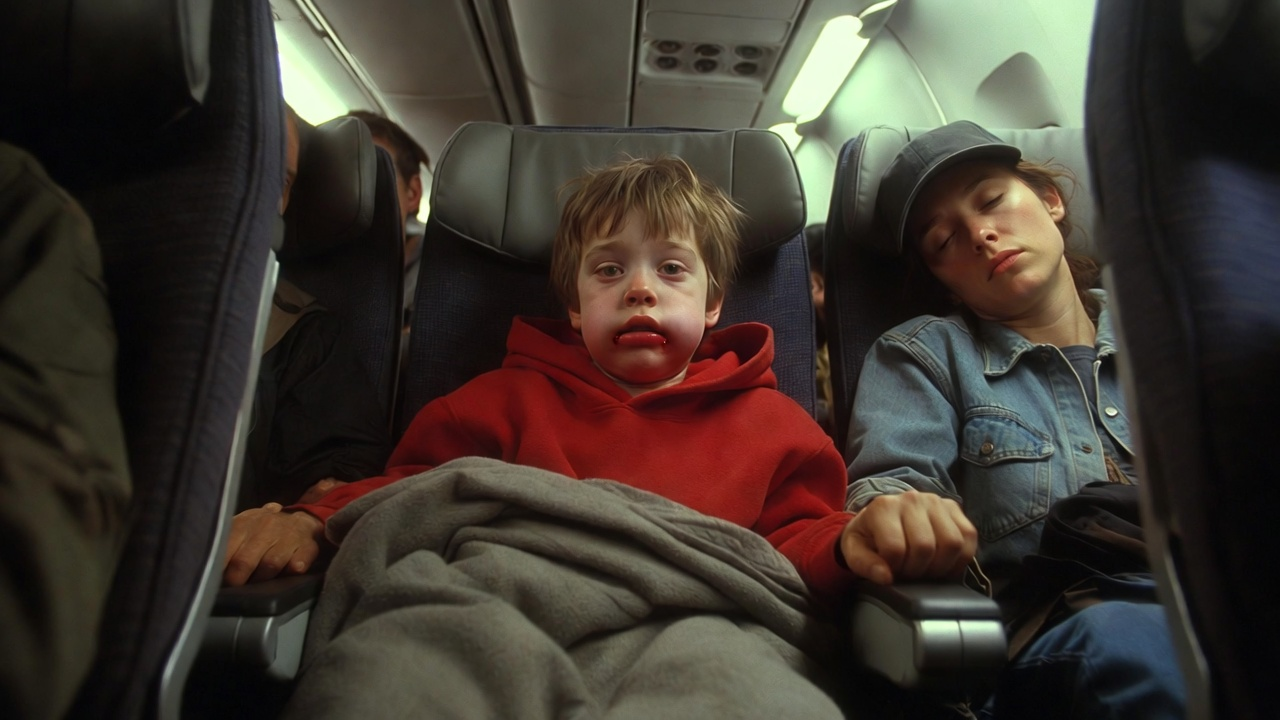
I was just about to close my eyes and pray for a quick three-hour journey to Denver when the row across the aisle became a sudden focal point of friction. A woman in a faded oversized denim jacket and a baseball cap pulled low over her brow was aggressively shoving a heavy black duffel bag into the overhead bin. She was moving with a frantic, jerky energy that immediately drew my attention, her breathing heavy enough that I could hear it over the low hum of the jet engines. Right behind her stood a little boy, maybe 6 or 7 years old, wearing a bright red hoodie that seemed three sizes too big for his frail frame.
The boy kept his head down, his chin pressed firmly against his collarbone, but as he stepped into the row to take the middle seat, the cabin light caught his face. My chest tightened instantly. His lower lip was swollen and split right down the center, the edges of the wound raw and dark with dried blood. He didn’t look up at the woman, nor did he look at the elderly gentleman who was already seated by the window. He just sat down stiffly, his small hands buried deep inside the pockets of his oversized hoodie.
“Sit down and don’t touch anything,” the woman muttered, her voice a sharp, raspy whisper that carried across the narrow aisle. She didn’t sound like a tired mother dealing with a restless child; she sounded like someone who was running completely on adrenaline and fear. She slid into the aisle seat, immediately grabbing a thick, gray fleece blanket from her tote bag and throwing it over the boy’s lap, tucking it roughly around his waist.

Sarah must have heard the tone, because she paused her phone and glanced over, her eyes lingering on the boy’s split lip for a fraction of a second before meeting mine. She arched an eyebrow, a silent, unspoken question passing between us. I shook my head slightly, silently telling her to let it go. People have bad days, kids fall on playgrounds, and it wasn’t our business to judge a stressed-out parent on a bumpy flight.
But then the woman reached across the armrest and grabbed the boy’s left wrist. She didn’t just hold it; she gripped it with a white-knuckled intensity, her fingers clamping down like a pair of iron handcuffs. The boy didn’t flinch, didn’t cry out, and didn’t even blink. He just stared straight ahead at the safety brochure in the seatback pocket in front of him, his entire body freezing up as if he were trying to become completely invisible.
The flight attendants began their safety demonstration, their synchronized movements standard and routine, but my eyes kept drifting back to row 12. The woman had pulled her baseball cap down even lower, leaning her head back against the headrest and closing her eyes, pretending to sleep. Yet, her grip on the boy’s wrist never loosened for a single second. It looked exhausting, painful, and entirely unnatural.
Ten minutes later, the plane tilted sharply upward as we took off, the pressure pushing us back into our seats. As the ground receded and the seatbelt sign remained illuminated, the woman’s head rolled to the side, her breathing slowing down into a heavy, rhythmic pattern that suggested she had finally drifted off to sleep. Her hand, however, remained anchored around the child’s wrist under the heavy fleece blanket.
That was when the boy’s right hand slowly crept out from the pocket of his red hoodie. He kept his arm perfectly still, his eyes darting sideways to ensure the woman was truly unconscious. Then, with an agonizingly slow and deliberate movement, he slid his hand just out from beneath the edge of the blanket, right in my direct line of sight.
He didn’t look at me. He kept his eyes locked straight ahead. But his fingers began to move in a rhythmic, repeated pattern. He flattened his palm, tucked his thumb across his skin, and then folded his 4 fingers down over it, sealing the thumb inside.
He did it once. Then he opened his hand and did it again.
My heart hammered violently against my ribs as the realization hit me like a physical blow. It was the universal sign for help—the covert signal developed for victims of domestic violence and human trafficking to alert outsiders without speaking a word. He was signing it over and over again, his tiny, trembling fingers moving frantically against the dark fabric of the airline blanket.
I reached over and gripped Sarah’s arm so hard she gasped, pulling her attention away from her screen. “Look,” I breathed, my voice barely audible over the roar of the air vents. “Sarah, look at his hand right now.”
— CHAPTER 2 —
The air inside the cabin felt ten times heavier the second Sarah’s eyes locked onto that little boy’s hand. I could feel her entire body stiffen against mine, her fingers digging so hard into my forearm that my skin went numb. She didn’t make a sound, but her breath caught in her throat, a sharp, ragged gasp that was completely swallowed by the steady, deafening drone of the Boeing 737’s jet engines. Around us, the other passengers were completely oblivious, flipping through magazines, adjusting their overhead air vents, or staring blankly at the backs of the seats in front of them. We were trapped in a floating metal tube at thirty-five thousand feet, surrounded by strangers, while a silent tragedy was unfolding less than four feet away from our faces.
The boy kept his movements incredibly small, his knuckles twitching beneath the shadow of that oversized red hoodie. Flatten the palm, tuck the thumb, fold the fingers down. Flatten the palm, tuck the thumb, fold the fingers down. It was a rhythmic, desperate loop, a silent SOS broadcasted from a terrified child to anyone who cared enough to look. Every single time his fingers closed over his thumb, my heart hammered violently against my ribs, a sickening thud that echoed in my ears. His face remained entirely motionless, a pale, blank mask of pure survival, but those tiny moving fingers told a story of absolute terror.
Sarah slowly leaned her head closer to mine, pretending to rest her cheek against my shoulder so anyone looking wouldn’t suspect we were whispering about them. Her voice was a microscopic thread of sound, vibrating directly against my collarbone. “Mark, oh my God, that’s the signal,” she breathed, her lips barely moving as she spoke. “That’s the Signal for Help from social media. He’s telling us he’s in danger.”
“I see it,” I whispered back, my eyes tracking the woman sitting right next to him in the aisle seat. She was still leaning back, her baseball cap pulled down so low it completely shadowed the bridge of her nose, her mouth slightly open as if she were fast asleep. But her right hand was still clamped around the boy’s left wrist like a vice, a brutal, unyielding anchor that never loosened for even a fraction of a second. It didn’t look like the grip of a sleeping mother holding her child for comfort; it looked like a prison guard keeping a high-risk inmate from making a run for it.
“What do we do?” Sarah’s whisper escalated, tinged with a rising note of panic that made me freeze. “Do we call the flight attendant? Do we say something to her? Look at his lip, Mark. Someone hurt him.”
“Shh, keep your voice down,” I urged, keeping my eyes fixed straight ahead on the headrest in front of me, using my peripheral vision to monitor row twelve. “If she wakes up and realizes we’re watching her, we don’t know what she’ll do. We’re over Kansas right now. There’s nowhere to go if things go sideways.”
My mind raced through every possible scenario, each one more terrifying than the last. If this woman was a kidnapper, she was desperate enough to board a commercial flight with a heavily bruised child in broad daylight. Desperate people are unpredictable, and unpredictable people are dangerous, especially in an enclosed space where nobody can escape. If I caused a scene right now, she might pull a weapon, or worse, use the little boy as a shield right there in the middle aisle. I needed to be smart, calculated, and completely covert.
I took a deep, steadying breath, trying to force the adrenaline back down into my stomach. “We need to get a flight attendant,” I whispered to Sarah, my mind finally settling on a plan. “But we can’t just press the call button. That makes a loud chime, and it’ll wake the woman up instantly. We have to wait until one of them walks past our row, and then we have to be completely subtle about it.”
Sarah nodded against my shoulder, her body still trembling slightly. We sat there in agonizing silence for what felt like hours, though it was probably only three or four minutes. Every second that ticked by felt like a cruel joke, the steady hum of the airplane engines mocking the absolute chaos happening inside my head. Across the aisle, the boy had stopped moving his fingers, as if he had run out of energy or realized that staring at his hand might give him away. He tucked his right hand back inside his oversized hoodie pocket, his small shoulders slumping forward in a posture of complete defeat.
Finally, I caught a glimpse of a navy-blue uniform moving down the aisle from the front galley. It was one of the flight attendants, a tall woman with her hair pulled back into a tight, professional bun, pushing a silver trash cart. She was moving slowly, collecting empty plastic cups and crumpled napkins from passengers along the way. Her face was a mask of polite, customer-service exhaustion, completely unaware that she was walking right into a high-stakes hostage situation.
As she drew closer, reaching row ten, then row eleven, my hands began to sweat. I reached up and pulled the collar of my shirt, trying to give myself some breathing room. When her cart finally aligned with our row, I didn’t press the call button, and I didn’t call out to her. Instead, I dropped my wallet onto the floor, letting it slide right against the wheel of her metal cart with a sharp thud.
The flight attendant stopped, blinking in surprise, and looked down at her feet. She saw the brown leather wallet resting against the cart, then looked up at me with a polite, questioning smile. “Oh, did you drop this, sir?” she asked, her voice dropping into a low, helpful tone.
“Yes, sorry about that,” I said, my voice intentionally shaky as I leaned out into the aisle to retrieve it. As I bent down, I made sure my face was only inches away from her legs, hidden from the view of the sleeping woman in row twelve. I grabbed the wallet, but as I stood back up, I didn’t retreat into my seat. I caught her eye, holding her gaze with an intensity that made her smile instantly falter.
I leaned slightly forward, keeping my voice so low it was practically a vibration in the air. “Don’t look now,” I muttered, my eyes locking onto hers with absolute desperation. “But the boy in 12B is secretly flashing the domestic violence distress signal. The woman next to him has him gripped by the wrist and his lip is split wide open. You need to look at his hand under the blanket.”
The flight attendant’s professional smile vanished entirely, replaced by a sudden, sharp stillness. She didn’t gasp, and she didn’t turn her head toward row twelve, which told me she was incredibly well-trained. Her eyes darted down to my face, scanning my expression to see if I was playing some kind of sick joke, but she must have seen the sheer, unadulterated terror in my eyes.
“Are you certain, sir?” she whispered back, her voice dropping its customer-service lilt entirely, replaced by a cold, serious edge.
“One hundred percent,” I said, my heart pounding so hard I was worried she could hear it. “My wife saw it too. He’s terrified. Please, just look at his hand if he does it again.”
The flight attendant nodded once, a microscopic movement of her chin. She picked up a stray napkin from the seat next to me, pretending to finish her cleaning routine, and then slowly pushed her cart another foot forward, positioning herself directly adjacent to row twelve. She leaned over the elderly gentleman in the window seat, pretending to ask him if he had any trash, but her eyes slid downward, scanning the space between the woman in the denim jacket and the little boy in the red hoodie.
For a long, agonizing moment, nothing happened. The woman remained motionless, her breathing heavy and rhythmic under her baseball cap. The boy sat perfectly still, staring at the back of the seat. But then, as if sensing that someone was finally watching him, the boy’s right hand slowly crept out from under the gray fleece blanket once again.
Right there, in full view of the flight attendant, his tiny fingers flattened out. He tucked his thumb into his palm. He folded his four fingers down over it.
I watched the flight attendant’s face out of the corner of my eye. I saw the exact moment she registered the signal. The color completely drained from her cheeks, leaving her skin a stark, ghostly pale under the harsh cabin lights. Her fingers gripped the handle of the silver trash cart so tightly her knuckles turned entirely white. She froze solid for a single, terrifying second, her eyes locked onto those tiny, moving fingers under the blanket.
She knew exactly what it meant. And the look of sheer horror that crossed her face told me that whatever we were dealing with, it was far worse than I had ever imagined. She didn’t say a word. She slowly stood up straight, pulled her cart back toward the front galley, and disappeared behind the blue privacy curtain, leaving Sarah and me sitting there in the suffocating silence, waiting for the storm to break.
— CHAPTER 3 —
The heavy blue privacy curtain fell shut behind the flight attendant, cutting off the front galley from the rest of the cabin. Sarah and I were left sitting in our seats, our hearts hammering against our ribs in the suffocating silence of the aircraft. Across the narrow aisle, the little boy in the red hoodie had pulled his hand back inside his pocket, returning to his frozen, rigid posture. The woman in the denim jacket beside him didn’t move an inch, her breathing remaining deep and rhythmic under the shadow of her baseball cap. But her hand never left his wrist, her fingers staying locked around his small joint like a set of steel handcuffs.
I looked down at my own hands and realized they were shaking uncontrollably, a cold sweat slicking my palms. I tried to take a deep, steadying breath, but the air inside the cabin felt completely devoid of oxygen. Sarah was leaning heavily against my shoulder, her body trembling so violently I was worried the passengers in the row behind us would notice. Every single second that ticked by felt like an eternity, a slow, agonizing torture as we waited for something, anything, to happen. The plane kept roaring through the turbulent sky, entirely disconnected from the terrifying drama unfolding in row twelve.
“Mark, what are they doing back there?” Sarah whispered, her voice cracking with an intense undercurrent of panic. Her eyes were wide, darting toward the front curtain every few seconds, desperate for a sign of the crew’s return. “Why is it taking so long? She saw the signal. She knows he’s in danger. Why aren’t they doing anything?”
“They’re calling the captain, Sarah,” I whispered back, trying to force a calm, steady tone into my voice that I absolutely did not feel. I kept my gaze fixed straight ahead, using my peripheral vision to monitor the sleeping woman. “They have a protocol for this kind of thing. They can’t just run out here and grab the kid without a plan. They have to coordinate with the ground, with law enforcement, with air traffic control. Just stay calm.”
But staying calm was an impossible task when the reality of the situation was staring us right in the face. I couldn’t stop looking at the little boy’s split lip, the dark, dried blood highlighting the severity of the injury. Who was this woman? Was she a runaway parent escaping a bitter custody battle, or was she something infinitely worse, a predator trading in the darkest corners of human trafficking? The thought made my stomach churn with a sickening wave of nausea, a heavy, metallic taste flooding my mouth.
Suddenly, the overhead public address system crackled to life with a sharp, static hiss that made both Sarah and me jump in our seats. The sound was incredibly loud in the quiet cabin, causing several sleeping passengers around us to stir and look up. My heart leaped into my throat, my eyes instantly snapping toward the woman in the denim jacket. I held my breath, terrified that the sudden noise would wake her from her deep slumber and ruin our only chance at saving the boy.
“Ladies and gentlemen, this is the flight deck,” the captain’s voice boomed through the speakers, sounding entirely relaxed and professional. “We are currently experiencing some unforecasted headwind and slight turbulence as we cross into eastern Colorado. For your safety and the safety of our crew, I’m going to ask everyone to remain in their seats with their seatbelts securely fastened. Flight attendants, please take your jumpseats and secure the cabin.”
I let out a long, shaky breath as the announcement ended, realizing it was a clever tactical move by the crew. By ordering everyone to stay seated, they were ensuring that the woman in row twelve couldn’t suddenly get up and move around the cabin if she woke up. It also gave the flight attendants a perfect excuse to remain stationary without drawing suspicion from the other passengers. It was a subtle, brilliant piece of crowd management, but it didn’t do anything to lessen the agonizing tension building in my chest.
A minute later, the blue curtain parted slightly, and a different flight attendant stepped out into the cabin. This was a man, tall and broad-shouldered, with a calm, imposing presence that instantly made me feel a fraction safer. He wasn’t pushing a cart this time; he was holding a small electronic tablet, pretending to check the seating chart as he walked slowly down the aisle. He checked row eight, row nine, row ten, his face completely expressionless as he performed his routine inspection.
When he reached our row, he stopped and leaned over slightly, pretending to check the overhead bin above our heads to ensure it was properly latched. As he did, his eyes dropped down to meet mine, a sharp, communicative look passing between us. He didn’t say a word to me, but he deliberately let his gaze slide across the aisle, locking onto the sleeping woman and the little boy in the red hoodie. He stood there for a few seconds, taking in every single detail—the baseball cap, the denim jacket, the heavy fleece blanket, and the white-knuckled grip on the boy’s wrist.
The boy didn’t look up at the male flight attendant, keeping his head pressed down against his collarbone, but I saw his small shoulders hitch slightly. He knew someone was looking at him again. The flight attendant gently tapped the overhead bin, latching it firmly, and then turned around to walk back toward the front galley. But right before he reached the curtain, he stopped at the forward attendant station and picked up the internal interphone, speaking rapidly into the receiver while keeping his back turned to the cabin.
“They’re calling the authorities,” Sarah muttered, her voice filled with a mixture of hope and intense dread. She had gripped my hand so tightly that my fingers were completely white, the circulation completely cut off. “Mark, look at her. I think she’s waking up.”
My eyes snapped back to row twelve, my adrenaline surging violently as I watched the woman’s head move. She groaned softly, a low, raspy sound that made my skin crawl, and shifted her weight in the cramped airline seat. Her long, unwashed hair spilled out from underneath the edges of her baseball cap as she tilted her head back, her eyes fluttering open beneath the low brim. She blinked against the bright overhead cabin lights, her expression instantly twisting into a sharp, paranoid scowl as she scanned her immediate surroundings.
The very first thing she did was look down at her right hand, ensuring her grip on the little boy’s wrist was still perfectly secure. When she saw that her fingers were still clamped around his skin, she let out a short, satisfied grunt and leaned back against the headrest. But the relaxation didn’t last long; her eyes began to dart around the cabin, looking at the passengers in front of her, then turning around to look at the rows behind her. Her behavior was textbook paranoia, the frantic actions of someone who knew they were being hunted.
When her gaze swept across the aisle and landed directly on me, my heart stopped completely. I forced myself not to look away, knowing that a sudden movement would look incredibly suspicious and give away the fact that we were watching her. Instead, I gave her a bored, tired expression, pretending to yawn as I looked past her toward the airplane window. I reached down and picked up my phone, pretending to be completely absorbed in a mindless mobile game, my fingers tapping the screen with a practiced ease I absolutely did not feel.
She stared at me for three long, agonizing seconds, her eyes narrowed in deep suspicion, trying to read my body language. I could feel the heat of her gaze burning into the side of my face, a terrifying pressure that made me want to scream. But I held my ground, keeping my breathing shallow and even, refusing to give her a single clue. Finally, she seemed satisfied that I was just another bored passenger, and she turned her head back toward the front of the plane, her jaw tightly clenched.
She leaned closer to the little boy, her raspy voice cutting through the cabin noise like a rusted blade. “You need to use the bathroom?” she demanded, her tone harsh and entirely devoid of maternal warmth.
The boy didn’t speak. He just shook his head rapidly, a frantic, terrified negative movement that made his oversized red hoodie bunch up around his ears. He looked absolutely petrified, his entire body shrinking back into the seat fabric as if he were trying to merge with the plastic molding.
“Good,” she snapped, her grip on his wrist tightening even further until I could see the boy’s small fingers begin to turn a dark, unnatural shade of purple. “We’re landing soon. You stay put, you keep your mouth shut, and you don’t look at anybody. You understand me?”
The boy nodded quickly, a single tear escaping his eye and tracing a clean path through the thin layer of grime on his pale cheek. It rolled down his face and landed right on his split lower lip, making him wince in silent agony. The sight broke something inside me, a sudden, fierce wave of protective anger replacing the fear that had been paralyzing me for the last hour. I wanted to reach across the aisle, rip her hand off his wrist, and shield him from her, but I knew that doing so would ruin everything the crew was setting up.
Just then, the airplane began to tilt downward, the heavy roar of the engines shifting into a low, vibrating whine as the pilots initiated our descent into Denver. The sudden change in pressure made my ears pop, the cabin altitude dropping rapidly as we began our approach through the thick, gray storm clouds. Outside the window, the sky turned a dark, bruised shade of purple, heavy rain suddenly lashing against the plastic panes with a frantic, tapping sound. The turbulence returned with a vengeance, the plane drops dropping sharply into air pockets, causing several passengers to gasp aloud.
The woman in the denim jacket gripped the armrest with her free hand, her knuckles turning white as the plane bounced violently through the rough air. She looked out the window, a sudden flash of panic crossing her features as she realized how close we were to our destination. She reached down with her left hand and began frantically pulling her heavy tote bag out from underneath the seat in front of her, preparing to make a quick exit the very second the plane hit the tarmac.
I looked toward the front of the cabin, desperate for any sign of the flight attendants, but the privacy curtain remained tightly closed. The tension inside our row was a physical entity now, a suffocating weight that made it hard to breathe. We were minutes away from landing, minutes away from this woman dragging that terrified little boy out into a crowded airport terminal where she could easily disappear into the masses. If the authorities weren’t waiting for her at the gate, she would walk out of that airport, and we would never see that boy again.
The plane bounced hard one more time, the landing gear dropping down with a loud, mechanical clunk that resonated through the entire fuselage. The “Fasten Seatbelt” sign flashed twice, accompanied by the familiar high-pitched chime, signaling that our arrival was imminent. The woman in row twelve stood up slightly in her seat, adjusted her baseball cap, and looked directly at the exit door at the front of the cabin, her body coiled like a spring, ready to bolt the moment the doors opened.
— CHAPTER 4 —
The heavy wheels of the Boeing 737 slammed into the tarmac of Denver International Airport with a violent, bone-jarring thud. The entire fuselage groaned under the immense pressure, the reverse thrusters roaring to life with a deafening, metallic shriek that vibrated straight through the soles of my shoes. Sheets of grey, wind-whipped mountain rain lashed against the small plastic window, blurring the flashing runway lights into long, distorted streaks of yellow and red. Passengers around us collectively exhaled, some clapping half-heartedly, entirely unaware of the absolute nightmare unfolding in row twelve.
Beside me, Sarah’s fingers were dug so deeply into my forearm that my hand had gone completely numb, the circulation entirely cut off. I kept my eyes locked straight ahead on the headrest, using my peripheral vision to track the woman in the faded denim jacket. The very second the plane’s nose wheel touched the ground, she was already unbuckling her seatbelt with a sharp, metallic snap. She didn’t wait for the aircraft to come to a complete stop, nor did she care about the illuminated safety signs.
“Sit up,” she hissed at the little boy, her raspy voice cutting through the fading roar of the engines like a rusty blade. Her left hand was still wrapped around his tiny wrist under the heavy fleece blanket, her knuckles white with an unyielding, desperate intensity. “Get your bag. Do it now.”
The boy didn’t say a word, his pale face a mask of pure, unadulterated terror as he struggled to pull his small backpack from the floor with his one free hand. His split lower lip was bleeding again, a thin, bright crimson trickle snaking down his chin and dripping onto the fabric of his oversized red hoodie. He looked completely defeated, his small shoulders slumped forward as if he had already accepted whatever horrible fate was waiting for him outside this plane.
“Ma’am, please remain seated until the captain has turned off the seatbelt sign,” a flight attendant’s voice called out from the front intercom, polite but firm.
The woman ignored the warning entirely, her eyes darting frantically toward the front exit door like a cornered animal calculating its escape route. She stood halfway up in the cramped aisle space, her heavy canvas tote bag already slung over her shoulder, her body tense and coiled like a spring. I could feel the raw, chaotic adrenaline radiating off her, a terrifying energy that filled the narrow space between our rows.
“Mark, she’s going to run,” Sarah whispered, her voice a microscopic thread of sound vibrating against my collarbone. “The moment that door opens, she’s going to use the crowd to disappear. We have to do something.”
“Wait,” I muttered back, keeping my hands flat on my thighs to hide the fact that they were shaking uncontrollably. “Look at the front. The crew knows.”
Through the narrow gap in the blue privacy curtains at the front galley, I caught a fleeting glimpse of the male flight attendant we had spoken to earlier. He wasn’t preparing the food carts or smiling at departing passengers; he was standing rigidly by the main exit door, a heavy black interphone pressed tightly to his ear. His face was grim, his jaw set in a hard, uncompromising line as he listened to instructions from the ground. He caught my eye for a brief fraction of a second, giving me a slow, almost imperceptible nod that told me everything I needed to know.
The plane taxied slowly through the blinding downpour, the minutes stretching out into an agonizing, torturous eternity. Every time the aircraft braked or turned, the woman in the denim jacket shifted her weight impatiently, her grip on the boy’s wrist tightening until his tiny fingers began to turn a dark, mottled purple. The sheer cruelty of it made a hot, fierce wave of anger surge through my chest, completely replacing the fear that had kept me paralyzed for the last two hours.
Finally, the plane came to a final, definitive halt at Gate B32, the loud whine of the engines slowly dying down into a low, rhythmic hum. The familiar double-chime echoed through the cabin, and the “Fasten Seatbelt” sign finally turned off. Instantly, the aisle was flooded with passengers standing up, reaching for their overhead luggage, and creating a dense, moving wall of human bodies.
The woman didn’t hesitate for a single second. She violently yanked the little boy out of the middle seat, forcing him into the crowded aisle ahead of her, using her body as a shield to push past an elderly couple who were slowly retrieving their coats.
“Excuse me, moving through,” she muttered aggressively, her voice cold and sharp as she shoved her way forward.
“Hey, wait your turn, lady!” a man in row ten shouted, looking back with a scowl, but she completely ignored him, her eyes fixed entirely on the open cockpit door ahead.
“Sarah, get up,” I ordered, snapping my own seatbelt open and stepping directly into the aisle right behind the woman, cutting off the passengers from row thirteen. I didn’t care about my carry-on bag or my jacket; my only focus was keeping that bright red hoodie in my direct line of sight.
We moved down the narrow aircraft aisle in a slow, agonizingly tight procession, the heat of the crowded cabin making it hard to breathe. The woman kept the boy directly in front of her, her hand buried deep inside the pocket of his hoodie, still holding his wrist beneath the fabric so no one else could see the restraint. Every few steps, the boy would stumble, his oversized sneakers catching on the carpeted floor, only for her to ruthlessly yank him back to his feet.
As we stepped through the threshold of the plane and into the ribbed, industrial tunnel of the jetway, the cool, damp mountain air hit my face like a physical blow. The woman accelerated her pace, almost running now, dragging the boy along the inclined walkway toward the bright lights of the terminal building.
“Don’t lose them, Mark,” Sarah breathed right behind me, her hand gripping the back of my shirt so tightly I could hear the fabric straining.
We burst out of the jetway and into the massive, echoing concourse of Denver International Airport. The terminal was a chaotic sea of traveling bodies, filled with the blare of automated announcements, the clatter of rolling suitcases, and the distant hum of the airport train. The woman immediately veered to the right, steering the boy toward the crowded main exit signs, away from the connecting gates.
But as she rounded the corner past the gate desk, she froze dead in her tracks, her heavy canvas bag slipping off her shoulder and hitting the tiled floor with a loud, heavy thud.
Standing directly in the center of the concourse, blocking the exit route entirely, were four heavily armed Denver Police officers and two plainclothes federal agents. They weren’t looking around or scanning the crowd; their eyes were locked with absolute, laser-like precision directly on the woman in the faded denim jacket.
“Denver Police! Nobody move!” the lead officer shouted, his voice booming through the terminal like a thunderclap, causing dozens of nearby passengers to scream and scatter in every direction.
The woman’s face turned a sickening, ghostly shade of white under the bright terminal lights, her lips pulling back into a snarl of pure, feral desperation. Instead of raising her hands or letting go of the child, she violently yanked the little boy backward, pulling his small body flush against her chest and wrapping her arm tightly around his neck.
“Stay back!” she screamed, her voice reaching a terrifying, hysterical pitch that echoed off the high glass ceilings. “Stay the hell back or I swear to God I’ll hurt him!”
My breath caught in my throat as I saw her left hand dive deep into the pocket of her oversized jacket, her fingers wrapping around a metallic object that gleamed dangerously in the harsh light.
— CHAPTER 5 —
The entire terminal of Denver International Airport seemed to grind to a terrifying, screeching halt as the woman’s hysterical scream echoed off the high, vaulted fabric ceilings. Travelers who had been casually rolling their luggage or sipping coffees just a second ago dropped to the floor or scattered like a flock of birds caught in a sudden storm. The heavy, metallic clink of four police officers drawing their service weapons in perfect, synchronized precision cut through the ambient chaos of the airport like a blade. The air instantly turned freezing cold, thick with the chemical stench of pure, unfiltered adrenaline and panic. I stood there, rooted to the spot just ten feet away from the barrel of a loaded gun, my heart hammering a frantic, agonizing rhythm against my ribs.
Beside me, Sarah didn’t just gasp; she let out a tiny, whimpering cry of absolute terror, her fingernails sinking so deeply into the fabric of my jacket that I could feel the sharp pressure against my skin. I instinctively took a half-step backward, extending my left arm to pull her behind the fragile shield of my own body, never once taking my eyes off the woman in the denim jacket. She had retreated until her back slammed hard against the heavy, faux-marble counter of an empty gate information desk, trapping herself in a corner of her own making. Her breathing was frantic, ragged, and loud, her chest heaving violently beneath the stained fabric of her jacket as she looked at the circle of weapons pointed directly at her.
The little boy in the oversized red hoodie was pulled completely flush against her front, his tiny feet dangling a few inches off the ground because she was holding him so tightly. Her right arm was wrapped like a steel cable around his throat, the thick denim compressing his trachea so hard that his small mouth was open, gasping for microscopic breaths of air. His eyes were wide, completely dilated with a level of terror that no human being, let alone a child of six, should ever have to experience in their entire life. The thin trickle of fresh, bright red blood from his split lower lip had smeared across the sleeve of her jacket, leaving a garish, bright stain that looked horrific under the bright, buzzing fluorescent terminal lights.
But it was her left hand that made the entire security detail freeze in their tracks, their boots glued to the shiny terrazzo floor. She had plunged her hand deep inside the oversized pocket of her denim jacket, and the heavy fabric was stretched tight around the unmistakable, blocky silhouette of a small handgun. She wasn’t pointing it yet, but the barrel was pressed directly against the boy’s ribs from inside the pocket, hidden from view but entirely lethal. The sheer, unpredictable desperation radiating off her face told every single person in that concourse that she was more than capable of pulling the trigger if anyone made a sudden move.
“Step back! I am not playing with you people!” she shrieked again, a thick strand of unwashed hair falling across her sweating face as her baseball cap tilted precariously backward. Her eyes were completely bloodshot, rolling wildly from the officers to the plainclothes agents, and then, for a brief, terrifying second, locking right onto my face. “You tell them to back off! You did this! I saw you looking at me on the plane! You ruined everything!”
A cold, paralyzing dread washed over me as her finger pointed the hidden weapon slightly toward my direction beneath the denim fabric, my breath catching instantly in my throat. The realization that my attempt to save this little boy had pushed a desperate woman to the absolute brink of violence made my stomach drop into a bottomless, sickening void. If she pulled that trigger, if she hurt that child or anyone else in this terminal, it would be my fault for the rest of my life. I felt Sarah’s body trembling violently against my back, her soft, muffled sobs vibrating through my spine as the standoff stretched into its first agonizing minute.
The lead police officer, a broad-shouldered man with a graying mustache and a calm, deep voice that sounded like heavy stones shifting together, held up his left hand in a universal gesture of peace. He didn’t lower his weapon, but his posture shifted, absorbing the chaotic energy of the room and trying to force a sense of control back into the space. “Ma’am, nobody is coming any closer,” he said, his voice incredibly steady, completely devoid of anger or excitement. “My name is Sergeant Miller. We just want to talk to you. Let’s take a deep breath and talk about how we can fix this.”
“There is no fixing this!” she screamed back, her voice cracking into a ragged, broken sob that sounded deeply unstable, her body shaking so hard the little boy shook along with her. “You don’t understand what they’ll do to me if I go back! You don’t know what he is! I’m taking him with me, or nobody is taking him at all!”
The words were chilling, filled with a dark, heavy implication that made the hairs on the back of my neck stand completely on end. This wasn’t a standard parental abduction or a simple custody dispute; there was something infinitely deeper, something structural and terrifying happening beneath the surface of this encounter. The plainclothes federal agent, a woman in a sharp navy blazer with her hair pulled back into a tight, efficient bun, stepped half an inch forward, her hands raised completely empty in front of her chest.
“Ma’am, my name is Special Agent Davis with the FBI,” she said, her voice dropping into a smooth, authoritative tone that was specifically designed to de-escalate high-stress situations. “We know exactly who you are, Linda. We know about the flight from Chicago, and we know about the vehicle you left at O’Hare Airport. But right now, the only thing that matters is the safety of that little boy. He needs medical attention for that lip, Linda. Look at him. He’s hurting.”
The woman, whom the agent had identified as Linda, blinked rapidly, a sudden flash of confusion and deep calculation crossing her frantic features as the name resonated through her panic. She looked down at the boy’s face for a fraction of a second, her grip on his throat loosening just enough for him to draw a sharp, wheezing breath that sounded incredibly painful in the quiet air. But the moment of clarity vanished as quickly as it had arrived, replaced by a renewed surge of paranoid, defensive adrenaline.
“Don’t you say his name!” she yelled, her arm tightening back down around his neck with a brutal, sudden jerk that made the boy wince in silent agony. “He doesn’t belong to you! He doesn’t belong to anyone! If you step one inch closer, I swear to God I will end this right here on the floor!”
I looked around the immediate area, realizing that Sarah and I were caught in the direct line of fire if a shooting breakout occurred near the gate desk. To our left was a row of heavy plastic terminal seats, and to our right was a massive structural concrete pillar that supported the upper level of the airport concourse. I knew we needed to move, needed to get behind cover before the situation completely deteriorated, but my legs felt like they had been poured full of heavy, solid lead. Every muscle in my body was screaming at me to run, but my eyes remained glued to the little boy’s right hand, which was still dangling limply against the side of her denim jacket.
Then, with an agonizingly slow and painful movement, the boy’s fingers began to twitch against the faded denim fabric once again. He didn’t look at me, and he didn’t look at the police officers who were trying to negotiate for his very life. But beneath the shadow of his oversized red sleeve, his tiny, trembling fingers flattened out against her pocket. He tucked his small thumb across his damp palm, and then he slowly, deliberately folded his four fingers down over it, sealing the thumb inside.
He was still doing it. Even with a weapon pressed against his ribs, even with an arm choking the air out of his lungs, that brave little boy was still sending out his silent cry for help to anyone who would look. The sheer, unyielding resilience of that tiny gesture broke through the icy paralysis that had been holding me captive. A strange, completely unearned sense of calm washed over my mind, replacing the chaotic panic with a sharp, crystal-clear focus. I knew I couldn’t pull a weapon, and I knew I couldn’t tackle a woman who was holding a gun to a child, but I also knew I couldn’t just stand there and watch him die.
I slowly shifted my weight, pressing my back against Sarah’s shoulder to guide her toward the safety of the concrete pillar without making a sudden, jerky movement that would draw Linda’s twitchy attention. “Sarah,” I breathed, my voice so low it didn’t even carry to the officers standing five feet in front of us. “Slide to the right. Get behind the pillar. Do it now, slowly.”
Sarah didn’t argue. She let go of my jacket, her body moving with a careful, gliding motion until she was completely shielded by the massive concrete column, her terrified eyes still peering around the edge to watch me. I remained in the open, positioned just slightly to the side of the police perimeter, my eyes darting between Agent Davis and the heavy canvas tote bag that Linda had dropped onto the floor just a few feet away from her boots.
The bag had fallen on its side, the heavy zipper bursting open from the impact with the hard terrazzo tile. Through the wide gap in the canvas, the bright terminal lights illuminated the contents that had partially spilled out onto the floor. There were several stacks of crisp, banded hundred-dollar bills, three different passports with different colored covers, and a small, glass vial filled with a clear, colorless liquid next to a sterile syringe. My breath hitched in my throat as the pieces of the puzzle began to slam together in a horrifyingly clear picture. This wasn’t just a kidnapping; this was a highly organized, professional extraction, and that little boy was a high-value target for reasons I couldn’t even begin to comprehend.
Agent Davis noticed the contents of the bag at the exact same time I did, her eyes narrowing slightly as her professional demeanor hardened into something infinitely more dangerous. She knew what those items meant, and she knew that every second we spent talking to Linda was a second that increased the risk of a catastrophic outcome. She made a tiny, circular motion with her left index finger behind her back, a silent tactical signal to the two police officers who had begun to slowly, carefully circle around the far side of the gate desk, using the shadows of the empty boarding lines for cover.
Linda was too busy watching Sergeant Miller to notice the movement on her flanks, her attention entirely consumed by the man who was keeping her engaged with his steady, rhythmic speech. “Linda, think about what happens next,” Miller said, his voice dropping into an almost conversational tone. “If you let the boy go, we can talk about why you’re doing this. We can protect you if you’re scared. But you have to give us the boy first. Put the gun on the counter, Linda.”
“No! No protections! You’re lying to me!” she screamed, her paranoia reaching an absolute fever pitch as she began to drag the boy backward toward the small security door that led behind the gate counter. If she got behind that secure door, she would have a defensible position, and the situation would turn into a protracted, bloody hostage negotiation that could last for days.
The boy realized what was happening, and for the first time since we had boarded the plane in Chicago, he fought back. He planted his small sneakers against the slick terrazzo floor, throwing his entire weight forward in a desperate attempt to break her balance. The sudden resistance caught Linda completely off guard, her boots slipping on the smooth tile as she stumbled backward against the desk.
“You little brat!” she snarled, her face contorting into an expression of pure, unadulterated rage. Her left hand jerked violently inside the pocket of her denim jacket, the heavy fabric twisting as she began to pull the weapon out into the open air, the barrel aligning directly with the center of the little boy’s back.
My heart leaped into my throat as time seemed to slow down to an agonizing, microscopic crawl. I saw the metal front sight of the handgun begin to clear the edge of the denim pocket. I saw the officer on the left lunging forward with a desperate, outstretched hand. I saw the little boy close his eyes, preparing for the impact. And in that split second, I realized that nobody was close enough to stop her finger from squeezing the trigger.
— CHAPTER 6 —
My brain entirely short-circuited as the dark, cold reality of that hidden firearm began to slip out of her denim pocket. Time slowed to a sickening crawl, stretching every single fraction of a second into a lifetime of agonizing, helpless terror. I could see the exact moment the dull, matte-black steel of the weapon’s front sight cleared the worn fabric edge. The woman’s knuckles were stark white, her entire arm trembling with a manic, unhinged energy that meant she was already pulling the trigger in her mind. The little boy had his eyes squeezed tightly shut, his tiny body tensing as if he already felt the devastating impact of the bullet piercing through his spine.
I didn’t think about my own life, my own safety, or the fact that Sarah was watching me from behind that concrete pillar. A raw, blinding surge of protective instinct completely bypassed my rational mind, taking full control of my muscles before I could even register the danger. I took a massive, explosive step forward, lunging across the small gap separating me from the gate counter with everything I had left. My boots slid slightly on the smooth, polished terrazzo floor, but I threw my entire upper body weight directly toward her extended left arm. My only goal in the entire universe was to alter the trajectory of that barrel before the firing pin could strike.
My hands slammed into the cold, stiff denim of her jacket sleeve with a dull, heavy thud that reverberated up my arms. I grabbed her wrist with a frantic, desperate grip, twisting her arm violently downward toward the hard floor just as the weapon cleared her pocket entirely. A deafening, earsplitting explosion rocked the terminal concourse, a blinding flash of orange fire erupting from the muzzle of the small handgun. The concussive blast was incredibly loud in the enclosed, echoing space of the gate area, instantly causing my ears to ring with a high-pitched, painful whine. The bullet tore through the fabric of her jacket pocket and slammed directly into the solid terrazzo tile, sending sharp, jagged shards of stone and white smoke spraying across our shoes.
The violent recoil of the gunshot ripped the weapon entirely out of her trembling hand, sending the heavy black pistol skittering loudly across the floor. It slid beneath the base of the gate counter, completely out of reach, leaving her entirely disarmed and vulnerable. For a single, frozen second, the woman stared down at her empty hand in absolute, stunned disbelief, her mouth hanging wide open in a silent scream of shock. She hadn’t expected a random passenger to intervene, and her entire, fragile web of control completely shattered into a million pieces.
Before she could recover her senses or reach for the child again, the lead police officer was already moving with terrifying, professional speed. Sergeant Miller tackled her from the side, his heavy tactical vest slamming into her chest and tearing her completely away from the little boy. They hit the faux-marble counter with a loud, crushing impact before crashing down onto the floor in a chaotic tangle of limbs and shouting. The other three officers converged on her instantly, their heavy boots pinning her limbs to the tile as they fought to secure her wrists in steel cuffs.
“Get your hands behind your back! Stop resisting! Stop resisting!” the officers yelled, their voices a chaotic chorus of adrenaline-fueled authority. The woman was thrashing wildly beneath them, screaming unhinged, guttural curses that didn’t sound human, her face pressed hard against the cold floor as the metal bracelets clicked shut with a definitive, metallic finality.
I didn’t care about her anymore; my eyes were locked entirely on the little boy in the bright red hoodie. The force of the tackle had thrown him sideways, and he had fallen hard onto his hands and knees a few feet away from the struggle. He wasn’t crying, and he wasn’t screaming; he was just staring at the floor, his entire body shaking so violently that his oversized sleeves were vibrating against his skin. The thin trickle of blood from his split lip had finally stopped, leaving a dark, sticky smear across his chin.
I dropped to my knees right beside him, completely ignoring the sharp pain as my kneecaps hit the hard terrazzo tile. I didn’t reach out to touch him immediately, knowing that a sudden movement might terrify him even further after what he had just been through. Instead, I kept my hands open and completely visible, lowering my head so I was at his eye level. “Hey, buddy,” I said, my voice incredibly shaky, cracking under the intense weight of the fading adrenaline. “It’s okay now. You’re safe. I promise you, nobody is ever going to hurt you again.”
The boy slowly turned his head toward me, his wide, dilated pupils tracking my movement with a profound, heartbreaking wariness. For a long, silent moment, he just looked at my face, searching my eyes to see if I was another monster or someone he could finally trust. Then, without a single sound, his small face crumpled, and he threw his tiny arms around my neck, burying his face deeply into the collar of my shirt. He began to sob, a deep, chest-heaving weeping that had been bottled up inside his small frame for God knows how many days or weeks.
I wrapped my arms tightly around him, pulling his fragile body against my chest and holding him close, offering him the only shield I had left. I could feel his small heart hammering like a trapped bird against my ribs, his tiny fingers gripping the fabric of my shirt with a desperate, white-knuckled intensity. I looked up through the stinging tears in my own eyes and saw Sarah running toward us from behind the concrete pillar, her face streaked with tears but filled with a profound, overwhelming relief. She dropped down beside us, wrapping her arms around both of us, creating a tight, protective circle of safety right there in the middle of the chaotic airport terminal.
Special Agent Davis stepped over the dropped canvas bag, her face grim as she looked down at the screaming woman who was currently being dragged away by the police. She pulled out a small black radio, speaking rapidly to the medical team that was already sprinting down the concourse toward our gate. Then, she walked over to where we were kneeling on the floor, her expression softening significantly as she looked down at the little boy resting in my arms.
“You did an incredibly brave thing, sir,” she said softly, her voice filled with a genuine, deep respect that made my chest tighten. “If you hadn’t moved when you did, that bullet would have gone straight through his chest. You saved his life.”
“Who is he?” I asked, my voice a rough, exhausted whisper as I gently stroked the back of the boy’s red hoodie, feeling his breathing slowly begin to stabilize against my skin. “What was she doing with him?”
Agent Davis sighed deeply, running a hand over her tight bun as she looked around the ruined gate area. “His name is Leo,” she said, her voice dropping into a low, confidential tone that made me freeze. “And that woman isn’t his mother. She’s a high-level operative for an international trafficking syndicate that we’ve been tracking for over eighteen months. This boy wasn’t just a random kidnapping victim; he’s the son of a federal witness who is currently testifying against the heads of that entire organization in Chicago.”
A cold, heavy dread settled back into my stomach as the full, terrifying scope of the situation finally hit me. This little boy hadn’t just been running from a bad domestic situation; he was a pawn in a massive, deadly game of international crime and corporate retaliation. The split lip, the oversized clothes, the heavy blanket—it had all been a desperate, rushed attempt to smuggle him out of the state before the federal government could lock down the airports. If he hadn’t known that silent signal for help, and if we hadn’t been paying attention, Leo would have been on a private flight out of Denver within the hour, disappearing into a dark, faceless system where no one would ever find him alive.
The paramedics arrived a few seconds later, their heavy red bags clattering onto the floor as they immediately began checking Leo’s vital signs and cleaning the wound on his lip. He refused to let go of my hand, his tiny fingers staying locked around mine even as they pressed a cool, sterile gauze pad against his injured mouth. I sat there on the cold floor, holding his hand tightly, realizing that our random, mundane flight to Denver had turned into the most important journey of our entire lives. But as Agent Davis began to sort through the spilled items in the canvas bag, her face suddenly went completely pale, her eyes widening in a new, sudden wave of alarm that made my blood run instantly cold once again.
— CHAPTER 7 —
The color didn’t just drain from Special Agent Davis’s face; it looked as if her entire civilian facade had been violently ripped away, leaving behind a cold, calculating machine of federal law enforcement. Her hands, which had been so steady while coordinating a tactical takedown in a crowded airport concourse, hovered over the open canvas duffel bag like she was looking at a live, ticking explosive device. The busy, ambient noises of Denver International Airport—the distant chiming of the terminal train, the muffled footsteps of rerouted travelers, the low hum of the massive ventilation system—all seemed to fade into a ringing, high-pitched vacuum. I sat on the hard, cold floor with my arms still wrapped tightly around Leo, feeling the frantic, rapid-fire beating of his tiny heart against my ribs. Sarah was pressed flat against my side, her breath hitching as she watched the federal agent pull a thick, clear plastic evidence bag from her heavy blazer pocket.
“Miller,” Davis called out, her voice dropping into a razor-sharp, quiet frequency that instantly cut through the loud commands the police officers were still shouting at the handcuffed woman. “Get a containment perimeter around this desk right now. Nobody touches this bag. Nobody comes within fifteen feet of this counter.”
Sergeant Miller looked up from where he was pinning the thrashing, cursing woman to the tile, his brow furrowing in immediate confusion before he saw the absolute gravity in the agent’s eyes. He didn’t ask questions; he just pointed at two of his junior officers and barked a series of rapid, command-level orders that sent them scrambling to stretch bright yellow police line tape across the entry to Gate B32. The few remaining passengers who had lingered to watch the dramatic arrest were pushed back forcefully into the main concourse, leaving our small group completely isolated in a island of quiet tension.
“What is it?” I asked, my voice sounding incredibly raspy, the back of my throat feeling dry and coated in dust from the adrenaline crash. I gently patted Leo’s back as the little boy buried his face deeper into the collar of my shirt, his small frame still shaking with a rhythmic, silent sobbing that broke my heart every time he took a breath. “What did you find in there?”
Agent Davis didn’t look at me right away; she used a pair of sterile latex gloves to carefully lift a heavy, professional-grade digital camera and a thick, blue leather ledger from the very bottom of the duffel bag. She placed them inside the evidence plastic, but her main focus was on a small, high-tech tracking device that was blinking with a tiny, aggressive crimson light from beneath a false bottom in the bag. The light wasn’t just flashing; it was pulsing in a rapid, double-beat pattern that indicated it was actively transmitting a high-frequency data signal to a nearby receiver.
“It’s an encrypted military-grade transponder,” Davis muttered, her eyes scanning the dark windows of the terminal as the heavy Colorado rain continued to lash against the glass panes outside. “It’s not just a tracker for her to know where she is. It’s a proximity beacon. It’s designed to broadcast a localized signal to a retrieval team the second she clears the airport security perimeter.”
“A retrieval team?” Sarah asked, her voice cracking with a new wave of panic as she squeezed my arm so tightly her fingernails bit through my denim sleeve. “You mean there are more of them? Here? In the airport?”
“We assumed she was operating alone on the domestic leg of this extraction,” Agent Davis said, her jaw tightening as she checked her secure tactical smartphone, her fingers flying across the encrypted screen with practiced speed. “But this beacon is active. It shifted into high-frequency mode the exact moment the plane’s landing gear locked into place on the tarmac. If they have a team on the ground here in Denver, they already know the flight has landed, and they know exactly which gate we’re standing at.”
The words hit me like a physical blow to the solar plexus, instantly freezing the small pocket of relief that had started to bloom in my chest when the handcuffs clicked shut on Linda. We weren’t safe; the nightmare hadn’t ended when the weapon was knocked out of her hand at thirty-five thousand feet. We were sitting ducks in a massive, glass-walled fishbowl, surrounded by thousands of moving strangers, while an unknown number of professional operatives were potentially closing in on our exact coordinates. I looked down at Leo, his tiny fingers still locked into the fabric of my shirt like a vice, and a fierce, primal anger flooded through my veins, washing away the residual fear.
“We need to move him,” I said, my voice hardening into a tone I didn’t even recognize as my own, my casual American compliance completely vanishing. “We can’t sit here on the open floor waiting for a medical crew or a transport van. If someone is tracking that bag, we’re exposed.”
“He’s right,” Sergeant Miller said, stepping over to our position after his officers had finished dragging a screaming, unhinged Linda down the secure service elevator toward the holding cells. “The main concourse is too large to lock down effectively without causing a massive, airport-wide panic that would play right into their hands. We have a secure break room behind the customer service counter with a solid steel door and no exterior windows.”
“Do it,” Agent Davis ordered, her eyes never leaving the crowded terminal walkway outside our perimeter tape, her hand resting firmly on the grip of her concealed sidearm. “Move them now. Miller, take the bag and the evidence. We need to cut that transponder signal before it relays our exact indoor positioning data.”
I carefully slid my arms beneath Leo’s small frame, lifting him off the cold terrazzo floor and cradling him against my chest as I stood up on my shaky legs. He felt incredibly light, almost weightless, like a small bundle of frail bones and wet fabric, his oversized red hoodie bunching up around his chin. Sarah stood up right beside me, her hand immediately finding the small of my back, offering a steadying, grounding pressure that kept me from stumbling as the dizziness of the adrenaline rush washed over my brain. We moved in a tight, compact formation—Sergeant Miller leading the way with his weapon cleared but held low, me carrying the boy, Sarah pressing close to my side, and Agent Davis covering our rear with her eyes scanning every single face in the distance.
We bypassed the main gate counter and moved through a heavy, grey security door that required Miller to swipe a specialized airport credential badge. The door clicked open with a deep, pneumatic hiss, and we stepped into a narrow, brightly lit service corridor that smelled of industrial floor wax and old coffee. The contrast between the chaotic, booming terminal and this stark, silent employee area was jarring, the sudden quiet making the sound of our heavy boots echoing off the concrete walls feel incredibly loud. Miller led us down the hallway to a plain, unmarked door, swiping his badge once more to let us into a small, windowless break room containing a few plastic chairs, a laminate table, and a humming vending machine.
“Stay here,” Miller commanded, his voice tight as he closed the heavy steel door behind us, the electronic lock engaging with a loud, definitive clack. “I’m going to station two armed officers right outside this door. Nobody gets into this room unless they have a direct clearance code from me or Agent Davis.”
The room felt small, almost claustrophobic, but the solid concrete walls and the absence of windows offered a profound, immediate sense of artificial safety that allowed my shoulders to finally drop half an inch. I carefully set Leo down onto one of the plastic chairs, but he refused to let go of my right hand, his small, dirt-streaked fingers gripping my wrist with the exact same white-knuckled intensity that Linda had used on him during the flight. I pulled another chair up right next to him, sitting down close so our shoulders were touching, while Sarah sat on his other side, immediately reaching into her purse to find a clean tissue.
“Let’s look at that lip, buddy,” Sarah said softly, her casual, motherly tone returning as she gently dabbed at the dried crimson crust on his lower lip. Leo winced slightly, his small body tensing, but he didn’t pull away from her, his wide blue eyes staring at her face with a quiet, heartbreaking curiosity. “You are so incredibly brave, Leo. You did a perfect job on that plane. Do you know that? You saved yourself.”
Leo didn’t speak for a long time, his throat clicking as he swallowed hard, his eyes moving from Sarah’s face down to where his hand was still anchored around my wrist. When he finally spoke, his voice was a tiny, fragile whisper that sounded incredibly young, completely devoid of the hardened survival mask he had been wearing in row twelve. “Is… is the bad lady gone?” he asked, his lower lip trembling against the clean white tissue Sarah was holding. “Is she going to take me back to the dark room?”
A cold, heavy knot twisted in my stomach as the words “the dark room” left his mouth, the horrific implications of his statement hanging in the quiet air of the break room like toxic smoke. I leaned closer to him, squeezing his small hand with a gentle, reassuring pressure. “She is gone, Leo,” I said, making sure my voice was as solid and unyielding as a rock. “The police have her in handcuffs, and she is never, ever going to come near you again. The people who are coming to get you now are the good guys. They’re going to take you to your dad.”
The mention of his father made something shift deep inside Leo’s expression, a sudden, bright spark of hope breaking through the thick layers of exhaustion and terror that had clouded his eyes. “My daddy?” he whispered, his grip on my hand tightening even further. “They told me my daddy was dead. The bad lady said if I made a sound on the airplane, she would make me dead just like him.”
“She lied to you, Leo,” Agent Davis said, stepping into the room and closing the door behind her, her professional demeanor softening into a look of deep, empathetic anger as she looked at the little boy. She sat across from us on the edge of the laminate table, her hands resting flat on her knees. “Your dad is safe, and he’s been looking for you for three weeks. He’s the one who taught you that hand signal, wasn’t he?”
Leo nodded slowly, a single, heavy tear escaping his eye and rolling down his cheek, leaving a clean track through the dust on his skin. “He told me if any bad people ever took me, I had to find a grown-up with nice eyes and show them the secret hand code. He said the secret hand code was a magic spell that would bring the protectors.”
“Your dad was right, buddy,” I said, a lump forming in my throat so large it felt hard to swallow, my own eyes burning as I looked at this incredibly resilient child. “It worked perfectly. You showed us the code, and the protectors came.”
Agent Davis looked up from Leo, her eyes meeting mine with a sharp, urgent expression that instantly shattered the brief moment of emotional warmth in the room. She tapped her secure smartphone screen, showing me a map of the Denver airport perimeter with several flashing blue and red icons moving toward the tarmac area below our terminal. “The containment team has found the source of the transponder signal,” she said, her voice dropping into a tense, quiet whisper that didn’t carry to the child. “But we have a major problem. The retrieval team wasn’t waiting outside the airport in a vehicle.”
“Then where are they?” I asked, my heart taking a sudden, uncomfortable leap into my throat as I watched the flashing icons on her screen.
“They’re on the tarmac,” Davis said, her jaw tight. “A private, corporate medical transport helicopter just landed on the secure helipad near the western runway without a verified flight plan. They used a forged federal emergency credential to clear the airspace, and three armed men dressed in private security uniforms are currently moving inside the baggage handling tunnels directly beneath this gate.”
The air inside the small break room instantly turned to ice once again, the heavy steel door suddenly feeling less like a shield and more like the entrance to a trap. Before I could even ask a question, the bright overhead fluorescent lights flickered twice, buzzed violently, and then died completely, plunging the windowless room into an absolute, pitch-black darkness that was immediately filled with Leo’s terrified, piercing scream.
— CHAPTER 8 —
The sudden, absolute blindness of the break room did not just kill the lights; it shattered the fragile illusion of safety we had spent the last ten minutes desperately clinging to. In the pitch-black vacuum, Leo’s piercing, high-pitched scream sliced through the dark like a jagged piece of glass, a sound of pure, unadulterated primal terror that made my blood freeze instantly in my veins. His tiny fingers violently clamped down on my right wrist, his nails digging so deeply into my skin that I could feel the sharp, throbbing prick of my own blood beginning to welt beneath his grip. I instinctively lunged forward in the dark, throwing my torso over his small frame, burying him beneath my chest to act as a human shield against whatever was about to burst through that heavy steel door.
“Mark! Mark, I can’t see anything!” Sarah shrieked from my right, her voice tight with a rising, suffocating panic as her hands frantically scraped across the laminate table, desperately searching for my arm in the void. I reached out blindly with my free left hand, my fingers colliding with her cold, trembling wrist, pulling her forcefully toward the space between my body and Leo’s chair.
“Stay down! Both of you, get flat on the floor behind the vending machine right now!” I commanded, my voice dropping into a harsh, breathless growl as the raw adrenaline surged back into my system with the force of a freight train.
Through the thick, heavy wood and steel of the break room door, the muffled sounds of a sudden, violent struggle erupted in the corridor outside. There was a sharp, grunting impact, followed by the heavy, unmistakable thud of a human body being slammed hard against the concrete wall, and then the metallic clatter of a police service weapon dropping onto the floor. A single, choked-off cry of pain was cut short by a dull, wet sound, and then an eerie, suffocating silence settled over the hallway, punctuated only by the low, mechanical hum of the backup batteries in the terminal’s main grid.
“Davis!” I yelled into the dark, my eyes straining against the blackness, trying to locate the federal agent who had been sitting on the edge of the table just seconds before the power died.
“I’m here. Do not move, Mark,” her voice hissed from the far corner of the room, sounding incredibly cold, steady, and terrifyingly close to the floor. I heard the sharp, distinct click-clack of her drawing her government-issued sidearm, the small metallic sound echoing with an ominous clarity in the enclosed space. “The backup generator for the security wing should kick in within thirty seconds. If that door moves before then, you stay flat and you don’t make a sound.”
My ears were ringing with a loud, high-pitched buzz as I held my breath, my entire universe shrinking down to the tiny, rapid-fire pounding of Leo’s heart against my ribs. The air in the break room felt heavy, hot, and completely devoid of oxygen, smelling faintly of ozone and the metallic tang of fear. In the distance, beneath the floorboards, a low, rhythmic vibration began to grow louder—the deep, throbbing whine of the illegal medical helicopter’s rotors spinning up to full power on the western tarmac. They were out of time, which meant the extraction team outside that door was going to be fast, brutal, and completely indiscriminate about who they killed to get the boy.
Suddenly, the heavy electronic lock on the break room door gave a loud, metallic clank as the backup battery power briefly surged through the circuit. The small, circular status light above the handle didn’t turn green; it began to flash a rapid, angry amber, signaling that the secure system had been bypassed from the outside using a hardwired terminal override tool.
“Get down!” Davis fired into the dark.
The heavy steel door didn’t just swing open; it was kicked inward with a violent, explosive force that splintered the frame, the metal handle slamming into the interior wall with a deafening crash. A bright, blindingly white beam of a tactical flashlight sliced through the darkness, illuminating the swirling dust motes in the air like a localized laser beam. Behind the light, the silhouette of a massive man dressed in a dark, faceless tactical jumpsuit and a heavy ballistic helmet filled the entire doorway, a short-barreled automatic submachine gun held tightly against his shoulder.
Before the operative could sweep his light toward the corner where Sarah and Leo were hiding, Agent Davis fired two rapid shots from her position on the floor. The muzzle flashes from her weapon were blinding, twin bursts of orange fire that lit up the room for a microsecond, the deafening cracks of the gunfire instantly blowing out my eardrums. The first round caught the operative squarely in the center of his heavy tactical vest, the impact forcing him a half-step back into the corridor with a sharp, grunting gasp of surprise. The second round ricocheted off the steel door frame, sending a shower of bright, white-hot sparks cascading across the concrete floor.
“Clear! Clear the door!” a second voice yelled from the hallway, his tone flat, professional, and entirely devoid of human emotion.
A heavy, cylindrical object was rolled violently across the floorboards, sparking with a tiny, sputtering fuse as it skittered directly toward the center of the laminate table. My eyes widened in absolute horror as I recognized the shape of an M84 flashbang grenade, a non-lethal but completely debilitating tactical weapon designed to blind and deafen anyone within a twenty-foot radius. I didn’t think; I threw my entire body weight flat over Leo and Sarah, pressing my face into the dirt-streaked carpet and tightly covering my ears with both hands.
The explosion that followed was a physical entity, a massive, concussive wave of pressure that slammed into my back like a solid block of wood, ripping the remaining air out of my lungs. A blinding, white-hot sheet of light penetrated straight through my closed eyelids, turning my vision into a burning, static-filled void of pure agony. The sound was a cataclysmic boom that completely destroyed my sense of balance, leaving my brain spinning in a nauseating, gravity-free loop as a sharp, metallic taste flooded my mouth.
Through the haze of the disorientation, I felt a pair of heavy, gloved hands violently tear at the back of my denim jacket, trying to pull me away from the child beneath me. I thrashed wildly, swinging my elbows backward in the dark with a feral, mindless rage, my fist colliding with something hard and plastic—the tactical goggles of the second operative. He let out a sharp curse, his heavy boot slamming into my ribs with a crushing force that cracked a bone and sent a white-hot spike of agony shooting through my chest.
“I have the asset! Move! Move!” the man yelled, his voice sounding incredibly distant and muffled through the intense ringing in my ears.
I forced my eyes open, my vision a blurry, double-imaged smear of gray shadows and flashing red spots as the emergency lights in the hallway finally flickered to life, casting a dull, crimson glow over the room. I saw the operative lifting Leo by the collar of his red hoodie, the little boy’s legs dangling limply as he was carried out into the corridor like a piece of luggage. Leo’s face was turned back toward me, his wide, tear-streaked eyes locked onto mine through the haze, his small right hand desperately extending through the air.
Even now, even as he was being dragged toward a subterranean tunnel to be disappeared forever, his tiny, trembling fingers flattened out one last time. He tucked his thumb into his palm. He folded his four fingers down over it. The universal sign for help.
The sight of that silent, unbroken signal acted like a direct jolt of pure electricity to my heart, completely overriding the crushing pain in my ribs and the blinding headache from the flashbang. I scrambled to my feet, my boots slipping in the pool of spilled coffee from the overturned table, and charged out into the crimson-lit corridor with a raw, guttural scream tearing out of my throat.
Twenty feet down the hallway, the first operative was backing toward the service elevator, his submachine gun raised to cover their retreat, while the second man ran toward the heavy metal doors with Leo tucked under his arm. But they weren’t alone anymore; the heavy fire-doors at the far end of the service corridor were violently blown off their hinges as a full, eight-man Denver Police SWAT team burst into the hallway, their heavy ballistic shields forming an unyielding wall of black steel.
“Drop the weapon! Drop the child! FBI! Drop it now!” a voice boomed through a megaphone, the sound an overwhelming, terrifying authority that filled the narrow concrete tunnel.
The operative holding the gun realized in a single, devastating second that the extraction had completely failed, the perimeter entirely locked down by federal forces. He didn’t lower his weapon; instead, he began to turn the barrel toward the back of Leo’s head, a final, cold-blooded act of elimination to ensure the witness’s son could never testify.
I didn’t hesitate. I threw myself forward in a desperate, sliding tackle across the concrete floor, my shoulder slamming into the operative’s knees with the force of a speeding vehicle. His balance shattered, his heavy body crashing sideways into the concrete wall with a loud, metallic impact as his weapon discharged a wild, three-round burst directly into the ceiling, raining plaster dust down on our heads.
The SWAT team converged on them like a massive, black wave, their heavy shields pinning both men to the floor in a matter of seconds, the metallic clink of multiple handcuffs echoing through the corridor like a beautiful symphony.
I crawled through the dust on my hands and knees, my breath coming in ragged, painful gasps as I reached the spot where Leo had been dropped onto the floor. The little boy was sitting up, his oversized red hoodie covered in white plaster dust, his face pale but completely uninjured. He looked at me through the settling smoke, his lower lip trembling slightly, and then he let out a small, breathless sob and threw his arms around my neck for the final time.
“You came,” he whispered against my ear, his tiny body finally relaxing, the white-knuckle tension completely draining out of his muscles as he realized the nightmare was truly over. “The magic spell worked.”
“I told you it would, buddy,” I choked out, wrapping my arms around him tightly as Sarah slid down onto the floor beside us, her face buried in my shoulder as she wept with a profound, overwhelming relief. “The protectors are here. You’re safe now.”
Three hours later, the storm had finally passed, leaving the Denver sky a clean, crisp shade of twilight blue as the final remnants of the gray clouds receded over the Rocky Mountains. We were sitting in a secure, private office in the federal wing of the airport, wrapped in heavy airline blankets, sipping hot coffee that tasted like the greatest luxury on earth. Leo was sitting on a plush leather couch across from us, a clean white bandage neatly pressed against his split lower lip, his small hands carefully holding a large cup of chocolate ice cream the paramedics had brought him.
The heavy oak door of the office opened slowly, and a tall man in a wrinkled gray suit stepped into the room, his face pale, exhausted, and lined with deep tracks of profound sorrow. He stopped dead in his tracks the moment his eyes landed on the little boy on the couch, his briefcase slipping out of his hand and hitting the carpet with a soft, unnoticed thud.
“Leo?” the man whispered, his voice cracking completely as his eyes filled with a sudden, overwhelming rush of tears.
Leo dropped his spoon, his wide blue eyes lighting up with a brilliant, radiant joy that completely erased every single trace of the terror he had carried from Flight 1482. “Daddy!” he screamed, launching himself off the couch and sprinting across the room, throwing his small body into his father’s outstretched, trembling arms.
I watched them hold each other, the man sobbing openly against his son’s red hoodie, his large hands cradling the back of the boy’s head as if he were trying to make sure he was actually real. Sarah reached over and slid her fingers into mine, her grip warm, steady, and filled with a quiet, eternal understanding that didn’t require a single spoken word. We had boarded a routine, boring commercial flight as two ordinary people escaping a spring storm, but we were leaving that airport with the knowledge that sometimes, the most important thing you can do in this life is simply choose to look down, notice a child’s hand, and refuse to look away.
END