Part 2: The Silent Student Finally Found His Voice
The Football Captain Thought The Quiet Scholarship Boy Would Kneel Like Always—He Had No Idea The Boy Had Trained Since Age Seven Under A Retired Military Master Who Taught Him Never To Strike First.
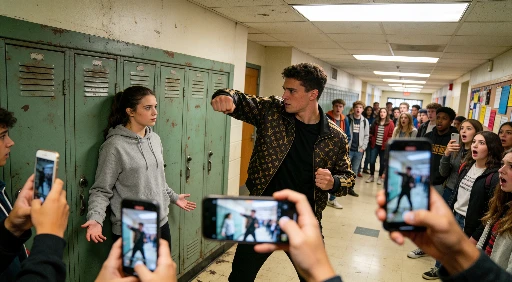
The school hallway was dead silent, save for the rhythmic clicking of phone cameras recording my humiliation. I was pinned against the locker, the smell of damp gym gear and cheap cologne suffocating me as the varsity captain loomed over my space, waiting for me to break. He expected me to drop, but he had no idea what was waiting for him beneath my silence.
The hallway was already recording when Marcus told me to get on my knees. His hand was shoved hard against my chest, pinning me to the metal lockers while thirty other students circled us, their phones held high like vultures. They were waiting for the show. They wanted to see the scholarship kid beg, just like I had done for the last six months to keep my head down and my place in this school.
“You deaf, scholarship?” Marcus sneered, his face inches from mine. “I said drop. Kneel. Give the crowd what they came to see.”
I looked past his shoulder. Mr. Henderson, the history teacher, was standing ten feet away, holding a stack of papers. He glanced over, his eyes flicking to the cameras and then to the varsity jacket, before he sighed and walked into his classroom, closing the door behind him. The message was clear: stay out of it, keep the peace, let the athlete have his fun.
The air felt heavy, vibrating with the anticipation of the crowd. A girl in the front row started chanting, “Kneel, kneel, kneel,” and the rest of the circle joined in, their voices rising in a jagged, cruel rhythm. I felt the cold bite of the lockers against my back and the familiar, burning weight of shame, but beneath that, there was a different kind of stillness.
I didn’t answer. I didn’t look at the cameras, and I didn’t look at Marcus’s eyes. I looked at the floor, breathing slowly, remembering the garage floor at home and the gravel-voiced man who had spent years teaching me that the loudest person in the room is rarely the most dangerous. Marcus took this as a sign of weakness. He grinned, tightening his grip on my shirt, and reared back to shove me down. He thought he was breaking a kid, but he was about to find out that some lessons are carved deeper than skin.
— CHAPTER 2 —
The harassment didn’t start with a shove in the hallway. It began six months ago, during the first week of my freshman year, with a single, whispered comment that grew into a daily ritual. I was the “Scholarship Kid,” the boy from the wrong side of the tracks who occupied a seat that someone from a prominent local family wanted. Marcus, the star varsity quarterback, decided that my mere presence was a social insult he needed to correct.
At first, it was subtle. He’d “accidentally” bump into me in the hallway, sending my books skittering across the linoleum. When I picked them up, he’d laugh, calling out, “Careful, scholarship. Don’t want to damage school property you can’t afford to replace.” I ignored it, just like my mentor had taught me. I kept my head down, my eyes fixed on the floor, and focused on getting to my next class. But silence to Marcus wasn’t a sign of maturity; it was an invitation.
By October, the cafeteria became a minefield. I started bringing my own lunch, eating in the library or behind the bleachers just to avoid the gauntlet. It didn’t matter. Marcus and his circle would track me down. They’d film me as they dumped their leftover milk or crusts onto my backpack, their phones glowing in the dim light of the school annex. They weren’t just bullying me; they were building an audience. Every time they posted a video to the school’s private group chat, the comments section would explode with laughter.
I remember one afternoon in late November, the air was freezing, but the heat in my stomach was worse. I was walking toward the exit when I heard a voice behind me. “Hey, broke-boy, look at the camera.” I didn’t turn around. I kept walking, my heart pounding in my ears. Marcus stepped in front of me, his chest puffed out, surrounded by three of his teammates. He didn’t even look at me; he looked directly into the camera held by one of his cronies.
“Give us a show, scholarship,” he sneered, his tone dripping with fake joviality that fooled every adult who wasn’t paying close attention. “Do a little dance, or better yet, bow for your betters.” When I refused, he didn’t hit me. He just shoved his shoulder into mine, hard, and then walked away, laughing as the group jeered.
The teachers saw it, or at least they saw enough to know something was wrong. I went to the guidance counselor once. Her office smelled like stale coffee and forced empathy. She looked at the report of the milk, the exclusion, and the constant verbal abuse. She didn’t look angry; she looked annoyed. She gave me the same speech she’d given a dozen other kids. “Life is full of difficult personalities, and we need to learn how to de-escalate. I’ll have a word with Marcus, but you need to avoid drama. Both sides usually contribute to these things, and I don’t want to see you making this bigger than it is.”
That was the turning point. I realized then that the school wasn’t a refuge; it was a stage, and I was the designated target. Marcus was protected because his father was a major donor to the athletic department, and his presence on the field was worth more to the school board than my peace of mind. Every time I stepped onto school grounds, I felt the walls closing in. The isolation was suffocating, and the constant fear of being recorded turned every interaction into a potential nightmare.
I started checking over my shoulder every time I walked to my locker. I turned off my phone notifications to avoid the taunts in the group chat. I became a ghost in my own school. Marcus knew he had won the power dynamic; he had the teachers, the crowd, and the camera lens on his side. He thought I was just a quiet, fragile boy who would eventually break under the weight of his attention. He had no idea that I was simply waiting for the moment when I would have no other choice but to stop him.
The tension was rising every day. The crowd was growing bolder, and Marcus was getting more aggressive. I could see the shift in his eyes—he wasn’t just having fun anymore; he was looking for a reaction. He wanted me to swing, he wanted me to lose my temper, and he wanted me to look like the aggressor. Little did he know, I wasn’t fighting his battle. I was honoring a promise I made to a man who had seen enough real violence to know that true strength isn’t about how hard you can hit—it’s about knowing when you have finally run out of room to run.
The next day at school, the atmosphere felt different. The air was charged with a static electricity that made the hair on the back of my neck stand up. As I walked down the hall, I noticed more phones being pulled out of pockets. The circle of students around Marcus seemed tighter, their laughter sharper. I was walking into a trap, and for the first time in months, I didn’t see an exit. The bell rang, the hallways began to clear, and I knew that whatever was about to happen would not stay in the hallways this time. I looked toward the teacher’s lounge, hoping for an adult to intervene, but the door remained shut. I was alone, and I was exactly where they wanted me to be.
— CHAPTER 3 —
My life at school was a carefully practiced exercise in invisibility, but my life at home was a masterclass in controlled discipline. While Marcus and his group spent their afternoons planning how to turn my lunch break into a public spectacle, I was spending mine in the dusty, quiet garage behind our small rental house on the edge of town. That was where Master Hale lived.
Master Hale was a man carved out of grit and silence, a retired Army combatives instructor who had seen more of the world’s ugliness than most people could fathom. He walked with a slight limp from a tour in a place he never talked about, and his hands were permanently calloused, like old leather. He didn’t have a gym or fancy mats. We worked on the cold, unforgiving concrete floor, surrounded by stacks of old newspapers and spare engine parts.
I started training with him when I was seven years old, shortly after my father passed away and my mother began working double shifts to keep us afloat. Master Hale had been my father’s friend, a man who saw the hollow look in my eyes and decided I needed something stronger than pity. He didn’t teach me how to fight for glory, and he certainly didn’t teach me how to win trophies. He taught me that the world was full of people who would try to push you into a corner just to see if you would snap.
“The person who strikes first has already surrendered their control,” he would tell me, his voice sounding like gravel grinding against stone. “When you strike out of anger, you aren’t protecting yourself—you’re feeding the very monster you’re trying to escape. True strength is the ability to stand still when the world is screaming at you to run or fight.”
He drilled the basics into me until my bones ached and my muscles screamed for rest. We practiced balance, spatial awareness, and the art of the exit. He taught me how to read a room, how to identify the exit route before a threat even materialized, and how to keep my hands open, never balled into fists, until the absolute last possible second. He wasn’t training a soldier; he was training a person who refused to be broken.
The most important lesson, the one he repeated until it became a part of my DNA, was simple: never strike first. “If you hit first, you are a criminal,” he’d say, watching me carefully as I stood in my stance. “If you defend yourself, you are a survivor. But if you walk away when there is another choice, you are a master of your own destiny.”
He didn’t just teach me physical maneuvers; he taught me the psychology of the bully. He explained that people like Marcus didn’t want a fight—they wanted a reaction. They wanted to see the victim lose their composure, because a loss of composure was a loss of humanity. “They will try to make you look like the aggressor,” he warned. “They will use the system, the crowd, and their influence to paint you as the villain. Your job is to make that impossible. You remain calm, you remain disciplined, and you remain the man you promised to be.”
There were nights when I came home from school feeling like the weight of the entire world was pressing against my ribs. I’d be bruised from a shove, my backpack soaked with spilled juice, or my ears ringing from a cruel joke shouted across the cafeteria. I would walk into that garage, head hanging low, ready to quit. Master Hale would just look at me, pull out a folding chair, and tell me to start the warm-up.
He never asked me to name the bullies, and he never asked me to tell him what they said. He knew. He could see the shame in the way I carried my shoulders and the fear in my eyes. But he never offered to come to the school or call the principal. He knew that if I couldn’t learn to carry my own weight, I would never truly be free.
“They want you to fear them,” he said one evening while we were practicing defensive pivots. “But fear is just a reaction. You choose whether or not to give them that power. You are not the things they say you are. You are the man who chooses to walk away until you can’t.”
I spent years becoming the person he envisioned. I learned that my silence wasn’t the silence of someone who didn’t know what to do; it was the silence of a coiled spring, waiting for the right moment to release just enough energy to neutralize the threat. I learned to breathe when I wanted to scream, and to move when I wanted to freeze.
The bullying at school intensified as I moved into my freshman year, but I kept the garage training a secret. If I had told anyone, they would have called it a fight club or a dangerous obsession. They wouldn’t have understood that this was my only tether to dignity. Master Hale was the only one who saw the boy I was becoming, and he was the only one who didn’t look at me with pity.
Now, as I faced the prospect of Marcus looming over me in the hallway, the memory of those long, lonely hours on the garage concrete washed over me. I could hear Master Hale’s voice in the back of my mind, cool and steady, cutting through the noise of the hallway. “Stay focused. Keep your eyes on the exit. Don’t let them bait you into being someone you aren’t.”
The crowd was still waiting for the show. The cameras were still rolling. Marcus was still pushing his luck, convinced that the quiet boy in the hoodie was just waiting to be broken. He didn’t know that the boy he was tormenting was the product of a decade of discipline. He didn’t know that he wasn’t just facing a student; he was facing a man who had been prepared for this exact moment since he was seven years old.
The hallway felt like a pressure cooker. I could feel the heat radiating from Marcus, the smug certainty that I would eventually fold. But for the first time in months, the fear started to recede, replaced by a cold, sharp clarity. The training was no longer a secret; it was my reality.
Marcus stepped even closer, his face twisted into a mask of cruel delight. “What’s the matter, coward? Lost your tongue?”
I didn’t answer. I didn’t need to. I just watched his eyes, waiting for the smallest shift in his weight that would signal his next move. I knew the rules, and I knew what was coming. I was ready. But just as I braced myself, a door at the end of the hallway swung open, and the principal stepped out, scanning the crowd with a weary, dismissive expression. My heart sank—if I did what I had been trained to do, would anyone even see the truth? Or would I be the one going home in handcuffs?
— CHAPTER 4 —
The hallways of our school were no longer just a place for getting to class; they had become a theater of cruelty, and I was the reluctant lead. The social ecosystem of the school was perfectly calibrated to protect those at the top while grinding down anyone who didn’t fit the mold. Marcus, as the varsity football captain, wasn’t just a popular student; he was a protected institution.
His status meant he could do almost anything, and the school administration would look the other way. If I reported him, it was labeled as “personal drama.” If he shoved me, it was “horseplay.” If his friends surrounded me, it was just “students hanging out.” The double standard was so blatant that it felt like an invisible ceiling over my head, keeping me small while he grew larger in the eyes of the staff.
The filming was the worst part. Every time Marcus approached me, the phones would come out. It was a reflex now—a digital signal that something entertaining was about to happen. I could see the students in the hallways, their faces lit by the glow of their screens, watching me with a mix of curiosity and detachment. They weren’t just witnessing bullying; they were recording it for the digital record, ensuring that my humiliation could be replayed in group chats long after the incident ended.
There was one girl in my history class, Sarah, who looked like she wanted to intervene. I’d see her flinch when Marcus would make a particularly harsh comment, or turn her head away when he started crowding my personal space. She had a kind face, one that hadn’t yet been hardened by the school’s social politics, but she never said a word. She couldn’t. To speak up for the “scholarship kid” was to put a target on her own back, and in this school, survival was the only currency that mattered.
One afternoon, the reality of the school’s complicity hit home when I tried to speak to the vice principal. I was tired, bruised, and frustrated beyond words. I walked into his office, hoping for someone to finally acknowledge the pattern of harassment. He was a man who prided himself on “maintaining order,” but his idea of order was simply the absence of noise.
“I’m telling you, it’s not just a few jokes,” I said, my voice shaking despite my best efforts to stay calm. “They are targeting me every day. They block my path, they film me, and they do everything they can to make me feel like I don’t belong here.”
The vice principal didn’t even look up from his computer screen. He let out a long, weary sigh, the sound of a man who had heard this a thousand times and had no intention of doing anything about it. “Look, we’re all under a lot of pressure, and I’m sure Marcus is just having a bit of fun. He’s a leader on the field, and he has a lot of energy. Don’t make this bigger than it is. Just keep your head down and focus on your grades, and this will blow over.”
That was the moment I realized that no one was coming to save me. The system was designed to keep the status quo, and I was an inconvenience to that order. The teachers saw enough to know the truth, but they chose to minimize it, calling it “drama” or “boys will be boys” because it was easier than confronting a star athlete and his family. The crowd continued to watch, the phones continued to roll, and the silence from the adults gave Marcus the implicit permission he needed to escalate.
The tension in the school was mounting. It felt like a storm that was gathering strength, and I was standing in the eye of it. Marcus could feel that he had the school’s tacit support, and that made him dangerous. He didn’t just want to bully me; he wanted to see me break in front of everyone, to make me a permanent fixture of his social dominance.
Every day, the environment felt more claustrophobic. Even the quiet moments between classes were filled with the anxiety of not knowing where Marcus would appear. I started to notice that even the teachers I once respected were now treating me like a liability. When I asked a question in class, they would look at me with pity or annoyance, as if I were the one causing all the disruption. It was a suffocating, isolated existence, and I felt like I was being slowly erased.
I knew that the school’s protection wouldn’t last forever, but I also knew that the longer this went on, the harder it would be for me to maintain my discipline. The pressure to just give in, to just apologize for existing, was immense. But deep down, I knew that if I did that, I would lose the only thing that really mattered: my own sense of self.
I looked at the hallway ahead of me, knowing that Marcus was likely waiting around the corner, ready to push me just a little further. I could feel the cold, hard weight of the lockers against my shoulder blades, and the familiar, burning sting of shame. But behind that, I could feel the training, the discipline, and the cold, unwavering resolve that Master Hale had spent years cultivating in me. I was alone, I was isolated, and I was being filmed, but for the first time, I wasn’t afraid. I was waiting for the moment when the system could no longer hide the truth, and I knew that when it did, the cameras that had been used to humiliate me would become my only witness.
The bell rang, signaling the end of the period. I took a deep breath, adjusted my backpack, and prepared myself for the walk ahead. I knew what was waiting for me. I just hoped that when it finally happened, I would be able to do exactly what I had been trained to do: stay calm, control the danger, and never, ever strike first. But as I turned the corner, I saw him standing there, his varsity jacket glowing under the fluorescent lights, a group of students already forming a circle around him, their phones held high, waiting for the show. I stopped, my heart pounding in my chest, and realized that the time for running was officially over.
— CHAPTER 5 —
The hallway felt like a pressure cooker, the air thick with the smell of floor wax and the stale scent of teen cologne. Marcus was looming over me, his massive frame blocking the only clear path to the stairwell, his hands planted firmly against the metal lockers on either side of my head. The varsity jacket he wore felt like a symbol of everything he was allowed to do and everything I was forbidden from fighting back against.
The crowd of students had formed a perfect semi-circle, their phones held aloft like votive candles in a temple of cruelty. I could see the reflection of the fluorescent lights dancing on the glass screens, each one capturing the moment they hoped would be the final, crushing blow to my self-respect. They weren’t just watching; they were hungry for it. They wanted to see me break, to see me finally drop to my knees and beg for the torment to stop.
“You’re a long way from your quiet little study corner, scholarship,” Marcus sneered, his voice dropping to a low, menacing register that was meant to sound like authority. He leaned in closer, his breath hot against my face. “Today, we aren’t just talking. Today, you’re going to show this school exactly what you’re worth. Kneel.”
A ripple of laughter moved through the crowd, sharp and jagged, like broken glass. A girl near the front, someone I’d had in my English class for months, didn’t laugh; she looked at the floor, her shoulders hunched up to her ears, clearly wishing she were anywhere else. But she didn’t leave. Nobody left. The collective inertia of the group kept them anchored to the spot, making them all complicit in the theatre of my humiliation.
I looked past Marcus, hoping for an opening, hoping for an adult to walk by and demand an end to it, but the hallway was empty of authority. Mr. Henderson’s door was cracked open just enough to see his silhouette at the desk, but he kept his head down, focused intently on a file, effectively choosing to be blind to the conflict just feet away. The school’s refusal to act wasn’t just neglect; it was a deliberate choice to prioritize the star athlete’s social standing over the safety of a student who held no weight.
Marcus grabbed a handful of my hoodie, bunching the fabric tightly in his fist as he shoved me backward, my shoulders slamming into the metal lockers with a hollow, ringing thud that echoed through the hall. It wasn’t just a push; it was a challenge. He wanted a reaction. He wanted the outburst, the swing, the desperate flailing that would justify his violence in the eyes of the administration.
“I’m waiting, scholarship!” he barked, his face turning a deep, agitated red. “Don’t make me ask twice.”
He shoved me again, harder this time, his shoulder driving into my chest and pinning me firmly against the metal. The pain was sharp, radiating from the impact, but I didn’t reach out. I didn’t grab him. I kept my hands open, just as Master Hale had drilled into me for years, my palms flat against the cold metal of the lockers. The crowd erupted into a chant, “Kneel, kneel, kneel,” their voices rising in a deafening, rhythmic wave.
I could feel the pressure mounting, a physical weight that made my chest tighten. My heart was pounding, the sound like a drum in my ears, but my mind was eerily quiet, a mirror-still pond in the middle of a hurricane. I wasn’t just a victim of a school bully anymore; I was a student of a man who knew the cost of every motion. I knew that the moment I chose to engage, there was no going back. I wasn’t fighting for honor or to look tough. I was fighting for the chance to walk away.
Marcus sensed my hesitation, but he misinterpreted it completely. He thought I was terrified, that I was frozen by the spectacle and the social gravity of his presence. He grinned, a dark, triumphant expression that made my stomach turn. He tightened his grip, pulling me off the lockers and thrusting me back, trying to force my legs to buckle.
“Looks like you’re still waiting for a miracle,” he laughed, turning back to the camera behind him. “Too bad, because the only thing you’re getting today is a lesson in knowing your place.”
He stepped in, intending to pin me down for good, his weight shifting forward as he prepared to shove me once more. The room seemed to slow down, the chanting fading into a dull, distant roar. I saw the way his shoulders shifted, the way his weight balanced—a tell that Master Hale would have spotted a mile away. He was over-committed, his center of gravity pushed far in front of him, relying on the assumption that I would do nothing but retreat.
I knew that in a few seconds, he would make the move that would cross the line. He wouldn’t just be pushing; he would be attacking. And when he did, I wouldn’t have the luxury of running away anymore. The exit was blocked, the teachers were gone, and the crowd was baying for blood. I took a steadying breath, my feet set firmly on the linoleum, and waited for the moment when I would finally have to stop him. The air was thick with the scent of electricity and impending impact, and for the first time in my life, I felt completely, terrifyingly calm. I was done being the silent victim. I was ready to end this, not with the violence he craved, but with the cold, precise discipline I’d learned in the dark of a garage. The real fight was about to begin, and he had no idea he was already standing in the shadow of a master.
— CHAPTER 6 —
The moment Marcus shifted his weight, I knew he was committed. He wasn’t just posturing anymore; he was stepping into my personal space with the clear intent to shove me to the ground. In that split second, the hallway seemed to drop away. I didn’t see the crowd, the iPhones, or the teacher’s closed door. I saw only the pivot of his hips and the tension in his shoulders—the tell-tale signs of a man who assumed he was the only force in the room.
He lunged forward, his hands reaching for my shoulders to force me down. I didn’t panic, and I didn’t swing. I remembered Master Hale’s voice: “Do not fight his strength. Use his momentum against him.” As Marcus committed his weight to the shove, I stepped sharply to my left, off the line of his advance. It was a small, precise movement, barely enough to clear his path.
Because he had put everything into the momentum of that push, he overextended. His hands grasped only air, and his forward momentum carried him past me. I didn’t strike him. I simply redirected his energy, my hand guiding his arm as he stumbled forward, unbalanced and confused. I used his own weight to steer him toward the empty space between the lockers and the wall, putting him exactly where he couldn’t keep hurting me.
He crashed into the locker, the metal groaning under the impact. He wasn’t hurt, but he was completely immobilized, pinned by his own momentum and my placement. He spun around, his face a mask of shock and fury, his hands balled into fists as he prepared to turn back and tackle me. I stepped back, my hands open, palms forward, my stance relaxed but ready. I stayed outside his reach, keeping my distance, refusing to let the situation escalate into a brawl.
“Check yourself, Marcus,” I said, my voice steady, betraying none of the adrenaline surging through me. “I don’t want to fight you. Stop.”
The silence in the hallway was absolute. The chanting had died instantly, replaced by a stunned, heavy quiet. Every phone was still aimed at us, but the cheering had stopped. They were seeing something they didn’t expect: the quiet kid, the “scholarship boy,” standing tall and unmoved while the varsity captain stumbled. Marcus looked at the crowd, his face burning with embarrassment, then looked back at me, his eyes wide with disbelief.
He moved to rush me again, but I didn’t flinch. I moved again, circling, keeping the lockers between us, maintaining the space he had denied me. I wasn’t being aggressive; I was being unreachable. Every time he stepped, I stepped. I was controlling the danger, refusing to provide the opening he was looking for, refusing to become the person he wanted me to be.
The girl who had been looking at the floor finally looked up, her eyes wide as she realized what was happening. She wasn’t the only one. Others in the crowd were lowering their phones, some looking between us with genuine confusion, others with a new, lingering hesitation. They were recording, yes, but the footage they were capturing wasn’t the humiliation they had been promised. It was a reflection of Marcus’s own unchecked temper.
“Check the cameras,” I repeated, loud enough for the back of the crowd to hear. “The school cameras, your phones—check them all. Everyone saw who moved first. Everyone saw who wanted this fight.”
Marcus froze, his hands still raised, his chest heaving with exertion. He looked at the phones, then at the door of the teacher’s lounge, where the handle began to turn. The reality of the situation was settling in. He wasn’t the one in control anymore, and for the first time, he realized that the audience he had built was no longer on his side. He had wanted a victim, but he had been outmaneuvered by his own ego. The hallway was no longer his stage; it was a witness to his failure. And as the teacher finally opened the door, the truth was already starting to spread.
— CHAPTER 7 —
The silence in the hallway after I had neutralized Marcus’s aggression felt heavier than any noise he had ever made. It was the silence of a hundred witnesses suddenly realizing the story they were recording had shifted under their feet. The teacher’s lounge door swung wide, and Mr. Henderson finally stepped out, his face pale as he surveyed the scene—Marcus hunched over, breathing hard, and me standing a few feet away, hands open, perfectly still.
“What is going on here?” Mr. Henderson’s voice lacked its usual dismissive authority. He looked at the circle of students, then at the phones, and finally at Marcus. “Marcus? Explain yourself.”
Marcus didn’t say a word. He couldn’t. The arrogance that usually shielded him was cracking in real-time. He knew that the very thing he had weaponized against me—the audience—was now his judge. He had wanted the school to see me break; instead, they had seen him fail, witnessed by fifty lenses that were still recording.
“Check the cameras, Mr. Henderson,” I said, my voice cutting through the tension. I kept my hands visible, never clenching them. “Everything is recorded. The shoving, the blocking, the intent. I didn’t start this. I just stopped it.”
The vice principal, who had been hiding in his office earlier, emerged at the sound of the commotion. He looked at the phones, his face dropping as he realized the sheer volume of evidence being captured. He started telling kids to put their phones away, but it was too late. The videos were already being uploaded to the school’s social media pages, shared in group chats, and sent to parents. The “drama” he had been so eager to ignore was now going viral, and it was attached to a time-stamped record of the truth.
Over the next twenty-four hours, the school’s ecosystem flipped. The administration tried to hold the line, calling a meeting with the football coach and the principal, but the sheer volume of footage made “boys will be boys” an impossible defense. Security camera footage from the hallway was pulled and reviewed, and it was damning. It showed Marcus deliberately tracking me down, cornering me, and initiating every physical contact. It showed me trying to exit the area, only to be blocked. It showed me waiting until I had absolutely no other option before I moved.
The fallout was swift and public. The group chat that had been used to coordinate the harassment was leaked, exposing dozens of students who had participated in the planning and execution of the bullying. Suddenly, the students who had been cheering and filming were being called into the principal’s office, one by one. The social power that Marcus had wielded like a weapon had evaporated because it was built on the assumption that no one would ever see the reality of his actions.
His parents were brought in, and for the first time, they couldn’t dismiss the behavior as an athletic rivalry. The football coach, who had spent months turning a blind eye to Marcus’s behavior, had to face the board of directors. Marcus lost his captaincy and his place on the team, not because of a school grudge, but because the evidence was undeniable. The bullying wasn’t an isolated incident; it was a systemic issue, and the school was forced to admit it.
The principal was finally forced to issue a formal apology to my mother. It wasn’t the kind of apology that erased the last six months of misery, but it was an acknowledgment. They had to label it what it was: cyberbullying and harassment. For the first time, the “scholarship kid” wasn’t treated like a liability to be managed; he was a student who had been failed by the institution.
I remember walking into the school two days later. The atmosphere was completely transformed. The hallways were quieter, more respectful. I didn’t walk with my head down anymore. I walked with the steady, measured pace Master Hale had taught me, eyes scanning for exits, not because I was afraid, but because I was prepared. I knew the social landscape hadn’t magically become perfect—there would always be people like Marcus—but I had learned that my restraint wasn’t weakness. It was the foundation of my integrity.
I walked past the lockers where the incident happened. They were just cold metal again. The phones were back in pockets, the filming had stopped, and the air didn’t feel like a trap. I went to the cafeteria, sat at a table in the center of the room, and opened my lunch. I wasn’t hiding anymore. I was exactly where I belonged. I had refused to become the monster that had tried to break me, and in doing so, I had taken back the only thing that really mattered: the right to exist on my own terms. The truth was out, the timestamp was permanent, and I was never going to kneel again.
— CHAPTER 8 —
The fallout of the hallway incident didn’t just fade away like a typical school rumor; it became the catalyst for a total shift in how our school functioned. By the end of the week, the athletic department had held a closed-door meeting that lasted until midnight. Marcus was officially removed from the football team, and his scholarship offer, which had been his primary social shield, was rescinded. The school board had no choice. With the hallway cameras and the dozens of phone angles proving that Marcus had initiated the violence, they couldn’t justify protecting him anymore.
The students who had spent months filming and egging him on were no longer the “cool” crowd. They were being dragged into the vice principal’s office one by one, forced to explain their involvement to administrators and their own parents. Many of them tried to claim they were just “recording for fun,” but when confronted with their own messages in the leaked group chat, the excuses fell flat. The culture of silence that had protected Marcus for so long had been shattered by the simple, undeniable truth of the footage.
Mr. Henderson, the teacher who had looked away, was placed on administrative leave while the board conducted an investigation into why he had ignored repeated reports of bullying. I didn’t hate him, but I felt a sense of relief knowing he would have to answer for his inaction. My mother, who had worked double shifts and sacrificed everything to keep me in this school, finally received a formal apology from the principal. Sitting in that office, watching the principal struggle to find the right words to apologize for the system he had allowed to rot, I realized that I wasn’t the broken kid they expected. I was the one who had survived it.
On my first day back in the cafeteria after the investigation settled, the environment was unrecognizable. There was no jeering, no chanting, and no one trying to trip me as I carried my tray to a table. I chose a seat in the middle of the room—not to show off, but because I had nothing to hide anymore. I didn’t look for exits, and I didn’t scan the room for threats. I sat with my head up, my eyes fixed on my book, at peace with the knowledge that I had finally reclaimed my space.
Marcus had transferred to a different school by the end of the month, his reputation in pieces, leaving behind the social structure he had once dominated. I heard he was trying to start over, but that was no longer my concern. I had learned the hard way that when you base your identity on the suffering of others, you are building your foundation on sand. He had wanted to see me kneel, but he was the one who ended up losing everything.
Master Hale never asked me how it ended. When I went to the garage the day after the truth came out, he just nodded, his face unreadable as ever. We finished our training, as we always did, with the same focus and the same discipline. He didn’t offer a congratulatory speech because he knew that this was just another lesson in a lifetime of them. He had taught me that true strength isn’t about the fight you win; it’s about the person you remain when the fight is over.
I still carry the lessons of the garage with me. I still keep my hands open, and I still look for the exit in every room I enter. But I don’t carry the shame anymore. I know now that my silence was never fear—it was a choice. It was the choice to remain the master of my own destiny, even when the world around me was screaming for me to lose my way.
They called it drama until the truth had a timestamp. And when that timestamp hit, everything changed. I am still the quiet boy from the scholarship program, and I still walk the same hallways. But I walk them differently now. I walk them with the quiet, steady confidence of someone who knows exactly who he is, and who knows that he will never, ever kneel to anyone again.
END