Part 2: The Silent Warning in the Deep Woods
— CHAPTER 2 —
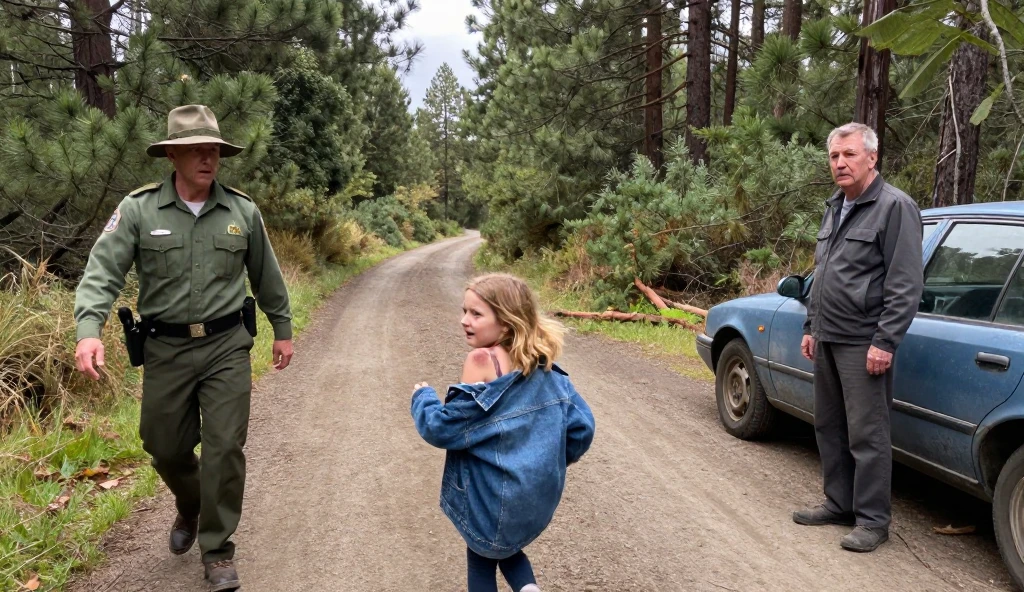
The silence of the Oregon woods had never felt so heavy, so completely suffocating, as it did in the precise second my brain processed the desperate message flashing from Lily’s small, trembling fingers. As a park ranger, I had been trained to handle a massive variety of crisis situations out here on the trails, from severe wildlife encounters and missing hikers to medical emergencies deep in the backcountry, but nothing in my years of service had prepared me for the sheer, paralyzing horror of this exact visual. The heavy leather strap marks crisscrossing her young back were visible even under the dim, filtered canopy of the pine trees, stark and undeniable against her pale skin where her oversized denim jacket had slipped completely askew. She wasn’t just running because she was disoriented or frightened by the dense wilderness; she was running for her absolute survival, sprinting headlong down the gravel path toward a man whose cold, unblinking eyes suggested he had already stripped away every ounce of her safety.
I didn’t stop to think, let alone analyze the severe legal or procedural boundaries that usually governed my daily interactions with the public on state land. My boots slammed hard against the damp earth, kicking up loose gravel and pine needles as I closed the distance between us, my own breath catching in my throat as I desperately tried to intercept her before she reached the rusted blue sedan. The elderly man standing by the open passenger door didn’t flinch, nor did he make any sudden movements to flee; instead, his posture remained rigidly calm, an icy, disturbing confidence radiating from his thin frame as his long, weathered fingers tightened around the top edge of the car door. He wore a heavy, grease-stained flannel shirt and worn canvas work pants that looked like they had seen decades of hard labor, but it was his face—completely devoid of any warmth, any shock, or any human empathy—that made the hairs on the back of my neck stand completely on end.
“Lily, stop right there! Stay behind me!” I shouted, my voice booming through the quiet forest, shattering the eerie stillness that had settled over the northern ridge trail. But the little girl didn’t slow down for even a fraction of a second; her small sneakers pounded against the ground with a frantic, desperate energy, her lungs heaving under the strain of her sprint as she bypassed my outstretched arm entirely. It was as if she believed that reaching him was an inevitability she couldn’t escape, or perhaps she was driven by a deep, terrifying conditioning that compelled her to return to her tormentor even when safety was actively calling out to her from behind. She reached the passenger side of the faded vehicle, her tiny hands gripping the dusty frame as she threw herself into the front seat, quickly pulling her knees up to her chest and staring straight ahead into the cracked dashboard, completely refusing to look back at me.
I pulled up short just a few feet from the sedan, my hand instinctively dropping to the heavy utility belt at my waist where my radio, flashlight, and standard-issue department firearm were secured, though I knew I had to handle this with extreme caution to avoid escalating a potentially lethal situation with a child trapped inside the car. The old man slowly turned his gaze from the girl to me, his lips thinning into a hard, humorless line that didn’t even attempt to mimic a pleasant greeting or a grandfatherly smile. His eyes were a pale, washed-out blue, looking almost translucent under the gray, overcast Oregon sky, and they held an unsettling level of calculation that told me he knew exactly how isolated this specific section of the park truly was.

“Can I help you with something, Officer?” his voice was incredibly dry, raspy like sandpaper sliding across old timber, completely devoid of any nervous tremor or defensive panic that a normal person would exhibit when confronted by a law enforcement figure in the middle of nowhere. He didn’t ask why I was shouting, nor did he acknowledge the fact that the seven-year-old girl who had just sprinted into his vehicle was visibly terrified and covered in deep, physical trauma hidden beneath her denim clothes.
“Sir, I need you to step away from the vehicle immediately and place your hands on the hood where I can see them,” I commanded, keeping my tone as firm and authoritative as possible while actively scanning the interior of the car for any visible weapons or immediate hazards to the child. My heart was hammering violently against my ribs, the image of those dark, overlapping welts on Lily’s back burned into my retinas, driving an intense, protective fury through my veins that I had to fight to keep strictly under control. “The young lady just signaled to me that she is in immediate danger, and I observed clear evidence of severe physical injury on her person that requires immediate medical evaluation and investigation.”
The old man let out a short, sharp breath that sounded terribly like a cynical chuckle, his fingers slowly drumming against the rusted metal of the door frame without moving a single inch to comply with my direct order. “You’re misinterpreting things, Ranger. The girl is mute, she’s highly disturbed, and she’s prone to throwing wild tantrums whenever she doesn’t get her way out in public. We’re just out here taking a quiet family drive to clear her head, and she ran off because she got spooked by a deer a few minutes back.”
“That doesn’t explain the marks on her back, sir, and it certainly doesn’t explain why she used sign language to beg me not to let you take her,” I countered, stepping slightly to the left to maintain a clear line of sight on Lily through the dirty windshield, watching as she sat perfectly motionless, her lower lip trembling violently while she stared blankly ahead. “I am instructing you for the second time to step away from this vehicle. If you do not comply immediately, I will be forced to detain you under suspicion of felony child abuse and endangerment.”
Instead of showing fear, the old man’s expression shifted from cold detachment to a subtle, deeply arrogant sneer that made me realize he wasn’t just a random abusive relative; there was a calculated, methodical nature to his behavior that suggested this wasn’t his first time dealing with authority figures. He slowly reached into his shirt pocket with his left hand, keeping his movements deliberate and painfully slow, before pulling out a worn, plastic-laminated identification card and holding it out toward me between two long, dirt-caked fingers. “My name is Arthur Vance, and I suggest you think very carefully about your next move before you make a massive mistake that ruins your career in this department, young man. I am her legal guardian, appointed by the court, and I have full authority over where she goes, who she sees, and how she is disciplined.”
I stepped forward just enough to glance at the identification card without compromising my defensive stance, noting the name and the official state seal of a specialized long-term foster care and guardianship program that operated out of the state capital, hundreds of miles away from this remote county. The realization hit me like a physical blow to the stomach: this man wasn’t a stranger hiding in the shadows of the woods, he was a deeply embedded part of the system that was supposed to protect children like Lily, meaning he had a legitimate legal shield to hide behind. But as I looked past his shoulder and saw the tiny, trembling form of the little girl, whose silent plea still echoed perfectly in my mind, I knew with absolute certainty that I could not let her drive away in that rusted blue sedan.
“Mr. Vance, regardless of your legal status or any guardianship paperwork you possess, I am currently witnessing a situation that involves a minor with visible, unexplained physical trauma in a remote area,” I stated, my voice dropping to a low, intense register that brooked absolutely no room for negotiation or compromise. “I am invoking emergency protective custody protocols under state forestry law. I am going to call for an official county sheriff’s unit to respond to this location, along with an emergency medical team to examine the child right here on site.”
The moment the words “sheriff’s unit” left my mouth, a distinct, subtle flicker of genuine tension passed through Arthur Vance’s cold, washed-out blue eyes, gone as quickly as it had appeared but loud enough to confirm that he desperately wanted to avoid official police scrutiny. He didn’t argue further, nor did he attempt to reach into his pockets for a weapon; instead, he took a slow step backward, his boots grinding into the gravel as his arm dropped to his side, his entire posture shifting into something intensely defensive yet deeply menacing. “You’re making a very big mistake, Ranger. You don’t know the first thing about this girl, you don’t know what she’s capable of, and you definitely don’t know who you’re dealing with out here in these woods.”
I reached down with my left hand, keeping my dominant hand free and positioned close to my duty weapon, and unclipped the heavy black radio from my belt harness, pressing the side transmit button firmly with my thumb. “Dispatch, this is Unit Two on the northern ridge trail near milestone fourteen. I have an emergency situation involving a seven-year-old female minor with visible, severe physical injuries. I am requesting an immediate priority response from the county sheriff’s department and an advanced life support ambulance to my current location.”
The radio crackled instantly, the harsh static cutting through the dense forest air before the familiar, calm voice of our afternoon dispatcher, Martha, filled the small space between us. “Unit Two, copy that. Be advised, the nearest county sheriff’s unit is currently handling a major traffic collision down on Highway 58, approximately forty-five minutes out from your position. EMS is being dispatched from the valley station, estimated time of arrival is thirty-five to forty minutes. Do you require immediate assistance, and do you have a suspect detained?”
“Dispatch, Unit Two, I have the adult male guardian on scene, identified as Arthur Vance,” I replied, keeping my eyes locked dead on Vance’s face, watching for any sign that he might try to bolt toward the driver’s side or pull a hidden weapon from beneath the seat. “He is currently cooperative but highly uncooperative with instructions to remain clear of the vehicle. I will maintain a secure perimeter here until the sheriff arrives. Advise the incoming units that the child is non-verbal and appears to have severe belt marks across her back.”
“Copy that, Unit Two. Sheriff’s department has been notified of the priority upgrade. Stay on this channel and keep your line open,” Martha’s voice was laced with a sudden, tense seriousness that told me she understood the gravity of what I was facing out here alone on the ridge.
I clipped the radio back onto my belt, the weight of the thirty-five-minute wait pressing down on my shoulders like a block of solid concrete, knowing that a lot of dangerous things could happen in more than half an hour in an isolated patch of the Pacific Northwest wilderness. Arthur Vance didn’t say another word; he simply walked around to the driver’s side of the sedan, his movements slow and agonizingly deliberate, before sliding behind the steering wheel and shutting the heavy metal door with a dull, echoing thud. He didn’t start the engine, which gave me a small measure of relief, but he rolled the window down just a few inches, allowing the cold mountain air to circulate while he sat back against the torn fabric seat, staring directly at me through the side mirror with that same arrogant, terrifying smile.
I walked over to the passenger side of the car, keeping a safe distance from the door but positioning myself where Lily could see me clearly through the glass, trying to project as much calm, protective warmth as I possibly could muster under the circumstances. The little girl hadn’t moved an inch since she threw herself onto the seat; her knees were still pulled tightly against her chest, her oversized denim jacket clutched around her shoulders like a shield against the cruel world outside. I tapped very softly on the glass with the pad of my index finger, waiting until her wide, tear-rimmed brown eyes slowly shifted over to look at me through the dirty windowpane.
Using the basic, fundamental elements of American Sign Language that I had learned years ago to communicate with a cousin of mine, I carefully formed the shapes with my hands, keeping my movements smooth and visible in the dimming afternoon light. “You are safe. I am staying right here. Nobody is going to hurt you again.”
Lily watched my hands intently, her chest rising and falling in rapid, shallow hitches as she processed the signs, a single, heavy tear finally spilling over her long lashes and tracking a clean line through the dust on her pale cheek. She didn’t sign back immediately; instead, her eyes darted quickly toward the driver’s seat where Arthur Vance sat like a stone statue, her entire frame flinching slightly as if she feared he could read the silent words passing through the air between us. When she was certain he wasn’t looking directly at her, her small hand subtly rose just a few inches above her lap, her fingers moving with a terrifyingly fast, precise urgency that made my blood run absolutely cold all over again.
“He has the others,” her fingers flashed, the sign for ‘others’ accompanied by a desperate, wide-eyed look toward the dense, uncharted woods that stretched for miles behind the rusted blue sedan. “In the ground. Under the floor. Don’t let him take me back to the dark house.”
Before I could even attempt to formulate a response or ask her to clarify what she meant by “the others in the ground,” the harsh, metallic roar of the sedan’s engine suddenly ripped through the quiet forest, the old V8 motor coughing violently before settling into a loud, rhythmic rumble. Arthur Vance had turned the key, his long fingers wrapping tightly around the steering wheel as he shifted the heavy transmission into reverse, the reverse lights throwing a dull, dirty red glow against the thick brush behind the car. My heart leaped into my throat as I realized he wasn’t going to wait for the sheriff’s department to arrive; he was preparing to flee into the labyrinth of logging roads that crisscrossed this mountain, where he could disappear completely without leaving a single trace.
“Vance! Turn off the engine right now!” I yelled, drawing my standard-issue firearm and bringing it to a tight, two-handed press, aiming directly at the driver’s side tire to disable the vehicle before he could accelerate down the narrow, winding access road. “Do not move this car! If you put this vehicle in motion, I will consider it a direct threat to the safety of the minor and will take immediate action to neutralize the vehicle!”
The old man didn’t look at me; he simply turned his head toward Lily, his jaw clenching tightly as he muttered something to her in a low, furious tone that I couldn’t hear through the closed windows, causing the little girl to cover her ears and bury her face deep into her knees. Then, with a sudden, violent jerk of his arms, Vance slammed his foot down on the gas pedal, the rear tires spinning wildly in the loose gravel, throwing up a massive cloud of gray dust and sharp stones that forced me to dive backward onto the dirt trail to avoid being struck by the swinging front fender. The sedan roared backward into a wide, reckless turn, the bumper clipping a young pine tree with a loud, cracking sound before Vance shifted into drive and accelerated down the mountain, the red taillights disappearing into the thick, darkening fog within a matter of mere seconds.
I scrambled back to my feet, my green uniform covered in dark mud and sharp pine needles, my hands trembling with an intense cocktail of pure adrenaline and raw panic as I sprinted back toward my official department truck parked a hundred yards away. I ripped the radio from my belt before I even reached the driver’s seat, my voice practically cracking under the immense pressure of the situation. “Dispatch! Dispatch! This is Unit Two! The suspect, Arthur Vance, has fled the scene in the blue sedan! He is heading south down the old logging bypass toward the lower valley roads! He has the minor with him, and she is in extreme, immediate danger!”
“Copy that, Unit Two! I am relaying your coordinates to the state police and the incoming county units right now!” Martha’s voice was sharp, the sound of her typing furiously in the background cutting through the speaker. “Can you maintain visual contact, Unit Two?”
“I’m in pursuit right now, but the visibility is dropping fast due to the mountain fog!” I shouted as I threw myself into the driver’s seat of my high-clearance four-wheel-drive truck, slamming the keys into the ignition and forcing the powerful engine to life. I flipped the heavy toggle switches on the dashboard, activating the brilliant red and blue emergency lights that flashed violently against the surrounding trees, before slamming the truck into gear and roaring down the narrow dirt path after the disappearing sedan. The chase was officially on, but as my truck bumped and swayed violently over the deeply rutted logging road, Lily’s final, terrifying message kept looping in my mind like a horrific chant: He has the others. In the ground. Under the floor.
The thick mountain fog was rolling in from the Pacific at an alarming rate, dense and heavy like a wet wool blanket dropping over the jagged ridges of the Oregon wilderness, cutting my visibility down to less than thirty feet in front of my bumper. I pressed hard on the accelerator, the truck’s massive off-road tires biting into the slick, muddy ruts of the abandoned logging bypass, the bright halogen headlights cutting weak, yellow tunnels through the swirling white mist. I could see the fresh, deep tire tracks left by Vance’s fleeing sedan in the soft mud ahead of me, the erratic, swaying lines showing just how fast and recklessly the old man was taking these dangerous, unmaintained mountain switchbacks.
Every single instinct in my body was screaming at me that this wasn’t just a routine rescue operation anymore; it was a desperate race against a clock that was ticking down to a very dark, permanent conclusion for a seven-year-old girl who had trusted me enough to break her silence. The sheer horror of what she had signed to me—the explicit mention of others hidden in the ground—suggested that Arthur Vance’s official state guardianship was nothing more than a grotesque cover for a predator who used the absolute isolation of these mountains to commit unspeakable acts. I knew that if I lost sight of that rusted blue sedan in this blinding fog, Vance would navigate into the deep network of thousands of miles of unmapped, forgotten logging trails, and Lily would vanish into the shadows forever.
I grabbed the microphone from the dashboard radio, my knuckles white as I steered around a sharp, hairpin turn that overlooked a sheer drop into a rocky ravine below. “Dispatch, this is Unit Two! I am currently tracking the suspect south on Logging Road 400, but the fog is zero-visibility at this altitude! I need the state police to set up a hard roadblock at the intersection of Road 400 and Route 58 before he can reach the main highway!”
“Unit Two, state police are advising that their closest unit is still fifteen minutes away from that intersection,” Martha’s voice came through, strained and accompanied by a heavy layer of radio static as the mountain terrain began to interfere with our signal. “They are moving as fast as possible, but you are currently the only unit in visual or physical proximity to that vehicle. Exercise extreme caution, the terrain ahead is highly unstable due to recent heavy rainfall.”
“Understood, Dispatch! I am staying on him!” I yelled back, hanging up the microphone just as my headlights caught a brief, terrifying glimpse of the blue sedan’s rusted rear bumper about fifty yards ahead, fishtailing violently as Vance tried to navigate a steep, downward slope. The car was sliding sideways, its old suspension groaning under the immense strain as the left rear tire slipped off the edge of the muddy trail, hanging precariously over the dark, empty ravine before Vance somehow corrected the slide and forced the vehicle forward with a loud, metallic screech.
My heart leaped into my throat as I saw Lily’s small head bobbing violently inside the passenger seat through the dirty rear window, her tiny hands clutched against the side glass as if she were pleading for the car to stop. The absolute unfairness of her situation filled me with a cold, focused rage; this innocent child had already endured the brutal torment of that leather belt, and now she was being driven toward a potential fatal crash by a monster who cared more about escaping justice than preserving her precious life. I pulled my truck closer, narrowing the gap between our bumpers to less than twenty feet, using the sheer size and weight of my official vehicle to pressure him into pulling over before he killed them both.
But Arthur Vance didn’t have any intention of stopping; instead of braking for the washed-out section of the trail ahead where a recent mudslide had taken out half the dirt road, he actually accelerated, the old blue sedan leaping across the deep gap like a desperate, wild animal. The car slammed down hard on the other side of the washout, the front bumper ripping completely off with a loud, deafening crash as sparks flew in every direction from the twisted metal grinding against the rocks. The impact caused the sedan to veer sharply to the right, smashing heavily into the side of a massive, ancient cedar tree before spinning completely around and stalling out across the narrow path, a thick cloud of white steam hissing violently from the ruptured radiator.
I slammed on my brakes, my truck sliding sideways in the deep mud before coming to a violent stop just ten feet away from the wrecked sedan, the brilliant red and blue emergency lights bathing the entire crash scene in a chaotic, rhythmic pulse of light. I didn’t wait for the dust or the steam to clear; I threw my door open, unholstering my duty weapon and moving forward in a tight, low tactical stance, my eyes locked on the shattered windows of the vehicle. “Vance! Keep your hands where I can see them! Step out of the vehicle with your hands on your head right now!”
The driver’s side door of the sedan was jammed tightly against the cedar tree, preventing Vance from exiting from that side, but through the cracked glass of the passenger side, I could see movement as the old man crawled over the center console, his face covered in dark, fresh blood from a deep gash on his forehead. He looked absolutely rabid now, the calm, arrogant facade completely gone, replaced by the desperate, vicious expression of a cornered predator who knew his dark secrets were on the absolute verge of being exposed to the world. In his right hand, clutched tightly with a white-knuckled grip, was a heavy, rusted tire iron that he had pulled from beneath the seat, his teeth bared as he forced the dented passenger door open and stepped out into the cold mountain air.
“Get back! Get away from us!” he screamed, his voice no longer a calm rasp but a high-pitched, manic shriek that echoed terribly through the dark pines. He stood between me and the open door where Lily lay huddled on the floorboards, her small body shaking uncontrollably as she cried silently, completely paralyzed by the violence of the crash and the terrifying sight of her bleeding guardian. “You have no right to interfere! She belongs to me! The state gave her to me! You can’t prove anything!”
“Drop the weapon, Vance! Drop it right now!” I commanded, my laser sight steady on the center of his chest, my finger taking up the slack on the trigger as I stood my ground in the pouring mountain fog. “It’s over! The police are on their way, and there is nowhere left for you to run! Drop the tire iron and step away from the child!”
Instead of dropping the heavy metal bar, Vance raised it high above his shoulder, his cold, bloodshot eyes fixing onto me with an intense, murderous intent that told me he was fully prepared to swing it at my skull if I took another step forward. “She’s not going to talk to you! She’s never going to tell anyone anything! I’ll make sure of it!”
Before he could swing or make a move toward the helpless girl inside the car, I closed the distance with a sudden, explosive burst of speed, using my heavy tactical boot to kick the tire iron directly out of his grip with a sharp, metallic clang that sent the tool flying into the thick brush. Vance let out a guttural howl of rage and lunged at me with his bare hands, his long, dirt-caked fingers scratching wildly at my face and uniform, but I easily countered his desperate attack, grabbing his arm and spinning him around against the dented frame of the sedan. I forced his face down onto the hot, steaming hood of the car, pulling his arms behind his back and clicking the heavy steel handcuffs tightly around his wrists with a satisfying, permanent click.
“Arthur Vance, you are under arrest for felony child abuse, kidnapping, and fleeing from a law enforcement officer,” I growled into his ear, pressing him firmly against the metal to ensure he couldn’t attempt to struggle free or cause any further harm. He didn’t answer; he just let out a low, pathetic moan as his forehead pressed against the wet paint of the hood, his chest heaving as the reality of his capture finally began to settle into his twisted mind.
I carefully secured him to the heavy bull bar on the front of my truck, ensuring he was locked down tight and couldn’t move, before I sprinted back to the passenger side of the wrecked sedan to check on Lily. The little girl was still curled into a tight ball on the floorboards, her hands clutched over her ears, her entire body trembling so hard that her teeth were actively chattering in the freezing mountain air. I slowly knelt down in the mud beside the open door, keeping my hands fully visible and my voice incredibly soft and gentle, trying to undo even a fraction of the immense terror she had just experienced.
“Hey there, Lily. It’s okay now. He can’t hurt you anymore, I promise,” I whispered, carefully reaching in to offer her my hand, waiting patiently for her to make the decision to trust me. She slowly uncovered her ears, her wide, tear-filled eyes looking up at me through her messy blonde hair, her gaze drifting over my uniform before finally locking onto my face with a look of pure, raw vulnerability.
She didn’t take my hand right away; instead, she slowly sat up on the torn seat, her small fingers rising into the air between us once again, moving with a steady, deliberate precision that told me she wanted to ensure I understood every single word this time.
“The dark house,” her hands spelled out, her face completely pale as she pointed a trembling finger down the mountain trail toward a hidden valley that wasn’t marked on any of our standard park maps. “The house where he keeps the keys. There is a trapdoor under the rug in the kitchen. My sister is still down there. Please, you have to save Emily.”
My heart stopped completely, a cold, icy dread washing over me that made the physical confrontation with Vance feel like nothing compared to the cosmic horror of what this brave little girl had just revealed. Arthur Vance didn’t just have Lily; there was another child, a sister named Emily, who was currently locked away in a hidden dark house somewhere deep within the uncharted ridges of this mountain forest. I looked back at Vance, who was currently staring at us from the front of my truck with a sudden, terrifying look of pure panic on his bloody face, confirming without a single doubt that the little girl was telling the absolute truth.
I pulled out my radio again, my hand shaking so violently I almost dropped the plastic device into the mud, my voice tight with an urgency that transcended any standard emergency protocol. “Dispatch! This is Unit Two! Code Red! I have the suspect in custody, but I need an immediate, massive reinforcement response to my location right now! We are not just dealing with child abuse here! The victim has just informed me that there is an active, hidden location containing another missing child in the immediate area! I need every available unit, canine teams, and search and rescue dispatched to the lower valley access road immediately!”
As the radio erupted into a chaotic flurry of responses from state troopers and sheriff’s deputies who were finally clearing their previous calls, I pulled my heavy winter jacket off my shoulders and gently wrapped it around Lily’s small, shivering frame. She clutched the warm fabric tightly around herself, her eyes locked onto mine with a profound, trusting intensity that told me she had spent months, perhaps years, waiting for someone to finally understand her silent language. I knew that the long, dark night was far from over, and that the search for the hidden house would take us into the deepest, most dangerous corners of these woods, but as I sat there in the mud beside her, holding her hand while the flashing emergency lights cut through the thick Oregon fog, I swore an absolute oath that I wouldn’t stop until every single child hidden in the dark was brought safely into the light.
The sound of distant sirens began to echo through the mountain passes, a low, rising wail that signaled help was finally on the way, but out here in the dense fog, the shadows still felt alive with secrets that were waiting to be uncovered. Arthur Vance remained silent against the front of my truck, his head hung low as the cold rain began to mix with the blood on his face, his arrogant confidence entirely shattered by the silent strength of the seven-year-old girl who had broken his cycle of terror with a single, desperate gesture on a lonely dirt trail.
— CHAPTER 3 —
The heavy, metallic thud of the handcuffs locking around Arthur Vance’s wrists felt like a temporary victory, but the icy dread pooling in my stomach told me the real nightmare was only just beginning. I stood in the pouring mountain fog, the mud clinging to my tactical boots, as I looked from the bleeding, tight-lipped old man secured to my truck’s bull bar back to the shattered passenger side of the rusted blue sedan. Inside, seven-year-old Lily was still curled into a shivering ball, her small hands flat against her ears as if she could visually block out the violent reality of the crash that had just saved her life. My heavy winter jacket swallowed her tiny frame, the dark green fabric stained with the damp Oregon mist and the faint, heartbreaking residue of the fresh welts on her back.
I took a deep, steadying breath to control the tremble in my own hands, unhooking my radio from my duty belt with a deliberate, slow motion so I wouldn’t alarm her further. “Dispatch, this is Unit Two, I have a confirmed secure scene at the mudslide washout on Logging Road 400,” I said, my voice dropping to a low, tight register as I stared into the swirling white fog. “Suspect is fully restrained, but the minor has just provided critical, time-sensitive intelligence regarding an active second location. I need the responding sheriff’s units to expedite, and I need the state police child abduction team routed to this coordinate immediately. We are looking for a secondary victim, a female minor named Emily, held at a residence somewhere in this immediate grid.”
The radio crackled instantly, the sound sharp and abrasive against the eerie quiet of the dense pine forest. “Unit Two, copy your request, all units are currently running code three with sirens active, but the washed-out lower ridge is slowing their ascent,” Martha’s voice came through, laced with a rare, professional panic that she was trying desperately to mask. “State police are deploying a K-9 search unit from the valley sub-station, but their estimated time of arrival is still twenty-two minutes out. Are you able to extract the specific location from the minor, or do you need to wait for a specialized forensic interviewer?”
“We don’t have twenty-two minutes, Dispatch,” I replied flatly, my eyes darting toward Arthur Vance, who had lifted his bloody forehead from the hood of my truck, his pale, washed-out blue eyes glaring at me with a mixture of cold malice and sudden, calculating desperation. “The victim is non-verbal but highly precise. I am going to attempt to gather actionable direction now. Keep the line open and map my GPS coordinates continuously.”
I clipped the radio back to my chest harness and walked back to the open passenger door of the sedan, dropping to one knee in the thick, black mud so I could meet Lily at eye level. The smell of leaking radiator fluid and burnt rubber was heavy in the damp air, but I forced my expression to remain perfectly calm, completely projecting a sense of absolute safety that I wasn’t entirely sure I felt myself. “Lily,” I said softly, keeping my hands resting openly on my knees, completely clear of my duty weapon. “You are doing so brave. You are so incredibly strong, Lily. Look at me, sweetie. He can never touch you again. I promise you, on my life, he is never going to hurt you or your sister ever again.”
The little girl slowly lowered her hands from her ears, her wide, tear-rimmed brown eyes searching my face with a terrifyingly mature intensity that no child should ever possess. She looked at my green uniform, the silver badge pinned to my chest, and then down at my hands, her chest rising and falling in rapid, shallow hitches. When she realized the old man was truly trapped behind the heavy steel of my truck’s bumper, her small jaw set into a firm, desperate line, and her hands rose into the small, cold space between us.
Her fingers moved with a dizzying, frantic speed, the fluid motions of her American Sign Language cutting through the damp mountain air like a lifeline thrown out of a dark sea. “The house with the red door behind the old lumber yard,” she signed, her fingers trembling violently as she formed the specific shapes, her eyes darting toward the dense, uncharted forest to the west. “He keeps the lights off. He tells the neighbors we are away at school. Emily has been in the dark room under the kitchen for three days because she tried to run to the road. She doesn’t have her shoes. Please, the water comes in from the rain. It’s cold.”
A wave of profound, nauseating fury washed over me, the sheer unfairness of her words striking me like a physical blow to the chest. This wasn’t just a case of severe domestic discipline or an isolated incident of an abusive guardian losing his temper in the woods; this was a calculated, hidden system of complete captivity operating right on the borders of my territory. I looked back over my shoulder at Arthur Vance, who was trying to shift his weight against the bull bar, his boots sliding in the mud as he tried to look over his shoulder at the girl’s moving hands.
“You’re listening to a crazy kid, Ranger!” Vance shouted, his raspy voice cracking as he spat a mouthful of dark blood into the dirt. “She’s a liar! She’s got a severe attachment disorder! The state gave her to me because nobody else wanted a broken, silent freak! There is no other girl! There is no house! You’re violating my civil rights, and I’m going to make sure you lose everything when this goes to court!”
I stood up slowly, the mud sucking at my boots as I walked over to the front of my truck, my shadow looming large over the old man in the flashing red and blue emergency lights. I didn’t say a word until I was standing less than six inches from his face, letting the steady, rhythmic pulse of the police lights illuminate the raw, uncompromising anger in my eyes. “Where is the lumber yard, Arthur?” I asked, my voice dangerously quiet, completely stripped of any professional politeness. “Where is the house with the red door?”
Vance let out a dry, rattling laugh, his thin lips curling into that same arrogant sneer that had made my skin crawl back on the trail. “Go look for it yourself, hero. You’ve got forty thousand acres of protected wilderness out here. Why don’t you go take a walk in the dark and see what you find? By the time your city cops get up this ridge, the rain’s gonna wash out the rest of this road anyway.”
He was right about one thing: the weather was turning dangerous. The light drizzle was rapidly shifting into a heavy, torrential Pacific Northwest downpour, the massive drops slamming into the pine canopy above us and turning the steep logging trails into unstable channels of rushing mud and loose gravel. If I waited here for twenty minutes for the sheriff’s deputies to navigate the lower washout, the narrow access roads to the abandoned western segments of the park could become entirely impassable, locking us out of the area where Lily’s sister was currently trapped in a flooding basement.
I turned back to my truck, opened the driver’s side door, and grabbed the heavy, hard-cased spotlight from the mounting bracket beside the steering wheel, along with a pair of thick leather gloves and my secondary emergency medical kit. I walked back to the passenger side of the sedan, gently lifting Lily out of the ruined vehicle and carrying her small, lightweight body over to the secure, warm cab of my official four-wheel-drive truck. I buckled her into the front passenger seat, adjusting the high-output heater vents so the warm air would blast directly onto her shivering hands, and handed her a clean, dry wool blanket from my rear storage box.
“Lily, I need you to stay right here in this seat where it’s warm and safe,” I said, looking directly into her eyes as I pointed to the heavy steel locking mechanism on the truck’s dashboard. “The doors are locked from the outside. He cannot get to you. I am going to find your sister, but I need you to be my navigator. Can you point the way for me through the glass?”
Lily nodded her head vigorously, her small fingers coming up to form a single, universal sign against her chest: “Yes.” She gripped the edge of the dashboard, her knuckles turning white as she peered through the heavy sweep of the windshield wipers, her eyes focused intently on a narrow, almost invisible opening in the thick brush about fifty yards past the mudslide washout.
I stepped out of the cab, slamming the heavy steel door shut and ensuring the automatic deadbolts clicked into place, leaving Arthur Vance securely handcuffed to the heavy front bumper where he could do absolutely nothing but watch his timeline of escape dissolve into the mud. I climbed into the driver’s side, threw the heavy transmission into its lowest four-wheel-drive gear, and locked the front differentials, the massive mud-terrain tires groaning as they gripped the slick, unstable edge of the ridge. With a smooth, calculated pressure on the accelerator, I forced the heavy utility truck across the shallowest section of the mudslide, the chassis scraping violently against a buried boulder with a loud, metallic shriek before the tires found solid rock on the other side.
“Which way, Lily?” I asked, keeping my eyes locked on the dark wall of trees ahead as the brilliant off-road light bars on my roof cut through the heavy downpour.
Lily lifted a trembling right hand, pointing directly toward a rusted, padlocked iron gate that was completely choked with thick wild blackberry vines and decaying logging debris—an entrance that hadn’t been officially mapped or utilized by the forestry service since the late nineteen-seventies. It was the entrance to the old Blackwood Lumber tract, a private parcel of land that had been caught in legal probate for decades, left to rot in the absolute isolation of the high ridge where the public never ventured.
I didn’t hesitate. I slammed the truck’s heavy steel brush guard directly into the center of the rusted gate, the old iron chains snapping with a loud, explosive crack that echoed through the cab like a gunshot. The truck surged forward into the unmaintained darkness, the heavy branches of overgrown pine and hemlock trees clawing violently at the side windows as we began a steep, treacherous descent into the hidden valley below. The road was nothing more than an eroded creek bed now, filled with deep ruts, sharp shale rock, and decaying logs that threatened to rip the steering wheel right out of my grip with every foot of progress we made.
Beside me, Lily remained perfectly still, her eyes wide and fixed on the narrow tunnel of light ahead, her small hand occasionally shifting to point left or right as the abandoned logging trail split into a confusing maze of forgotten paths. The emotional weight in the cab was suffocating; every passing minute was a minute that another seven-year-old girl was sitting in a dark, flooding room beneath the floorboards of a monster’s house, wondering if anyone in the outside world even knew she existed. The unfairness of their reality burned hot in my chest, fueling a driving desperation that made me push the heavy truck past its mechanical limits, the engine roaring as we cleared another steep rocky shelf.
After three miles of brutal, bone-jarring descent through the absolute heart of the wilderness, the dense wall of trees suddenly opened up into a wide, eerie clearing that looked like a ghost town from a forgotten era. The remains of the old Blackwood sawmill stood on the left—a massive, collapsing structure of gray, weathered timber and rusted corrugated iron roofs that had partially caved in under the weight of decades of winter snow. The ground was littered with rotting log piles, rusted machinery chassis, and deep pools of black, stagnant water that reflected the brilliant strobe of my emergency lights.
But it was what sat directly past the old mill that made my breath catch completely in my throat. Nestled against the base of a sheer, rocky cliff face was a small, single-story cabin constructed from heavy, dark-stained logs. The windows were entirely covered from the inside with thick sheets of black plywood, preventing even a single sliver of light from escaping into the surrounding woods, and the heavy front door was painted a dull, chipping shade of crimson red. It was exactly as Lily had described—a hidden fortress of isolation, designed specifically to keep the world out and a dark secret permanently contained within.
I pulled the truck to a stop about twenty yards from the front porch, leaving the engine running and turning the heavy roof-mounted spotlight directly onto the red door, illuminating the thick padlocks and heavy steel hasps that were secured to the outside of the frame. The sheer malice of the setup was undeniable; this wasn’t a home, it was a specialized prison built in the one place where no one would ever hear a child scream.
“Lily, stay here,” I said, my voice tight as I unbuckled my seatbelt and checked the retention strap on my duty holster, ensuring my heavy tactical flashlight was primed and ready in my left hand. “Do not get out of this truck under any circumstances. The sheriff will be here soon. I’m going to get Emily.”
Lily looked at me, her small fingers moving one last time in the dim light of the dashboard. “Be careful. The floor is bad.”
I nodded, opened the door, and stepped out into the freezing, torrential rain, the wind howling through the old sawmill structures like a chorus of dying animals. I moved toward the cabin in a low, defensive stride, my tactical flashlight throwing a piercing white beam across the muddy porch steps as I approached the red door. The air around the cabin smelled heavily of woodsmoke, decay, and something else—something damp and sour that suggested a total lack of human sanitation.
I pulled my heavy iron halligan bar from the rear utility rack of my truck and brought it down hard against the top padlock on the door, the impact sending a shower of bright sparks into the rain as the cheap lock shattered under the immense leverage. I worked quickly, my adrenaline overriding the burning fatigue in my shoulders, until the final chain dropped into the mud with a heavy, hollow thud. I drew my duty weapon with my right hand, bracing my flashlight against my wrist, and kicked the heavy red door open with a single, violent strike of my boot.
The interior of the cabin was pitch black, the air instantly hitting me with a wave of stagnant heat, old grease, and a suffocating, metallic odor that made my stomach turn over in immediate revulsion. My flashlight beam cut through the darkness, revealing a room that was in a state of absolute, chaotic squalor—broken furniture, piles of dirty clothes, and empty tin cans littered the floor, while the walls were covered in strange, erratic scratch marks that looked like they had been made by human fingers. There was no television, no books, no signs of life or comfort; it was a space designed entirely for survival and control.
“Emily!” I shouted, my voice booming through the small, enclosed space, the sound reflecting off the black plywood window covers. “My name is Ranger Miller! I’m here with Lily! Emily, if you can hear me, make some noise! I’m here to get you out!”
The only response was the steady, heavy drumming of the rain against the metal roof above, followed by a faint, barely audible scratching sound that seemed to originate from directly beneath my feet. I dropped my gaze to the floor, my flashlight beam sweeping across the filthy, grease-stained linoleum rug that covered the center of the small kitchen area on the back wall of the cabin. The edges of the rug were curled and held down by heavy iron weights, but in the center, the linoleum was worn completely thin, showing the outline of a rectangular cut in the heavy wooden floorboards beneath.
I walked over to the kitchen area, my boots crunching on broken glass, and used the tip of my boot to kick the heavy iron weights aside, ripping the dirty linoleum rug away from the floor with a single, violent motion. Beneath it lay a heavy, homemade wooden trapdoor, constructed from thick three-inch timber planks and secured with a massive, industrial-grade steel sliding bolt that was currently padlocked into place. The lock was heavy, but the wood around the hasp was old and softened by the damp air that was actively rising from the dark void below.
I jammed the flat edge of my halligan bar directly beneath the steel hasp, throwing my entire body weight against the tool as I leveraged the wood upward with a loud, splintering roar. The old timber gave way with a massive, cracking sound, the steel bolt ripping clear of the frame and sending a shower of rotten wood splinters across the kitchen floor. I grabbed the heavy iron handle of the trapdoor and yanked it upward, throwing it back against the wall as I shone my flashlight down into the deep, black square hole.
The beam of my light cut through a cloud of freezing, damp mist, revealing a narrow set of steep wooden steps that descended into a hand-dug earthen cellar beneath the cabin’s foundation. The bottom of the cellar was filled with three inches of black, muddy water that was actively rushing in through the porous stone walls from the torrential downpour outside. The air rising from the hole was freezing, smelling of wet dirt, mold, and an absolute, terrifying isolation that made my blood freeze in my veins.
“Emily!” I called out again, my voice trembling slightly as I began a slow, careful descent down the slippery wooden steps, my weapon held ready as I scanned the dark corners of the basement. “Emily, I’m right here! It’s okay!”
At the far end of the cellar, huddled on top of an old, waterlogged wooden pallet that was barely keeping her above the rising mud, was a second little girl. She looked identical to Lily—same messy blonde hair, same small, fragile frame—but her skin was deathly pale, translucent in the harsh white light of my flashlight, and her thin cotton nightshirt was completely soaked through with the freezing ground water. Her bare feet were caked in thick black mud, her toes blue from the early stages of severe hypothermia, and her small hands were tucked tightly into her armpits as she shook so violently that her entire body was vibrating against the wooden pallet.
The moment the light hit her face, she didn’t scream or cry out; instead, she slowly lifted her head, her wide, hollow brown eyes blinking painfully against the sudden illumination, a look of complete, broken resignation on her face that suggested she had already given up on the concept of rescue. She didn’t have the strength to stand, let alone run toward me; she was simply waiting for the dark to swallow her completely.
I holstered my weapon instantly, dropping the heavy halligan bar into the water with a loud splash as I rushed across the flooded cellar floor, my boots sinking into the thick mud as I reached the wooden pallet. I fell to my knees in the freezing water, completely ignoring the cold as I reached out and gently scooped Emily’s small, rigid body into my arms, pulling her tightly against my chest to share whatever body warmth I had left. Her skin felt like ice against my neck, her breathing so shallow and weak that for a terrifying second, I thought her heart might stop right there in my arms.
“I’ve got you, Emily. I’ve got you, sweetie,” I muttered repeatedly, my voice thick with an intense, overwhelming emotion as I wrapped my arms completely around her, shielding her from the damp air of the cellar. “Your sister Lily found me. She told me exactly where you were. You’re safe now, Emily. The monster is gone. He’s never coming back down here.”
The little girl didn’t speak—she couldn’t—but as I lifted her up toward the steep wooden stairs, her small, icy fingers subtly moved against the wet fabric of my shirt, forming a single, trembling shape that I recognized instantly from my training. It was the sign for “Home.”
I carried her up the steps and out of the dark hole, stepping back into the squalor of the kitchen just as the distant, rising wail of multiple police sirens finally broke through the heavy roar of the rain outside. The flashing red and blue lights of the first sheriff’s units were visible through the trees, casting long, dramatic shadows across the clearing as they roared down the abandoned logging road toward the cabin. I carried Emily out onto the front porch, the freezing rain washing the black mud from her bare feet as I walked toward my truck, where Lily was already pressing her face against the passenger glass, her eyes wide with a profound, tearful relief as she saw her sister alive in my arms.
I opened the truck door and placed Emily gently into the passenger seat beside her sister, watching as Lily instantly threw her arms around the shivering girl, wrapping her in the dry wool blanket and holding her with a fierce, protective strength that defied their young age. They sat there together in the warmth of the cab, two silent survivors who had defeated a monster through nothing more than pure love and a secret language that the outside world had never bothered to understand.
I stood by the open door for a moment, the cold rain soaking through my uniform as I watched the first three county sheriff’s cruisers roar into the clearing, their tires throwing up massive plumes of muddy water as they surrounded the cabin. A team of heavily armed deputies threw their doors open, their flashlights cutting through the fog as they moved into a tactical perimeter around the house, their faces grim as they took in the broken locks, the red door, and the sheer isolation of the scene.
Sheriff Thomas, a veteran lawman with thirty years of service in this county, walked up the porch steps toward me, his heavy yellow raincoat dripping with water as he looked from the two little girls in my truck back to the dark interior of the cabin. His face was pale, his eyes heavy with a deep, professional exhaustion as he looked down at the splintered wooden hasp and the rusted chains laying in the mud.
“Miller,” Thomas said, his voice a low, gravelly rumble as he placed a heavy hand on my shoulder, looking into the cab at the two sisters who were still clinging to each other under the blanket. “State police just confirmed Arthur Vance’s identity on your radio. The guy’s been running a specialized foster placement agency out of Marion County for fifteen years. He’s been taking in non-verbal kids from the state system—kids with no active family, kids who can’t speak up for themselves—and moving them out to these private wilderness tracts where nobody checks up on them.”
The horror of his words hung in the air between us, a dark, systemic nightmare that was infinitely larger than this single log cabin in the woods. Vance hadn’t just slipped through the cracks of the system; he had actively used the system as a hunting ground, selecting the most vulnerable, silent children he could find and burying them in the absolute darkness of the Oregon mountains where their cries would never be heard.
“There’s more, Sheriff,” I said, my voice cold and steady as I pointed toward the open trapdoor inside the kitchen. “Lily signed to me before the chase. She said he has others. She said they were in the ground, under the floorboards. We need a full forensic excavation team out here immediately. We need to check every inch of this property, the old sawmill, and every tract of land this man has ever owned.”
Sheriff Thomas’s face went entirely rigid, his eyes narrowing as he stared into the dark square hole in the kitchen floor, the implications of my statement striking him with a visible, sickening force. He didn’t answer right away; he simply turned to his sergeant and gave a series of quiet, urgent orders that sent half the deputies scrambling back to their cruisers to call for specialized search equipment, cadaver dogs, and state forensic units.
The clearing was rapidly filling with emergency vehicles—two ambulances, state police cruisers, and a massive search and rescue command truck were all navigating the dangerous, muddy trail, turning the silent ghost town of the Blackwood sawmill into a chaotic, brightly lit staging ground for a massive federal investigation. The flashing lights reflected off the black plywood windows of the cabin, a brilliant, unrelenting pulse of justice that was finally piercing the darkness that Arthur Vance had spent decades constructing.
I walked back to the front of my truck, where Vance was still handcuffed to the steel bull bar, his clothes soaked through with the freezing rain, his head bowed as he listened to the massive deployment of law enforcement units around him. He didn’t look up when I approached; the arrogant, untouchable system builder had been completely replaced by a pathetic, broken old man who knew his kingdom of dirt and secrets was being torn down piece by piece.
“You’re going to spend the rest of your life in a small, dark room, Arthur,” I said, my voice flat and completely devoid of empathy as I looked down at him. “And the most beautiful part of it is that you won’t have a single word to say that will ever get you out.”
Before I could turn away to assist the medical team with the two girls, a senior state police investigator named Detective Vance—no relation to the suspect—stepped up beside me, a heavy plastic evidence bag in his hand. Inside the bag was a thick, worn leather binder that he had pulled from the glove compartment of Vance’s rusted blue sedan during their initial search of the vehicle.
“Miller, you need to see this,” the detective said, his voice trembling slightly as he opened the binder to a page filled with official state placement forms, social security cards, and small, polaroid photographs of seven different children, all of them listed as non-verbal or severely disabled, all of them assigned to Arthur Vance’s personal care over the last ten years. “We just ran the names through the federal missing persons database. Three of these kids are listed as ‘runaways’ who vanished from his care years ago without a trace. The state just took his word for it because there was nobody else to advocate for them.”
My chest tightened until it felt like my ribs might snap, the sheer scale of the horror threatening to overwhelm my professional composure as I looked at the smiling faces of the children in the photographs. They were all like Lily and Emily—vulnerable, silent, completely dependent on a system that had failed them at every single level, leaving them in the hands of a predator who hid behind a laminated ID card and a court order.
I walked back to the cab of my truck, where the paramedics were gently lifting Emily out of the seat onto a specialized pediatric stretcher, wrapping her in heated blankets and securing an oxygen mask over her small face. Lily stood beside her, her hand locked tightly in her sister’s as they moved toward the waiting ambulance, her wide brown eyes looking back at me one last time through the swirling mountain fog.
She stopped at the rear doors of the ambulance, her small frame illuminated by the brilliant white interior lights of the vehicle, and turned her head completely toward me. She didn’t have her denim jacket anymore, and the red, overlapping belt marks on her back were clearly visible to every law enforcement officer in the clearing, a silent, damning testament to the brutality she had survived.
With a slow, deliberate motion that drew the attention of every deputy on the scene, Lily raised her right hand to her lips, blew me a gentle, silent kiss, and then formed the final, most powerful signs her fingers could create: “Thank you for listening. Thank you for saving us.”
I lifted my hand and signed back, my movements smooth and respectful as I watched the tears stream down her pale cheeks. “Always. You are safe now.”
The ambulance doors slammed shut, the heavy vehicle shifting into gear and moving slowly up the muddy logging trail toward the main highway, its red lights disappearing into the thick, dark pines as the massive forensic investigation began to dig into the wet earth behind the cabin. The rain was still pouring, cold and unrelenting, but as I stood there in the mud watching the tail lights fade away, I knew that the silence of these woods would never hold a power over those two girls ever again.
— CHAPTER 4 —
The heavy steel doors of the county ambulance slammed shut, cutting off the chill of the torrential Oregon rain and leaving me alone on the flooded gravel driveway of the old Blackwood sawmill. Through the rain-streaked glass, I watched the silhouettes of the paramedics working quickly under the bright white interior dome lights, adjusting heated blankets and monitoring the fragile, shallow breathing of little Emily. Lily remained clamped to her sister’s side like an unyielding human shield, her small, pale hands still clutching the edges of my oversized department jacket while her wide brown eyes locked onto mine through the rear windowpane. As the emergency vehicle shifted into low gear and began its slow, cautious ascent up the unstable mountain switchback, its flashing crimson taillights bleeding heavily into the dense creeping fog, a profound, hollow silence descended over the clearing. The localized crisis had shifted from an immediate wilderness rescue into something far more expansive, a cold, bureaucratic horror story that had been quietly rotting beneath the surface of our state’s child welfare system for over a decade.
I turned back toward the dark log cabin, my tactical flashlight throwing a long, piercing beam through the sheet of falling water, illuminating the chaotic cluster of arriving law enforcement vehicles. Four county sheriff’s cruisers and two unmarked state police SUVs had successfully negotiated the lower ridge mudslide, their high-intensity roof bars casting a dizzying, rhythmic pulse of blue and red light across the weathered, rotting timber facades of the abandoned mill structures. A team of six heavily equipped deputies, their yellow rain slickers glistening under the artificial glare, were already establishing a hard physical perimeter around the perimeter of the property, dragging yellow crime scene tape across the rusted iron framework of the snapped gate. The physical evidence of Arthur Vance’s systemic cruelty lay exposed to the open air, the splintered wooden hasp and shattered padlocks of the kitchen trapdoor resting in the black mud near the porch steps like broken teeth.
Sheriff Thomas walked over to the front of my utility truck, his boots sinking deep into the saturated earth, his weathered face set into a grim, unreadable expression as he looked down at the suspect. Arthur Vance remained securely handcuffed to the heavy steel bull bar, his flannel shirt soaked completely through to his skin, his thin gray hair plastered across his forehead where a deep, jagged laceration continued to ooze a steady trickle of dark blood. The previous mask of untouchable legal arrogance, the calculating confidence of a man who had successfully hidden behind state-approved guardianship paperwork for fifteen years, had entirely dissolved into the freezing rain. He looked nothing more than a cornered, desperate animal now, his pale, washed-out blue eyes darting erratically between the arriving state troopers and the gaping, dark square hole visible through the cabin’s open front door.
“The transport unit is pulling up right now, Miller,” Sheriff Thomas said, his low, gravelly voice barely carrying over the steady, thunderous roar of the downpour hitting the corrugated iron roofs of the old sawmill. “State police investigators are already calling down to the state capital to freeze every active asset, bank account, and corporate filing associated with Vance’s foster placement network. We’ve got a team from the state attorney general’s office waking up judges to secure sweeping search warrants for his primary residence in Marion County and three other rural properties he registered under shell companies.”
“He told me I was making a career-ending mistake, Sheriff,” I muttered, wiping a mixture of sweat and cold rainwater from my eyes as I adjusted my heavy duty belt, the adrenaline that had carried me through the high-speed pursuit finally beginning to give way to a deep, bone-weary ache. “He sat right there in that rusted sedan and tried to use his court-appointed legal status as a shield, confident that because those little girls couldn’t speak, the world would never believe anything they tried to tell us.”
“That’s exactly how predators like him operate within the bureaucracy, son,” Thomas replied, his hand dropping onto my shoulder with a heavy, supportive pressure that carried thirty years of harsh law enforcement experience. “They seek out the absolute most vulnerable, the children who have been completely left behind by the system, the ones who don’t have vocal advocates or extended families checking up on them. He knew that if a non-verbal foster child went missing from his care, all he had to do was file a standardized runaway report with a low-level caseworker, and the file would get buried under thousands of other backlogged cases.”
Before I could respond, Detective Vance—the senior state police investigator who had been assigned to lead the developing task force—approached us from the driver’s side of the suspect’s wrecked sedan, holding the heavy, water-damaged leather binder protected inside a thick plastic evidence bag. His face was entirely devoid of color, his jaw clenched so tightly that the muscles in his cheeks were visibly pulsing under the harsh strobe of the emergency lights. He held the bag up between us, his flashlight beam illuminating the neat rows of laminated identity cards, social security documents, and faded polaroid photographs of seven different young children.
“We just received the preliminary database hits from the National Center for Missing and Exploited Children,” Detective Vance said, his voice carrying a distinct, sharp tremor that he couldn’t completely suppress. “Three of the children featured in these photographs—Marcus, Sarah, and a ten-year-old boy named David—were officially reported as chronic runaways by Arthur Vance between the years 2018 and 2023. In every single instance, the state closed the active investigation within six months, operating under the assumption that the children had simply crossed state lines or integrated into unmapped homeless populations.”
“Look at the dates on those placement orders, Detective,” I said, stepping closer to inspect the documents through the clear plastic lining, my heart hammering violently against my ribs as the true scope of the horror unfolded. “The state kept funneling high-risk, non-verbal children directly into his custody, accompanied by substantial monthly state stipends, without a single physical wellness check being conducted at this remote location. He was using the absolute geographical isolation of the Oregon wilderness to create a literal dead zone where human rights could be stripped away without a single neighbor ever noticing.”
Arthur Vance suddenly lifted his head, his teeth bared in a wet, bloody snarl as he tried to twist his wrists against the unyielding steel of the handcuffs, his raspy voice rising into a manic, desperate shriek that cut through the sound of the rain. “You don’t know anything about the work I did! I took the garbage that the state didn’t want! I provided a roof for kids that were completely broken, kids that would have starved in the city streets within a week! You think the courts care about how these freaks are disciplined? They were glad to get them off their books, and you’re destroying a necessary service over a few marks on a back!”
“Shut your mouth, Vance,” Sheriff Thomas growled, stepping directly into the suspect’s line of sight, his towering frame completely blocking out the light from the cabin porch. “Every word that comes out of your mouth right now is being recorded on three separate body cameras, and I guarantee you that the prosecutors are going to use every single ounce of your arrogance to ensure you never see the outside of a maximum-security cell for the rest of your natural life.”
Two transport deputies stepped forward, uncoupling the old man from my truck’s bull bar with practiced, efficient movements, keeping his arms pinned securely behind his back as they marched him toward the rear cage of a waiting transport van. Vance didn’t offer any further physical resistance, his boots dragging uselessly through the deep mud as his energy finally evaporated, leaving him looking small, withered, and thoroughly defeated by the silent strength of the children he had terrorized. The heavy metal doors of the transport van slammed shut with a sharp, echoing clang, a sound that felt like the definitive closing of a dark chapter, though I knew the physical excavation of the property was bound to yield far worse truths.
“Miller, I need you to walk me through the interior of that structure exactly as you found it,” Detective Vance said, gesturing toward the open red door of the cabin where a team of forensic technicians was already setting up powerful portable floodlights. “We need to document the entry point, the structure of the kitchen trapdoor, and the exact environmental conditions of that cellar before the rising groundwater destroys any trace biological evidence or additional clues.”
I nodded silently, my body operating on pure autopilot as I led the detective and the sheriff up the slippery wooden steps of the porch, stepping across the threshold into the suffocating, stagnant air of the main room. Under the brilliant, unflinching glare of the forensic floodlights, the true squalor of the space was magnified a hundredfold, the peeling wallpaper and piles of molding clothes revealing a landscape of long-term psychological and physical degradation. The air still carried that heavy, sour stench of old grease and human neglect, a smell that had become permanently etched into my sensory memory over the last two hours.
We walked over to the back wall of the cabin where the kitchen linoleum had been ripped away, the jagged, splintered edges of the homemade wooden trapdoor standing open like a gaping wound in the floorboards. I pointed toward the heavy iron weights that Vance had used to keep the rug flat, concealing the hidden prison from any casual visitor or aerial forestry surveillance that might have scanned the clearing through the trees.
“The sliding steel bolt was padlocked from the outside, Detective,” I explained, my voice echoing hollowly within the small wooden room as the forensic camera began to click rapidly, its bright flash illuminating the splintered remnants of the hasp. “Emily was kept down there on a waterlogged wooden pallet, entirely surrounded by rising groundwater that was actively pouring through the foundation stones due to the storm. She was suffering from advanced hypothermia, non-verbal, and completely unable to ascend the steps on her own due to her physical condition.”
Detective Vance knelt beside the opening, his gloved hands carefully measuring the thickness of the timber planks, his face growing darker with every passing second as he realized the specialized engineering that had gone into the trapdoor’s construction. “This wasn’t a makeshift basement or a storm shelter that was repurposed on a whim, Sheriff. Look at the insulation strips along the edges of the frame and the heavy soundproofing foam attached to the underside of the wood. He built this specifically to muffle any auditory distress signals, ensuring that even if a stray hiker or a utility worker wandered onto the property, they wouldn’t hear a single sound from beneath the floor.”
“Lily used American Sign Language to communicate the existence of this room while we were still up on the ridge trail,” I added, looking down into the dark, watery void where the flashlights of the basement team were actively moving. “But before she told me about Emily, she signed something else—something that we need to address immediately. She explicitly stated that he had ‘others’ hidden in the ground, under the floorboards, and she pointed toward the uncharted woods surrounding the old sawmill.”
The room went entirely silent for a fraction of a second, the only sound being the rhythmic clicking of the forensic camera and the steady hum of the portable generator outside on the grass. Sheriff Thomas slowly turned his head to look at me, his eyes narrowing as he processed the terrifying weight of Lily’s silent testimony, a testimony that suggested the seven photographs in the leather binder might represent a far more lethal timeline than simple abductions.
“We brought the state police K-9 search and rescue unit down the logging trail about five minutes ago,” Thomas said, his voice dropping to a low, somber whisper that didn’t hide the deep dread behind it. “They’ve got two certified human remains detection dogs sitting in the back of the command vehicle right now. If there are additional victims buried on this tract, those animals are going to find them, regardless of how deep Vance thought he buried his secrets in this mud.”
We exited the cabin, the freezing rain hitting our faces with a sharp, stinging force as we walked toward the rear of the property where the old sawmill structures loomed like skeletal giants against the rocky cliff face. The K-9 handlers, two specialized state troopers in heavy tactical rain gear, were already preparing a pair of German Shepherds, their noses down as they strained against their tracking harnesses, their behavior shifting instantly into an intense, focused work mode the moment they stepped into the clearing. The dogs moved past the rusting frames of the old logging machinery, their paws splashing through the black pools of water as they began a methodical, grid-based sweep of the soft earth bordering the western edge of the property.
I stood beside Sheriff Thomas near the rear utility rack of my truck, watching the flashing emergency lights cut through the swirling white mist, my mind continuously looping back to the image of Lily’s small, trembling fingers flashing the word others against the backdrop of the dark forest. The sheer resilience of that seven-year-old girl was the only reason we were standing here tonight; if she hadn’t found the absolute, superhuman courage to sprint past my arm, break her silence through her hands, and expose the marks on her back, Arthur Vance would still be driving that blue sedan down Highway 58 with another victim hidden in his shadow.
Suddenly, less than fifty yards from the edge of the cabin’s rear foundation, the lead search dog froze completely in its tracks, its tail going perfectly rigid before it dropped its snout deep into a depression beneath an old, decaying woodpile. The second handler’s dog converged on the exact same location within a matter of seconds, both animals immediately sitting down and locking their eyes onto the muddy ground—the definitive, trained alert signal for the presence of human decomposition biological markers beneath the surface.
A heavy, suffocating weight seemed to drop over the entire clearing, the conversation among the assembled deputies dying away instantly as every flashlight beam in the yard slowly converged on the decaying woodpile. Detective Vance closed his eyes for a long, silent moment, his head bowing against the rain as the terrifying reality of Lily’s warning was officially validated by the behavior of the search animals.
“Mark the coordinates and secure the grid,” Sheriff Thomas ordered, his voice flat, completely stripped of any remaining emotional resonance as he turned toward his sergeant. “Call the state medical examiner’s office in Portland and tell them we have an active forensic recovery scene in the Blackwood tract. Tell them to send a full excavation team with ground-penetrating radar units on the first available transport at daybreak.”
“It’s going to take days to process this entire property, Sheriff,” I said, looking out at the vast, dark expanse of the forty-thousand-acre wilderness that stretched into the high ridges above us, realizing how easily a person could become a permanent part of these mountains if no one was looking for them. “Vance has owned this specific parcel since 2012. There’s no telling how many times he used this road, or how many silent children were brought down into this valley before Lily and Emily managed to break the cycle.”
“But the cycle is broken, Miller,” Thomas said firmly, turning to look me dead in the eye, his expression shifting from professional grimness to a deep, genuine respect that settled the frantic hammering in my chest. “You didn’t just follow standard procedure tonight; you trusted your instincts when everything about this situation told you to treat it like a routine missing child call. If you had listened to that man’s paperwork or waited for the sheriff’s units to clear that highway accident before taking action, we would be looking at an entirely different, completely tragic outcome for those two little girls.”
The transport van slowly pulled away from the scene, its tires churning through the deep mud as it began the long journey back to the county jail, carrying Arthur Vance toward a legal system that was preparing to systematically dismantle every aspect of his existence. Over the next forty-eight hours, the regional media would erupt into a chaotic storm of breaking news bulletins, the headlines detailing the shocking collapse of a prominent state-approved foster care provider and the horrifying discoveries being unearthed beneath the floorboards of the hidden cabin in the woods. The public reaction would be a mixture of profound outrage and intense grief, driving widespread state legislative investigations into the total lack of oversight within the non-verbal youth placement networks.
But out here in the quiet, rain-soaked forest, the chaotic noise of the developing investigation felt incredibly distant compared to the profound sense of emotional relief that was finally beginning to settle over my spirit. I walked back to the driver’s seat of my utility truck, climbing inside the warm, quiet cab where the scent of the wool blankets and the faint residue of the girls’ presence still lingered in the air. I reached down and picked up my radio microphone one last time, my voice steady and clear as I checked in with the valley dispatch center.
“Dispatch, this is Unit Two,” I said, leaning my head back against the headrest as I watched the forensic teams continue their vital work under the bright lights. “The scene is fully secure, suspect is in transit, and secondary recovery operations are officially underway. I am clearing this detail to transport my unit back to the station for formal statement documentation.”
“Copy that, Unit Two,” Martha’s voice came through the speaker, the previous tension entirely gone, replaced by a soft, professional warmth that carried a deep sense of shared relief. “Excellent work out there tonight, Miller. The hospital just checked in—both Lily and Emily are in stable condition, resting comfortably under twenty-four-hour police guard, and the pediatric staff is already coordinating with specialized trauma advocates. You brought them home.”
I hung up the microphone, turned the key in the ignition, and forced the powerful engine of my truck to life, the bright red and blue emergency lights continuing to flash against the dark wall of pine trees as I slowly navigated the vehicle out of the clearing. As I drove up the steep, winding logging road away from the hidden cabin with the red door, leaving the darkness of the valley behind me, I looked out at the vast Oregon wilderness through the sweeping stroke of the windshield wipers. The mountains were still massive, silent, and filled with deep unmapped shadows, but tonight, two of those shadows had been brought permanently into the light, and their silent language had finally been heard by a world that would never forget their names.
END