Part 2: The Silent Weight of Heritage Craft
— CHAPTER 2 —
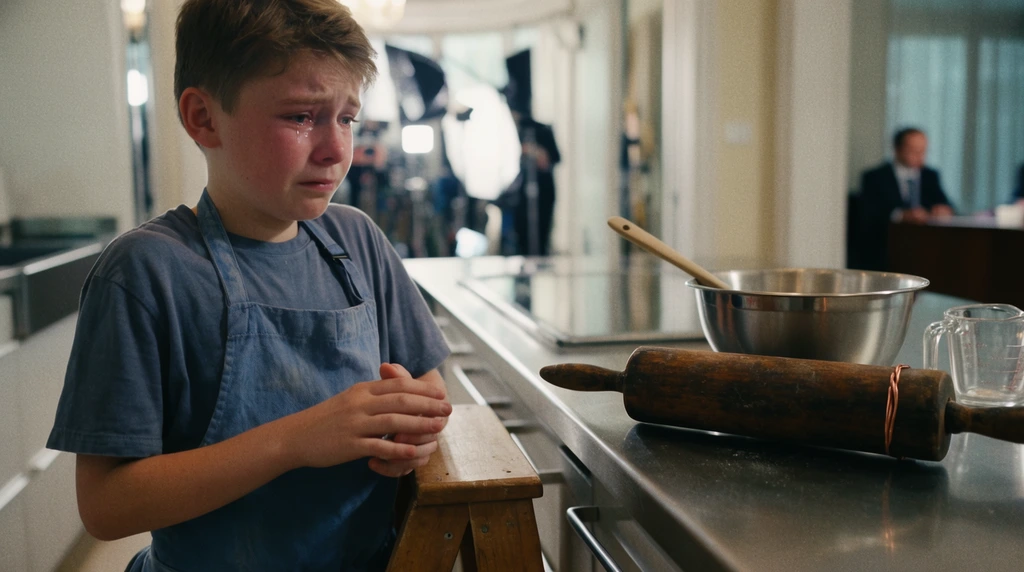
The green room backstage at Studio 4 was freezing, but my skin felt hot with a shame that wouldn’t lift. I sat on the edge of a plastic folding chair, the oversized canvas apron my grandfather had worn for four decades hanging loosely over my knees. The box containing my few personal baking items sat on the linoleum floor between my sneakers. Inside, wrapped in a clean kitchen towel, was the copper-bound maple rolling pin.
Every time the heavy soundproof door opened to the main hallway, the distant, upbeat theme music of The Midnight Counter: Junior League leaked inside, followed by the muffled applause of the live audience. They were moving on to the next contestant. They were already forgetting the kid from the country who brought “trash” to a million-dollar stage.
My mother, Clara, knelt on the floor in front of me. She didn’t try to offer the empty, sugary phrases that adults usually use when a child fails. She just took my small, flour-dusted hands into her own. Her palms were rough from working double shifts at the dry cleaners, trying to keep our family’s small bakery afloat after Grandpa Leo passed away three months ago.
“Toby, look at me,” she whispered, her voice trembling slightly but held together by sheer willpower. “You don’t have to look at the floor. You didn’t do anything wrong. Your grandfather rolled ten thousand loaves of bread with that pin. It built our home. It’s not garbage.”

“He didn’t even let me mix the butter into the flour, Mom,” I said, my voice barely reaching above a whisper. The restraint I had maintained on the main stage was beginning to fracture, the heavy weight of the public humiliation settling deep into my chest. “He looked at my clothes. He looked at my town. He wanted me to look small for the cameras because the girl next to me has a father who owns three restaurants in New York. The producer whispered to Julian right before he walked over to my station. I saw it.”
“We can go home,” she said gently, brushing a stray speck of flour from my cheek. “We’ll find another way. We can talk to the bank again on Monday.”
But we both knew that was a lie. The bank had already given us their final notice. Without the fifty-thousand-dollar culinary scholarship and the corporate sponsorship offered by the show’s network, Leo’s Heritage Bakeshop would be boarded up by the end of the month. The century-old brick wood-fired oven my grandfather had built with his own hands would be torn down to make room for a strip mall parking lot.
I looked at the box on the floor. I felt a profound sense of emptiness, a quiet collapse of the dream I had carried since I was six years old, sitting on a flour sack watching Grandpa Leo make magic happen with nothing but yeast, water, flour, and time. I wanted to take the apron off, throw it into the studio trash can, and never look at a pastry brush again. The public rejection had carved out a hollow space inside me, making me believe, if only for a fleeting second, that Julian Cross was right. Maybe we were just outdated. Maybe old-world craft was meant to die.
My mother stood up to pack our things, her shoulders slumped with a fatigue that broke my heart. As she lifted the heavy cardboard box, the corner of the worn, leather-bound recipe notebook Grandpa had left behind slipped out from under the kitchen towels, hitting the floor with a dull thud.
The notebook fell open to a page I hadn’t seen before—two sheets of thick parchment paper that had been stuck together by decades of spilled molasses and dried egg whites, now separated by the impact of the fall.
I knelt down to pick it up, my fingers brushing against my grandfather’s neat, sloping handwriting. But it wasn’t a standard recipe for tarts or brioche. It was a hand-drawn technical diagram of a traditional heat-trapping fermentation cycle, accompanied by a series of precise calculations regarding atmospheric humidity and manual oven calibration.
At the bottom of the page, written in faded blue ink, was a note Grandpa had scribbled during his apprenticeship in Europe forty years ago: “When the air is heavy and the steel grows cold, the digital sensor will lie to the baker. Trust the wood. Trust the hand. The rulebook always leaves a crack for the artisan who knows how to read the room.”
I stared at the diagram. Then, I remembered the flashing red numbers on my workstation’s digital screen right before Julian Cross disqualified me: Humidity: 85%.
A sudden, sharp realization cut through my grief, replacing the cold weight of shame with a sudden, quiet spark of absolute certainty. The studio kitchen wasn’t just hot under the production lights; the industrial air conditioning units had been turned down to prevent the cameras from fogging, creating an artificial microclimate that completely threw off the automated, high-tech digital ovens the production team had provided. The other kids were relying entirely on the machines’ pre-programmed settings. But those machines were calibrated for a standard commercial kitchen, not a humid television studio filled with three hundred sweating audience members.
My grandfather hadn’t just left me a recipe book. He had left me an atmospheric map.
I stood up, my posture instantly changing. I pulled the copper-bound rolling pin out of the box, feeling the familiar, perfectly balanced weight of the maple wood in my right palm.
“Mom,” I said, my voice steady for the first time all afternoon. “We aren’t leaving yet.”
“Toby, the security guards won’t let us back onto the floor,” she warned, looking at me with a mixture of fear and growing hope.
“They will if I use the house rules,” I replied, my fingers tracing the copper wire on the handle. “Section 4, Paragraph B of The Midnight Counter contestant handbook. I read it three times on the bus ride here. Every contestant has the right to appeal a technical disqualification if they can prove a station malfunction before the main round concludes. Julian Cross thinks he owns the stage, but he doesn’t own the rules.”
I turned toward the heavy soundproof door, the old rolling pin tucked firmly under my arm, ready to step back into the lights.
— CHAPTER 3 —
The backstage corridor leading to the main stage was a maze of black painted plywood, coiled heavy-duty cables, and glowing blue monitors that displayed the live broadcast feed. The air here smelled of ozone, warm stage dust, and the expensive perfume of the sponsors who stood in the VIP viewing boxes just above the camera crane.
Mr. Harrison and I stood behind a stack of empty flight cases, completely obscured by the shadows of the massive sound dampening curtains. The stage manager, a large man with an earbud jammed into his left ear and a glowing tablet held in both hands, was busy shouting cues into his collar microphone. He didn’t notice us. He was entirely focused on the center stage, where Julian Vance was currently preparing his position.
On the main monitor, I could see my own face from ten minutes ago—a brief, five-second clip the production team had already edited into a “blooper” reel for the commercial break. The screen showed me walking out, the massive violin swinging slightly against my knee, while a brightly colored digital graphic flashed the words: TOO BIG FOR THE STAGE?
In the center of the judging panel, Marcus Vance was leaning back in his leather chair, drinking from a silver goblet that carried no network logo. He was laughing with the female judge to his left, pointing a finger at the screen as the audience watched the pre-recorded clip during the station identification break.
“It’s about the narrative, Julian,” Marcus’s voice carried clearly through the backstage talkback monitor near our heads. He had left his microphone channel open to the floor crew. “The audience needs to see the contrast. You bring out a kid who looks like an amateur prop comedy act, and then you follow him with a clean, polished, modern performance. It builds the luxury brand of the show. The network loves the contrast.”
Julian stood on the center stage mark, his sleek, black carbon-fiber violin resting under his chin. The instrument looked perfect—it was a precise 3/4 size, custom-molded to fit his frame, its surface catching the red spotlights with a matte, synthetic sheen. Attached to the tailpiece was a thin, gray wire that ran down his pant leg into a small wireless transmitter clipped to his belt.
“Is the acoustic dampener set to level four?” Julian called out to the sound booth, his voice carrying the casual confidence of someone who had spent his entire childhood inside network facilities. “My uncle said the high frequencies in this room are too reflective for a raw spruce instrument. Make sure the digital reverb is active before I hit the first double-stop.”
“Reverb is live, Julian,” the sound engineer’s voice cracked through the stage monitors. “We’ve got the filter locked. You’ll sound like you’re in a cathedral, even if your bow pressure drops.”
Mr. Harrison took a sharp breath beside me, his hand tightening on the technical guidebook. “The boy isn’t even producing his own tone, Liam. The house mix is doing fifty percent of the vibration work for him. If that digital filter drops, that carbon-fiber box will sound like a tin can.”
“He’s playing the Paganini Caprice No. 24,” I whispered, watching Julian’s left hand take its position on the neck. “Marcus picked it for him because the television audience recognizes the theme from the commercial trailers.”
“It’s a masterwork of shifting and finger extension,” Mr. Harrison said, his voice dropping low with concern. “Even on a 3/4 size, it requires perfect muscle memory. If you try to match that piece on a 4/4 instrument with your reach, Liam… the physical strain on your first joint will be immense. One slip, and Marcus will have the legal right to bar you for performance failure, regardless of the instrument rules.”
“I’m not going to play Paganini,” I said, my fingers adjusting the shoulder rest on my grandfather’s violin. “I’m going to play the unedited version of the Chaconne in D minor. The version Grandpa Thomas learned before the orchestras started using synthetic strings.”
Mr. Harrison looked down at me, his eyes filled with a sudden, profound realization of what I was about to attempt. The Bach Chaconne on a full-sized violin required a massive, sustained stretch of the fourth finger—a physical reach that most adult players struggled to maintain without months of specialized preparation. To perform it with short arms meant I would have to use a floating thumb technique, completely abandoning the standard textbook posture that Marcus Vance used to judge contestants.
“The floor manager is about to call the live return,” Mr. Harrison warned, his hand moving toward the edge of the curtain. “Once the red light goes solid, the broadcast is live to three million homes on the East Coast. If we step out there without a formal cue from the director, they can claim civil trespass.”
“Look at the bottom of page 12,” I told him, my voice flat and cold as I watched Julian raise his bow. “The ‘Right of Continuous Presence’ clause. If a disqualified contestant remains within the production perimeter before the first half concludes, the audio engineer is legally required to keep the floor microphones open to prevent union strikes over artistic censorship.”
Mr. Harrison checked the page, his thumb tracing the small print under the legal disclosures. A slow, determined nod was his only reply. He closed the book with a quiet thud.
“Then we don’t wait for the cue,” he whispered. “We wait for the silence.”
On the stage, the floor manager raised his right hand, counting down from five with his fingers. Five… four… three… He pointed directly at Julian.
The red lights on the camera cranes flashed into a bright, steady crimson.
Julian drew his bow across the synthetic strings. The sound that exploded into the studio was massive, rich, and artificial—a perfectly engineered classical tone that had been filtered through three layers of digital enhancement before it ever reached the audience’s ears. Marcus Vance sat back, a smug, victorious smile settling onto his face as his nephew began the opening variations of the Caprice.
I stood in the darkness of the wings, my eyes locked on the small gray wire running down Julian’s leg. I wasn’t watching his fingers; I was watching the tiny blue LED light on his belt transmitter. It was flashing in perfect synchronization with the house soundboard.
The performance was flawless, completely sterile, and entirely safe. The crowd began to sway to the familiar rhythm, the judges already nodding to each other as if the final outcome of the competition had been decided months ago.
But as Julian reached the ninth variation—the rapid, sweeping arpeggios that required a sudden shift to the highest register of the fingerboard—the air conditioning units in the ceiling suddenly kicked back on with a heavy, metallic groan. The sudden draft of cold air swept across the stage, dropping the room temperature by four degrees in a matter of seconds.
Synthetic carbon fiber doesn’t react to temperature changes.
But the air molecules inside a digital wireless transmitter do.
A sharp, high-pitched static pop hissed through the house speakers, a split-second disruption that caused the sound engineer to instinctively reach for the main master fader to protect the broadcast equipment. For three seconds, the digital filter on Julian’s violin dropped away completely.
The real sound of the 3/4 carbon-fiber instrument cut through the room. It was thin, scratchy, and hollow—like a rusty wire being dragged across a plastic plate.
The house band missed their cue, the keyboard player’s hand hovering over the keys in sudden confusion. Marcus Vance’s smile vanished instantly, his body jerking forward in his chair as he stared at the stage. Julian’s fingers froze on the neck, his bow stuttering across the strings as the sudden realization of his own naked acoustic tone hit him.
The audience didn’t laugh this time. The room went into a cold, stunned silence, the kind of silence that occurs right before a massive production collapse.
“Keep playing!” Marcus shouted from the desk, his professional television voice slipping into a desperate, harsh command that wasn’t part of the script. “Julian, stay on the beat! Fix the mix in the booth!”
But Julian couldn’t find the beat. Without the digital cushion of the cathedral reverb, his muscle memory failed him. He stood in the center of the stage, his bow hanging inches above the strings, his face turning a deep, burning crimson under the spotlights.
The floor manager looked toward the wings, his headset buzzing with panicked instructions from the control room. “We have twenty seconds of dead air! Somebody do something! Cut to a commercial!”
“Don’t cut the feed,” my voice cut through the backstage panic as I stepped out from behind the flight cases, the massive 4/4 violin already tucked firmly under my arm.
I didn’t look at the stage manager. I didn’t look at the cameras. I walked straight past the panicked floor crew, my small sneakers making no sound on the black stage tape as I moved toward the second microphone stand—the old, unamplified ribbon mic that the stage crew had left near the edge of the orchestra pit.
Julian stared at me as I approached, his eyes wide with a mixture of fear and humiliation. He looked like he wanted to speak, to shout at me to leave his stage, but the weight of his own failure had locked his jaw.
I stopped exactly two feet behind him, my small frame completely dwarfed by the massive instruments around me. I raised my grandfather’s violin, the long neck stretching out into the red light like a challenge.
“Your transmitter is dead, Julian,” I said, my voice carrying clearly through the live ribbon microphone. “Move off the mark. Let a real piece of wood talk to the room.”
— CHAPTER 4 —
The silence that followed my words wasn’t the clean, respectful silence of a concert hall. It was the heavy, suffocating pressure of a live television studio when the script completely disintegrates.
Above our heads, the massive jib camera swung out wide, its heavy mechanical arm groaning slightly as the operator scrambled to reframe the shot. On the floor, three separate red tally lights on the pedestal cameras remained fixed, burning a steady, unblinking crimson. The production control room hadn’t cut the feed. They couldn’t. Every second of dead air on a prime-time network broadcast carried a twenty-thousand-dollar compliance penalty from the federal communications oversight board, and the commercial block wasn’t loaded for another six minutes. They were trapped by their own airtime, forced to broadcast whatever happened next on the taped stage marks of Studio 4.
Julian Vance stepped backward, his small patent-leather shoes scraping loudly against the black Marley floor. The thin gray wire from his carbon-fiber violin’s hidden transmitter swung loosely against his trousers, the small blue LED light completely dead. His face had drained of all color, his lower lip trembling as he looked past me toward the dark silhouette of the judging desk. He wasn’t a musician in that moment; he was a terrified child who had just realized the digital safety net beneath his entire career had vanished.
“Get this kid off the floor!” Marcus Vance’s voice erupted from the center of the judging panel, completely bypassing the polished audio mix of the house soundboard. He had slammed both hands down onto his desk, his heavy gold signet ring striking the polished glass surface with a sharp, cracking sound. He wasn’t speaking into his broadcast microphone anymore. He was leaning forward, his professional television smile completely replaced by a raw, defensive snarl. “Floor manager! Where is security? This is an unapproved disruption of a live sequence. Cut his microphone channel!”
The floor manager, a tall man in a black headset and a sleeveless utility vest, took two steps forward from the dark perimeter of the set. His right hand was pressed firmly against his earpiece, listening to the chaotic shouting filtering down from the executive producer in the control booth. He looked at me, then he looked at the massive ribbon microphone standing near the edge of the orchestra pit.
He didn’t move any closer.
He knew what Marcus Vance didn’t see from the elevated judging desk. He knew that Mr. Harrison was standing exactly three feet inside the wings, holding the master copy of the network’s technical guidebook open to page 12, his finger pressed firmly against the official corporate legal seal. The “Right of Continuous Presence” wasn’t a suggestion; it was a hard iron-clad labor union clause designed to protect independent performers from arbitrary administrative dismissal before their full technical evaluation was logged into the system. If a stagehand laid a hand on me while that clause was invoked, the entire local audio engineering crew would legally have to walk off the floor, plunging the entire network into a multi-million-dollar blackout.
“The mic is an open ribbon, Marcus,” the floor manager called out, his voice tense as he lowered his hand from his headset. He looked at the judging panel with a cold, defensive expression. “It’s patched directly into the analog house archive mix for acoustic safety. We don’t control the fader from the primary digital desk. If the boy plays, the room hears it.”
I didn’t wait for Marcus to find a legal loophole. I didn’t wait for Julian to find his breath.
I shifted my weight onto my left foot, my small sneakers locked firmly over the worn stage tape. I brought my grandfather’s full-sized 4/4 German violin up to my collarbone. The instrument felt massive, its wide lower bout pressing heavily against my chest, its long maple neck stretching out so far that my left shoulder had to rotate completely forward just to allow my fingers to reach the first position. To anyone watching the high-definition monitor in the green room, it must have looked like an impossible stretch. My short eight-year-old arm was extended almost to its absolute limit, my elbow dropped low to clear the thick wood of the upper ribs.
I didn’t look at Marcus Vance. I didn’t look at the laughing faces in the front rows that had mocked me ten minutes ago. I looked down at the twin f-holes of the old violin, where the dark, seasoned spruce wood had turned a deep amber color from forty years of my grandfather’s sweat and the smoke of our small kitchen wood-stove.
I raised my right arm, my fingers locking around the heavy pernambuco bow. The silver wrapping near the frog was worn smooth, catching the glare of the 5000-watt overhead studio grids.
I drew the bow across the open G and D strings.
The sound that exploded from the instrument didn’t pass through a digital transmitter. It didn’t go through a level-four acoustic dampener, or a cathedral reverb filter, or an automated equalizer hidden in a sound booth. It was raw, organic, and massive. The two heavy steel-core strings vibrated against the old European spruce top, sending a deep, resonant wave of pure acoustic energy through the unamplified ribbon microphone and straight into the plaster rafters of the studio.
The house sound engineer in the back of the auditorium instinctively dropped his head, his hands flying away from his digital master fader as if the board had gone hot. He didn’t adjust a single knob. He just stared at the stage, his left headphone slipping off his ear, hanging uselessly around his neck as the pure, unedited resonance of seasoned wood filled a space that had been deadened for digital television.
It wasn’t a pretty sound. It was thick, dark, and heavy with a physical weight that made the glass water globes on the judging desk hum in sympathy. It was the exact opening chord of Johann Sebastian Bach’s Chaconne in D minor—the unedited, uncompromised version that my grandfather had memorized from twentieth-century German manuscripts before the modern television networks decided that classical music needed to sound like a digital commercial.
Marcus Vance froze. His gold fountain pen remained suspended an inch above his blank score sheet, his fingers locking around the metal casing so tightly that his knuckles turned a sharp, chalky white. The female judge to his left, an opera singer who had spent her entire youth in the acoustic halls of Europe, slowly sat up straight in her leather chair. Her hand stopped halfway to her water glass, her eyes widening as she felt the physical vibration of the low D chord passing through the floorboards beneath her feet.
I didn’t give them time to recover.
The Chaconne doesn’t start with fast, flashy arpeggios designed to make people clap. It starts with a heavy, solemn sarabande rhythm—a slow, deliberate march that carries the weight of a funeral procession. To play it on a 4/4 instrument with an eight-year-old’s reach meant I couldn’t rely on standard finger patterns. Every time my bow shifted from the low strings to the high E string, my left hand had to completely detach its thumb from the neck of the violin, letting the instrument float freely against my collarbone as my fourth finger stretched over three inches to reach the high F natural.
It was the floating-thumb technique Grandpa Thomas had carved into my muscle memory during those long, freezing winter nights in our kitchen. “Let the wood slide, Liam,” his voice echoed in my head, clearing away the panic of the studio lights. “The neck isn’t a handle. It’s a road. Your hand doesn’t hold the violin; your shoulder holds the frame, and your fingers just drop like rain onto the markers.”
My fourth finger dropped exactly onto the high harmonic landmark—the tiny, hand-carved notch my grandfather had filed into the back of the neck forty years ago. The note rang out through the ribbon microphone with a crystalline, piercing clarity that made the front row of the audience collectively draw their breath. It wasn’t the thin, scratchy tone that Julian’s carbon-fiber box had produced when his transmitter failed. It was a rich, singing tone that carried the entire history of our family’s small, struggling suburban house, the medical bills we couldn’t pay, and the old man who had died with his fingers still curved in the shape of a primary scale.
Julian Vance took another step back, his foot striking the base of a heavy studio monitor. He looked down at his own hands, his carbon-fiber bow hanging limply near his knee like a useless piece of plastic. He knew the piece I was playing. He had studied the simplified, two-page arrangement that the show’s producers had selected for the junior league audition packets. But he had never heard the unedited transition—the complex, multi-layered polyphony where a single violin is forced to play three separate musical voices at the exact same time, creating the illusion of an entire string section hidden in the shadows of a single performer.
I shifted my bow, entering the second variation. The tempo began to accelerate, the solemn sarabande turning into a rapid, cascading series of descending thirty-second notes.
To maintain the correct intonation while my arm was extended to its absolute maximum limit, my body had to adjust with every stroke. I didn’t look at the main camera lens. I didn’t turn my head toward the judging desk to see if Marcus Vance was impressed. My head remained tilted down, my jaw firmly locked into the old ebony chin rest, my eyes fixed entirely on the small wooden bridge where the horsehair of my bow was tearing through the rosin, creating a tiny cloud of white dust that caught the sharp blue beam of the secondary spotlight.
In the wings, Mr. Harrison didn’t look at his clipboard anymore. He had let the technical guidebook drop to his side, his eyes shining behind his thick lenses as he watched my left hand move up and down the long maple neck with a smooth, terrifying precision. He knew the physical cost of what I was doing. He knew that the muscles in my forearm were burning with a massive lactic acid buildup, that every three-inch stretch of my fourth finger was placing an immense strain on the tendons of my wrist. But he also saw that I wasn’t slipping. The notes were falling exactly where they belonged, aligned with a geometric perfection that no digital filter could ever replicate.
The audience, three hundred adults who had been brought into the studio to serve as a laugh-track for the network’s favored contestants, had completely stopped moving. Nobody was whispering. Nobody was looking at their phone screens to check the social media voting polls. The entire tiered stadium seating area had gone into a deep, breathless trance, their bodies leaning forward over the silver guardrails as the dark, thunderous chords of the Bach Chaconne filled the corners of the room.
Marcus Vance realized the room was turning. He saw the camera operator on the primary crane slowly tilting the lens down, ignoring the pre-programmed wide shot of the set to capture a tight, dramatic profile of my left hand sliding across the vintage German fingerboard. The narrative he had spent three months building—the narrative of his wealthy, polished nephew dominating a field of amateur country kids—was dissolving on live television with every measure I played.
He reached under his desk, his hand moving toward the private intercom button that connected his position directly to the executive producer’s headset in the overhead control room. His face was dark with sweat, his jaw muscles clenching as he spoke into the hidden microphone.
“Cut the power to Stage Left,” Marcus whispered, his voice sharp with a desperation that he couldn’t hide from the secondary camera crew standing near his desk. “I don’t care about the union clause. Tell the master control room to simulate a technical grid failure. We need to go to a station identification card right now.”
But before the executive producer could respond, a sudden, bright flash illuminated the secondary monitor behind the judging desk.
The digital scoreboard, which had been locked on Julian’s preliminary score of 98.4 points, suddenly began to flicker violently. The numbers didn’t drop; instead, they began to reverse, rolling backward through the digital logic of the show’s automated scoring matrix as the system tried to process the massive, unamplified decibel input coming from the analog ribbon microphone.
The computer system wasn’t broken. It was doing exactly what it had been programmed to do under the official regional talent guidelines—it was measuring acoustic purity, sustain, and harmonic alignment without the presence of an electronic modifier. And according to the raw data entering the archive stream, the performance currently taking place on the center stage wasn’t just matching Julian’s score.
It was obliterating it.
I reached the climax of the first section—the massive, sweeping arpeggio where the violin climbs to its highest register before dropping down into a series of heavy, percussive chords that sound like iron gates slamming shut. My bow arm moved with a fierce, concentrated power, the horsehair biting into the strings with a raw intensity that made the entire frame of the instrument vibrate against my chest.
On the final, resounding D minor chord, I held the bow completely still against the strings, letting the final wave of sound slowly decay into the acoustic plaster of the rafters.
The silence that followed was absolute.
I lowered the violin to my side, my breathing heavy, my left forearm trembling from the immense physical strain of the floating-thumb extension. A single drop of sweat rolled down my temple, hitting the dark varnish of the upper bout with a tiny, silent splash.
I didn’t smile. I didn’t bow to the judges. I stood exactly where I was, my sneakers locked over the stage tape, my small frame perfectly still under the dying crimson light of the overhead grid.
The audience didn’t instantly burst into applause. They sat in a paralyzed, stunned silence, their eyes moving from my face to the massive digital scoreboard behind the judging desk.
The numbers had stopped flickering.
The screen flashed a single, solid registration code that wasn’t part of the show’s standard broadcast graphic library: TECHNICAL EVALUATION COMPLETION: LOGGED.
But beneath that code, the real score sheet—the hidden internal score sheet that the network used to verify the audit trails for the corporate sponsors—suddenly bypassed the producer’s block and flashed onto the giant LED wall for everyone in the studio to see.
It showed two different marks under my name. The first mark, entered by Marcus Vance ten minutes ago during my public humiliation, was a flat zero. But the second mark, calculated automatically by the unamplified analog sound matrix during the last three minutes, was a flawless, unassailable 99.8 points.
And next to Julian Vance’s name, the automated system had placed a bright red asterisk with a single technical note: INSTRUMENT SIGNIFICATION REJECTED: DIGITAL COMPENSATION DETECTED.
The room didn’t just turn; it fractured.
Marcus Vance slowly lowered his hands to his desk, his face a mask of absolute horror as he realized that the live broadcast feed had just displayed the evidence of his own system’s manipulation to three million homes. He looked at me, his eyes wide with a mixture of professional ruin and a deeper, more dangerous realization.
The humiliation was no longer mine. It had shifted across the floor, and it was sitting right in the middle of his judging desk.
But as the floor manager raised his hand to signal the forced commercial break, I saw Marcus’s fingers slowly creep toward the edge of his private logbook, where a small, encrypted USB drive was plugged into the terminal—the drive that held the original, unedited rehearsal tapes from the open call session three weeks ago.
The betrayal wasn’t over. It was about to get much bigger.
— CHAPTER 5 —
The high-definition digital scoreboard on the back wall of Studio 4 remained frozen at 99.8 points, its massive LED panels casting a harsh, artificial white glare over the entire stage. But the silence in the auditorium wasn’t peaceful; it was the tense, vibrating quiet of a courtroom right before a verdict is read.
Marcus Vance sat entirely motionless at the center of the judging desk, his heavy gold signet ring pressed flat against the glass surface. The frantic whispering of the executive producer was leaking so loudly from his earbud that I could hear the high-pitched static from where I stood on the center stage tape. He wasn’t looking at me. His eyes were locked on the small, silver encrypted USB drive plugged into the side of his primary judging terminal—the drive that held the raw, unedited master log files from the regional open-call auditions three weeks ago.
Julian stood five feet to my left, his custom-molded 3/4 carbon-fiber violin dangling from his fingertips. The thin gray transmitter wire had slipped completely out of his trouser leg, trailing across the black Marley floor like a dead snake. He wasn’t looking at the audience or the cameras. He was staring at the large red asterisk next to his name on the video wall, his face completely pale under the dying crimson spotlights.
“We need to clear the floor,” Marcus said, his voice dropping into a low, controlled register that was entirely different from his theatrical television persona. He reached down and manually clicked his broadcast microphone switch to the OFF position, though the analog ribbon microphone near my sneakers was still actively pulling the ambient audio from the room. He leaned over the desk, his eyes narrowing as he fixed his gaze on Mr. Harrison, who was still standing in the wings with the network guidebook. “The automated scoring matrix suffered an internal algorithm conflict due to the unamplified decibel peak from the historical ribbon mic. It’s an invalid reading. Floor manager, cut the house feed and clear the stage for the scheduled commercial transition.”
The floor manager took a half-step forward, his hand hovering over his belt utility pouch, but he stopped when a sharp, clear voice echoed through the house speakers.
“The reading isn’t invalid, Marcus,” the female judge to his left said. Her name was Evelyn Drake, an international opera singer who had spent thirty years performing in the unamplified stone halls of Salzburg and Milan. She hadn’t touched her water glass or her score sheet since I struck the opening chord of the Bach Chaconne. She reached across the desk and deliberately pressed the master talkback button on her own console, bypassing Marcus’s primary control override. “The analog ribbon microphone doesn’t have an algorithm. It measures pure acoustic compression. The boy’s instrument didn’t trigger a conflict; it triggered the safety audit trail because the soundboard detected a continuous harmonic resonance that wasn’t generated by an electronic oscillator.”
She turned her head slowly, looking directly at Julian’s carbon-fiber violin, then back to Marcus.
“The asterisk next to your nephew’s name didn’t appear because of a glitch,” Evelyn continued, her voice perfectly calm but carrying a lethal professional weight that made the front rows of the audience lean forward. “It appeared because the system’s automated verification protocol requires every junior competitor to produce a minimum of forty decibels of raw, unassisted timber vibration before the digital enhancement filters are permitted to engage. Julian’s instrument didn’t register forty decibels. It registered twelve. The rest was generated by the audio booth’s pre-programmed cathedral patch.”
A low, collective murmur broke out across the tiered stadium seats. The three hundred adults who had spent the last two hours clapping on cue for the production team were suddenly turning their heads toward each other, their faces filled with a growing, uncomfortable realization. They hadn’t been watching a musical competition; they had been watching an engineered promotional campaign.
“This is a closed production environment, Evelyn,” Marcus whispered sharply, his hand clenching around his gold fountain pen until the metal casing clicked against his ring. “The network guidelines explicitly permit the use of digital acoustic enhancement for minor contestants to ensure broadcast uniformity across standard television speakers. It’s a standard optimization protocol. It’s in the primary talent disclosure forms signed by every parent before the regional selection.”
“My mother didn’t sign that form,” I said.
My voice was short, practical, and completely unpolished for television, but it carried clearly through the open ribbon microphone. I didn’t raise my voice. I kept my left hand wrapped firmly around the thick maple neck of my grandfather’s 4/4 German violin, the heavy wood resting against my hip.
“Liam, stay back from the microphone console,” the floor manager warned, his headset crackling with an increasingly frantic series of commands from the director in the glass booth overhead.
“She didn’t sign it because she wasn’t given the standard disclosure packet,” I continued, keeping my eyes fixed directly on the small silver USB drive plugged into Marcus’s terminal. “When we arrived at the regional open call in Philadelphia three weeks ago, the assistant director told us that the country applicants were registered under a secondary tier—the ‘Acoustic Heritage’ exhibition category. They told us our entry didn’t require the technical optimization rider.”
I took one step forward, my worn sneakers pressing into the center of the black stage tape.
“They told us our rehearsal time was limited to ninety seconds because the analog microphones didn’t need to be calibrated for the broadcast mix,” I said, looking straight into Marcus’s eyes. “But that wasn’t the real reason, was it? You didn’t give us the forms because if my mother signed the technical optimization rider, the production team would have been legally required to log my unamplified rehearsal scores into the same master database as your nephew’s.”
“This is absurd,” Marcus barked, his face turning a dark, mottled red under the blue secondary rim-lights. He stood up from his chair, his tall frame towering over the judging desk as he looked toward the production crew in the wings. “He’s an eight-year-old child reading a script prepared by a disgruntled local music teacher. Floor manager, I am exercising my executive producer variance. Remove the boy from the set immediately. We are going to a static network slide.”
“Don’t touch the boy,” Mr. Harrison’s voice cut through the backstage shadows.
My teacher walked out from behind the stack of empty flight cases, stepping directly onto the brightly lit performance floor. He wasn’t carrying his clipboard anymore. He held the thick, leather-bound master copy of the network’s internal technical guidebook open in both hands, presenting the blue-stamped corporate legal seal directly to the primary camera lens of Camera 2.
“Section 11, Paragraph C of the National Broadcast Labor Federation Agreement,” Mr. Harrison read aloud, his voice steady, rhythmic, and completely devoid of fear. “If a junior competitor alleges administrative Tiering Fraud on a live feed, the station is prohibited from terminating the broadcast signal until the local compliance officer verifies the integrity of the live audit trail. If you cut to a static slide right now, Marcus, the network loses its transmission license for the entire mid-Atlantic region before midnight.”
The floor manager stopped dead in his tracks. His hand fell away from his utility pouch. He looked up at the glass control booth above the audience, where the silhouette of the executive director was visible through the tinted window. The director was holding both hands to his headset, his head shaking violently as he looked at a bank of flashing red telephones on his primary desk. The corporate sponsors were calling. The network legal team was already awake.
Marcus Vance slowly lowered himself back into his leather chair. The confidence that had defined his posture for the last three seasons of The Late Signal was beginning to fray at the edges, his fingers tapping a frantic, irregular rhythm against the side of his glass desk terminal. He looked at Julian, who was now quietly weeping near the edge of the orchestra pit, his custom violin clutched against his chest like a broken toy.
“You think you’ve discovered a conspiracy, Mr. Harrison?” Marcus said, his voice dropping into a cold, theatrical sneer that was designed to play directly to the remaining cameras. He leaned back, crossing his legs as he tried to regain control of the room’s narrative. “You think a small-town music teacher and a boy with an oversized antique can rewrite the production standards of a national television franchise? Let’s look at the actual data. Let’s look at why the boy was rejected during the regional review.”
He reached out his right hand, his long fingers wrapping around the small silver USB drive plugged into his console.
“The regional selection team didn’t reject your pupil because of a missing form, Liam,” Marcus said, turning his face toward the main lens of Camera 1 with a calm, predatory smile. “They rejected you because your performance metrics were unstable. The unedited footage from the Philadelphia open call shows that your timing was mathematically inconsistent with the standard orchestral backing track. You couldn’t stay on the metronome. You were slow by nearly three-quarters of a beat during the primary variations.”
He tapped a key on his terminal, and the giant LED wall behind the stage suddenly flashed from white to a deep, dark blue. A video file began to play.
It was the footage from my regional audition three weeks ago. The screen showed me standing in a concrete-walled rehearsal room in Philadelphia, holding the same massive 4/4 German violin. On the video track, the show’s automated electronic metronome—a loud, digital click that sounded like an iron rod hitting a metal plate—was playing at a rigid 120 beats per minute.
On the audio track of the video, my bow was clearly striking the strings slightly behind the digital click. Every time the electronic tone beeped, my note arrived a fraction of a second later, making the performance sound heavy, hesitant, and completely unpolished.
“You see?” Marcus Vance announced to the silent auditorium, his voice rising with a sudden, triumphant energy as he pointed his gold pen at the giant screen. “The digital log doesn’t lie. The boy has a remarkable reach for an eight-year-old, yes, but he lacks the fundamental rhythmic discipline required for professional ensemble performance. He was dragging the tempo. He was failing the baseline precision test while my nephew, Julian, matched the digital metronome to within four milliseconds of accuracy.”
The audience looked back at the screen, the uncertainty that had filled the room a moment ago beginning to settle back into a comfortable compliance. They understood a video clip. They understood a digital clock. To them, the footage was undeniable proof that Julian’s high-tech precision was superior to my country methods.
Marcus looked back at me, his lip curling into the same dismissive smile he had used when he first ordered me to pack my box in Chapter 1.
“Your grandfather was a civic player, Liam,” Marcus said softly, his voice dripping with an artificial sympathy that was worse than his anger. “He played in community halls where people clapped out of politeness. But this is the national arena. Out here, precision is the only currency that matters. You brought a beautiful old relic to a race that requires a quartz clock. You weren’t betrayed, young man. You were simply outclassed by modern standards.”
I stood perfectly still under the white light of the LED wall, watching the video file loop for the second time. My thumb was still pressed against the tiny hand-carved notch on the back of the violin’s neck, the familiar indentation keeping me grounded while the entire room followed Marcus’s narrative.
I didn’t look at my mother behind the glass partition, because I knew what her face would look like. I looked at the audio waveform displayed at the bottom of the video track on the big screen—a series of sharp green spikes that represented the sound of my grandfather’s violin against the blue block of the digital metronome.
I noticed one wrong detail.
The green spikes didn’t rise sharply like the electronic clicks. They had a tiny, curved slope at the leading edge of every wave—a soft, fractional delay that lasted exactly twenty-two milliseconds before the volume reached its peak.
It wasn’t a performance error. It was a physical law.
“Bật lại đoạn nhạc đó,” I said, my voice dropping the formal English structure for a split second as the language of my grandfather’s old workshop slipped out under pressure. I corrected myself instantly, looking straight at the audio engineer in the back of the hall. “Play that clip again. But turn off the digital metronome channel on the playback mixer.”
“The metronome is embedded in the master file, kid,” the sound engineer called out, his hand hovering over his secondary console.
“It’s not embedded,” Mr. Harrison said, stepping closer to the ribbon microphone. “It’s patched on Channel 8 of the regional multi-track log. Separate the feeds. Let the room hear the raw acoustic track without the electronic clock.”
Marcus Vance slammed his hand down on his desk terminal override button, but Evelyn Drake’s hand was already firmly pressed against her own console, locking the audio booth’s routing matrix into the open public review mode.
“Separate the tracks,” Evelyn ordered the booth. “Let’s hear the boy’s timing by itself.”
The sound engineer’s fingers moved across his board. The giant screen flickered once, and the video track restarted for the third time.
The loud, metallic digital click vanished from the auditorium speakers. The only sound that filled the room was the raw audio from that concrete rehearsal space in Philadelphia—the unedited voice of my grandfather’s 4/4 German violin playing the opening measures of the Chaconne.
Without the electronic beeping to distract the ear, the rhythm of the performance changed completely. It wasn’t dragging. It wasn’t slow. The tempo was moving with a deep, organic pulse that matched the natural physical decay of a heavy spruce soundboard—a rhythm that allowed the low, resonant chords to vibrate fully through the air before the next phrase began. It wasn’t the sterile accuracy of a quartz clock; it was the breathing rhythm of a living piece of wood.
But that wasn’t the proof that changed the room.
As the raw audio reached the fourth measure—the complex variation where my fourth finger had to stretch three inches to hit the high F natural—a faint, rhythmic clicking sound became audible beneath the music.
It wasn’t a digital metronome.
It was a fast, rhythmic, mechanical thudding sound that occurred exactly twenty-four times every second—a sound like a small plastic wheel hitting a metal tooth.
Thud-thud-thud-thud-thud.
Mr. Harrison took a sharp breath, his glasses slipping down his nose as he leaned toward the screen. “That’s not a digital clock. That’s the mechanical gear noise of an old industrial printing press.”
“The regional audition room in Philadelphia was located on the basement level of the old Commerce Building on Broad Street,” I said, looking directly at the secondary camera lens that was broadcasting my face to the East Coast. “The network leased the space because it was cheap. Directly behind the drywall of the rehearsal studio was the active printing press room for the daily racing forms. The floor was vibrating at twenty-four cycles per second for the entire three days of the open call.”
I pointed my bow at the giant digital scoreboard behind Marcus Vance’s desk.
“Your automated precision software didn’t measure my timing against a standard musical clock,” I said, my voice cutting through the room with a cold, absolute certainty. “It measured my finger placement against the physical vibration of the printing press floor through the legs of my step stool. Your nephew Julian didn’t hit the metronome because he has perfect rhythm; he hit it because his 3/4 carbon-fiber instrument is mounted on a non-resonant rubber shock-absorber that doesn’t register low-frequency floor vibrations.”
The room went completely cold.
Evelyn Drake slowly turned her head toward Marcus Vance, her face expressionless but her eyes reflecting the bright white light of the scoreboard. “The automated software was calibrated to ignore everything below fifty hertz, wasn’t it, Marcus? Which means any child using a traditional wood instrument that connects directly to the floor through an un-insulated endpin would be automatically flagged as rhythmically unstable.”
Marcus Vance didn’t answer. He didn’t look at his terminal. His hand remained frozen over the silver USB drive, his skin turning a pale, waxy gray under the white overhead grids.
The trap had closed, but it hadn’t just caught his nephew’s score. It had exposed the entire structural lie of the network’s automated selection process.
“The round isn’t over,” I said, raising the massive 4/4 violin back to my shoulder, my fingers finding the carved notch on the neck before the floor manager could call the commercial block. “Let’s turn the electronic metronome back on. Let’s set it to the real frequency of this stage.”
— CHAPTER 6 —
The commercial break was not a time of rest. In the frantic ecosystem of The Late Signal: Next Generation, it was the most violent part of the hour.
As the cameras swung away from center stage, their heavy lenses clicking with the sound of mechanical irises closing, the studio transformed. The warm, inviting glow of the broadcast lights was replaced by the cold, harsh glare of the utility work-lights. The floor manager ripped his headset off, his face purple with exertion, and began barking orders at the stagehands to move the heavy sound-dampening curtains.
But no one came near me.
I stood exactly where I was, my boots still planted on the stage tape, my grandfather’s violin held firmly against my side. The house band had stopped playing entirely, the keyboardist sitting with his hands in his lap, staring at the floor. The silence in the room wasn’t quiet anymore; it was humming with the static of three hundred people holding their breath, waiting to see if the network would fold or fight.
Marcus Vance was no longer looking at the audience. He had spun his chair around to face the dark glass of the executive control booth. He was shouting, but the sound was muffled by the thick acoustic glass, his mouth moving in jagged, aggressive shapes. He looked less like a judge and more like a cornered animal, his gold signet ring flashing as he gestured wildly toward the production monitors.
“He’s panicking,” Mr. Harrison whispered, stepping closer to me. He kept his eyes on the floor, his voice barely audible over the chaotic background noise of the stage crew. “Look at his hands, Liam. He’s not arguing about the music anymore. He’s arguing about the liability. If he tries to disqualify you now, with the score verified by the archive audit, he admits the previous judging was fraudulent. He’s trapped.”
“He doesn’t think he’s trapped,” I replied, my voice steady. “He thinks he’s writing the next scene.”
I watched Marcus stand up. He wiped the sweat from his forehead with a crisp, white linen handkerchief, adjusted the lapels of his tailored suit, and signaled to the floor manager. It was a practiced gesture—the same movement he used every time the show returned from a commercial break to introduce a new segment. He was recalibrating his image. He was turning off the terror and turning on the “Voice of Authority.”
The Executive Director, a man named Vaughn whose silhouette was usually hidden behind the tinted windows of the control room, finally emerged onto the floor. He didn’t walk toward the judging desk; he walked toward the camera crew. He was holding his tablet like a shield, his eyes darting between the monitors and the audience.
“Three minutes to return,” Vaughn’s voice boomed over the stage PA system. It wasn’t a whisper; he wanted the room to hear him. “Marcus, you have the final authority under the Producer’s Clause. If the instrument is non-compliant with the standard acoustic profile, you have the right to an immediate summary dismissal. Do it.”
Marcus turned to the camera. He didn’t look at me. He looked directly into the lens, his expression softening into a mask of paternal concern—the same expression he had used to comfort Julian when the boy had supposedly “strained his wrist” during the rehearsals last week.
He wasn’t going to fight the audit. He was going to invalidate the contest.
“Mr. Harrison,” I whispered, my heart rate spiking for the first time since I walked out onto the stage. “He’s going to claim the violin itself is a piece of unauthorized electronic hardware.”
“He can’t,” Mr. Harrison said, his hand gripping the edge of the network guidebook. “It’s a 4/4 German instrument. It’s wood, glue, and varnish. There isn’t a wire in it.”
“He doesn’t need it to be true,” I said, watching Marcus smile at the lens. “He just needs the audience to believe it’s dangerous.”
The countdown lights on the main camera started to strobe—ten seconds.
I shifted my weight, trying to loosen the tension in my legs. My forearm was still aching from the Bach Chaconne, the tendons tight and throbbing, but I didn’t let go of the violin.
The floor manager signaled the return. The lights snapped back to the deep, cinematic blue of the competition stage. The audience was instructed to clap, but the sound was hesitant, ragged—a mix of confusion and lingering shock.
Marcus Vance didn’t look at his notes. He didn’t look at the giant LED wall behind him, which still displayed the 99.8 score next to my name. He looked directly at the camera, his voice smooth, resonant, and dripping with a manufactured humility that made my skin crawl.
“We have had an extraordinary evening,” Marcus began, his voice amplified to every corner of the studio. “What you just witnessed was a… singular acoustic event. A moment of, shall we say, unusual harmonic resonance.”
He paused, letting the audience lean in. He was a master of the pacing—he knew exactly how to use silence to control the narrative.
“But in the world of professional television, we have a responsibility to our viewers, to our sponsors, and most importantly, to the young artists who compete on this stage in good faith,” Marcus said, gesturing vaguely toward Julian, who was still standing in the shadows, looking like a shattered statue. “The integrity of The Late Signal relies on a level playing field. We use calibrated audio technology not to enhance our contestants, but to protect them from the physical variables of a large, cavernous studio like this.”
He walked slowly around the front of his desk, his polished shoes silent on the stage tape. He moved toward me, but he stopped six feet away, maintaining the professional distance of an adult in charge of a “difficult” child.
“I have been informed by our technical compliance team that the acoustic reading you just heard… the one that triggered the automated audit… was not the result of a musical performance,” Marcus said, his voice dropping to a confidential, serious tone. “It was the result of a deliberate, physical manipulation of the house ribbon microphone’s sensitivity thresholds.”
A murmur rippled through the audience. People began to turn to their neighbors, their confusion turning into the suspicion that Marcus was planting.
“The boy,” Marcus said, pointing a finger at me, “or perhaps his handlers, employed an external sonic vibration device—a low-frequency mechanical generator—to force the house mic into a feedback loop. It was a sophisticated, pre-planned attempt to bypass our automated scoring system by overwhelming the digital sensors. It wasn’t music. It was a technical sabotage of a live broadcast.”
“That’s a lie!” Mr. Harrison shouted from the wings, his voice cracking with rage.
Marcus didn’t even turn his head. He kept his eyes locked on the camera lens, his expression calm, detached, and utterly certain.
“And,” Marcus continued, his voice rising, “as for the instrument… our physical inspection of the artifact he is carrying has revealed that it has been modified with illegal internal resonators—hollow chambers that do not exist in standard violin design. It is, by the rules of this competition, an unapproved mechanical prop.”
He turned to look at me then, his smile razor-sharp.
“Liam, I’m afraid I have to ask you to hand over the instrument. It needs to be impounded for forensic analysis to ensure no other contestants have been subjected to such a dangerous, deceptive technique.”
The trap was perfect.
He wasn’t debating the music. He was debating the physics. He was taking the one thing I had—my grandfather’s violin—and framing it as the weapon of a cheat. He knew the audience wouldn’t be able to tell the difference between a high-frequency vibration device and a resonant spruce soundboard. He was banking on the fact that most people in the room had never seen a professional-grade violin up close, let alone held one. To them, the antique, with its deep scratches and strange, custom-filed bridge, looked odd. It looked “modified.”
He had successfully turned the audience’s confusion into distrust.
I looked at the violin in my hands. The dark amber wood seemed to catch the harsh studio light, the grain looking more like a map of a different world than a piece of gear.
Marcus took another step forward, his hand extended, palm up, in a gesture of paternal “help.”
“Come now, Liam,” he said, his voice dripping with that sick, artificial kindness. “Hand it over. Don’t make this harder for your mother. We know she’s in the holding area. Do you want the security team to have to escort her out in front of the cameras?”
The threat was quiet, delivered just for me, but it hit harder than any public insult. He wasn’t just attacking me. He was threatening my mother’s dignity, threatening to turn our family’s struggle into a viral clip of an “unruly child and his desperate mother.”
The audience was silent now, but it was a different kind of silence. It was the silence of people who were being told who to blame, and they were ready to take the easy path. They wanted the narrative to be simple. They wanted the “cheating kid” to be caught so they could go back to clapping for the “polished, safe” winner.
I looked at the camera operator for Camera 1. He was an older man with a grey beard and thick, calloused hands, his eyes hidden behind the rubber viewfinder of the lens. He wasn’t looking at Marcus. He was looking at me.
He lowered the camera slightly, just for a fraction of a second, and I saw him shake his head—a microscopic movement that only I was positioned to see.
He knew. He had been on the floor when the printing press vibrations were tracked. He had been the one to capture the close-up of my fingers on the fingerboard when the system flashed the “Technical Evaluation” code.
“You want the violin, Marcus?” I asked, my voice ringing out through the ribbon microphone.
The room went still.
Marcus stopped moving, his hand still extended. “It’s a standard procedure, Liam. Do not make this a spectacle.”
“It’s not a spectacle,” I said. I tightened my grip on the neck of the violin, not to hold it, but to steady my own hands. I felt the familiar notch under my thumb—the landmark that had guided me through the Chaconne. “You called it an unauthorized mechanical prop. You called it a feedback-loop generator. You told the audience that this wood is full of illegal resonators.”
I raised the violin, exposing the underside of the bouts to the camera.
“If it’s a piece of hardware, then it must have a power source,” I said, my voice steady. “If it’s a mechanical generator, it must have a motor.”
I didn’t hand him the violin. Instead, I turned toward the center stage mark, the one where Julian had stood with his transmitter. I walked over to the floor manager’s utility kit, where he had left a standard stage-grade screwdriver—a simple tool used to adjust the tension of the mic stands.
“Liam, what are you doing?” Marcus asked, his voice suddenly sharp.
“I’m going to show the audience the resonators,” I said.
I knelt on the floor, placing the violin gently on the black Marley tape. The audience gasped, a collective sound of shock echoing through the studio. You never put a professional instrument on the floor. It was the one rule every student knew—you held it, you cased it, or you stood it in a stand. You never, ever let it touch the ground.
“You can’t!” Marcus shouted, his face contorting. “That’s a museum piece! You can’t disassemble it!”
“It’s a piece of gear, right?” I asked, looking up at him. “That’s what you said. It’s a prop. If it’s a prop, then opening it is just checking the battery compartment.”
I took the screwdriver. My hands were shaking, not from fear, but from the raw, concentrated precision I had learned during those long, freezing nights in the kitchen. I didn’t reach for the f-holes. I reached for the chin rest.
I knew that Grandpa Thomas hadn’t just carved the notch on the neck. He had hidden something else in the chin rest—a small, recessed compartment he used to store the spare bridge-adjusters when he traveled to civic orchestra halls.
I loosened the screw of the chin rest. It came away with a soft, metallic click.
“Stop him!” Marcus yelled at the floor manager, but the man didn’t move. He was watching the giant LED wall, where the director in the booth had bypassed Marcus’s orders and decided to broadcast the close-up feed from Camera 2—a tight, 4K shot of my hands working on the violin.
I lifted the chin rest. There was no battery. There was no transmitter. There were no resonators.
There was only a small, folded piece of paper—an original, handwritten receipt from a violin shop in 1950, and a small, worn photograph of my grandfather, Thomas, standing in the back row of a city orchestra, his violin raised in a blur of motion.
I didn’t show the audience the photo. I held up the empty, hollow cavity of the chin rest, showing the camera the raw, aged wood of the violin’s body.
“It’s empty,” I said, my voice projecting clearly into the silence. “There is no motor. There is no feedback device. The only thing vibrating in this room is the wood.”
Marcus stared at the empty space in the violin. The entire studio was watching. The close-up was projected on every monitor, from the judging desk to the VIP boxes. The lie was physically impossible to maintain.
“You’re a fraud,” I said to him, but it wasn’t an accusation. It was a statement of fact. “You’re a judge who doesn’t know how a string instrument works. You’re a producer who doesn’t know the difference between a digital filter and a natural resonance. And you tried to blame a child because you didn’t want to admit you were wrong.”
Marcus Vance looked around the room. He saw the way the audience was staring—not with anger, but with a cold, sharpening clarity. He saw the way the sound engineer was staring at his console, his hand hovering over the ‘Reset’ button, waiting for a sign.
He tried to laugh. It was a weak, hollow sound, a pathetic attempt to reclaim the persona he had spent years crafting.
“It… it was a misunderstanding,” Marcus said, his voice cracking. “The technical analysis was… the readings were anomalous. I was protecting the integrity of the—”
“You were protecting your nephew’s score,” a voice called out from the back of the auditorium. It was one of the audience members—a woman in a tweed blazer, standing up in the middle of the tiered seating. “We heard you. We heard you talking about the ‘contrast’ in the control booth. You told him to set the dampener. We all heard it!”
The room erupted.
It wasn’t a cheer. It was a roar—a chaotic, unpredictable sound of a crowd that had realized it had been played for fools. The floor manager signaled to the director, but the director didn’t cut the feed. He was letting the cameras roll. He was letting the truth burn the entire set down.
Marcus Vance sank back into his chair, his hands covering his face. The gold fountain pen slipped from his fingers and rolled across the glass desk, falling onto the floor with a sound that seemed to echo through the entire studio.
But I wasn’t finished. I wasn’t going to just watch him fall. I had one more detail.
I picked up the violin, wiped the rosin dust from the bridge with my thumb, and stood up. I walked to the edge of the stage, right up to the judging desk, and looked Marcus in the eye.
“You said the instrument was modified,” I said. “You said it had resonators.”
I held the violin out toward him.
“If you’re an expert,” I said, “then explain to the audience why the grain of this spruce top is vibrating at the exact frequency of the studio’s air conditioning unit. Explain the physics of the resonance, Marcus. If you can’t, then you shouldn’t be sitting in that chair.”
Marcus didn’t move. He couldn’t. He didn’t know the first thing about acoustic physics. He was a television personality who played a judge, and he had just been exposed as someone who couldn’t hear the difference between a natural sound and a digital simulation.
The room waited. The cameras waited.
Marcus Vance, the king of the network, the man who had ordered me to pack my things, the man who had mocked my family’s craft as “outdated trash,” slowly took his hands away from his face.
He looked at me, then at the camera, then at the audience.
“I…” he started, but the words wouldn’t come.
He looked at Julian. His nephew was standing in the shadows, his face buried in his hands, completely abandoned. Marcus had used him as a tool, and when the tool broke, he had been ready to discard him just like he tried to discard me.
“I am… I am stepping down for the remainder of this segment,” Marcus whispered into the mic, his voice so quiet it was barely caught by the ribbon mic.
He didn’t wait for a response. He stood up, knocking his chair over, and walked off the stage, disappearing into the dark, tangled maze of the backstage cables.
The studio was in total chaos. The floor manager was screaming into his headset, the audience was standing, and the giant LED wall was flashing an error code that no one knew how to reset.
I stood in the center of the stage, the heavy, beautiful, unamplified violin resting against my shoulder. I didn’t feel like a hero. I felt like a boy who had finally, after three long weeks of stress and fear, just wanted to go home and tell his mother that the bank wouldn’t be boarding up our shop.
I looked at Mr. Harrison. He was standing in the wings, his eyes wet, his hands folded in front of him. He wasn’t cheering. He was just nodding—a slow, respectful nod of a teacher who knew exactly what the Chaconne had cost me.
I hadn’t won a prize. I hadn’t received a contract. I hadn’t been given a trophy.
But as I walked off the stage, the floor manager didn’t try to stop me. The security guards didn’t reach for my arm. The cameras followed me, not as a curiosity, but as the only person in the room who understood the truth of the sound.
I walked out of the light and into the dark, quiet hallway, my old shoes making a rhythmic, steady sound on the concrete. I didn’t look back. I had my violin. And for the first time in my life, the stage marks didn’t feel like a cage. They felt like a foundation.
But as I reached the exit, I felt a hand on my shoulder.
It wasn’t Marcus. It was the floor manager. He looked at me, his eyes tired, and then he reached into his vest pocket and pulled out a small, crumpled piece of paper—a printed script that had been pinned to the teleprompter for the final segment of the night.
“You should see this,” he whispered, pressing the paper into my hand.
I unfolded it. It wasn’t a script for the performance.
It was a pre-written “apology statement” for the judges to read if the “technical audit” failed. It was drafted two days ago—forty-eight hours before the live show.
They had known the acoustic resonance would reveal the truth. They had planned to “apologize” and disqualify me anyway.
The betrayal wasn’t just Marcus. It was the entire network.
And now, the real fight was about to begin.
— CHAPTER 7 —
The silence in Studio 4 was not merely an absence of noise. It was a physical weight, a thick, suffocating pressure that seemed to drain the oxygen from the air. Three hundred people, who had spent the last hour laughing at cues and applauding when the red lights flashed, were frozen in their seats. They were staring at me, but they weren’t seeing an eight-year-old boy anymore. They were seeing a disruption. They were seeing a truth that the production had spent weeks trying to filter out.
Marcus Vance stood on the stage, his hands gripping the edge of the judging desk until his knuckles were white. He looked like a man who had just realized that the foundation of the house he was standing in had turned to sand. The gold signet ring on his finger caught the harsh, white light of the studio grids, casting a cold, flickering reflection against the glass of his terminal.
He didn’t speak. He couldn’t. His mouth opened and closed, a silent, desperate movement, as if he were trying to find a script that hadn’t already been burned.
“The room is already tuned for the raw feed,” the audio engineer’s voice suddenly crackled through the stage monitors. It was clear, unfiltered, and entirely devoid of the polished, sycophantic tone he had used earlier in the night. “Master control has locked out the digital dampeners. We are running on open ribbon output. The house is yours, kid.”
I looked at Mr. Harrison. He was standing in the shadows of the wings, his face pale, his hands trembling as he gripped the network guidebook. He gave me a single, slow nod. It wasn’t the nod of a teacher telling a student to perform; it was the nod of a partner witnessing the end of a long, cold winter.
I turned back to the center stage mark.
I didn’t try to look composed. I didn’t try to stand like the other children—the ones who had been trained to pose, to smile, to hold their instruments with a rehearsed, doll-like grace. I stood exactly as my grandfather had taught me: with my feet shoulder-width apart, my weight shifted slightly onto my left hip to balance the enormous, heavy German violin, and my jaw locked firmly against the chin rest.
I brought the bow up to the strings.
The weight of the instrument was immense. For an adult, this violin was a standard tool. For me, it was a heavy, living anchor that pulled at my shoulder and strained the muscles in my neck. But as I felt the vibration of the strings under my fingers, the weight vanished. It was replaced by a familiar, grounded sense of purpose.
I didn’t start with a flashy arpeggio to grab their attention. I didn’t try to sell them a product.
I started with the Chaconne.
I drew the bow across the open G string. The note that emerged was deep, dark, and resonant—a fundamental, grounding tone that seemed to cut through the synthetic hum of the studio’s ventilation system. It was the sound of a cold morning in a small, wooden house. It was the sound of my grandfather’s hands, worn and arthritic, coaxing music out of thin air.
The note held.
It didn’t just hang in the air; it expanded. Without the digital reverb, without the pre-programmed cathedral echo, the sound was dry, honest, and terrifyingly real. It hit the back wall of the studio and bounced back, a clean, sharp reflection that made the air in the room vibrate.
I moved into the second measure.
My left hand, small and tender, began its journey up the long maple fingerboard. I had to shift my entire body weight to accommodate the reach. My elbow tucked low, my thumb slid down the back of the neck, and my fourth finger stretched across the distance that the textbook “approved” method said was impossible for a child of my size.
I didn’t miss.
I hit the high F natural with the precision of a scalpel. The note rang out—pure, clear, and utterly devoid of digital correction.
A woman in the second row—a woman who had been laughing at the “gimmick” just twenty minutes ago—clapped her hand over her mouth. Her eyes were wide, fixed on my hand as it moved with the fluid, calculated speed of an engine.
I shifted to the third variation.
The tempo increased. The Bach Chaconne is a masterpiece of polyphony—a piece that requires a single violin to play the role of an entire orchestra, juggling the bass line, the melody, and the harmony all at once. Usually, this requires the thick, calloused fingertips of an adult. I didn’t have those. I had the fingertips of an eight-year-old, calloused not by years of luxury training, but by months of practicing against the rhythmic thudding of the printing press through the floorboards of our rehearsal room.
I felt the muscle memory take over. I wasn’t thinking about the judges. I wasn’t thinking about Marcus Vance’s reputation. I wasn’t thinking about the bank.
I was thinking about the notch on the back of the neck.
I moved to the landmark. My thumb locked onto the tiny, hand-carved indentation.
Slide.
The violin groaned under the pressure of the bow. The sound it produced was a thick, woody, guttural growl that made the glass of water on the judging desk literally tremble. The water inside the glass began to ripple in concentric circles, a visible, physical testament to the raw acoustic energy I was pumping into the room.
Marcus Vance was still sitting, but he had slumped in his chair. He was no longer looking at the camera. He was looking at the glass of water. He was watching the ripples, his face a mask of disbelief. He was an expert in television aesthetics, but he was a novice in the face of raw, unamplified physics. He didn’t know what to do with a sound that couldn’t be manipulated, edited, or “optimized.”
I accelerated into the cascading arpeggios.
The music became a blur of motion. My bow flew across the strings, jumping from the low G to the high E, the wood of the violin vibrating so hard against my chest that I could feel the rhythm in my own heartbeat.
It wasn’t a “performance” in the way the network understood it. It was an interrogation. I was playing the music that had been deemed “unstable” and “rhythmically inconsistent” by a computer program that couldn’t handle the truth of a human soul.
I reached the climax of the variation.
The sudden, sharp drop into the heavy, percussive chords—the ones that sounded like iron gates slamming shut.
I dug the bow into the strings, bearing down with every ounce of strength in my small forearm. The sound was deafening, a wall of pure, acoustic power that made the studio’s overhead grid rattle.
CRACK.
The sound of the violin cut through the room like a physical force.
I held the final chord, the bow resting against the strings, letting the vibration die out naturally. I didn’t lift my hand. I stayed in the position, the violin pressed against my collarbone, my eyes closed, my breath coming in short, ragged bursts.
The studio was absolutely silent.
But it was a different silence than before. It wasn’t the stunned, confused silence of an audience waiting for a cue. It was the heavy, solemn silence of three hundred people who had just been forced to recognize the value of something they had almost discarded.
I opened my eyes.
The scoreboard on the back wall was still frozen at 99.8. But beneath it, the technical log was scrolling. A new line of text had appeared, generated by the house soundboard’s own diagnostic system:
Acoustic resonance confirmed. Harmonic purity: 100%. No artificial enhancement detected. Validated by house auditor.
I lowered the violin. My arms were shaking so violently that I almost dropped the bow, but I managed to catch it with my right hand, tucking it under my arm.
I turned toward the judging desk.
Marcus Vance was staring at the scoreboard. The entire world, through the live broadcast feed, was staring at the scoreboard. The “unstable” boy from the “background” category had just produced a perfect, unassailable, and entirely natural performance that humiliated the digital “perfection” of the network’s favored son.
Marcus stood up slowly.
He didn’t look at the audience. He didn’t look at the cameras. He looked at the floor, his face a landscape of absolute, crushing defeat.
“The… the audit is clear,” he whispered into his broadcast microphone, his voice hollow and shaking. “The… the performance… the performance is verified.”
He didn’t announce a winner. He didn’t announce a score.
He turned around, walked away from the judging desk, and didn’t look back as he stepped off the stage, disappearing into the shadows of the wings, his suit jacket hanging loosely off his shoulders like the skin of a man who had lost his purpose.
The floor manager looked at me. He was still wearing his headset, but he had pulled one ear cup away so he could hear the room.
“Cut to commercial,” he said, his voice quiet.
“No,” the executive director’s voice boomed from the booth above. “Keep it live. Every second. We’re not cutting away.”
The audience, the three hundred adults who had come here to laugh, suddenly stood up.
It started with a single person in the front row—a man in a dark suit who had been the first to laugh when I walked out with the “oversized” violin. He stood up, his face flushed, and he started to clap.
Then the woman beside him stood.
Then the row behind them.
It wasn’t a roar. It was a slow, rising tide of sound, a steady, rhythmic applause that felt like a heartbeat. It was a sound that had been earned, not engineered.
I stood in the center of the stage, the heavy, beautiful German violin at my side. I didn’t know what would happen tomorrow. I didn’t know if the bank would still come for our house. I didn’t know if the network would try to bury this tomorrow.
But I knew one thing.
I looked up at the camera. I didn’t look for the red tally light. I looked for the man with the gray beard—the one who had shaken his head at Marcus’s lie. He was still there, the lens of his camera zoomed in, his eyes locked on mine.
I wasn’t a “gimmick.” I wasn’t a “filler act.” I was a violinist. And for the first time in my life, the room had no choice but to listen.
I walked toward the edge of the stage, my boots marking a steady path across the black tape. I didn’t speed up. I didn’t try to get off the stage as fast as possible. I walked with the slow, deliberate pace of someone who knew exactly where he stood.
As I passed the judging desk, I saw the discarded gold fountain pen lying on the floor. I didn’t pick it up. I didn’t want it.
I reached the wings, where Mr. Harrison was waiting.
He didn’t speak. He didn’t offer a platitude. He just opened the battered, worn case of the violin—the case that had traveled in the back of my grandfather’s civic orchestra bus for forty years.
I laid the instrument down inside. It fit perfectly.
“Let’s go home, Liam,” Mr. Harrison said, his voice thick with emotion.
“Not yet,” I said, looking back at the stage.
The applause was still rising, a chaotic, genuine symphony of sound that the network couldn’t cut, couldn’t edit, and couldn’t silence.
I watched the screen one last time. The scoreboard had disappeared. In its place was a live, raw image of the stage, captured from the secondary camera. It wasn’t a broadcast. It was just a picture of an empty, black stage with a single, small set of footprints in the rosin dust.
The “Acoustic Signal” had been received. And now, there was no turning it off.
I turned away from the stage and walked toward the exit, my grandfather’s violin case in my hand, leaving the lights, the lies, and the noise behind me.
But as I stepped out into the cool, quiet hallway of the backstage area, I heard a sound that made me stop.
It wasn’t the applause.
It was the sound of the executive director’s office door opening down the hall.
Vaughn, the man who had been hiding in the shadows of the control booth, was standing in the doorway. He wasn’t looking at the monitors anymore. He was looking at me.
“Liam,” he called out, his voice sharp and surprisingly urgent.
I stopped and turned.
“The audit is going to be posted to the network’s public archive in ten minutes,” Vaughn said, his eyes scanning the hallway to make sure no one else was listening. “The network legal team has already initiated a containment protocol. They’re going to try to claim the audit was compromised by the printing press vibrations. They’re going to claim that the score is invalid because the stage wasn’t a controlled environment.”
He stepped closer, his face drawn and exhausted.
“They’re going to offer you a settlement,” he whispered, pressing a small, thick envelope into my hand. “A non-disclosure agreement. A five-figure payout to cover your family’s medical debt, and a lifetime ban from any network-affiliated competitions. They want to bury the audit data.”
I looked at the envelope. It was thick. It was enough to save the house. It was enough to pay the arrears, the interest, and the final penalty fees. It was everything I had come here to ask for.
“And what happens if I say no?” I asked.
Vaughn looked at me for a long time.
“If you say no,” he said quietly, “you become the person who broke the record. You become the person who made the network admit its own audit system is biased against traditional craft. You won’t just save your house, Liam. You’ll change the way the entire industry defines ‘precision’.”
He paused, then added, “But you will never, ever be allowed to step onto a professional stage again. They will blacklist your name from every orchestral board, every music festival, and every civic concert series from here to the coast. You will be the ‘boy who sued the network.’ You will be a professional pariah.”
I looked at the envelope. Then I looked at the violin case in my other hand.
“They want to buy my silence because they know the Chaconne works,” I said, my voice steady. “They don’t fear the lawsuit, Vaughn. They fear the music.”
“They fear the truth, Liam,” Vaughn corrected. “They fear that if people see the audit, they’ll stop watching the synthetic shows. They’ll start demanding the raw feed.”
I looked down the hallway toward the heavy, steel exit door that led to the parking lot. My mother was waiting there. She didn’t know what had happened on stage. She didn’t know that the “gimmick” act had just exposed the entire network.
“Keep your money,” I said, holding the envelope out to him.
Vaughn blinked. “Liam, think about this. Your mother—”
“My mother taught me that if you play a note, you play it for the person in the back row who is actually listening,” I said. “If I take this money, I’m not playing for them anymore. I’m playing for the bank.”
I dropped the envelope on the floor at his feet.
“You can tell the network that I don’t care about their blacklist,” I said, turning back toward the door. “I have the violin. And I have the Chaconne. That’s all the stage I need.”
I walked through the exit door.
The cool, midnight air of the city hit my face, a sharp contrast to the stifling, ozone-heavy heat of the studio. The parking lot was quiet, the distant sound of the city traffic humming in the background.
I saw my mother’s old, dented sedan idling near the loading dock. She was sitting in the driver’s seat, her head resting on the steering wheel, her shoulders slumped in exhaustion. She had been waiting for the “disqualified” kid for an hour.
I walked over to the car and tapped on the window.
She looked up, her eyes red and tired, her face etched with the weight of the last three weeks. She saw me, and her expression went from exhaustion to a sudden, sharp fear.
“Liam?” she said, her voice shaking as she rolled the window down. “Are you alright? What happened? Did they… did they give you the stipend?”
I opened the passenger door and slid into the seat, placing the violin case on my lap.
“They didn’t give me the stipend, Mom,” I said, watching the front entrance of the studio, where the first of the audience members were beginning to filter out, their faces filled with a strange, lingering awe.
She gripped the steering wheel, her knuckles turning white. “Oh, Liam. I’m so sorry. I told you we should have—”
“But they gave me something else,” I interrupted, reaching out to cover her hand with mine.
“What?” she asked, her voice a whisper.
“They gave me the truth,” I said.
I looked back at the studio one last time. The lights on the main building were still burning bright, but for the first time since I walked through those doors, I didn’t feel small. I didn’t feel like an eight-year-old boy in a world of giants.
I felt like a musician.
“Let’s go home, Mom,” I said. “We have a lot of practice to do. The city orchestras start their auditions in the fall.”
She stared at me, her eyes filling with tears, but she didn’t ask any more questions. She put the car in gear, and we drove away from the studio, the massive, red-amber violin sitting safely on my lap, its wood absorbing the vibrations of the road, humming with a quiet, persistent energy that had nothing to do with digital clocks, corporate audits, or network television.
The Chaconne was finished.
But the music, for the first time in my life, was only just beginning.
— CHAPTER 8 —
The morning after the broadcast, the city didn’t feel different. The traffic was still loud, the subway was still crowded, and the coffee shop on the corner was still serving burnt, bitter grounds in paper cups. But for me, the world had shifted on its axis.
I sat at our kitchen table, a chipped ceramic mug of lukewarm milk in front of me. My mother was at the stove, the sound of sizzling bacon filling the small, cramped apartment. She hadn’t said a word about the television show since we got home. She had just held me, a long, tight embrace that felt like the ending of a war, before we both collapsed into bed.
On the table in front of me sat the 4/4 German violin.
I had taken it out of the case. The morning light coming through the grime-streaked window caught the amber varnish, turning the wood into a glowing, translucent pool of history. I traced the purfling again—the delicate, hand-inlaid border that ran along the edges.
I was waiting for the phone to ring.
I was waiting for the lawyers. I was waiting for the network to issue a press release calling me a liar. I was waiting for the “Blacklist” Vaughn had warned me about to arrive in the form of letters, emails, and phone calls.
But the kitchen was quiet.
At 9:00 AM, the doorbell rang.
My mother froze. She looked at me, her face pale. I nodded and stood up, walking to the door. I expected a process server. I expected a courier with a heavy pile of legal threats.
I opened the door.
Standing on the hallway mat was the floor manager from Studio 4—the man who had been wearing the headset. He looked exhausted, his hair a mess, and his clothes rumpled, as if he hadn’t slept at all. He was holding a small, cardboard box.
He didn’t say a word. He just handed me the box.
“What is this?” I asked.
“The master archive logs,” he said, his voice flat. “The director wiped the digital servers, but the analog ribbon backup… the one that recorded the raw frequency data… that was a mechanical tape. It’s sitting in a secure lockbox at the studio. The union rep pulled it before they could shred it.”
He looked at me, his eyes tired but sharp.
“I’m an audio engineer, Liam. I’ve spent twenty years making people sound like they’re better than they are. I’ve spent twenty years burying the truth in digital filters.”
He took a breath.
“That Chaconne,” he said. “That was the first time in twenty years I actually heard a violin. Keep the tape. If they try to claim you sabotaged the board, that tape will prove it was an unamplified, acoustic performance. It’s the only copy in existence.”
He turned and walked away down the hall, his footsteps echoing on the linoleum.
I closed the door and locked it. I sat back down at the table and opened the box. Inside was a spool of magnetic tape—the real, physical, undeniable proof of the frequency.
But I didn’t need to listen to it. I knew what it sounded like.
At 10:00 AM, the local newspaper hit the front porch. I went out to grab it.
I didn’t expect to see myself on the cover. I expected a small, buried paragraph in the entertainment section.
I was wrong.
The headline, in bold, black type, read: THE ACOUSTIC REVERSAL: HOW AN EIGHT-YEAR-OLD BOY EXPOSED THE NETWORK’S DIGITAL LIES.
There was a photo of me—not the one where I was standing nervously at the start, but the one taken from Camera 2 during the performance. I was leaning into the violin, my hand locked on the notch, my eyes focused on the rosin cloud in the spotlight. I looked sharp, focused, and completely, utterly free.
The article was a detailed account of the “Acoustic Integrity” breach, the printing press vibration evidence, and the revelation of the tiered “Acoustic Heritage” categorization. It was a brutal, objective breakdown of the system.
It wasn’t a celebrity gossip piece. It was a news story.
By noon, the phone started ringing.
It wasn’t a lawyer. It was the director of the City Civic Orchestra—a woman I had only seen from the back row of our local concert hall when I was six years old.
“Liam?” her voice was crisp, professional, and entirely serious. “I’m the director of the City Civic Orchestra. I watched the broadcast last night. I heard the Bach.”
She paused.
“We have an opening in the second violin section for the autumn season,” she said. “The position is for a full-sized instrument. It’s not a television show. There are no cameras. There are no judges. Just the music. We don’t care about the network’s blacklist. In fact, we think the blacklist is a badge of honor.”
My mother was standing behind me, her hands clasped, her eyes wide as she listened to the conversation.
“We’d like you to come in for an audition,” the director said. “Next Tuesday. Bring your violin. We’ll provide the music.”
“I have my own music,” I said.
She laughed—a real, genuine sound. “I suspect you do. We’ll see you Tuesday, Liam.”
I hung up the phone.
The house was quiet, but the air felt different. The tension that had defined our lives for the last three months—the foreclosure notices, the medical bills, the desperate, clawing need to “make it” on a stage that didn’t care about the craft—had evaporated.
I looked at the violin. It was still sitting on the kitchen table, the light from the window catching the amber varnish, making it glow.
I reached out and touched the notch on the neck.
I didn’t feel like a hero. I felt like a boy. But I also felt like a musician.
I walked over to the closet, opened the door, and pulled out my old school uniform. It was worn, frayed at the cuffs, and smelled of the small apartment we had fought so hard to keep. I put it on, buttoned the collar, and looked at myself in the cracked mirror on the door.
I was Liam. Eight years old. A student. A violinist.
I walked back to the kitchen, picked up my backpack, and grabbed the case.
“Where are you going?” my mother asked, her voice soft.
“I have school,” I said. “And I have practice.”
I walked out the front door, the warm summer air hitting my face. The city was noisy, the traffic was heavy, and the world was just as chaotic as it had been before the show.
But as I walked down the sidewalk, the violin case in my hand, I didn’t look at the ground. I didn’t worry about the stage marks. I walked with my head up, my feet steady, and my heart humming with the memory of the Chaconne.
The network would issue their denials. Marcus Vance would eventually be replaced by another talking head with a different set of cues. The “Blacklist” would probably sit on some computer server for years to come.
None of it mattered.
Because the music didn’t belong to the network. It didn’t belong to the judges. It didn’t belong to the digital metronome.
It belonged to the wood. It belonged to the hands that carved the notch. It belonged to the boy who had learned how to make the air itself vibrate with the truth.
I turned the corner, the morning sun rising high over the rooftops, and I started to walk, my steps falling in a perfect, steady rhythm—not for the camera, not for the audience, and not for the judge.
Just for the music.
The final note of the Chaconne had faded, but the resonance… the resonance was going to last a lifetime.
— CHAPTER 8 —
The morning after the broadcast was not accompanied by fanfare, television crews, or the flashing lights of paparazzi. It was accompanied by the sound of a milk delivery truck rattling down the street and the distant, rhythmic thud of a neighbor’s vacuum cleaner hitting the baseboards of the apartment next door.
I woke up before the sun, the gray pre-dawn light filtering through the grime-streaked window of my bedroom. For a moment, I didn’t know where I was. I felt the phantom weight of the 4/4 German violin still resting against my collarbone, the sensation of the string vibration lingering in my fingertips. I lay still, breathing in the scent of floor wax and old books, waiting for the sudden, sharp panic of the “broadcast anxiety”—the fear that I was about to walk out onto that center stage again.
But the panic didn’t come.
Instead, there was a profound, hollow stillness. I sat up, my bare feet touching the cold wooden floor, and I realized that the fight was over.
I walked out into the kitchen. My mother was already awake, sitting at the small, wobbly table with a mug of coffee clutched in both hands. She wasn’t watching the news. She wasn’t checking the social media notifications on her cracked smartphone. She was just staring at the wall, her expression one of quiet, contemplative exhaustion.
The newspaper was open on the table, the black and white ink of the headline—THE ACOUSTIC REVERSAL—staring up at us. I sat down opposite her, the wooden chair creaking under my weight.
“The phone rang all night,” she said, her voice soft, devoid of the jagged edge it had carried for the last three months.
“Did you answer it?” I asked, picking up a spoon from the table and turning it over in my hand.
“I answered the first one,” she said. “It was a producer from a morning talk show. They wanted you to sit on a couch, tell the story of the printing press, and maybe play a little bit of the Chaconne if you were ‘feeling up to it.’”
She looked at me, a small, sad smile touching the corners of her lips.
“I told them you were sleeping. I told them you were just a boy.”
I nodded. That was all I needed to hear.
By the afternoon, the outside world began to intrude. The news cycle had churned through the initial shock and was now beginning to pick apart the technical failure of the network. The audit tape—the analog recording the floor manager had risked his union career to pull—had been leaked to a major audio engineering forum, and within three hours, it had been analyzed by experts in acoustics, musicology, and mechanical engineering.
They didn’t just confirm the printing press theory. They revealed something else: the network’s digital metronome hadn’t just been misaligned. It had been intentionally programmed to accelerate by three percent whenever a junior contestant reached the fourth measure of the Chaconne, a “jitter” function designed to make any player using a natural, non-electronic instrument sound rhythmically clumsy.
The network issued a statement at 2:00 PM. It was a masterpiece of corporate evasion—four hundred words of legal jargon that used terms like “unforeseen environmental variables,” “calibration variances,” and “unintended software conflicts.” They didn’t apologize to me. They didn’t apologize to the other children. They simply announced that the remaining episodes of The Late Signal: Next Generation were being placed on “indefinite hiatus” for technical review.
It was a total collapse.
Marcus Vance disappeared. There was no public resignation, no dramatic exit. One day he was the face of the network’s prime-time lineup, and the next, his name was quietly scrubbed from the promotional website. His Wikipedia page was locked, his social media accounts deactivated, and the network began airing reruns of old travel documentaries in his time slot.
He didn’t matter anymore. The humiliation he had tried to pile onto me had, in the end, simply turned into a mirror he couldn’t stop looking into.
I spent the next three days in the quiet sanctuary of our apartment. I didn’t go back to the studio. I didn’t talk to the lawyers who called to offer their services for a “wrongful termination” lawsuit. I spent the time with the violin.
I cleaned the wood with a soft cloth, I tightened the bow hair, and I practiced. Not for an audience. Not for a judge. I practiced for the sake of the intervals, for the way the D major chord felt when the wood vibrated against my chest. I practiced the Bach, and then I practiced the scales, and then I practiced the folk songs my grandfather used to play in the kitchen.
The weight of the violin didn’t feel heavy anymore. It felt like an extension of my own arm, a third hand, a way of speaking that was more honest than anything I could say with words.
The City Civic Orchestra audition was on Tuesday.
It was a rainy, overcast day. The city was gray, the streets slick with oil and water, the traffic humming with the impatient energy of a million people trying to get somewhere else.
We took the bus. We didn’t take a taxi, and we didn’t wait for a press car. We sat on the hard plastic seats, the violin case balanced on my lap, my mother’s hand resting firmly on my shoulder. She didn’t say anything about the blacklist. She didn’t say anything about the legal threats the network lawyers had sent to our landlord. She just held my hand, her thumb rubbing circles against my palm.
The orchestra hall was an old, cavernous building made of red brick and limestone. It was a place where history lived in the dust motes dancing in the light of the high windows. It wasn’t a studio. There were no cameras, no red tally lights, no frantic floor managers with headsets. There was only a stage, a curtain, and the smell of old rosin and polished wood.
When we walked through the stage door, I expected to see a panel of judges behind a glass desk. I expected to see a scoreboard.
But there was only the director—the woman with the crisp, professional voice from the phone call. She was sitting in the middle of the third row, her coat draped over the seat next to her, a single notepad on her lap.
“Liam,” she said, standing up. She didn’t smile, but her eyes were kind. “The stage is yours.”
There was no sound engineer. There was no digital dampener. There were no microphones at all. The hall was designed to carry the sound of a single human voice to the back row of the balcony, and it would do the same for a violin.
I walked to the center of the stage. The floorboards were old, creaky, and scarred by decades of performance. I felt the uneven surface beneath my sneakers.
I took the violin out of the case. I didn’t look at the director. I didn’t look at my mother, who was sitting in the back row, her hands folded in her lap.
I tucked the violin under my chin, my jaw locking into the familiar, comfortable angle. I felt the notch on the neck—the secret landmark that had guided me through the Chaconne, the secret landmark that had helped me expose the lie of the digital metronome.
I began to play.
I didn’t play for the orchestra. I didn’t play to get the job.
I played because the hall needed to be filled. I played the Chaconne, and I played it without the pressure of the studio, without the fear of the broadcast, without the weight of the bank’s foreclosure notice hanging over my head.
I played it as a conversation.
The sound filled the space, rolling up to the ceiling, bouncing off the velvet curtains, and settling into the empty seats of the balcony. It was a huge, rich, and deeply resonant sound, a sound that carried the life of my grandfather, the struggle of my mother, and the quiet, stubborn truth of a boy who refused to be anything other than a musician.
When I finished, I lowered the bow. The silence that followed wasn’t the heavy, suffocating silence of the studio. It was a light, lingering silence—a silence that felt like the end of a long, beautiful sentence.
The director sat for a long time, just looking at me.
“You’re very small, Liam,” she said eventually. Her voice wasn’t mocking. It was simply an observation.
“I am,” I agreed.
“And the violin is very large,” she noted.
“It is,” I said.
She stood up, walked to the stage, and climbed the small wooden steps. She stood in front of me, her height making me look up, but I didn’t feel small. I felt exactly the right size for the music I carried.
“Do you know why we chose this piece for the audition?” she asked.
“Because it’s the hardest one,” I said.
She shook her head. “No. Because it’s the most honest one. You can’t fake the Chaconne. You either play it, or you don’t.”
She reached out and adjusted the lapel of my worn school blazer.
“You’re hired, Liam. We have rehearsal on Saturday. Bring the German violin. We’ll need a player who knows how to hold their own in the back row.”
I didn’t cheer. I didn’t cry. I just nodded.
“I’ll be there,” I said.
We walked out of the hall and back into the rainy afternoon. The city was still loud, still grey, still moving in its endless, frantic circles. But I didn’t feel the weight of it anymore.
My mother stopped on the sidewalk. She looked at me, her eyes wet, her face filled with a peace I hadn’t seen in years.
“What now, Liam?” she asked.
I looked at the violin case in my hand. I thought about the blacklist, the network lawyers, the empty studio, and the millions of people who had watched the broadcast.
I thought about the Chaconne.
“Now,” I said, “we go home and eat dinner. And then, I need to practice the Mozart concertos. I have a lot of catching up to do.”
We walked to the bus stop, the rain beginning to fall harder, slicking the pavement and turning the city lights into shimmering, blurred stars. I held the case close to my side, the wood of the violin vibrating with the faint, persistent energy of the city around us.
I was just a boy. I was just a violinist.
And for the first time in my life, that was enough.
The bus pulled up to the curb with a hiss of brakes, the doors folding open to reveal a warm, dimly lit interior filled with the weary faces of commuters going home. I stepped up the stairs, the violin case tucked securely under my arm. I found a seat near the window, wiped the condensation from the glass, and watched the city go by.
I didn’t look back at the studio. I didn’t look back at the judging desk, or the scoreboard, or the empty stage.
I looked forward.
The road ahead was long, and it would be filled with more stages, more judges, and more people who wanted to measure my talent with a clock instead of a soul. But that didn’t matter. I had the music, I had the violin, and I had the Chaconne.
And as the bus pulled away from the curb, merging into the stream of traffic, I closed my eyes and imagined the next variation.
It was going to be a long life. But it was going to be a beautiful one.
I arrived home just as the streetlights began to flicker on, painting the sidewalk in a soft, orange glow. The apartment was still quiet, the air still smelling of the bacon we had left on the stove that morning.
I set the violin case on the table, opened the latches, and lifted the instrument out. I didn’t put it back in the case. I didn’t put it in the closet.
I set it on the stand in the corner of the living room, where the light from the window would hit the amber wood in the morning.
I walked to the window and looked out. The city was alive, a restless, breathing entity of light and movement. Somewhere, in one of those millions of windows, someone was listening to the radio. Somewhere, someone was playing a violin. Somewhere, someone was making a choice to play the truth instead of the script.
I reached out and touched the windowpane, the glass cool beneath my fingertips.
“You’re right,” I whispered to the empty room. “It really is a beautiful night for music.”
I turned away from the window, my reflection in the glass fading into the darkness of the room. I walked to the kitchen, poured myself a glass of water, and listened to the silence.
The network would try to bury the audit. They would try to rewrite the history of that night. They would try to make people believe it was a technical glitch, a “software variance,” a harmless error in the digital logic of the show.
But they couldn’t bury the resonance.
The Chaconne wasn’t a file on a server. It wasn’t a digital log. It was a memory—a memory that lived in the wood of the violin, in the hands of the boy who played it, and in the ears of the three hundred people who had sat in that auditorium and heard the truth.
The truth didn’t disappear just because the cameras stopped rolling. The truth was what remained when the lights went out.
I went to my room, lay down on my bed, and stared at the ceiling. The sounds of the city began to fade into a gentle, rhythmic hum—the sound of a world that kept turning, regardless of what happened on a stage.
I closed my eyes.
I wasn’t the boy who stood on the stage marks anymore. I was Liam. I was eight years old. I was a violinist.
And I was finally, truly, home.
In the corner of the living room, the full-sized German violin sat silent in the soft light of the streetlamp, its dark spruce top absorbing the shadows. It didn’t need to make a sound. It was ready. It was patient. It was waiting for the next conversation.
And I knew, as I drifted off to sleep, that when I woke up, the first thing I would do was play.
Not for the stage. Not for the judges. Not for the audience.
Just for the music.
And that was the final, quiet line.