Part 2: The Stolen Custody Paper My 7-Year-Old Hid In My Purse
MY EX HUSBAND SMILED CRUELY AS THE JUDGE RULED AGAINST ME, STRIPPING AWAY MY RIGHTS BASED ON HIS SICK LIES. “You are nothing but a memory now, Sarah,” he whispered, holding our 7-year-old daughter Chloe’s hand tight. But as we walked out to the courthouse parking lot, Chloe broke away from him, crying, and shoved a crumpled piece of paper into my purse that changed everything.
The court victory he just celebrated was built on a massive, calculated lie, and he had no idea his own daughter had just exposed it.
I stood frozen in the hallway of the family court department, my hands shaking so violently I could barely hold my car keys. The fluorescent lights overhead buzzed loudly, mimicking the painful throbbing inside my own skull. Just 5 minutes ago, a judge signed an order granting my ex-husband, David, sole legal and physical custody of Chloe.
David stood across the corridor, a smug, victorious grin plastered across his face as he huddled with his expensive high-profile lawyer. He looked like the picture-perfect suburban father in his tailored navy suit, the exact image he spent months cultivating for the court. Meanwhile, I felt completely hollowed out, wearing a cheap blazer from a thrift store, looking like the unstable person he claimed I was.
Our 7-year-old daughter, Chloe, was sitting on a wooden bench between us, clutching her favorite stuffed rabbit close to her chest. Her small face was pale, and her eyes were wide with a mixture of confusion and sheer terror. She kept looking between her father and me, sensing the heavy, suffocating tension that filled the space between us.

David noticed me staring at Chloe and intentionally stepped into my line of sight to block my view of her. He leaned in close to his lawyer, whispering something that made them both chuckle softly before turning his attention back to me. The sheer malice in his eyes made my stomach violently turn, bringing back years of hidden emotional abuse.
“Don’t even think about coming to the house tonight, Sarah,” David said, his voice dripping with venomous satisfaction as he approached me. “The judge made his decision clear, and you have exactly 0 rights to her until I say otherwise.”
“She is my daughter too, David,” I whispered back, fighting with every ounce of my strength to keep my voice from cracking in public. “You lied to the evaluator, you fabricated those texts, and you know deep down that Chloe belongs with her mother.”
“Prove it,” he scoffed, leaning in so close I could smell his expensive mint mouthwash. “In the eyes of the state of California, you are a liability, and I am the protector. Enjoy your empty house, because it is going to stay that way for a very long time.”
He turned on his heel, grabbed Chloe sharply by her small wrist, and began walking toward the heavy glass exit doors of the courthouse. Chloe looked back over her shoulder at me, her eyes filling with tears as she was dragged along the polished floor. Every maternal instinct inside me screamed to run after her, to pull her away from him, but I knew that would only play into his trap.
I followed them at a distance, completely numb, watching them walk out into the bright, blinding glare of the afternoon sun. The courthouse parking lot was bustling with people, but to me, the entire world had fallen completely silent. David was rummaging through his pockets for his car keys, his back temporarily turned to Chloe as he opened the trunk of his SUV.
In that split second, Chloe turned around, saw me standing near the concrete pillar, and broke away from his side without a sound. She sprinted toward me, her tiny sneakers slapping against the hot asphalt, her face twisted in absolute desperation. Before David even realized she was gone, she reached me and threw her arms around my waist.
“I love you, Mommy,” she sobbed quickly, pressing her face into my stomach. “Don’t let him take me away, please don’t let him.”
As she hugged me, I felt her small hand frantically slip something heavy and crumpled into the open side pocket of my purse. Before I could ask her what it was, David roared her name from across the parking lot, his face turning a deep, angry crimson. He marched over, grabbed her arm forcefully, and yanked her away from me, giving me a look of pure, unadulterated hatred.
“Keep away from her!” he yelled, attracting the attention of several bystanders. He dragged Chloe back to his vehicle, shoved her into the backseat, and locked the doors before speeding out of the parking lot, leaving behind a cloud of exhaust.
I stood there alone, trembling, as the roar of his engine faded into the distant city traffic. Slowly, my trembling hand reached down into the side pocket of my purse to feel the object Chloe had desperately hidden there. My fingers wrapped around a thick, folded stack of official legal documents, secured with a heavy rubber band.
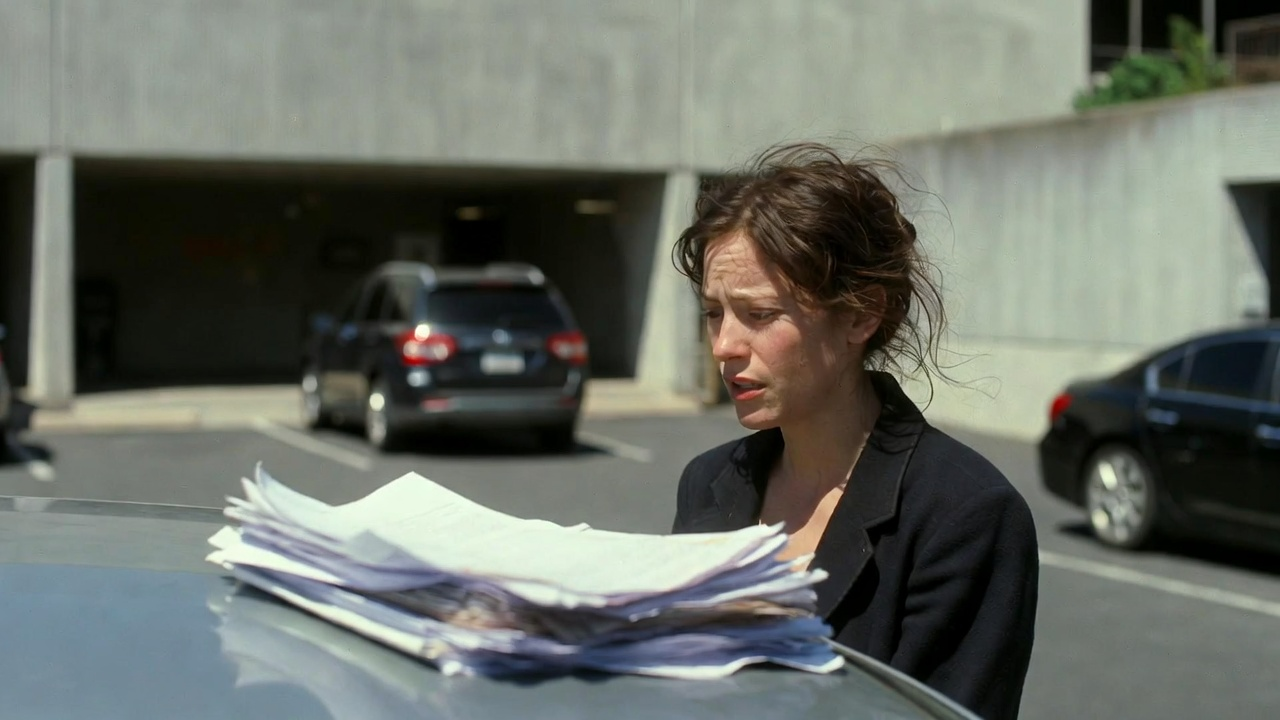
I pulled the papers out, smoothing out the deep creases on the hood of my car, my eyes scanning the text rapidly. It was an official custody evaluation report, stamped by the state court, but the contents were completely different from what David’s lawyer presented inside. On the final page, the court investigator explicitly stated that David was a severe danger to the child and recommended full custody to me.
David had somehow intercepted the real report, replaced it with a forged version for the judge, and hid the truth from everyone. My heart hammered against my ribs as I realized my 7-year-old daughter had just stolen the evidence that could save us both. But looking up, I saw a black sedan idling near the parking exit, its dark windows rolled down slightly, watching me.
— CHAPTER 2 —
The black sedan didn’t move. It sat there at the edge of the courthouse parking lot, its engine a low, menacing thrum that vibrated right through the soles of my thrift-store flats. The tinted glass of the driver’s side window was rolled down maybe two inches, just enough for me to feel the weight of an unseen gaze locking onto me. My heart was hammering a frantic, erratic rhythm against my ribs as I stood frozen by the hood of my car, the heavy stack of crumpled legal papers still clutched in my trembling fingers. I knew I couldn’t just stand there looking compromised, so I forced my stiff muscles to move, quickly folding the thick document and shoving it deep back into the side pocket of my purse.
I got into my car, locked the doors immediately, and turned the key in the ignition with hands that shook so badly the keys rattled against the steering column. My eyes kept darting back to the rearview mirror, watching the black sedan as I shifted into reverse and backed out of the concrete stall. The moment my tires cleared the parking space, the sedan’s brake lights flickered off, and it slowly began to roll forward, keeping a calculated, terrifying distance behind me. Sweat broke out cold across the back of my neck as I pulled out onto the main boulevard, navigating through the thick, suffocating midday traffic of downtown Los Angeles. Every turn I made, every lane change I executed in a desperate bid to lose them, the black sedan followed with a chilling, synchronized precision.
They weren’t trying to hide the fact that they were tailing me; they wanted me to know I was being watched, to feel the psychological weight of their presence. I gripped the steering wheel so tight my knuckles turned a stark, bloodless white, my mind racing through a million terrifying possibilities. Who did the car belong to? Was it a private investigator hired by David to ensure I didn’t try anything reckless after losing custody, or was it something much worse? If David had the power and resources to completely manipulate a state-stamped custody evaluation report, he certainly had the means to hire people to watch my every move.
I decided to take a series of erratic, spontaneous turns through a maze of residential side streets, far away from the route to my empty apartment. I hung a sharp right onto a narrow, tree-lined avenue, immediately followed by a quick left into a grocery store parking lot, pulling into a space directly in front of the bustling entrance. The black sedan cruised past the lot entrance, slowing down for a fraction of a second before continuing down the street, disappearing around the corner. I let out a long, shuddering breath I didn’t realize I’d been holding, my forehead slumping forward against the cold vinyl of the steering wheel as the adrenaline crash hit me like a physical blow.
I sat there in the quiet sanctuary of my car for ten minutes, listening to the ambient sounds of shoppers pushing carts and chatting, trying to ground myself. I needed to see what Chloe had given me; I needed to understand the exact scope of the weapon my seven-year-old daughter had miraculously put into my hands. With shaking fingers, I pulled the thick, rubber-banded stack of papers back out of my purse and spread them across the passenger seat. The official emblem of the California Family Court stared back at me, pristine and authoritative, completely contradicting the fraudulent document David’s legal team had submitted to the judge just an hour ago.
I flipped past the boilerplate legal jargon and went straight to the comprehensive evaluation notes written by Dr. Aris Thorne, the court-appointed child psychologist. My eyes scanned the lines rapidly, my breath catching in my throat as the true depth of David’s deception began to unravel on the page. “The father, David Vance, exhibits severe narcissistic personality traits, a history of covert emotional manipulation, and a demonstrated pattern of alienation tactics designed to sever the child’s bond with the mother,” the report read. The words seemed to burn right through the paper, validating every single nightmare I had lived through during our marriage and the subsequent custody battle.
But it was the next section that made my blood run entirely cold, turning my shock into pure, unadulterated terror. Dr. Thorne had documented a private interview with Chloe, during which my little girl had detailed a series of deeply disturbing incidents that occurred at David’s house. She had described how her father would lock her in a dark guest bedroom for hours whenever she cried for me, telling her that I was sick, dangerous, and didn’t love her anymore. He had forced her to memorize a specific script for the court evaluator, threatening that if she got a single word wrong, he would make sure she never saw her favorite stuffed rabbit, or her mother, ever again.
The report concluded with a definitive, unequivocal recommendation from the state investigator: “Due to the imminent risk of severe psychological harm, emotional abuse, and parental alienation, it is urgently recommended that full legal and physical custody be awarded solely to the mother, Sarah Vance, with supervised visitation for the father only after a comprehensive psychiatric evaluation.” This was the absolute truth, the golden ticket that would have saved my daughter and kept her in my arms. Yet, inside that courtroom, David’s high-priced attorney had handed the judge a document that looked identical to this one, but stated the exact opposite—claiming I was the one who was unstable and abusive.
David hadn’t just lied; he had committed a massive, calculated federal fraud, infiltrating the court’s administrative system or bribing someone incredibly high up to swap the official records. A wave of profound nausea washed over me as I realized the terrifying reality of my situation: the system meant to protect my child had been completely weaponized against us. I was entirely alone, holding the single piece of evidence that could destroy David’s life and corporate career, but I had no idea who I could trust to present it to. If David had the power to falsify a court-ordered evaluation, he likely had eyes and ears inside the local police department and the courthouse itself.
I carefully folded the papers back up, my mind working at a feverish pace as I tried to piece together how Chloe had managed to get her hands on this document. David must have kept the original copy in his locked study at home, feeling entirely invincible, never imagining that his own quiet, observant seven-year-old daughter would find it. She must have recognized the official court stamps, remembered the names, and understood with her brilliant, protective little heart that this paper was the key to helping her mommy. The sheer courage it took for her to steal that document from his desk and hide it on her person during the entire court hearing left me in absolute awe.
Suddenly, the harsh, jarring ring of my cell phone shattered the silence of the car, making me jump so violently my knee slammed against the dashboard. I grabbed the phone from the center console, my eyes widening in an instant as David’s name and picture flashed across the glowing screen. My thumb hovered over the green button, every instinct screaming at me to ignore it, to run to the nearest federal building or news station. But I knew that if I didn’t answer, it would immediately signal to him that something was wrong, that I was hiding something.
I pressed the accept button and brought the phone to my ear, forcing my voice to sound as defeated, broken, and hollow as he expected it to be. “What do you want, David?” I whispered, deliberately letting a tremble slip into my tone to feed his insatiable ego.
“Check your front porch when you get back to your pathetic little apartment, Sarah,” David’s voice came through the line, smooth, arrogant, and dripping with an unsettling, triumphant malice. “I had my assistant drop off a few boxes of Chloe’s old things that I don’t want cluttering up my garage anymore. Consider it a parting gift, since you won’t be needing a child’s bedroom anymore.”
“You’re a monster, David,” I said, fighting back the real rage that was threatening to break through my carefully constructed facade. “You know what you did in that courtroom was wrong. You know those lies won’t hold up forever.”
He let out a low, chilling chuckle that sent a shiver straight down my spine. “Lies? The law doesn’t care about your feelings, Sarah. The judge looked at the official record, and the record says you are unfit. Oh, and by the way… have you seen my copy of the case file? I seem to have misplaced a rather important set of documents from my study this morning.”
My breath hitched in my throat, my heart stopping for a terrifying second as the trap suddenly snapped shut around me. He knew. He knew the papers were missing, and he was calling to fish for information, to see if I was the one who had them.
“I don’t know anything about your legal files, David,” I lied, my voice dropping an octave as I tried desperately to maintain my composure. “Go ask your expensive lawyers.”
“I think you do know, Sarah,” David hissed, his voice suddenly losing all its warmth, turning incredibly sharp and dangerous. “And let me make one thing perfectly clear to you. If I find out you have something that belongs to me, or if you try to use any pathetic, fabricated nonsense to reopen this case, you will disappear. Do you understand me? I will ensure you are put away in a state facility so fast your head will spin.”
Before I could respond, the line went completely dead, leaving me with the chilling sound of my own ragged breathing in the quiet car. He didn’t just suspect me; he was actively actively hunting for the papers, and he was willing to use any corrupt means necessary to destroy me if I stepped out of line. I looked out the window of my car, my eyes scanning the busy grocery store parking lot, looking for any sign of danger. That’s when I noticed a security guard walking toward my vehicle, his expression deadly serious, holding a small slip of paper in his hand.
He tapped firmly on my driver’s side glass, and when I rolled it down an inch, he handed the slip through the narrow opening without saying a single word. I unfolded the small piece of notebook paper, my eyes widening in pure horror as I read the words scribbled in frantic, messy handwriting.
“They know you have it. Don’t go home. They are waiting inside your apartment right now.”
— CHAPTER 3 —
My lungs felt completely crushed, as if the air inside the cabin of my silver sedan had suddenly turned to solid concrete. I sat in that crowded grocery store parking lot, staring down at the jaggedly torn piece of lined notebook paper in my palm, the frantic ink blurring before my eyes. The casual, everyday sounds of the suburban world outside—the rhythmic clinking of shopping carts, a mother gently scolding her toddler, the distant hum of a delivery truck—felt completely alien, like a soundtrack playing for a life I no longer belonged to. “They know you have it. Don’t go home. They are waiting inside your apartment right now.” The short, jagged words felt less like a warning and more like a physical blow to my sternum, sending a violent wave of adrenaline crashing through my bloodstream.
I raised my head slowly, my eyes wide and tracking frantically as I looked at the uniform shirt of the security guard who had delivered the note. He wasn’t a standard corporate guard; he wore a faded, generic navy uniform with a generic security patch, his face a completely unreadable mask of exhaustion and caution. He didn’t linger for a second, didn’t offer a reassuring word, and didn’t look back as he immediately turned on his heel and walked briskly toward the store’s heavy glass double doors. He blended right back into the midday crowd of shoppers, leaving me entirely isolated in the front seat of my car with a piece of paper that felt like a ticking explosive device. My eyes shot to the rearview mirror, then to the side mirrors, searching the rows of parked vehicles for the sleek, predatory silhouette of the black sedan that had tracked me from the family court building.
It was gone from my immediate line of sight, but the terrifying implication of the note made it clear that they didn’t need to follow me anymore because they already knew my destination. David had always been a master of anticipation, a man who treated our entire marriage, and subsequent divorce, like a high-stakes corporate takeover where every piece of data was a leverage point. He knew the layout of my modest, two-bedroom apartment on Elm Street; he knew the exact time my shift at the local clinic usually started, and he knew I had nowhere else to go in this city. If his men were already inside my home, it meant they had bypassed the deadbolt, compromised my sanctuary, and were currently turning my personal life inside out looking for the true custody evaluation.
A suffocating sense of violation washed over me, hot and sharp, followed quickly by a paralyzing panic that made my hands freeze against the hard plastic of the steering wheel. My mind immediately conjured an image of my small apartment, the place where I had spent the last eight months trying to build a safe, peaceful environment for Chloe after the separation. I thought of her small bedroom, the walls we had painted a soft lavender together, the shelves lined with her favorite storybooks, and the tiny hand-drawn pictures she had taped to the closet door. The thought of David’s cold, mercenary associates moving through those intimate spaces, tossing her clothes, ripping apart her mattress, and searching for the stolen papers made me want to scream.
But beneath the layer of violation, a colder, sharper realization began to take root in my mind: who had written that note, and how did they know what was happening? The handwriting was frantic, completely different from David’s precise, elegant cursive or the sterile font of his legal team’s correspondence. It had to be someone who was actively monitoring David’s operations, someone who had access to his direct orders but possessed enough of a conscience to risk their own safety to warn me. Could it be someone from his own security detail, or perhaps a staff member inside the family court system who had witnessed the fraudulent document swap and felt a pang of guilt?
I squeezed my eyes shut, forcing myself to take deep, measured breaths, trying to suppress the rising tide of hysteria that threatened to cloud my judgment. I couldn’t afford to panic, not now, because the stakes were no longer just about my legal rights as a mother—they were about survival for both me and my daughter. Chloe had risked everything to slip that thick, rubber-banded stack of documents into my purse in the courthouse parking lot, showing a level of bravery that humbled me to my core. She had trusted me to use that truth to save her from the psychological prison David was building around her, and I refused to let her down because I was too afraid to think clearly.
I opened my eyes, my gaze falling back down to the passenger seat where the true custody evaluation report lay flat, its official state seal gleaming faintly in the harsh afternoon light. Dr. Aris Thorne’s definitive conclusion stared back at me, a stark contrast to the web of lies David had woven for the judge: “…it is urgently recommended that full legal and physical custody be awarded solely to the mother, Sarah Vance…” That single document was my shield, my only leverage against a man who possessed millions of dollars, a top-tier legal team, and a network of corrupt connections. If I lost these papers, if David’s men found them and destroyed them, the fraudulent version currently on the judge’s desk would become the permanent reality, and I would lose Chloe forever.
I reached over, grabbed the thick document, and carefully slid it into the deepest, zippered compartment of my leather tote bag, pulling the zipper shut with a definitive snap. I then took the small, terrifying warning note from the security guard, crumpled it into a tight ball, and shoved it deep into my jeans pocket, out of sight. I knew I couldn’t go back to my apartment, but I also knew I couldn’t just keep driving aimlessly around the city streets until my gas tank hit empty. I needed a safe place to hide, a temporary sanctuary where I could review every single page of the report and figure out a strategy to get this evidence to a federal authority.
The problem was that my social circle had been systematically decimated over the last four years of my marriage to David, a classic isolation tactic that I hadn’t recognized until it was far too late. He had subtly driven wedges between me and my childhood friends, made family gatherings so tense and uncomfortable that my relatives stopped inviting us, and restricted my financial freedom. I had no family left in the immediate area; my mother had passed away two years ago, and my older brother lived halfway across the country in Chicago, entirely out of reach for immediate physical help. The few casual acquaintances I had made at my new job at the medical clinic were nice people, but asking them to shelter a woman fleeing a corrupt, powerful billionaire was a dangerous burden to place on them.
Then, a face flashed vividly in my mind: Evelyn Vance, David’s estranged older sister. Evelyn was a fiercely independent, sharp-tongued woman who had cut ties with David and the rest of the wealthy Vance family nearly a decade ago, disgusted by their corporate ruthlessness and moral bankruptcy. She lived a quiet, reclusive life on a small, isolated property about forty-five miles north of the city, tucked away in the rugged foothills of the San Gabriel Mountains. David rarely spoke her name, and when he did, it was always with a bitter, venomous contempt, labeling her as unstable and radical simply because she refused to bow to his control.
Evelyn had always seen right through David’s polished, charismatic exterior, recognizing the calculating predator that lurked beneath the tailored suits and charming smiles. During the early days of our marriage, she had pulled me aside at a family dinner and told me, in no uncertain terms, to keep a private bank account and never trust her brother completely. At the time, I was young, deeply in love, and naive, so I had dismissed her warnings as mere family drama, a decision I now regretted with every fiber of my being. Evelyn hadn’t been present at any of our custody hearings, and she hadn’t reached out to me during the divorce, likely assuming I had chosen David’s side or wanting to stay far away from the toxic fallout.
But she was my only option now, the only person alive who understood the exact depth of David’s capacity for cruelty and possessed the strength to stand against him. I pulled out my phone, my fingers hovering over the screen as I searched for her contact information, only to realize with a sickening jolt that David had forced me to delete her number from my cloud account two years ago. I sat there, a cold sweat breaking out on my palms again, trying desperately to visualize the address of her property from the single time we had visited her years ago. It was off a winding, unpaved mountain road near a small, rural town called Acton, a place where neighbors were miles apart and the terrain was unforgiving.
I shifted my car into drive, checked my mirrors with a hyper-vigilant intensity that made my neck muscles ache, and slowly pulled out of the grocery store parking lot. I avoided the main interstate highways, terrified that David’s associates might have access to automated license plate readers or highway traffic cameras to track my vehicle’s trajectory. Instead, I stuck to the older, lesser-known state routes, navigating through a labyrinth of industrial districts and rural valleys as the sprawling urban landscape of Los Angeles gradually gave way to arid hills. Every time a dark vehicle or an SUV appeared in my rearview mirror, my heart would stop, my foot hovering over the brake pedal as I waited for the flashing lights or the aggressive ram against my bumper.
The drive felt interminable, a suffocating gauntlet of tension where every ticking minute felt like an hour, and every shadow on the asphalt looked like a threat. My mind kept returning to Chloe, wondering what David was doing to her at that exact moment, what lies he was spinning to explain why she couldn’t see her mother. Was she safe in her room, or was he interrogating her about the missing case files, using that smooth, terrifying voice to break her down until she confessed? The thought of my little girl suffering because of her incredible act of loyalty to me sent a wave of profound, burning fury through my veins, burning away the last remnants of my fear.
By the time the sun began its slow descent toward the western horizon, casting long, dramatic orange and purple shadows across the desert landscape, I finally reached the outskirts of Acton. The terrain here was harsh and beautiful, dominated by massive, jagged rock formations, sparse high-desert vegetation, and narrow dirt roads that wound upward into the mountains. I reduced my speed, my tires crunching loudly against the loose gravel as I began the ascent up the unpaved canyon road, trying desperately to recognize the landmarks from my distant memory. A rusted mailbox shaped like a tractor, a cluster of ancient oak trees, a weathered wooden fence—every detail became a crucial puzzle piece as I navigated deeper into the isolation.
After twenty minutes of climbing, the road dead-ended at a heavy, weathered iron gate secured by a thick chain, flanked by dense scrub oak and high chain-link fencing. Beyond the gate, nestled against the rocky hillside, stood a modest, single-story ranch house built of natural stone and dark timber, completely hidden from the main road below. A wave of relief, so intense it made my eyes sting with unshed tears, washed over me as I recognized Evelyn’s property, a fortress of solitude in a world that had turned completely hostile. I parked my car under the shade of a large pine tree, grabbed my leather tote bag containing the true evaluation report, and stepped out into the crisp, cool mountain air.
I walked up to the iron gate, my boots kicking up small clouds of dust, and called out Evelyn’s name into the quiet, still canyon, my voice sounding small and desperate against the vast landscape. For a long, agonizing minute, there was no sign of life from the stone house, and a cold dread began to settle in my stomach, whispering that she might not be home, or worse, that she might refuse to help me. Then, the heavy wooden front door of the ranch house swung open with a slow, deliberate creak, and a tall, striking woman stepped out onto the porch. Evelyn Vance looked exactly as I remembered her: mid-forties, with sharp, intelligent silver-streaked hair pulled back in a practical braid, wearing faded denim and a heavy canvas work jacket.
She didn’t move toward the gate immediately; instead, her sharp blue eyes—the same shade as David’s, but completely devoid of his deceptive warmth—locked onto me with a piercing intensity. She took in my wrinkled thrift-store blazer, my disheveled hair, and the desperate, haunted look in my eyes, her expression shifting from cautious suspicion to a deep, solemn recognition. She walked down the gravel pathway with a slow, measured stride, her boots clicking firmly against the stones, until she stood just on the other side of the iron gate, separated from me by the heavy bars.
“Sarah,” Evelyn said, her voice a low, gravelly alto that carried a surprising amount of weight in the quiet air. “I never expected to see you out here again, especially not looking like you’ve just escaped from a war zone. What has my brother done?”
“He took Chloe, Evelyn,” I choked out, my voice cracking as the emotional dam finally broke, the tears I had been holding back for hours spilling down my cheeks. “He falsified the court documents, he lied to the judge, and he stripped away every single one of my parental rights based on a fraud. I have the real report right here in my bag, the one that says he’s a danger to our daughter.”
Evelyn’s expression hardened instantly, her jaw tightening until a small muscle pulsed in her cheek, her blue eyes flashing with a cold, ancient fury that made her look terrifyingly like her brother, but directed toward a completely different purpose. She reached into her jacket pocket, pulled out a heavy brass key, and unlocked the massive padlock on the chain, swinging the iron gate open with a sharp, metallic clang. “Get your car inside, Sarah, right now,” she commanded, her voice dropping to a sharp whisper as she scanned the road behind me. “If David is doing what I think he’s doing, you weren’t followed by a private investigator—you were followed by professionals.”
I didn’t ask questions; I ran back to my sedan, drove it through the open gate, and parked it in the deep shadows of her detached garage as she quickly locked the iron gates behind us. We walked into the stone ranch house, and the moment the heavy timber door clicked shut behind me, the suffocating weight of the outside world seemed to lift, if only for a fraction of a second. The interior of the house was warm and utilitarian, filled with floor-to-ceiling bookshelves, a roaring wood stove, and large wooden tables covered in blueprints, historical texts, and legal documents. Evelyn locked the deadbolt, threw a heavy iron security bar across the door, and turned to me, her arms crossed over her chest.
“Show me the report,” she said simply, walking over to a large oak table in the center of the living room and clearing away a stack of papers to make space.
I reached into my tote bag, pulled out the crumpled, thick document that Chloe had risked everything to give me, and laid it out flat on the wooden surface. Evelyn leaned over the table, her sharp eyes scanning the pages with the practiced efficiency of someone who had spent her entire life dealing with complex corporate and legal texts. She didn’t speak for nearly fifteen minutes, the only sound in the room being the crackle of the wood stove and the sharp, rhythmic flipping of the heavy white pages. As she read Dr. Thorne’s detailed accounts of David’s psychological abuse toward Chloe and his systematic manipulation of the family court system, her face grew progressively paler, her breath coming in short, sharp bursts.
“This is worse than I thought,” Evelyn whispered, her voice carrying a rare trace of genuine shock as she finally looked up from the final page, her fingers resting on the official state seal. “David hasn’t just hired a slick legal team, Sarah. To swap a court-ordered custody evaluation with a completely fraudulent version inside the official court record requires direct assistance from someone with administrative clearance. He has someone inside the Department of Children and Family Services, or a high-ranking court clerk, on his payroll.”
“What do I do, Evelyn?” I pleaded, taking a step toward her, my hands outstretched in absolute desperation. “If I go to the police, David will know immediately. He already called me; he knows the papers are missing from his study, and he threatened to have me committed to a state facility if I try to reopen the case. His men are literally inside my apartment right now waiting for me.”
Evelyn walked over to a small wooden cabinet, pulled out a bottle of amber liquid and two small glasses, poured a generous amount into each, and handed one to me. “Drink this,” she ordered gently but firmly. “You need to steady your nerves, because the next twenty-four hours are going to determine whether you get your daughter back or spend the rest of your life running from my family’s shadow.”
I swallowed the liquid, the harsh alcohol burning a path down my throat and sending a sudden, artificial warmth spreading through my frozen chest, helping to clear the fog of exhaustion from my brain. Evelyn took a slow sip from her own glass, her eyes fixed on the large window that looked out over the darkened canyon, her mind clearly spinning through tactical scenarios. “David thinks he’s a god because he can buy people, because he treats human beings like assets on a balance sheet,” she said, her voice dripping with a profound, righteous contempt. “But he’s arrogant, Sarah. His arrogance is his greatest weakness, and it’s exactly how we are going to destroy him.”
“How?” I asked, looking down at the papers. “We have the proof, but who can we actually trust to show it to? If the local courts are compromised, where do we go?”
“We don’t go to the local courts, and we don’t go to the LAPD,” Evelyn replied, turning around to face me, her expression grim and resolute. “We take this directly to the federal level. I have a close friend, someone I’ve known for twenty years, who works as a special agent in the FBI’s public corruption unit here in the Central District. If David is bribing court officials or falsifying state-stamped documents, that crosses into federal racketeering and civil rights violations.”
A tiny spark of hope, the first real warmth I had felt since entering that courtroom that morning, flared up inside my chest, but it was quickly dampened by a terrifying reality. “But how do we get to her?” I asked, my voice rising in anxiety. “David’s men are looking for me. They know my car, they know my face, and if David realizes I’m with you, he’ll send everything he has to this mountain.”
“We go tomorrow morning, at first light,” Evelyn said, walking over to a closet and pulling out a heavy, dark green tactical duffel bag. “We will use my truck, not your sedan. My truck has tinted windows, a modified engine, and no GPS tracking system. We will drive straight to the federal building downtown, bypass the local authorities entirely, and hand this report directly to Special Agent Miller.”
She looked at me, her gaze softening for a brief moment as she placed a hand on my shoulder, her grip surprisingly strong and reassuring. “You’re going to stay here tonight, Sarah. I have a security system that connects directly to the local county sheriff’s outpost, and I keep enough firepower in this house to hold off a small army if David’s people are stupid enough to trespass on my land. Get some sleep in the guest room. You’re going to need your strength for what comes tomorrow.”
I nodded, utterly exhausted, the sheer physical and emotional toll of the day finally catching up to me as my muscles began to ache with a deep, systemic fatigue. Evelyn showed me to a small, comfortable guest bedroom at the back of the house, its single window looking out onto a sheer rock wall that offered natural protection from any outside approach. I lay down on the bed fully clothed, keeping my leather tote bag zipped tight and pressed firmly against my ribs, my fingers intertwined with the strap like a lifeline. Despite the security of the stone house and Evelyn’s formidable presence, sleep did not come easily; every time I closed my eyes, I saw Chloe’s tear-stained face, her small hand shoving the papers into my purse, her voice begging me not to let her father take her away.
Hours crawled past in a haze of restless, fractured dozing, the deep silence of the mountain canyon broken only by the occasional lonely howl of a distant coyote or the wind rattling the pine needles outside. Somewhere around three o’clock in the morning, a sudden, unnatural sound broke through the quiet, snapping my eyes open instantly, every muscle in my body locking into a state of rigid apprehension. It wasn’t the wind, and it wasn’t an animal; it was a low, heavy metallic thud, followed by the distinct, unmistakable sound of gravel shifting slowly under a heavy weight near the front gate.
I rolled off the bed silently, my heart hammering a terrifying, deafening rhythm in my ears as I crept toward the bedroom door, keeping my back pressed flat against the wall. The house was pitch black, the fire in the wood stove having died down to a faint, glowing bed of red embers that cast long, monstrous shadows across the living room. I stepped out into the hallway, my bare feet making no sound against the hardwood floor, my eyes searching the darkness for Evelyn.
I found her standing near the side of the large living room window, completely concealed by the heavy velvet drapes, her body tense and alert as she peered through a tiny slit in the fabric. In her hands, she held a short, black tactical shotgun, the weapon held at a low, professional ready position, her finger resting lightly against the trigger guard. She didn’t turn her head as I approached, but she reached out a hand, her fingers gripping my forearm with a vice-like strength, pulling me down beside her into the shadows.
“What is it?” I whispered, my voice barely a breath of air, my throat completely dry with fear.
“Look,” Evelyn murmured, her voice entirely devoid of emotion, a cold, calculated warrior tone that made my blood run cold.
I leaned forward slightly, squinting through the narrow opening in the drapes, my eyes adjusting to the pale, silver moonlight that illuminated the gravel driveway outside. My heart stopped entirely, a wave of pure, unadulterated horror washing over me as I saw what was happening just beyond the heavy iron gate. Three large, dark SUVs were parked in a silent, synchronized semi-circle just off the unpaved road, their headlights completely turned off, their engines idling so quietly they were almost imperceptible.
From the vehicles, four tall, heavily built men dressed in matching black tactical gear and dark caps were moving with a chilling, military precision toward the perimeter fence. One of them held a large pair of heavy-duty bolt cutters, positioning the steel blades directly against the thick links of the gate chain, while another man raised a short, silenced automatic weapon, aiming it directly at the security camera mounted on the pine tree. David hadn’t waited for morning, and he hadn’t sent a private investigator—he had sent a professional extraction team to wipe out the evidence, and us along with it.
— CHAPTER 4 —
The cold steel of the shotgun barrel gleamed faintly under the dim crimson glow of the dying embers. Evelyn stood completely motionless beside the window, her silhouette appearing frozen against the heavy velvet drapes. My heart beat so violently against my ribs that I was certain the men outside could hear it echoing through the walls. Outside, the low, mechanical hum of the three idling SUVs seemed to vibrate right through the floorboards of the old stone ranch house. Through the tiny vertical sliver in the fabric, I watched the lead operator adjust his grip on the massive steel bolt cutters.
The heavy jaws of the tool clamped down hard onto the thick, rusted links of the security chain wrapping the iron gate. A sharp, metallic snap echoed through the silent canyon, a sound that felt like a gunshot in the dead of night. The heavy iron gate swung inward with a slow, agonizing creak that signaled the absolute end of our temporary sanctuary. The four men moved through the opening instantly, their heavy tactical boots making almost no sound as they stepped onto the loose gravel driveway. They fan-out into a precise, professional tactical formation, their short, suppressed automatic rifles raised to their shoulders, sweeping the dark perimeter.
One of the operators paused briefly, raising a hand to signal the others as he pointed toward the detached wooden garage. He had spotted my silver sedan parked deep in the shadows, its outline visible through the open side slats of the structure. He tapped the side of his helmet, communicating silently through a throat microphone to the other teams waiting out on the main dirt road. They knew I was here now, and any lingering doubt about my presence on Evelyn’s isolated mountain property evaporated into the night air. The lead man gestured toward the front porch, and two of the heavily armed operators began a slow, synchronized advance toward our position.
Evelyn didn’t blink, her sharp blue eyes tracking their movements with a cold, terrifying intensity that belonged to a seasoned combatant. She slowly reached down with her left hand, never taking her gaze off the window, and pressed a small black button mounted on the baseboard. A faint, high-pitched electronic beep chimed once in the darkness, activating the silent emergency distress signal connected to the county sheriff’s outpost. “The local substation is twenty-five miles away through winding mountain passes,” Evelyn whispered, her voice a flat, emotionless murmur that barely disturbed the air. “It will take a lone deputy at least twenty minutes to navigate the canyon roads, assuming they even have someone on duty tonight.”
“We don’t have twenty minutes, Evelyn,” I breathed, my hands trembling violently as I clutched the leather straps of my heavy tote bag. The true custody evaluation report felt like a block of ice pressed against my chest, a heavy reminder of what we were fighting for. If these men breached the heavy timber door, they wouldn’t just take the papers; they would make sure neither of us could ever speak again. David was playing a game with no rules now, driven by an insatiable need to protect his billions and his manufactured public image. He had sent an armed extraction team to a remote mountain property, proving he was willing to commit mass murder to keep his secrets buried.
“We don’t need twenty minutes to make them regret coming up this mountain,” Evelyn replied, a faint, dangerous smile touching her lips. She stepped back from the curtain, her movements fluid and entirely devoid of panic as she gestured for me to follow her into the kitchen. The kitchen was dark, the air smelling faintly of old wood, copper pots, and dried herbs hanging from the exposed ceiling beams. She pointed toward a narrow, low-profile wooden door built into the side of the pantry wall, almost completely hidden behind a shelf of canned goods. “Get inside the root cellar, Sarah, and do not make a sound regardless of what you hear happening upstairs.”
“I’m not leaving you out here alone with a shotgun against automatic weapons,” I whispered, the maternal instinct that had driven me this far morphing into a fierce, stubborn refusal to abandon the only person who had stood by me.
“You aren’t leaving me, you’re protecting the evidence,” Evelyn hissed, her grip tightening on my shoulder until it bordered on painful. “If they find you with those papers, everything Chloe did, everything we’ve done over the last twelve hours, becomes completely meaningless. I built this house out of reinforced river stone and solid timber for a reason, and I know every blind spot on this acre.” She reached into her canvas jacket pocket, pulled out a small, heavy silver flashlight, and shoved it into my hand before unlatching the hidden pantry door. “Go. Now.”
I swallowed the lump of terror in my throat, nodded once in the darkness, and squeezed my body through the narrow opening into the cramped space beyond. The hidden door clicked shut behind me, plunging me into an absolute, suffocating darkness that felt like being buried alive in the earth. I felt my way down a flight of steep, rough-hewn wooden steps, the air turning instantly cold, damp, and smelling heavily of rich soil and stone. My boots touched the packed-dirt floor of the subterranean cellar, and I immediately sank to my knees, pulling my tote bag tight against my stomach. I curled into a tight ball beneath the heavy wooden support beams, my ears straining to catch any sound from the floorboards directly above my head.
For a long, agonizing minute, the world fell completely silent, the absolute stillness of the underground bunker broken only by the sound of my own ragged breathing. Then, the silence was shattered by a loud, splintering crash that echoed through the structure as the heavy front door was violently forced open. The sound of heavy tactical boots stomped directly onto the hardwood floors of the living room, accompanied by the sharp, metallic clicks of weapons sweeping the space. I heard the deep, muffled rumble of a man’s voice, commanding and harsh, ordering his team to fan out and clear the bedrooms. “Find the woman and find the file,” the voice barked, the words vibrating through the floorboards and down into the damp soil around me. “David wants this wrapped up before the sun hits the ridge.”
A sudden, deafening roar shattered the air upstairs, the unmistakable, booming blast of Evelyn’s tactical shotgun ripping through the quiet house. The explosion was immediately followed by a chorus of chaotic shouting, the sharp, rhythmic crackle of suppressed automatic gunfire, and the sound of heavy bodies slamming against walls. I screamed silently into the fabric of my jacket, pressing my hands over my ears as the violent battle raged directly above my head. Glass shattered, wood splintered, and the floorboards groaned under the weight of the conflict, the vibrations shaking loose small showers of dry dirt from the cellar ceiling. Another shotgun blast echoed, followed by a sharp groan and the heavy, solid thud of a body collapsing onto the living room floor.
Then, a terrifying silence fell over the house once more, a heavy, suffocating quiet that felt infinitely more dangerous than the gunfire. I held my breath, my heart stopping entirely as I listened for any sign of life, any indication of who had survived the brutal encounter. Slow, heavy footsteps began to move across the kitchen floor, directly toward the pantry area where the hidden cellar door was located. The footsteps were uneven, dragging slightly as if the person moving was injured or carrying a heavy weight across the blood-slicked wood. My hand shook uncontrollably as I raised the silver flashlight, my finger resting on the power button, ready to use it as a weapon if the door opened.
The footsteps stopped directly above the cellar entrance, and I heard the unmistakable sound of someone leaning heavily against the pantry shelves, causing the cans to rattle. A low, painful gasp echoed through the floorboards, followed by the sound of a hand sliding down the wooden paneling toward the hidden latch. The latch clicked loudly, and the narrow door swung open, allowing a thin, faint beam of moonlight to cut through the absolute darkness of the cellar. I shrank back into the deepest corner of the dirt wall, my eyes wide with terror as a tall, dark silhouette filled the small entryway.
“Sarah…” a weak, strained voice called out into the darkness, the tone raspy and filled with an immense, exhausting pain. It was Evelyn.
I scrambled up the wooden steps instantly, my hands slipping on the rough timber as I reached the top and pulled myself through the narrow pantry opening. Evelyn was leaning against the counter, her face deathly pale in the moonlight, her breath coming in shallow, ragged wheezes as she clutched her left side. A dark, thick stain was spreading rapidly across her canvas work jacket, seeping through her fingers and dripping onto the linoleum floor with a steady, sickening patter. “They… they underestimated the house,” she managed to say, a weak, defiant flicker of a smile appearing on her bloodless lips. “Two of them are down in the living room, but the other two fell back to the vehicles to call for reinforcement.”
“You’re hurt, Evelyn, you’re bleeding badly,” I cried, my medical clinic training kicking in as I immediately ripped open her jacket to examine the wound. A bullet had torn through her lower left abdomen, the entry wound neat but bleeding profusely, signaling potential internal damage that required immediate surgical intervention.
“It doesn’t matter,” Evelyn gasped, grabbing my wrist with a surprising, desperate strength that forced me to look directly into her fading eyes. “They know the sheriff’s department was signaled. They are going to block the only canyon road out of here within five minutes to intercept the deputy and us. You can’t take my truck anymore; they are watching the main driveway from the ridge.”
“I’m not leaving you here to die, Evelyn,” I sobbed, tears blurring my vision as I tried to apply pressure to her wound with a clean kitchen towel.
“Listen to me!” she commanded, her voice suddenly sharpening with an intense, authoritative urgency that demanded absolute obedience. “Behind the old barn, there is an overgrown trail that cuts through the rocky ravine and leads down to the old Pacific Crest trailhead. It’s too narrow for their SUVs, and they don’t know it exists. Take the keys to my old dirt bike from the peg by the back door.” She pointed a trembling finger toward the small metal ring hanging near the mudroom exit. “Get down to the main highway, find a public space, and don’t stop until you reach the federal building.”
Before I could answer, the distant, eerie sound of barking dogs echoed from the ridge above the property, a sound that chilled me to the absolute bone. David’s associates weren’t just waiting in their vehicles; they had brought tracking dogs to ensure that even if the house raid failed, I wouldn’t escape the canyon alive. The low, menacing baying of the hounds grew louder with every passing second, moving down the rocky hillside toward the back of the ranch house.
Evelyn shoved me toward the back door, her expression turning into a mask of pure, unyielding determination as she reached down and picked up her shotgun from the counter. “Run, Sarah,” she whispered, her voice steady and resolute as she turned back toward the front window to face the approaching nightmare. “Save your daughter.”
I grabbed the keys from the peg, threw the tote bag over my shoulder, and burst out into the cold, dark mountain air, running blindly toward the shadow of the old wooden barn. The wind howled through the pines as the barking of the tracking dogs grew terrifyingly close, their heavy paws thumping against the dirt just fifty yards behind me. I reached the back of the barn, my hands scrambling through the thick brush until my fingers brushed against the cold handlebars of the old dirt bike hidden beneath a tarp. I threw my leg over the seat, shoved the key into the ignition, and kicked the starter with all the frantic strength left in my body.
The engine roared to life with a loud, echoing sputter that shattered the night, immediately drawing a chorus of frenzied snarls from the darkness just behind the barn. I twisted the throttle, and the bike surged forward onto the narrow, rocky ravine trail, plunging down into the pitch-black canyon at a terrifying speed. As I navigated the treacherous, twisting path, a sudden, blinding flash of light illuminated the sky behind me, followed by a massive, booming explosion that rocked the entire mountain. I looked back over my shoulder for a fraction of a second, my eyes widening in utter horror as I saw Evelyn’s beautiful stone house completely engulfed in a roaring sheet of orange flame.
The blast wave threw the dirt bike off balance, the front tire striking a jagged boulder and sending me skidding sideways down the steep, gravelly incline. I crashed heavily into a thick patch of manzanita bushes, the impact knocking the wind completely out of my lungs and sending my tote bag flying into the darkness. I lay there in the dirt, gasping for air, bruised and bleeding, as the sound of heavy footsteps began to descend rapidly into the ravine toward my position.
— CHAPTER 5 —
The dirt was cold against my face, tasting of copper and dry pine needles. For a second, the universe went completely silent, save for the rhythmic, wet wheezing of my own bruised lungs. Every single bone in my body felt like it had been shattered and rearranged by the impact of the crash. The handlebars of the dirt bike had twisted violently into my ribs as we went down, leaving a blooming, white-hot ache that made it nearly impossible to draw a full breath. But panic is a powerful narcotic, and the sudden, sharp sound of a heavy boot snapping a dry branch just thirty feet up the ridge brought me roaring back to consciousness.
I scrambled on my hands and knees through the thick, thorny shadow of the manzanita bushes, my fingers tearing into the loose gravel as I searched frantically for my leather tote bag. If I lost that file now, if those papers burned in the mountain air or fell into the hands of David’s clean-up crew, everything was over. My hand brushed against the thick, familiar texture of the leather strap, and a sob of pure relief nearly tore from my throat. I pulled the bag against my chest, checking the zipper by feel alone in the deep, suffocating darkness of the ravine. The thick, rubber-banded stack of documents was still there, bent but intact—the absolute truth of my daughter’s nightmare, preserved through fire and blood.
Above me, the tracking dogs let out a series of low, frustrated whines, their heavy paws scrambling over the loose shale where I had lost control of the bike. “Down here!” a voice barked through the dark, the tone flat, clinical, and completely devoid of any human empathy. “The bike spun out into the brush. She can’t have gone far on foot after a hit like that.” I froze, pressing my body so flat against the dirt that I could feel the cold dampness of the earth seeping through my thin thrift-store blazer. Through the jagged branches of the brush, I saw a thin, piercing beam of a tactical flashlight cut through the midnight air, sweeping across the wreckage of the overturned motorcycle.
The beam lingered on the bent metal of the handlebars, then began a slow, systematic sweep of the surrounding vegetation, coming within inches of my boots. I held my breath, my chest burning with an agonizing pressure as the white light illuminated the very leaves concealing my face. If they took one more step down the incline, they would see the dark outline of my body pressed into the ravine floor. But just as the lead operator lowered his weapon to push past the branches, a sudden, heavy crashing sound echoed from the far side of the rocky ridge, accompanied by the distant, echoing wail of a police siren.
The county deputy had finally reached the outer perimeter of the property, his arrival triggering a chaotic shift in the tactical team’s priorities. “We’ve got local law enforcement entering the lower canyon,” a crackling voice transmitted through the operator’s earpiece, loud enough for me to hear in the dead silence. “Pull back to the secondary vehicle. We are out of time. David said the file is the priority, but we don’t get caught by small-town cops.” The man holding the flashlight swore under his breath, clicked the beam off, and began a rapid, agile ascent back up the steep hillside toward the idling SUVs.
I lay there in the pitch black for what felt like hours, listening to the distant roar of engines as the three dark vehicles sped away into the labyrinth of mountain roads, leaving behind the smell of burning rubber and ozone. The distant sirens faded and grew louder in turns as the lone deputy navigated the treacherous terrain toward the smoldering ruins of Evelyn’s home. Part of me, the broken, terrified part that just wanted to be safe, screamed at me to run toward those flashing lights and throw myself at the mercy of the local police. But Evelyn’s dying words echoed through my mind with a chilling clarity: David has someone inside the system. They will block the road. Take the trail.
If I walked out onto that main road now, I would be walking straight into a trap, exposing myself to whoever David had stationed at the base of the mountain to catch the leftovers of the raid. I forced my battered body to stand, using a thick oak branch for support as a wave of dizziness threatened to drop me back into the dirt. I couldn’t use the dirt bike anymore; the front wheel was completely warped against a boulder, and the engine was dead. My only option was the Pacific Crest trailhead—a narrow, forgotten footpaths that wound down through the rugged, boulder-strewn belly of the canyon toward the high-desert highway five miles below.
I slung the heavy tote bag over my shoulder, adjusting the strap so it wouldn’t rattle against the metal buckles of my jacket, and began a slow, agonizing march into the wilderness. The trail was barely visible under the pale, filtering light of the moon, a faint indentation in the earth surrounded by jagged rock formations and dense, whispering desert scrub. Every step was an exercise in pure agony; my left ankle was badly sprained from the crash, swelling rapidly against the leather of my shoe until every impact felt like a needle driving into the joint. But every time I felt my knees buckle, every time the darkness seemed to close in around me, I pictured Chloe’s face in that courthouse hallway.
I thought about her seven-year-old hands frantically stuffing those stolen papers into my purse, risking the wrath of a father who locked her in dark rooms for crying. If my little girl could find that kind of terrifying courage inside a mansion of mirrors and lies, then I could walk through five miles of dark desert to deliver her freedom. The hours blurred into a continuous nightmare of shifting shadows, rattling gravel, and the constant, paranoid certainty that someone was watching me from the high ridges above. By the time the deep black of the night sky began to soften into a pale, bruised purple along the eastern horizon, the narrow trail finally leveled out, spilling me onto the shoulder of a deserted two-lane state highway.
The asphalt was cold and empty, stretching out in both directions through a vast, featureless landscape of Joshua trees and low-lying sagebrush. There were no buildings, no gas stations, and no signs of life—just a lonely ribbon of road cutting through the high desert of Southern California. I collapsed onto a concrete drainage culvert near the edge of the road, my breath coming in ragged, freezing gasps as the early morning desert air chilled the sweat on my skin. I pulled my cell phone from my pocket, my heart sinking into my stomach as I saw the screen remained completely blank, the battery completely drained by the hours of searching for signals in the canyon.
I was completely cut off from the world, stranded on a highway with no communication, no transportation, and a stolen federal document that made me a moving target for a billionaire’s private security force. Suddenly, the low, steady vibration of a heavy engine echoed from the south, the sound growing louder and more distinct against the vast silence of the desert dawn. I scrambled behind a thick cluster of Joshua trees, my eyes widening with fear as a large, weathered commercial semi-truck rounded the bend, its yellow high-beams cutting through the morning mist.
It wasn’t a sleek, dark SUV, but at this point, anyone could be working for David, or anyone could report a disheveled, bleeding woman hitchhiking on a remote highway to the local authorities. But as the massive truck drew closer, I noticed a faded, painted logo on the side of the cab: a local agricultural transport company based out of Palmdale. This wasn’t a high-priced corporate vehicle; it was a working-class rig driven by someone who likely had no connection to the high-society circles David navigated. Desperation overrode caution, and I stepped out onto the asphalt shoulder, raising a trembling, dirt-stained hand into the air as the truck roared toward me.
The air brakes let out a loud, terrifying hiss that echoed across the desert floor as the massive vehicle slowed down, its heavy tires crunching into the gravel shoulder just ten feet from where I stood. The driver’s side door swung open, and a stocky, older man with a thick grey beard and a faded flannel shirt leaned out, looking down at me with a mixture of profound shock and immediate concern. “Jesus, lady,” he called out, his voice a rough, gravelly baritone that sounded like the most beautiful thing I had ever heard. “You look like you just went twelve rounds with a mountain lion. Are you okay? Did your car break down out here?”
“I… I was in an accident up in the canyon,” I lied, my voice cracking with an exhaustion that was entirely real as I walked toward the cab, keeping my tote bag shielded behind my body. “My phone is dead, and I need to get to the federal building in downtown Los Angeles immediately. Please, my daughter’s life depends on it.”
The driver looked at me for a long, agonizing second, his sharp eyes taking in the blood on my blazer, the dirt caked under my fingernails, and the raw, unadulterated desperation etched into my face. He didn’t ask for details, and he didn’t call the police; he simply reached over, cracked open the passenger side door, and gestured for me to climb up into the warm, vinyl-scented sanctuary of the cab. “Name’s Frank,” he said gruffly as I hauled my battered body into the seat, pulling the door shut behind me. “I’m heading straight down the fourteen toward the city to drop a load of produce. Put your seatbelt on, sister. You look like you need a minute to breathe.”
As the massive truck rumbled back onto the highway, accelerating toward the distant, smog-choked basin of Los Angeles, I finally let my head fall back against the headrest, my eyes closing as the warmth of the heater washed over me. We drove in a heavy, protective silence for over an hour, the desert landscape slowly transforming into the dense, chaotic concrete grid of the suburban valleys. Frank didn’t pry, and I didn’t volunteer a single piece of information, both of us understanding the unspoken rules of the road when a stranger is fleeing a nightmare.
By eight o’clock in the morning, the massive glass and steel monoliths of the downtown financial district began to loom through the morning haze, their reflective surfaces gleaming like cold knives under the rising sun. Frank pulled the massive rig onto the shoulder of Temple Street, just a single block away from the imposing, concrete fortress of the Edward R. Roybal Federal Building and United States Courthouse. “This is as close as I can get this big rig to the federal center, kid,” Frank said, turning to look at me with a solemn, fatherly concern in his eyes. “You sure you’re gonna be alright out here? I can find a place to park and walk you inside if you’re scared.”
“Thank you, Frank,” I whispered, my eyes stinging with tears as I reached across the seat and squeezed his rough, calloused hand. “You’ve done more for me than you will ever know. I can take it from here.”
I stepped out of the truck cab, my sprained ankle screaming in protest as my foot hit the hard concrete sidewalk, but I forced myself to walk with a steady, purposeful stride toward the federal complex. The streets were bustling with civil servants, attorneys in sharp suits, and security personnel, a dense crowd that offered a temporary sense of safety after the isolation of the mountain. I walked up the massive concrete steps of the federal building, my eyes scanning the security checkpoints inside the glass lobby, my heart fluttering with the realization that I was finally within reach of protection.
I entered the building, passed my leather tote bag through the heavy-duty X-ray machine, and walked through the metal detector, my body trembling as the federal guards cleared me without a second glance. I asked the information desk for the specific floor of the FBI’s Public Corruption Division, my voice steadying as the clerk handed me a visitor’s pass and pointed toward the high-security elevators. Five minutes later, I was standing in a sterile, brightly lit waiting room on the twelfth floor, staring at a heavy oak door with a polished brass plaque that read: Federal Bureau of Investigation.
The receptionist inside the glass partition looked up at my disheveled appearance, her brow furrowing with suspicion as I approached the window and pressed my pass against the glass. “I need to see Special Agent Miller immediately,” I said, my voice carrying an intense, undeniable authority that made her freeze. “Tell her I am Sarah Vance, and I have the original court records proving a multi-million dollar judicial fraud involving David Vance. Evelyn Vance sent me.”
The receptionist’s eyes widened at the mention of Evelyn’s name, and she immediately picked up her desk phone, whispering urgently into the receiver while keeping her eyes locked onto my face. Within two minutes, the heavy oak door clicked open, and a tall, elegant African American woman in a tailored charcoal suit stepped into the waiting room, her expression deadly serious. Special Agent Miller possessed an aura of absolute command, her sharp, intelligent eyes taking in my injuries and the leather bag clutched in my arms within a single second.
“Sarah,” Agent Miller said, her voice a calm, reassuring anchor in the storm that had been my life for the past twenty-four hours. “Evelyn called my private line from a burner phone yesterday morning before her property went dark. She told me to expect you, but she said you’d be coming in her truck. What happened out there?”
“They attacked the house, Agent Miller,” I choked out, the reality of Evelyn’s sacrifice finally crashing down on me in the safety of the federal office. “They burned it to the ground. Evelyn is… I don’t know if she survived. But I have the file. Chloe stole it from David’s study, and it proves everything.”
Agent Miller’s face turned into a mask of pure, unyielding stone as she stepped forward, placed a supportive hand on my elbow, and guided me through the secure door into the inner offices of the bureau. “Come with me right now,” she commanded, leading me into a large, windowless conference room filled with secure computer terminals and whiteboards covered in organizational charts. “We are going to log this evidence into the federal system immediately. If David Vance thinks he can purchase a federal district, he is about to find out how wrong he is.”
I sat down at the large conference table, my trembling hands finally opening the zipper of my tote bag to pull out the thick, state-stamped custody evaluation report. I laid it on the polished wood surface, smoothing out the deep creases that had been formed during the motorcycle crash and the trek through the desert ravine. Agent Miller put on a pair of latex gloves, carefully lifted the document, and began to scan the pages into a high-speed federal database connected directly to Washington, D.C.
“This is incredible,” Miller muttered as she read Dr. Thorne’s actual conclusions regarding David’s psychological abuse and the recommendation for full maternal custody. “The document David’s legal team filed in family court yesterday has the exact same filing number, but the text has been completely rewritten to frame you as the abuser. This isn’t just a custody dispute anymore, Sarah—this is a major federal conspiracy involving the tampering of state court records and public corruption.”
Suddenly, the glass door of the conference room swung open, and a junior agent stepped inside, his face pale and holding a secure tablet in his hand. “Agent Miller, we have a major problem,” the young man said, his voice shaking slightly as he looked between me and his superior. “A high-ranking official from the Los Angeles County District Attorney’s office just contacted our field director. They’ve issued an emergency state warrant for the immediate arrest of Sarah Vance.”
My heart stopped, a cold, familiar terror freezing the blood in my veins as I stared at the junior agent.
“On what charges?” Agent Miller demanded, her voice dropping to a dangerous, icy register.
“Grand larceny, child endangerment, and the suspected kidnapping of Chloe Vance,” the agent replied, reading directly from the glowing screen of the tablet. “The local police are claiming she assaulted David Vance’s security staff, stole confidential legal files, and fled into the mountains. They are demanding we turn her over to state custody immediately, and David Vance’s lawyers are already downstairs in the lobby with a recovery team.”
The weight of the young agent’s words hung in the air like a localized blackout. In the sterile, fluorescent-lit confines of the FBI conference room, the hum of the cooling fans on the high-speed scanners suddenly sounded like a countdown timer. Agent Miller didn’t flinch, but I could see the sudden, sharp calculation happening behind her eyes as she slowly lowered the original custody report back onto the table. My own hands went completely numb, the skin of my fingers tingling as the realization of David’s reach settled over me like a suffocating shroud. He wasn’t just trying to win a custody battle anymore; he was actively using the machinery of the state to turn me into a fugitive before I could even clear my name.
“They are moving fast,” Agent Miller said, her voice dropping into a low, authoritative register that commanded immediate silence from the junior agent. “David’s legal team isn’t just downstairs to serve a warrant; they brought a recovery team because they know exactly what happens to their client if that original document gets entered into a federal grand jury record.” She turned to the computer terminal, her fingers flying across the keys with a practiced, rhythmic precision that signaled years of handling high-stakes operational crises. “I’m locking this digital scan into our secure server in Washington right now, which means even if they seize the physical papers, the evidence is legally permanent.”
“But what about Sarah?” the junior agent asked, his eyes darting toward the heavy glass door of the conference room as if he expected the local police to breach the federal perimeter at any second. “If the District Attorney’s office has a signed warrant for grand larceny and child endangerment, we legally cannot harbor her here without initiating a direct jurisdictional conflict with the state.”
“The state warrant is built on a systemic fraud, and you know it, Davis,” Agent Miller snapped, never looking up from her monitor as the progress bar on the upload screen hit one hundred percent. “But you’re right about one thing—if she stays in this building, the Bureau’s legal counsel will be forced to tie her up in administrative red tape for seventy-two hours while the local DA processes her into a county facility.” She stood up, her tall frame casting a long shadow across the polished oak table as she looked directly at me. “And if you go into a county facility controlled by the people David Vance has on his payroll, Sarah, you aren’t coming out to testify.”
A cold, heavy knot of terror tightened in my stomach, making it difficult to breathe. I looked down at my wrinkled clothes, the dried blood from the motorcycle crash staining my sleeve, and felt the absolute weight of my own vulnerability. I had survived a midnight raid on a mountain property, watched my only ally’s house burn to the ground, and walked through miles of high-desert terrain just to find myself trapped inside the very agency meant to protect the innocent. “Where do I go?” I whispered, my voice cracking with an exhaustion that felt systemic. “If I leave, I’m a fugitive. If I stay, I’m a target.”
“You don’t leave the building through the front lobby, and you don’t go back to your apartment,” Agent Miller said, reaching into her desk drawer and pulling out a small, unbranded black flip phone and a set of keys attached to a generic plastic fob. “My personal vehicle is parked in the secure underground sub-basement, stall forty-two. It’s an old grey sedan, completely unlisted in the Bureau’s active motor pool, and it doesn’t have an automated toll transponder that David’s people can track.” She shoved the items into my hands, her grip firm and reassuring. “Take the service elevator at the end of the hall. Use this phone only if the sky falls, and head directly to a safe house I use for federal witnesses in San Pedro.”
“What about Chloe?” I pleaded, the name of my daughter acting as the only anchor keeping me from completely collapsing under the weight of the panic. “If they arrest me, if they label me a kidnapper, he will use that to completely brainwash her, to tell her that her mother abandoned her or went to prison.”
“We are already moving on the civil rights violation angle,” Agent Miller said, her eyes flashing with a dangerous, protective fire that made her look entirely formidable. “The moment that scan hits the federal magistrate’s desk in Washington, we are requesting an emergency federal protective order for the child based on the imminent risk of psychological abuse detailed in Dr. Thorne’s real report.” She walked me toward the back door of the conference room, which led to a narrow, restricted concrete hallway used by maintenance staff. “But that process takes time, Sarah. You need to stay alive and free for the next twelve hours so you can sign the federal affidavit in person when my team secures the location.”
I didn’t waste another second. I threw the leather tote bag over my shoulder, holding the empty physical folder as a decoy, and slipped through the door into the cool, silent concrete labyrinth of the building’s core. The service elevator was ancient, its metal walls groaning as it descended deep into the earth, far beneath the bustling lobbies where David’s corporate fixers and high-priced attorneys were likely demanding my surrender. When the doors finally slid open with a heavy, mechanical thud, the air in the sub-basement smelled heavily of damp concrete, exhaust fumes, and old oil. I navigated the dim rows of parked vehicles, my sprained ankle throbbing with a dull, rhythmic agony until I spotted the nondescript grey sedan in stall forty-two.
I got behind the wheel, adjusted the mirrors with hands that wouldn’t stop shaking, and turned the key in the ignition. The engine started with a quiet, reliable purr that offered a fraction of comfort in a world that had turned entirely hostile. I drove slowly up the concrete ramp, my heart hammering against my ribs as I approached the automated security gate that opened onto the side street behind the federal complex. A lone security guard checked my visitor’s pass through the glass partition, his expression entirely neutral as he pressed the button to raise the heavy steel barrier.
As the nose of the grey sedan cleared the shadow of the federal building, I glanced to my left, my eyes widening in an instant as I spotted a familiar vehicle parked illegally near the fire hydrant. It was a clean, late-model black SUV with dark tinted windows—the exact same make and model as the vehicles that had breached Evelyn’s mountain property just hours ago. The driver’s side window was rolled down an inch, and I could see the distinct silhouette of a man holding a digital camera with a massive telephoto lens, pointing it directly at the vehicles exiting the underground garage. He didn’t see me clearly through the tinted glass of Agent Miller’s sedan, but as I pulled out into the morning traffic, the SUV’s brake lights flickered off, and it began to roll forward into the lane behind me.
They hadn’t just covered the front lobby; David had anticipated every single exit point of the federal building, establishing a surveillance dragnet designed to catch me the moment the Bureau’s legal limitations forced me back into the open. I squeezed the steering wheel until my knuckles turned white, forcing myself to navigate through the dense, chaotic morning rush hour of downtown Los Angeles without driving erratically. I stuck to the middle lanes, letting large commercial delivery vans and city buses position themselves between my vehicle and the predatory black shape tracking me from three cars back. Every red light felt like a trap, every pedestrian crossing a potential ambush point as the morning sun grew brighter, exposing me to the world.
The drive down toward San Pedro felt like an endless gauntlet of psychological warfare. I kept my eyes fixed on the rearview mirror, watching the black SUV navigate the lane changes with a terrifying, professional synchronization that made it clear they weren’t going to lose me. They weren’t trying to pull me over or ram the vehicle in broad daylight on a busy city street; they were waiting for me to hit a less populated area, a place where the concrete towers of the city gave way to the industrial warehouses and isolated shipping yards of the harbor district. That was where they would make their move, where a sudden vehicular accident or a forced abduction could happen without drawing the immediate attention of federal authorities.
By the time I reached the outer industrial fringes of San Pedro, the landscape had transformed into a grim, sprawling maze of rusted metal shipping containers, massive gantry cranes, and deserted asphalt roads lined with chain-link fences. The heavy morning fog from the Pacific Ocean was rolling in over the harbor, mixing with the industrial smog to create a thick, gray soup that reduced visibility to less than fifty feet. It was the perfect environment for a clean, quiet extraction, and as if on cue, the black SUV behind me suddenly accelerated, its heavy engine roaring against the silence as it pulled into the lane directly beside me.
Through the dark tinted glass of their passenger window, I could see the blurred outline of a man raising a heavy, black object toward the glass. My maternal instinct, sharpened by twenty-four hours of continuous survival, screamed at me to react before the trap could snap shut. I slammed my foot down on the accelerator, twisting the steering wheel violently to the right as Agent Miller’s sedan surged forward, its tires screaming against the slick, moisture-heavy asphalt of an old maritime access road. The sedan fishtailed wildly, the back bumper clipping a rusted oil drum before I regained control, plunging the vehicle deep into the labyrinth of a deserted shipping container storage yard.
The black SUV pursued with a terrifying precision, its massive frame ignoring the rough terrain as it pursued me through the narrow, high-walled corridors of stacked metal containers. The towering structures rose forty feet into the air on either side of me, creating a claustrophobic maze of blue, red, and green steel that echoed with the roaring engines of our vehicles. I made a series of blind, frantic turns, left then right, trying desperately to use the sharp corners to break their line of sight in the gathering fog. But David’s operators were professionals, and within seconds, a second black SUV appeared from a side corridor ahead of me, its high-beams flashing on to blind me as it established a perfect tactical roadblock.
I was completely boxed in, the nose of my car facing the reinforced steel bumper of the second SUV, while the first vehicle closed the distance from behind, cutting off any possibility of reverse escape. The engines of both tracking vehicles dropped into a low, predatory idle, their headlights casting long, ghostly beams through the thick sea fog that swirled around us. The doors of both SUVs swung open simultaneously, and four large men dressed in civilian clothes but carrying the unmistakable air of professional mercenaries stepped out onto the damp asphalt, their hands tucked inside their jackets.
The lead operator, a tall man with a scarred jawline and cold, dead eyes that looked like shattered glass, walked slowly toward my driver’s side window, his boots clicking sharply against the wet ground. He didn’t pull a weapon; instead, he tapped a heavy gold signet ring against my glass, a sound that resonated through the interior of the sedan like a death knell. “End of the line, Sarah,” he said, his voice easily carrying through the thin window structure, low and dripping with a terrifying, bureaucratic calm. “David just wants his property back, and the local authorities are already on their way to process your warrant. Make this easy on yourself, or we can make it look like you resisted a lawful arrest.”
My hand flew to the small, black flip phone Agent Miller had given me, my thumb pressing the single speed-dial button as I kept my eyes locked on the man outside. The phone in my hand vibrated once, twice, before a voice cut through the static, but it wasn’t Agent Miller’s calm, reassuring tone.
Instead, a smooth, mocking laugh came through the small speaker, a sound that made my entire body turn entirely cold. “Did you really think my sister or a mid-level federal agent could save you from me, Sarah?” David’s voice whispered through the line, vibrant with a terrifying, triumphant malice. “Look out your passenger window.”
— CHAPTER 7 —
The cold glass of the passenger window felt like a block of ice against my cheek as I slowly turned my head, my heart hammering a chaotic, deafening rhythm against my ribs. Through the thick, swirling grey sea fog, a third vehicle had silently materialized in the narrow space between the stacked shipping containers. It wasn’t another dark SUV, but a pristine, midnight-blue luxury sedan that looked entirely out of place amidst the rusted steel and industrial grime of the San Pedro shipyard. The rear passenger window rolled down with a smooth, whisper-quiet mechanical hiss, revealing the unmistakable silhouette of David sitting comfortably in the leather interior. He held a high-end tablet in his lap, its bright screen casting a cold, blue glow over his sharp features and the smug, victorious smile plastered across his face.
He didn’t look like a man who had just ordered a midnight assault on a remote mountain property or contracted a team of mercenary extraction operators to hunt down his ex-wife. He looked like a Fortune 500 executive pausing between corporate meetings, his tailored charcoal suit immaculate, his silver watch gleaming under the faint morning light. He raised a sleek, silver smartphone to his ear, his eyes locking onto mine through the double layer of glass with a terrifying, absolute certainty. The small black flip phone in my hand vibrated with his voice, the audio remarkably clear despite the static of the harbor. “Did you really think my sister or a mid-level federal agent could save you from me, Sarah?” he repeated, his tone dripping with an unsettling, paternalistic amusement.
“You’re insane, David,” I whispered into the receiver, my voice shaking violently as I pressed my back hard against the driver’s side door, trying to maximize the distance between myself and the windows. “The FBI has the real custody report now. Agent Miller uploaded the entire document to the federal database in Washington before I left the building. You can’t bury the truth anymore, no matter how many people you bribe or how many fake warrants you sign.”
David let out a low, chilling chuckle that sent a physical shiver straight down my spine, a sound that brought back years of hidden psychological torment. “Oh, Sarah, your absolute naivety would be charming if it weren’t so incredibly pathetic,” he murmured, shifting his gaze down to the tablet screen in his lap. “Do you honestly believe a digital scan inside a preliminary federal file is going to stop a multi-billion dollar corporate merger or dismantle my legal standing? By noon today, Dr. Aris Thorne will sign a sworn affidavit stating that the document your little thief stole from my study was an early, discarded draft containing unverified hearsay. The official court record remains entirely unchanged, and as far as the state of California is concerned, you are currently an active fugitive who kidnapped my daughter.”
My breath caught in my throat, a wave of intense, burning nausea washing over me as the true scope of his counter-strategy began to crystallize in my mind. He hadn’t just intercepted the report; he had already prepared a secondary layer of legal deception to invalidate the truth even if it managed to escape his grasp. He had bought the silence of the court-appointed psychologist, weaponized the local District Attorney’s office, and turned my own frantic flight for survival into the ultimate proof of my instability. I looked down at the leather tote bag resting on the passenger seat, the physical weight of the empty folder reminding me that I was entirely weaponless in this concrete trap.
“Where is Chloe, David?” I demanded, the sheer terror inside me morphing into a fierce, protective rage that burned through the fog of my exhaustion. “What did you do to her when you found out those papers were missing from your study? If you’ve harmed a single hair on her head, I swear to God I will find a way to destroy you even if it takes the rest of my natural life.”
“Chloe is exactly where she belongs, Sarah—under the care of top-tier private medical professionals at an exclusive residential facility north of Santa Barbara,” David replied, his voice flattening into a cold, transactional drone. “She experienced a severe psychological breakdown due to your erratic, abusive behavior over the last year, and she is currently undergoing a comprehensive evaluation. She won’t be seeing you, or anyone else, for a very long time, because the court has legally determined that your presence is a direct threat to her developmental stability.”
The world seemed to spin on its axis, the walls of the blue and red shipping containers closing in around me until the air inside the grey sedan felt entirely unbreathable. He had locked our seven-year-old daughter away in a private psychiatric facility, using her incredible act of loyalty to me as the justification to isolate her from the world. He was punishing her for saving me, breaking her brilliant, courageous little spirit behind locked doors while he used his millions to ensure I could never reach her. The sheer cruelty of his actions rendered me completely speechless, my tears freezing on my cheeks as a profound, ancient hatred took root in the center of my chest.
The tall operator with the scarred jawline tapped his heavy gold signet ring against my window again, the sharp, rhythmic metallic clicks shattering the silence of the cabin. “Open the door, Sarah,” he commanded, his hand moving slowly toward the concealment of his heavy canvas jacket, revealing the dark utility grip of a high-voltage stun device. “We have a private transport vehicle waiting at the edge of the terminal to take you to the county processing center. Don’t make us use force in a public port area; it complicates the paperwork for everyone involved.”
My thumb hovered over the small end-call button on the flip phone, my eyes scanning the narrow space between the two black SUVs for any possible avenue of escape. The grey sedan’s engine was still idling quietly, the fuel gauge showing a quarter of a tank left—not enough to run forever, but enough to make a final, desperate stand. I knew that if I stepped out of this vehicle voluntarily, if I let these men place me in the back of an unbranded transport car, I would disappear into the black hole of a compromised state facility. I would become the broken, unstable woman David claimed I was, and Chloe would be left entirely alone in the dark.
“I’m not going anywhere with you, David,” I said into the phone, my voice dropping an octave as a strange, absolute calm suddenly settled over my senses. “You think you’ve won because you have the money and the men, but you forgot one thing. I am her mother, and I will never stop fighting you until the breath leaves my body.”
Before he could respond, I slammed the phone down onto the passenger seat, threw the gear shift into reverse, and stomped my foot down on the accelerator with all the remaining strength in my body. The grey sedan’s rear tires spun violently against the wet, moisture-heavy asphalt, emitting a loud, screeching wail that echoed off the metal walls of the shipping containers. The back bumper slammed heavily into the front grille of the SUV blocking me from behind, the violent impact jolting my spine and sending a shower of shattered plastic and glass across the ground. The mercenary operator outside lunged toward the handle, his fingers brushing against the chrome before the sudden backward surge threw him off balance, sending him sprawling onto the slick pavement.
I didn’t look back to see if he was injured; I immediately shifted into drive, cut the steering wheel sharply to the left, and accelerated through the narrow opening created by the impact. The side panels of the sedan scraped loudly against the corrugated metal of a blue shipping container, emitting a shower of bright orange sparks as I forced the vehicle through the tight bottleneck. The second black SUV attempted to pivot to block my trajectory, but its massive, heavy frame was too slow to react in the confined space of the corridor. I burst out of the container maze onto the wide, open concrete apron of the main cargo terminal, the thick sea fog swallowing the vehicle as I raced toward the perimeter exit.
Behind me, the deep, furious roars of the two high-powered SUV engines shattered the morning air, their high-beams cutting through the gray mist like searchlights as they initiated a high-speed pursuit. I navigated through a labyrinth of heavy straddle carriers, massive industrial cranes, and rows of stacked timber, my tires screaming as I pushed the old sedan to its absolute physical limits. The steering wheel shook violently in my hands, a sharp vibration signaling that the rear suspension had been severely compromised during the intentional collision in the container yard. Every bump in the rough pavement sent a jarring wave of pain through my sprained ankle, but I refused to lift my foot from the gas pedal.
I drove blindly through the industrial grid, relying on pure survival instinct to guide me through the shifting curtains of harbor fog as the sounds of pursuit drew steadily closer. I managed to reach the main access road leading toward the harbor freeway, the heavy commercial trucks providing a temporary shield as I blended into the flow of early morning port traffic. But David’s operators were relentless, their dark vehicles appearing in my side mirrors with an terrifying regularity, navigating the traffic with an aggressive, military precision that forced other drivers to swerve out of the way. They didn’t care about drawing attention anymore; they had been ordered to terminate the asset before I could reach a secure location.
As I approached the entrance ramp of the Interstate 110 freeway, a sudden, heavy metallic thud rattled the rear of my vehicle, sending the sedan into a dangerous, high-speed fishtail across three lanes of traffic. The lead black SUV had managed to close the gap, its reinforced steel bumper intentionally clipping my rear quarter panel in a classic PIT maneuver designed to spin the car out of control. I fought the steering wheel frantically, my muscles tearing as I countered the spin, the tires smoking as the vehicle skidded sideways across the asphalt before straightening out just feet from the concrete barrier.
I managed to push the car onto the freeway ramp, the engine screaming in protest as the transmission struggled to find the gear after the violent collision. The grey sedan was falling apart beneath me, the hood unlatching slightly and vibrating against the safety catch, blocking a portion of my forward vision. I looked down at the passenger seat, my hand searching for the black flip phone Agent Miller had given me, only to realize it had slipped under the dashboard during the impact. I was entirely isolated again, traveling at seventy miles per hour down a major southern California transportation artery with two heavily armed corporate tactical vehicles executing an active termination order against me.
The chase continued for miles through the industrial corridors of Carson and Compton, the dense morning traffic providing the only barrier preventing them from completely running me off the road. I managed to keep the sedan ahead of them through sheer, reckless desperation, cutting across lanes, using the emergency shoulders, and forcing my way through tight gaps between semi-trucks. But as the freeway began to ascend over a massive concrete flyover interchange near Torrance, the grey sedan’s engine suddenly let out a loud, metallic clanking sound, followed by a thick cloud of white smoke pouring from beneath the crumpled hood. The temperature gauge shot into the red zone instantly, the power steering failing as the drive belt snapped under the immense strain of the continuous high-speed pursuit.
The vehicle began to decelerate rapidly, the speed dropping from seventy to forty miles per hour within a matter of seconds as the engine block seized completely. The two black SUVs closed the distance instantly, one positioning itself directly against my rear bumper while the other pulled alongside my driver’s side door, effectively boxing me against the high concrete retaining wall of the overpass. The scarred operator in the passenger seat of the parallel vehicle rolled down his window, raising a heavy, black semi-automatic pistol with a long, cylindrical suppressor attached to the barrel. He aimed the weapon directly at my head through the glass, his finger tightening against the trigger as the vehicles traveled side by side over the massive bridge.
I closed my eyes, preparing for the shattering impact of the glass, my mind screaming a final, desperate apology to Chloe for failing to save her from the dark mansion. But before the operator could execute the shot, a massive, deafening roar echoed from the sky directly above the overpass, the violent downwash of a heavy aircraft rattling the windows of all three vehicles. A sleek, black twin-engine helicopter bearing the gold and black insignia of the Federal Bureau of Investigation dropped out of the low-hanging clouds, hovering just twenty feet above the freeway lanes.
The side door of the aircraft was locked wide open, and two federal tactical operators dressed in full body armor and holding high-powered sniper rifles were leaning out of the cabin, their weapons trained directly on the windshields of David’s SUVs. Through a powerful external loudspeaker, a commanding, metallic voice shattered the noise of the traffic, echoing across the concrete flyover with an absolute, undeniable authority. “This is the Federal Bureau of Investigation! All vehicles clear the roadway and stop immediately! You are entering a federal tactical enforcement zone!”
The scarred operator hesitated for a fraction of a second, his weapon lowering slightly as the reality of a direct engagement with federal military assets forced a tactical retreat. The black SUV beside me slammed on its brakes, its tires smoking as it pulled away from my vehicle, attempting to reverse down the freeway ramp to escape the hovering aircraft. The second SUV followed suit, both vehicles executing a chaotic, desperate U-turn against the flow of incoming traffic as the helicopter pursued them from above, its searchlight locking onto their license plates.
My dead sedan coasted to a final, silent halt against the concrete retaining wall of the overpass, the engine bay emitting a steady, clicking hiss as the white smoke gradually cleared in the ocean breeze. I sat there in the driver’s seat, my hands frozen on the steering wheel, my body shaking so violently that my teeth clicked together in the quiet cabin. The driver’s side door was suddenly thrown open from the outside, and Agent Miller stepped into the space, her face grim and covered in soot, her tailored jacket replaced by a heavy tactical vest.
“Sarah!” she called out, reaching inside to unbuckle my seatbelt and pull me gently out of the ruined vehicle. “We’ve got you. The federal magistrate just signed the emergency warrant for David Vance’s arrest based on the digital evidence we secured. We have tactical teams moving on his corporate headquarters and his residence right now.”
I stood on the elevated concrete freeway, the wind whipping through my disheveled hair as I looked at Agent Miller through a veil of tears. “Evelyn…” I choked out, my voice barely a whisper against the distant hum of the city. “Did she make it out of the house?”
Agent Miller’s expression softened, a deep, solemn sorrow clouding her intelligent eyes as she placed a hand on my shoulder, looking down at the highway below. “Evelyn is alive, Sarah, but she’s in critical condition at a secure military hospital under federal protection. She held them off long enough for you to escape, and she made sure we had the coordinates of the extraction team.” She reached into her vest, pulling out a secure satellite tablet and turning the screen toward me. “But we have a situation. Our tactical teams just breached David’s estate in Montecito. He isn’t there, Sarah. He took Chloe from the residential facility two hours ago, and his private jet just filed a flight plan for a non-extradition territory in South America. They are at the private terminal at LAX right now, boarding the aircraft.”
— CHAPTER 8 —
The concrete of the freeway overpass seemed to vibrate beneath my feet as the true horror of Agent Miller’s words settled into my soul. David wasn’t just trying to outrun the federal investigation anymore; he was executing a scorched-earth escape plan, kidnapping our daughter and fleeing the jurisdiction of the United States forever. If that private aircraft cleared the runway, if he managed to cross into international airspace with Chloe, she would be lost to me in a labyrinth of offshore accounts, fake identities, and un-extraditable territories. The system that had failed us yesterday was finally moving to protect us, but it was moving at the speed of bureaucracy, while David was moving at the speed of a private jet.
“We have to stop him, Agent Miller,” I said, my voice losing all its tremor, replaced by a cold, absolute clarity that surprised even myself. I didn’t feel the pain in my sprained ankle anymore; I didn’t feel the exhaustion of the last twenty-four hours or the terror of the high-speed chase. Every remaining cell in my body was focused on a single, burning objective: reaching my daughter before that hangar door closed for the final time. “If he gets her on that plane, he will make sure she disappears forever. He told me she was in a medical facility, but he was just buying time to pack his life into a suitcase.”
“We are grounding the aircraft legally, Sarah, but David has private clearance and the airport authority is processing a conflicting corporate injunction filed by his legal team,” Agent Miller said, pulling me toward the side of the idling FBI transport SUV that had parked behind the helicopter’s perimeter. “My tactical unit is clearing the highway right now to escort us to the private aviation terminal at Los Angeles International Airport. We have a window of exactly fifteen minutes before his flight plan receives automatic clearance from a compromised regional controller.”
I climbed into the back seat of the reinforced SUV, the door slamming shut with a heavy, protective thud as the siren began its loud, rhythmic wail. Two secondary federal vehicles fell into a tight tactical formation ahead of us, their flashing lights clearing a path through the dense, chaotic traffic of the coastal highway as we raced toward the airport. I sat in the darkness of the cabin, my eyes fixed on the digital clock mounted on the dashboard, watching the minutes tick away with a terrifying velocity. Fifteen minutes to cross ten miles of urban sprawl—a logistical impossibility under normal circumstances, but we were driving with the full weight of a federal emergency behind us.
As we approached the restricted outer perimeter of the private aviation sector at LAX, the landscape transformed into a high-security zone of chain-link fences, massive hangars, and concrete runways shimmering in the midday heat. Agent Miller was on her secure radio continuously, her voice sharp and commanding as she coordinated with the airport’s federal security detail and the air traffic control tower. “Block the taxiway!” she barked into the receiver, her jaw tightening as she listened to the response from the tower. “I don’t care about corporate liability! That aircraft is transporting a federal flight suspect and a kidnapped minor! If that plane moves a single foot, you are looking at an obstruction charge!”
Our three-vehicle convoy blew through the security gate of the private terminal without slowing down, the heavy steel barrier snapping under the impact of the lead SUV’s reinforced bumper. We surged onto the wide, open tarmac of the corporate hangar district, the tires screaming as Agent Miller guided the vehicle toward a secluded runway where a sleek, white Gulfstream jet was already idling. The aircraft’s massive twin engines were emitting a high-pitched, deafening roar, the exhaust creating a shimmering distortion in the air behind the tail section as the pilot prepared for immediate taxiing.
The mobile boarding stairs were still attached to the fuselage door, but two private security guards dressed in matching black corporate blazers were frantically preparing to decouple the structure. Standing at the top of the stairs, holding a small leather travel bag in one hand and clutching Chloe’s tiny wrist in the other, was David. He looked down at the approaching federal convoy with an expression of pure, unadulterated rage, his polished composure completely shattering as he realized his escape route had been compromised. He began to drag Chloe forcefully up the remaining steps toward the open cabin door, his face twisted into a snarl as she struggled against his grip, her small pink sneakers slipping on the metal steps.
“Mommy!” a high-pitched, desperate scream echoed across the tarmac, cutting through the roar of the jet engines with a heartbreaking clarity. Chloe had spotted our vehicle, her small face pale and tear-stained as she fought with every ounce of her strength to pull away from her father’s iron grip. She was still clutching her favorite stuffed rabbit close to her chest, the fabric dirt-stained and torn from the chaos of the last two days.
The FBI SUV slammed to a violent halt just twenty feet from the boarding stairs, the doors flying open simultaneously as Agent Miller and her tactical team stepped out onto the concrete, their weapons raised. “David Vance! Stand down and release the child immediately!” Miller roared through a megaphone, her voice carrying an immense, undeniable authority. “The airspace is locked! Your flight plan has been revoked by federal order! Step down from the aircraft with your hands above your head!”
David froze at the top of the platform, his back pressed against the frame of the cabin door, his eyes darting frantically between the federal snipers and the open runway behind him. He knew he was completely trapped, that his millions couldn’t buy a path through a wall of federal high-caliber rifles or reverse a digital flight restriction. But instead of surrendering, a dark, desperate madness seemed to take hold of his features, his grip tightening on Chloe’s wrist until she let out a sharp cry of pain. He pulled her body directly in front of his chest, using our seven-year-old daughter as a human shield against the law enforcement officers surrounding the plane.
“Stay back!” David screamed, his voice cracking with a terrifying, high-pitched hysteria that signaled the absolute end of his sanity. “If anyone takes a step toward this plane, I will take her inside and we will take off regardless of the tower’s orders! I control this aircraft, and I control her! You have no rights here, Sarah! You have nothing!”
I stepped out from behind Agent Miller’s protective shadow, walking slowly and deliberately out onto the wide, open concrete of the tarmac, entirely exposed to him. I didn’t look at the weapons, and I didn’t look at the mercenary guards who had dropped to their knees under the federal standoff; my eyes were locked entirely on my daughter’s face. “Let her go, David,” I said, my voice carrying a quiet, terrifying stillness that cut through the roaring engines better than any megaphone could. “It’s over. The court record has been corrected. The world knows exactly what you are now, and there isn’t enough money in the hemisphere to change that.”
“You’re nothing without me, Sarah!” he hissed, his body trembling as the federal tactical operators began a slow, synchronized flanking movement around the base of the stairs. “I built the life you lived! I own the court, I own the city, and I own her!”
“You don’t own anything, David,” Chloe suddenly said, her small voice carrying a surprising, miraculous strength that made both of us freeze in our tracks. She stopped crying, her wide blue eyes looking directly into her father’s face with a profound, righteous contempt that she had learned from Evelyn. “You lied about Mommy. You locked me in the dark. You’re a bad man, and I hate you.”
With a sudden, brilliant flash of movement, Chloe raised her small arm and slammed her thick, heavy stuffed rabbit directly into David’s face, the weighted plastic eyes of the toy striking him squarely across the bridge of his nose. The unexpected impact, combined with the sheer audacity of her resistance, caught him completely off balance, causing his hand to slip from her wrist as he stumbled backward into the cabin doorway.
In that split second of freedom, Chloe turned and bolted down the metal boarding stairs, her tiny sneakers flying over the steps as she sprinted toward me with her arms outstretched. “Mommy!” she screamed, her face lighting up with a pure, unadulterated joy that erased every single nightmare of the last twenty-four hours.
“Get her!” David roared from inside the cabin, attempting to lunge back out onto the platform to chase her, but he was too late.
Agent Miller and three federal tactical operators surged up the stairs instantly, their heavy boots slamming against the metal as they tackled David to the floor of the aircraft before he could even clear the doorway. The sounds of a brief, violent struggle echoed from inside the cabin, followed by the sharp, definitive click of heavy steel handcuffs snapping shut around his wrists. The private security guards on the tarmac were simultaneously disarmed and pressed flat against the concrete by the remaining federal team, the entire corporate conspiracy dismantling within a matter of seconds.
I fell to my knees on the hot asphalt of the runway, my arms opening wide as Chloe slammed into my chest with a force that knocked the remaining breath from my lungs. I pulled her into my body, burying my face in her soft hair, weeping tears of absolute, unfiltered relief as her small arms wrapped tightly around my neck. “I’ve got you, baby,” I sobbed, squeezing her so close I could feel the rapid, frantic beating of her little heart steadying against my own. “You’re safe now. Mommy’s here, and no one is ever going to take you away from me again.”
She pulled back slightly, her small, dirt-streigned hand reaching into her pocket and pulling out a tiny, crumpled piece of plastic ribbon—the rubber band that had secured the real custody file. She pressed it into my palm, a brave, beautiful smile breaking through the dirt on her face. “We won, Mommy,” she whispered. “I kept the secret just like you told me to.”
I looked up toward the sky, the warm midday sun finally breaking through the dense harbor fog, illuminating the concrete towers of the city in a brilliant, golden light. Across the tarmac, Agent Miller was leading David down the boarding stairs, his tailored suit torn, his face covered in bruises, his head bowed in absolute defeat as he was escorted toward the back of a federal transport vehicle. He looked small, broken, and entirely powerless—a pathetic predator stripped of his manufactured legal shield and exposed to the full, unyielding weight of justice.
We walked away from the runway together, Chloe’s small hand clutched tightly in mine, her stuffed rabbit resting safely under her arm as we moved toward the FBI vehicles. The road ahead would be long; we had a military hospital to visit to see Evelyn, a legal process to complete to finalize the federal protection orders, and a lifetime of healing to begin after the trauma we had survived. But as I looked down at my daughter’s bright, courageous eyes, I knew that the system hadn’t saved us—we had saved each other through an unbreakable bond of maternal love and terrifying, beautiful courage.