Part 2: They Thought I Was Weak Until I Couldn’t Walk Away
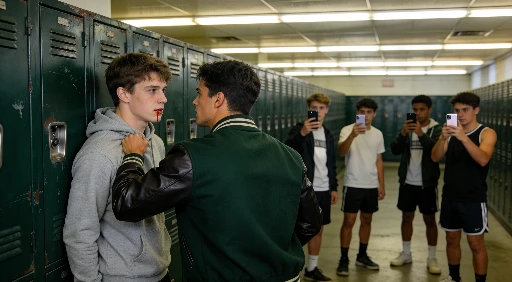
The Principal’s Son Lunged At The Skinny Boy To Punch Him In The Mouth—But The Boy Slipped Left, Hooked His Leg, And Dumped Him On His Back So Hard The Hallway Went Silent.
The hallway was already recording when Trent cornered me against the lockers. He was the principal’s son, the untouchable star of the school, and he wanted a show. Thirty phones were up, waiting for the skinny scholarship kid to break. I just wanted to walk away.
Trent stepped into my space, his chest puffed out, flashing that arrogant smile everyone was so afraid of. He shoved my shoulder hard enough to rattle the metal locker behind me. A few kids in the crowd laughed. Someone yelled for him to end it.
“Look at me when I’m talking to you, trash,” Trent snapped. He shoved me again, knocking my worn backpack to the floor.
I kept my hands open and down by my sides. I didn’t say a word. For months, he had mistaken my silence for fear. He thought I was just a quiet, poor kid who didn’t know how to defend himself. He had no idea about the grueling hours I’d spent since I was seven years old, sweating on old mats with a retired Marine combatives instructor who taught me discipline before he ever taught me a technique.

Mr. Miller, the history teacher, walked past the edge of the crowd. He glanced over, saw Trent’s letterman jacket, and immediately looked down at his clipboard, pretending he didn’t notice a thing. “Just keep moving, folks,” Mr. Miller muttered to nobody in particular, vanishing down the stairs.
That was the green light Trent needed. The adults were officially turning a blind eye.
“Pick up your bag,” Trent ordered, his voice echoing in the packed corridor. He kicked my backpack further down the hall. “Actually, nah. Get on your knees and apologize for breathing my air.”
The chanting started. People I shared geometry with were egging him on, holding their phones higher to get a better angle. A girl near the front flinched, clutching her books tight, but she didn’t dare say a word or try to help. To the whole school, Trent was royalty. To me, he was just a guy with terrible balance and a lot of unearned confidence.
I finally looked him in the eye. “I’m not doing that, Trent. Just let me go to class.”
His face turned red. The laughter around us died down as people sensed the shift. I wasn’t following the script. I was supposed to cower. I was supposed to submit.
“You don’t talk to me like that,” he snarled, dropping his shoulders and balling his fists. He took a heavy, aggressive step forward, closing the last bit of distance between us. The crowd gasped, tightening the circle, blocking my only exit.
— CHAPTER 2 —
It did not start with violence. It started with silence.
If you want to understand how a hallway of thirty kids gets to the point where they will happily pull out their phones to watch a kid get destroyed, you have to look at the months before it happens. Bullying at a place like Oak Creek High does not begin with a punch in the face. It begins with a slow, systematic isolation that strips away your humanity until nobody sees you as a person anymore. You just become the school’s daily entertainment.
I arrived at Oak Creek in late August. I was fourteen, underweight, and carrying a backpack that had been stitched back together by my mom so many times the original logo was gone. I was there on a community merit scholarship, a program the school district ran to look good for the local papers. They took three low-income kids from the east side of town and dropped us into a building where the parking lot looked like a luxury car dealership.
My mom cried the day the acceptance letter came. She worked double shifts at a diner just to afford the gas to drive me across town. She told me this was my ticket out. She told me to keep my head down, get my grades, and ignore the noise.
I intended to do exactly that. I didn’t want to be popular. I just wanted to survive, graduate, and make her proud. But at Oak Creek, being invisible was not an option. Wealth and status were the only currencies that mattered, and if you didn’t have them, you were a target.
Trent Caldwell noticed me on the third day of school.
Trent was the varsity football captain as a junior, which was rare, but everything about Trent was an exception to the rule. He was tall, built like a brick wall, and had that perfectly tousled hair that made the girls whisper when he walked by. More importantly, he was Principal Caldwell’s oldest son.
That fact alone made him a god in the hallways. The teachers deferred to him. The coaches built the entire offensive line around him. The administration treated his infractions like cute little misunderstandings. Trent knew he was untouchable, and he carried himself with the lazy, dangerous confidence of a kid who had never been told no in his entire life.
Our first interaction happened in the locker room before gym class. I was sitting on a wooden bench, trying to quietly change into my standard-issue grey gym shirt. I had my back turned to the main aisle, hoping to just blend in with the metal lockers.
Trent walked past with his three main followers—guys who were basically just slightly smaller, less charismatic versions of him. He stopped right behind me. I didn’t look up, but I could feel the shift in the room’s energy. The loud chatter in the locker room suddenly dialed down to a nervous hum.
“Hey, new kid,” Trent said. His voice wasn’t loud, but it cut through the room. “Is that a thrift store shirt, or did you just fish it out of a dumpster?”
A few kids snickered. I kept my eyes on my faded sneakers. I tied my laces, grabbed my lock, and stood up without looking at him. I tried to just walk around him to head out to the gym floor.
Trent stepped sideways, blocking my path. His shoulder bumped hard against my chest.
“I asked you a question, charity case,” Trent said, smiling that bright, terrifying smile. “We have a dress code here. We don’t really do the homeless look.”
I took a breath. I remembered what my mom said. Keep your head down. Ignore the noise. “Excuse me,” I mumbled, stepping to the left to bypass him.
Trent let me go that time, but as I walked away, I heard him laugh. It was a cold, sharp sound. That was the moment I got marked. I hadn’t fought back, but I hadn’t cowered enough to satisfy him. I had just tried to exist, and to someone like Trent, a poor kid refusing to grovel was an insult.
The cafeteria exclusion started the following week.
If you want to know where you stand in a high school hierarchy, you look at the lunchroom. It is a brutal, unspoken map of social power. The football team and the cheerleaders had the center tables near the large windows. The band kids, the theater kids, and the math club all had their designated zones.
As a new scholarship kid, I had no zone. I usually just bought the cheapest hot meal on the line, kept my head down, and found an empty seat near the back exits.
On a Tuesday, I was carrying my plastic tray toward a small, empty circular table near the recycling bins. I was just about to sit down when Trent and his crew materialized from the center of the room. Trent slid into the chair I was aiming for, kicking his legs up onto the table.
“Seat’s taken, charity,” Trent said, not even looking at me. He was checking his phone.
I looked around. There were four other empty chairs at the table. “There’s plenty of room,” I said quietly, my grip tightening on my plastic tray.
Trent’s head snapped up. His eyes narrowed. He looked around the cafeteria, making sure people were watching. They were. At Oak Creek, people always watched Trent.
“I said the seat is taken,” Trent repeated, his voice rising just enough to carry to the neighboring tables. “In fact, this whole table is taken. My bags need a place to rest. They’re probably worth more than your house anyway.”
His friends erupted into laughter. Kids at the next table over started giggling too. My face burned with instant, hot humiliation. My ears were ringing. I stood there holding a tray of cheap spaghetti, feeling the eyes of fifty people boring into my cheap clothes and my cheap shoes.
I didn’t argue. I turned around and walked out of the cafeteria. I threw my lunch in the trash can in the hallway and spent the next thirty minutes sitting in a bathroom stall, staring at the tile floor, waiting for the bell to ring.
That became my daily routine. Trent made it his mission to ensure I had nowhere to sit. If I went to the library, he and his friends would sit at the next table and throw small wads of paper at my head when the librarian wasn’t looking. If I sat on the bleachers outside, they would “accidentally” kick soccer balls into my backpack.
Then came the nicknames. Trent was smart about it. He didn’t use slurs or curse words that could get him suspended. He used words that were just cruel enough to stick, but innocent enough that adults could ignore them.
He started calling me “Stamps,” implying my family used food stamps. Then it evolved to “Goodwill,” and finally just “Trash.”
“Hey Trash, move out of the way,” he would say in the hallway.
“Pick that up, Trash,” he would whisper in chemistry class, knocking my pencil off my desk.
The worst part was how quickly the rest of the school adopted it. That is the terrifying thing about social power. People don’t join in because they hate you. They join in because they are terrified of becoming the next target. If Trent Caldwell called me Trash, then calling me Trash was the easiest way for a sophomore to prove they were on Trent’s good side.
Within a month, kids I didn’t even know were using the name. I would walk down the hallway and hear it whispered behind lockers. I would log into a required school discussion board for English class, and someone would reply to my post with a subtle joke about garbage collection.
The digital bullying was the invisible poison that hurt the most. You can leave a hallway. You can walk out of a cafeteria. You cannot escape a group chat.
I didn’t have a nice phone, just an older, cracked Android my mom bought secondhand. But I still had social media accounts because it was the only way to get updates for school clubs and track assignments.
In late October, a photo of me started circulating on Snapchat. I was sitting on the curb waiting for my mom’s old sedan to pick me up. It was raining, and I had my hood pulled up, looking miserable.
Someone had taken the photo from inside a warm, dry SUV. The caption written across the image read: Trash waiting for the garbage truck to take him home.
It went viral within the school. By the next morning, people were laughing when I walked through the front doors. I heard the notification chime pinging on phones all around me during first period. A girl in front of me literally pulled the photo up on her screen, showed it to her friend, and then turned around to look at me and smirk.
I felt completely, utterly hollowed out. I wanted to scream. I wanted to grab the nearest phone and smash it against the whiteboard. But I remembered my training. I remembered the old man in the dusty gym on the east side who told me that anger is a poison you drink yourself, hoping the other guy dies.
So I breathed. I packed my books. I stayed silent. I thought my silence would eventually bore them. I thought if I gave them no reaction, they would move on to someone else.
I was wrong. My silence just made Trent angry. It frustrated him that I wasn’t breaking. He wanted tears. He wanted me to yell so he could look like the cool, calm victim. My restraint was driving him crazy, and he started pushing harder to get a reaction.
It escalated in November. We were in the locker room again. I was opening my combination lock when Trent walked by and intentionally shoulder-checked me so hard my head bounced against the metal door.
“Watch where you’re standing, Trash,” he spat.
My vision swam for a second. The metal lock dug into my palm. My knuckles went white. For one split second, the discipline cracked. I turned around, my shoulders squared, looking him dead in the eyes.
Trent smiled. He was thrilled. He raised his hands in mock surrender. “Ooh, is the charity case gonna cry? Come on. Do it. Swing.”
The locker room went dead silent. Everyone was watching. Trent’s friends stepped up behind him. I looked at his stance. He was heavy on his front foot. His chin was up. His hands were loose. He was a football player, used to tackling, but he had absolutely no idea how to actually fight. In that moment, I knew exactly how easily I could drop him. A simple sweep, a pivot, and he would be on the concrete floor wondering why his shoulder didn’t work anymore.
But then I saw Coach Miller standing in the doorway of his office.
Coach Miller was the varsity football coach and the gym teacher. He had seen the whole thing. He had seen Trent slam me into the lockers.
I looked at the coach, waiting for him to step in. Waiting for him to blow his whistle. Waiting for the adult to do his job.
Coach Miller looked at me, then looked at Trent. He sighed, rubbed his neck, and stepped out of his office.
“Alright, boys, that’s enough grabbing around,” Coach Miller said. His voice was bored, casual. “Caldwell, get dressed. You too, new kid. Stop the drama before I make you both run laps.”
Stop the drama.
Those three words hit me harder than the locker did. I realized right then that the system wasn’t broken. It was working exactly as it was designed to. Trent was the star quarterback and the principal’s son. I was a disposable kid from the east side. In Coach Miller’s eyes, Trent assaulting me was just “drama.”
I uncurled my fists. I turned my back to Trent and finished opening my locker. I heard Trent chuckle, victorious. He had just learned the most dangerous lesson a bully can learn: the adults were not going to stop him.
I went to the guidance counselor that afternoon. It was my last desperate attempt to fix things the right way. Mr. Harrison was a younger guy, usually wearing a sweater vest and a fake, comforting smile.
I sat in his office and told him everything. I told him about the cafeteria. I told him about the nicknames. I showed him the photo on my cracked phone screen. I told him about the locker room.
Mr. Harrison listened, nodding slowly, steepling his fingers on his desk. When I finished, he let out a long, heavy sigh.
“Look,” Mr. Harrison said gently, leaning forward. “High school is tough. It’s a transition period. And Trent… well, Trent is under a lot of pressure. His dad is the principal, he’s carrying the football team. Sometimes kids blow off steam in ways that aren’t productive.”
I stared at him, stunned. “He slammed my head into a locker.”
“Now, did he slam your head, or did you guys bump into each other in a crowded room?” Mr. Harrison asked, raising an eyebrow. “Coach Miller said it was just some horseplay that got out of hand. Both sides were a little wrong.”
“I was opening my locker.”
“I understand you feel targeted,” Mr. Harrison continued smoothly, ignoring my words. “But you have to realize that you isolate yourself, too. You don’t join clubs. You don’t try to fit in. Maybe if you made an effort to be part of the community, these misunderstandings wouldn’t happen. Boys will be boys. Just keep your head down and don’t make this bigger than it is.”
He was blaming me. He was actually blaming me for not smiling enough while getting abused.
I walked out of his office feeling colder than I had ever felt in my life. I realized there was no safety net. The principal was Trent’s father. The coach was Trent’s protector. The counselor was a coward. I was completely, terrifyingly alone.
Things got worse after that meeting. Trent somehow found out I went to the counselor, which meant someone had talked. He took it as a personal challenge. I wasn’t just a quiet kid anymore; I was a snitch who had failed to get him in trouble.
He stopped being subtle. He stopped waiting for the locker room or the cafeteria. He started hunting me in the main hallways, right where everyone could see.
It was the first week of December, right before winter break. The school was decorated with cheap paper snowflakes. The heating in the building was cranked up, making the air thick and dry.
I was walking to my final class of the day, keeping my eyes on the floor, counting the tiles. I was three doorways away from my classroom. Just three more doors, and I would be safe for the weekend.
Suddenly, a heavy hand grabbed the back of my backpack and yanked hard.
I stumbled backward, my sneakers squeaking violently on the waxed floor. I hit the row of lockers behind me so hard my teeth rattled.
I looked up. Trent was standing right in front of me. His varsity jacket was unbuttoned, his face red and furious. His three friends quickly stepped around him, forming a tight half-circle, boxing me in completely.
“Where are you going, snitch?” Trent hissed, stepping so close I could smell the peppermint gum he was chewing.
People in the hallway stopped moving. Conversations died instantly. The atmosphere shifted from noisy chaos to a suffocating, electric silence. I saw hands reaching into pockets. I saw the glint of glass lenses. The phones were coming out. Thirty people were raising their cameras, pressing record, waiting for the show to begin.
Trent slapped his hand flat against the locker right next to my ear, trapping me in.
“I heard you went crying to Harrison,” Trent said loud enough for the cameras to catch every word. “I heard you think you’re a victim. So let’s give them a real show. Get on your knees, Trash.”
I looked at the circle of phones. I looked at the smirks on the faces of his friends. I looked down the hall and saw a teacher step out of a classroom, take one look at the situation, and pull her door quietly shut.
My heart hammered against my ribs. My breathing hitched. The old rules of walking away were gone. There was no exit. There was no adult coming to save me. There was only the lockers behind me, Trent in front of me, and a hallway demanding blood.
I closed my eyes for one fraction of a second, and in the dark behind my eyelids, I didn’t see the hallway. I saw the dusty mats. I smelled the old canvas. I heard my master’s voice, rough like sandpaper, echoing in my head.
We do not strike first, he had said. But when they leave you no exit… we do not kneel.
I opened my eyes. I dropped my hands loosely to my sides, shifted my weight to the balls of my feet, and looked Trent Caldwell dead in the face.
— CHAPTER 3 —
I didn’t come from a family that believed in violence. My mom, a woman who worked sixteen-hour shifts at a roadside diner just to keep the heat on, believed in two things: God and hard work. She was the one who found the ad for Master Hale’s academy on a crumpled flyer stuck to a telephone pole.
Master Hale wasn’t like the instructors you see in fancy suburban strip malls. He didn’t have colorful uniforms, and he didn’t hand out gold-plated trophies for perfect attendance. He was a retired Army combatives instructor, a man whose face looked like it had been carved from granite. He ran his classes in a converted warehouse on the east side of town, a place that smelled permanently of floor wax, old sweat, and floor mats that had seen better decades.
I was seven years old when I first walked in there, gripping my mom’s hand so hard my knuckles were white. I was the smallest kid in the room, terrified of everything. Master Hale didn’t look at me like I was a customer; he looked at me like I was a recruit who had just realized he was in over his head.
“You’re here to learn how to fight?” he had asked, his voice gravelly and devoid of any warmth.
I had nodded, too scared to speak.
“Wrong,” he said, shaking his head. “You’re here to learn how to walk away. You’re here to learn how to keep your hands in your pockets when your pride is screaming at you to swing. If you want to learn how to hurt people, go find a boxing gym. If you want to learn how to keep your life, stay here.”
That was the foundation of everything he taught me. Over the next eight years, I spent every Tuesday and Thursday, and every Saturday morning, in that warehouse. While other kids were playing video games or going to movies, I was learning the physics of balance and the psychology of conflict.
Master Hale was brutal, but he was fair. He taught me that fear is a biological feedback loop—it’s just your body preparing for a threat. He taught me to recognize the signs of a coming storm before the first raindrop fell: the way a bully’s shoulders tense, the way they scan the room for an audience, the way they position themselves to cut off an exit.
He didn’t teach me flashy kicks or complex submission holds. He taught me economy of movement. He taught me that if you have to use force, it should be the absolute minimum required to stop the aggression. He taught me about “the line”—the imaginary boundary where you go from being a bystander in your own life to being the person in control of the situation.
“The person who swings first is usually the person who loses the most,” he’d drill into me while we were resetting our positions on the mats. “Once you throw that first punch, you aren’t just fighting the person in front of you; you’re fighting the consequences. You’re fighting the principal, the police, the court, and the regret that comes with knowing you chose violence over discipline.”
He taught me that silence wasn’t the same as weakness. To him, keeping my mouth shut when Trent Caldwell mocked my clothes wasn’t failing; it was practicing the ultimate control.
“Everyone wants to be the lion,” he used to say. “But a lion is loud, and a lion is predictable. Be the person who can be pushed, and pushed, and pushed, and stays upright. Because when the time finally comes, when there is truly nowhere left to go, you won’t need to shout to be heard. You’ll just be the one still standing.”
Every time I endured a fresh round of humiliation at Oak Creek—every time a lunch tray was knocked from my hands, every time a cruel photo was uploaded to a group chat—I felt that training anchoring me. I felt the weight of Master Hale’s lessons in my spine. I was playing a long game, one that Trent Caldwell was too blinded by his own arrogance to see.
I was building a reserve of calm that I knew, eventually, would become my greatest weapon. But by the time I was fourteen, the pressure was starting to warp the edges of that discipline. The social isolation, the constant, low-level buzz of being the school’s “Trash,” it was wearing me down.
I started having dreams about the warehouse. In my dreams, I was back on the mats, and Master Hale was yelling at me to move, to stop being a target, to stop waiting for permission to exist. I would wake up in my cramped bedroom, sweating, my heart racing, feeling the familiar, suffocating shame of another day at school awaiting me.
I began to realize that while Master Hale taught me how to handle the physical danger, he had never quite prepared me for the systematic erosion of my spirit. He had taught me to stop a bully, but he hadn’t taught me how to live in a world where the adults were the ones holding the door shut for the bully to enter.
I felt like a coiled spring, wound tighter and tighter with every passing week. I was waiting for a signal, for a moment where the rules of the game would shift from psychological warfare to something I could actually solve with my feet and my balance.
And then, that December morning happened in the hallway.
When Trent grabbed my backpack and slammed me into those lockers, the years of quiet training, the countless hours of drilling the same defensive pivots, and the crushing weight of the school’s indifference all collided in one split second. I knew, with a sudden, crystal-clear certainty, that the moment Master Hale had warned me about—the moment where there was no safe way out—had finally arrived.
I wasn’t scared anymore. The fear had been replaced by a cold, sharp, focused clarity. For the first time in my life, I wasn’t just a scholarship kid. I was the person Master Hale had been trying to build for seven years. I was ready.
Trent didn’t know what he was looking at. He saw a skinny, poor kid standing against a wall. He saw a victim waiting to be broken. He didn’t see the thousands of repetitions, the years of discipline, or the unwavering resolve of someone who had learned how to survive long before they ever walked through the doors of Oak Creek High.
He thought he was winning, but as I stood there, feeling the cold steel of the locker against my back and the heat of the hallway pressing in, I knew the game was already over. He just didn’t have the timestamp for his own defeat yet.
He stepped in, drawing back his fist, his face twisted in a mask of triumph. The hallway went silent, a collective gasp held in the throats of thirty teenagers, waiting for the impact.
I adjusted my stance by a fraction of an inch, tucked my chin, and prepared to move. I wasn’t going to fight him. I was going to show him, once and for all, exactly what happens when you mistake restraint for fear.
I looked at his fist, moving in slow motion now, and I knew exactly where he would be in the next three seconds. He was falling into a trap that had been set seven years ago, in a dusty warehouse on the east side of town.
But just as he started his swing, the doors to the hallway burst open. Coach Miller stepped out, holding a stack of papers, his eyes flicking toward us, then toward the students, then back toward the floor. He didn’t stop. He didn’t even break his stride. He just muttered something under his breath about “getting to class on time.”
Trent’s fist paused for a heartbeat, his confidence bolstered by the coach’s dismissal. He smiled, a dark, jagged expression that promised nothing but pain.
He was so sure of his power. He was so sure that the world would always let him have his way.
He swung.
And for the first time in my life, I didn’t hold back. I moved.
— CHAPTER 4 —
The hallways of Oak Creek High felt like a pressure cooker that was slowly, methodically being turned up to a boiling point. It wasn’t just the physical threat of Trent Caldwell; it was the atmosphere of the entire school. It was the way the air seemed to thin whenever I walked into a room, the way conversations would abruptly stop, and the way every pair of eyes in the vicinity would track my movement like a pack of wolves watching a wounded deer.
By the time I reached my locker after the “kneeling” incident, the news had already traveled faster than the school’s own PA system. Someone had uploaded a clip of the encounter to the school’s unofficial Discord server. I knew because I could hear the looped audio of Trent’s voice ringing out from three different phones as I walked toward the science wing.
“Get on your knees, Trash.”
The sound was everywhere. It was a digital echo of my humiliation.
I kept my head down, my pulse hammering a steady, frantic beat against my temples. I could feel the heat radiating off the people I passed. There was a weird, distorted sense of celebrity attached to being the target of a football captain. I wasn’t a student anymore; I was a plot point in their daily drama.
I reached my locker and began frantically working the combination. My fingers were trembling, which made the dial feel slick and difficult to manipulate.
“Hey, look, it’s the guy who thinks he’s a samurai,” a voice sneered from behind me.
I didn’t turn around. I recognized the voice. It was one of Trent’s cronies, a linebacker named Dave who took pleasure in physically nudging me into trash cans whenever the teachers were looking the other way.
“I heard you didn’t kneel,” Dave continued, his voice dripping with mock awe. “How does it feel to be the biggest loser in school history? You know, the whole football team is laughing about it in the locker room right now. Trent said he’s going to make you crawl to the cafeteria by the end of the week.”
I pulled my history book out, trying to ignore the prickling sensation of a phone being held up somewhere to my left. They were filming again. They were always filming.
“Leave me alone,” I muttered.
“Oh, the samurai speaks!” Dave shouted to the crowd that was already gathering. “What are you going to do, Trash? Are you going to go cry to the guidance counselor again? Maybe ask Mr. Harrison for a hug?”
The crowd laughed. It was a sharp, biting sound. I felt the familiar burn of humiliation, but underneath it, something else was hardening. It was the cold, disciplined resolve that Master Hale had spent years forging in me. Every laugh, every jab, every phone lens pointed in my direction was just more noise. It was the white noise of a failing system.
I closed my locker and started to walk away, but someone tripped me.
I stumbled, my books spilling out across the floor. As I scrambled to pick them up, I saw a girl standing near the lockers, her face pale, her hands trembling as she held her textbook to her chest. She was a quiet girl from my English class—we had traded a few nods over the semester. She wanted to help. I saw her glance at the teacher’s lounge, then back at me, her eyes darting toward the other students, terrified of becoming the next target.
She opened her mouth, a small, choked sound escaping her lips, but then someone shoved her shoulder, and she looked down at the floor, blending back into the background, effectively paralyzed by the social hierarchy.
That was the most painful part of it all. It wasn’t just the bullies. It was the silence of the people who knew better. It was the way the crowd watched, hungry for a breakdown, hoping that if they gave Trent what he wanted, he might spare them.
I gathered my books and kept moving.
I made it to my next class, but the harassment didn’t stop. Notes were passed around. Little scraps of paper with cruel drawings of me in a garbage can landed on my desk. Every time the teacher turned to the whiteboard, someone would flick a pen at the back of my head.
The teacher, Mrs. Gable, was a veteran of the district, and she had to know what was happening. She had to hear the snickers and the hushed whispers. But when I finally raised my hand, my voice shaking, and said, “Mrs. Gable, can you please tell them to stop?” she didn’t turn around.
She just kept writing. “We have a lesson to get through, and I don’t have time for middle-school drama. If you can’t handle the environment, perhaps you should be in independent study.”
Independent study. That was the school’s favorite phrase for “we don’t want to deal with you, so please just disappear.”
I realized then that the school wasn’t just protecting Trent. The school was actively trying to make me disappear. I was a liability to their image. A scholarship kid who was causing “drama” in the hallways was an eyesore that disrupted their perfectly curated football-hero narrative.
That afternoon, I found a note taped to my locker. It was a printed screenshot of the group chat. It had a list of things they were planning to do to me the following day. “Spill the milk,” “Lock him in the janitor’s closet,” “Tear his bag.”
It was a manifesto of cruelty.
I stared at it for a long time. I realized that Trent wasn’t just having fun. He was building a campaign of terror. He wanted to break me before the winter break so he could own the next semester without me even being there.
I thought about going to the principal’s office. I thought about printing this out and forcing someone to look at it. But I knew better. The principal was Trent’s father. Anything I brought in would just be used as evidence that I was a “troublemaker” who was “fixated” on the school’s star athlete.
I crumpled the note and put it in my pocket.
As I walked out toward the parking lot, I saw Trent waiting by his truck. He was surrounded by his team, looking like a king in his element. He caught my eye, smiled, and made a throat-slashing gesture.
The weight of the silence, the weight of the cameras, the weight of the teachers—it all felt like it was finally crushing the life out of me. I walked toward my mom’s sedan, my eyes fixed on the pavement, feeling more alone than I had ever felt in my entire life.
I had been holding the line for months. I had been practicing every ounce of discipline I possessed. But as I sat in the car, watching Trent laugh with his friends in the rearview mirror, I knew the line was about to break.
The next day, I didn’t go to class. I didn’t go to the cafeteria. I went straight to the library, intending to hide, but the librarian told me the room was reserved for a “team meeting.”
I walked back into the hallway, and there they were. The entire football team. They were blocking the way, their jackets forming a wall of red and white.
“Hey, Trash,” Trent said, stepping out from the center. He looked bored, like he was doing a chore. “We heard you had a rough day yesterday. We wanted to help you finish it.”
The crowd was already there. The phones were already raised. The atmosphere was so thick with malice I could taste the metallic tang of fear in the air. I looked around for an exit, but the doors were blocked. I looked for a teacher, but the hallway was perfectly, intentionally empty of adults.
I realized then that they had orchestrated this. It wasn’t a chance encounter; it was an execution of my social status.
I looked at Trent, his hand resting casually on the wall next to my head, and I felt something shift inside. The fear was gone, replaced by a cold, hard, crystalline focus.
He moved forward, his hand grabbing my collar, his voice dropping to a whisper that only I could hear. “I’m going to take you to the ground, and you’re going to crawl to the principal’s office and beg for forgiveness. And it’s all going to be on the school’s main feed.”
I didn’t blink. I didn’t breathe. I just watched him, my body perfectly still, my weight shifted in the way Master Hale had taught me.
“I’m not doing that, Trent,” I said, my voice steady, even, and deathly quiet.
His eyes widened in shock. He wasn’t used to anyone saying no. He wasn’t used to a victim who didn’t shake.
He raised his fist, his face darkening with a murderous rage.
But as he swung, I caught a glimpse of something moving at the end of the hall. A shadow. A person.
I couldn’t tell who it was, but the person had a phone out—not to film, but to record what was happening to me.
And then, the swing came.
— CHAPTER 5 —
The swing was coming, and for a split second, the world seemed to freeze. I saw the way Trent’s shoulder dipped, the way his knuckles tightened, and the way the entire hallway seemed to lean in, hungry for the sound of impact. It was the same look I’d seen on the faces of every bully who thought they were kings of their own little dirt patches.
I didn’t panic. I didn’t reach for the lockers, and I didn’t try to shrink into the wall. I pivoted.
Master Hale had spent years teaching me how to read the intent behind a movement. He had taught me that a person who strikes out of anger always reveals their telegraph long before the limb actually moves. Trent wasn’t fighting; he was lashing out. He was throwing a heavy, committed hook designed to humiliate, not to finish.
As his fist cut the air, I dropped my center of gravity and stepped off the line of his attack. I didn’t use force against him; I used his own momentum against the empty air he was trying to fill. His fist whistled past my ear, and because he had committed so much weight to the swing, he stumbled forward, his balance shattered.
I didn’t hit him. I never hit him. I just moved into the space he had vacated, reached out, and guided his forward momentum into the lockers he had pinned me against.
The sound was jarring—not the sickening crack of bone on bone, but the heavy, dull thud of a shoulder hitting industrial metal.
Trent hit the lockers hard, his momentum carrying him into a clumsy sprawl. He didn’t drop; he bounced. He spun around, eyes wide, confused, and suddenly, violently unmasked. He had expected me to fold. He had expected me to take the punch, fall to my knees, and give the crowd the video they were filming for. Instead, I was standing three feet away, my hands open, my breathing steady, my posture relaxed.
The hallway went dead silent.
The phones were still out, but the laughing had stopped. The students who had been chanting Trent’s name seconds before were now standing with their mouths slightly open, processing the sight of their untouchable captain sprawling against the metal.
I didn’t advance. I didn’t gloat. I didn’t say a word. I just stood there, maintaining my guard, watching him to see if he was going to continue.
Trent scrambled to his feet, his face turning a deep, humiliated purple. He looked around, suddenly realizing that the power dynamic had shifted. He wasn’t the king anymore; he was just a kid who had swung at air and fallen in front of his peers.
“You—” he started, his voice cracking. He reached for me again, his face a mask of blind, desperate rage.
But I didn’t move toward him. I just stepped back, maintaining the distance, keeping my hands up in a way that signaled clearly to anyone watching: I am not fighting you. You are the one choosing to be a danger.
“Check the cameras,” I said, my voice cutting through the silence like a blade.
The phrase hung in the air, heavy and absolute. I gestured toward the security camera mounted at the corner of the ceiling, its red light blinking steadily, a cold, indifferent witness to everything that had just happened.
“Check the cameras,” I repeated. “Check them right now.”
Trent stopped. He looked up at the camera, then back at me, then at the phones held by the students. He realized, in a flash of terrifying clarity, that there were now thirty different angles of him failing, swinging wildly, and hitting a wall. He realized that the narrative he had carefully cultivated—the narrative where he was the hero and I was the broken victim—had just been dismantled in three seconds.
He didn’t swing again. He couldn’t.
He was paralyzed by the sudden, freezing realization that the school’s protection was no longer a shield. It was a mirror. And what it was showing him was not a star quarterback, but a bully who had just been outplayed by the very kid he had spent months trying to destroy.
He turned, not looking at me, but looking at his friends, who were slowly lowering their phones. The “show” wasn’t what they wanted anymore. They wanted a victory; they had been given a spectacle of failure.
“We’re done,” I said, my voice firm. “Don’t touch me again.”
I turned my back on him. I picked up my backpack, which had fallen during the initial grab, and began to walk down the hall.
The crowd parted. They didn’t cheer, and they didn’t laugh. They just stood there, stunned, watching me walk toward the exit. It was as if I had suddenly become a ghost in their midst, someone they had been pretending didn’t exist until that very moment.
As I passed the teacher’s lounge, the door swung open, and the principal stepped out, his face etched with a mix of confusion and irritation. He had heard the thud, and he had heard the silence.
“What is going on here?” he demanded, looking down the hall.
Trent was still standing by the lockers, his chest heaving, his face an impossible shade of red. He looked at his father, expecting the usual intervention, the usual demand that the “problem” be removed.
But for the first time, his father’s eyes weren’t just on him. They were on the phones. They were on the students. They were on the camera.
The principal froze. He saw the scene—the sprawled locker, the humiliated son, the silent, watching crowd. He saw the digital trail that was currently uploading to a dozen different servers.
He knew, just as clearly as Trent did, that the truth was no longer a matter of opinion. It was a matter of record.
I kept walking. I didn’t wait for an answer. I didn’t look back to see how the principal would handle it, or how Trent would try to save face. I just kept walking toward the front doors, my feet steady, my heart finally quiet.
I had crossed the line. I had been forced into the corner. And when I had no other choice, I had used the discipline Master Hale had given me to stop the danger, not to start a fight.
I reached the front doors and pushed them open. The cold winter air hit my face, and for the first time in months, I felt like I could actually breathe. The walk to my mom’s car felt like walking out of a prison. I knew there would be consequences. I knew the school would try to spin it, and I knew Trent’s father would try to bury the evidence.
But as I sat in the driver’s seat, I looked at the school one last time, feeling the weight of the phone in my pocket—the phone that hadn’t recorded a single thing, but had witnessed the end of an era.
The hallway had watched me being bullied for months. Today, it watched me stop it. And there wasn’t a single person in that building who would ever look at me—or Trent—the same way again.
But I knew this was just the beginning. The school’s response was coming, and I had a feeling the most difficult part of the fight was just about to start.
The principal’s office was already lit up, the door closing behind him as he dragged Trent inside. I didn’t drive away yet. I waited. I watched as the students filtered out, their phones held close to their chests, looking at me with a mixture of fear, confusion, and something I hadn’t seen in a long time—respect.
I had the truth on my side now. But in a place like Oak Creek, was the truth enough to save me? Or was I just walking into an even bigger target?
— CHAPTER 6 —
Trent was still reeling from the shock of his own failed strike. He stood there, chest heaving, his face drained of that arrogant, untouchable glow. The hallway was silent, save for the hum of the overhead lights and the distant, muffled sound of a locker door slamming somewhere down the wing.
I didn’t move. I kept my weight centered, my hands open, and my eyes fixed on his shoulders. Master Hale’s voice was ringing in my ears, clearer than it had ever been: Control the danger. Stop the moment the danger is controlled.
Trent’s face twisted. His pride, the one thing he had built his entire existence around, was hemorrhaging. He had to save face. He had to prove to the phones, to the crowd, and to himself that he was still the predator. He lunged again.
This time, he didn’t swing. He came in for a tackle, a desperate, clumsy attempt to drive me into the lockers and end this with brute force. He was banking on his size, his football training, and the sheer desperation of a bully who had just realized he was losing control.
I saw the movement before he even shifted his feet. He was heavy. He was over-committed. He was angry, and anger makes you blind to everything but the target in front of you.
I didn’t step back. I didn’t try to outmuscle him. I stepped to the side, a simple, fluid motion that felt like second nature after years of drills. As he rushed past, I caught his lead arm, used his momentum, and redirected his path. I didn’t push him; I simply opened the door, and he walked through it, stumbling into the open space near the center of the hall.
He lost his footing, his arms windmilling in a frantic attempt to grab onto something. He hit the floor hard, his shoulder slamming into the polished tiles.
He didn’t stay down. He started to scramble back up, his face wild, his eyes darting toward the crowd. He was looking for approval. He was looking for a reason to keep going.
“Get him!” someone screamed from the back of the crowd. It was one of his inner circle, his voice cracking with the same desperation Trent was showing. “Don’t let him get up, Trent! Finish it!”
The pressure was mounting again. The phones were back up. The crowd was vibrating, the mob mentality flickering back to life. They wanted the violence. They wanted the spectacle. They wanted the blood.
Trent started to get to his feet, his hands balled into fists, his breath coming in ragged, ugly gasps. He looked at me, a low, guttural sound rising in his throat.
“I’m going to kill you,” he hissed.
The words didn’t scare me. They made me sad. I looked at him—really looked at him—and I didn’t see a football hero. I saw a kid who had been told his whole life that he was better than everyone else, and who had never been forced to face the reality of his own limitations.
He moved in again, this time with a wild, telegraphed swing.
I didn’t even think. I ducked underneath the arc of his arm, stepped inside his reach, and controlled his lead wrist. I brought him down into a seated position on the floor, holding his wrist firm, keeping his other arm pinned to his side, and shifting my body weight to keep him from getting back up.
I didn’t hurt him. I didn’t press down on his joints. I just held him there, immobile, controlled, and completely neutralized.
“It’s over, Trent,” I said, my voice steady, projecting clearly to every phone, every student, and every teacher watching from the shadows of the doorways. “It’s over.”
He struggled, thrashing against the hold, but I kept my grip firm and calm. I didn’t apply pain; I applied physics. I kept him where he couldn’t reach me, couldn’t strike me, and couldn’t continue the escalation.
“Check the cameras!” I shouted again, looking directly into the nearest phone lens. “Everyone, look at the camera! Look at the footage! Ask yourself why you’re filming a kid being held on the floor, and not the guy who started it!”
The hallway shifted. The tension broke, replaced by a sudden, jarring wave of realization. The students began to look at one another. The phones started to lower, not because they were afraid, but because they were beginning to understand the reality of what they were recording.
Trent stopped struggling. He sat there on the floor, pinned, his face a mask of utter, crushing defeat. He looked up at me, and for the first time, there was no hate in his eyes—just a hollow, echoing void.
“Let me go,” he whispered.
“If I let you go, do we have a problem?” I asked, my voice calm, my grip steady.
He didn’t answer. He just looked at the floor.
I released my grip and stood up, stepping back to a safe distance. I kept my hands open, ready to act, but completely non-aggressive. I had done what Master Hale had trained me to do. I had stopped the danger. I had controlled the situation without losing my humanity.
I stood there for a moment, looking at the wreckage of the hallway—the spilled books, the scattered pens, the stunned, silent crowd. Then, I turned and started to walk toward the exit.
I didn’t look back. I didn’t need to. I knew that the hallway had seen everything it needed to see. The record was set. The timestamp was locked in.
I walked out of the school and into the gray, winter afternoon, my heart finally, truly at peace. But as I walked to the parking lot, I heard the sirens.
They weren’t for me. But I knew exactly who they were for, and I knew that once the police arrived, the game was going to change in ways that neither Trent nor I could possibly control.
The hallway had watched, but now, the world was going to have to make a choice. And in Oak Creek, the truth had a way of being far more dangerous than any punch.
— CHAPTER 7 —
The arrival of the sirens was the sound of the world finally waking up. For months, Oak Creek High had existed in a bubble where Trent Caldwell’s word was law and my reality was something to be ignored or mocked. As the patrol cars pulled into the front lot, tires crunching on the gravel, that bubble didn’t just pop—it disintegrated.
I was waiting by my mother’s car, watching the scene unfold. Students were pouring out of the building, phones tucked away, their faces pale. The bravado that had fueled them in the hallway was gone. Now, they were just kids who had witnessed something they couldn’t justify.
Principal Caldwell emerged from the main doors, his face a mask of practiced authority, but even from the parking lot, I could see the sweat on his forehead. He was walking toward the lead officer, his hands gesturing defensively, his mouth moving in that fast, rehearsed way he used when he was “managing a situation.”
I didn’t feel afraid. I felt a strange, detached clarity. I knew exactly what was about to happen.
The officer didn’t stop to talk to the principal. He walked straight into the school, his hand resting on his radio, his expression neutral. He was followed by a second officer who went straight to the security office.
They weren’t there for a friendly chat. They were there for the footage.
I sat in the car, my heart rate steady. I thought about Master Hale. I thought about all those years on the mats, the drills, the endless repetition of how to stay calm when the world around you is trying to force you into a panic. He had told me that the truth wasn’t a sword; it was an anchor. You didn’t swing it to win; you planted it to stay grounded.
About an hour later, the police escorted Trent out of the school. He wasn’t in handcuffs, but he was flanked by two officers, and his father was trailing behind them, his shoulders slumped in a way I had never seen before. Trent didn’t look at the crowd. He didn’t look at his friends. He just stared at the pavement, his varsity jacket looking like an oversized costume on a kid who had suddenly realized he had no place left to play the hero.
The fallout was immediate and it was surgical.
The security camera in the hallway—the one that had watched everything, the one the teacher had tried to look away from—became the center of the universe. When the police reviewed the footage, the narrative of “drama” and “horseplay” didn’t just fail; it vanished. The video showed Trent attacking first, shoving me, trapping me, and swinging with clear, unprovoked intent. It showed me moving, avoiding, and controlling, never once throwing a punch, never once escalating, and stepping back the moment he was neutralized.
The group chat screenshots? Someone had leaked them to the local news before the school could even try to spin the story. It turned out that “Trash” and the plans to humiliate me weren’t just funny jokes. They were a digital trail of premeditated harassment. The parents of the other kids in the chat were suddenly terrified, not of me, but of the legal implications of what their children had been writing.
The next day, the school was a ghost town.
I walked into the building with my head held high, not because I was looking for a fight, but because I had nothing left to hide. The atmosphere was unrecognizable. The teachers who had told me to “stop the drama” were nowhere to be found, or they were busy filing reports in the main office.
I walked toward the cafeteria. I didn’t head for the back exits. I didn’t look for a dark corner. I walked straight to the center of the room, sat at an empty table, and opened my lunch.
Kids stared at me. For a moment, nobody spoke. Then, one by one, the room went quiet.
I didn’t look for an apology. I didn’t look for their approval. I just sat there, eating my lunch, feeling the weight of the last few months lifting off my shoulders.
Suddenly, a chair slid out at my table. I looked up. It was the girl from my English class—the one who had wanted to help, the one who had been too scared to move. She sat down, her hands still shaking a little, but her eyes were clear.
“I’m sorry,” she whispered.
I looked at her, and I realized that she was just as much a victim of that hallway as I had been. She had been trapped by the same fear, the same social pressure that had almost convinced me to stop being myself.
“It’s okay,” I said softly.
More kids followed. By the end of the lunch period, the table was full. They didn’t talk much, but the silence wasn’t the cold, predatory silence of the past. It was a tentative, uncertain quiet of people realizing that the world they had been living in was a lie.
Later that afternoon, I was called into the principal’s office. It wasn’t the same room I had sat in before. The furniture felt smaller, the walls less imposing.
The principal didn’t look at me like an inconvenience. He looked at me like a problem that had become far too large to ignore. He apologized—not because he meant it, but because he had to. He told me that Trent was suspended indefinitely, that the school was conducting a “full review” of its bullying policies, and that I would be given “full support” moving forward.
I didn’t say thank you. I didn’t say it was fine. I just listened, waiting for him to finish, waiting for the system to stop pretending that it had been anything other than what it was.
As I walked out of the office, I saw the coach. He was standing by the lockers, his face tight, his eyes avoiding mine. He didn’t look at me, and he didn’t try to stop me. He knew, just like everyone else, that the time for “Boys will be boys” had ended.
I walked out to the parking lot and found my mother waiting by the car. She had heard the news, she had seen the footage, and she was crying. She hugged me, a long, tight hug that made me feel like I was seven years old again, back in that warehouse, feeling safe for the first time.
I had survived. I hadn’t become them. I hadn’t let the anger turn me into the thing I was fighting. I had stayed disciplined, I had stayed true to the training, and in the end, that was the only victory that mattered.
But as I drove away, I knew that the story wasn’t just about what happened in the hallway. It was about what happens when you finally stop playing the game by their rules, and start living by your own.
I still had one thing left to do. Master Hale hadn’t just taught me how to defend myself; he had taught me that once the danger is over, you have to find a way to move on. And I knew exactly how I wanted to start.
— CHAPTER 8 —
The finality of the school’s investigation didn’t feel like a celebration. There were no fireworks, no parade, and no sudden transformation of the human heart. It felt, more than anything, like a deep, long-overdue exhale.
The disciplinary hearing was held in the principal’s conference room, a space that felt strangely cramped now that the aura of power had been stripped away. Principal Caldwell wasn’t presiding; he had been recused pending an external audit of the school’s administration. Instead, a representative from the school board sat at the head of the table, her expression neutral and tired.
Trent was there, sitting next to his mother. He looked smaller than I remembered. The varsity jacket was gone, replaced by a simple, oversized sweater. He didn’t look at me. He stared at the wood grain of the table, his fingers picking at a loose thread on his cuff.
The evidence was laid out with cold, clinical efficiency. The security footage of the hallway encounter was projected onto a screen—the moment he grabbed me, the moment he swung, and the moment I moved. It was all there, silent and undeniable. The group chat logs were printed out, highlighted in yellow, detailing weeks of planned humiliation.
The girl who had been too afraid to intervene in the hallway was there as a witness, and for the first time, she spoke. She didn’t whisper. She looked directly at the board member and described exactly how she had been treated when she tried to show concern. She described the culture of silence that had been enforced by the coaches and the senior staff.
It wasn’t just my story anymore. It was the truth of Oak Creek High.
The resolution was decisive. Trent was officially expelled, his football career at the district level effectively over. The students who had filmed the incidents were suspended for varying lengths of time, depending on their level of participation. Coach Miller was placed on administrative leave while the board investigated his role in fostering the toxic environment.
But the most significant change wasn’t the punishments. It was the shift in the air.
On my first day back in the cafeteria, the room was different. The “football tables” in the center weren’t occupied by a pack of wolves anymore. They were just tables. People were talking, eating, and living their lives, and the heavy, suffocating pressure of a hierarchy that depended on humiliation had simply vanished.
I sat with the girl from English class. We didn’t talk about the incident. We talked about homework, and the upcoming winter break, and the books we were reading. It was the most normal conversation I had ever had in that building.
I wasn’t a hero. I was just a kid who had refused to play a rigged game. I was a kid who had remembered what he was taught: that you don’t need to strike first to win, and you certainly don’t need to kneel to prove your worth.
I thought about Master Hale. I thought about the dusty warehouse and the smell of floor wax. I knew he wouldn’t be proud of me for “beating” Trent. He would be proud of me because I hadn’t lost myself in the process. He would be proud because I had walked through the fire and come out on the other side with my discipline, my restraint, and my integrity intact.
The school isn’t perfect. It never will be. But the silence is gone. People are talking, and more importantly, they are listening. The culture of “Boys will be boys” has been replaced by a quiet, persistent demand for accountability.
I still wear my simple hoodie and my worn-out sneakers. I still keep my head down when I’m studying, and I still walk away from unnecessary noise. But now, when I walk through those doors, I know that I am not carrying the weight of being “Trash.”
I am just myself. And for the first time in my life, that is more than enough.
I learned that power isn’t in hurting the person who tries to break you. Power is in refusing to become the person they want you to be. It is in the choice to be better, to be calmer, and to be stronger than the chaos around you.
I will never kneel again. Not because I am arrogant, and not because I am looking for a fight. But because I finally know exactly who I am, and I know that no amount of pressure, no social status, and no varsity jacket can ever take that away from me.
The hallway doesn’t watch me with hunger anymore. It watches with respect. And that is the only kind of recognition I ever wanted.