Part 2: Two Bikers Escorted a 5-Year-Old to Kindergarten Every Morning — The Day Only One Showed Up, 15 Harleys Came Around the Corner.
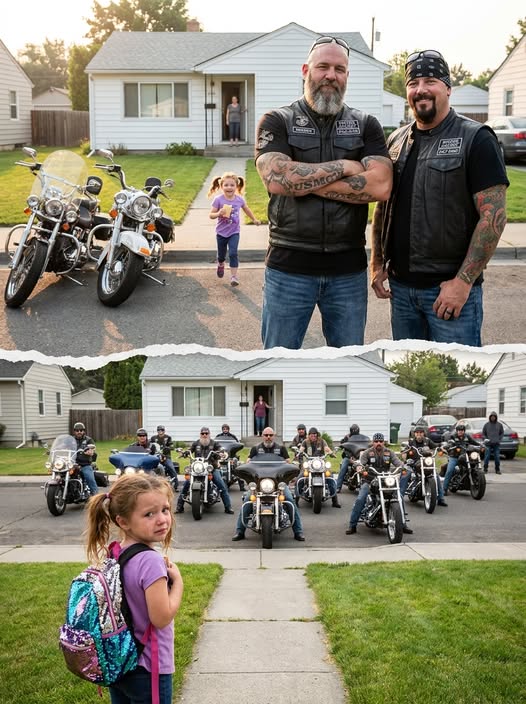
The first time I met Boomer, he was sitting on my front porch step at four in the afternoon with a cup of coffee I’d handed him, looking at the floorboards instead of at me.
It was the day Sadie was officially “patched in” — that’s the BACA term for it. The day a child becomes a sister of the chapter. The day they bring her, with her parents, to their clubhouse, give her a small leather vest of her own with the BACA patch on the back, give her a road name picked just for her, and tell her — in front of the whole chapter, all of them in their cuts, standing in a circle — that she is theirs now.
Sadie’s road name was Pixie.
She got to ride home on the back of Boomer’s Harley with her tiny arms barely reaching around his enormous tattooed waist. She held onto his cut for dear life. He drove the speed limit minus five. He took every turn like it was made of glass. She wore the little leather vest over her glittery purple t-shirt for the rest of the day. She wore it to bed that night. Megan finally pried it off her around midnight and folded it next to her pillow.
The next morning, Boomer was on our sidewalk at 7:42. So was Diesel. Two motorcycles at the curb. Two enormous men with their arms folded.

Sadie came running out at 7:43 in her purple shirt and crooked pigtails, and slammed into Boomer’s leg the way she had been slamming into him at the clubhouse the day before — and Boomer, six-foot-four and 290 pounds, got down on one knee on our concrete walkway in front of God and the neighbors and asked her, very seriously, “Pixie, you ready for school today, sister?”
She nodded so hard her pigtails came loose.
That was February.
I learned, slowly, who these people were.
Boomer’s real name was Mark Hennessey. Forty-nine years old, three combat tours in Iraq with the Marines, retired from the Spokane Fire Department two years ago after a roof collapse broke his back in three places. His wife had died of cancer in 2019. He had a grown daughter living in Seattle who he visited every other weekend. He had joined BACA the year after his wife passed, because he said he had too much love left over and nowhere to put it.
Diesel’s real name was Christopher Vasquez. Forty-four. A licensed plumber. A father of three. The youngest of his kids was on the autism spectrum and Diesel had taken six months of Saturdays to learn American Sign Language because his son sometimes preferred it to speech.
The chapter president’s road name was Pastor. Sixty-one years old, white hair in a long braid, mostly Cherokee, ran a small Baptist church on the north side of Spokane during the week and rode a custom 1983 Shovelhead on the weekends. Yes — a Baptist preacher who was also the president of a 1%-style charity motorcycle club. Spokane is a strange town.
The fifteen members of the chapter included a high school chemistry teacher, a registered nurse, a county sheriff’s deputy who rode in his off-duty cuts, two retired truckers, a 28-year-old female welder with sleeves of pin-up tattoos, a Vietnamese-American restaurant owner everyone called Pho, and a 71-year-old retired Air Force colonel with a steel knee.
They had, between them, no agenda except this: kids who had been hurt should not have to feel afraid walking to school.
Boomer told me, sitting on our porch one evening in March, “Ma’am, my daughter’s grown. My wife is gone. I got two pensions and a busted spine and more time than I know what to do with. The least I can do is stand on a sidewalk for forty-five minutes a day.”
I noticed, that same evening, that he had a small embroidered patch I hadn’t seen before — sewn onto the inside of his cut, near the heart. It said one word: MEGAN.
He saw me looking. He didn’t explain.
He just said, “It’s a long story, ma’am.”
It would be six more months before I learned what that patch meant.
Last Wednesday morning, at 7:42, the curb in front of our house was empty for the first time in 124 school days.
I noticed it from the kitchen window. I’d been pouring my coffee. I looked up, the way I always looked up at 7:42, expecting to see two motorcycles and two enormous men standing with their arms folded — and there was nothing. Just empty curb. The garbage truck on the next block over. A neighbor’s sprinkler.
I went out onto the porch in my robe.
7:43 came and went. 7:44.
Megan came out behind me, holding Sadie’s hand. Sadie was dressed and ready — purple shirt, crooked pigtails, glittery sequined backpack, a Pop-Tart in her free hand.
“Mama?” Sadie said. “Where are they?”
Megan tried to call Boomer. It rang twice and went to voicemail. She tried Diesel. Same thing. She tried Pastor. Voicemail.
What we did not know, sitting on that porch with our hearts climbing into our throats, was this: Boomer and Diesel had been on their way to our house at 7:30 when a tractor-trailer had jackknifed across all three lanes of I-90 westbound, two miles from our exit. They were stuck behind it. Cell service in that section was bad. Boomer had been frantically trying to text the chapter group thread — we’re stuck, somebody else get to Pixie’s house — but the messages were not going through.
7:45. Megan stood up. She said: “Mom, I’m going to walk her. I’ll just walk her. It’s three blocks.”
I did not say what I was thinking, which was: three blocks past his house.
Sadie was very quiet. She had her small hand in her mother’s. She was looking down our street toward the corner where Boomer always came from. Her lower lip was starting to tremble.
I said: “Honey, let’s wait two more minutes. Just two.”
7:46. 7:47.
At 7:48, Sadie let go of her mother’s hand and walked, by herself, in her tiny pink Velcro sneakers, all the way down the concrete walkway to the very end where it met the sidewalk. She stopped at the curb. She did not step into the street — Boomer had taught her that, those first weeks, never step off the curb without me — but she stood there at the edge of it, with her sequined backpack on her shoulders and her Pop-Tart still in her hand, and she watched the empty corner of our block.
She was alone on that sidewalk.
She was so small.
I want you to understand how small a five-year-old looks standing alone at the curb of a suburban street, with her crooked pigtails and her glittery backpack, when you know — when she knows — that the man who hurt her lives three blocks away, and the men who normally stand between them have not come.
7:50. Sadie’s hands were shaking on her backpack straps.
7:51. The first tear ran down her cheek. She didn’t wipe it away.
7:52. I started walking toward her.
7:53. Before I got to the curb, the sound came.
It came from the wrong direction.
The bikers always came from the south. They lived in the south part of Spokane. They came up from Highway 195. The corner of our block they always came around was the corner south of our house.
The sound on Wednesday came from the north. Coming around the opposite corner. And it was not two engines.
It was many.
I stopped on the lawn. Sadie turned. Megan came up beside me with her hand over her mouth.
The first Harley came around the corner of Maple Avenue at 7:53 a.m. exactly.
Then the second. Then the third.
Then ten more.
Fifteen Harleys, in a tight diamond formation that filled our quiet suburban street curb to curb, came rolling up Maple Avenue toward our house with that low rolling thunder, and at the front of the formation, leading them, was Boomer — wind in his beard, Diesel on his right, Pastor on his left, twelve more bikers in their cuts behind them, every single one of them with the BACA patch on their chest.
Sadie’s wet eyes went huge.
Her trembling mouth started to break into the smallest astonished smile.
I thought, in that moment, that this was the climax of the story. I thought what mattered was that fifteen bikers had come around the wrong corner to bring my granddaughter to school.
I was wrong.
What mattered was on the other side of our block.
Two streets over, behind a parked silver Honda Civic, a man had been watching since 7:30 a.m.
His name was on a court order Megan kept folded in her wallet. He was supposed to remain at least 1,000 feet from Sadie at all times pursuant to a no-contact order signed by Spokane County Superior Court Judge Maria Reyes. He was, on Wednesday morning, approximately 280 feet from her front sidewalk.
He had a baseball cap pulled low. He had a coat zipped to the chin in fifty-degree weather. He had been watching Sadie’s house — by his own later admission, in a sworn statement to detectives — every weekday morning for the last eleven days.
He had figured out the BACA pattern. Two bikers, every morning, 7:42. He had watched. He had counted. He had timed.
And on Wednesday, when the BACA bikers did not show up at 7:42, he had — by his own statement — taken three steps out from behind the Honda Civic toward the corner of our street.
He was preparing to walk to my granddaughter’s house.
He was 280 feet away when fifteen Harleys came around the corner of Maple Avenue.
He froze.
He has, through his attorney, denied that he heard them at first. The detectives who interviewed him later did not believe him. His shoes were photographed where he had been standing — the imprint in the wet grass behind the Civic was clear. He had been moving toward the corner of our street.
He stopped when the first Harley came around the bend. He stepped backward behind the Honda Civic. He stayed there, hidden, for the entire ten minutes that fifteen bikers stood in formation in front of our house, including the moment when Pastor — sixty-one years old, white braid down his back, Baptist minister and chapter president — climbed off his bike, walked across our lawn, and crouched down on the concrete walkway in front of my five-year-old granddaughter and said, in his quiet rumbling voice:
“You ain’t never gonna run out of bikes, sister. You hear me? You ain’t never gonna run out of bikes.”
He picked her up. She put her small arms around his neck. She buried her face in his white braid.
The sound she made was not crying. It was the deep settling exhale of a child who has been holding her breath for eleven minutes and finally gets to let it go.
Sadie looked over Pastor’s shoulder, with her cheek against his white hair, and her bright wet blue eyes scanned the street.
She saw, two streets over, between the Hendersons’ house and the empty lot, a hooded figure step backward behind a silver Honda Civic.
She saw him.
She did not say anything in that moment. She told her mother, three hours later, sitting in the school counselor’s office: “Mama, the man was there. The man was watching. But the bikers came so he went away.”
The man who had been her father, by blood and by the worst kind of definition, never came near our block again.
Two days after Wednesday morning, he was arrested in a Walmart parking lot in Coeur d’Alene, Idaho, sixty-eight miles east, on a violation of the no-contact order based on the doorbell camera footage from the Hendersons’ house, which had captured him standing behind the Civic for eleven straight days at 7:30 a.m.
He took a plea. Eight years. No parole.
He will not see Sadie again until she is thirteen years old, and only then if she chooses.
That afternoon, Boomer sat on our porch step and told me, finally, what the patch inside his cut meant.
The patch said MEGAN. But it was not for my daughter Megan.
It was for his Megan.
His Megan was six years old in 1981. She was Boomer’s little sister. They were two of four kids in a small house in Pasco, Washington, and their stepfather had been hurting Megan the way grown men sometimes hurt small girls. Mark — Boomer, then ten years old — had told the school counselor. The counselor had not believed him. The stepfather had beaten Mark for telling. The stepfather had continued.
Megan died at the age of seven. The cause of death was officially listed as a fall down the basement stairs. The investigation was reopened in 1994 when one of the other siblings testified. The stepfather was, by then, already serving a federal sentence for an unrelated charge in Lompoc. He was never tried for Megan.
Boomer joined the Marines at eighteen. He did three combat tours. He came home with a chest full of medals and an empty space where his sister should have been.
He told me on my porch that day, with his enormous tattooed hands wrapped around a cold coffee mug:
“I been waiting forty-three years for somebody to come around the corner for Megan, ma’am. Nobody ever did. So when your Megan called BACA, and they gave me Sadie — I told myself, I told my brothers — this one. This one we don’t miss. This one we don’t ever, ever miss.”
He told me about the eleven minutes on Wednesday. About being stuck behind the jackknifed truck on I-90, watching the clock on his dashboard go from 7:42 to 7:48, knowing he was going to be late, finally getting through to the chapter group thread at 7:50 — and reading the responses come back in a flood.
Pastor: Two minutes out, brother. Coming from the church. Pho: Three minutes. Already on Maple. Diesel-2 (a different Diesel): Coming from work. Five out.
By the time Boomer cleared the wreck and got onto our street at 7:53, twelve other bikers had already converged on the north corner of Maple Avenue from every direction across Spokane, and Pastor had organized them into the diamond formation in the middle of an intersection three blocks from my granddaughter’s house.
Boomer said, “None of ’em asked. They just came.”
He looked at his coffee.
He said, “That’s brotherhood, ma’am. Brotherhood ain’t a word. It’s a noise on a Wednesday morning when a five-year-old’s standing on a curb.”
I have thought about that sentence every single day since.
That was four months ago.
The escort still happens every weekday morning at 7:42. Two Harleys. Two bikers — usually Boomer and Diesel, sometimes Pastor and Pho, sometimes the welder Smiley and the off-duty deputy named Ghost. Sadie still runs out our front door at 7:43 in her glittery purple shirt and slams into whichever leg is available.
But now, on the first Wednesday of every month, all fifteen members of the chapter come.
It is something Pastor decided, the day after our Wednesday. We came once. We come the same day every month. So she always knows it’s possible.
On the first Wednesday of every month, fifteen Harleys come around the corner of Maple Avenue at 7:42 a.m. exactly. They form their diamond at our curb. Sadie comes out our front door in her glittery purple shirt and her little BACA cut, and she walks down the line of bikes high-fiving every single one of the fifteen bikers in turn — Pastor first, Boomer second, Diesel third, all the way down — before she climbs onto Boomer’s bike for the ride to school.
She has names for all of them. She knows all their road names and most of their real names. Pho brings her a small bag of dried mango on first Wednesdays because she likes them. Smiley taught her how to do a knuckle bump that ends with finger explosions. The deputy lets her sit on his bike at the school parking lot afterward because his is the loudest.
She does not flinch at men anymore. Her teacher noticed. Her therapist noticed. Megan noticed.
The court is monitoring this whole arrangement and has formally entered it into the record as part of Sadie’s safety plan.
The man who used to be her father will be released, if he serves his full sentence, on a date my granddaughter will be old enough to vote.
By then, she will have known fifteen bikers, twelve more in the rotation, and more brotherhood than most adults experience in a lifetime.
Last Wednesday morning was a first-Wednesday morning.
Fifteen Harleys came around the corner at 7:42 sharp.
Sadie ran out the front door in her glittery purple shirt and her little BACA cut, with her crooked pigtails flying, and slammed into Boomer’s leg the way she has been slamming into him for ten months now.
Pastor walked to the front. He bent down. He said: “Pixie. You ain’t never gonna run out of bikes.”
Sadie, six years old now, looked up at him. She put both her tiny hands on either side of his bearded face, the way only she gets to.
She said: “I know, Grandpa Pastor. You taught me.”
The fifteen bikers stood very still.
The garbage truck two blocks over kept going.
A small girl climbed onto the back of a 290-pound Marine’s Harley and rode to kindergarten.
❤️ If this story moved you, please follow our page for more real stories about the men everyone misjudges and the children they quietly carry. We post a new one every week. And if you want to learn more about the real organization in this story, look up Bikers Against Child Abuse — BACA. They are not fiction. They show up on Wednesdays.