Pronounced Dead in Labor, Then the Doctor Said There Were Two Babies
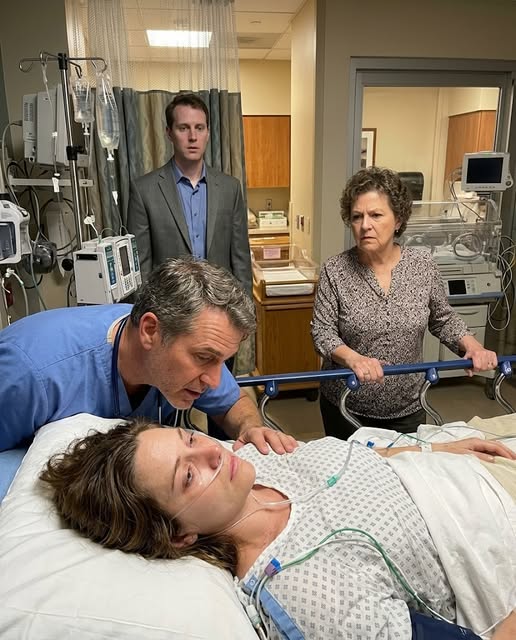
The first time I understood that love can die long before a body does was at 3:47 on a Tuesday morning, when a doctor pronounced me dead and my husband did not ask anyone to save me.
He asked whether the baby was alive.
I remember that question more clearly than the pain, and the pain was extraordinary.
I had been in labor for sixteen hours by then.
Every contraction felt like a steel cable tightening around my spine, then yanking downward with enough force to split me in two.

The room smelled like antiseptic, sweat, and that faint copper scent that clings to fear.
Andrew stood in the corner in a pressed blue shirt that still looked office crisp, as if he had preserved himself from the mess of what was happening to me.
Every time I reached for him, his eyes were on his phone.
In the months before that night, I had begun to understand that something in our marriage was wrong.
Andrew had grown distracted when I got pregnant, then impatient, then secretive.
He guarded his phone.
He started taking calls in the driveway.
His mother, Margaret, became even less subtle than usual, criticizing the nursery paint, my diet, my doctor, my breathing, my posture, my tone, my family, everything except the things that actually mattered.
I told myself it was stress.
I told myself first pregnancies did strange things to everyone.
I was too busy building a crib and folding tiny cotton sleepers to admit I was living with a man who had already emotionally left.
The labor began on a wet Monday afternoon.
By midnight, the pain had sharpened into something primal and endless.
Nurses kept telling me I was progressing.
The obstetrician, Dr.
Keller, said long labor was common with first births.
I clung to those words until my body gave me another message.
I felt a sudden rush of warmth beneath me, far too much, and watched the nearest nurse go pale.
She hit the emergency button so hard the plastic cracked against the wall.
The room filled at once.
Gloves snapped on.
Metal trays rattled.
Someone adjusted my oxygen.
Someone else shouted my blood pressure.
Dr.
Keller’s voice changed from practiced calm to naked urgency.
He was saying I was hemorrhaging.
Then he was saying they were losing me.
My sight narrowed from the edges inward.
The lights stretched into white tunnels.
I heard the heart monitor flatten into one endless shriek.
In the middle of that chaos, Andrew’s voice came from somewhere near the wall, flat and detached.
He asked, almost annoyed, whether the baby was okay.
Then everything went dark.
When awareness returned, I thought I had entered some cruel afterlife.
I could hear, but I could not move.
I could feel, but I could not react.
Cold air brushed my face.
Wheels squeaked underneath me.
A sheet was pulled over me and settled against my lips.
Then a tired male voice said, Time of death, 3:47 a.m.
Inside my mind, I screamed until I thought I would split apart.
I wasn’t dead.
I was still there.
They wheeled me to the morgue.
I know that because I felt the change in temperature first, a deep metallic cold that seemed to seep into my bones.
The table beneath me
was hard and freezing.
I could hear an attendant humming under his breath while he moved instruments and opened drawers.
Then he stopped.
Everything stopped.
His voice, suddenly frightened, said he thought he felt a pulse.
What followed was chaos in reverse.
I was rushed back through the hospital, machines hooked to me, voices overlapping, orders snapped out in rapid succession.
By then I had no sense of time, only sound.
A different doctor, Dr.
Patel, explained to Andrew that I had suffered catastrophic blood loss and a period of oxygen deprivation.
My body was alive, but I was in what he called a locked-in state.
There was a chance, however small, that I could hear and understand what was happening even though I could not respond.
Andrew asked whether I could recover.
Dr.
Patel told him the odds were very low.
Andrew said he needed to make some calls.
I had married him four years earlier in a garden behind my father’s house.
He had been charming then, the sort of man who knew exactly how to tilt his head when he apologized and exactly how to smile when he wanted to be forgiven.
My father liked him less than I did.
Walter Whitmore had built a regional supply company from nothing and trusted very few people.
When he died, he left me the house I grew up in, an investment account, and a tightly written family trust designed to protect any future children I might have.
Andrew used to joke about my father controlling us from the grave.
After my pregnancy, he stopped joking and started asking pointed questions.
The trust mattered because it was structured in layers.
If I died leaving one minor child, the surviving spouse could serve as guardian and control the home and a generous monthly distribution for the child’s expenses.
If I died leaving multiple children, my father’s attorney and the bank would step in as co-trustees, sharply limiting what a surviving spouse could touch without approval.
It was my father’s way of preventing exactly the sort of manipulation he always feared.
I had never explained every clause to Margaret, but Andrew had.
That became obvious on my second day in intensive care.
I heard Dr.
Patel enter my room when no one else was there.
He adjusted a tube, checked a monitor, then bent close to my ear.
His voice softened in a way I will never forget.
He said he did not know whether I could hear him, but if I could, he wanted me to know my babies were alive.
Babies.
Plural.
He said I had delivered twins, a girl and a boy.
The girl was stable in the nursery.
The boy was smaller and had been admitted to the NICU for breathing support.
He told me both were fighters.
The force of that information inside my motionless body was indescribable.
We had spent months preparing for one child.
Every scan had shown one heartbeat.
Later, I learned that my son had remained tucked high behind his sister and an anterior placenta, hidden in a way no one recognized until the emergency delivery.
At that moment, all I knew was that I had two babies in the world and no ability to protect either of them.
That afternoon Andrew and
Margaret came in together.
Margaret shut the door.
I heard the scrape of her handbag against the chair as she sat down.
Andrew asked, in a low voice, whether the doctor was certain about two infants.
Margaret asked the next question even lower, but not low enough.
She wanted to know what two children would do to the trust.
Andrew answered.
He sounded angry, not bereaved.
If both babies lived, Rebecca Collins and the bank would lock everything down.
The house, the money, the accounts, all of it.
He would get almost nothing directly.
Margaret was quiet for a moment, and in that silence I felt something colder than the morgue table.
Then she said the little girl could stay.
The little boy, she added, was another matter.
I learned the name Celia Mercer that day.
Margaret said Celia handled private placements for babies with complicated paperwork.
Andrew asked whether she was trustworthy.
Margaret said money made people efficient.
I could not move.
I could not thrash.
I could not even cry in any visible way.
All I had was thought, and thought without action becomes its own torture.
That night I heard another woman’s voice in my room for the first time.
Vanessa.
Even before I knew her name, I recognized the intimacy in the way she spoke to Andrew.
She was not a friend from church or a cousin or some concerned coworker.
She was too familiar, too amused, too at ease in my absence.
She called him babe under her breath when she thought no one else would hear.
The next morning I found out how far their cruelty extended.
Margaret had sent Vanessa to my house to pick up clothes for Andrew.
Instead she took my wedding dress out of its preservation box.
Andrew was on speakerphone from my hospital room while they laughed about it.
Margaret said the dress fit Vanessa better than it had ever fit me.
Vanessa said maybe that was a sign.
I heard a cork pop, then all three of them drinking to what Margaret called a new beginning.
That was the moment hatred became a physical force inside me.
My heart rate monitor betrayed me before the rest of my body could.
Whenever Andrew entered, it climbed.
Whenever Margaret spoke about the babies, it spiked.
A night nurse named Elena noticed.
She had a soft New Mexico accent and the kind of patience that makes frightened people brave.
On her third overnight shift, she pulled the curtain, touched my hand, and said that if I could hear her, I should try to change my breathing.
I could not.
Then she said, if you understand me, think about squeezing my fingers.
Nothing happened.
But a tear slid from the corner of my eye.
Elena stilled.
She wiped my cheek, then began asking yes-or-no questions in a very calm voice.
She told me one blink meant yes and two meant no if I could manage it.
It took everything in me, but when she asked whether my name was Samantha, my eyelid fluttered once.
When she asked whether I was in pain, once again.
When she asked whether I could hear everything around me, I blinked so hard my vision sparked white.
By sunrise Dr.
Patel, a neurologist named Dr.
Ortega, and
a speech therapist were in my room.
They tested for awareness again and again until they could no longer dismiss it as reflex.
Elena brought in a letter board and then, later, a primitive eye-gaze tablet.
Communication was excruciatingly slow.
I would stare at rows of letters while someone called them aloud, waiting for the machine to catch my eye movement or for Elena to understand the pattern of my blinks.
My first complete message took nearly forty minutes.
T W I N S question mark.
When Elena confirmed I had a son and a daughter, I cried so hard my chest alarm started chiming.
My second message took even longer.
S E L L B A B Y.
Everything in the room changed after that.
Dr.
Patel did not tell me I was confused.
Elena did not pat my hand and call it trauma.
Instead they brought in the hospital social worker, Janice, and contacted security.
I spelled out names one terrible letter at a time.
A N D R E W.
M A R G A R E T.
C E L I A.
I described what I had heard about the trust, the plan to keep the girl, the plan to move the boy.
I gave them a day and a location because I had overheard Margaret whisper that the transfer would happen Thursday evening on Level C of the south parking garage.
Janice contacted my father’s attorney, Rebecca Collins, the same morning.
Rebecca had known me since I was twelve, when she used to come over for dinner with giant legal binders and leave with pie wrapped in foil.
By noon she was standing at my bedside, furious in a navy suit.
She reviewed the trust, blocked Andrew from representing my interests, and demanded temporary protective orders concerning both infants.
The hospital locked down the NICU records and flagged every release request.
Andrew sensed something changing.
He started showing up more often, performing grief in front of staff.
He held my hand when others watched.
He called me sweetheart in a voice that made my skin crawl.
Margaret did worse.
She asked one resident when life support discussions could begin, then asked another whether a mother in my condition was really still considered mentally competent.
Vanessa stopped coming to the hospital but continued texting Andrew constantly.
Hospital security, with police approval, mirrored his phone after Rebecca produced evidence of financial motive tied to my trust.
By the end of the day, they had more than enough to justify watching him closely.
The messages were uglier than I expected.
Vanessa complained about waiting.
Margaret said the boy had to disappear before paperwork got complicated.
Andrew told Celia Mercer that he needed the cash quickly because his debts were becoming unmanageable.
One text from Margaret read, Keep the girl.
She secures the story.
Move the boy.
On Thursday evening, the hospital let the plan proceed far enough to expose everyone involved.
Margaret arrived in the NICU with forged transfer forms for my son, whom I had not yet even seen.
She claimed he was being moved to a specialty pediatric facility.
A nurse verified the paperwork, smiled, and stalled just long enough for surveillance to confirm the handoff chain.
The baby they placed in the carrier was my
son, Noah, still tiny and underweight, monitored the entire time by a hidden medical team nearby.
Margaret took the elevator to Level C of the south garage.
Andrew was already there in his car.
A gray SUV pulled into the far lane.
Celia Mercer stepped out.
They did not make it thirty seconds.
Police units emerged from both sides of the garage.
Hospital security closed the ramp.
Celia dropped the forged documents.
Margaret began screaming that there had been some misunderstanding.
Andrew tried to reverse out and hit a concrete pillar.
Noah was removed from the carrier by the NICU nurse who had accompanied the operation in civilian clothes.
Every second of it was captured on video.
Vanessa was arrested the next morning at my house.
She was not wearing my wedding dress by then, but detectives found photographs on her phone from the celebration Margaret had described.
In one, she stood in my bedroom in the ivory satin gown while holding a champagne flute.
In another, Andrew kissed her cheek beside my closet mirror.
The timestamp placed both photos within hours of my being put on life support.
Criminal cases move more slowly than rage, but they move.
Celia took a plea first and handed prosecutors everything.
Andrew had hidden gambling debt, personal loans, and a series of transfers suggesting he had been planning around my father’s trust for months.
Margaret had been the architect, Andrew the willing beneficiary, Vanessa the eager replacement waiting for the funeral she thought was inevitable.
The charges included conspiracy to commit kidnapping, fraud, document forgery, attempted trafficking of a minor, and financial crimes connected to the trust scheme.
I wish I could say I recovered in one beautiful cinematic burst.
I did not.
Recovery was humiliating and stubborn and slow.
There were tubes.
There was a tracheostomy.
There were days when moving my eyes exhausted me and days when my left hand refused to obey me.
My first sound was not a speech but a ragged broken syllable around swollen vocal cords.
My first full word was Noah.
They brought Lily to me first because she was healthier.
Rebecca stood beside the bassinet while Elena gently lifted my daughter into the crook of my arm, arranging pillows and wires so I would not lose her.
Lily had a pink mouth shaped like a rosebud and my father’s serious brow.
I cried without restraint.
Two days later, after Noah was stable enough, they wheeled his incubator beside my bed.
He was smaller than his sister, all delicate bones and fierce little fists, with Andrew’s dark hair and none of Andrew’s soul.
When the nurse laid him against my chest for skin-to-skin contact, his breathing steadied almost immediately.
I have never felt triumph as quiet or as complete as that tiny body settling over my heart.
The family court proceedings were brutal but mercifully clear.
Rebecca petitioned for emergency guardianship while I completed rehabilitation.
Once I could communicate reliably, I gave a statement.
So did Elena, Dr.
Patel, Janice, the NICU staff, the morgue attendant named Luis who had found my pulse, and the detectives who ran the garage sting.
Andrew’s lawyers attempted to paint me as neurologically compromised until my eye-gaze transcripts, therapy notes, and medical evaluations made that strategy impossible.
His parental rights
were suspended, then terminated after the criminal convictions.
Margaret never saw either child again outside a courtroom hallway.
Vanessa disappeared into a plea deal and a probation sentence that ensured she would never be part of our lives.
My divorce was finalized eleven months after the night I was pronounced dead.
The judge asked whether I wanted to restore my maiden name.
I said no.
I wanted my children and I to share one name, but it would be mine, not his.
So I kept Samantha Mitchell only long enough to legally become Samantha Whitmore Mitchell, then filed to change Lily and Noah’s last names to Whitmore.
It was a small bureaucratic correction with the force of a prayer.
Recovery kept unfolding after the headlines vanished.
I had nightmares about the sheet over my face.
I could not tolerate the beep of monitors for months.
I learned to walk with a cane, then without one.
I learned to drive again.
I learned that anger can coexist with gratitude.
I sent Luis a card every year on the date he found my pulse.
I invited Elena to the twins’ first birthday.
She came with a stuffed rabbit for Lily and a small stuffed fox for Noah, then cried when both babies reached for her.
Two years later, on a bright October afternoon, I stood in the backyard of the house my father left me and watched Lily chase bubbles while Noah toddled behind her with determined outrage because she was faster.
The maple tree near the fence had turned copper.
The grass needed mowing.
A toy truck lay on its side by the porch steps.
It was an ordinary scene, the kind people pass without noticing, and it felt miraculous.
My left hand is still slightly weaker than my right.
Long days leave me tired in a way I never was before.
Some losses stay permanent.
But I am alive.
My children are alive.
The people who planned to profit from our deaths and disappearances were convicted, sentenced, and removed from our world.
Rebecca oversees the trust exactly as my father intended.
Lily likes strawberries and books with animal sounds.
Noah laughs with his whole body.
Neither of them will ever remember the night I could hear but could not move.
I will remember enough for all of us.
Sometimes survival is described as a second chance, as if it arrives gently with sunlight and gratitude.
Mine arrived on a morgue table, through a stranger’s fingertips and a nurse who believed a tear could mean something.
It arrived through paperwork, police reports, eye blinks, and stubborn women who refused to let powerful, selfish people decide the story.
It arrived because the truth held long enough for me to speak it.
That is the whole ending.
No cliff.
No missing piece.
No secret inheritance twist left waiting in another room.
Andrew lost everything he tried to steal.
Margaret lost the family she tried to control.
Vanessa got exactly the man she chose, only from the wrong side of a courtroom rail.
And I walked out of the hospital months later with both of my children, one in each arm, into a life they had already tried and failed to take from us.