She Handed My Daughter a Trash Bag and Said, ‘Real Family Comes First’ — But the Night My Mother-in-Law Tried to Steal My Child’s Bedroom for Her Pregnant Daughter, My Husband Finally Revealed the Secret About Our Home That Destroyed His Family Forever
Part 1
“Why does that girl need such a big bedroom anyway? Starting tonight, she can sleep wherever she fits.”
Those were the first words my thirteen-year-old daughter heard before she called me crying from our townhouse in Seattle.
At the time, I was sitting in a glass conference room thirty floors above downtown, trying to finish a merger presentation with two impatient investors staring at me across the table. My phone had been face down beside my laptop the entire meeting, but the second I saw four missed calls from Ivy, my stomach tightened. My daughter hated bothering people. She apologized when she sneezed too loudly. If she called four times in a row, something was terribly wrong.
I excused myself from the meeting and answered while walking quickly down the hallway.
“Ivy? Honey, what happened?”
For a few seconds, I only heard shaky breathing.
Then her tiny voice cracked.
“Mom… Aunt Vanessa says I have to move out of my room tonight.”
Everything inside me went cold.
“What are you talking about?”
“Grandma Lorraine is here too,” she whispered. “They brought suitcases and boxes. They said Vanessa and the twins are moving in because she lost her apartment again. Grandma said the baby needs my room more than I do.”
I stopped walking completely.
Vanessa was my husband’s younger sister. For years, she bounced from one disaster to another, dragging her children through broken relationships, unpaid rent, maxed-out credit cards, and dramatic excuses. Somehow, every crisis became everyone else’s responsibility. Especially ours.
And Lorraine—my mother-in-law—treated Vanessa like a tragic princess abandoned by the world. Meanwhile, I was always “the cold career woman” who supposedly stole her son away from his real family.
“Ivy,” I said carefully, “where are you right now?”
“In my room.”
Her voice trembled harder.
“Grandma gave me trash bags for my clothes. She said I’m too spoiled and that decent girls learn how to sacrifice for family.”
My chest burned so suddenly I had to lean against the wall.
“Listen to me carefully,” I said. “Do not pack a single thing. Lock your bedroom door if you have to. I’m coming home right now.”
“But Grandma said Dad already agreed,” Ivy whispered. “She said the house belongs to him, and you don’t get to decide anything.”
The fear disappeared instantly.
What replaced it was rage.
I grabbed my coat, ignored my confused coworkers calling after me, and headed straight for the elevator while dialing my husband.
Declan answered on the second ring.
“What’s wrong?”
I told him everything in one breath.
At first, he said nothing.
Then his voice changed into something dangerously calm.
“I’m leaving work now,” he said. “Don’t go inside until I get there.”
But by the time I reached our neighborhood, patience no longer existed inside me.
A moving truck was parked outside our townhouse.
On the front lawn sat Ivy’s backpack, her sketchbooks, two framed photos from her dance recital, and a plastic storage bin filled with stuffed animals. One of the boxes had a sheet of paper taped to it in thick black marker.
BABY ROOM.
I didn’t even remember parking my car.
I ran straight to the front door and shoved it open so hard it slammed against the wall.
The living room looked like a disaster zone.
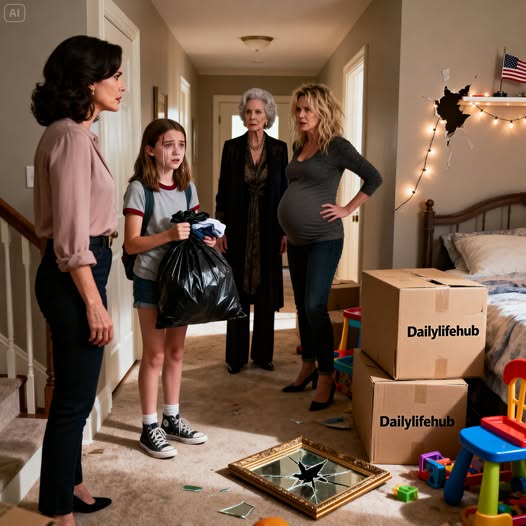
Half-open boxes covered the floor. Dirty blankets were piled across my couch. Children’s toys and grocery bags blocked the hallway. And sitting comfortably in my cream-colored armchair like she owned the place was Vanessa, one hand resting dramatically over her pregnant stomach while scrolling through her phone.
She looked up at me without shame.
“Oh good,” she sighed. “You’re home. We need to discuss sleeping arrangements.”
Before I could answer, I heard Lorraine shouting from upstairs.
“Throw away those childish posters! The walls need to be cleaned before the nursery furniture gets here!”
I froze.
She was inside my daughter’s room.
I pushed past Vanessa and stormed upstairs two steps at a time.
When I reached Ivy’s bedroom doorway, I felt physically sick.
Lorraine was ripping fairy lights off the wall while two movers carried Ivy’s white desk into the hallway. Her ballet trophies were tossed carelessly into a cardboard box beside the bed. One of Ivy’s framed watercolor paintings had cracked glass across the center.
And standing in the middle of the room was my daughter, pale and shaking, clutching a black trash bag filled with clothes.
Lorraine turned when she saw me.
Instead of embarrassment, irritation crossed her face.
“There you are,” she snapped. “Honestly, Celeste, this would go much faster if you taught your daughter not to be so dramatic.”
For one horrifying moment, I couldn’t even speak.
I just stared at the woman who thought humiliating a child inside her own bedroom was somehow acceptable.
Then I walked directly to Ivy, pulled the trash bag gently out of her hands, and wrapped my arms around her trembling body.
“No one is taking your room,” I said quietly.
Lorraine laughed.
“Oh, stop being ridiculous. Vanessa has two toddlers and another baby coming. Ivy is old enough to sleep downstairs for a while.”
“A while?” I repeated slowly.
Vanessa had finally wandered upstairs.
“Well,” she said with a shrug, “until I get back on my feet.”
I almost laughed at the absurdity of it.
Vanessa had been “getting back on her feet” for nearly ten years.
“She can share the office,” Lorraine added dismissively. “Or the couch. Honestly, kids today are too attached to comfort.”
Ivy pressed her face harder into my shoulder.
That tiny movement nearly broke me.
My daughter had spent months decorating this room herself. Every painting, every bookshelf, every strand of lights had been carefully chosen after the divorce anxiety she suffered years earlier. This room was the first place that ever made her feel safe again.
And these women had marched inside and decided her peace was disposable.
“You entered my home without permission,” I said carefully.
Lorraine crossed her arms.
“This is my son’s house.”
“No,” I replied. “It isn’t.”
Vanessa rolled her eyes.
“Please. Declan works. We all know who actually pays the bills here.”
I looked directly at her.
“You should be very careful about assumptions.”
Before either of them could answer, the front door downstairs opened.
Heavy footsteps crossed the living room.
Then Declan appeared at the bedroom doorway.
He took one look at Ivy crying in my arms, the destroyed room, the boxes in the hallway, and the movers standing awkwardly against the wall.
I watched the exact moment something inside him snapped.
His face lost all color.
“What,” he said quietly, “is going on here?”
Lorraine immediately changed her tone.
“Oh sweetheart, thank God you’re home. Your wife is overreacting. We’re only trying to help Vanessa until she stabilizes financially.”
Declan didn’t even look at her.
His eyes stayed on Ivy.
“Who touched her things?”
Nobody answered.
That silence was answer enough.
Vanessa finally lifted her chin defensively.
“She’s a child, Declan. She doesn’t need this much space while my kids are sleeping in motels.”
“My daughter,” he said slowly, “was handed a trash bag in her own bedroom.”
Lorraine scoffed.
“Don’t be dramatic. Family sacrifices for family.”
Declan stepped fully into the room.
Then he said something that made the entire house fall silent.
“Everyone who doesn’t live here needs to leave. Right now.”
Vanessa blinked.
“What?”
“You heard me.”
Lorraine’s expression hardened instantly.
“You cannot throw your own family into the street for a spoiled teenager.”
Declan finally looked at his mother.
And the coldness in his eyes frightened even me.
“You walked into my daughter’s room,” he said, “and made her feel unwanted in her own home.”
“She needs discipline—”
“She needs protection.”
Lorraine opened her mouth again, but Declan cut her off.
“No. We’re done.”
Vanessa suddenly laughed bitterly.
“You’re seriously choosing your wife and her kid over your own sister?”
The room went completely still.
Because Ivy was not “her kid.”
Declan had raised her since she was six years old.
And everyone knew it.
I saw hurt flash across Ivy’s face before she quickly looked down.
Declan noticed too.
That was when his voice became terrifyingly calm.
“You want the truth?” he said.
Lorraine frowned.
“What truth?”
Declan slid one arm protectively around Ivy’s shoulders.
“The truth is this house doesn’t belong to me.”
Vanessa’s expression changed.
“What are you talking about?”
He looked directly at his mother.
“Celeste bought this townhouse years before we got married. Her name is the only one on the deed.”
Silence exploded across the room.
Lorraine stared at him in disbelief.
“No,” she whispered.
“Yes,” Declan replied. “Every mortgage payment. Every renovation. Every bill. Celeste built this home. Not me.”
Vanessa’s face drained completely.
And downstairs, outside the townhouse, red and blue lights suddenly flashed across the front windows.
Someone had called the police.
And judging by the look on Lorraine’s face, she had finally realized just how badly she had underestimated the woman she spent years trying to humiliate.
Part 2
The moment the police officers stepped inside our townhouse, the energy in the room shifted so violently it almost felt physical. Lorraine’s outrage vanished behind trembling hands and wounded expressions, while Vanessa suddenly began rubbing fake tears from the corners of her eyes as if she were the victim in all of this. One officer looked around carefully at the overturned bedroom furniture, the packed boxes, and Ivy standing silently beside Declan with red swollen eyes. “Can someone explain what’s happening here?” he asked calmly. Before I could answer, Lorraine stepped forward dramatically. “This is simply a family misunderstanding,” she insisted. “My pregnant daughter needed temporary help, and my daughter-in-law became hysterical.” I watched the officer’s expression tighten slightly when he noticed the black trash bags filled with my daughter’s clothes sitting in the hallway. Declan moved before I could speak, placing himself slightly in front of Ivy like a shield. “My mother and sister entered this house without permission,” he said evenly. “They attempted to remove my daughter from her bedroom and move themselves into the property.” Vanessa folded her arms immediately. “That’s not true. We only reorganized the rooms because there’s more space upstairs for my children.” The second officer glanced toward Ivy. “Sweetheart,” he said gently, “did someone tell you to leave your room?” Ivy looked terrified to answer. Her fingers tightened around the sleeve of Declan’s sweater. Then, very quietly, she nodded. “Grandma said I was selfish if I didn’t give it up,” she whispered. “And Aunt Vanessa said kids don’t get choices when adults are struggling.” The silence afterward felt unbearable. Even the movers standing near the staircase looked uncomfortable. Lorraine tried again, this time sharper. “Children exaggerate things.” But one officer had already crouched beside the broken picture frame lying near the wall. Another noticed Ivy’s schoolbooks scattered across the floor. Suddenly, the entire situation no longer looked like a simple disagreement. It looked exactly like what it was: two grown women trying to force a child out of her own safe space through intimidation and humiliation.
Vanessa’s composure cracked first. “You people are acting like criminals kicked down the door,” she snapped. “I’m pregnant and homeless!” She pointed directly at me with shaking anger. “And she has more than enough money to help family if she actually cared about anyone besides herself.” I could feel years of resentment pouring out of her now, years I had quietly tolerated during holidays, birthdays, and family dinners for Declan’s sake. Every time she overspent, someone else was blamed. Every failed relationship became evidence the world was unfair to her. Every sacrifice made for her was somehow never enough. “You didn’t ask for help,” I replied carefully. “You arrived with movers while I was at work and tried to take a child’s bedroom.” Lorraine scoffed loudly. “Oh please. As if Ivy needs an entire room to herself while babies sleep cramped together.” Declan turned toward his mother so slowly that even she stepped back slightly. “Do you hear yourself right now?” he asked quietly. “You terrorized a thirteen-year-old girl because you decided your daughter deserved her space more.” Lorraine’s face hardened immediately. “I raised you better than this. Blood should matter.” “Blood?” Declan repeated. “You want to talk about blood after the way you treated my child?” Vanessa laughed bitterly. “She isn’t even really your child.” The second those words left her mouth, I saw the devastation spread across Ivy’s face. It was fast, almost invisible, but devastating enough to make my stomach twist. Declan saw it too. The entire room froze. Even Vanessa seemed to realize too late what she had exposed. Declan’s voice became frighteningly calm. “You will never say that again.” Vanessa lifted her chin defensively, but I noticed fear creeping into her expression for the first time all evening. “It’s true,” she muttered weakly. “You’ve ruined your relationship with your real family for them.” Declan stared at her for several long seconds before answering. “The day I married Celeste and chose to raise Ivy as my own, they became my real family.” Lorraine looked genuinely stunned, as if she had never imagined her son would openly choose us over her. And maybe she hadn’t. For years, she survived by making everyone believe loyalty meant tolerating her behavior forever. But standing there in front of police officers, neighbors gathering outside, and her son finally refusing to bend, I think she realized the control she held over him was disappearing.
One of the officers eventually asked the movers to stop unloading boxes while they sorted out the situation. The men looked relieved. Apparently even they had sensed something felt wrong from the beginning. While the officers documented the scene, I walked Ivy downstairs to the kitchen so she wouldn’t hear more fighting. She sat quietly at the counter while I poured her a glass of water with hands that still wouldn’t stop shaking. “Did I do something wrong?” she asked softly after several minutes. The question shattered me. I crouched in front of her immediately. “No,” I said firmly. “You did absolutely nothing wrong.” Tears filled her eyes again. “Then why do they hate me?” I inhaled sharply because there was no simple answer to that. Some people resent kindness because it reminds them of what they lack. Some people resent stability because they destroy every stable thing they touch. And some people look at a child who is loved and protected and decide that child must somehow deserve less. But Ivy was too young to carry the ugliness of adults on her shoulders. “This isn’t about you,” I told her gently. “It’s about grown people making selfish choices.” She looked down at the water glass. “When Grandma said Dad agreed, I believed her.” That hurt more than anything else. Because it meant somebody had used her trust against her. Before I could answer, Declan entered the kitchen. His face looked exhausted, but the second he saw Ivy, his expression softened completely. He walked straight toward her and knelt beside my chair. “I need you to hear me very carefully,” he said. “Nobody on this planet gets to decide you don’t belong in this house. Ever.” Ivy stared at him silently while tears rolled down her cheeks again. “Not my mother. Not Vanessa. Nobody. Do you understand?” She nodded slowly. Declan swallowed hard before continuing. “I should have protected you from this before it ever reached your bedroom door. That’s my failure. Not yours.” For a moment Ivy simply looked at him. Then she suddenly threw her arms around his neck and started crying against his shoulder so hard her entire body shook. I watched Declan close his eyes tightly while holding her, and I realized he was crying too. Upstairs, I could still hear Lorraine arguing loudly with the police, insisting she had every right to be there. But down in the kitchen, none of that mattered anymore. Because for the first time in years, Declan had finally stopped trying to keep peace with everyone else at the expense of the people who needed him most.
Nearly an hour later, the officers informed Lorraine and Vanessa they needed to remove all their belongings immediately or risk trespassing charges. The humiliation on Lorraine’s face was unlike anything I had ever seen. Neighbors had gathered outside by then, pretending not to stare while openly staring anyway. Vanessa kept muttering curses under her breath while shoving boxes back toward the moving truck. At one point, she turned toward me with tears streaking her mascara. “You’re seriously throwing pregnant children into the street,” she hissed. I looked directly at her. “No. I’m refusing to throw my daughter out of her own home.” She had no response to that. Meanwhile, Lorraine cornered Declan near the doorway one final time. “After everything I sacrificed for you,” she whispered furiously, “this is how you repay me?” Declan didn’t raise his voice. Somehow that made his answer even colder. “Love is not sacrifice if you use it as a weapon later.” Lorraine looked stunned. He continued before she could interrupt. “You taught Vanessa that accountability is cruelty and boundaries are betrayal. That ends today.” For once, Lorraine truly had nothing left to say. Roberto arrived halfway through the chaos, clearly having expected a simple move-in rather than police involvement. The second he realized officers were documenting the situation, he avoided eye contact entirely. One officer eventually asked whether anyone else possessed keys to the townhouse. The silence lasted too long. Declan slowly turned toward his father. “You made copies?” Roberto rubbed his forehead nervously. “Your mother thought it was smart for emergencies.” “You mean for control,” Declan replied. The officers requested every copy immediately. Watching Lorraine hand over those keys looked strangely symbolic, like someone surrendering power they believed belonged to them forever. And when the moving truck finally pulled away from the curb near midnight, carrying Vanessa, Lorraine, crying toddlers, and mountains of resentment with it, the house became quiet for the first time all evening. But the damage they caused was still sitting inside every room. Especially inside my daughter’s heart.

Part 3
The house felt haunted after they left. Even though the moving truck was gone and the police cars had disappeared from the street, traces of that night lingered everywhere. Ivy’s bedroom door had scratches near the frame from furniture being dragged out too quickly. One of her shelves hung crooked against the wall. Broken glass from the shattered picture frame still glittered near the baseboards despite how many times I vacuumed. But the worst damage wasn’t physical. It lived in the silence that settled over Ivy afterward. For the next few days, she barely left her room except for school. She smiled when I checked on her and insisted she was fine, but mothers know when their children are hurting in ways words cannot explain. One evening, almost two weeks after the incident, I found her sitting cross-legged on the floor beside her bed, staring at the trash bag Lorraine had handed her that day. She had hidden it in the back of her closet instead of throwing it away. “Why do you still have that?” I asked gently. Ivy shrugged without looking at me. “I think part of me wanted proof it really happened.” My chest tightened painfully. I sat beside her on the floor while she traced circles across the black plastic with her fingertips. “When Aunt Vanessa said I wasn’t really Dad’s daughter,” she whispered, “I thought maybe he secretly wished he had a real family instead.” I closed my eyes briefly because no child should ever carry a thought that cruel. Before I could answer, Declan appeared quietly in the doorway. He had clearly overheard everything. Without a word, he crossed the room, took the trash bag from Ivy’s hands, and carried it downstairs. A minute later we heard the back door open, followed by the sound of the garbage bin slamming shut outside. When he returned, he sat directly in front of Ivy and held both her hands tightly. “You are my real family,” he said firmly. “I don’t care whose DNA you inherited. I was there for your first dance recital, your panic attacks, your broken arm, your math competitions, and every nightmare after your biological father disappeared. I chose you every single day, Ivy. And I will keep choosing you for the rest of my life.” Ivy burst into tears so suddenly she nearly collapsed into him. Declan held her against his chest while she cried, and for the first time since that horrible night, I saw something begin healing inside both of them.
A month later, Lorraine attempted to regain control the only way she knew how: manipulation. She started sending Declan long emotional messages about loyalty, forgiveness, and family unity. At first he ignored them. Then the guilt tactics escalated. She claimed the stress from the argument had affected her blood pressure. She accused me of turning him against his “real blood.” She even told extended relatives that I had weaponized the police against a pregnant woman and thrown children into the street. Predictably, some family members believed her. Declan’s phone filled with judgmental calls from cousins and distant aunts who knew nothing about what truly happened inside Ivy’s bedroom. But this time, Declan refused to retreat into silence the way he had for years. One Sunday afternoon, after another flood of accusatory texts arrived, he invited his entire extended family onto a video call. I sat beside him while Ivy quietly colored at the kitchen table nearby. Lorraine joined the call already crying dramatically. Vanessa looked exhausted and bitter from what appeared to be a motel room. Before either woman could start rewriting history again, Declan calmly held up printed photographs: Ivy’s belongings thrown onto the lawn, the broken picture frame, the trash bags, the damaged bedroom. Then he read aloud the police incident report documenting unauthorized entry into our home. Nobody interrupted him. Nobody defended Lorraine after that. The silence from the relatives was almost uncomfortable. Finally, Declan looked directly into the camera at his mother. “You keep asking why I chose my wife and daughter over you,” he said quietly. “The truth is, you made that choice yourself the moment you tried to make a child feel unwanted in her own home.” Lorraine’s face crumpled instantly. “So you’re abandoning me now?” she whispered. Declan shook his head slowly. “No. I’m finally protecting the people you taught me to neglect.” After that call, the messages stopped almost completely. Some relatives apologized privately to us. Others disappeared entirely. But for the first time in our marriage, there were no more forced holiday dinners filled with tension, no more guilt-driven compromises, and no more pressure to sacrifice our peace to keep toxic people comfortable. The silence that followed felt strangely beautiful.
Meanwhile, Vanessa’s life unraveled exactly the way everyone secretly knew it eventually would. She moved with her children into a cramped apartment on the edge of the city after Lorraine drained most of her retirement savings covering hotel bills and overdue debts. The baby’s father never returned. Bills piled up faster than Vanessa could manage them, and without constant rescue from other people, reality hit her brutally hard. I heard through relatives that she and Lorraine fought almost daily now. Lorraine blamed Vanessa for “destroying the family,” while Vanessa blamed Lorraine for raising her to believe somebody would always save her from consequences. Roberto quietly moved out three months later and rented a small studio apartment alone after forty years of marriage. According to one cousin, he told Lorraine he was tired of spending his entire life cleaning up emotional disasters she created. As for Lorraine, bitterness consumed her completely. She continued insisting she had only acted “out of love,” even as more relatives slowly distanced themselves from her constant manipulation. But the saddest part was that she still didn’t understand why she lost her son. In her mind, motherhood meant permanent ownership. She never understood that love without respect eventually becomes control, and control eventually destroys the very relationships it tries to dominate. One afternoon near Christmas, a package arrived unexpectedly at our front door. Inside was a small knitted blanket for Vanessa’s new baby and a short note written by Lorraine. The note simply read: “Families should forgive each other before it’s too late.” Declan stared at it silently for a long time before folding it carefully and placing it back inside the box. Then he donated the blanket to a women’s shelter downtown. “I spent years confusing guilt with love,” he admitted quietly afterward. “I don’t want Ivy growing up thinking she has to tolerate cruelty just because someone shares her blood.” Hearing him say that felt like witnessing the end of one life and the beginning of another.
By spring, our home finally started feeling warm again instead of fragile. Declan repainted Ivy’s bedroom himself during her spring break vacation. Together they replaced the damaged shelves, hung new fairy lights, and built a window seat where she could read after school. Slowly, laughter returned to the house. Ivy began inviting friends over again. She stopped locking her bedroom door. She even joined the school art competition she almost quit after the incident. The night of the exhibition, I stood beside Declan inside the crowded school gymnasium while Ivy nervously waited for the results. When her name was announced for first place, she looked completely stunned. Her painting showed a young girl standing inside a brightly lit home during a thunderstorm while dark shadows waited outside the windows. But the house remained glowing and strong against the storm. I felt tears sting my eyes the moment I understood what she had painted. Later that evening, while we celebrated with milkshakes at her favorite diner, Ivy suddenly looked across the table at Declan. “Do you think people can ruin families forever?” she asked softly. Declan reached over and squeezed her hand. “No,” he said. “I think people reveal what kind of family they truly are when life gets difficult.” Ivy thought about that quietly for several seconds before smiling for the first time in months without sadness hiding behind it. In that moment, I realized something important: Lorraine and Vanessa never actually destroyed our family. They exposed its weakest fractures so we could finally repair them properly. The night they tried taking my daughter’s bedroom, they believed they were entering a house owned by guilt, obligation, and old family control. Instead, they accidentally forced us to become stronger than we had ever been before. And months later, as I watched my husband laugh beside my daughter under the soft diner lights, I understood the truth they never learned. A real home is not built by blood, intimidation, or entitlement. It is built by the people who choose, every single day, to protect each other when the world becomes cruel.