The Forty-Seven Minutes: Her Husband Cried Beside The Casket… But The Biker Knew About The Forty-Seven Minutes Outside The ER
CHAPTER 1
The smell of white lilies was thick enough to choke on. It hung in the vaulted, air-conditioned nave of Saint Jude’s like a chemical fog, sweet and rotting all at once. Hundreds of them, arranged in massive, ridiculous displays around the altar, paid for by a man who couldn’t be bothered to hold his wife’s hand when she was dying.
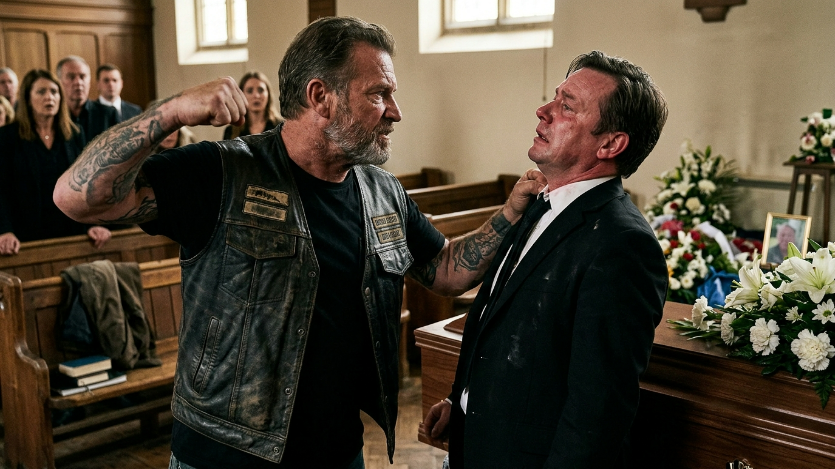
I sat in the back row. Far away from the front pews reserved for the grieving family. I wasn’t family to these people. To the three hundred guests packed into the cathedral, wrapped in tailored Armani and custom black silk, I was a stain. I was Emily’s rough, estranged older brother. The biker who showed up to a high-society funeral wearing a heavy leather cut over a black t-shirt, my scuffed engineer boots resting flat on the polished marble floor.
Up at the podium, William Davis adjusted the microphone. He gripped the edges of the mahogany stand, bowing his head perfectly. The overhead lights caught the subtle, expensive sheen of his hair. Even now, standing ten feet from my sister’s closed casket, the man looked like he was posing for a campaign poster.
“Emily was…” William paused, letting a ragged, expertly crafted breath escape into the microphone. “She was my compass. My guiding light.”
A murmur of sympathetic grief rippled through the front pews. A woman two rows ahead of me dabbed her dry eyes with a monogrammed handkerchief.
“When we found out we were expecting,” William continued, his voice trembling with the precise amount of vulnerability, “it was the happiest day of my life. We had a nursery ready. We had a name picked out.” He wiped a phantom tear from his cheek, showing off the heavy, platinum Rolex on his wrist. “To lose her… to lose them both, so suddenly. The doctors said it was an anomaly. A tragic complication. We did everything we could. I held her, and I told her how much I loved her as she slipped away peacefully.”
Peacefully.
The word hit the inside of my skull like a ball-peen hammer. My jaw locked. I stared at the closed casket. Solid mahogany with brass handles. Closed because of the bruising. Closed because of the autopsy. Closed so these country club vultures wouldn’t have to look at the reality of what happened to a thirty-two-year-old woman left to rot on the freezing concrete of an emergency room drop-off zone.
I remembered Emily’s hands. When we were kids, growing up in a duplex that smelled like stale cigarette smoke and bleach, she used to tug on the sleeves of my denim jacket when she was scared. Small, warm hands. Always holding onto me when the world got too loud. I was supposed to protect her. That was the only job I ever cared about. But she grew up, went to college on a scholarship, and met a man whose family owned half the commercial real estate in the county. She crossed the bridge into the manicured suburbs, and I stayed in the dirt. I let her go because I thought she was safe.
“We have to lean on each other now,” William was saying, his voice swelling with practiced emotion. “We have to remember her grace. Her kindness. We have to—”
I stood up.
The heavy wooden pew groaned under my weight. The sound was sharp, cutting straight through the soft, mournful acoustic of the church. A few heads in the back rows turned, eyes widening as they took in my leather cut, the bottom rocker of my club patch visible.
I stepped out into the center aisle.
“Excuse me,” an usher whispered, stepping into my path in a sharp black suit. He put a hand on my chest. “Sir, the family has requested—”
I didn’t look at him. I just kept walking, driving my shoulder forward. The usher stumbled back, hitting the edge of a pew with a dull thud. He didn’t try to stop me again.
My boots echoed on the marble. Clack. Clack. Clack. Slow, heavy, deliberate.
The whispering started. It rippled forward, row by row, an infectious wave of discomfort and scandal. William paused his speech. He looked up from his prepared notes, peering down the long, red-carpeted aisle. When he saw me, the performed sorrow on his face slipped for a fraction of a second, replaced by a flash of deep, ugly annoyance. He thought I was just a drunk, grieving brother coming to make a scene. He thought I was here to embarrass him.
He had no idea.
“Marcus,” William said into the microphone. His voice was lower now, laced with a soothing, patronizing tone. The tone a man uses to calm a stray dog. “Marcus, please. I know you’re hurting. We are all hurting. But this isn’t the time.”
I kept walking. Past the state senators. Past the golf pros. Past the women gripping their designer clutch purses with white-knuckled tension.
“Marcus.” William’s voice sharpened. The microphone picked up the slight tremor of real panic now. I was halfway down the aisle. I wasn’t stopping. I wasn’t breaking eye contact. “Sit down. Don’t do this here. Out of respect for your sister, sit down.”
I reached the front row. William’s mother stood up, her face tight with outrage, opening her mouth to speak. I didn’t even glance at her. I walked straight past the front pew, stepping up the two low, carpeted stairs onto the altar.
William took a step back from the podium. His hands came up, palms out, instinctively trying to build a wall between us. “Marcus, I swear to God, if you take one more step—”
I didn’t say a word. I didn’t yell. I didn’t wind up.
I just stepped inside his guard and threw a right cross straight into his face.
The impact was sickeningly loud. A wet, heavy crack of bone snapping under the force of my knuckles. The punch caught him square on the left side of his jaw. The kinetic energy lifted him off his feet.
William spun, crashing hard into the mahogany podium. The wooden stand tipped and shattered against the stone floor. The microphone hit the marble, letting out a deafening, shrieking wall of feedback that echoed off the stained-glass windows.
Screams erupted. High, frantic, terrified screams.
The front rows scattered. People scrambled over the wooden pews, tearing their expensive clothes, shoving each other out of the way. It was a stampede of the elite, their polished manners evaporating in exactly one second of physical violence.
William lay on his back, groaning in a puddle of spilled altar water and shattered wood. I stood over him. I flexed my right hand. The knuckles were split, blood welling up in the cuts, the pain a dull, distant throb compared to the hollow cavern in my chest.
“Are you crazy?!” a man in a gray suit yelled from a safe distance, pointing at me with a shaking hand. “Call 911! Get the police!”
I ignored him. I looked down at William.
He rolled onto his side, coughing violently. Blood poured from his mouth, staining the collar of his custom shirt a bright, vivid crimson. He clutched his jaw, his eyes wide and leaking tears of pure, physical agony. It wasn’t the fake, graceful crying from three minutes ago. This was real.
“You… you animal…” William gasped, spitting a tooth onto the marble. The white enamel clattered against the stone. He backed away from me, dragging himself across the floor like a wounded insect. “Look at what you did… you psycho! At my wife’s funeral!”
The crowd was murmuring now, the shock solidifying into outrage. Phones were out. Fingers dialing. The system was already kicking in to protect its own.
“She slipped away peacefully,” I said.
My voice wasn’t loud, but it cut through the room. The acoustics carried it.
William froze. He stopped crawling. He looked up at me, breathing heavily through his nose, his eyes darting to my face. A new kind of fear flickered behind his pupils.
“That’s what you just told them,” I said, taking one slow step toward him. “You held her hand. You did everything you could.”
“I did!” William cried out, his voice cracking. He looked toward his friends in the crowd. “I loved her! He’s crazy! Get him away from me!”
I reached into the front pocket of my leather cut. My fingers brushed against the small, cold metal of the thumb drive. The one I had paid a hospital IT tech ten thousand dollars in cash to pull from the primary server before William’s fixers could wipe it.
I pulled the black drive out and held it up.
The church was completely silent now, save for William’s ragged breathing.
“I spent the last two days sitting in a dark room,” I said, my voice steady, though my chest felt like it was caving in. “Watching you kill my sister.”
William’s face went entirely slack. The blood continued to drip from his chin, but he stopped moving completely. He recognized the shape of a USB drive. He knew what it had to mean.
“Forty-seven minutes,” I said. The words tasted like ash.
I looked out at the terrified crowd, at the senators and the CEOs, forcing them to hear it. “Forty-seven minutes. That’s how long Emily sat in the passenger seat of your Mercedes in the emergency room drop-off zone. In the freezing rain.”
A woman in the third row let out a small, sharp gasp.
I looked back down at William. He was staring at the drive, his chest heaving.
“The security cameras are high-def, William. They catch everything,” I said, the rage finally bleeding into my tone, dropping my voice to a low, dangerous gravel. “I watched her open the door. I watched her fall onto the concrete. I watched her clutch her stomach. And I watched you.”
“Stop,” William whispered, a pathetic, wet sound.
“I watched you stand over her,” I continued, ignoring him. “I watched you pace back and forth under the awning, keeping your suit dry. You didn’t run inside for a wheelchair. You didn’t scream for a doctor. You pulled out your phone.”
The silence in the cathedral was absolute. No one moved. No one dialed.
“You were on the phone for forty-seven minutes while she bled out on the pavement,” I said, stepping closer, casting my shadow over him. “Who were you calling, William? The investors? Your lawyers? Your campaign manager? Trying to figure out how to save your massive waterfront development deal before your wife inconvenienced you by dying?”
“It wasn’t like that!” William screamed, his voice breaking into a hysterical, ugly sob. “You don’t understand! I panicked! I was in shock!”
“She dragged herself to the automatic doors,” I said, the image burning behind my eyes, scorching my brain. “She was reaching for the glass. And you grabbed her by the shoulder and pulled her back to the car. You hid her behind the door so the triage nurses wouldn’t see.”
“Liar!” William’s mother shrieked from the side aisle. “He’s a liar! William, tell them he’s lying!”
William didn’t look at his mother. He couldn’t take his eyes off the small black drive in my hand. He knew I had it. He knew the illusion was dead.
Far off in the distance, cutting through the heavy, suffocating quiet of the affluent neighborhood, the wail of police sirens began to rise. Two, maybe three cruisers, burning rubber to get to the church. Someone had called them. Good.
“You let her die on the concrete because a scandal would ruin your political run,” I said. I crouched down, bringing my face inches from his bleeding, terrified features. I could smell the expensive cologne on his neck. I could smell his sweat. “You traded her life, and my niece’s life, for a seat in the state senate.”
The sirens grew louder, howling down the main avenue, turning onto the church’s private drive.
William looked toward the stained-glass doors at the back of the church. Relief washed over his bloody face. The police were coming. His protectors. The people he donated to. The people who would arrest the violent biker and put him in a cage.
He looked back at me, a desperate, arrogant sneer pulling at his torn lip. “You’re going to prison, Marcus. Assault. Harassment. I’ll make sure you never see daylight again.”
I didn’t run. I didn’t brace for the cops. I slowly stood back up to my full height, towering over him, the black drive gripped tightly in my fist. The heavy oak doors at the back of the cathedral burst open, and three police officers rushed in, hands resting on their holsters, scanning the panicked crowd.
“Drop the weapon!” one of them yelled, seeing the blood on William and looking at me. “Hands where I can see them!”
I didn’t raise my hands. I looked down at the pathetic, broken man on the marble floor.
“Show them the tape, William,” I said.
CHAPTER 2
The fluorescent lights in the precinct holding cell hummed with a low, sick vibration.
It was a sterile, unforgiving kind of bright. The kind of light that made your skin look gray and made the blood drying on my right hand look like rust. I sat on a solid steel bench that was bolted to the concrete floor. My wrists were locked in heavy steel cuffs, the chain tethered to a rusted ring on the wall.
Every time I breathed, the chain rattled. It was the only sound in the room.
My knuckles throbbed. The skin across my index and middle fingers was split wide open from where I had shattered William’s jaw. I didn’t regret the pain. I wanted it to hurt worse. I wanted the physical sting to override the crushing, suffocating weight sitting dead in the center of my chest.
Through the reinforced glass of the holding cell door, I watched the machinery of the affluent justice system work.
If a guy from my neighborhood got into a fight, he was thrown in the drunk tank and ignored for twelve hours. But I hadn’t hit a guy from the neighborhood. I had hit William Davis. The future state senator. The man whose family name was stamped on half the commercial high-rises downtown.
Out in the bullpen, I could see three different high-end lawyers in custom wool suits pacing the worn linoleum floor. They weren’t there for me. They were William’s fixers. They were talking quietly to the desk sergeant, sliding heavy, sealed envelopes across the counter. They were building the narrative while I sat locked to a wall.
The heavy metal door to my cell clicked and swung open.
A detective walked in. He didn’t look like a street cop. He wore a sharp navy blazer, a perfectly knotted silk tie, and carried a sleek silver tablet instead of a notepad. He smelled like expensive aftershave and peppermint gum. He looked at me with the kind of practiced, empty disgust usually reserved for scraped gum on the bottom of a shoe.
He pulled a metal folding chair from the corner, set it down backward, and sat, resting his arms over the backrest.
“Marcus Reynolds,” he said. He didn’t introduce himself. He didn’t need to. In this room, he was the law, and I was just the violent biker who ruined a country club funeral.
I didn’t answer. I just stared at the knot in his tie.
“You made a real mess at Saint Jude’s,” the detective said, chewing his gum slowly. “Broke a man’s mandible in three places. Dislodged two molars. They had to wire his jaw shut at County General. That’s a Class C felony assault, Marcus. And doing it at his wife’s funeral? The DA is going to have a field day with you.”
“She was my sister,” I said. My voice was a dry, hollow rasp.
“And she was his wife,” the detective shot back smoothly, not missing a beat. “A grieving widower. A pillar of the community. And you assaulted him in front of three hundred witnesses, including two judges and the mayor.”
I shifted on the steel bench. The chain clanked against the wall. “Did you look at the cameras, Detective?”
He stopped chewing. “Excuse me?”
“The hospital drop-off zone,” I said, leaning forward as far as the chain would allow. I locked my eyes onto his. “Saint Mary’s ER. Three days ago. Did you pull the footage?”
The detective sighed, a long, exaggerated sound of total boredom. He tapped the screen of his tablet, pulling up a file. “We have the preliminary coroner’s report. Sudden placental abruption. Massive internal hemorrhaging. A tragic, unavoidable medical anomaly. That’s the official ruling.”
“It wasn’t unavoidable,” I said, the heat rising in my chest, tightening my throat. “He left her in the rain for forty-seven minutes while he made phone calls to save his real estate deal. He wouldn’t take her inside.”
The detective looked at me. His expression didn’t change. There was no shock. No moral outrage. Just a flat, bureaucratic wall.
“Mr. Davis gave a statement from his hospital bed an hour ago,” the detective said, his voice dropping into a smooth, rehearsed cadence. “He stated that he was in a state of profound shock. That he panicked. That he was desperately trying to get his private physician on the phone before moving her, because he didn’t trust the ER staff. It’s a tragic misjudgment born of grief and panic. Not a crime.”
I stared at him. The sheer audacity of the lie was suffocating.
“He was protecting his campaign,” I said, my voice dropping to a dangerous, low gravel. “He dragged her away from the doors. I saw it.”
The detective stood up. He smoothed the front of his blazer. “What you saw, Marcus, is irrelevant. You are a patched member of a known motorcycle club. You have two priors for aggravated battery from over a decade ago. You are a violent, estranged relative who showed up uninvited to a private ceremony and brutally attacked a defenseless man.”
He turned the tablet around and held it up to the glass for me to see.
It was a local news website. The headline was massive, printed in bold black letters across the top of the screen:
TRAGEDY AT THE ALTAR: WIDOWER BRUTALLY ATTACKED BY GANG-MEMBER BROTHER AT WIFE’S FUNERAL.
Beneath the headline was a photo of William. He was in a hospital bed, a pristine white bandage wrapped around his head and jaw. He looked bruised, exhausted, and incredibly sympathetic. His PR team had moved faster than the police. They were spinning him into a martyr. They were erasing Emily’s suffering and replacing it with his own.
“William’s lawyers are pressing for maximum charges,” the detective said, sliding the tablet under his arm. “No plea deals. They want you in a cage. And frankly, looking at you, that’s exactly where you belong.”
He turned and walked out, letting the heavy steel door slam shut behind him. The lock engaged with a loud, final click.
I leaned my head back against the cold concrete wall and closed my eyes. The injustice of it felt like physical pressure, crushing my ribs. Money bought the truth. Money bought the headlines. Money turned a coward who let his pregnant wife bleed out on the pavement into a victim on the six o’clock news.
I sat in that cell for six hours.
I watched the clock on the bullpen wall tick past midnight. I watched the night shift roll in, carrying stale coffees and ignoring my existence. The numbness of grief began to curdle, hardening into a cold, absolute fury. The legal system wasn’t going to help me. The police were bought and paid for. The media was already writing my conviction.
If I played by their rules, William would win. He would bury Emily, put on a dark suit, and ride the sympathy vote straight into the state senate.
At 2:00 AM, the cell door finally opened.
It wasn’t the detective this time. It was a tired-looking uniform holding a ring of keys. He walked over, unlocked the cuffs from the wall bracket, and jerked my arms down.
“You made bail,” the cop grunted, unlocking the cuffs from my wrists. “Get your stuff from the desk and get out.”
I rubbed my raw wrists, the blood circulation burning as it returned to my hands. I followed the cop out into the empty bullpen.
Standing by the front desk, dwarfed by the harsh overhead lights, was Tommy.
Tommy was my road captain. He was built like a cinderblock, wearing a faded denim cut over a black hoodie, his arms covered in faded prison ink. He didn’t look like he belonged in this sterile, high-end precinct, but he was standing there with a calm, unbothered posture.
I walked up to the counter. The desk sergeant handed me a plastic bag containing my wallet, my phone, and my keys.
“Bail was set at a hundred thousand,” I said quietly, looking at Tommy. I knew my bank account didn’t have a fraction of that.
“Club pooled it,” Tommy said, his voice a low rumble. “Took a second mortgage on the clubhouse. You’re out. Let’s walk.”
We didn’t say another word until we were outside. The night air was freezing, biting through my thin black t-shirt. The sky was an empty, starless black over the manicured lawns of the police department.
Tommy tossed me a lit cigarette. I caught it, taking a long, deep drag. The harsh smoke filled my lungs, grounding me for a split second.
“It’s bad out here, Crow,” Tommy said, leaning against the side of his truck. He used my road name. “News is running with it. Every channel. They got experts on TV talking about your priors from fifteen years ago. They’re painting William as the saint of the suburbs. They’re saying you attacked him because you wanted a cut of her life insurance.”
I stopped dragging on the cigarette. My jaw tightened so hard my teeth ached.
“Life insurance,” I repeated. The words felt dirty in my mouth.
“His PR firm is burying you,” Tommy said, looking at me with grim, serious eyes. “They’re building a wall of money, Crow. You can’t punch your way through this one. If you go near him again, they’ll revoke your bail and bury you under the jail.”
I dropped the cigarette onto the wet asphalt and crushed it under the heel of my boot.
“Take me home,” I said.
We drove in silence. We crossed the invisible line that separated William’s world from mine. The pristine, tree-lined boulevards turned into cracked pavement, dim streetlights, and rusted chain-link fences.
Tommy dropped me off in front of my childhood house. It was a narrow, aluminum-sided duplex that had been slowly sagging into the dirt for thirty years. I hadn’t been back here since the day I moved out. Emily had inherited it when our mom died, but she never lived here. She just kept it. Maintained it. Because she couldn’t let the past go.
I stood on the cracked concrete walkway and watched Tommy’s taillights disappear around the corner.
I unlocked the front door and pushed it open. The hinges screamed in the quiet night.
The air inside was stale. It smelled like old dust and faint lavender. I walked past the small living room, the furniture covered in white sheets, looking like ghosts in the dark. I moved down the narrow hallway, my boots heavy on the creaking floorboards.
I stopped at the last door on the right.
Emily’s childhood bedroom.
I pushed the door open. The streetlamp outside cast long, pale shadows across the room. Her bed was still neatly made with a faded yellow quilt. A small, worn teddy bear sat propped up against the pillows. Her high school diploma was still framed on the wall.
It was a shrine to a girl who didn’t exist anymore.
I walked into the center of the room. The silence was absolute. There were no sirens here. No cameras. No PR teams spinning lies. There was only the empty space where my sister was supposed to be.
My legs finally gave out.
I sank down onto the edge of her bed. The springs groaned underneath me. I buried my face in my hands, the dried blood on my knuckles scraping against my cheeks. I took a breath, trying to hold it together, but the damn broke. A single, ragged, ugly sob tore its way out of my throat, echoing in the empty room.
I failed her.
I was the older brother. I was supposed to keep the monsters away. Instead, I let her marry one, and he left her to die in the freezing rain while he worried about his bank account.
I sat there in the dark for a long time, letting the cold reality settle into my bones.
The police had William’s back. The media was printing William’s lies. The whole damn city was designed to protect men who wore expensive suits and wore platinum watches. They held all the cards. They owned the board.
I slowly sat up. I wiped my face with the back of my hand.
I reached down to the heavy leather cut resting on my shoulders. When the cops had tackled me in the church, pinning my arms behind my back, their hands had rushed over me, searching for a gun, a knife, a weapon. They felt the thick cowhide. They felt the bulky seams.
They didn’t feel the small tear in the inner lining of the right breast pocket.
I slipped two fingers into the torn seam, reaching deep inside the lining of the vest. My fingers brushed against hard, cold plastic.
I pulled it out.
I sat in the dark of my dead sister’s bedroom, staring at the small black thumb drive resting in the palm of my bruised hand.
The police didn’t have the hospital footage. William’s fixers didn’t have it.
I had it.
I closed my fist around the drive, the hard plastic biting into my skin. The system was rigged. The law was deaf. So I wasn’t going to use the law. I was going to use the truth, and I was going to make it bleed.
CHAPTER 3
The coroner’s report cost me three hundred dollars in cash, passed to a county records clerk in a sealed envelope behind a diner on 4th Street.
It was three pages long, printed on thick, watermarked county letterhead. I sat alone at the heavy oak table in the back room of the clubhouse, the air smelling of stale beer and engine oil. The single bulb hanging overhead cast a harsh, yellow glare across the paper. I traced my bruised index finger over the final paragraph. The black ink was definitive. It was institutional. It was absolute.
Cause of death: Massive internal hemorrhaging secondary to spontaneous placental abruption. Manner of death: Natural. No signs of foul play. Tragic medical anomaly.
I stared at the words until the letters began to blur.
Natural.
There was nothing natural about a thirty-two-year-old woman dying on the freezing concrete while her husband stood five feet away, worrying about a zoning permit.
The police had closed the file. The DA hadn’t even opened an inquiry. William’s lawyers had moved with terrifying speed, wrapping their protective, expensive arms around the police department, the hospital board, and the local news stations. They were burying Emily beneath a mountain of official documents and PR statements. The system was functioning exactly as it was designed to: a fortress built by the wealthy, for the wealthy, to keep the rest of us out.
The heavy wooden door to the back room creaked open. Tommy stepped inside. He held a rolled-up architectural blueprint in his massive hand. He didn’t say a word. He just walked over to the table, pushed the coroner’s report to the side, and unrolled the blueprint, pinning the corners down with heavy glass ashtrays.
It was the floor plan for the Oakmont Country Club.
“They’re hosting the Autumn Gala tonight,” Tommy said, his voice a low, gravelly rumble. He pointed a thick, calloused finger at the grand ballroom in the center of the schematic. “Four hundred guests. The mayor. The chief of police. Half the city council. The people who sign William’s checks, and the people whose checks William signs.”
I leaned forward, resting my forearms on the table. My knuckles still throbbed from the church, the split skin pulled tight under thick white bandages.
“Is he going?” I asked.
Tommy nodded slowly. “He’s not just going, Crow. He’s the guest of honor. His PR firm bought a two-page spread in the Tribune this morning. He’s using the gala to announce the launch of the Emily Davis Memorial Foundation. A charity for expectant mothers.”
A cold, electric shock of pure nausea hit the bottom of my stomach.
A charity. He was using her name. He was using the ghost of the woman he let die to launder his public image and kickstart his political campaign. The sheer, suffocating arrogance of it defied gravity.
“They’re asking for million-dollar pledges tonight,” Tommy continued, tapping the blueprint. “He’s going to stand up on that stage, cry for the cameras, and collect checks. He thinks he won.”
I looked at the blueprint. The grand ballroom. Three main exits. Two service corridors. An elevated A/V booth at the back of the hall.
The law had failed. The police were bought. If I went to the press, they would just paint it as a doctored video supplied by a violent felon. The only way to destroy a man who hides behind his reputation is to burn that reputation to the ground while his friends are watching.
I reached into the front pocket of my denim jacket and pulled out the black USB drive. I set it on the table right in the center of the grand ballroom schematic.
“Get the heavy chains from the lockup,” I said, my voice dead calm. “And get the bolt cutters. We’re going to a party.”
The Oakmont Country Club sat on a massive, rolling hill at the edge of the city limits. It was a fortress of privilege, surrounded by perfectly manicured golf greens and tall, wrought-iron gates. The driveway was lined with imported European luxury cars. Valets in crisp white jackets jogged back and forth under a massive, glowing portico, opening doors for women draped in silk and diamonds, and men wearing bespoke tuxedos.
We didn’t take the driveway.
Tommy drove the club’s rusted, unmarked cargo van down a dark access road bordered by thick pine trees. He killed the headlights a quarter-mile out, navigating by the pale light of a crescent moon. We pulled up to the loading dock at the rear of the kitchen kitchens. It was 9:45 PM. The gala was in full swing.
There were four of us. Me, Tommy, and two prospects who knew how to keep their mouths shut and follow orders. We were dressed in black work clothes, carrying heavy duffel bags.
We moved fast.
Tommy slipped through the service door, bypassing the electronic lock with a master keycard we’d bought off a disgruntled kitchen manager that afternoon. The heavy steel door clicked open, and we stepped into the humid, chaotic heat of the industrial kitchen. Chefs were shouting, plates clattering, steam rising from massive stainless-steel vats. Nobody looked twice at four guys in dark clothes carrying tool bags. In places like Oakmont, the help was invisible.
We bypassed the kitchen, moving through the carpeted service corridors that ran behind the walls of the grand ballroom like hidden veins. The muffled sound of a string quartet bled through the drywall.
“Phase one,” I whispered.
The prospects split off. They had one job. They moved to the heavy, gold-leafed double doors that served as the primary and secondary fire exits for the ballroom. They pulled thick, industrial steel chains from their bags, wrapped them tightly around the brass handles, and snapped heavy-duty master locks into place. The metallic clack of the steel locking echoed faintly in the hallway.
The room was sealed. Nobody was leaving.
Tommy and I took the narrow, spiral staircase up to the A/V control booth overlooking the ballroom. The booth was a small, dark room suspended above the crowd, separated by a wall of tinted glass. The young technician sitting at the control board was scrolling through his phone, completely oblivious.
Tommy stepped up behind him and clamped a massive hand over his shoulder.
“Time for a break, kid,” Tommy rumbled.
The tech spun around, his eyes going wide as he took in Tommy’s sheer size, the prison ink crawling up his neck, and the grim, unsmiling set of his jaw. The kid didn’t argue. He scrambled out of the chair, grabbed his jacket, and bolted down the stairs without a sound.
I locked the booth door behind him and slid a heavy steel wedge under the frame.
I turned and looked out through the tinted glass.
The grand ballroom was breathtakingly opulent. Massive crystal chandeliers hung from the vaulted ceiling, casting a warm, golden glow over the sea of tables draped in white linen. Three hundred of the city’s most powerful people were sitting, eating, drinking, and laughing. The clinking of crystal champagne flutes drifted up to the booth like wind chimes.
And there he was.
William was standing at the podium on the raised stage at the far end of the room. He was wearing a flawless, midnight-blue tuxedo. The bandages on his jaw had been replaced by a subtle, flesh-colored surgical strip that only highlighted his supposed victimhood. He looked solemn, heroic, and completely in control.
“Ladies and gentlemen,” William’s voice boomed through the massive concert speakers, smooth and rich. “I cannot thank you enough for being here tonight. This last week has been… the darkest trial of my life.”
He paused perfectly, letting his voice crack just a fraction of an inch. A sympathetic hush fell over the room.
“But Emily,” William continued, looking up at the ceiling, playing to the cheap seats of their shared delusion, “Emily wouldn’t want me to surrender to despair. She was a light. She was a protector. And that is why, tonight, I am honored to announce the Emily Davis Memorial Foundation. To ensure that no family ever has to endure the medical tragedy that we faced.”
Applause erupted. Polite, enthusiastic, wealthy applause. The sound of people patting themselves on the back for their own generosity.
I looked at Tommy. He was staring down at the crowd with a look of pure, unadulterated disgust.
“Do it,” Tommy said.
I stepped up to the main control board. I took the black USB drive from my pocket and slotted it into the primary server tower. The computer recognized the drive immediately. I brought up the media player. The file was labeled simply: Cam_4_DropOff_Raw.mp4.
I routed the video feed directly to the massive, drop-down projector screen that hung against the back wall of the stage, right behind William’s podium.
Then, I reached over to the master lighting panel.
I gripped the main breaker switch. I took a slow, deep breath, letting the anger, the grief, and the cold, hard reality of what was about to happen settle into my bones.
I pulled the switch down.
The crystal chandeliers went black. The accent lights died. The stage lights vanished. The entire grand ballroom was instantly plunged into total, suffocating darkness.
The applause died in a confused wave. A few people gasped. A murmur of wealthy annoyance rolled through the crowd.
“Please remain calm,” William’s voice echoed through the microphone, sounding slightly irritated but maintaining his polished cadence. “It seems we’ve blown a breaker. The hotel staff will have the backup generators running in a moment.”
I reached for the audio mixer, grabbing the slider that controlled William’s microphone. I slammed it all the way down to zero, cutting him off mid-sentence.
Then, I hit Play on the keyboard.
The massive projector mounted in the ceiling hummed to life. A blinding beam of high-definition white light sliced through the pitch-black darkness of the ballroom. It hit the massive screen right behind William’s head, illuminating him in stark, harsh silhouette.
The socialites stopped murmuring. The room went dead silent.
The video began to play.
It wasn’t a slideshow of Emily smiling. It wasn’t a tribute.
It was silent, raw security footage. The timestamp in the upper right corner glowed a harsh digital red: 10:14 PM.
The weather on the screen was a torrential downpour. The harsh, fluorescent lights of the Saint Mary’s Hospital emergency room drop-off zone glared against the wet concrete.
A sleek, black Mercedes pulled into the frame, jerking to a messy stop just outside the automatic sliding doors. The vanity license plate was clearly visible, ten feet high on the projector screen. Everyone in the room knew that car. Everyone knew the plate.
On the screen, the passenger door pushed open.
Emily stumbled out.
Even on the grainy security footage, her pain was visceral. She didn’t step out; she fell. Her knees hit the freezing, wet concrete. She was wearing a thin maternity dress, immediately soaked by the driving rain. She clutched her swollen stomach, her body curling inward, her face pressed against the wet pavement.
A collective, horrified gasp sucked the air out of the grand ballroom.
I looked down through the glass. William had turned around. He was staring up at the massive screen, his face washed in the pale, blue light of the footage. His polished, heroic mask was gone. His eyes were wide, his mouth slightly open. He was frozen. Paralyzed by the ghost of his own cowardice.
On the screen, the driver’s side door opened.
William stepped out. He was wearing the exact same expensive raincoat he had worn to a city council meeting earlier that day. He didn’t run to her. He didn’t drop to his knees. He walked slowly around the back of the car, stepping carefully to avoid a puddle.
He stood over his pregnant, dying wife. He looked down at her.
Then, the William on the screen reached into his pocket and pulled out his cell phone.
“Oh my god,” a woman in the front row whispered, the sound carrying clearly up to the booth.
The timestamp rolled forward. 10:16 PM.
Emily reached a hand out, grasping at William’s pant leg. She was begging him. She was pleading for him to take her the remaining thirty feet through the automatic glass doors into the triage lobby.
William kicked his leg back, pulling his slacks out of her grip. He pressed the phone to his ear and started pacing. Pacing back and forth under the dry awning, leaving her in the rain.
The murmurs in the ballroom were no longer confused. They were dark. They were sharp. The climate of the room was shifting violently. Chairs scraped against the floor as people leaned away from the stage, instinctively trying to put physical distance between themselves and the man at the podium.
“Cut it!” William suddenly screamed, his voice raw, echoing without the microphone. He spun toward the back of the room, looking blindly up into the dark toward the A/V booth. “Cut the feed! It’s a deepfake! It’s doctored! Someone turn it off!”
He scrambled off the podium, running toward the side of the stage. He tripped over a microphone cable, stumbling to his hands and knees.
Nobody moved to help him.
The state senators, the wealthy donors, the women who had just been weeping for his loss—they all just sat there in the dark, watching the screen.
The timestamp hit 10:28 PM. Fourteen minutes on the concrete.
Emily found the strength to drag herself forward. She crawled toward the glowing red EMERGENCY sign above the sliding doors. She was dragging her body through the freezing water, inches away from salvation, inches away from nurses and doctors who could have saved her.
The William on the screen saw her moving. He dropped the phone from his ear. He walked over to her.
He didn’t pick her up.
He grabbed her by the shoulder of her soaked dress and physically dragged her backward. He pulled her behind the open passenger door of the Mercedes, hiding her body from the line of sight of the triage windows. He was drunk. He was terrified of a DUI. He was terrified of a scandal. He shoved his dying wife out of view so nobody would see him.
The reaction in the ballroom was explosive.
“You bastard!” a man yelled from the middle tables.
A wine glass shattered against the floor.
The carefully constructed illusion of William Davis, the grieving, heroic widower, shattered into a million irreparable pieces. The money couldn’t protect him now. The PR firm couldn’t spin this. The truth was ten feet tall and painted in high-definition light for his entire world to see.
Down on the floor, William realized it was over.
The silence of his peers had turned into a suffocating, hostile wall of judgment. He looked at the faces staring at him in the dark. Faces twisting with disgust.
William scrambled to his feet. He didn’t try to explain anymore. He didn’t try to play the victim.
He turned and bolted for the side exit, disappearing into the dark service corridors, fleeing like a rat escaping a sinking, burning ship.
CHAPTER 4
The sirens were already wailing by the time Tommy fired up the engine of the rusted cargo van.
They weren’t coming for us. We sat idling in the dark on the access road, hidden behind the thick line of pine trees, watching the flashing red and blue lights swarm the front gates of the Oakmont Country Club. We had left the ballroom sealed. We walked out through the kitchens while the city’s elite were still trapped in the dark with the ghost of my sister playing on a loop.
Tommy killed the headlights and navigated the van down the winding gravel path, putting distance between us and the country club. The back of the van was completely silent. The two prospects sat on the wheel wells, staring straight ahead, the adrenaline of the breach slowly bleeding out of them.
I sat in the passenger seat, staring out the window at the blurred, passing trees.
My knuckles throbbed a deep, rhythmic ache, but I barely felt it. My mind was stuck in the dark of that ballroom. I was replaying the footage. Over and over. Emily falling. Emily crawling. William dragging her out of sight.
The public execution was done. The video was out. In a matter of minutes, every news station, every social media feed, and every political blog in the state would have the raw file. William’s pristine reputation was currently burning to the ground in high-definition.
But it wasn’t enough.
A burning reputation didn’t explain the why.
Why hide her? Why pace back and forth in the freezing rain while your pregnant wife bled out on the concrete? If he was so worried about his public image, the smartest thing a politician could do was play the hero. Carry her in. Scream for a doctor. Demand the best care.
Instead, he hid her behind a car door. He delayed.
“Check the scanner,” I said, my voice cutting through the heavy quiet of the van.
Tommy reached out and turned the dial on the police scanner mounted under the dashboard. The radio cracked to life, a chaotic, overlapping mess of dispatch codes and frantic patrol officers.
“Dispatch, be advised, we have a near-riot condition at the Oakmont Gala. Multiple 911 calls reporting a fraudulent charity event. We need crowd control.”
“Unit 4, we have press vans blocking the main gate. They’re trying to breach the perimeter.”
“Dispatch, do we have eyes on the target? William Davis? Suspect is wanted for questioning regarding newly surfaced video evidence.”
“Negative, Unit 4. Target fled the premises. His vehicle is gone. We are sending cars to his primary residence now.”
Tommy turned the volume down. He looked over at me, his massive hands gripping the steering wheel. “He’s a ghost. The cops are looking for him. The press is looking for him. Where do you want to go?”
“The people who clean up his messes,” I said. “He didn’t bury that hospital tape by himself. He had help. And whoever helped him bury it knows exactly why it happened.”
“Vance,” Tommy rumbled.
David Vance. William’s lead attorney and primary political fixer. A man who charged a thousand dollars an hour to make the ugly realities of wealthy men disappear into thin air. He was the one who handed the police the coroner’s report. He was the one who threatened the local news stations with defamation suits.
“His office is downtown,” Tommy said, taking a hard left onto the interstate on-ramp. “Forty-second floor of the glass tower on 5th and Main. He won’t be sleeping tonight.”
The financial district was dead quiet at 1:00 AM.
The skyscrapers loomed over the empty streets like massive monuments to greed, their glass facades reflecting the amber glow of the streetlights. We parked the van in a loading zone three blocks away. I told the prospects to stay with the vehicle and keep the engine warm.
Tommy and I walked the three blocks in the freezing night air.
The high-rise that housed Vance’s law firm was a fortress of polished steel and bulletproof glass. The lobby was entirely empty, except for a single, uniformed security guard sitting behind a massive marble desk, watching a portable TV.
We didn’t knock. We didn’t sign in.
Tommy walked through the front doors, grabbed the security guard by the collar of his polyester shirt, and quietly lifted him out of his chair. The guard’s eyes bugged out of his head. He opened his mouth to shout, but Tommy just shook his head once, a slow, terrifying warning. The guard swallowed his words and handed over the master elevator keycard with trembling hands.
We took the express elevator to the forty-second floor.
The doors slid open with a soft, expensive chime. The hallway smelled like lemon polish and deep-pile wool carpet. The frosted glass double doors of Vance & Associates were locked, but the lights inside were blazing.
I stepped back, raised my heavy engineer boot, and kicked the lock directly on the deadbolt.
The frosted glass shattered. The heavy wooden frame splintered, groaning under the force, and the doors blew open.
I stepped into the reception area, the glass crunching under my boots.
Down the main corridor, at the very end of the hall, a door was hanging wide open. I could hear the frantic, mechanical hum of an industrial paper shredder working in overdrive.
Tommy and I walked down the hall. I stopped in the doorway of the corner office.
It was a massive room with floor-to-ceiling windows overlooking the city skyline. The desk was made of imported mahogany, covered in stacks of manila folders.
Two men were in the room.
David Vance, wearing a wrinkled dress shirt with the sleeves rolled up, his silk tie loosened around his neck, was frantically feeding documents into the shredder.
Standing nervously by the window was an older, heavy-set man in an ill-fitting gray suit. I recognized him immediately. Miller. The Chief of Security for Saint Mary’s Hospital. The man who had personally pulled the server drives the night Emily died.
Vance’s head snapped up when he heard my boots on the hardwood floor. He froze, a thick stack of medical records gripped in his sweating hands. He looked at my leather cut. He looked at the dried blood on my bandages.
“Reynolds,” Vance breathed, the color instantly draining from his face.
Miller took a step backward, his back hitting the plate glass window. He looked like he was going to be sick.
“You’re working late, David,” I said, my voice low and dead calm.
“You need to leave,” Vance said, his voice cracking. He tried to sound authoritative, falling back on his legal arrogance, but his hands were shaking so badly the papers rustled. “You’re trespassing. Breaking and entering. I will have you locked up for the rest of your natural life.”
I walked slowly into the room. Tommy stepped in behind me and closed the heavy oak door.
“Call the police, David,” I said. I pulled my phone out of my pocket and tossed it onto his mahogany desk. It clattered against the polished wood. “Dial 911. Tell them you have Marcus Reynolds in your office. Tell them I’m the guy who just broadcasted the hospital footage at the Oakmont Gala.”
Vance didn’t move toward the phone. His eyes darted to Miller, then back to me.
“You saw the news,” I said, stepping around the desk, cornering him. “You know it’s out. You know the narrative is dead. That’s why you’re shredding the paper trail.”
“It’s a doctored video,” Vance spat, backing up until his hips hit the shredder. “It won’t hold up in court. It’s inadmissible.”
I didn’t argue the law with him. I reached out, grabbed Vance by his expensive silk tie, and slammed him backward into the wall. The framed law degrees hanging behind him rattled violently.
Vance let out a high, thin gasp, his hands coming up to claw at my wrist, but I held him pinned, the fabric of his tie cutting off his air supply.
“I don’t care about a courtroom,” I whispered, leaning in so close he could smell the stale smoke on my jacket. “I don’t care about inadmissible. I care about the forty-seven minutes.”
“I don’t know what you’re talking about!” Vance choked out, his face turning an ugly shade of red.
I tightened my grip. “You’re a fixer, David. You fix things. He didn’t pace in the rain for forty-seven minutes because he was in shock. He was waiting for something. Or someone.”
I turned my head and looked at Miller. The hospital security chief was sweating through his suit, his eyes darting frantically toward the locked door. Tommy was standing in front of it, an immovable wall of muscle and faded ink.
“Miller,” I said, my voice a dangerous growl. “You pulled the tape. You saw the raw footage before anyone else. What was he doing out there?”
“I… I don’t know,” Miller stammered, raising his hands defensively. “I just did what the board told me to do. They said it was a private medical matter. They paid me a severance to retire early.”
I let go of Vance’s tie. He slumped against the wall, coughing violently, clutching his throat.
I walked over to Miller. The man was trembling, terrified of the violence I brought into the pristine, sterilized world he operated in.
“Emily called him at nine-thirty,” I said, piecing the timeline together out loud, forcing them to hear it. “Her water broke early. She was in agony. He picked her up from their house. He drove her to the hospital. But when they got there, he wouldn’t take her inside.”
I grabbed Miller by the lapels of his suit jacket. “Why?”
“He was drunk!” Miller blurted out, his voice a panicked shriek. He shrank away from me, squeezing his eyes shut. “He was drunk, okay! That’s what Vance told me when he bought the hard drives! He was drunk!”
The room went entirely, suffocatingly still.
The hum of the paper shredder seemed deafening.
I stood there, my hands still gripping Miller’s jacket. I felt the air leave my lungs. I felt the floor drop out from underneath me.
“What?” I whispered.
Vance groaned from the floor, pushing himself up onto his knees. “Shut up, Miller. Shut your damn mouth.”
“I’m not dying for him!” Miller yelled, tears of pure terror leaking out of his eyes. He looked at me, completely broken. “William was at the Mayor’s fundraiser at the Harbor Club that night. Open bar. He had been drinking scotch for four hours before your sister called him. He was completely wasted.”
I let go of Miller. He slid down the glass window, burying his face in his hands.
“He picked her up,” Miller sobbed. “But when he pulled up to the ER doors, he realized… if he walked her into triage, he smelled like a distillery. He was slurring his words. The triage nurses are mandated reporters. They would have noted his intoxication. If she died, or if the baby died, and the cops showed up… they would have drawn his blood.”
I stared at the city skyline outside the window, the amber lights blurring together.
It wasn’t a grand conspiracy. It wasn’t malice. It was something so much worse.
It was pure, pathetic, mundane cowardice.
“A DUI manslaughter charge,” I said, the words tasting like battery acid on my tongue. “It would have killed his state senate run. It would have ruined his brand.”
“Yes,” Vance rasped from the floor, leaning his head back against the drywall, totally defeated. “He called me from the drop-off zone. He was panicking. He said Emily was bleeding. I told him… I told him to hold on. I dispatched a sober driver. One of our private security guys. He was supposed to get there, take the keys, and pretend he drove them.”
“You told him to wait,” I said.
I looked down at the lawyer. The man who had calculated the value of my sister’s life against a political poll in a matter of seconds over a cell phone.
“The driver got stuck in the rainstorm traffic,” Vance whispered, closing his eyes. “It took him forty-seven minutes to get to the hospital. By the time he pulled up… Emily had already collapsed by the car door.”
The silence in the room was heavy enough to crush bone.
Emily died because of a breathalyzer. She bled out on the freezing concrete, begging for help, because her husband didn’t want a bad headline on his campaign trail. He traded two lives for a clean public record.
The rage inside of me didn’t burn hot anymore. It went freezing cold. It crystallized into something sharp, permanent, and absolute.
I looked down at Vance.
“Where is he?” I asked.
“He’s gone, Reynolds,” Vance coughed, refusing to look me in the eye. “You ruined him. The video is everywhere. The campaign manager just resigned. The donors are pulling their money. He has nothing left.”
“I didn’t ask what he had left,” I said, stepping over to him, dropping into a low crouch. I grabbed a handful of his hair and wrenched his head back, forcing him to look at me. “I asked where he is.”
Vance stared into my eyes, and whatever he saw there completely broke the last of his resistance.
“The lake house,” Vance choked out. “The private estate up in Blackwood. He’s packing his car. He has a chartered flight waiting at the county airfield at 3:00 AM. He’s fleeing the state. He’s not coming back.”
I let go of his hair. Vance’s head slumped forward.
I stood up. I didn’t say another word to either of them. They were just symptoms of the disease. William was the rot.
I walked past Tommy, who was staring at the two men with a look of pure murder.
“Leave them,” I said, my voice hollow, completely devoid of emotion.
We walked out of the corner office, leaving the door open, the paper shredder still humming in the background. We took the elevator down in absolute silence. We walked out of the glass tower and into the freezing street, our boots echoing against the concrete.
William thought the destruction of his reputation was the worst thing that could happen to him. He thought losing his money and his political career was the punishment.
He was wrong.
I got into the passenger seat of the van. I pulled the heavy steel wrench out from under the seat and rested it on my lap.
“Blackwood,” I said to Tommy.
Tommy put the van in gear. We pulled away from the curb, driving north, into the dark.
CHAPTER 5
The Saint Mary’s Hospital emergency room drop-off zone was a massive, sweeping curve of asphalt bathed in the harsh, blue-white glare of industrial LED lights.
It was 2:15 AM. The rain had finally stopped, leaving the pavement slick and reflecting the glowing red letters of the EMERGENCY sign mounted above the automatic sliding glass doors. The air was bone-chillingly cold, the kind of deep, biting frost that seeped through the soles of your boots and settled directly into your joints.
I stood perfectly still in the dead center of the driveway.
I was standing on the exact patch of concrete where Emily had spent the last forty-seven minutes of her life.
I looked down at the ground. There was no chalk outline. There was no memorial. There was just a dark, greasy stain of old motor oil and the damp reflection of the overhead lights. Inside the building, thirty feet away, triage nurses were typing on keyboards and sipping lukewarm coffee out of styrofoam cups, completely unaware of the ghost that lingered on the other side of the glass.
I held a two-foot length of drop-forged steel in my right hand.
It was a heavy-duty mechanic’s wrench from the back of Tommy’s van. The metal was freezing against my bare palm, the weight of it dragging my arm down. I didn’t try to warm my hand. I wanted to feel the cold. I wanted to feel exactly what Emily had felt when she lay here, begging for a man who was too worried about his state senate run to carry her inside.
“He’s off the interstate,” Tommy’s voice crackled through the small, black two-way radio clipped to the collar of my leather cut.
Tommy was positioned in the rusted cargo van a half-mile down the hospital access road. We knew William’s route. There was only one state highway that connected the private estates of Blackwood to the county airfield, and it ran directly past the medical campus.
“He’s driving a black Range Rover,” Tommy’s voice rumbled through the static. “Moving fast. Over eighty. I just pulled the van across the main artery. I blocked the outbound lanes. He has to take the detour.”
“The detour funnels right into the hospital bypass,” I said, my voice dead and hollow.
“Yeah,” Tommy replied. “He’s in the chute, Crow. He’s coming to you. I’ll keep the cops off the access road as long as I can.”
The radio clicked off.
I rolled my shoulders, feeling the heavy, bruised ache in my muscles. The quiet of the hospital campus was heavy and suffocating. The world felt like it had stopped spinning. All the money, all the PR spin, all the high-end lawyers in their glass towers—none of it mattered right here, on this patch of freezing concrete. It all came down to a broken brother and a terrified coward in a luxury SUV.
A high, distant whine cut through the freezing air.
It was the sound of a heavy engine being pushed far past its limit. The sound bounced off the concrete parking structures, echoing through the empty campus.
A pair of blindingly bright xenon headlights tore around the corner of the parking garage, throwing long, wild shadows across the brick walls of the hospital. The black Range Rover took the turn too fast, the heavy tires screaming against the wet asphalt, the rear end of the vehicle fishtailing violently before the traction control forcibly corrected it.
William was panicking.
He had his passport. He had his packed bags. He was ten miles away from a chartered flight that would take him out of state, far away from the subpoenas and the ruin of his political empire. But the road had been blocked. And now, he was boxed into the sprawling loop of the hospital driveway.
The Range Rover accelerated down the straightaway, heading directly toward the drop-off zone.
I didn’t move. I didn’t step out of the way. I stood directly in the center of the lane, the heavy steel wrench resting against my thigh, staring directly into the blinding high beams.
The SUV was a hundred yards away. Moving at sixty miles an hour.
Inside the cabin, behind the tinted windshield, William saw me.
He had to have seen me. A massive man in a black leather cut, standing like a stone statue in the middle of the road.
The brake lights didn’t flash.
The engine didn’t decelerate.
Instead, the deep, guttural roar of the V8 engine pitched higher. The front grille of the massive luxury vehicle lifted slightly as William pressed the accelerator all the way to the floorboard. He wasn’t trying to swerve. He wasn’t trying to escape anymore. The sheer, blinding terror of losing his life had stripped away the last layer of his polished humanity.
He was trying to kill me.
Fifty yards.
The tires hissed over the wet pavement. I gripped the steel wrench so hard the tendons in my forearm screamed. I planted my boots flat against the asphalt.
Thirty yards.
The heat radiating from the engine block washed over me, cutting through the freezing air. I locked my eyes on the center of the windshield. I wasn’t going to dive. I wasn’t going to give him the satisfaction of watching me run. If he wanted to run me down, he was going to have to wear my blood on his hood for the rest of his life.
Ten yards.
At the very last possible microsecond, William’s cowardice overpowered his murderous instinct. He realized that hitting a three-hundred-pound man at seventy miles an hour would shatter his engine block and trap him in the wreckage.
William violently jerked the steering wheel to the left.
The heavy Range Rover lurched sideways. The tires broke traction completely, squealing in a deafening, high-pitched scream as the massive vehicle hydroplaned across the wet concrete.
The SUV missed me by less than three feet. The sheer force of the displaced air tore at my heavy leather jacket, whipping my hair across my face.
I didn’t flinch. I just turned my head and watched.
William had completely lost control. The two-ton vehicle slid sideways across the drop-off zone, hopping the six-inch concrete curb with a violent, structural crunch.
The Range Rover slammed dead-center into the massive, reinforced concrete pillar that supported the hospital’s protective awning.
The sound of the impact was apocalyptic.
It was a sickening, deafening explosion of shattering safety glass, crumpling aluminum, and snapping steel. The entire front end of the SUV folded inward like an accordion, wrapping around the concrete pillar. The rear wheels lifted three feet off the ground before slamming back down onto the pavement with a bone-jarring thud.
Inside the cabin, the white curtain airbags detonated with a concussive pop, filling the interior with a thick, acrid cloud of chemical dust.
The horn blared—a continuous, blaring, flat-lined note echoing into the night.
Then, total silence, save for the violent hissing of the ruptured radiator spewing boiling green antifreeze onto the freezing concrete.
I walked toward the wreckage.
My boots crunched over the carpet of shattered safety glass that covered the driveway. The thick white smoke from the airbags was drifting slowly out of the cracked windows, catching the harsh blue light of the overhead LEDs.
I stepped up to the driver’s side door.
The door frame was warped, the metal twisted and groaning under the pressure. Through the shattered window, I could see William.
He was pinned against the steering column by the deflating airbag. His custom-tailored suit was covered in white chemical powder. A deep, ugly gash ran across his forehead, blood pouring freely down his face, soaking into his collar. He was coughing violently, his hands frantically clawing at the seatbelt that had locked across his chest.
He looked up through the broken window. He saw me standing there, the heavy steel wrench gripping in my bloody hand.
Total, absolute terror washed over his face.
“Marcus,” William choked out, spitting blood onto the dashboard. He thrashed in the seat, pulling desperately at the jammed seatbelt. “Marcus, please! The car is stuck! Get me out!”
He was pleading. He was begging for salvation from the very man whose life he had destroyed. The arrogance was entirely gone. The political polish had evaporated. He was nothing but a terrified, bleeding animal trapped in a metal cage.
I reached through the shattered window.
I didn’t grab the seatbelt release. I grabbed William by the lapels of his ruined suit jacket.
I planted my boot against the rocker panel of the SUV, braced my weight, and pulled backward with everything I had.
The warped hinges of the car door screamed, fighting the tension, and then violently snapped. The heavy metal door ripped open, hanging loosely by the bottom latch.
I didn’t let go of his jacket. I hauled him out of the driver’s seat.
The nylon seatbelt tore against his shoulder, but he came loose, tumbling out of the high cabin. William hit the wet concrete hard, scraping his hands and knees. He let out a pathetic, high-pitched yelp of pain.
He scrambled backward, crawling away from me like a crab, leaving a trail of bloody handprints on the wet pavement.
“I have money!” William screamed, his voice breaking into a hysterical sob. He held his hands up, trying to shield his face. “Marcus, listen to me! I can pay you! Whatever you want! A million dollars! Two million! Just let me walk away! Let me get to the airfield!”
I stepped forward. The heavy soles of my boots hit the ground with slow, deliberate rhythm.
“You traded her for a poll number,” I said. My voice was a low, unnatural rumble, stripped of any warmth.
“I made a mistake!” William sobbed, tears cutting tracks through the white dust and blood on his face. He backed into the side of a concrete planter, his shoulders hitting the brick. He had nowhere left to crawl. “I panicked! I was drunk! I didn’t want to lose the campaign! Please, you have to understand the pressure I was under!”
“The pressure,” I repeated, stopping three feet away from him.
I looked down at the pathetic, weeping shell of a man.
“Get up,” I said.
William just shook his head, burying his face in his hands, crying openly.
I reached down, grabbed the collar of his suit, and hauled him to his feet. He was dead weight, his legs shaking so badly they could barely support him. I spun him around, locking my left arm around the back of his neck, driving him forward across the driveway.
“Wait! What are you doing?!” William screamed, thrashing wildly, his expensive shoes slipping on the wet concrete.
I dragged him twenty feet across the asphalt, right to the center of the drop-off zone. Right to the dark, greasy stain where the Mercedes had parked three nights ago.
I swept my leg out, kicking his knees out from under him.
William collapsed onto the pavement. Before he could push himself up, I drove my knee squarely into the center of his back, pinning him flat against the freezing, wet concrete. I grabbed a fistful of his hair and forced his face down, pressing his cheek directly against the slick, cold asphalt.
“Look at it,” I growled, leaning my weight into his spine, ensuring he couldn’t move a single inch.
“Please!” William shrieked, the sound muffled by the ground. “You’re hurting me!”
“This is where she lay,” I whispered, lowering my face so my mouth was inches from his ear. My voice was completely steady, a terrifying contrast to his frantic sobbing. “Right here. On this exact patch of concrete. While you paced back and forth, worried about your reputation.”
“I’m sorry! I’m so sorry!”
“Feel how cold it is, William,” I said, pressing his face harder into the wet pavement. “Feel the ice in the water. Feel how hard the ground is. She lay here for forty-seven minutes. She felt her organs failing. She felt her child dying. And she looked up at the man who was supposed to protect her, and she watched him hide her behind a car door.”
William convulsed underneath me, weeping with a pathetic, agonizing wail. It wasn’t the grief of a man mourning his wife. It was the absolute, raw grief of a narcissist realizing his life was entirely over.
“She begged you for help,” I said, the memory of the security footage burning against the back of my eyelids. The rage inside my chest was a living, breathing thing, expanding until it pushed against my ribs. “She reached for your leg. And you kicked her away.”
I slowly lifted my right hand.
The heavy steel wrench gleamed under the harsh blue lights.
My knuckles cracked as I adjusted my grip. One swing. That was all it would take. One heavy, downward arc of solid steel to the back of his skull, and the world would be permanently rid of William Davis. It would be entirely justified. It would be a brutal, necessary balancing of the scales.
William saw the shadow of the wrench moving across the pavement.
“No!” he screamed, his voice shredding his vocal cords. He squeezed his eyes shut, bracing for the impact, his entire body going completely rigid. “Oh god, please! Don’t kill me! Don’t kill me!”
I held the wrench high in the air. The muscles in my shoulder locked tight. My heart hammered against my sternum. The urge to bring it down was a physical, magnetic pull. It would be so easy to turn his skull into the same shattered ruin he had made of my life.
Far off in the distance, cutting through the freezing night air, I heard it.
The high, piercing wail of police sirens.
They weren’t just coming from the highway. They were coming from the surface streets. From the north. From the south. The entire city’s police force, the same people William had paid to protect him, the same people Vance had tried to manipulate, were converging on the hospital campus.
The flashing red and blue lights began to wash over the brick walls of the parking garage, cutting through the white smoke billowing from the wrecked Range Rover.
I stared down at William.
He was hyperventilating, his face smeared with blood and dirty water, crying so hard he was choking on his own saliva. He was stripped of everything. His wealth, his power, his dignity, his future. He wasn’t a politician anymore. He was just a pathetic, broken coward waiting for the executioner’s blow.
Killing him would end his suffering. It would put him in the ground next to Emily, and he didn’t deserve to share the same earth.
I looked at the wrench in my hand.
I slowly opened my fingers.
The heavy piece of steel dropped, hitting the concrete inches from William’s face with a loud, ringing clatter.
William gasped, a ragged, desperate intake of air, realizing the blow wasn’t coming.
I took my knee off his back. I stood up, stepping away from him.
The first two police cruisers tore into the drop-off zone, their tires squealing as they locked their brakes, sliding on the wet pavement. The doors flew open, and four officers stepped out, drawing their service weapons, aiming them directly at us.
“Police! Don’t move! Put your hands in the air!”
I didn’t raise my hands. I didn’t reach for a weapon. I just stood there in the harsh glare of the police spotlights, staring down at the man on the ground.
William didn’t try to run. He didn’t try to stand up and spin a lie. He just lay there in the freezing water, curling his body into a tight, miserable ball, sobbing uncontrollably.
He had crashed his car trying to kill me. He was fleeing the state. And the video of him committing criminal negligence was currently playing on every news station in the country. Vance couldn’t save him now. His money couldn’t buy a judge out of this level of public exposure.
I looked at the officers advancing with their guns drawn, and then I looked back down at the weeping, destroyed shell of my brother-in-law.
“They’re coming for you, William,” I said quietly, the words meant only for him. “And this time, you don’t get to walk inside.”
CHAPTER 6
The television mounted above the bar in the clubhouse was muted, but the harsh glare of the screen lit up the dark, wood-paneled room.
It was mid-November. Three months since the night I dragged William out of the wreckage of his luxury SUV in the hospital drop-off zone. Three months since the forty-seven minutes of raw security footage hit the internet, bleeding onto every news network, every social media feed, and every political talk show in the country.
I sat alone at the scarred wooden bar, a glass of water sweating on the coaster in front of me, watching the closed-captioning scroll across the bottom of the screen.
The media circus had been absolute. The same affluent society that had spent William’s entire life protecting him had turned on him with terrifying, predatory speed. The moment the video went public, the political donors vanished. The high-end PR firm dropped his account overnight. His real estate partners invoked morality clauses and forced him out of his own company, terrified that the public outrage would sink their commercial investments.
The system didn’t punish him because it had a conscience. The system punished him because he had become a liability to their bottom line.
On the screen, a news helicopter hovered over the county courthouse. The camera zoomed in on a crowd of reporters and protesters pressing against the barricades.
Then, the feed cut to the interior of the courtroom.
William Davis sat at the defense table. He looked nothing like the polished, untouchable man who had delivered a eulogy in a custom tuxedo three months ago. He had lost twenty pounds. His tailored suit hung off his frame, too large in the shoulders, emphasizing the hollow, gray exhaustion in his face. His hair was thinning, unkempt. He looked small. He looked like exactly what he was: a coward stripped of his armor.
He was entirely alone at that table, save for a public defender looking down at a legal pad.
David Vance, his high-priced fixer, hadn’t defended him. Vance had taken a plea deal the second the DA offered it, testifying under oath about William’s phone calls from the drop-off zone, securing his own immunity in exchange for driving the final nail into William’s coffin. Even William’s mother had stopped coming to the trial after the second week, unable to sit in the gallery while the video of her son dragging his dying wife behind a car door was played on a loop for the jury.
The camera angle shifted, focusing on the judge’s bench.
The text at the bottom of the screen updated in bold white letters: JURY REACHES VERDICT IN DAVIS MANSLAUGHTER TRIAL.
Tommy walked out of the back room, a towel thrown over his massive shoulder. He stopped behind me, crossing his thick arms, staring up at the television screen. He didn’t say a word. The rest of the clubhouse was entirely empty. Nobody was drinking. Nobody was playing pool. The air was thick, heavy with the suffocating gravity of the moment.
On the screen, the foreman of the jury stood up and handed a slip of paper to the bailiff.
The camera snapped back to William. He squeezed his eyes shut. His hands, resting on the wooden table, were trembling so violently they blurred on the high-definition feed.
The closed-captioning translated the judge’s words as they were read into the microphone.
Count one. Vehicular assault. Guilty.
Count two. Criminal negligence resulting in death. Guilty.
Count three. Involuntary manslaughter. Guilty.
The bailiff immediately stepped forward, pulling William’s arms behind his back. The metal handcuffs flashed under the fluorescent courtroom lights, snapping shut around his wrists with a heavy, final click. William didn’t look back at the gallery. He didn’t look at the cameras. He just let his head drop, his shoulders shaking as the deputies physically dragged him toward the holding cell doors at the back of the room.
The news anchor reappeared on the screen, her face somber, the graphic behind her declaring that William Davis was facing up to twenty-five years in state prison.
Tommy let out a long, slow breath. The sound was a low rumble in the quiet bar.
“They put him in a cage,” Tommy said, his voice quiet. He reached out and placed a heavy, calloused hand on my shoulder, squeezing the thick leather of my cut. “It’s over, Crow. You won. He’s gone.”
I stared at the television screen. The anchors were already transitioning to the next segment, talking about the weather, analyzing a local sports game. The world was already moving on.
I looked down at the glass of water on the bar.
I didn’t feel victorious. I didn’t feel the sudden, rushing relief that the movies promise when the villain finally falls. The rage that had fueled me, the white-hot, consuming fire that had kept me moving, fighting, and breathing for the last three months, suddenly went out.
It didn’t leave a warm glow. It left an absolute, freezing vacuum.
“Yeah,” I whispered, the word scraping out of my dry throat. “It’s over.”
I stood up from the bar stool. The wooden legs scraped against the floorboards. I picked up my helmet from the counter.
“Where are you going?” Tommy asked, dropping his hand. “Club is having a sit-down tonight. Boys want to buy you a drink. Celebrate.”
“I need a ride,” I said quietly, not looking at him.
Tommy looked at my face, reading the hollow, dead space in my eyes. He nodded slowly. “Take as long as you need, brother.”
I walked out the heavy front doors of the clubhouse and into the biting November air.
The sky was a solid ceiling of flat, unbroken gray clouds. The temperature was hovering just above freezing, the kind of damp, miserable Midwestern cold that seeps directly into the marrow of your bones. I swung my leg over the seat of my motorcycle. I didn’t bother zipping my jacket. I didn’t care about the cold.
I kicked the engine over. The heavy V-twin motor roared to life, a deep, mechanical thunder that vibrated up through the frame and into my chest. I kicked the kickstand up, dropped the bike into first gear, and rolled out of the gravel parking lot onto the empty industrial street.
I rode out of the city limits.
I left the rusted factories, the chain-link fences, and the cracked pavement behind. The wind ripped past my helmet, deafening and sharp, tearing at my clothes. I pushed the throttle open, the engine screaming as the speedometer needle climbed. I wanted the noise. I wanted the physical vibration of the machine to drown out the deafening silence inside my own head.
But it didn’t work.
I couldn’t stop seeing her hands. Small, warm hands tugging on the sleeve of my denim jacket when we were kids. I couldn’t stop hearing the way she laughed when I used to sneak her out of the house to get ice cream. I couldn’t stop thinking about the empty nursery sitting in a massive, cold house in the suburbs.
A judge hitting a wooden gavel on a desk didn’t change any of that.
Twenty-five years in a concrete cell wouldn’t put the blood back into Emily’s veins. It wouldn’t put breath back into her lungs. The system had finally done its job, but justice was just a concept. It was a word lawyers used to balance ledgers. It wasn’t a time machine. It couldn’t undo the forty-seven minutes on the wet concrete.
The landscape shifted. The gritty industrial outskirts gave way to rolling hills, thick pine trees, and the pristine, quiet wealth of the northern suburbs.
I pulled off the state highway, tires crunching over the gravel shoulder as I turned through the massive, wrought-iron gates of Oak Hill Memorial Cemetery.
The contrast was jarring. My motorcycle was loud, aggressive, and entirely out of place in this perfectly manicured, silent sanctuary of the dead. I rode slowly down the winding asphalt paths, passing massive marble mausoleums and towering granite statues of weeping angels. This was where William’s family buried their dead. It was where they had buried Emily, locking her into their world even in death.
I navigated to the far eastern ridge, where the trees broke to reveal a sweeping view of the valley below.
I cut the engine.
The sudden silence was absolute. It rushed in from all sides, heavy and suffocating. The only sound was the faint rustle of dry, dead leaves scraping across the frozen grass in the wind.
I stepped off the bike. My heavy boots sank slightly into the soft, freezing earth. I walked down the gentle slope, navigating between the polished granite headstones, my eyes scanning the names etched in the stone.
I stopped near the edge of the ridge.
The grass here was slightly uneven, the earth still settling from three months ago. A brand-new headstone sat flush against the ground. It was simple, elegant gray marble, entirely free of the gaudy ornamentation that covered the rest of the cemetery.
I stood over the stone and looked down at the engraved letters.
Emily Anne Davis.
Beloved Sister, Mother, and Light.
The family name was a permanent scar carved into the rock, but I didn’t have the energy to hate it anymore. I was too tired. The war was over, and I had nothing left to fight.
My knees finally gave out.
I collapsed onto the freezing grass, sitting cross-legged directly in front of the marble marker. I took off my leather riding gloves, tossing them onto the dirt. I reached out with my bare right hand. The knuckles were scarred now, thick white lines of healed tissue from where the skin had split against William’s jaw.
I pressed my palm flat against the cold, polished stone.
It felt like ice. It felt permanent.
“They locked him up, Em,” I whispered. My voice was a cracked, broken rasp in the empty cemetery. “They took it all away from him. He has nothing left.”
The wind picked up, biting at the exposed skin of my neck. The silence of the graveyard offered no answer. There was no ghostly whisper of approval. There was no sudden feeling of peace washing over me. There was only the cold rock beneath my hand.
I pulled my hand back. I reached into the breast pocket of my jacket and pulled out a crushed pack of cigarettes. I pulled one out, placed it between my lips, and struck a match. The flame flared bright orange in the gray afternoon, casting a brief, warm glow before I touched it to the tobacco.
I took a long, deep drag, filling my lungs with the harsh smoke. I exhaled, watching the gray cloud drift up into the freezing air, twisting and thinning until it vanished entirely into the overcast sky.
I sat there on the frozen earth, staring at her name.
I had burned an empire to the ground. I had exposed a coward, dismantled a political machine, and forced the truth down the throat of an entire city. I had done exactly what I promised I would do on the night of her funeral. I had protected her memory. I had avenged her pain.
But as the cigarette burned down toward my fingers, the final, crushing reality settled into my chest, a weight that I knew I would carry for the rest of my natural life.
I won.
But I was still sitting alone in the dirt.
The End.