Wait—Stop! Please!’ — The Day They Pushed Me Toward the Escalator and Laughed, But Didn’t Know a Stranger Would Turn My Fall Into the Beginning of Their End
PART 1
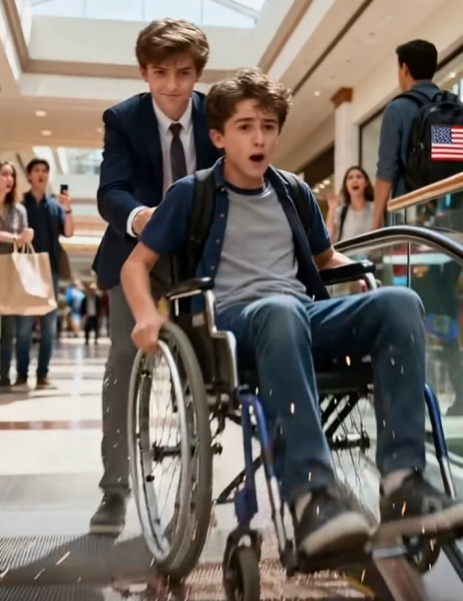
I hadn’t stepped into a shopping mall in nearly four years—not since the night everything changed, the night a reckless street race left me trapped in a body that no longer listened below my waist.
I was fifteen when it happened. Now I was nineteen, but in many ways, it felt like my life had frozen at that exact moment. While everyone else moved forward—college, relationships, dreams—I was still learning how to exist in a world that suddenly felt built against me.
But that afternoon, my mother insisted we go out. “Just a short trip,” she had said, her voice soft but determined. “You need to breathe real air, not just the walls of our apartment.”
Her name was Elara. She had aged faster than time should allow, working endless shifts as a nurse just to keep our lives from collapsing under hospital bills and therapy costs. I knew she blamed herself for letting me go out that night years ago.
The mall was enormous—bright lights, polished floors, the smell of overpriced perfume and sugar. It overwhelmed me instantly. Still, I forced a smile for her. For once, I didn’t want to be the reason she worried.
“Stay here for a minute, Rowan,” she said, adjusting the thin blanket over my legs. “I’m going to grab you something to drink. You want iced tea?”
“Yeah,” I nodded. “Take your time. I’m not going anywhere.”
She smiled faintly at the joke, kissed my forehead, and walked toward a café kiosk about forty meters away.
For the first time in years, I sat alone in public—not being watched, not being pitied, not being treated like fragile glass. Just… existing.
I focused on the view below the glass railing. People moved like currents—fast, careless, alive.
That’s when I heard laughter behind me.
Loud. Sharp. Mocking.
I didn’t turn around immediately. I already knew that tone.
It was the kind of laughter that looked for weakness.
“Hey, look at this,” a voice said. Smooth. Arrogant. The kind that had never been told no.
I felt it before I saw it—the presence closing in behind me.
There were three of them.
The one in front stepped closer, his reflection appearing faintly in the glass panel ahead of me. Tall, expensive haircut, confidence dripping from every movement. His name, I would later learn, was Kade Voss.
He held his phone up casually, recording.
“Man, is this like… a parked vehicle or something?” he said, grinning at his friends.
They laughed.
I kept my eyes forward. My hands tightened around the rims of my wheelchair.
“Just ignore them,” I told myself.
But people like him didn’t like being ignored.
A sudden kick hit the back of my wheel.
The chair jolted forward slightly.
“Hey,” he snapped. “You deaf or something?”
I swallowed, forcing calm into my voice. “I’m just waiting for my mom.”
“Ohhh,” he dragged the word out, turning his camera toward his friends. “He’s waiting for mommy.”
More laughter.
Something twisted inside my chest—not fear, not yet—but that familiar humiliation I had learned to bury.
“I’m not in your way,” I added quietly.
There was plenty of space. Too much space.
He stepped closer anyway.
“Relax, man,” Kade said, voice dropping into something colder. “We’re just curious.”
Then I felt it.
Hands.
On the handles of my chair.
My entire body locked up instantly.
“Don’t—”
Too late.
He yanked the chair backward hard. The sudden movement snapped my head back, disorienting me.
“Whoa, this thing’s lighter than I thought,” he laughed.
“Stop!” My voice cracked. “Let go!”
Panic surged through me like electricity. I reached for the brakes, but my fingers slipped.
The world spun as he twisted the chair sideways, forcing me to face him.
His smile widened when he saw my fear.
That’s when I understood.
This wasn’t curiosity.
This was entertainment.
“Ever try downhill mode?” one of his friends joked.
Kade tilted his head, eyes glinting.
“Let’s find out.”
My stomach dropped.
“No. Please. Just stop.”
He didn’t.
He pushed.
Hard.
The momentum caught instantly.
The smooth floor turned into a slick runway, and I rolled backward faster than I could react.
I looked down—
—and my heart stopped.
The escalator.
Descending.
Right behind me.
“No—no, please!”
I grabbed for anything—air, rails, control—but there was nothing. My palms scraped uselessly against the rubber handrail, burning with friction.
The front wheels hit first.
The metal teeth of the steps swallowed them.
Then everything collapsed.
The chair pitched forward violently.
For a split second, I felt weightless.
Then came the impact.
Pain exploded through my upper body as I slammed into the jagged steps. The chair flipped, crushing down onto me as we tumbled.
Metal against bone.
Skin against steel.
The sound was unbearable—a grinding, tearing symphony that echoed inside my skull.
My shoulder struck something hard. A flash of white-hot agony shot through me.
My face scraped across the ridged surface. I tasted blood instantly.
I couldn’t breathe.
I couldn’t stop it.
Each rotation was another collision, another impact, another loss of control.
And then—
silence.
I lay twisted at the bottom, tangled in metal and fabric.
The escalator continued its mechanical hum above me, indifferent.
The chair pressed down on my legs—useless, unmoving, but still trapped.
Blood dripped from my arm. Warm. Sticky. Real.
My chest heaved as I struggled to inhale.
Then I looked up.
Through blurred vision, through tears I hadn’t even realized were falling—
I saw him.
Standing at the top.
Kade.
Laughing.
Not nervous laughter.
Not shocked.
Pure, unfiltered amusement.
His phone still pointed at me.
Filming.
Capturing every second.
Around me, people gathered.
A circle formed.
Gasps. Whispers. Shocked expressions.
But no one moved.
No one stepped forward.
No one helped.
I had never felt so exposed.
So small.
So completely alone.
I closed my eyes.
For a moment, I wished I could disappear.
Then—
a sound.
Heavy.
Fast.
Not like the others.
Not hesitant.
Not afraid.
Footsteps.
Each one hit the ground with force, cutting through the noise like thunder.
The floor beneath me seemed to tremble.
A shadow fell across my body, blocking out the bright skylight above.
I opened my eyes.
A man stood over me.
Massive.
Broad shoulders, arms thick with muscle, tattoos wrapping around them like armor. His presence alone silenced the crowd more effectively than any scream.
He looked down at me.
At the blood.
At the twisted metal cage pinning me in place.
Then he looked up.
His gaze locked onto Kade.
And something changed in the air.
No shouting.
No warning.
Just raw, controlled fury.
The man turned.
And without a single word—
he stepped onto the escalator.
Going up.
Fast.
Each step deliberate.
Relentless.
Like a storm climbing toward its target.
Above, Kade’s laughter faltered.
Just for a second.
But it was enough.
PART 2
The sound of those heavy footsteps climbing the escalator didn’t just echo—it cut through the entire mall like a warning siren, sharp and unavoidable, forcing every head to turn toward the unfolding storm. I lay there, half-crushed beneath the warped frame of my wheelchair, my breathing shallow and uneven, every inch of my upper body throbbing with pain, while the man moved upward with terrifying purpose. People who had been frozen moments ago now shifted uneasily, whispers spreading through the crowd, but still, no one stepped forward to help me. Above, Kade’s smirk flickered, cracking at the edges as he took a hesitant step back, his confidence slipping for the first time. “Hey—hey, relax, man!” he called out, forcing a laugh that didn’t quite land. His friends exchanged glances, uncertainty replacing their earlier amusement. One of them muttered something under his breath, already edging away. The man climbing the escalator didn’t respond. His silence was heavier than any threat. Each step he took seemed to compress the distance between them, tightening the air until it felt impossible to breathe. I could see it now—the shift in power, the moment when a predator realized it had become prey. Kade raised his phone again, but his hand trembled slightly, betraying him. “It was just a joke!” he added louder, as if volume alone could rewrite what had already happened. But jokes don’t leave blood on the floor, and they don’t leave someone broken at the bottom of a staircase. The man reached the top landing, stepping off the escalator with a calm that made everything worse. His eyes never left Kade’s face, and in that stare was something deeper than anger—something old, something buried, something that had been waiting for a moment exactly like this to surface again.
Kade backed up until his shoulders hit the glass railing, the transparent barrier separating him from a long drop down to the lower level where a decorative indoor fountain shimmered under artificial light. “Stay back!” he snapped, though his voice cracked under pressure. His friends didn’t stay. They turned and ran—fast, disappearing into the crowd without looking back, abandoning him to face what he had created. I watched it all through blurred vision, my head spinning, the edges of my sight darkening, but I couldn’t look away. The man stopped a few feet in front of Kade, towering over him, his presence swallowing the space between them. For a brief moment, everything held still, like the world itself was waiting to see what would happen next. Then Kade tried one last defense—the only one people like him ever believed in. “You don’t know who I am,” he said, straightening slightly, clinging to the illusion of control. “My family—” He didn’t get to finish. The man moved faster than I thought someone his size could. One hand shot forward, gripping the front of Kade’s jacket, lifting him off his feet with shocking ease. A collective gasp rippled through the crowd. Kade’s legs kicked uselessly in the air, panic flooding his face as his bravado shattered completely. “Put me down! Are you insane?!” he shouted, his voice rising into desperation. The man still didn’t answer. He stepped closer to the railing, holding Kade suspended over the drop, and for the first time, fear replaced arrogance entirely. “Please—wait—listen, I didn’t mean—” Kade’s words tumbled over each other, frantic, incoherent. The man leaned in slightly, his voice finally breaking the silence, low and steady. “You thought it was funny,” he said. Not a question. A statement.
Below them, I heard a sound that cut deeper than anything else—a scream. My name. “Rowan!” My mother. She came rushing through the crowd, dropping the drinks she had been carrying, plastic shattering against the floor as she fell to her knees beside me. Her hands were shaking violently as she tried to lift the twisted metal off my body, her breath coming in panicked bursts. “Oh God—Rowan, look at me, baby, look at me,” she pleaded, her voice breaking apart with every word. I tried to answer, but my throat felt tight, my chest constricting under the weight of pain and fear. “I’m here,” I managed to whisper. She tried again to lift the chair, but it didn’t budge. “Someone help me!” she cried out, her voice echoing across the space. “Please, help my son!” A few people stepped forward hesitantly now, too late, their hands unsure, their courage finally arriving after the damage was done. Above us, the man glanced down, his eyes landing on my mother, on the blood, on the desperation in her face. Something shifted again—his grip tightened. Kade followed his gaze, and whatever he saw there erased the last of his resistance. “I’m sorry!” he blurted, the words spilling out in a rush. “I’m sorry, okay? I didn’t think—” “No,” the man interrupted quietly. “You didn’t.”
For a fraction of a second, I thought he might stop. That he might pull Kade back over the railing, that everything would end with fear instead of consequence. But the silence stretched too long, and the tension snapped. The man’s arm moved—not wildly, not out of control, but with deliberate force. He released him. Kade’s scream tore through the air as he fell, the sound echoing off the high ceiling, stretching out in a way that made time feel distorted. Every eye followed his descent. He hit the fountain below with a violent crash, water exploding upward in a chaotic burst that drenched the surrounding area. The crowd erupted—shouts, screams, chaos finally breaking through the paralysis that had held them moments before. My mother flinched, instinctively shielding me, her hands gripping my face as if to anchor me to the moment. I stared upward, my mind struggling to process what had just happened. The man remained at the railing for a brief second, looking down at the aftermath, his chest rising and falling steadily. There was no triumph in his expression. No satisfaction. Only a grim, unyielding certainty. Then he turned and began walking down the stairs—not rushing, not hesitating, just moving with quiet finality toward us.
By the time he reached the bottom, security alarms were blaring, and the distant wail of sirens began to seep into the background. He stepped over the broken remains of my wheelchair, crouching beside me with a gentleness that felt almost impossible compared to what I had just witnessed. “Easy,” he said, his voice softer now, grounded. His hands gripped the twisted metal and lifted it away as if it weighed nothing, freeing my legs from the trap. The relief was immediate, though the pain still burned through me. My mother looked up at him, eyes wide with a mixture of fear and gratitude she couldn’t quite separate. “Thank you,” she whispered, her voice trembling. He gave a small nod, then looked at me directly. “You’re safe now,” he said. Those words settled into me deeper than anything else that day. For the first time since the fall, my breathing steadied slightly. But safety didn’t last long. Police officers stormed into the mall moments later, weapons drawn, voices sharp and commanding as they took in the scene—the injured teenager in the fountain, the broken wheelchair, and the massive man kneeling beside me. “On the ground! Hands where we can see them!” one officer shouted. The man didn’t argue. He slowly stood, raising his hands without resistance. As they rushed forward to restrain him, I tried to speak, to explain, but my voice failed me. The last thing I saw before everything faded into darkness was my mother reaching for me, and the man being forced to his knees, surrounded by flashing lights and drawn weapons, as if the hero of the moment had suddenly become the villain in everyone else’s story.
PART 3
I woke to the sterile brightness of a hospital ceiling and the distant hum of machines that measured life in quiet, relentless beeps. My body felt like it had been taken apart and stitched back together without warning, every breath sharp, every movement a reminder of how close I had come to something far worse. My mother sat beside me, her fingers wrapped tightly around mine as if letting go might pull me back into that nightmare. Her eyes were red, exhausted, but when she saw me awake, something fragile in her expression softened. “You’re okay,” she whispered, though her voice trembled as if she didn’t fully believe it herself. I tried to speak, but my throat was dry, my voice barely a sound. “The man…,” I managed, forcing the words out. Her face changed instantly, tension replacing relief. She hesitated, then looked away. “His name is Darius Hale,” she said quietly. “They arrested him.” The words hit harder than the pain in my body. Arrested. The man who had been the only one to act, the only one who had stepped in when everyone else stood still, was now the one in chains. I closed my eyes, the memory of him kneeling beside me, lifting the wreckage away, echoing louder than anything else. Outside the room, I could hear voices—news reporters, nurses, whispers carrying fragments of a story that had already begun twisting into something else.
The days that followed blurred together, but the narrative outside those hospital walls became painfully clear. Kade Voss was being portrayed as a victim—injured, traumatized, nearly killed by an “unprovoked act of violence.” His family’s influence moved fast, shaping headlines, controlling interviews, burying inconvenient truths before they could surface. The security footage from the mall was suddenly “unavailable,” and the crowd that had witnessed everything remained silent, their hesitation now turning into complicity. Meanwhile, Darius Hale sat in a holding cell, charged with aggravated assault and facing years behind bars. When a public defender finally visited us, the reality settled like a weight on my chest. “Without evidence,” he said, “it’s your word against theirs.” My mother clenched her jaw, anger flickering beneath her exhaustion. “My son nearly died,” she replied. “That man saved him.” The lawyer nodded, but his eyes held little hope. “The court doesn’t run on what feels right,” he said. “It runs on what can be proven.” That night, I stared at the dark ceiling of my room, replaying every second in my mind—the shove, the fall, the laughter. The truth felt so loud inside me, yet somehow invisible to the world that mattered. I realized then that surviving wasn’t enough. If I stayed silent, then everything that had happened would be rewritten, and the only person who had done the right thing would pay for it alone.
The turning point came from somewhere no one expected. Three days before the preliminary hearing, a video surfaced online—grainy, slightly angled, clearly not meant to capture what it did. It had been recorded by a teenage girl sitting behind a dessert stand across from the railing, her phone casually pointed outward as she filmed herself. But in the reflection of the glass behind her, everything was visible. Kade’s approach. His mocking gestures. The deliberate shove. The fall. And most damning of all—his laughter afterward. The video spread like wildfire, impossible to contain, shared across platforms faster than anyone could suppress it. Public outrage erupted almost instantly, the narrative shifting in a matter of hours. News channels that had once defended Kade scrambled to revise their coverage, now condemning the cruelty that had been hidden in plain sight. By the time the footage reached the courtroom, it had already done what no testimony alone could achieve—it made the truth undeniable. I was there when they played it, my hands gripping the armrests of my replacement chair, my heart pounding as the room fell silent. The judge watched without interruption, his expression hardening with every second. Kade sat frozen, the color draining from his face, while his father’s composure finally cracked under the weight of exposure.
The outcome came swiftly after that. The charges against Darius were dropped, the court recognizing his actions as a desperate response to a violent situation that no one else had intervened to stop. He was released the same day, walking out of custody with the same quiet presence he had carried into the chaos, though something in him seemed lighter, as if a burden he had long carried had finally eased. Kade, on the other hand, was charged with aggravated assault and reckless endangerment, his family’s influence no longer enough to shield him from the consequences he had once believed didn’t apply to him. His father, Elias Voss, became the subject of a separate investigation—tampering with evidence, coercing witnesses, attempting to manipulate the narrative through wealth and power. Within weeks, his reputation collapsed, business partners distancing themselves, legal pressure closing in from every direction. As for the bystanders who had remained silent, some came forward after the video’s release, their guilt pushing them to finally speak the truth, though their voices arrived far too late to erase what had already happened.
Two weeks later, I met Darius again, not in a courtroom or a hospital, but in a quiet park where the world felt normal for the first time since that day. I sat in a new chair—lighter, faster, a gift from donations that had poured in after the story broke, strangers choosing compassion where others had hesitated. My mother stood nearby, watching with a softness I hadn’t seen in years, her shoulders finally free of the constant tension she had carried for so long. Darius approached slowly, hands in his pockets, his presence still imposing but no longer overshadowed by anger. “You look better,” he said simply. “So do you,” I replied, offering a small smile. We stood there for a moment, the silence between us no longer heavy, but steady, grounded. “You didn’t have to do what you did,” I said finally. He shook his head slightly. “Yeah,” he answered. “I did.” That was the end of it—no grand speech, no need for anything more. Kade would face the system he once thought he could control, his future shaped by the consequences of his own choices. His father’s empire would unravel piece by piece, built on power that proved weaker than truth. My mother would finally rest, no longer fighting alone against a world that had nearly broken us. And Darius would walk forward with his freedom intact, not as a criminal, but as the man who refused to look away when it mattered most. As for me, I understood something I hadn’t before—not about strength, or survival, but about the quiet, rare courage it takes to stand up when everyone else stays seated. And that was something no accident, no fall, and no broken part of me could ever take away.