1 search result for “Harrowing footage of two helicopters crashing mid-air surfaces – one dead, two injured”
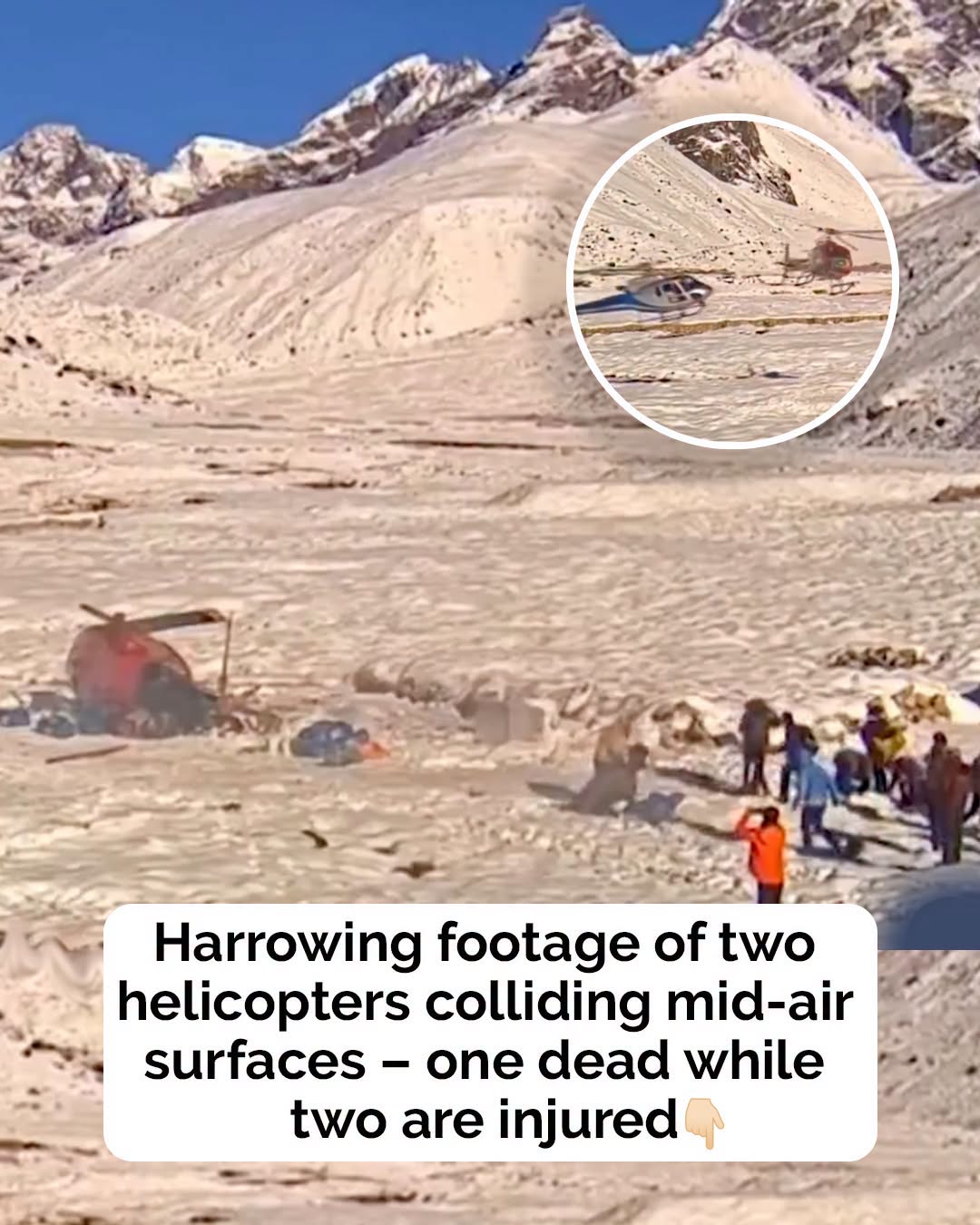
A routine helicopter operation near Mount Everest ended in tragedy after two aircraft collided while attempting to land at a helipad in Nepal, killing one tourist and leaving three others injured.
The frightening incident, which was captured on video and has since circulated on social media, occurred at approximately 8:11 a.m. local time on Tuesday, November 3, at the Pheriche helipad in Nepal’s Solukhumbu district.
The remote mountain village sits at an altitude of approximately 13,780 feet (4,200 meters), more than 1,000 meters below Everest Base Camp.
Authorities confirmed that a 47-year-old tourist from India died following the collision. The information was provided by Bhupendra Thapa, an officer with the Solukhumbu district administration.
The accident involved two helicopters operated by Fishtail Air and Air Dynasty. According to initial reports, both aircraft were attempting to land at the same helipad when they collided, resulting in a devastating incident in one of the world’s most challenging aviation environments.

What Happened During the Helicopter Collision?
The two helicopters were carrying out different operations when the accident occurred.
The Fishtail Air helicopter was returning from the Everest region with two foreign passengers on board. One of them was a 47-year-old Indian tourist who died in the collision. The second passenger, a New Zealand resident, survived but sustained injuries and was transported to Kathmandu for further medical treatment.
The other aircraft, operated by Air Dynasty, was completing a cargo flight from Lukla. It was not carrying any passengers at the time of the accident.
Both pilots involved in the collision were Nepalese nationals and suffered injuries.
Following the incident, the Fishtail Air pilot was airlifted to Kathmandu for medical attention, while the Air Dynasty pilot received treatment at a nearby medical facility.
The Civil Aviation Authority of Nepal (CAAN) subsequently identified the two aircraft involved as an Air Dynasty helicopter, registration number 9N-AOD, and a Fishtail Air helicopter, registration number 9N-AJR.
Both aircraft belong to the Airbus AS350 helicopter family, a widely used series of single-engine helicopters designed for passenger transportation, aerial operations and demanding environments.
The AS350 series is commonly used in mountainous regions because of its versatility and ability to operate in challenging conditions. However, flying in the high-altitude environment surrounding Mount Everest presents significant operational difficulties, even for experienced pilots.
Why Were So Many Helicopters Operating Near Everest?
The unusually high level of helicopter activity in the area may have contributed to the circumstances surrounding the collision.
According to officials, weather conditions had recently improved following heavy snowfall that covered several trekking routes. As conditions became more favorable, thousands of trekkers were able to resume their journeys through the region.
The sudden increase in activity meant more people were moving through the mountain trails, creating greater demand for transportation and emergency services.
Unlike many popular trekking destinations, the mountainous region surrounding Everest has no road network connecting its remote settlements. Helicopters therefore play a crucial role in transporting visitors, particularly trekkers who become ill, suffer injuries or require urgent medical evacuation.
With more hikers returning to the trails, aircraft movements in the area also increased, making the region busier than usual.
The timing of the accident is particularly significant because autumn is traditionally one of the most popular seasons for trekking in Nepal.
The rainy season has ended, bringing clearer skies and more favorable conditions, while the extreme cold and harsh weather of winter have yet to fully arrive.
For many international visitors, this period offers one of the best opportunities to experience the Everest region.
The trek to Everest Base Camp, which stands at approximately 17,380 feet, typically takes around two weeks from Lukla. The town is home to the only airstrip serving the area and acts as a major starting point for trekkers heading toward the world’s highest mountain.
As thousands of visitors make their way through the region during the peak season, helicopters become an increasingly important part of the area’s transportation system.
What Could Have Caused the Collision?
Although authorities have confirmed that the two helicopters collided while attempting to land, investigators have not yet established what caused the accident.
Flying at extreme altitudes presents unique challenges that pilots must carefully manage.
One of the biggest difficulties is the reduced air density found at high elevations. As altitude increases, the air becomes thinner, meaning helicopter rotors have less air available to generate lift. Engine performance can also be affected, potentially reducing the aircraft’s overall capabilities.
These conditions require pilots to make careful calculations and adjustments, particularly when operating in mountainous terrain.
Weather can create additional complications. Sudden changes in visibility, strong winds and unpredictable mountain conditions can make flying significantly more difficult.
Landing areas in remote Himalayan settlements also tend to be relatively confined, leaving pilots with limited space to maneuver, especially when multiple aircraft are operating nearby.
However, investigators have not confirmed whether high altitude, weather conditions, restricted landing space or any other operational factor contributed to Tuesday’s collision.
The exact circumstances surrounding the crash remain unclear, and further investigation will be needed to determine how the two aircraft came into contact while approaching the helipad.
The incident has once again highlighted the dangers associated with aviation operations in the Himalayan region, where helicopters provide an essential service but must operate in some of the world’s most demanding flying conditions.
Our thoughts are with the family and friends of the person who lost their life, as well as everyone affected by this tragic incident.