Part 2: He Rode 1,400 Miles for His Dying Mother — But the Woman Waiting in the Hospital Wasn’t the One He Had to Forgive
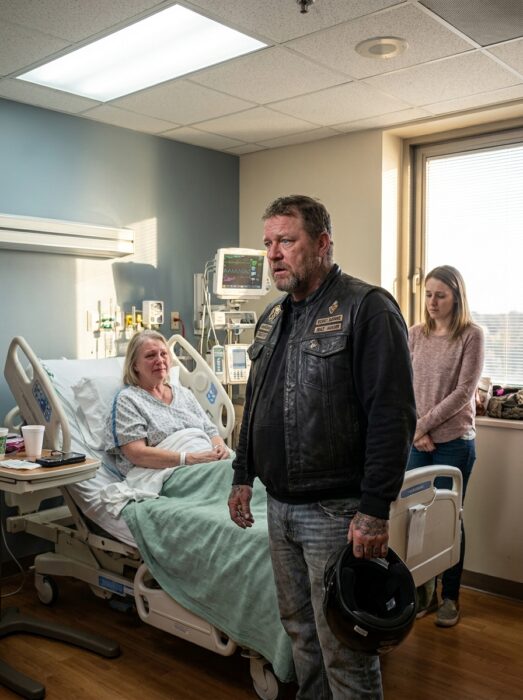
They see the cut first.
Then the beard.
Then the scars.
Then the Harley.
He rides a black Road King Special, stripped down and heavy, with highway pegs worn smooth and saddle bags that smell like leather, rain, and old tobacco. When he shuts it down, the chrome ticks as it cools. His boots hit concrete like hammer blows. His vest creaks when he moves. Even the chain on his wallet sounds hostile.
He has prison-yard tattoos but never did prison. He has a broken nose from a refinery fight in 2004 and a white scar over one eyebrow from going through a truck windshield at nineteen. He doesn’t smile often, and when he does, it looks like he borrowed the expression from somebody else and forgot how long he was supposed to hold it.
Waitresses call him “sir” too quickly.
Men at gas stations pretend not to stare.
Kids stare anyway.
He is the kind of man strangers label before he orders coffee.

But if you were paying attention, there were things that didn’t fit.
His hands were rough, knuckles split and tattooed, but his nails were always cut short and clean. He carried a small sewing kit in his left saddlebag next to a tire gauge and a rust-stained multi-tool. He never passed a stranded driver without slowing down, even if he kept his face blank while he helped. He always stopped at the same roadside diner outside Tucumcari and tipped the teenage waitress like she was supporting three children alone even when she was only covering a Saturday breakfast shift.
And he never, ever took calls from family unless he thought somebody was dead.
That tells you more about the man than the bike ever will.
By the time he rolled into Mercy General that morning, he had road dust on his shoulders, dried sweat in the collar of his T-shirt, and that hollow look men get when they’ve been awake too long with only anger and adrenaline taking turns at the wheel.
He looked terrifying.
He also looked like a son.
That was the part most people missed.
I’m the middle child.
Abby is the youngest, sharp-tongued and practical, the one who stayed near home because somebody had to. Cole is the oldest by almost ten years, and by the time I was old enough to remember much, he already had one foot out the door and the other on a kickstart.
Our father left when Cole was seventeen, I was nine, and Abby was six.
No big shouting match.
No smashing plates.
No dramatic midnight scene.
Just a truck packed before sunrise, an unpaid electric bill on the kitchen table, and Mom standing at the sink in a housecoat so still she looked like part of the room. Dad had a new woman in Albuquerque and a story about needing another start. Men like him always have a story ready.
Cole found the note first.
He read it.
Folded it once.
Put it in his pocket.
Then he walked out back and punched through the side window of the garage hard enough to open his hand to the bone.
He never cried in front of us.
Not then.
Not at the foreclosure hearing two years later when Mom lost the house.
Not when he dropped out of community college to work pipeline jobs.
Not when he sent half his checks home so Abby could have braces and I could stay in school.
Not when Mom worked double shifts at the nursing home until her feet swelled and her voice went thin.
But from then on, something in him stayed set against the world.
He got into bikes the way some men get into religion: not because they’re looking for speed, but because they need structure, noise, and a place to put pain where it won’t rot them from the inside. He found his first club outside Lubbock. Not criminals. Not saints either. Mostly welders, mechanics, one retired Marine, one pharmacist who looked like he should have been coaching softball. Men who knew how to mind their own business until somebody threatened one of their own.
That’s where Cole made sense.
He was good at the things broken homes make you good at. Not sleeping much. Reading danger fast. Carrying more than your share without asking for applause. He could ride in crosswind, fix a stator in a motel lot, and sit silently beside a grieving man for four hours without reaching for his phone once.
He could also be difficult as hell.
He held grudges like sacred objects.
He didn’t forgive laziness, lying, or men who left their kids.
He never said our father’s name out loud unless he was using it like a curse.
Still, there were moments when the man under all that leather showed through.
I remember a winter stop outside Elk City when a young mother in a minivan had a shredded tire and two kids crying in the back. Every man at the gas station found an urgent reason not to make eye contact. Cole killed his engine, walked over looking like a mug shot, changed the tire in sleet, gave the woman forty bucks for gas, then got back on the bike before she could finish saying thank you.
I remember him staying all night outside the ICU when Mom had her first minor stroke, sitting on a plastic chair with a vending-machine coffee and his cut thrown over his knees. He never went inside her room while she slept. Said he didn’t want her waking up confused and seeing “a damn thunderstorm in the corner.”
I remember him at Abby’s wedding, standing behind the venue by the dumpsters with his tie stuffed in his pocket and tears in his eyes because the father-daughter dance had happened without a father.
He wasn’t soft.
He was careful.
That’s different.
The brotherhood mattered too, more than outsiders understand. Men in clubs joke a lot, talk rough, test each other, disappear for months and show up when it matters. Cole trusted those men more than he trusted blood. Maybe because blood had already shown him what it could do when it went bad.
His chapter knew not to ask about our father. They knew there was a line there. They also knew something else: every Father’s Day, Cole rode alone. Same route. Same back roads. Same cheap motel outside Santa Rosa if weather got ugly. He never explained it.
Abby once asked why he kept doing that.
He said, “To prove I can come back.”
At the time I thought he meant home.
Later I understood he meant himself.
The call came at 3:11 a.m.
I know because Abby told me later she stared at the clock for a full minute after she dialed, hoping he wouldn’t answer so she could live with the lie a little longer.
He picked up on the third ring.
“What.”
That was all he said.
She told him Mom was in the hospital. Told him the doctors were giving it twenty-four hours, maybe less. Told him if he wanted to see her, he needed to come now.
No hesitation.
No questions.
Just one sentence in that flat old voice.
“I’m on my way.”
That should tell you something too.
Men don’t ride fourteen hundred miles for people they don’t love.
They ride that far for people they’re afraid to lose before they can say what matters.
Abby knew that.
It’s why she used Mom.
Because she knew he wouldn’t come for Dad.
By the time Cole hit Amarillo, he had been living on gas station coffee, jerky, nicotine, and whatever prayer lives in the hands of tired men gripping chrome at eighty miles an hour.
He’d ridden through the dark stretch outside Holbrook where the trucks own the road. Through dawn winds near Albuquerque. Through a rain burst outside Santa Rosa that turned his jeans cold and heavy. Through the kind of highway fatigue where lane markers start to look like they’re moving and your spine forgets what rest feels like.
He pulled into the parking garage looking like he had ridden out of a storm no one else could see.
When he walked into Mom’s room and found her alive, upright, and not dying, every mile he had swallowed turned into something sharp.
He didn’t yell first.
That’s the part people always get wrong about men like Cole. They imagine explosion. Most of the time the first thing is silence. A silence so hard it sucks all the oxygen toward it.
Mom started talking too quickly. She said she was sorry, said she didn’t know Abby had told him that, said she woke up from her procedure and nearly had a heart attack of her own when she saw him standing there.
Abby stood near the foot of the bed with both hands clasped so tight I could see the tremble. She looked younger than she was. Guilty does that to a face.
Cole turned to her.
“You used Mom.”
Abby nodded once. She was crying already, but quietly, like she didn’t feel entitled to make noise.
“Yeah.”
“For what?”
Abby swallowed. Didn’t answer.
Cole looked at me. I looked away.
He knew then.
He always knew before words caught up.
He backed up one step, then another. His jaw worked once. He dragged a hand over his beard and stared through the hospital window at nothing.
Mom said his name.
He didn’t look at her.
Abby finally forced it out. “He’s here, Cole.”
That got his eyes on her.
“Don’t.”
“He asked for you.”
Cole laughed once. No humor in it. Just damage. “Thirty years late.”
“He’s dying.”
“So?”
The word landed like a dropped tool.
Abby moved toward him, then stopped. “I lied because you wouldn’t come.”
“You’re right,” he said. “I wouldn’t.”
Then he turned and walked out.
I went after him because I was the only one dumb enough and old enough to try.
He was already halfway down the corridor, boots hard on tile, cut shifting against his back, chain striking his thigh with every step. Nurses looked up. Families looked away. He looked like violence, but it wasn’t that.
It was grief with nowhere clean to go.
I caught up near the vending machines. He stood there with both hands on his hips, breathing hard, eyes wet but not spilling. Bikers don’t cry easy. Not where anyone can clock it. It’s not healthy. It’s not wise. It’s just how some of them were built.
“You rode all night,” I said.
“Apparently for a trap.”
“He is dying.”
“He was dying thirty years ago when he got in that truck.”
That was Cole. Every sentence came out like it had already been sanded down to the hardest truth inside it.
I should have shut up.
Instead, I said, “Maybe this isn’t about him.”
He looked at me then. Really looked.
And because exhaustion strips a man of polish, I saw it clear as day: under the anger was fear. Not fear of our father. Fear of what one last room, one last breath, one last unfinished sentence might do to him.
That was the false climax. The point where I thought he’d leave.
He had every right.
He could have gone back to the garage, kicked the Harley over, and let that engine decide the ending. He could have ridden out with his hatred intact and nobody could have blamed him for it.
Instead he asked the question that changed the shape again.
“Did he ask for Abby?”
I blinked. “What?”
“Did he ask for her. Did he ask for you. Or did he ask for me.”
I didn’t answer fast enough.
That told him everything.
“He wants the son,” Cole said, voice low. “Not the family.”
He said it like a verdict.
Then he sat down in one of those cheap molded hospital chairs and stared at the floor for so long I thought he had turned to stone.
The main twist wasn’t just that Abby lied.
It was why.
And it wasn’t only for Dad.
Twenty minutes later, Abby found us by the vending machines holding a wrinkled envelope. Cream-colored. Bent at one corner. Cole looked at it like it might be contaminated.
“He wrote it yesterday,” she said. “Then told the nurse not to give it to you unless you came.”
Cole didn’t take it.
“Read it yourself.”
Abby shook her head. “No. It’s yours.”
Mom had made her choice by then too. She had signed herself out against advice, IV bandage still on her hand, because she refused to let one child face the other side of that corridor alone. That’s mothers for you. Even exhausted ones. Even angry ones. They will drag their own body behind duty if they have to.
Cole finally took the envelope.
His fingers looked wrong holding paper. Too scarred. Too big. Too used to handlebars and wrenches and bar glasses and funeral rails.
He opened it with a thumbnail.
Inside was one page. Shaky handwriting. Short lines. The words of a man who had run out of body before he ran out of regret.
I didn’t see every line, but I saw enough.
I know I do not deserve this.
I told myself for thirty years that staying gone was easier on you. That was a coward’s sentence and I used it like scripture.
I have one thing that belongs to you. I should have brought it back when you were seventeen.
I was afraid of the man you had every right to become.
Cole stopped reading there.
Looked up.
“Thing?”
Abby nodded toward the room at the end of the hall. “He kept asking if the box was still there.”
“A box.”
She swallowed. “From the garage.”
That hit Cole harder than the letter.
Because when Dad left, he didn’t just take his clothes and whatever cash was hidden in the coffee tin above the fridge. He took one box out of the garage. Cole’s box. The one full of old motocross photos, race numbers, a state fair trophy, and the only thing our grandfather ever gave him: a worn leather map pouch from Vietnam with our family name scratched inside.
Cole had torn the house apart looking for it that summer. Mom said maybe it got lost in the move. Dad said nothing because he was already gone.
For thirty years, Cole thought that box had vanished with the rest of childhood.
It hadn’t.
Our father had kept it.
That’s twist number two, if you want to count it properly. The man who abandoned his son had spent three decades holding onto the one box that proved he remembered who that son had been before he broke.
Cole folded the letter once. Perfectly. Carefully. Like that mattered.
Then he asked Abby, “What else didn’t you tell me?”
She was crying openly now. “He’s been asking for you for months. He saw a bike outside the rehab center in Tucson and thought it was you. He started saving the box where he could reach it. He said if you ever came, it should be the first thing he gave back.”
Cole leaned back in the chair and closed his eyes.
Not to rest.
To survive the next thirty seconds.
When Cole finally stood, every movement looked deliberate, like his body had become a list of tasks.
He tucked the letter into the inside pocket of his cut.
Smoothed his beard once with his palm.
Adjusted the chain at his wallet.
Then he said, “I’m not doing this for him.”
Nobody argued.
We walked the corridor together anyway.
The father I remembered as loud looked small in that hospital bed. Smaller than sickness should be allowed to make a man. Oxygen in his nose. Skin gone thin. Hands spotted and weak on top of the blanket. He still had our eyes. That part felt unfair.
A cardboard box sat on the chair by the window.
Cole saw it before he saw him.
That alone told the whole story.
Dad opened his eyes when we came in. He looked first at Mom. Then Abby. Then me. Then finally at Cole, and whatever he had rehearsed died in his throat.
Cole didn’t move closer right away.
The room sounded like hospital rooms always do when big feelings show up: monitor chirps, air vent hiss, rubber soles outside, somebody’s ice machine down the hall dropping cubes into a metal tray.
Dad tried to sit up. Failed.
Cole said, “Don’t.”
It came out rough, but not cruel.
Our father looked at the box. “That’s yours.”
Cole still didn’t touch it. “Why’d you keep it?”
Dad swallowed. “Because I knew if I brought it back, I’d have to face what I did.”
Cole gave a short nod. “So you kept both.”
That line cut so clean even Mom turned away.
There are men who beg when death gets near. Our father didn’t. Maybe because he knew begging would insult what he had broken. Maybe because shame had finally done what age never could.
He said, “I used to tell myself I left because I was no good for this family. That sounded noble in my head. Truth is, I was weak. Then every year I stayed gone made it harder to come back.”
Cole stepped to the chair and put one hand on the box.
I saw it then, the returned seeds.
His clean nails. Because he still kept himself ready for work that mattered.
His yearly Father’s Day ride. Because part of him had always been circling the wound, not avoiding it.
The sewing kit in his saddlebag. Because he was a man who fixed torn things even when he didn’t believe people counted among them.
Our father kept talking, voice thinner by the sentence.
“I heard about the bike first. Then the refinery. Then Abby’s wedding from someone who saw pictures. You looked like your granddad in that one. Mean as barbed wire. I thought… maybe you made it anyway.”
Cole’s mouth twitched once. Almost a laugh. Almost a wound reopening.
“You don’t get to claim that.”
“I know.”
Then came the third twist. Small, but it broke me more than the rest.
Dad looked at Mom and said, “I never stopped sending money.”
Mom let out one hard breath through her nose. “You sent cash twice. No return address. Forty dollars one time, sixty another.”
Dad closed his eyes. “That was all I had then.”
For years Cole had believed our father never thought of us again. In truth, he had thought of us often, just not bravely enough to matter. That’s the uglier kind of failure. Not absence of feeling. Absence of courage.
Cole finally opened the box.
Inside were the old motocross photos, yellowed at the edges. His race number plate, cracked but intact. The state fair trophy with his name misspelled. And the map pouch from our grandfather, leather darkened with time, initials carved inside.
Underneath all that was one more thing.
A Polaroid.
Cole at seventeen, angry and skinny, standing beside his first bike in the garage. Dad had taken it the week before he left. On the back, in blue ink, were four words written by a younger hand that hadn’t yet become shaky:
You were always headed home.
Cole stared at that longer than anything else.
Then he did the one thing none of us expected.
He pulled a chair close to the bed and sat down.
Not forgiveness.
Not absolution.
Just presence.
Sometimes that’s the most a dying man gets.
Dad looked at him like someone seeing shore after drifting too long.
Cole said, “I came because Abby lied.”
Dad nodded once. “Good.”
Another silence.
Then Cole reached out and laid his hand over the old man’s wrist. Big scarred hand over papery skin. Son over father. Anger over time.
He didn’t say I forgive you.
He didn’t need to lie back.
What he said was smaller. Truer.
“You should’ve come sooner.”
Dad breathed in around the oxygen. “I know.”
And there it was. The whole wreckage of thirty years reduced to two sentences no one could argue with.
He died that night.
Cole was still in the room.
After the funeral, Cole didn’t stay.
That would make a cleaner story, maybe. The prodigal son parking the Harley and moving back home to heal around casserole dishes and family photos. Life doesn’t honor that kind of symmetry often.
He stayed four days.
Long enough to help Mom sort the paperwork.
Long enough to load the box into his saddlebag one item at a time.
Long enough to sit on Abby’s porch drinking bad coffee at sunrise and not mention the lie again.
On the last morning, before he rode out, he went alone to the old house lot where the garage used to stand before the county finally tore it down. Nothing left now but hard dirt, scrub grass, and one corner of concrete where oil stains still darkened the slab.
He stood there in his cut while trucks whispered along the highway a mile off.
Then he took the Polaroid from the map pouch, looked at it for a full minute, and tucked it inside the lining of his vest.
Not in the wallet.
Not in the saddlebag.
Inside the cut.
Close to the chest.
That became his ritual after that.
Every Father’s Day, he still rides alone. Same route. Same roads when weather lets him. Same stop at the diner outside Tucumcari. But now he carries the photo inside his vest and the old map pouch in the left saddlebag beside the sewing kit.
He doesn’t talk about the hospital.
He doesn’t talk about Dad.
He doesn’t need to.
But once, at a gas station west of Santa Rosa, I saw him help a teenage boy tighten a loose battery cable on a beat-up Honda while the kid’s embarrassed father stood there useless and apologizing.
Cole handed back the wrench and told the man, “Show up before somebody else has to.”
Then he got on the Harley and left.
That was as close to a sermon as he’ll ever give.
Last fall I rode with him as far as the New Mexico line.
Evening was coming on. The road looked burned gold at the edges. Truck noise moved in waves across the flats. We stopped at a little gas station with a busted ice machine and one working pump.
Cole killed the engine and the ticking started up in the cooling metal.
He stood there for a while with one hand on the bars, looking west.
Older now.
Still hard-faced.
Still the kind of man strangers misread in the first five seconds.
But not empty.
When he opened his cut to pull out cash, I saw the corner of the Polaroid tucked inside the lining. Just a sliver. Just enough.
He noticed me notice.
Didn’t hide it.
Didn’t explain it either.
He only said, “Road’s getting dark.”
Then he thumbed the starter.
That deep V-twin came alive under him.
He pulled on his gloves, nodded once, and rolled back onto the highway.
I watched the red taillight get smaller against the long American dusk until it looked less like a motorcycle and more like a promise refusing to die.
Some men ride to get away.
He rode to arrive too late.
Then stayed anyway.
Follow the page for more biker stories that hit where it hurts.
======================