The Viral Riddle That is Driving the Internet Crazy: Can You Solve It?
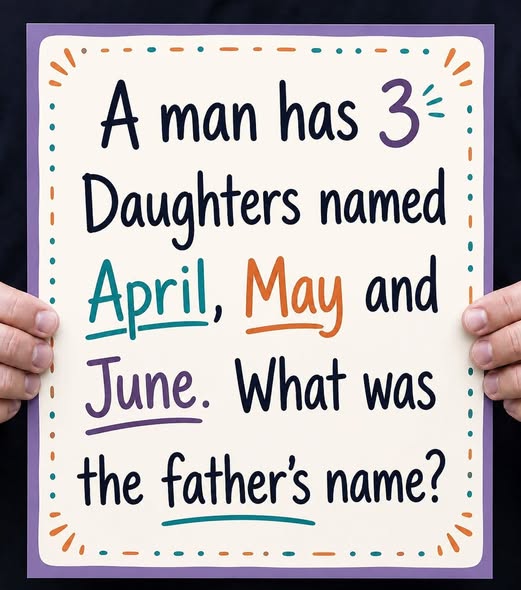
Social media is no stranger to brain teasers, but every once in a while, a riddle comes along that completely divides the comment section. The latest puzzle making the rounds is a deceptively simple wordplay challenge that has thousands of people second-guessing their reading comprehension.
The image features a colorful sign with a seemingly straightforward question:
“A man has 3 daughters named April, May and June. What was the father’s name?”
At first glance, it looks like a trick question about the calendar. Many people immediately start guessing other months—is it “July”? Or maybe “August”?
But the real answer lies not in math or calendar trivia, but in basic grammar.

The Clue is in the Punctuation
If you read the riddle out loud, the trick becomes much clearer. The key to solving this puzzle is paying close attention to the phrasing of the very last sentence: “What was the father’s name?”
Most readers interpret this as a question asking you to identify the name. However, in many versions of this classic riddle, it isn’t a question at all—it’s a statement of fact.
The Statement: “What” is the father’s name.
The Punctuation Trick: By replacing the period with a question mark, the creator of the riddle tricks your brain into looking for a hidden puzzle, when they actually already gave you the answer in the first word of the sentence.
So, if you take the riddle literally: The father’s name is “What.”
Alternative Interpretations: The “What” vs. “What?” Debate
Of course, the internet loves a debate, and this riddle has sparked two major schools of thought in the comments:
The Literal Grammarian: This crowd insists the answer is “What” because of the classic structure of this wordplay joke. In spoken riddles, it is often presented as: “A man has three daughters… What is the father’s name.” (Using a statement, not a question).
The Practical Thinker: Others argue that because the image explicitly uses a question mark, it must be a question. For this group, the riddle is simply unsolvable with the information provided. The father’s name could be anything from Bob to Bartholomew—the names of his daughters have no logical bearing on his own name.
Why These Riddles Go Viral
Psychologists suggest that riddles like this go viral because they exploit our brain’s tendency to look for patterns. Because the daughters are named after consecutive months (April, May, June), our brains naturally want to continue the sequence or find a thematic link.
By forcing us to override our pattern-recognition instincts and look at the actual structure of the words, the riddle delivers a satisfying “aha!” moment (or a collective groan) once the solution is revealed.
Which side of the debate do you fall on? Is his name “What,” or are we all just overthinking a question that has no answer?