A Biker Showed Up to Mentor a Foster Kid Who Wouldn’t Look at Him — Two Years Later, the Boy Called Him Dad
Let me tell you about those first three visits, because what Hank did — or didn’t do — is the part that matters.
Visit one: Hank arrived at the foster home at 10 a.m. on a Saturday. He parked his Harley — a 1998 Road King, matte black, pipes that announced him two blocks before he arrived — and walked to the porch where Marcus was sitting. He sat down. Six feet away. Didn’t introduce himself. Didn’t say “Hey buddy.” Didn’t ask what Marcus liked or what school he went to or any of the questions adults ask kids when they’re performing interest.
He just sat.
Marcus turned his back.
Hank stayed for three hours. When he left, he said one thing to the foster mother: “Same time next week.”
Visit two: Same. Hank arrived. Sat. Marcus faced the other way. Three hours. Nothing.
But I noticed something on the second visit — I was there for the check-in. Hank brought a thermos of coffee and two cups. He poured one for himself and set the other on the step between them. Not offered. Just placed. Like rain on a step.
Marcus didn’t touch it. But his eyes moved to it once. A flick. Half a second. Then back to his shoes.
Hank saw it. I know he saw it because his hand — the one with HOLD FAST on the knuckles — relaxed on his knee. Just slightly. The way a fisherman’s hand relaxes when the line goes taut.
Visit three: Hank brought the thermos again. Two cups. Set one between them. Marcus didn’t touch it. But this time his body shifted — not toward Hank, but less away. The angle of his shoulders opened by about ten degrees. If you weren’t watching for it, you’d miss it.
Hank didn’t miss it.
When he left, he told me: “He’s listening. He just ain’t ready to let me know.”
Visit four changed everything.
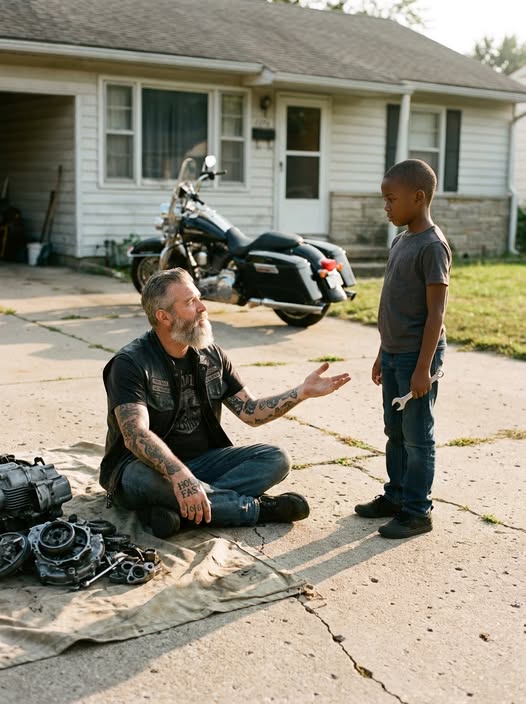
Hank didn’t sit on the porch. He pulled into the driveway, killed the Road King, and walked to the side yard. He was carrying a canvas tool roll — the kind mechanics use, heavy, clanking with wrenches and sockets. Over his shoulder was a milk crate full of parts.
He set up on the cracked concrete pad next to the foster home’s carport. He laid out the tool roll. He opened the crate. Inside were the guts of a small engine — a 200cc single from an old Honda dirt bike, disassembled, each part in a labeled bag.
He sat on the ground. Cross-legged. A 55-year-old man in leather and boots, sitting on concrete, and he started putting an engine together.
He didn’t look at Marcus. Didn’t call him. Didn’t invite him. He just worked. Hands moving. Wrenches turning. The sound of metal on metal — tap, click, the occasional grunt when a bolt resisted.
Marcus was on the porch. Back turned. Same posture. Same silence.
Ten minutes.
Twenty.
At twenty-three minutes — I timed it because I was in my car writing notes — Marcus stood up. He didn’t turn around. He stood, facing away, and his head tilted. The dog-frequency tilt. Listening to the sound of someone building something instead of leaving.
At twenty-eight minutes, he turned around.
He watched Hank work for eleven minutes from the porch. Hank didn’t look up. Didn’t acknowledge. Just worked. The wrench turned. The bolts seated. The engine took shape.
At thirty-nine minutes, Marcus stepped off the porch.
He walked across the yard. Slowly. The walk of a kid approaching something he’s been burned by before — cautious, ready to bolt, every step a decision. He stopped three feet from Hank. He looked at the parts. He looked at Hank’s hands.
Then he looked at the tool roll. A crescent wrench was lying at the edge, closest to Marcus. Twelve inches of chrome steel.
Marcus picked it up.
He didn’t know he was picking up the first conversation. He just picked up a wrench because it was there and his hands were empty and for the first time in seven placements, an adult was doing something that wasn’t about him.
Hank looked up. Not surprised. Not eager. Just looked.
“Hold that for me,” he said.
Four words. The first words spoken between them in twelve hours of silence.
Marcus held the wrench. Hank went back to work. A minute later, Hank reached out his hand — palm up, open, the universal mechanic’s gesture for hand me the next tool.
Marcus put the wrench in his palm.
And somewhere in the transfer — in the half-second where a boy’s fingers and a man’s fingers occupied the same piece of steel — something locked into place that had nothing to do with engines.
The next six months were built in wrenches and silence.
Every Saturday, Hank brought parts. They rebuilt the Honda engine over eight weeks — Marcus holding, Hank turning, communication reduced to gestures and grunts and the occasional “that one” or “tighter” or “good.” Marcus learned torque before he learned to say Hank’s name out loud.
By month three, Marcus was talking. Not much. Not about feelings or foster homes or the seven families that had sent him back. About engines. About tools. About the difference between a box-end and an open-end wrench and why you use one and not the other.
Hank answered every question the same way — short, factual, no filler. The way you explain things to an apprentice, not a child. He never dumbed it down. He never used the voice adults use with kids they feel sorry for. He spoke to Marcus the way he spoke to the prospects at the Forge MC garage: with respect for the person’s intelligence and zero patience for bullshit.
By month four, the Honda engine was running. They’d mounted it in a frame Hank sourced from a salvage yard and built a dirt bike that Marcus was technically too young to ride but rode anyway, in circles around the foster home’s backyard, while Hank stood at the edge and watched with his arms crossed and his jaw doing something that wasn’t quite a smile but was in the neighborhood.
By month five, Marcus said Hank’s name. Not “Mr. Jessup,” which is what the case file said. “Hank.” He said it while handing over a socket wrench, the way you’d say a word you’ve been practicing in your head and finally trust enough to let out.
By month six, Marcus was sitting next to Hank. Not across. Not six feet away. Next to. Close enough to bump elbows. Close enough to smell the chain lube and coffee. Close enough that when Hank reached for a tool, his forearm — the one with the barbed-wire roses — passed in front of Marcus’s face, and Marcus didn’t flinch.
A kid who hadn’t let an adult within arm’s reach for four years was voluntarily sitting in the shadow of a man covered in skulls.
The crisis came in month fourteen.
Marcus’s foster placement fell through. The seventh family. They were “restructuring,” which is the word the system uses when a family decides a child is too much. Marcus came home from school on a Tuesday and his bag was packed by the door.
I got the call at 4 p.m. I drove to the house. Marcus was sitting on the porch step. Same posture as the day I met him — back to the world, chin down, shoulders pulled in. Fourteen months of progress compressed back into the shape of a boy who expects to be left.
I called Hank. He arrived in twenty minutes. The Road King’s pipes announced him from two blocks away, and I saw Marcus’s head lift — just slightly, just an inch — at the sound. The first sign that a sound meant something to him. That an arrival mattered.
Hank walked to the porch. He didn’t sit six feet away this time. He sat right next to Marcus. Shoulder to shoulder. The kid’s bony shoulder against the biker’s leather sleeve.
Marcus didn’t turn away.
“They gave me back,” Marcus said. First words. Flat. No tears. The voice of a kid who’s been returned so many times he’s stopped being surprised by it.
Hank sat with that for a long time. His hands were on his knees. HOLD FAST on the knuckles, visible, steady.
“I know what that feels like,” Hank said.
Marcus looked at him. For the first time, really looked — not at the tattoos, not at the vest, not at the size of him. At his eyes. Searching for the lie.
“You don’t know,” Marcus said.
“Eleven times,” Hank said.
The porch went quiet.
“I was in the system till I was eighteen. Eleven placements. Four states. Nobody adopted me. Nobody kept me.”
His jaw clenched. One second. The hold.
“I aged out with a garbage bag of clothes and a social security card. No family. No address. No one who knew my middle name.”
He looked at Marcus.
“I found a motorcycle club when I was twenty-two. You know what they told me when I patched in?”
Marcus shook his head.
“They said: ‘This is your family now. We don’t send people back.’”
He put his hand on Marcus’s shoulder. The hand with HOLD FAST. He let it rest there — heavy, warm, permanent.
“I don’t send people back either.”
Everything made sense now.
The silence. Those first three visits where Hank sat and said nothing — that wasn’t patience. That was fluency. Hank spoke silence because he’d grown up in it. Eleven foster homes. Every new placement started with adults talking too much, promising too much, performing interest they’d withdraw in six months. Hank knew that words were the cheapest thing adults gave to foster kids and the first thing they took back. So he gave Marcus the only thing he’d wanted as a boy: a person who showed up and shut up and stayed.
The tool roll. The engine project. Hank didn’t bring activities to “engage” Marcus. He brought work. Real, useful, adult work. Because the fastest way to tell a kid “I see you as a person, not a project” is to hand him a wrench and say “hold that for me.” Not play with this. Not isn’t this fun. Hold that. I need you. You’re part of this.
“Hold that for me” were the first words. Not “how are you” or “what’s your name.” Hold that. A request. A need. The first time an adult had told Marcus he was useful instead of difficult.
The coffee cup placed between them on the second visit. Not offered — placed. Because offering is asking for something back. Placing is just leaving it there. No strings. No transaction. The way you leave things for people you intend to keep coming back to.
And HOLD FAST on the knuckles. Not a biker slogan. A foster kid’s prayer. The thing you carve into your skin when your hands have been pried open and emptied eleven times: Hold fast. Don’t let go. Grip tighter. This time, stay.
Two years after Hank walked onto that porch, Marcus — twelve years old now, four inches taller, forty-seven Saturday engine sessions wiser — was sitting in the Forge MC garage on Dickerson Pike, helping Hank rebuild a carburetor for a prospect’s Sportster. The garage smelled like solvent and coffee. The radio played Merle Haggard.
Hank asked for a 10mm socket. Marcus handed it over without looking — the way two people who’ve worked together for years pass tools, by feel, by rhythm, by a language made of metal and motion.
“Hank,” Marcus said.
“Yeah.”
A pause. The length of a bolt turning.
“Can I call you something else?”
Hank’s hand stopped on the wrench. Not dramatically. Just paused. The way an engine idles between gears.
“Like what?”
Marcus looked at the carburetor. At his own hands — bigger now, calloused from Saturday sessions, stained with the same permanent grease that lived in Hank’s creases. Matching hands. Apprentice hands. Son’s hands.
“Dad,” Marcus said.
The garage went quiet. Even the radio seemed to hold its breath between songs.
Hank’s jaw did the thing. The clench. The hold. One second. Two. Three. Four.
He picked up the wrench.
“Hand me the gasket,” he said.
Marcus handed him the gasket.
They went back to work.
And if you weren’t watching — if you didn’t know what had just happened in the silence between a request and a response — you’d think nothing changed. Two people rebuilding a carburetor on a Saturday afternoon.
But Hank’s eyes were wet. Not crying. Not a single tear escaped. Just wet. The wet of a man who spent fifty-five years in a world that never used that word for him, hearing it for the first time from a twelve-year-old boy whose hands fit the same wrenches.
He never corrected Marcus. He never said “I’m not your dad.” He never explained the legalities or the technicalities or any of the things the system would say.
He just handed him the next bolt.
And Marcus tightened it.
Hank is filing for adoption. It’s been four months. The paperwork is slow. The system that failed them both is now the system they need to make it official.
Every Saturday, the Road King pulls up to Marcus’s current foster home — his eighth, but his last, because Hank made sure of that. Marcus is on the porch. Not with his back turned. Facing forward. Waiting.
They ride to the Forge MC garage. They work on whatever needs working on — bikes, lawnmowers, a leaf blower once. They don’t talk about feelings. They talk about torque specs and gasket sealant and which wrench fits where.
At the end of every session, Marcus puts the tools back in the roll. Same order. Same positions. A ritual learned from a man who learned it from a club that learned it from the road.
Then they sit. Side by side. On the garage floor. Close enough to bump elbows.
No one speaks.
The garage smells like chain lube and coffee.
Somewhere under the workbench, the rebuilt Honda 200cc engine sits on a shelf. The first thing they made together. The first machine that ran because two people who didn’t trust the world decided to trust a wrench.
Last Saturday, I stopped by the garage to drop off paperwork. Hank was under a bike. Marcus was handing him tools.
“10mm,” Hank said.
Marcus handed it down.
“Flathead.”
Handed down.
“Hold this.”
Marcus held.
I stood in the doorway and watched a man and a boy speak the only language that had ever worked between them — metal, oil, the sound of something being built instead of broken.
I set the adoption papers on the workbench.
Marcus saw them. He looked at Hank. Hank slid out from under the bike, wiped his hands on a shop rag, and looked at the papers.
He looked at Marcus.
“We gotta sign these,” Hank said.
“Okay,” Marcus said.
They signed them on the workbench. Between the solvent can and the socket set. Oil smudges on the margins.
Then Hank picked up the flathead screwdriver.
“Back to work,” he said.
Marcus nodded.
Back to work.
If this story handed you something heavy and told you to hold it — follow this page. We write the ones that show up on Saturday and never stop coming back.