At 18, I Fought to Keep My 7 Siblings Together—Then One Photo Exposed the Truth About Our Parents
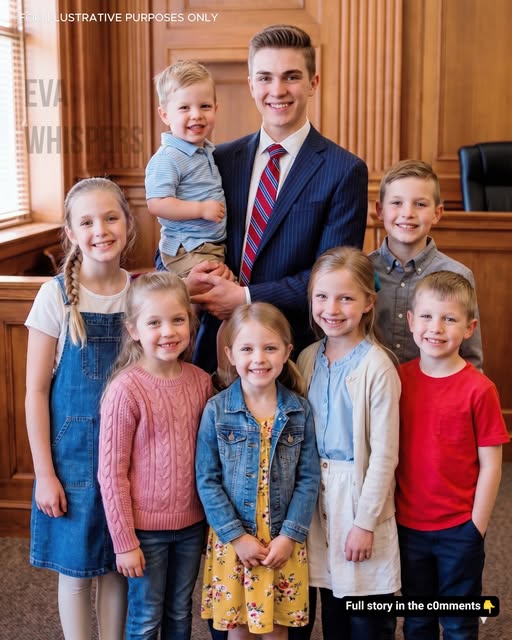
I was eighteen the day my entire life changed.
That morning, everything felt normal.
Lila was laughing in the kitchen because Tommy had dumped cereal into a saucepan and proudly called it “breakfast soup.” Phoebe was yelling that it was disgusting. Sybil was hopping around, searching for her missing shoe.
Ethan and Adam were arguing over a hoodie neither of them even owned, and little Benji dragged his blanket behind him like a sleepy ghost.
For ten seconds, we were just a loud, chaotic, ordinary family.

Then I opened the door.
Two police officers stood on the porch.
“Are you Rowan?” one of them asked.
I didn’t need to hear anything else. Something in his expression told me everything before he even spoke.
“There’s been an accident,” he said quietly. “Your parents didn’t survive.”
Behind me, the laughter stopped.
I turned back toward the house, where seven pairs of eyes were already looking at me, waiting for me to explain what was happening.
I closed the door halfway so they wouldn’t see the officers’ faces.
“Everyone… sit down,” I said.
Phoebe’s voice trembled. “Where are Mom and Dad?”
I opened my mouth.
But nothing came out.
A few days later, reality hit harder.
Ms. Hart from child services sat at our kitchen table, a thick folder in front of her like a sentence already decided.
“The children will need temporary placement,” she said gently.
“Together?” I asked.
She didn’t answer right away.
She didn’t have to.
“No.”
From the hallway, Lila let out a small, broken sound.
I clenched my hands. “They just lost their parents.”
“I know, Rowan.”
“No,” I said, shaking my head. “If you knew, you wouldn’t be talking about splitting them up like they’re objects.”
Her voice softened. “You’re only eighteen. You don’t have a stable income. The house is behind on payments—”
“I’ll figure it out,” I cut in. “I’ll work. I’ll learn. Just… don’t separate them.”
She sighed. “Love isn’t always enough.”
“Then help me learn what is,” I said. “But don’t take them away from each other.”
Court was even worse.
Aunt Denise arrived dressed like she already owned the outcome. Uncle Warren stood beside her, holding a folder like proof of victory.
“I care deeply about the children,” she told the judge, dabbing at dry eyes. “But Rowan is still a child himself. I can take the youngest two until things stabilize.”
Phoebe clutched Lila’s arm.
I couldn’t stay quiet.
“The youngest two?” I said. “Do you even know their names?”
Denise turned to me with a tight smile. “Don’t be selfish, sweetheart. You can’t save everyone.”
“I’m not trying to save everyone,” I said, facing the judge. “I’m trying to keep my family together.”
The judge leaned forward. “Do you understand what you’re asking?”
“Not completely,” I admitted. “But I know them. I know Tommy needs his inhaler at night. I know Benji hides food when he’s scared. I know Sybil gets mean when she’s hungry. I know how they sleep, what they fear… I know them.”
Behind me, Lila broke down first.
“I don’t want Aunt Denise,” she cried. “I want Rowan.”
Then Phoebe nodded, then Tommy started sobbing, then Benji… even Adam covered his face.
Two weeks later, temporary guardianship was mine.
I celebrated by throwing up in the courthouse bathroom.
The next three years were survival.
I dropped out of college. I worked every job I could find—warehouse shifts, grocery stores, deliveries. I learned how to function on almost no sleep.
Our neighbor, Mrs. Dalrymple, became our lifeline. She watched the kids, brought food, and refused every dollar I offered.
“Pay me back by not burning your kitchen down,” she said once, setting a casserole on the counter.
“I only burned rice,” I muttered.
“Rice isn’t supposed to smoke,” she replied.
Lila laughed for the first time in days.
We weren’t thriving—but we were still together.
And that mattered.
One night, Sybil found me staring at the electric bill.
“You’re doing that face again,” she said.
“What face?”
“The ‘I might sell a kidney’ face.”
I laughed weakly. “Go to bed.”
She sat across from me instead. “You don’t have to do everything alone.”
That hurt more than anything.
Because I wanted them to be kids—not people worrying about me.
Aunt Denise kept showing up, offering criticism but never help.
“This house is falling apart,” she said one afternoon. “Don’t you have access to the funds yet?”
“Not yet.”
“What’s taking so long?”
“I don’t know.”
She lowered her voice. “You know, asking for help isn’t failure.”
“Great,” I said. “Help.”
She blinked.
“Tommy needs shoes. Benji needs glasses. Sybil needs money for a field trip. Pick one.”
Her smile froze.
“I meant adult help,” she said.
“You mean taking them,” I replied.
She didn’t deny it.
I thought that was the worst of it.
I was wrong.
One night, little Benji walked into my room, holding an old photo.
“I was looking for the Christmas lights,” he said softly. “I missed Mom.”
The photo showed our parents standing outside a courthouse.
Behind them stood Aunt Denise and Uncle Warren.
Denise was smiling.
Something about that smile felt wrong.
I turned the photo over.
And my heart stopped.
In my mother’s handwriting, it read:
“If anything happens to us, don’t let Denise take the kids. Rowan will know what to do.”
The next day, I took the photo to Mrs. Dalrymple.
She stared at it for a long time.
“I remember that day,” she said quietly.
“What day?”
“The day your mother came home scared… and told me that if anything happened, I should trust you—not Denise.”
My chest tightened.
“She said my name?”
“She said you were the only one who loved them without wanting anything in return.”
Then she opened a safe and handed me a folder.
Inside were documents—emails, copies of papers.
Proof.
My parents hadn’t left us with nothing.
They had been trying to protect us.
And Denise had been trying to take everything.
For the first time in three years, I stopped surviving…
…and started fighting.
At the next hearing, Denise stood confidently.
“Rowan loves them,” she told the judge. “But love doesn’t fix a broken home.”
I placed the photo on the table.
“My mother knew that,” I said. “That’s why she left this.”
The courtroom went silent.
I handed over the documents.
Mrs. Dalrymple spoke up too, confirming everything.
Denise’s composure cracked.
“You tried to separate us,” I said.
“I tried to protect them!”
“No,” I replied. “You tried to take what wasn’t yours.”
The judge ruled quickly.
Her request was denied.
She would not be allowed to pursue guardianship again without court approval.
For the first time, Denise had nothing to say.
After the hearing, Mrs. Dalrymple made a request of her own.
She wanted to be listed as our emergency caregiver.
So I could go back to school someday.
I looked at her.
“You really want that?”
She smiled. “I’ve been taking care of you all for three years already.”
That night, I filled out the emergency contact form.
Relationship: Family.
She laughed. “I’m just your neighbor.”
I shook my head.
“No,” I said. “Family lives next door.”
For three years, I thought I was barely enough.
But my mom had known something I didn’t.
She knew I would fight.
She knew I wouldn’t let them be taken.
And in the end…
She was right.