I gave my coat to a woman in the cold—two weeks later, everything changed
If you’ve ever walked down Fifth Avenue at the tail end of winter, then you know precisely the kind of morning I am talking about. You likely remember the particular feeling of hopelessness that sets in on such mornings, when the city seems stripped bare of everything pleasant and good. Not a trace of snow anywhere, let alone any Christmas decorations, just gray concrete, gray slush, and a sky that resembles nothing so much as an old, ragged piece of wool. And the wind… it’s not just a gust; it’s a hunt, finding the smallest point where your scarf meets your chin.
I was doing what most of us do when we are overwhelmed by the situation, dwell on small, trivial matters so that we would not have to face the bigger and scarier ones. I was practically lecturing myself about how stupid it was for me to wear such thin socks, instead of the thick ones I should’ve picked. Then I made promises to myself that once I had received my bonus, I would invest in a proper coat because until then, I had no intention of spending money on anything fancy. These were the “safe” things that I told myself, which meant that I did not have to confess how exhausted I really was. I was already feeling drained before I had even reached the office and started working.
Well, that’s when I saw her, curled up in the space between the marble of our lobby and the sidewalk. Security guards generally run people off, but at such an early hour and in such freezing temperatures, I guess everyone was trying to stay indoors for warmth. She sat so close to the stone that it seemed as if she was trying to blend into it, as if by pressing herself further against the wall she might find traces of warmth from the building’s radiators. The woman was dressed in what I could only describe as a threadbare purple sweater, covered in the tiny balls of fluff that appear after multiple washes. She wasn’t even wearing a coat.
At that moment I acted like a true New Yorker and did the “polite ignore.” We all know what I mean by that. There you are, and there is a person right in front of you going through hell, and your mind just blocks them out. This is the way nature works, no? You would never get to work if you had to stop for everybody that is suffering. And I had certainly passed that girl by dozens of times over the week, but I didn’t even recognize that she was a living person.
However, as I approached her, the “pocket shuffle” kicked in. This is that unconscious reflex in which we search our pockets for anything and everything that we can offer so we do not look like a complete jerk. The old trick was well-rehearsed. I would give an appreciative nod and perhaps even a dollar if I had it, followed by a sympathetic half-smile, before disappearing into the comfort of the building’s lobby. However, all I could find was some pocket lint, a torn receipt from the bodega deli, and a gum wrapper.

When she spoke, it caught me off guard. Her voice wasn’t high or shaky or desperate. It was just… flat. Neutral. She asked if I had any spare change, but it didn’t sound like a plea. It sounded like she was just taking a poll, checking to see if kindness was still a thing that existed in the world, but not really expecting a “yes.”
I told her my standard line of “Sorry, I am tapped out” and headed towards the door. However, something made me pause. In fact, I did stop and look back at her. But, more importantly, I actually paid attention to her. It’s not because she looked cold. Instead, it was because of her face. She wasn’t looking down or looking into thin air. Her eyes were observing everything around her with such intensity.
At that moment, the gust of wind blew through the street, and it was like somebody had smacked me in the face with a piece of ice. I was bundled up in three layers and a scarf, but I still felt terrible. This woman had only a tattered sweater and a wall. It struck me that I would be okay. I would be indoors in thirty seconds. I would be at a heated bus stop shortly. A couple of minutes of freezing wouldn’t hurt me, but it seemed like she was about to die from the cold right now.
For some reason, I took an action that wasn’t part of the plan. I unzipped my coat. As soon as I took it off, the air seemed to have a certain weight, just pressing out all the warmth from my body. I refused to think about it because otherwise, I wouldn’t do it. I only held out my coat to her.
She didn’t snatch it from me. Instead, she just gazed at it as if it was some venomous snake that I was holding in front of her eyes. She was completely stunned. Finally, I had to bump her shoulder with it so that she took it and held it, but her fingers were literally cold like ice. She made me jump when she laid her hands on mine. And despite the fact that the coat hung below her wrists because it was far too large for her, it felt good.
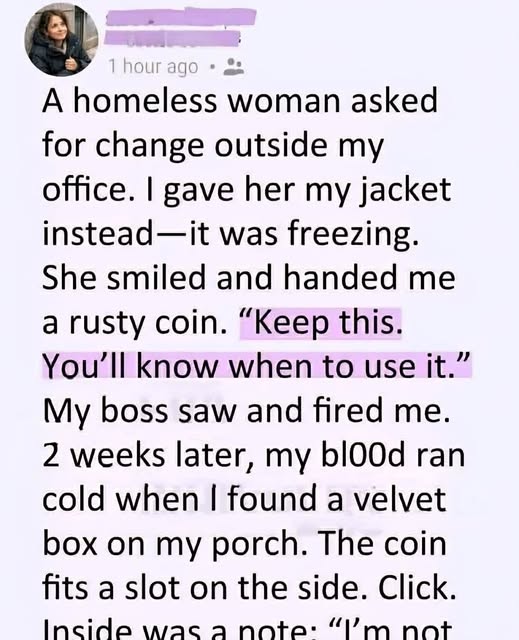
She never said “thank you.” At least, not right away. She just smiled and it was an “I see you’re still alive” smile—not a “thank you for the coat” smile. Then she thrust something into my palm. It was a coin. Old, rusted, heavy. Like it would be in a museum or a 1920s junk drawer. And I wanted to give it back to her. But she shut my hand around it, and she had that look in her eye, that utter confidence, that made me know that it was mine now.
And that’s when the heavy glass doors slid open, and Mr. Harlan emerged. The thing is, at this point, you need to visualize what Mr. Harlan looks like to understand just how awful the next minute and a half became. Harlan is one of those men who seems like he was created in a factory specializing in making lobbyists look good. His charcoal suit is flawlessly cut, his hair hasn’t moved from wherever it was in 1994, and the man has such an inflated ego that it practically needs its own zip code. He saw me—the guy standing in front of him, shivering in just his dress shirt, berating a “loiterer,” and his face went purple.
There was no private conversation about the matter, he just began shouting. In Harlan’s book, I hadn’t just done something inappropriate or rude; I had made myself into a “liability” and a “bad look” for the firm’s image. He even mentioned having to navigate through “this kind of element,” as if the woman I gave my coat to was some sort of dangerous weather condition. Before I could explain anything about how my coat had ended up on her in the first place, he cut me off. “Clear your desk,” he said. “Effective immediately.”
He used those exact words as if he’d read them from some kind of corporate script he kept beneath his pillow. There was no discussion, no mention of a Human Resources meeting, none of the things you’d expect when firing an employee. He simply did it. And then, as if he’d just dealt with a minor annoyance, he walked inside.
There I was, standing outside in the wind as the glass doors closed on my career. I had just traded a 401k for a rusty coin and a $200 jacket. She, still wrapped in my oversized coat, apologized and said something that stuck with me: “You knew what you were doing.”
I left feeling like an utter fool. The next two weeks saw me doing “pasta math” while recruiters stayed silent on the phone. I froze in my apartment to save money, and constant anxiety became my only roommate. I was falling, and time was running out.
Fourteen days later, a small velvet box appeared on my front doorstep—no stamps, no return address. I retrieved the rusty coin from my junk drawer and slid it into a narrow slot on the side of the box. It clicked, opening to reveal a card: she wasn’t homeless at all, but a CEO testing who would really give something up.
But below that was an offer of employment with a salary that seemed like a typographical error. It was life-altering.
Within days, I was falling apart, but the new office was sleek, made of glass, and filled with expensive silence. I walked into the boardroom, and there she was—without her pilled sweater, dressed in a business suit, and with that same piercing stare. No long explanation was necessary. She understood how close I’d come to tossing the coin; I understood that she had saved my life.
On the fiftieth floor, I came to understand that by removing my suit jacket, I had not only done a good turn for a stranger but had prevented myself from turning into yet another empty suit like Harlan. I was finally warm. I think I’m going to enjoy this place.
Please SHARE this article with your family and friends on Facebook.