PART 2: A biker watched a massive teenager corner his deaf nephew on the school bus, so he decided to handle it himself.
CHAPTER 1
The afternoon heat was baking the asphalt on the corner of Maple and 5th.
Marcus sat idling on his customized Harley, the low rumble of the exhaust vibrating up through his boots. He checked his watch. 3:15 PM. The bus was running three minutes late.
To anyone else driving by, Marcus looked like trouble. He was built like a cinderblock, covered in faded ink from his knuckles to his neck, wearing a worn leather cut over a plain black t-shirt. He had a scar cutting through his left eyebrow and a permanent scowl that kept strangers at a comfortable distance.
But he wasn’t there for trouble. He was there for Leo.

Leo was ten years old. He was also completely deaf.
Marcus’s sister, Sarah, worked back-to-back shifts at the diner just to keep the lights on in their tiny two-bedroom apartment. She couldn’t be there at 3:15. So Marcus was. Every single day.
He took the job seriously. The world was already hard enough on a kid who couldn’t hear it coming.
Three months ago, Sarah had finally scraped together the money for Leo’s new hearing aid. Three thousand dollars. She had cried when the audiologist turned it on. Marcus had watched his nephew’s eyes go wide as the boy heard the rumble of his uncle’s motorcycle for the first time.
It was a small piece of plastic and wire, but it was Leo’s lifeline. It was his connection to the world.
The familiar hiss of air brakes broke through Marcus’s thoughts.
The heavy yellow school bus turned the corner, lumbering down the suburban street. It pulled to a stop at the curb. The stop sign swung out. The red lights flashed.
A cluster of parents stood on the sidewalk, mostly mothers in yoga pants holding iced coffees, waiting to collect their kids. They always gave Marcus a wide berth. They cast nervous glances at the heavy motorcycle and the tattooed man sitting on it.
Marcus ignored them. His eyes were locked on the folding doors.
The doors swung open.
A dozen kids spilled out, laughing, shoving each other, their backpacks bouncing. They scattered toward the waiting parents.
Marcus waited.
The flow of kids stopped. The doors stayed open.
Leo didn’t come out.
Marcus frowned. He killed the engine. The sudden silence in the heavy afternoon air felt wrong.
He kicked the stand down and stepped off the bike.
He walked toward the bus, his heavy boots crunching on the gravel near the curb. He looked up at the row of tinted windows.
In the very back row, pressed hard against the glass, he saw him.
Leo.
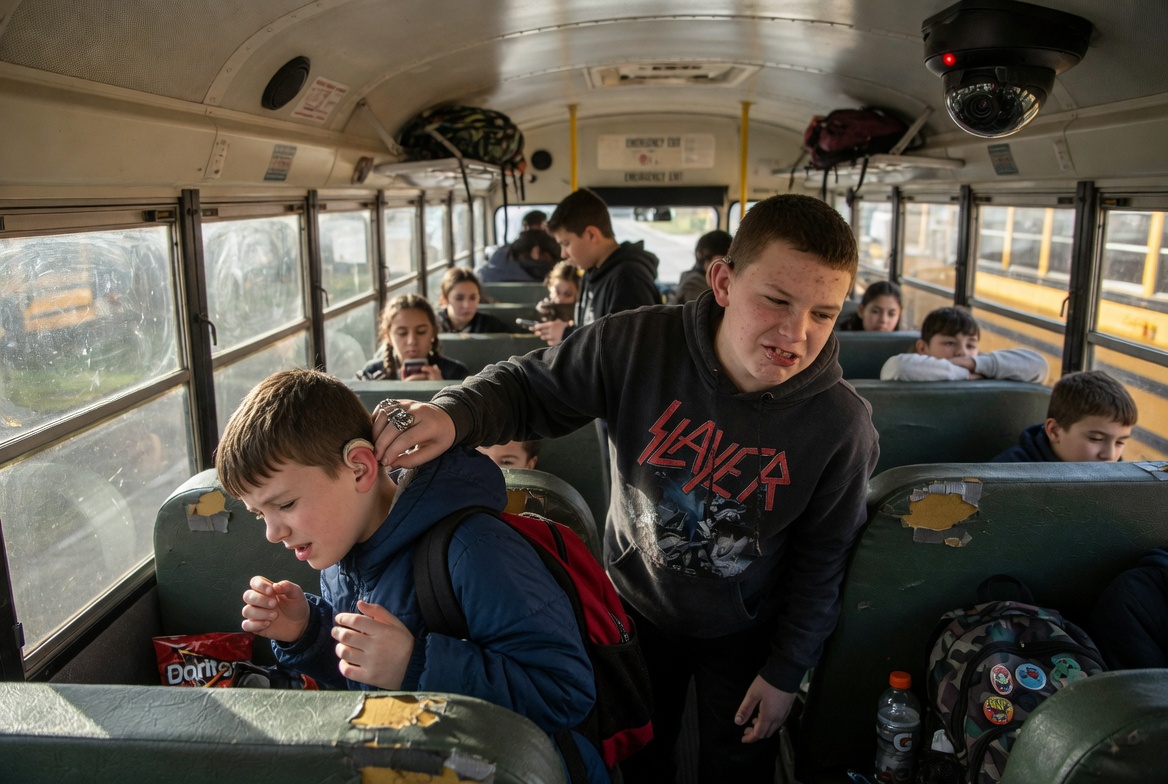
He was pinned in the corner seat. Standing over him, blocking him completely in, was a teenager.
The kid had to be at least fifteen. He was massive, built like a high school linebacker, wearing a crisp, expensive-looking polo shirt.
The teenager was leaning down, getting right in Leo’s face. He was laughing. A cruel, ugly laugh that twisted his features.
Leo was backed into the corner, his small shoulders hunched. His face was ghostly pale. His hands were up, moving frantically.
Stop.
Please.
He was signing, but the big kid was just mimicking him, waving his hands around mockingly, laughing harder.
Then Marcus noticed the teenager’s right hand.
It was jammed deep into the pocket of his jacket. He was holding something tight inside the fabric, refusing to let it go.
Leo lunged forward, trying to grab at the pocket.
The teenager shoved the ten-year-old hard in the chest, knocking him back against the window glass.
Something inside Marcus snapped.
It wasn’t a slow build of anger. It was a cold, absolute rage that flooded his veins in an instant.
He didn’t yell. He didn’t wave his arms.
He just moved.
He took the steps of the bus two at a time. The metal groaned under his weight.
“Hey!” The bus driver, an older man with a receding hairline and a stained uniform shirt, jumped up from his seat. “You can’t be on this bus! It’s against district protocol!”
“Sit down,” Marcus growled, not even looking at him.
The driver took one look at the sheer size of the man, the dead look in his eyes, and sank back into his vinyl seat without another word.
Marcus walked down the narrow aisle.
The bus smelled like stale sweat, rubber, and cheap floor cleaner. The silence back here was heavy.
The teenager in the back row didn’t hear Marcus coming. He was too busy enjoying his power trip. He was still laughing, saying something cruel that Marcus couldn’t quite make out over the hum of the bus engine.
Marcus stopped right behind him.
He reached out.
His large, calloused hand clamped down on the back of the teenager’s neck, his fingers digging in just hard enough to send a shockwave of pain straight to the kid’s brain.
The laughter cut off instantly.
The teenager gasped, his shoulders shooting up. He tried to spin around, but Marcus’s grip was like an iron vice.
“Move,” Marcus said.
The kid looked up. The color drained from his face entirely. The swagger evaporated, replaced by pure, wide-eyed terror. He was looking at a man who looked entirely capable of tearing him in half.
“I… I wasn’t doing anything,” the kid stammered, his voice cracking. “We were just playing.”
“Stand up,” Marcus ordered.
The kid hesitated. His right hand was still buried deep in his pocket.
Marcus didn’t ask twice.
He shifted his grip from the kid’s neck to the thick fabric of his expensive polo shirt, right at the collar. He twisted his fist, tightening the fabric against the kid’s throat, and pulled.
The teenager was yanked out of the seat with terrifying ease. He stumbled into the aisle, nearly falling over his own oversized sneakers.
“Hey, let go of me!” the kid yelled, a note of panic rising in his chest. “You can’t touch me! My dad is a lawyer!”
Marcus didn’t care who his dad was.
He started walking backward down the aisle, dragging the heavy teenager with him.
The kid scrambled, trying to find his footing, his expensive shoes squeaking uselessly against the ribbed rubber floor. He grabbed at the seatbacks, trying to stop his momentum, but Marcus just kept pulling. It was effortless.
They reached the front of the bus.
Marcus practically threw him down the steps.
The teenager stumbled out the doors, waving his arms to catch his balance, and slammed hard against the metal side of the bus. He stayed there, panting, looking terrified.
The sidewalk erupted.
The cluster of waiting parents had seen the whole thing through the open doors. Now, they were furious.
“What are you doing?!” a woman shrieked. She was wearing designer sunglasses and holding a set of keys to a brand-new Lexus SUV. “You psycho! You’re attacking a child!”
“Someone call the police!” another mother yelled, already digging her phone out of her purse. “I’m calling 911!”
The woman with the sunglasses rushed forward, inserting herself between Marcus and the teenager. She threw her arms around the heavy-set kid.
“Trent, honey, are you okay?” she cried.
She turned a vicious glare on Marcus. “Are you out of your mind? I saw you drag him! That’s assault! You’re going to jail, you filthy thug!”
Marcus didn’t look at her. He didn’t care about the phones recording him. He didn’t care about the sirens that would inevitably be called.
He was looking back at the open doors of the bus.
Leo stepped out into the sunlight.
The boy was shaking. His small chest heaved with silent, gasping sobs. He looked so small standing on the top step, looking down at the chaos he had been thrown into.
Marcus softened instantly. He stepped forward, ignoring the screaming mother, and reached a hand out to his nephew.
Leo came down the steps and grabbed Marcus’s hand, holding on tight.
Marcus looked at the side of Leo’s head.
The space behind his ear was empty.
The hearing aid was gone.
A cold dread pooled in Marcus’s stomach. He looked back at Trent.
The teenager was hiding behind his mother, looking smug again now that he had protection. But his right hand was still jammed nervously into his pocket.
“What’s in the pocket?” Marcus asked. His voice wasn’t a yell. It was a low, dangerous rumble that cut right through the screaming women.
Trent froze. “Nothing.”
“Show me,” Marcus said, taking a step toward them.
Susan, Trent’s mother, puffed out her chest. “He doesn’t have to show you anything! Stay back! You lay a finger on my son again and we will ruin you!”
“I’m not asking you, lady,” Marcus said, his eyes locked on Trent. “Show me what you took from him.”
“It’s just a toy!” Trent blurted out defensively. “He dropped it! I was just holding it for him!”
Leo tugged violently on Marcus’s sleeve.
The boy was crying harder now. He pointed a trembling finger directly at Trent’s right pocket. He signed three words, sharp and desperate.
He took it.
Marcus didn’t wait anymore.
He stepped around the mother so fast she didn’t even have time to react. He grabbed Trent by the wrist of his right arm and yanked it out of the pocket.
Trent yelped in surprise. His fist was clenched tight.
Marcus squeezed the boy’s wrist with just enough pressure to make it hurt. “Open it.”
Trent’s hand uncurled.
In the center of his meaty palm lay a pile of shattered plastic, twisted wires, and a crushed battery casing.
It was utterly destroyed. Ground into pieces.
The three-thousand-dollar hearing aid. Leo’s lifeline to the world.
The street went dead silent.
The screaming mother stopped mid-sentence. The other parents lowered their phones slightly, looking at the broken pieces in the teenager’s hand.
Marcus stared at the plastic.
It hadn’t just been dropped. It had been intentionally crushed under the heel of a heavy shoe. It was pulverized.
He looked at Trent.
The teenager realized the gravity of the situation. His smugness vanished, replaced by the instinct to lie.
“It was an accident,” Trent stammered, stepping back, wiping his sweaty palms on his jeans. “It fell out of his ear. I stepped on it by mistake. I swear.”
Leo watched the boy’s lips move.
The ten-year-old let go of Marcus’s hand. He stepped forward, his face flushed red with tears and anger.
He looked up at his giant uncle. He made sure Marcus was watching him.
Then, with perfect, deliberate anger, Leo signed.
Not an accident.
He does it every day.
Marcus felt the blood roaring in his ears.
Every day.
This massive kid hadn’t just bullied Leo once. He had been tormenting a deaf child, cornering him, breaking his things, every single day on this bus.
And the driver had done nothing. The school had done nothing.
In the distance, the sharp wail of police sirens began to cut through the heavy afternoon air. The mother with the cell phone looked triumphant.
“They’re coming,” she sneered at Marcus. “You’re done.”
Marcus didn’t run. He didn’t move toward his bike.
He reached out and carefully took the crushed, broken pieces of plastic from Trent’s trembling palm. He closed his large fist around the wreckage.
He looked at the mother, then down at the bully.
“No,” Marcus said, his voice terrifyingly calm. “I’m just getting started.”
CHAPTER 2
The scream of the sirens cuts through the heavy afternoon heat.
Two black-and-white police cruisers screech to a halt, blocking the intersection. The doors pop open. Four officers step out, their hands resting casually on their duty belts as they assess the chaos.
Susan is on them instantly.
“He attacked my son!” she shrieks, pointing a manicured finger directly at Marcus. “He dragged him off the bus! Look at him! He’s a thug!”
The officers immediately split up. Two move toward Susan and the teenager to de-escalate. The other two approach Marcus.
Their eyes sweep over him. They see the worn leather cut. They see the faded ink covering his arms. They see a massive man who looks entirely out of place in their wealthy suburban neighborhood.
“Sir, step away from the boy,” the older officer says, his voice flat and authoritative. “Put your hands where I can see them.”
Marcus doesn’t flinch. He doesn’t raise his voice.
He grew up dealing with the law. He knows exactly how this game is played. One wrong move, one sudden twitch, and he’ll be face-down on the baking asphalt with a knee in his spine.
He slowly opens his right hand.
The shattered pieces of the three-thousand-dollar hearing aid catch the harsh sunlight.
“I didn’t attack anyone,” Marcus says. His voice is a low, steady rumble. “I removed a threat. That kid just destroyed my nephew’s hearing aid.”
The officer looks at the crushed plastic. Then he looks down at Leo.
Leo is pressing himself against Marcus’s heavy motorcycle boot. The boy is staring terrified at the flashing police lights. The world is completely silent to him again, making the aggressive movements of the adults even more terrifying.
“Is that true, son?” the older cop asks Trent.
Trent is putting on a masterclass performance. He’s slumped against the side of the yellow bus, breathing hard, rubbing his neck and looking absolutely traumatized.
“No!” Trent cries, his voice cracking perfectly. “It fell out of his ear! I accidentally stepped on it when we were getting off the bus. Then this giant psycho just grabbed me by the throat!”
“He’s terrified!” Susan yells, wrapping her arms protectively around Trent’s thick shoulders. “We are pressing charges. I want him arrested for assault right now.”
The younger cop steps closer to Marcus. He reaches around to his belt and unclips his handcuffs.
“Turn around, sir. Hands behind your back.”
Marcus stiffens.
He looks down at Leo. If he gets arrested, who takes Leo home? His sister Sarah is working a double shift at the diner. She won’t be off until midnight. The police will hand the boy over to child protective services until they can reach her.
It’s a nightmare scenario. The system is already working exactly how Susan wants it to. Money and status are protecting the aggressor, and the victim is about to be punished.
“You’re making a mistake,” Marcus says softly.
“We can sort it out at the station,” the young cop says, grabbing Marcus’s heavy wrist.
Leo sees the silver cuffs. He knows what they mean.
The ten-year-old panics. He steps between Marcus and the police officer, violently pushing the cop’s hands away.
He starts signing frantically, his face twisted in desperate anger.
No. No. Bad boy. He points an accusing finger at Trent. Bad boy. Hurt me. Every day.
“Hey, back the kid up,” the older cop says, taking a cautious step back.
“He’s deaf,” Marcus says, his jaw tight. “He’s telling you what happened. That piece of garbage cornered him. He does it every single day.”
“I don’t speak sign language, buddy,” the younger cop says dismissively. “I just know we have a witness saying you assaulted a minor.”
Marcus turns his head. He looks at the bus driver.
The driver is still standing on the bottom step of the bus, sweating profusely through his stained uniform shirt, watching the scene unfold.
“Tell them,” Marcus demands.
The driver swallows hard. He looks at Marcus, then looks at Susan. He knows who pays property taxes in this town. He knows whose husband golfs with the district superintendent.
“I… I didn’t see anything,” the driver stammers, looking at his shoes. “I keep my eyes on the road. Next thing I knew, this man was on my bus.”
Marcus feels the rage spiking again, hot and blinding.
“You’re lying,” Marcus growls.
“Sir, turn around,” the cop orders, his voice rising.
Marcus ignores the command. He points a massive finger at the little black glass dome mounted directly above the driver’s seat.
“You don’t need a witness,” Marcus says. “You have a camera. Pull the tape.”
The officers follow his finger. They look at the camera.
Susan’s face twitches. Just for a second, the mask of the terrified mother slips. She looks at her son. Trent suddenly stops fake-crying.
“The bus camera?” the older officer asks the driver. “Is it rolling?”
“It… it’s supposed to be,” the driver says, wiping his slick forehead. “But I don’t have access to the hard drive. Only the school administration does.”
The older officer looks at his partner. He sighs heavily.
“Alright,” he says. “Nobody is getting arrested right this second. This happened on district property. We’re going to the principal’s office. Right now.”
Susan scoffs. “This is ridiculous. Look at my son’s neck! He has red marks!”
Marcus looks at Trent’s neck. There is a faint pink smudge where Marcus grabbed his collar.
Then Marcus looks at Leo.
He reaches down and gently brushes Leo’s hair back from his ear.
There is a deep, raw scratch behind the boy’s earlobe. A dark streak of dried blood. It’s exactly where the hearing aid was violently ripped out of his head.
Marcus shows his blood-tipped finger to the older cop.
The cop doesn’t say a word.
“Let’s go to the school,” the cop says.
The elementary school is only two blocks away, but the walk feels like a death march.
They don’t take the cruisers. They walk down the suburban sidewalk in a bizarre parade. Two police officers leading the way. Susan walking with her arm around Trent, whispering furiously into her cell phone.
Marcus walks in the back, holding Leo’s hand tightly.
Leo is disoriented. The total silence is terrifying. Without the hearing aid, he can’t hear the cars passing by. He can’t hear the footsteps behind him. He’s trapped in a bubble of complete isolation.
Every few steps, he looks over his shoulder at Trent.
Trent isn’t limping. He isn’t crying anymore. He’s walking with a smug swagger, completely unfazed by the police escort. He knows he’s protected.
They reach the school. The heavy glass doors slide open.
The front office is brightly lit and heavily air-conditioned. Glass trophies line the walls. Colorful posters about kindness and anti-bullying are taped to the doors. The hypocrisy makes Marcus sick to his stomach.
The receptionist’s eyes go wide as the group marches in.
“We need to see Principal Vance,” the older officer says. “Now.”
A man steps out of a side office before the receptionist can even answer.
Principal Vance is in his late forties. He wears a tailored suit that costs more than Marcus’s motorcycle. He has perfect teeth and a politician’s practiced smile.
The smile vanishes the second he sees the police.
Then he sees Susan.
“Susan,” Vance says, his voice dripping with immediate concern. “What on earth is going on? Trent, are you alright?”
He doesn’t even look at Marcus. He completely ignores the deaf ten-year-old standing right in front of him.
“Richard, it’s a nightmare,” Susan says, stepping forward to command the room. “This… this thug assaulted Trent on the bus. He dragged him out onto the street. We’re pressing charges immediately.”
Vance turns to the police officers, his face darkening. “Is this true? On my buses?”
“There’s a dispute about what happened,” the older officer says diplomatically. “This gentleman claims your student destroyed his nephew’s hearing aid.”
Marcus steps forward.
He drops the crushed plastic, the cracked battery casing, and the twisted wires onto Vance’s spotless mahogany desk.
The pieces rattle loudly against the wood.
“He ripped it out of his ear and stomped on it,” Marcus says. “My nephew says he’s been doing it for months.”
Vance looks down at the broken plastic. He looks up at Marcus’s tattoos. He makes an instant, calculated judgment.
“Well, let’s not rush to conclusions,” Vance says smoothly, adjusting his expensive tie. “Boys roughhouse. Things get broken. If there’s a financial issue with a device, I’m sure the district can look into some sort of partial reimbursement program.”
Marcus stares at him.
Reimbursement. Like it’s a broken pencil. Like it’s a lost pair of winter mittens.
“It’s not about the money,” Marcus says. The entire room goes quiet. “It’s about the fact that this kid is torturing a deaf child on your bus, and your driver let it happen.”
Susan slams her hand down on the desk.
“Don’t you dare accuse my son!” she yells. “Trent has a 3.8 GPA. He’s on the varsity wrestling team. He volunteers at the animal shelter. He doesn’t bully anyone.”
She points a vicious finger at Leo. “Your nephew is probably just clumsy and looking for someone to blame. And you used it as an excuse to put your hands on a good kid.”
Marcus doesn’t argue with her. He knows a brick wall when he sees one.
He looks directly at Principal Vance.
“There’s a camera on bus 42,” Marcus says. “The police want to see the tape. I want to see the tape.”
Vance shifts his weight. A micro-expression of absolute panic flashes across his polished face.
He looks at Susan. Susan glares back at him. It’s a silent, heavily loaded exchange.
Marcus catches it. He knows exactly what it means. Susan’s husband is a prominent lawyer. He probably funds the school’s new football stadium. He probably plays golf with the superintendent.
“Of course,” Vance says, recovering quickly with a fake smile. “We take bullying very seriously here at Oak Creek. Let me go pull the hard drive from the transportation server. It will just take a moment.”
Vance walks out of the office, heading toward a secure server room down the hall.
The wait is agonizing.
The police officers stand by the door, arms crossed. Susan smooths Trent’s polo shirt, whispering in his ear. Trent smiles. He knows he’s perfectly safe.
Before Vance returns, Susan turns to Marcus. She opens her designer purse and pulls out a leather-bound checkbook.
“Look,” she says, her tone suddenly shifting from angry to purely transactional. “You people obviously need the money.”
Marcus stares at her.
“How much was the little device?” she asks, uncapping a gold pen. “A thousand? Two? I’ll write you a check right now for three thousand dollars. You take the money, you walk out of here, and we forget any of this happened.”
The older cop looks away, embarrassed by the blatant payoff attempt.
Leo tugs on Marcus’s shirt. He doesn’t know what the paper means, but he knows the woman’s face is cruel.
Marcus looks at the checkbook. Three thousand dollars. It would cover the hearing aid. It would take the immense financial pressure off his sister.
But it would also mean Trent wins. It would mean Leo has to get back on that bus tomorrow and face the exact same monster, knowing absolutely nobody will protect him.
“Put your checkbook away,” Marcus says softly.
“Don’t be stupid,” Susan sneers. “It’s more money than you make in a month. Take it.”
“I said put it away.” Marcus’s voice drops a dangerous octave. “Before I make you eat it.”
Susan gasps and snaps her purse shut just as the door opens.
Principal Vance walks back in. His face is set in an expression of deep, artificial regret.
“Officers,” Vance says, sighing heavily. “I have terrible news.”
Marcus stands up. The air in the room suddenly feels too thick to breathe.
“I just checked the server,” Vance continues, looking at the police, avoiding Marcus’s eyes entirely. “It appears the camera system on bus 42 has been malfunctioning for the past week. A corrupted hard drive. There is no footage of the ride home today.”
Silence.
Susan lets out a loud, theatrical sigh of relief.
“Well,” she says, turning to the older officer. “There you have it. No proof of anything except this man assaulting my son. Arrest him.”
Trent smiles. A small, vicious, victorious smile aimed right at Leo.
The younger cop pulls out his handcuffs again. He looks at Marcus with a heavy sigh.
“Sir, I need you to put your hands behind your back.”
Marcus doesn’t move.
He looks at the principal. He looks at the smug teenager. He looks at the mother who knows exactly how to buy her way out of reality.
They think they won. They think because there’s no video, the truth just ceases to exist.
Marcus looks down at the crushed hearing aid on the desk.
Then, he reaches into his own pocket and pulls out his phone.
“That’s funny,” Marcus says, his voice cutting through the tension like a straight razor.
He taps the black screen.
“Because when I walked onto that bus,” Marcus says, holding the phone up, “the little red light on the camera dome was blinking.”
Vance freezes.
Susan stops smiling.
“And I know a little something about security systems,” Marcus continues, taking a slow, heavy step toward the principal’s desk. “A corrupted hard drive doesn’t send a recording signal to the camera lens. Only an active recording does.”
He locks eyes with Vance.
“Furthermore, district buses run on a cloud backup system for liability,” Marcus lies smoothly, betting everything on the principal’s technical ignorance. “The district office gets a real-time feed.”
Vance’s face turns the color of wet ash.
Marcus leans his massive frame over the mahogany desk, invading the principal’s space.
“So,” Marcus whispers. “Are we going to call the district superintendent right now to check the cloud, or are you going to stop lying to the police?”
CHAPTER 3
The silence in the principal’s office was absolute.
The heavy hum of the air conditioner suddenly felt deafening.
Principal Vance stared at Marcus. The blood had completely drained from his face, leaving his spray-tan looking sickly and yellow under the fluorescent lights.
His mouth opened, but no words came out.
He looked at Susan. He looked at the two police officers. Then he looked back at the massive, tattooed biker leaning over his mahogany desk.
Vance wasn’t a technical guy. He was an administrator. A politician in a cheap suit. He had no idea if the district superintendent actually had a real-time cloud feed of the bus cameras.
But he couldn’t risk it.
If he covered for Susan’s son, and the police found out he lied about a corrupted hard drive, he wouldn’t just lose his job. He could face criminal charges for obstruction.
The older police officer stepped forward. His name tag read MILLER.
Miller wasn’t an idiot. He had been a cop for twenty years. He saw the sweat beading on Vance’s forehead. He recognized the look of a man caught in a massive, career-ending lie.
“Principal Vance,” Officer Miller said. His voice was no longer polite. It was hard, flat, and dangerously official. “Is there a backup feed?”
Vance swallowed hard. His Adam’s apple bobbed.
“I… I might have been mistaken,” Vance stammered, his eyes darting toward the door. “The IT department updated the servers over the weekend. The local drive might be corrupted, but… the primary server might still have a cached copy.”
Susan’s face turned scarlet. “Richard! What are you doing?”
Vance didn’t look at her. He couldn’t afford to play her game anymore.
“Show us,” Miller commanded. “Right now.”
Vance slowly stood up from his leather chair. His hands were shaking.
He grabbed a set of keys from his desk drawer. He walked out of the office, moving like a man walking to his own execution.
The group followed him.
They walked down a long, quiet hallway lined with student artwork and anti-bullying posters. The hypocrisy made Marcus clench his jaw so hard his teeth ached.
He held Leo’s hand tightly. The ten-year-old was exhausted. The total absence of sound was wearing him down, leaving him hyper-vigilant, his eyes darting to every adult in the hallway.
They stopped at a heavy steel door marked STAFF ONLY – SERVER ROOM.
Vance unlocked it.
The room was the size of a large closet, freezing cold, and filled with the loud, steady roar of cooling fans. Racks of blinking black boxes lined the walls. A single metal desk sat in the corner with a computer monitor on it.
Vance sat down at the desk. His hands hovered over the keyboard.
“Pull up bus 42,” Officer Miller said, standing directly over Vance’s shoulder. “Today’s date. Time stamp 3:00 PM.”
Vance typed in his administrative password. His fingers kept slipping on the keys.
Susan pushed her way into the small room, pulling Trent with her.
“This is an illegal search,” Susan snapped. “You don’t have a warrant for this video. You can’t use it!”
“This is district property, ma’am,” the younger cop said, blocking her from getting any closer to the monitor. “And the principal is voluntarily accessing it. It’s completely legal. Now step back.”
For the first time all afternoon, Trent looked genuinely terrified.
The teenager’s chest was heaving. He looked at his mother, his eyes pleading. The arrogant smirk was entirely gone.
“Mom,” Trent whispered.
“Shut up, Trent,” Susan hissed back. “Let me handle this.”
On the screen, a loading bar appeared.
RETRIEVING FILE…
The room was dead silent except for the whir of the server fans.
Marcus stepped closer to the screen. He kept Leo slightly behind him, not wanting the boy to relive the trauma, but he needed to see this for himself.
The screen flickered.
A video feed popped up. It was high-definition, full color. The camera angle was from the front of the bus, looking straight down the center aisle.
There was no audio, which made it feel eerie. Like watching a silent horror movie.
The time stamp in the bottom corner read 3:05:12 PM.
On the screen, the bus was half empty. Most of the kids had already been dropped off.
In the very back left corner, sitting alone, was Leo.
He was reading a comic book. He looked peaceful. He was completely unaware of anything happening around him.
Then, Trent appeared in the frame.
The massive teenager stood up from a seat halfway down the aisle. He looked toward the front of the bus.
The camera clearly caught the driver looking up into the large rectangular rearview mirror. The driver made direct eye contact with Trent in the reflection.
The driver then looked back down at the road. He deliberately ignored him.
Marcus felt a cold, violent fury knot in his stomach. The driver knew.
On the screen, Trent walked slowly down the aisle. He wasn’t rushing. He was stalking. He looked like a predator cornering prey.
He stopped directly beside Leo’s seat.
Leo didn’t look up until Trent’s shadow fell over his comic book.
The ten-year-old jumped. He instantly pressed himself against the window, his body language screaming pure terror. He knew exactly what was coming.
Trent leaned in. He was talking, his mouth moving in a cruel, mocking sneer.
Leo dropped the comic book. He raised his hands, signing desperately.
Stop.
Trent laughed. He reached out and violently shoved Leo’s shoulder, pinning the boy against the glass.
Then, Trent’s hand darted out.
It was a fast, practiced motion. He grabbed the side of Leo’s head. His fingers hooked around the expensive plastic casing behind the boy’s ear.
Leo screamed—a silent, open-mouthed scream on the video—and grabbed at his own head.
Trent yanked hard.
The hearing aid ripped free.
Trent stepped back into the aisle. He held the small device up between his thumb and forefinger, dangling it like a trophy.
Leo scrambled out of the seat, lunging for it.
Trent shoved him hard in the chest. Leo fell backward, slamming his head against the metal seat frame.
Then, Trent dropped the hearing aid onto the ribbed rubber floor.
He raised his heavy designer sneaker.
He brought it down with all his weight. He ground his heel into the floor, twisting his foot back and forth.
Officer Miller let out a slow, heavy breath. “Son of a bitch,” he whispered.
On the video, Trent shoved his hands into his pockets and laughed.
Five seconds later, a massive figure filled the front of the camera frame.
Marcus.
The video showed Marcus walking down the aisle, grabbing Trent by the collar, and dragging him out. It looked exactly like Marcus had described it. It wasn’t an assault. It was an extraction.
The video ended. The screen went black.
Nobody moved.
Officer Miller turned his head very slowly. He looked at Trent.
Trent was backed against the server room wall, hyperventilating. His face was ghostly pale. He couldn’t even look the police officer in the eye.
“He stepped on it by accident, huh?” Miller asked, his voice dripping with disgust.
Susan panicked. The video was undeniable. Her son was caught.
“He was provoked!” Susan yelled, her voice echoing shrilly in the small room. “You don’t know what happened before that! That deaf kid probably threw something at him! Trent was just defending himself!”
“Defending himself against a ten-year-old?” the younger cop asked, staring at her in disbelief. “He’s twice his size.”
“You don’t know these kids!” Susan snapped, pointing a manicured nail at Leo. “These special needs kids have behavioral issues! They lash out! Trent is the real victim here!”
Marcus didn’t yell at her. He didn’t even look at her.
He reached over Vance’s shoulder and grabbed the computer mouse.
“Hey, you can’t touch that,” Vance said weakly.
Marcus ignored him. He clicked the search bar on the video archive.
“What are you doing?” Officer Miller asked.
“My nephew said he does it every day,” Marcus said. His voice was a terrifying, hollow monotone.
He typed in yesterday’s date. He hit play.
The screen flickered.
Tuesday. 3:10 PM.
The video showed Leo sitting in the middle of the bus.
Trent walked by. As he passed, he casually reached out and smacked the back of Leo’s head so hard the boy’s face smashed into the seat in front of him.
Leo clutched his nose, tears streaming down his face.
Trent kept walking, laughing with his friends. The bus driver did nothing.
Marcus clicked back again.
Monday. 3:08 PM.
Leo was walking down the aisle to find a seat.
Trent stuck his massive leg out. Leo tripped hard, face-planting onto the rubber floor. His backpack spilled open. His pencils and notebooks scattered everywhere.
As Leo scrambled on his hands and knees to pick them up, Trent kicked the boy’s notebooks further down the aisle.
Marcus clicked back again.
Last Friday. 3:12 PM.
Trent stood over Leo, holding a half-empty bottle of Gatorade. He tipped it upside down, pouring the sticky red liquid directly onto the top of Leo’s head.
The liquid soaked the boy’s hair, running down his face and into his hearing aid. Leo sat frozen, crying silently, too terrified to move.
Marcus stopped clicking.
He let go of the mouse. He took a slow step backward.
His massive chest rose and fell with a shaky breath. He looked down at Leo.
Leo was staring at the floor. The boy was shivering. He had lived through this hell every single day for weeks. A silent, terrifying gauntlet of humiliation and pain, and he had hidden it because he didn’t want to be a burden to his exhausted mother.
Marcus felt a tear burn the corner of his eye. He wiped it away angrily.
Officer Miller reached down to his duty belt.
The metallic snap of the leather pouch unbuttoning echoed loudly in the small room.
He pulled out his heavy silver handcuffs.
“Trenton Davis,” Officer Miller said. His voice was completely devoid of sympathy. “Turn around and put your hands behind your back.”
Trent let out a strangled sob.
“No!” he cried, shrinking back against the servers. “Mom! Don’t let them! Mom!”
“Get your hands off my son!” Susan screamed. She threw herself in front of the officer, shoving her hands hard against Miller’s chest. “You are not arresting him over a stupid piece of plastic! Do you know who I am?!”
“Ma’am, step back right now or you’re going in cuffs too for assaulting an officer,” Miller barked, his hand dropping to his taser.
Susan froze. She looked at the hardened expression on the cop’s face. She realized, for the first time in her privileged life, that she couldn’t scream her way out of this.
The younger cop stepped around her. He grabbed Trent by the arms, spun the massive teenager around, and locked the steel cuffs tight around his wrists.
The click-click-click of the metal teeth locking into place was the sweetest sound Marcus had ever heard.
Trent started sobbing openly, huge, ugly, heaving sobs. His knees buckled slightly as the reality of the arrest set in.
“You have the right to remain silent,” the younger cop began reciting, leading the crying teenager toward the door.
Vance sat at the desk, burying his face in his hands. He knew his career was over. The district would have to fire him to avoid the massive lawsuit Marcus was about to drop on them.
Marcus looked at Susan.
She was standing in the center of the server room, watching her golden-boy son get hauled away in handcuffs.
Her face was pale, but it wasn’t defeated. It was twisted into a mask of absolute, venomous hatred.
She didn’t look at the cops. She didn’t look at the principal.
She slowly turned her head and locked eyes with Marcus.
She opened her designer purse with trembling hands. She pulled out her sleek, expensive smartphone.
“You think you won,” Susan whispered. Her voice shook, but not with fear. It shook with pure malice.
“He’s going to juvenile detention,” Marcus said plainly. “He’s getting charged with a felony. Yeah, I think I won.”
Susan let out a sharp, ugly laugh.
“You have no idea how this town works,” she sneered.
She unlocked her phone. She didn’t dial a lawyer. She opened her contacts and scrolled to a specific name.
“Your sister is Sarah, right?” Susan asked.
Marcus stiffened. The air in the room suddenly felt twenty degrees colder.
“How do you know my sister’s name?” Marcus demanded, taking a step toward her.
Susan smiled. It was a cold, reptilian smile.
“Oak Creek is a very small town,” Susan said, holding the phone up. “And my husband’s real estate firm owns a lot of commercial property here. Including the strip mall on 4th Street.”
Marcus felt his blood run cold.
The strip mall on 4th Street.
That was where the diner was. The diner where Sarah worked back-to-back shifts just to keep a roof over Leo’s head.
“She’s a waitress, isn’t she?” Susan asked mockingly. “Barely making minimum wage? It would be a real tragedy if the building owner decided not to renew the diner’s lease tomorrow morning. The whole place would shut down. Everyone out of a job.”
Marcus stared at her. The sheer, calculated cruelty of it took his breath away.
She wasn’t just trying to protect her son anymore. She was going to destroy their entire family. She was going to make sure Sarah couldn’t feed her deaf child, just out of pure spite.
“If you press these charges,” Susan whispered, her thumb hovering over the dial button, “your sister will be in the unemployment line by Friday. And you’ll be the reason she’s homeless.”
She pressed call and held the phone to her ear.
“Your move, biker.”
CHAPTER 4
The server room was freezing, but Marcus felt a hot, prickling sweat break out across his neck.
Susan stood there with her phone pressed to her ear. She wasn’t yelling anymore. She wasn’t manic. She was completely calm.
That was the terrifying part.
She was looking right at Marcus, her eyes flat and dead, as she listened to the dial tone ring on the other end of the line. She was a woman who was entirely used to getting exactly what she wanted, simply by threatening the livelihoods of people smaller than her.
“Susan,” Principal Vance hissed, his voice trembling. “Don’t do this here. Please.”
She ignored him.
“Yes, hello, David?” Susan said into the phone. Her voice was suddenly sweet. A sickening, practiced sweetness. “It’s Susan Davis. Yes, Richard’s wife. I need you to do something for me regarding the commercial lease on the 4th Street property. Specifically, the diner.”
Marcus took a heavy step forward.
Officer Miller instantly put a hand on Marcus’s chest. The cop didn’t push hard, but the message was clear.
Don’t do it.
“If you touch her,” Miller warned in a low mutter, “I have to arrest you. And then who takes the kid home?”
Marcus stopped. His fists were clenched so hard his knuckles were bone-white. The silver rings bit deeply into his own flesh.
He looked down at Leo.
The ten-year-old was staring up at him, completely oblivious to the phone call. Leo just knew the police were there, the bully was crying, and the room was full of angry adults. He gripped the heavy leather of Marcus’s cut, seeking safety in the one person who never let him down.
Marcus couldn’t go to jail. Not today.
“I want the month-to-month agreement terminated immediately,” Susan said smoothly into the phone. “Standard 30-day notice? No. Review the morality clause. Richard slipped one into all the old contracts when he bought the block. I want them out by the end of the week. Or, they can fire a specific employee today.”
She smiled at Marcus.
“Yes. A waitress named Sarah. Make the call, David. Thank you.”
She hung up.
She slipped the sleek phone back into her designer purse and snapped it shut. The crisp click echoed off the metal server racks.
“You see,” Susan said, adjusting her expensive silk blouse. “You thought because you got a little video, you won the game. But you don’t even know what board we’re playing on.”
She looked at Officer Miller.
“You can process my son,” Susan said coldly. “My husband’s attorney will be at the precinct before you even finish the paperwork. He’ll be home for dinner.”
She turned and walked out of the server room. Her high heels clicked sharply against the linoleum floor of the hallway, steady and unbothered, fading into the distance.
The silence she left behind was suffocating.
Principal Vance sank back into the chair in front of the monitors. He buried his face in his hands, his breath coming in ragged, panicked gasps.
The younger cop was already halfway down the hall with Trent, who was still sobbing uncontrollably in his handcuffs.
Officer Miller looked at Marcus. The older cop let out a long, heavy sigh.
“I’m sorry,” Miller said quietly.
Marcus didn’t say anything.
“You did the right thing,” Miller continued, his voice tight with frustration. “You protected your boy. But people like the Davises… they don’t play by the rules. They own the rules. You need to warn your sister.”
Marcus looked at the crushed pieces of the hearing aid still resting in his large palm. The sharp edges of the broken plastic dug into his skin.
“Yeah,” Marcus grunted. “I know.”
He took Leo’s hand. They walked out of the server room, leaving the ruined principal alone in the dark.
The walk back to the motorcycle was a blur.
The afternoon heat had peaked, baking the suburban asphalt. The neighborhood looked exactly the same—perfect lawns, expensive SUVs, quiet streets—but it felt entirely different now. It felt like a trap.
Marcus lifted Leo onto the back of the Harley.
He handed the boy his helmet. Leo strapped it on, his small face pale and exhausted. The total silence he was trapped in was clearly disorienting him. Without the hearing aid, he couldn’t hear the roar of the engine when Marcus fired it up. He could only feel the vibration through the seat.
Marcus kicked it into gear.
They didn’t go back to the apartment. They headed straight across town, leaving the manicured lawns of Oak Creek behind, crossing over the train tracks into the industrial side of the city.
The buildings here were older. Brick facades stained with years of exhaust. Potholes cratering the roads.
This was where they lived. This was where Sarah worked.
Marcus pulled into the cracked asphalt parking lot of Patsy’s Diner.
It was a relic from the eighties. Faded neon sign in the window. Yellowed blinds. It smelled permanently of burnt coffee, heavy grease, and floor bleach.
Through the large, smudged plate-glass window, Marcus saw her.
Sarah.
She was carrying a heavy plastic tray loaded with four plates of meatloaf and mashed potatoes. She looked exhausted. Her blonde hair was pulled up in a messy bun, strands escaping and sticking to her sweaty forehead. Her pink uniform dress was stained with coffee down the front.
She was thirty-two, but the stress of single motherhood and poverty made her look ten years older.
Marcus killed the engine.
He helped Leo off the bike. The boy immediately grabbed his uncle’s hand, clinging tight.
Marcus pushed the heavy glass door open. The little bell above it chimed, a sound Leo couldn’t hear.
The diner was half full of late-afternoon regulars. Truck drivers, construction workers off their shift, tired locals nursing black coffee.
Sarah turned toward the door.
When she saw Marcus standing there with Leo in the middle of her shift, she froze.
The tray in her hands dipped slightly. A splash of brown gravy spilled over the edge of a plate, staining the cuff of her sleeve.
She knew Marcus never brought Leo here unless it was an absolute emergency.
“Marcus?” she asked, her voice tight with immediate panic. She quickly set the tray down on the nearest empty booth. “What’s wrong? Is he okay? Is he hurt?”
She rushed over, dropping to her knees on the sticky checkered floor to look Leo in the eyes. She grabbed his shoulders, inspecting him frantically.
“He’s okay,” Marcus said quickly, trying to keep his voice low.
Sarah let out a breath, closing her eyes for a second. Then, she opened them. She looked at the side of Leo’s head.
Her hands stopped moving.
She stared at the empty space behind his ear. She saw the raw, red scratch marking the skin.
“Where is it?” Sarah whispered. The color completely drained from her face. “Marcus. Where is his hearing aid?”
Marcus reached into his heavy leather pocket.
He pulled his hand out and opened his fist.
The pulverized plastic, the twisted tiny wires, the crushed battery casing. It looked like garbage.
Sarah stared at it.
She didn’t scream. She didn’t cry. She just stopped breathing.
“No,” she whispered. “No, no, no.”
It took her a year to save for that. A year of double shifts, skipping meals, wearing shoes with holes in the soles, dodging the electric bill. Three thousand dollars.
“A kid on the bus,” Marcus said, his voice heavy with guilt. “He cornered him. Ripped it out. Stomped on it.”
Sarah covered her mouth with her trembling hands. Tears welled up in her eyes, instantly spilling over her exhausted face.
“I handled it,” Marcus said quickly. “The kid was arrested. I got the video.”
Sarah looked up at him. “Arrested? Marcus, who? Who was it?”
Before Marcus could answer, the door to the back office swung open.
Sal, the owner of the diner, walked out.
Sal was a heavyset man in his sixties, usually loud and cheerful, always quick with a joke for the regulars.
Today, he looked like he was going to throw up.
He held a cordless phone in his hand. His bald head was shining with nervous sweat. He looked at Sarah, then at Marcus.
“Sarah,” Sal croaked. His voice sounded like sandpaper.
Sarah stood up slowly, wiping her eyes with the back of her wrist. “Sal? Give me one second, I just need to—”
“I need you to take off your apron,” Sal said.
The diner suddenly felt entirely too quiet. A few of the regulars sitting at the counter turned their heads to watch.
Sarah blinked, confused. “What? Sal, I know I’m upset, but I can finish my shift. I just need a minute in the back to calm down.”
“No,” Sal said, swallowing hard. He couldn’t look her in the eye. He looked at the dirty floor instead. “I mean you’re done, sweetheart. I have to let you go.”
Sarah froze.
“What?” she breathed. “Sal, please. I’m sorry my brother came in, I’m sorry for the drama, but please. I need this job.”
“It’s not the drama,” Sal said, his voice cracking. He looked physically ill. “I just got a call from the property management company. Davis Realty.”
Marcus felt a cold rage lock his spine perfectly straight.
It was happening right now. Susan hadn’t even waited to get to the police station. She had executed the hit from the parking lot.
“They said… they said they’re invoking a clause in my lease,” Sal continued, tears actually pooling in his tired eyes. “They’re gonna terminate my contract by Friday. Shut the whole place down. Lock the doors.”
“Why?” Sarah asked, her voice rising in pure panic. “Sal, why would they do that?”
“Unless I fire you,” Sal whispered.
Sarah staggered back a step, bumping hard into the edge of a vinyl booth.
“Me?” she asked, her voice breaking. “I don’t even know who Davis Realty is! I don’t know anyone named Davis!”
“I do,” Marcus said.
The low, rumbling authority of his voice made everyone in the diner flinch.
Sarah turned to him. She looked at the crushed hearing aid in his hand. She looked at the guilt in his eyes.
The pieces fell together in her mind.
“The boy on the bus,” Sarah whispered, her voice hollow. “His family?”
Marcus nodded slowly. “His mother. She was at the school. She owns this block.”
Sarah looked around the diner. She looked at the worn booths, the stained uniform, the shattered remains of her son’s ability to hear the world.
She had done everything right. She had worked herself to the bone. She kept her head down. She paid her taxes. She loved her son.
And in five minutes, a wealthy woman she had never even met had snapped her life in half out of pure spite.
Because she could.
“I’m sorry, Sarah,” Sal cried, wiping his face with a dirty rag. “If they shut me down, I lose everything. My house is tied to this place. The other girls lose their jobs. I can’t fight them. They have too much money.”
Sarah didn’t argue. She knew he was right.
Poverty meant you had no armor. When the wealthy decided to crush you, there was no shield to raise. You just had to take the hit.
She slowly reached behind her back. Her hands were shaking violently as she untied the strings of her stained apron.
She pulled it over her head and set it gently on the counter.
“Let’s go home,” Sarah whispered to Marcus.
She reached out and took Leo’s hand. The ten-year-old looked up at her, sensing the crushing despair radiating from his mother. He hugged her waist tightly.
Marcus followed them out the door.
The bell chimed again.
The ride back to the apartment was agonizing.
They crammed into Sarah’s beat-up sedan. Marcus left his motorcycle at the diner. He couldn’t let her drive alone in this state.
They didn’t speak.
They walked up the three flights of concrete stairs to their tiny, two-bedroom apartment.
Inside, the air was stifling. The window unit AC was broken again. The walls felt like they were closing in.
Sarah walked directly into the small kitchenette. She dropped her purse on the counter.
Then, she broke.
She gripped the edge of the cheap Formica counter, her knuckles turning white. She let out a sob that sounded like something tearing inside her chest.
She slid down the front of the cabinets, collapsing onto the cheap linoleum floor, pulling her knees to her chest.
She sobbed uncontrollably, gasping for air, crushed under the absolute weight of her helplessness.
Leo ran to her immediately. He threw his small arms around her neck, burying his face in her shoulder, crying because she was crying. He couldn’t hear her sobs, but he could feel the violent shaking of her body.
Marcus stood in the doorway.
He watched his sister shatter. He watched the bravest person he knew get utterly broken by a system built to protect the cruel and punish the weak.
Susan Davis wanted to teach them a lesson. She wanted to show them that people like Marcus and Sarah were nothing but dirt under her expensive shoes. She wanted them to feel powerless.
Marcus slowly closed his large, scarred hand.
He didn’t feel powerless.
He felt a different kind of clarity. A cold, absolute focus.
He turned around and walked out the front door. He stepped onto the rusty metal balcony of the apartment complex, overlooking the sun-baked parking lot.
He pulled his phone out of his pocket.
Marcus wasn’t just a guy with a motorcycle. He wasn’t just a protective uncle.
He wore the heavy leather cut of the Iron Kings Motorcycle Club. He was the Sergeant-at-Arms for the local charter.
People like Susan Davis thought power only came in tailored suits and real estate portfolios. They thought leverage was only found in country clubs and boardrooms.
They had absolutely no idea what kind of leverage existed in the shadows they refused to look at.
Marcus dialed a number.
It rang twice.
“Yeah,” a deep, gravelly voice answered.
“Dutch,” Marcus said, looking out over the hazy city skyline. “It’s Marcus.”
“I know who it is, brother,” Dutch said. The president of the Iron Kings sounded relaxed, probably sitting in the back room of their clubhouse. “What’s wrong? You sound rigid.”
“I need a favor,” Marcus said. “A big one.”
“Name it.”
“There’s a real estate firm in town. Davis Realty. Owned by a guy named Richard Davis.”
“I know the name,” Dutch grunted. “Rich prick. Buys up low-income blocks, flips them into overpriced retail space. Drives out the locals. What about him?”
“His wife just crossed a line,” Marcus said, his voice dropping to a terrifying whisper. “She got Sarah fired. She’s trying to put my family on the street because her son touched Leo.”
The silence on the other end of the line was immediate and heavy.
When Dutch spoke again, the relaxed tone was entirely gone. It was replaced by a cold, sharp intent. You didn’t touch a club member’s family. You never touched a kid.
“What do you need?” Dutch asked.
“I don’t need broken bones,” Marcus said. “That’s what they expect me to do. That’s how they win.”
Marcus looked down at his heavy boots.
“I need you to pull the boys who work at the county clerk’s office,” Marcus said. “I need the guys who run the tech shop. I want every piece of paper on Richard Davis. I want his tax records, his shell companies, his permit bribes, his code violations. Everything he’s ever signed his name to.”
Marcus looked back at the apartment door, listening to the muffled, heartbroken sobs of his sister.
“They want to play games with money and property?” Marcus asked the empty air. “Fine.”
“We’ll dig,” Dutch promised. “Give me twenty-four hours. We’ll find the rot.”
“Find it all,” Marcus said softly. “Because I’m going to burn their entire castle to the ground.”
CHAPTER 5
The night was suffocatingly hot.
The broken window unit in the apartment rattled, blowing warm, stale air across the tiny living room.
Marcus sat in the dark on the sagging sofa. He didn’t turn on the TV. He just watched the shadows stretch across the cheap linoleum floor.
In the next room, the door was cracked open.
A sliver of yellow light spilled out into the hallway. Marcus could see Sarah sitting on the edge of Leo’s narrow twin bed.
She was rubbing the boy’s back.
Leo wasn’t crying anymore, but his eyes were wide open, staring at the ceiling. He was trapped in total, impenetrable silence.
Every time a floorboard creaked, every time a siren wailed in the distance, Leo didn’t react. He was cut off from the world again. He kept reaching up, his small fingers brushing the raw, empty space behind his right ear.
Searching for the plastic lifeline that wasn’t there.
Sarah gently pulled his hand down. She kissed his forehead. She tried to smile, but her face was a hollow mask of absolute exhaustion.
She stayed there until the boy finally blinked his heavy eyes closed and slipped into an uneasy sleep.
Sarah quietly stood up. She walked out of the bedroom and pulled the door shut until it clicked softly.
She walked into the tiny kitchenette. She didn’t turn on the overhead light.
Marcus watched her from the shadows of the living room.
She reached into her apron pocket and pulled out a fistful of crumpled dollar bills and a handful of silver coins. Her tips from her final, abbreviated shift at the diner.
She smoothed the bills out on the Formica counter, one by one.
Five. Ten. Thirteen. Fourteen dollars. And maybe four dollars in quarters.
She stared at the pathetic pile of money.
Rent was due in eight days. The electric bill was already printed in red ink. The fridge had half a gallon of milk, a loaf of cheap bread, and some leftover meatloaf Sal had let her take home.
And the three-thousand-dollar hearing aid was crushed to dust inside a police evidence bag.
Sarah put her hands on the edge of the sink, bowed her head, and let out a long, ragged breath.
Marcus stood up.
His heavy boots thudded softly against the floor. He walked into the kitchen and stood beside her.
He didn’t offer empty promises. He didn’t tell her everything was going to be fine.
He reached into his leather cut, pulled out a thick roll of twenty-dollar bills, and set it on the counter next to her meager tips. It was his emergency cash. Seven hundred dollars.
Sarah looked at the money, then up at him.
“I can’t take that, Marcus,” she whispered, her voice raw. “That’s your savings. For the shop.”
“It’s paper,” Marcus said, his voice a low rumble. “Buy groceries tomorrow. Take Leo to the park. Don’t look at your phone. Don’t check your email.”
“Marcus,” she said, panic bleeding back into her eyes. “What are you going to do? Susan Davis said—”
“I don’t care what Susan Davis said,” Marcus interrupted. “Susan Davis is used to bullying people who follow the rules. People who care about their credit scores and social standing.”
Marcus looked out the small kitchen window at the glowing streetlights of the industrial district.
“She picked a fight with a ghost,” Marcus said softly. “I have nothing to lose. I have no reputation to protect. She didn’t calculate for that.”
“They have money, Marcus. They have lawyers.”
“And I have brothers,” Marcus said.
His cell phone vibrated in his pocket.
It was 6:00 AM.
He pulled it out. The screen flashed a single name. Dutch.
Marcus tapped the screen and held the phone to his ear.
“Tell me,” Marcus said.
“You need to get down to the clubhouse,” Dutch’s gravelly voice crackled through the speaker. “Right now.”
“You found something?”
Dutch let out a low, dark chuckle. It wasn’t a sound of amusement. It was the sound a predator makes when it finds the weak point in the fence.
“Brother,” Dutch said. “We didn’t just find a leak. We found the whole damn sewer. Get here.”
The line went dead.
Marcus put the phone back in his pocket. He looked at his sister.
“Lock the door behind me,” Marcus said. “I’ll be back by noon.”
Marcus took the stairs two at a time. He stepped out into the humid morning air, threw his leg over the Harley, and fired it up.
The roar of the engine echoed off the brick walls of the apartment complex.
He rode hard. He crossed the river, heading toward the industrial docks where the Iron Kings kept their clubhouse.
It was an old, converted warehouse surrounded by a high chain-link fence topped with barbed wire. To the wealthy citizens of Oak Creek, it was a blight. A place to be avoided.
To Marcus, it was a fortress.
He parked his bike in the gravel lot, kicked the stand down, and walked up to the heavy steel door. He punched the code into the keypad. The deadbolt clacked open.
The inside of the clubhouse smelled like stale beer, engine oil, and old leather.
Dutch was sitting at the long wooden bar. He was a massive man in his fifties, with a thick gray beard and arms like tree trunks.
Sitting next to him was a skinny, pale kid in a faded band t-shirt. They called him Mouse. He didn’t ride. He barely spoke. But give him a laptop and an IP address, and he could crack open bank vaults.
Mouse was hunched over a glowing screen, typing furiously. A thick manila folder sat on the bar next to a pot of black coffee.
“Have a seat, Marcus,” Dutch said, sliding a ceramic mug across the wood.
Marcus ignored the coffee. He stared at the folder.
“What is it?” Marcus asked, his voice tight.
Dutch grabbed the folder and flipped it open. The pages inside were covered in highlighted numbers, bank routing codes, and municipal property records.
“Richard Davis,” Dutch said, tapping the paper with a thick, calloused finger. “Your sister’s landlord. The husband of the year.”
Dutch leaned forward.
“Turns out, being rich makes you arrogant,” Dutch said. “And arrogance makes you sloppy.”
“Show him, Mouse,” Dutch ordered.
Mouse tapped a key. The screen turned around to face Marcus. It showed a web of interconnected corporate logos, shell companies, and LLCs.
“Davis Realty isn’t just a property management company,” Mouse said, his voice reedy and fast. “It’s a front for a massive municipal fraud operation.”
Marcus frowned. “Speak English.”
“Richard Davis buys low-income properties,” Mouse explained. “Like the strip mall where the diner is. He buys them cheap. Then, he applies for federal and state grants for ‘urban renewal and safety upgrades.’”
Mouse clicked another file. Scanned documents filled the screen.
“He gets millions in tax-payer money to fix the roofs, update the electrical, remove asbestos,” Mouse continued. “But he never does the work. He hires fake contractors—shell companies he owns—and bills the city for the upgrades.”
“He pockets the federal money,” Dutch translated. “And leaves the buildings rotting.”
Marcus felt his heart beat a little faster.
“It gets better,” Mouse said, his fingers flying across the keyboard. “To pull this off, you need building inspectors to sign off, saying the work was completed. I dug into Davis’s personal accounts. Off-shore transfers.”
Mouse pointed to a series of wire transfers.
“He’s been paying off two city building inspectors and a zoning commissioner for five years. Thirty grand a pop. Every time they sign a fake safety certificate.”
Marcus stared at the screen.
This wasn’t just a rich guy throwing his weight around. This was federal fraud. Embezzlement. Bribery of public officials. The kind of crimes that carried mandatory minimum sentences in federal penitentiaries.
“And the diner?” Marcus asked softly.
“The diner is a death trap,” Mouse said bluntly. “According to the city records, Davis Realty spent two hundred thousand dollars last year retrofitting the kitchen’s gas lines and fire suppression systems.”
Marcus remembered the smell of heavy grease and the ancient, sputtering stoves at Patsy’s Diner.
“None of that was done,” Marcus said.
“Exactly,” Mouse said. “If a fire marshal walked in there today, he’d shut it down instantly. But the paperwork says it’s state-of-the-art. Because Davis bought the signature.”
Dutch closed the thick manila folder and slid it across the bar.
It stopped right in front of Marcus.
“Everything is in there,” Dutch said. “The bank records, the fake invoices, the wire transfers to the city officials. It’s an atomic bomb, Marcus. You drop this on the FBI’s desk, Richard Davis loses his company, his money, and he spends the next twenty years in a concrete box.”
Marcus rested his large hand on the folder.
He thought about Susan Davis standing in the freezing server room, smiling that cruel, reptilian smile.
You think you won. But you don’t even know what board we’re playing on.
She thought she held all the cards because she could fire a waitress.
She had no idea that while she was busy trying to ruin Sarah’s life over a broken hearing aid, a skinny kid in a biker bar had just dismantled her entire empire.
“I’m not going to the FBI,” Marcus said quietly.
Dutch frowned. “Why the hell not?”
“Because if I go to the cops, it gets tied up in red tape for months,” Marcus said. “Lawyers file motions. The diner stays closed. Sarah loses her apartment next week.”
Marcus picked up the heavy folder.
“And because Susan Davis needs to look me in the eye when her world ends,” Marcus said. “Where is Richard’s office?”
Mouse tapped his screen.
“Davis Realty Corporate Headquarters. It’s a high-rise downtown. Top floor.”
“Thanks, brother,” Marcus said.
He turned and walked out of the clubhouse. The heavy steel door slammed shut behind him.
The morning sun was fully up now, baking the asphalt.
Marcus secured the folder inside his leather jacket, zipping it tight against his chest. He got back on the Harley.
He didn’t ride fast. He rode with terrifying, deliberate precision.
Downtown Oak Creek was a stark contrast to the industrial district. Here, the streets were immaculately paved. Trees lined the sidewalks. Men in tailored suits and women holding expensive lattes walked briskly past glass-fronted cafes.
Marcus pulled up to the front of the tallest, newest glass tower on the block.
DAVIS REALTY was etched into a massive marble slab near the revolving doors.
He didn’t park in a spot. He drove the heavy motorcycle right up onto the pristine brick plaza, parking it directly in front of the main entrance, completely blocking the handicap ramp.
He killed the engine.
A security guard in a crisp white shirt immediately started walking toward him, waving his arms.
“Hey! You can’t park that here!” the guard yelled.
Marcus ignored him. He dismounted, adjusted his heavy leather cut, and walked straight toward the spinning glass doors.
The guard stepped in his path, putting a hand on Marcus’s chest.
“I said move the bike, pal,” the guard demanded.
Marcus stopped. He looked down at the guard’s hand. Then he looked the man dead in the eye.
Marcus didn’t yell. He didn’t threaten. He just let the sheer, violent gravity of his presence settle over the smaller man.
“Take your hand off me,” Marcus said softly. “Or you’re going to need a new one.”
The guard swallowed hard. The bravado evaporated. He slowly lowered his arm and took a step back.
Marcus walked through the revolving doors.
The lobby was a cathedral of wealth. Vaulted ceilings, polished marble floors, an abstract steel sculpture in the center. The air conditioning was freezing cold.
Marcus walked to the directory.
Davis Realty – Executive Suites – 14th Floor.
He walked to the elevator bank. A group of executives in suits parted like the Red Sea when they saw him coming. They stared at his tattoos, his heavy boots, the scar cutting through his eyebrow.
He stepped into the mirrored elevator box alone. He pressed 14.
The ride up was silent. Marcus watched his own reflection in the polished doors. He didn’t look like a man seeking justice. He looked like an executioner.
The doors slid open with a soft chime.
The 14th floor was entirely encased in glass. Behind a sleek, curved reception desk sat a young woman wearing a headset. Beyond her were rows of pristine white desks, and at the far end, a massive corner office with frosted glass walls.
Marcus walked out of the elevator. His heavy boots echoed like gunshots on the hardwood floor.
The receptionist looked up. Her eyes widened.
“Sir?” she said, her voice catching. “Can I help you? You… you need an appointment to be up here.”
Marcus didn’t stop walking.
“I’m here to see Richard,” Marcus said, walking right past her desk.
“Sir! Wait!” the receptionist cried, jumping out of her chair. “Mr. Davis is on a conference call! You can’t go in there!”
Marcus reached the massive double doors of the corner office. They were made of thick, frosted glass.
He didn’t knock.
He raised his heavy motorcycle boot and kicked the center where the two doors met.
The lock shattered instantly with a loud, violent crack.
The double doors flew open, slamming against the interior walls.
Inside the office, the air was thick with the smell of expensive cologne and rich leather. A massive mahogany desk dominated the room, overlooking a panoramic view of the city.
Sitting behind the desk was Richard Davis.
He looked exactly like his wife. Polished, arrogant, completely untouchable in his perfectly tailored suit. He was holding a sleek silver pen, staring at a laptop screen.
At the sound of the doors exploding open, Richard jumped violently in his chair. The silver pen clattered across the desk.
“What the hell is this?!” Richard bellowed, his face instantly flushing bright red. He stood up, pointing a trembling finger at Marcus. “Who are you? Security! Get security up here right now!”
Marcus stepped into the office.
He reached behind him and calmly pulled the shattered glass doors shut.
The office went completely silent, sealed off from the panicked gasps of the receptionist outside.
Marcus walked slowly across the expensive Persian rug.
Richard stepped back, hitting the edge of the glass window behind him. His arrogance wavered for a split second, replaced by primal fear at the sheer size of the man invading his sanctuary.
“I’m calling the police,” Richard stammered, reaching for the sleek phone on his desk.
Marcus didn’t stop him.
He reached into his leather jacket, pulled out the thick manila folder, and tossed it onto the center of the mahogany desk.
It landed with a heavy, sickening thud.
“Go ahead, Richard,” Marcus said. His voice was a low, terrifying rumble that vibrated through the floorboards. “Call the cops. In fact, ask for the FBI field office.”
Richard’s hand froze inches from the receiver.
He looked at the biker. Then he looked down at the unmarked folder.
“What is that?” Richard demanded, trying to keep his voice steady.
Marcus planted both hands flat on the desk, leaning his massive frame forward, invading Richard’s space.
“That,” Marcus whispered, “is your wife’s mistake.”
CHAPTER 6
Richard Davis stared at the thick manila folder resting on his pristine mahogany desk.
The air in the glass-walled office felt suddenly entirely devoid of oxygen.
He didn’t want to touch it. He looked at the heavily tattooed biker standing over him, then back at the unmarked envelope.
With trembling hands, Richard reached out and flipped the heavy cover open.
The first page was a bank ledger. High-lighted in bright yellow were the routing numbers for his offshore accounts in the Caymans.
The second page was a printed email exchange between his shell company and the city zoning commissioner, discussing a thirty-thousand-dollar “consulting fee” in exchange for a safety variance on a residential complex.
The third page was a list of federal grants he had applied for, matched side-by-side with photographs of the rotting, untouched buildings he had claimed to renovate.
Richard felt his stomach drop out completely.
A cold, terrifying sweat broke out across his forehead. His spray-tan looked suddenly ashen and sickly.
“Where did you get this?” Richard whispered. His voice was completely hollowed out.
“From the shadows you pretend don’t exist,” Marcus said softly.
Richard swallowed hard. His mind raced, desperately trying to find a way out, trying to fall back on the one tool that had always solved his problems.
Money.
“Look,” Richard stammered, his eyes darting frantically. “I don’t know who you are, or what you think you found, but we can handle this like adults. How much do you want? Fifty thousand? A hundred?”
Marcus let out a slow, dark laugh. It wasn’t a sound of amusement. It was the sound of a trap snapping shut.
“You think I want your dirty money?” Marcus asked.
He leaned his massive frame over the desk, pressing his calloused knuckles into the polished wood.
“I don’t want your money, Richard,” Marcus growled. “I want your life.”
Before Richard could respond, the shattered glass doors of the office swung open.
Susan marched in.
She was holding her sleek cell phone, her designer heels clicking sharply against the hardwood floor. She looked furious, completely unaware of the radioactive bomb sitting on her husband’s desk.
“Richard, you need to call the lawyer right now,” Susan snapped, glaring at her phone screen. “The precinct is giving me the runaround about Trent’s bail, and the little rat principal is refusing to take my calls—”
She stopped dead.
She looked up. She saw Marcus.
Her jaw dropped. Her face contorted into a mask of absolute, aristocratic rage.
“You!” Susan shrieked, pointing a manicured finger at Marcus. “How did you get in here? Security! Richard, what is this animal doing in your office?”
Richard didn’t move. He didn’t look at Marcus. He slowly lifted his head and looked at his wife.
He looked at the woman who had just burned down their entire empire over a broken piece of plastic.
“Susan,” Richard whispered. His voice was shaking.
“I’m calling the police,” Susan yelled, dialing furiously. “I told you what would happen if you crossed me! I told you I would ruin your sister!”
“Shut up, Susan,” Richard said.
Susan froze. She lowered the phone, staring at her husband in shock. “Excuse me?”
Richard grabbed the manila folder. He stood up, his hands shaking so violently the papers rustled loudly in the silent room.
He threw the folder across the desk. It slid and stopped right in front of her.
“You picked a fight with him?” Richard asked, his voice cracking into a panicked shriek. “Over a school bus fight? You went after his sister’s job?”
Susan looked at the papers. “He assaulted our son! I needed to teach him a lesson! They are nobodies, Richard! They are trash!”
“You stupid, arrogant woman,” Richard spat, tears of pure terror finally welling in his eyes. “He has everything. The shell companies. The bribes. The federal fraud. Everything.”
Susan blinked. The words didn’t compute at first. She was too insulated by her wealth, too used to being untouchable.
She looked down at the highlighted routing numbers. She saw the signatures.
Slowly, the color drained from her face. The manic energy evaporated, leaving behind a terrified, hollow shell.
She looked up at Marcus.
Marcus wasn’t yelling. He wasn’t posturing. He was just watching them drown.
“You wanted to show me how this town works,” Marcus said, his voice a low, steady rumble that vibrated through the floorboards. “You wanted to show me the board we were playing on.”
He took a slow step toward Susan. She instinctively shrank back, pressing herself against the glass wall.
“You thought because you could fire a waitress, you were God,” Marcus said softly. “But you forgot one thing about the people you step on. We talk to each other. We see everything you do.”
Marcus reached into his heavy leather cut. He pulled out a single sheet of paper and a black pen.
He set it on the desk in front of Richard.
“What is this?” Richard asked, his voice barely a whisper.
“That is a commercial lease agreement for Patsy’s Diner,” Marcus said. “Ten years. Rent is locked at exactly half of what it is today. And there’s a clause at the bottom.”
Richard looked at the fine print.
“You are going to cut a cashier’s check to Sal for two hundred thousand dollars,” Marcus dictated. “To cover the fire suppression and gas line retrofits you billed the city for but never installed.”
“Two hundred thousand?” Richard gasped. “I… I can’t just move that kind of cash today without raising flags!”
“Figure it out,” Marcus said bluntly. “Or I walk this folder across the street to the FBI field office.”
Susan panicked. The reality of losing her country club membership, her cars, her entire identity, finally broke through her arrogance.
“Richard, sign it!” she cried. “Just sign the stupid paper and give them the diner!”
Richard picked up the black pen. His hand was shaking so badly he could barely hold it. He scribbled his signature across the bottom line.
He pushed the paper back across the desk.
“There,” Richard breathed, wiping the sweat from his face. “It’s done. You have the diner. Now give me the hard drives.”
Marcus picked up the signed lease. He folded it carefully and slipped it into his jacket.
Then, he looked at Richard.
“I don’t have the hard drives,” Marcus said.
Richard froze. “What?”
“My club president has them,” Marcus said, turning toward the shattered glass doors. “And he already mailed them to the district attorney and the FBI field office an hour ago.”
Susan let out a strangled, horrified gasp. Her hands flew to her mouth.
Richard slammed his hands on the desk. “You gave me your word! We made a deal!”
“I never made a deal,” Marcus said, looking over his shoulder. “I told you to sign the lease. I didn’t say it would save you.”
Marcus walked out of the office.
“You didn’t really think I’d let you keep stealing from the city, did you?” Marcus asked, his voice echoing in the glass hallway. “The lease was just to make sure my sister doesn’t miss a paycheck while you’re sitting in a concrete box.”
He didn’t look back as Susan started screaming at her husband, the sound of their empire collapsing behind him.
Friday morning.
The neon sign in the window of Patsy’s Diner was dark.
Inside, the air felt heavy and dead. The smell of burnt coffee and heavy grease was still there, but the life was gone.
Sal stood behind the counter, holding a cardboard box. He was carefully wrapping a framed photograph of his late wife in an old newspaper. His hands were moving slowly. He looked ten years older than he had two days ago.
Sarah was standing by the booths.
She was wearing a plain gray t-shirt and jeans. She wasn’t holding a tray. She was wiping down the vinyl seats one last time, purely out of habit.
Tears were streaming silently down her face.
She had spent the last two days calling every restaurant, every warehouse, every retail store in a ten-mile radius. Nobody was hiring. The rent was due in less than a week. The panic was a physical weight crushing her chest.
The little bell above the glass door chimed.
Sarah didn’t look up. “I’m sorry,” she choked out. “We’re permanently closed.”
Heavy motorcycle boots thudded against the sticky checkered floor.
Sarah turned around.
Marcus was standing there.
He didn’t look angry anymore. The permanent scowl that kept the world at a distance was gone.
He walked up to the counter. Sal looked up from his cardboard box, his eyes red and exhausted.
“Marcus,” Sal said weakly. “I’m sorry, buddy. The coffee machines are already drained.”
Marcus didn’t say a word.
He reached into his leather cut. He pulled out a crisp, white envelope and set it on the counter next to Sal’s box.
“What’s this?” Sal asked, frowning. “An eviction notice? They couldn’t even wait until noon?”
“Open it,” Marcus said.
Sal hesitated. Then, he reached out with his thick, tired fingers and tore the envelope open.
He pulled out the folded papers.
He adjusted his reading glasses. He read the first page. He blinked. He read it again.
His mouth opened, but no sound came out.
He flipped to the second page. Then, he looked at the blue piece of paper tucked in the back. A certified cashier’s check from Davis Realty, made out to Patsy’s Diner, for two hundred thousand dollars.
Sal dropped the papers on the counter. His knees physically buckled. He had to grab the edge of the register to keep from collapsing.
“Sal?” Sarah asked, rushing forward, pure panic in her voice. “Sal, what is it? Are you okay?”
Sal couldn’t speak. He was openly weeping. He pointed a shaking finger at the papers.
Sarah looked down.
She read the terms of the lease. Ten years. Half rent. Signed and notarized by Richard Davis.
Sarah looked up at her giant, heavily tattooed brother.
“Marcus,” she whispered, her voice breaking. “How? What did you do?”
“Turns out,” Marcus said, a small, genuine smile finally cracking his scarred face, “the landlord felt terrible about the misunderstanding. He wanted to make it right.”
Sal let out a loud, wet laugh. He came out from behind the counter, wrapped his thick arms around Marcus’s massive torso, and hugged him tight.
Sarah covered her face with her hands, sobbing uncontrollably. But this time, it wasn’t from despair. It was the absolute, overwhelming release of a nightmare finally ending.
Marcus reached out and pulled his sister into a heavy embrace.
“You still have a shift today,” Marcus whispered into her hair. “Turn the neon sign back on.”
Monday afternoon.
The heat was baking the asphalt on the corner of Maple and 5th.
Marcus sat idling on his customized Harley, the low rumble of the exhaust vibrating up through his boots. He checked his watch. 3:15 PM.
The familiar hiss of air brakes cut through the suburban air.
The heavy yellow school bus turned the corner, lumbering down the street. It pulled to a stop at the curb. The stop sign swung out. The red lights flashed.
The doors swung open.
Kids spilled out, laughing, shoving each other, their backpacks bouncing.
Marcus watched the doors.
He knew Trent wouldn’t be stepping off. Trent had spent the weekend in juvenile detention. The school district, terrified of the impending media storm, had expelled him on Friday. His mother and father were currently fighting federal indictments, their bank accounts frozen by the FBI.
They couldn’t protect him anymore. The monster was gone.
The flow of kids stopped.
Then, a small figure appeared at the top of the metal steps.
Leo.
He wasn’t hunched over. He wasn’t looking over his shoulder. He walked down the steps with his head held high.
He looked at Marcus. A massive, bright smile broke across the ten-year-old’s face.
Marcus looked at the side of the boy’s head.
Tucked neatly behind his ear was a brand-new, sleek black piece of plastic. The audiologist had rush-ordered it over the weekend, paid for in full by the emergency victim restitution fund the judge had forced the Davis family to establish.
Leo ran across the sidewalk. He didn’t stop to sign.
He threw his arms around Marcus’s heavy leather jacket, hugging him tight.
Marcus killed the engine of the bike. He knelt down on the hot asphalt, wrapping his massive arms around his nephew.
“You good, kid?” Marcus asked, his voice a low rumble.
Leo stepped back. He looked his uncle in the eyes.
The boy smiled. He raised his hands, and with perfect, joyful precision, he signed two words.
I hear.
Marcus felt a lump form in his throat. He reached out and ruffled the boy’s hair.
“Yeah, you do,” Marcus said softly.
He grabbed the spare helmet off the handlebars and handed it to Leo.
“Come on,” Marcus said. “Your mom gets off shift in an hour. Let’s go get some meatloaf.”
Leo strapped the helmet on. He climbed onto the back of the heavy motorcycle, wrapping his small arms tightly around his uncle’s waist.
Marcus kicked the stand up. He fired the engine.
The roar of the Harley shattered the quiet suburban street. Leo closed his eyes, smiling as the loud, beautiful noise flooded into his brand-new hearing aid.
Marcus dropped it into gear, and they rode away, leaving the quiet, empty corner of Maple and 5th far behind them.
THE END