Part 2: The Boy Who Signed For Help In The Park
— CHAPTER 2 —
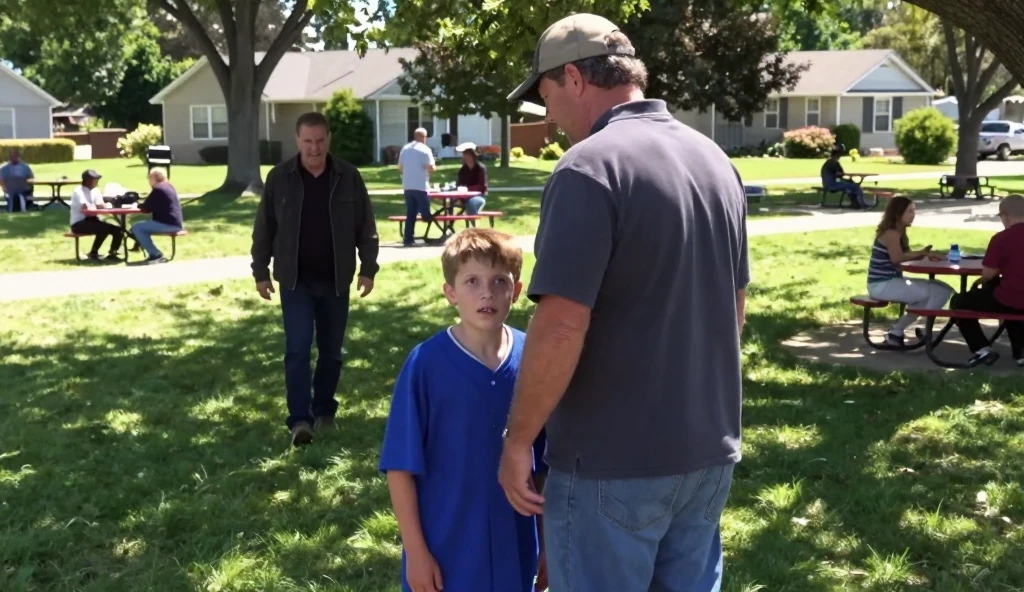
The heat rising off the sun-baked asphalt of the municipal park parking lot felt like a physical wall, but it was nothing compared to the ice water currently pumping through my veins. Toby was practically vibrating against my right leg, his fingers dug so deeply into the coarse pocket lining of my cargo shorts that I could feel the sharp pull against my skin with every shallow breath he took. His tiny, sweat-dampened frame was tucked completely behind my bulk, using me as a human shield against the world, while my eyes remained locked onto the approaching figure of the man in the dark jacket.
The stranger didn’t look like a monster, which somehow made the entire situation ten times more terrifying. He looked like any other suburban dad you’d see buying a gallon of milk or washing his sedan on a Sunday morning—maybe early forties, hair neatly parted, wearing clean running shoes and a lightweight black windbreaker despite the sweltering June heat. But his eyes were entirely different; they were completely flat, unblinking, and locked onto the tiny sliver of Toby’s blue Little League jersey that peeked out from behind my hip.
“Toby,” the man said, his voice carrying a practiced, rhythmic warmth that sent an immediate shiver down my spine. “Hey, buddy. There you are. Your mother and I have been looking all over the playground for you. You can’t just run off like that.”
He stopped exactly six feet away, his arms hanging loosely at his sides, though I noticed his right hand remained casually jammed deep inside his windbreaker pocket. Up close, I could see a faint, jagged white scar running along the edge of his jawline, and a heavy gold wedding band glinted on his left hand. He offered me a tight, apologetic nod that felt completely rehearsed, the kind of look one parent gives another when their toddler throws a tantrum in a grocery aisle.

“Sorry about that, coach,” the man said, his tone smooth, conversational, and entirely unbothered by the tense standoff. “He’s got a habit of wandering when he gets overwhelmed. I appreciate you looking out for him, but I’ll take him off your hands now.”
I didn’t move an inch, keeping my wide stance firmly anchored between them, my old catcher’s knees groaning under the sudden shift in weight. “He seems pretty shaken up,” I said, keeping my voice low, steady, and entirely devoid of the panic that was hammering against my ribs. “And he’s not exactly running toward you, mister.”
The man’s smile didn’t fade, but the muscles around his jaw visibly tightened, a sharp, momentary twitch that told me everything I needed to know. “Well, he knows he’s in trouble for leaving the yard,” he replied smoothly, taking a half-step forward, his clean sneaker crunching loudly on a stray piece of gravel. “We’re just visiting the area, and he gets confused. Come on, Toby. Let’s go. Don’t embarrass us in front of your old coach.”
Behind me, Toby gave a sharp, choked whimper, and his little hands moved frantically against my thigh. I couldn’t look down without breaking eye contact with the stranger, but I could feel the rhythmic, repetitive tapping of his knuckles against my leg—the unmistakable, desperate cadence of a child trying to communicate without making a sound.
“What’s your name?” I asked bluntly, deliberately dropping the polite, deferential tone that old timers in this town usually used with strangers.
The man paused, his eyes narrowing just a fraction of a millimeter, the flat gray color of his irises hardening like wet cement. “Marcus,” he said after a beat too long. “Marcus Vance. Look, mister… I appreciate the neighborhood watch routine, truly. But that’s my kid, and we have a long drive ahead of us. Toby, get over here right now.”
The sudden change in his tone—from smooth salesman to a sharp, metallic command—made Toby flinch violently behind me. The boy’s grip on my shorts was so intense I thought the fabric would tear, and I could feel him trembling so hard his knees were literally knocking against the back of mine.
“I don’t think so, Marcus,” I said, deliberately using his name to throw him off balance, though my heart was pounding so hard I could hear it echoing in my ears. “I’ve known Toby since he was six years old. I coached him through two seasons of winter ball. I know his mom, Sarah. And I sure as hell know he doesn’t have a father named Marcus.”
The silence that settled between us was thick, heavy, and suffocating, completely drowning out the distant sounds of children laughing on the swings and the rhythmic clinking of horseshoe pits fifty yards away. Marcus didn’t blink. The fake warmth melted off his face like cheap wax, leaving behind a cold, expressionless mask that made him look completely detached from humanity.
“You’re an old man, coach,” Marcus said, his voice dropping an octave, losing every trace of its previous suburban charm. “You’re a retired old man sticking your nose into a domestic situation you don’t understand. Toby is coming with me. You can either make this easy, or we can make this incredibly loud and unpleasant for everyone in this park.”
He took another step, his left hand reaching out toward Toby’s shoulder, his fingers hooked like a claw.
Before he could touch the boy, I reached out and slammed my heavy, calloused palm directly against Marcus’s chest, pushing him back with the residual strength of a man who had spent forty years hauling crates in an industrial warehouse. He stumbled back two steps, his eyes widening in genuine surprise that an old man in cargo shorts and a faded baseball cap had the nerve to lay hands on him.
“Touch him again, and I’ll drop you right here on the asphalt,” I snarled, the raw, unfiltered protective instinct of a grandfather completely overriding any common sense or self-preservation. “I don’t care who you think you are. You’re not taking this boy anywhere.”
Marcus recovered his balance instantly, his face darkening as a dark, dangerous flush crept up his neck. His right hand, still buried inside his windbreaker pocket, shifted sharply, and I saw the distinct, rigid outline of something heavy and metallic press against the thin nylon fabric. My stomach dropped into a bottomless pit as I realized exactly what he was holding inside that pocket.
“You’re making a massive mistake,” Marcus whispered, his eyes darting quickly over my shoulder toward the crowded pavilion where the local rotary club was hosting their weekend barbecue. “Look around you, old man. There are fifty people within shouting distance. You think you’re a hero? You think you can protect him from what happens next?”
“I don’t need to be a hero,” I muttered, my voice tight as I kept my eyes locked on his hidden hand. “I just need to keep you right here until the authorities arrive.”
Even as I said the words, a cold spike of reality hit me. My cell phone was sitting on the wooden bench of the dugout across the field, easily a hundred yards away, right next to my clipboard and my half-empty water bottle. There was nobody close enough to hear a whispered threat, and the surrounding families were entirely wrapped up in their own weekend lives, oblivious to the high-stakes hostage situation unfolding right under their noses.
Marcus seemed to read my mind, a slow, cruel smirk spreading across his thin lips. “Go ahead. Call them,” he taunted softly, taking another small step to the left, trying to angle around my heavy frame to get a clean line of sight on the boy. “Show me your phone, coach. Let’s see how fast they get here.”
Toby suddenly let go of my shorts, and for a terrifying second, I thought he was going to run. But instead, he stepped slightly to my left, just far enough for me to see his hands out of the corner of my eye. His small fingers were moving with a furious, precise energy, forming shapes in the air that I hadn’t seen since my late wife used to volunteer at the state school for the deaf.
He tapped his chest, made a sweeping motion downward, and then pointed a trembling index finger directly at the black windbreaker Marcus was wearing. Then, with an agonizingly slow deliberation, Toby raised his left hand, tucked his thumb across his palm, and closed his four fingers over it—the universal sign for help, the desperate silent signal of a child trapped in a living nightmare.
“Toby, cut it out,” Marcus snapped, his eyes flashing with sudden anger as he noticed the boy’s hand movements. “Stop doing that garbage. Get over here now.”
“He’s telling me something, Marcus,” I said, my voice rising slightly, trying to draw the attention of a young couple walking a golden retriever about thirty yards away. “He’s telling me exactly what you did to him.”
“He’s a disturbed kid who makes things up!” Marcus barked, his calm facade finally shattering as he took a hard, aggressive stride toward us, his hidden hand tensing inside the pocket. “This is your last warning, old man. Step aside.”
The couple with the dog paused, looking over at us with a mixture of curiosity and mild discomfort, but Marcus immediately turned his head toward them, shifting his expression back to one of stressed, exhausted paternal patience. “Everything’s fine, folks!” he called out, his voice loud and clear. “Just a stubborn grandson refusing to get in the car for his doctor’s appointment. We’ve got it handled!”
The young man with the dog nodded sympathetically, pulled his girlfriend’s arm, and continued walking toward the grass field, completely buying the lie. My heart sank. Marcus was a professional; he knew exactly how to manipulate public perception in a split second, turning a potential rescue into a common family dispute.
As Marcus turned his attention back to me, his face hardened into pure malice. “See?” he whispered, his voice dripping with venom. “Nobody cares. Nobody is going to help you. Now hand over the boy before I stop being polite.”
I knew I couldn’t outrun him, and I certainly couldn’t outrun whatever was inside his pocket. My mind raced through my options, each one worse than the last. If I swung at him, he might pull the trigger right here in front of Toby. If I yelled for help again, he would just spin another convincing lie or worse, use the weapon to clear a path.
But then, Toby did something that changed everything.
With a sudden burst of frantic movement, the boy reached out and grabbed the edge of his own blue baseball jersey, pulling it entirely over his head in one swift, desperate motion. Underneath, he wasn’t wearing a t-shirt.
In the bright, unyielding glare of the afternoon sun, the full extent of the horror was laid bare. Toby’s small, pale torso was covered in a network of angry, intersecting marks—deep, purplish-black welts that wrapped around his ribs like a cage, and a terrifyingly distinct, perfectly straight impression of a thick leather strap stamped directly across his collarbone. The marks were fresh, some of them slightly oozing, standing out in horrific contrast against his fragile skin.
A collective gasp echoed from behind us.
I hadn’t realized it, but the old timer from the horseshoe pits, a retired sheriff’s deputy named Miller who I’d known for twenty years, had walked up behind us to ask if I wanted to grab a hot dog from the pavilion. He had arrived just in time to see Toby pull off his jersey.
Marcus froze, his face turning a sickly, ash-gray color as he realized he was no longer dealing with an isolated old man in an empty corner of the parking lot. Miller’s heavy boots crunched on the gravel as he stepped up beside me, his hand already resting firmly on the heavy leather holster at his hip.
“Well, now,” Miller said, his voice dropping into a low, dangerous rumble that sounded like a approaching thunderstorm. “That doesn’t look like any doctor’s appointment I’ve ever heard of, mister.”
Marcus looked at me, then at Miller, then at the marks on Toby’s back. The arrogant, calculating smirk completely vanished from his face, replaced by the frantic, darting eyes of a cornered animal realizing the trap had just snapped shut on his leg. His right hand twitched violently inside his windbreaker pocket, and for a breathless, terrifying second, the entire park seemed to hold its breath.
“Don’t even think about it, son,” Miller warned, his voice deadpan and steady as his thumb unclipped the safety strap on his holster. “You pull whatever is in that pocket, and you won’t make it to the edge of the grass.”
Marcus stood perfectly still, his chest heaving under the black nylon jacket as he calculated his chances against two grown men, one of them an armed former lawman. The silence stretched out, taut as a piano wire, until a sudden movement from the playground broke the spell.
A woman’s sharp, piercing scream tore through the afternoon air from the direction of the pavilion, followed by the chaotic sound of running footsteps. Marcus’s head snapped toward the noise, and in that split second of distraction, I knew our nightmare was about to enter an entirely new, far more dangerous phase.
The sharp, piercing scream cutting through the muggy June afternoon didn’t come from a child on the playground, but from a woman standing near the covered pavilion where the local Rotary Club was setting up a row of silver chafing dishes. It was a sound of absolute, unadulterated terror that instantly shattered the lazy, sun-drenched atmosphere of Oakridge Community Park.
Every single head in the immediate vicinity snapped toward the noise, the collective attention of dozens of families shifting away from their picnics and lawn games in an instant. Marcus Vance, whose hand remained coiled tightly like a spring inside his dark nylon windbreaker pocket, flinched at the sound, his rigid posture breaking just enough for me to see the raw panic flashing across his pale features.
Beside me, Deputy Miller didn’t hesitate for a single heartbeat, his hand remaining anchored to the grip of his service weapon while his eyes swept the immediate perimeter with the cold, practiced precision of a veteran lawman. “Stay right where you are, mister,” Miller growled, his voice dropping into a register that was barely audible over the rising murmur of the crowd but carried the weight of a stone wall.
“I didn’t do anything,” Marcus muttered quickly, his voice cracking slightly as the smooth, calculated bravado he had displayed just moments ago began to unravel at the seams. He took a cautious, dragging step backward, his clean running shoes kicking up a small cloud of grey gravel that settled over the polished leather of Miller’s uniform boots.
Toby was still shivering violently against my left side, his small, bare chest heave-hoing as he drew in ragged, desperate breaths of the humid summer air. The purple, crisscrossed welt marks wrapping around his rib cage seemed to darken under the harsh glare of the high afternoon sun, standing out like a horrific roadmap of a nightmare no nine-year-old child should ever have to endure.
I reached down with my left hand, keeping my broad frame positioned squarely between the boy and the stranger, and gently pressed Toby back into the narrow shadow cast by my body. “Keep your head down, buddy,” I whispered, my voice thick with an overwhelming mixture of protective fury and a sickening dread that seemed to coat the back of my throat like ash.
From the direction of the pavilion, a woman in a floral summer dress came sprinting across the grass, her sandals twisting in the thick turf as she pointed a trembling finger toward the treeline that bordered the northern edge of the park. “He’s got a gun!” she shrieked, her voice echoing off the aluminum siding of the equipment shed where the Little League gear was stored. “There’s a man with a rifle by the old maintenance shed! He’s looking through a scope!”
The effect on the park-goers was instantaneous and catastrophic; the polite, middle-class order of a Saturday afternoon collapsed into pure, unbridled chaos within a matter of seconds. Parents threw themselves over their children on the grass, picnic blankets were upended as people scrambled toward the brick restroom structure for cover, and the distant clinking of horseshoe pits was replaced by the frantic, echoing screams of dozens of fleeing citizens.
Marcus Vance didn’t look toward the maintenance shed; instead, his flat, cement-grey eyes snapped right back to Toby, a terrifying expression of cold resolve hardening his features as the surrounding world fell apart. His hand inside the windbreaker pocket shifted with a sudden, violent jerk, the heavy, rigid outline of the concealed firearm pressing hard against the thin fabric as he leveled it directly at my midsection.
“Move aside, coach,” Marcus said, his voice dropping into a chillingly calm whisper that was completely detached from the hysterical screaming echoing across the open field. “I’m taking the boy right now, and if you or your retired friend make a single move, I will clear a path through both of you before anyone even realizes what happened.”
Miller didn’t wait for Marcus to draw the weapon from his pocket; with a speed that defied his heavy build and grey hair, the old deputy stepped forward and brought his heavy leather flashlight down in a swift, arc-like motion against Marcus’s right forearm. The solid thud of metal striking bone echoed clearly over the din of the park, followed instantly by a sharp, agonized gasp from Marcus as his knees buckled under the force of the blow.
The concealed firearm fired through the bottom of the nylon windbreaker pocket, a deafening, metallic crack that sounded like a firecracker exploding inside a metal garbage can. The bullet chewed into the grey gravel of the parking lot just inches from my right work boot, sending a sharp spray of stone fragments and dirt biting into my denim jeans.
Toby let out a high, thin shriek of pure terror, his tiny hands flying up to cover his ears as he collapsed onto the gravel, his bare, bruised back curling into a tight, defensive ball against the rear tire of my old Ford pickup truck.
Marcus scrambled backward on his hands and knees, his injured right arm clutching his ribs while his left hand desperately tore at the shredded, smoking fabric of his jacket pocket to free the small, black semi-automatic pistol trapped inside. “Get down!” Miller roared, his voice completely overpowering the ambient noise of the panic as he drew his own weapon and leveled it at Marcus’s chest. “Drop the weapon! Drop it right now or so help me god I will end this right here!”
But Marcus wasn’t looking at Miller’s gun; his eyes were fixed on the northern treeline, his head snapping around as a second, far more distant gunshot echoed from the direction of the maintenance shed. The sound was different—a deep, resonant crack that carried the unmistakable signature of a high-powered hunting rifle, the bullet whistling high through the leaves of the oak trees above our heads before thudding into the wooden scoreboard of the Little League field.
“He’s clearing the perimeter!” Marcus yelled, a hysterical, wild laugh bubbling up from his throat as he scrambled to his feet, ignoring the barrel of Miller’s service weapon. “You think you old timers can stop this? You have no idea what you’re standing in the middle of! Hand over the asset!”
The word hit me like a physical blow to the sternum—the asset. He didn’t say ‘my son,’ he didn’t say ‘the boy,’ and he certainly didn’t look like a desperate father trying to reclaim a runaway child. He looked like an operator who had just lost control of a highly structured technical recovery, his clean, suburban dad persona completely discarded to reveal something clinical, professional, and utterly ruthless underneath.
Before Miller could fire or advance, a dark blue sedan with tinted windows came tearing over the grass from the secondary entrance of the park, its tires spinning wildly in the turf and throwing clods of dirt into the air as it roared toward the parking lot. The passenger door swung open before the vehicle had even come to a complete stop, revealing a second man dressed in identical black tactical clothing, a short-barreled shotgun held tight against his chest.
“Get in the car, Vance!” the driver screamed over the roar of the engine, the vehicle pivoting in a tight, aggressive slide that positioned the heavy metal frame of the sedan directly between Miller and Marcus.
Miller fired two shots in rapid succession, the heavy rounds punching clean, star-shaped holes through the rear windshield of the sedan, but the driver didn’t hesitate, slamming the car into reverse and backing up at a terrifying speed toward the spot where Toby lay curled against my truck tire.
I didn’t think; there was no time for tactical calculations or rational thought. I lunged downward, my old, aching shoulders protesting violently as I grabbed Toby by the waistband of his oversized blue shorts and dragged him beneath the high, rusted chassis of my Ford F-150 just as the blue sedan slammed into the truck’s rear bumper with a sickening crunch of tearing metal.
The impact rocked the heavy pickup, the rear axle groaning as the frame shifted three inches to the left, but the sturdy American steel held against the lighter foreign sedan. Beneath the truck, the air was thick with the smell of old grease, hot exhaust, and the sharp, metallic tang of leaking coolant, but it was a fortress compared to the open asphalt of the parking lot.
Toby was pressed flat against my chest, his small heart hammering against his ribs like a trapped bird, his fingers digging into the fabric of my polo shirt so hard I could feel his nails breaking against my skin. “I’ve got you, Toby,” I growled into his hair, my eyes locked on the space beneath the truck frame where two pairs of heavy tactical boots had just slammed down onto the gravel. “I’ve got you, son. Hold on to me.”
Through the narrow gap between the bottom of the truck door and the gravel, I saw Marcus’s running shoes stumble toward the passenger side of the sedan, his movements hurried and erratic. “The boy is under the truck!” he shouted, his voice muffled by the roaring engine of the sedan. “Get him out! We don’t have time before the local state troopers respond to the shots fired call!”
“Leave him!” the driver yelled back, his voice crackling with a strange, high-pitched static that suggested he was speaking through a radio headset integrated into his gear. “The old deputy is calling it in on his radio, and the perimeter shooter says local units are already shifting from the highway intersection! We go now, or we get bottled up in this valley!”
A heavy boot slammed against the side of my truck’s quarter panel, a parting gesture of pure, frustrated malice that left a deep, crescent-shaped dent in the rusted metal. The passenger door of the sedan slammed shut with a heavy, solid thud, and the vehicle’s tires tore into the gravel once more, reversing out of the parking lot at a breakneck speed before spinning onto the main access road and vanishing toward the highway in a cloud of grey dust and burning rubber.
The silence that followed was heavy, suffocating, and absolute, broken only by the distant, fading wail of a car alarm near the pavilion and the rhythmic, ticking sound of my truck’s cooling engine block.
Miller’s face appeared in the gap beneath the running board, his grey hair disheveled and a thin trickle of dark blood running down from a small scratch near his temple where a piece of flying gravel had caught him. “Alex, you okay down there?” he breathed, his chest heaving as he slid his service weapon back into its holster with a hand that was visibly shaking. “Did they hit either of you?”
“We’re intact,” I grunted, my voice sounding hollow and strange in the confined space beneath the truck chassis. “But Toby’s in bad shape, Miller. We need to move him before those bastards figure out a way to circle back around from the county line.”
With Miller’s help, I carefully backed out from beneath the truck, keeping my arms wrapped tightly around Toby’s small frame to ensure his bare skin didn’t scrape against the rusted undercarriage. The boy refused to let go of my shirt; his fingers were locked in a literal death grip, his chin tucked so deeply into my collarbone that he was practically dead weight as I hauled myself up onto the gravel.
The park was completely deserted now, a ghost town of abandoned strollers, half-eaten hot dogs, and overturned lawn chairs scattered across the emerald-green grass. In the distance, the faint, rising wail of emergency sirens began to cut through the heavy summer air, approaching from both the north and south avenues—the local police and county sheriffs finally responding to the chaotic reports of an active shooter in the community park.
Miller stood over us, his hand resting on his hip as he stared down at the deep, parallel bruises on Toby’s exposed torso. The anger in the old deputy’s eyes had hardened into something cold, clinical, and deadly. “Those weren’t marks from a standard family dispute, Alex,” he said softly, his voice dropping into the tone he used when he used to examine crime scenes along the interstate. “That’s deliberate, structured restraint marking. Someone kept this boy tied down.”
I looked down at Toby, whose face was completely hidden against my chest, his small frame still hitching with residual sobs. “He signed ‘Not home,’ Miller,” I said, my own voice trembling as the adrenaline began to drain from my system, leaving behind a cold, hollow ache in my bones. “He didn’t mean he was lost. He meant his home wasn’t a home anymore. He was running for his life.”
“We can’t stay here,” Miller said, his eyes scanning the empty treeline where the rifleman had been spotted just minutes prior. “When the local department gets here, they’re going to log this as a domestic abduction attempt with shots fired. They’re going to want to take the boy to the county hospital for a forensic evaluation, and they’re going to processing the scene for hours.”
“And Marcus and his friends will know exactly which hospital room he’s in within twenty minutes of the police radio dispatch,” I added, the cold reality of the situation settling into my gut like a lead weight. “You heard that guy in the car—he called Toby an asset. These aren’t standard backwoods abusers, Miller. They have coordination. They had a shooter watching the perimeter from a hundred yards out.”
Miller nodded slowly, his jaw set in a rigid, uncompromising line that reminded me of the days when he was the toughest investigator in the tri-county area. “My cabin up on the Ridge is empty,” he said, reaching into his pocket and pulling out a heavy ring of brass keys. “It’s off the grid, no landline, and the road isn’t on the standard GPS maps. Take your truck, get the boy out of here before the first cruiser pulls through the main gate. I’ll stay behind, cover the scene, and tell the chief I lost sight of you in the initial panic.”
“You’re risking your pension, Miller,” I said, looking up at my old friend from my position on the gravel.
“I’m sixty-seven years old, Alex,” Miller replied with a faint, humorless smile that didn’t reach his eyes. “My pension is already locked in, and my conscience wouldn’t survive letting that monster get his hands back on this kid. Now move. The sirens are less than two miles out.”
I didn’t argue. I scooped Toby up in my arms, his small body surprisingly light against my chest, and opened the passenger door of my dented F-150. I placed him gently onto the worn vinyl bench seat, reaching across to pull his oversized blue baseball jersey back over his shoulders to cover the horrific network of bruises that seemed to cry out for justice in the bright afternoon light.
He didn’t make a sound as I buckled him in, but his wide, terror-stricken eyes never left my face, tracking my every movement with the desperate intensity of a drowning victim locking eyes with a lifeguard. I climbed into the driver’s seat, slammed the door shut, and turned the key in the ignition. The old V8 engine roared to life with a comforting, mechanical rumble that felt like the only stable thing left in my universe.
As I backed out of the parking space, the rear bumper scraping loudly against the crumpled metal where the blue sedan had struck us, I looked back at Miller. The old deputy was already walking toward the center of the parking lot, his back straight, his hand resting casually near his holster as the first white-and-blue police cruiser came tearing through the park’s main gates, its emergency lights flashing red and blue against the summer leaves.
I turned the truck down the narrow dirt utility road that skirted the back of the baseball diamonds, avoiding the main exit entirely. The path was rough, overgrown with thick brush and low-hanging branches that scraped loudly against the truck’s windshield, but it led directly to the old logging trail that cut through the valley toward the Ridge.
For the first ten minutes of the drive, the cabin of the truck was completely silent except for the rhythmic thumping of the tires over the unpaved road and the low, rattling vibration of the dashboard. Toby sat completely rigid against the passenger door, his knees pulled up to his chest, his small hands still trembling as he stared out the side window at the thick, green blur of the passing forest.
“Toby,” I said softly, keeping my eyes fixed on the narrow, winding dirt path ahead of us. “You’re safe now, buddy. I promise you. Nobody is going to hurt you while you’re with me.”
The boy didn’t turn his head, but I saw his reflection in the side glass—his jaw was clenched so tightly that the muscles in his cheeks were twitching, a direct mirror of the expression I had seen on Marcus Vance just a short time before. Slowly, deliberately, Toby lowered his legs and turned his body toward me, his hands rising into the space between us.
He didn’t use standard sign language this time; instead, he made a series of quick, sharp gestures that were completely unfamiliar to me—two fingers tapping his left wrist twice, followed by a flat palm slicing horizontally through the air, and finally, his small hand forming a tight fist that he pressed directly against his mouth.
“I don’t know that one, Toby,” I said gently, my heart aching as I realized the boy was trying to tell me something of immense importance but lacked the voice to say it aloud. “You’ll have to show me another way, buddy. We’re going to a safe place. An old friend’s cabin up in the mountains.”
Toby’s hands dropped into his lap, his shoulders slumping in a gesture of profound, exhausting defeat. He reached down into the pocket of his oversized shorts and pulled out a small, crumpled piece of paper that had been folded into a tight, hard square no larger than a postage stamp. He held it out toward me, his small fingers trembling so violently that the paper rattled against the plastic center console of the truck.
I reached over and took the paper, smoothing it out against the steering wheel with my thumb while keeping my left hand firmly on the wheel. It wasn’t a note or a drawing; it was a small, high-density thermal printout, the kind used in industrial logistics or medical facilities, bearing a complex, two-dimensional barcode and a single line of alphanumeric text printed in crisp, black font: PROJECT VANGUARD – SUBJECT 09 – STATUS: CRITICAL.
Below the text, written in a hurried, frantic hand with a blue ballpoint pen that had bled through the cheap paper, were four words that made the hair on the back of my neck stand completely on end: They are watching everything.
A sudden, sharp shadow fell over the cab of the truck, accompanied by a low, rhythmic thumping sound that grew steadily louder until it completely drowned out the noise of the old V8 engine. I leaned forward, looking up through the dusty windshield just as a sleek, matte-black helicopter without any commercial markings or registration numbers cleared the crest of the ridge ahead of us, its nose dipping sharply as it banked directly into the narrow valley where the logging trail ran.
The aircraft was flying incredibly low, barely fifty feet above the treetops, its powerful rotor wash ripping through the canopy and sending a storm of loose leaves and broken branches raining down onto the hood of my truck.
“Hold on!” I shouted, slamming my foot onto the accelerator as the truck fish-tailed wildly on the loose dirt road. The helicopter tracked our movement perfectly, its powerful searchlight snapping on despite the bright daylight, casting a blinding, brilliant beam of white light directly into the cab, turning the interior of the truck into a high-contrast arena of terror.
Toby screamed—a sound that finally broke through his silent wall, a raw, gutteral cry of pure panic that tore through my heart like a jagged blade. He threw himself into the floorboard, tucking his head beneath the dashboard as the massive black shape of the aircraft hovered directly over the path ahead, effectively cutting off our only escape route up the mountain.
I slammed on the brakes, the tires locking up instantly and sending the truck sliding into a sideways skid that ended with the front bumper wedged deep into a thick patch of blackberry brambles at the edge of the trail. The engine sputtered once, coughed a thick cloud of grey smoke, and died, leaving us trapped in the blinding glare of the aerial searchlight while the rhythmic, deafening beat of the rotor blades vibrated through the very frame of the vehicle.
Through the dust-covered passenger window, I saw the side door of the helicopter slide open, revealing three men dressed in identical black tactical gear, their faces hidden behind dark ballistic visors as they began to lower themselves down onto the dirt road using thick, braided nylon ropes.
We were completely trapped, thirty miles into the rugged backcountry, with no police support, no working vehicle, and an armed paramilitary extraction team closing in on our position from less than thirty yards away. I looked down at Toby, who was curled into a tight ball on the floorboards, his small hands clutching the crumpled piece of thermal paper as if it were a lifeline.
“Alex,” a cold, metallic voice echoed from a high-powered loudspeaker mounted on the undercarriage of the helicopter, the sound vibrating through the glass windows of the truck. “Step out of the vehicle with your hands behind your head. The asset belongs to the corporation. Your involvement terminates now.”
I reached into the glove compartment, my fingers wrapping around the cold, heavy handle of my old iron-framed Smith & Wesson revolver—a gun I hadn’t fired since my days on the county watch thirty years ago. I knew the six rounds inside the cylinder were completely useless against an airborne tactical unit, but as I looked at the terrifying purple welts on Toby’s back, I knew I would die on this dirt road before I let them take him back to whatever living hell he had escaped from.
The front passenger door of the truck was suddenly ripped open from the outside, the metal hinges groaning under an immense force as a blast of wind from the rotor wash tore through the cabin, scattering loose papers and dust everywhere. A heavy, gloved hand reached into the dark floorwell, grabbing Toby by the collar of his blue Little League jersey and lifting him bodily toward the open door.
“No!” I roared, swinging the heavy iron barrel of the revolver with everything I had left in my old frame, striking the tactical operator across the side of his helmet with a loud, metallic crack that sent him stumbling backward into the dirt.
But before I could level the weapon to fire, a second figure appeared in the open doorway, the dark muzzle of a weapon pointed directly at my chest, and a sharp, blinding flash of light exploded in my vision, plunging the entire world into a deep, silent darkness.
— CHAPTER 4 —
The heavy, metallic slam of the truck’s passenger door echoing through the dense canopy of the Ridge logging trail was the last normal sound I heard before the world dissolved into absolute, unmitigated chaos. My fingers were frozen around the cold, textured grip of my old iron-framed Smith & Wesson revolver, the weight of the weapon feeling entirely inadequate against the high-powered tactical force descending from the belly of the matte-black helicopter hovering fifty feet above us. The blinding beam of the aircraft’s searchlight pinned us to the gravel road like insects on a display board, bleaching all the color out of the forest and turning the interior of my rusted Ford F-150 into a cage of stark, terrifying shadows.
Through the dust-covered windshield, I watched the first tactical operator hit the ground, his heavy combat boots crunching violently into the loose stone as he disconnected his descent line from the thick nylon rope in one smooth, practiced motion. His entire uniform was an oppressive, non-reflective black, devoid of any patches, insignias, or national flags, confirming my worst fears that we weren’t dealing with local law enforcement or federal agents following a standard legal protocol. These men were private, clinical, and completely detached from the boundaries of the law, moving with the terrifying synchronization of an elite extraction team that had spent months preparing for this exact recovery.
Beside me, down in the cramped floorwell of the passenger side, Toby was curled into a ball so tight his tiny joints looked ready to snap under the pressure of his own terror. His small hands were still clamped over his ears to blot out the deafening, rhythmic thudding of the rotor blades, but his lips were moving in silent, frantic patterns, forming words in American Sign Language against the dark carpet of the floorboard. He wasn’t signing “Not home” anymore; his fingers were repeating a single, desperate sequence over and over again—a frantic plea for hiding, for disappearing, for the ground to swallow him whole before the gloved hands could drag him back to the facility.
“Stay down, Toby,” I barked, though my voice was completely swallowed by the ambient roar of the aircraft and the rushing wind of the rotor wash that was ripping through the open passenger door. I shifted my weight on the worn vinyl seat, my old catcher’s knees groaning in protest as I leaned across the center console, trying to use my broad, aging torso to shield the boy from the open doorway where the first operator was already advancing.
The man didn’t hesitate, his movements cold and mechanical as he reached into the cab with a heavy, Kevlar-gloved hand, his fingers hooking directly into the collar of Toby’s oversized blue Little League jersey. The fabric tore with a sharp, high-pitched screech that went straight to my spine, and the sudden physical contact broke Toby’s silent paralysis, causing him to unleash a raw, gutteral shriek of pure panic that seemed to shake the very frame of the truck.
The sound of that child’s voice—the first real, vocalized sound of absolute terror I had heard from him all afternoon—cleared away every trace of hesitation or self-preservation left in my sixty-eight-year-old body. I didn’t think about the tactical rifles, I didn’t think about the helicopter, and I didn’t think about the fact that I was completely outmatched by men forty years younger than me.
I swung the heavy iron barrel of the Smith & Wesson with everything I had left, bringing the solid steel frame down in a brutal, descending arc that caught the operator squarely across the side of his ballistic helmet. The impact was a solid, metallic crack that vibrated all the way up my arm to my shoulder, the force of the blow driving the man backward off the truck’s running board and sending him stumbling into the thick blackberry brambles lining the edge of the dirt trail.
“Get your hands off him!” I roared, my voice raw and cracking with a primitive, grandfatherly fury that I didn’t know I possessed.
But my small victory lasted less than a second. Before I could level the revolver to clear the doorway, a second black-clad figure appeared in the open space, the short, modular barrel of a tactical weapon pointed directly at my chest through the swirling dust. There was no verbal warning, no command to drop my weapon, no negotiation—just a sharp, deafening pop and a brilliant, blinding flash of white light that exploded directly in front of my eyes.
A wave of intense, localized heat slammed into my shoulder, followed instantly by a crushing force that felt like being struck by a speeding fastball delivered straight from a major league mound. The impact threw me backward against the driver’s side door, my head bouncing hard against the glass window as the revolver slipped from my numbed fingers, clattering uselessly into the darkness between the seats.
The world didn’t go completely black, but it narrowed down to a tiny, suffocating tunnel of gray mist and distorted audio, the deafening roar of the helicopter suddenly sounding like it was trapped under miles of deep ocean water. I could feel the cold vinyl of the seat against my cheek, and I could smell the sharp, chemical tang of burnt nylon and propellant, but my limbs felt entirely disconnected from my brain, refusing to respond to my frantic commands to move, to fight, to stand back up between Toby and the doorway.
Through the haze of my failing vision, I saw the gloved hands reach into the truck again, moving with efficient, unhurried precision now that the old man had been neutralized. They lifted Toby bodily from the floorwell, his small legs kicking wildly against the dashboard as he fought with the desperate, futile strength of a captured animal.
The crumpled piece of thermal printout—the tiny square of paper that bore the words PROJECT VANGUARD and the frantic blue ink warning—slipped from Toby’s trembling fingers as they dragged him backward out of the cab. It floated lazily through the dust-choked air of the interior, landing softly on the blood-stained vinyl of the seat just inches from my face, the crisp black barcode staring back at me like a mockery of my failure.
“Alex!” Toby’s voice screamed out from the darkness outside the truck, a sharp, piercing cry that managed to pierce through the heavy curtain of my fading consciousness. It wasn’t a silent sign; it was my name, spoken aloud with a terrifying clarity that filled the entire valley before it was abruptly cut short by the heavy, pressurized slam of a helicopter door.
The thudding of the rotor blades changed pitch, shifting into a high-pitched, straining whine as the aircraft began to climb back into the mountain sky, the powerful downdraft washing over the stalled truck one last time before fading into the distance. The blinding white searchlight swept away from the cab, leaving the interior of the vehicle plunged into the deep, gray shadows of the late afternoon forest, the sudden silence of the woods setting in like a heavy shroud.
I lay there for what felt like hours, the cool air from the open passenger door slowly clearing the thick fog from my brain until the sharp, throbbing ache in my shoulder flared to life with an agonizing intensity. I rolled onto my back, a ragged groan escaping my lips as I forced my left hand to reach up and touch the front of my polo shirt, my fingers coming away slick and dark with fresh, warm blood.
The round had caught me just below the collarbone, a clean entry wound that missed the bone but had torn through the muscle with enough force to leave my entire right side completely paralyzed. I dragged myself up using the steering wheel for leverage, my breath coming in shallow, burning gasps as I looked over at the empty passenger seat, the torn fragments of Toby’s blue baseball jersey the only physical proof that he had ever been there.
My phone was gone, destroyed or lost back at the park, and Miller’s cabin was still miles away up a logging trail that my truck could no longer traverse. I was completely alone in the rugged backcountry of the Ridge, bleeding out on a vinyl seat, with no way to call for help and no idea where the corporate extraction team had taken the little boy who had run into my arms for protection.
But as I stared down at the crumpled piece of thermal paper resting on the seat beside me, the sheer, unadulterated anger inside my chest began to burn through the pain and the exhaustion. They thought they had ended it; they thought an old man with a ruined shoulder would just lie down in the dirt and let them disappear back into their shadow world with their “asset.”
They didn’t know who they were dealing with. I spent forty years running logistics for the heaviest freight lines in the state, and I spent twenty years coaching kids how to stand their ground at home plate when a fastball was coming straight for their ribs. I wasn’t going to back down now.
I used my left hand to tear a strip of fabric from the clean rags I kept behind the seat, binding it tightly over my bleeding shoulder to stanch the flow before reaching down to retrieve the tiny square of paper. My fingers were shaking, but my grip was steady as I stuffed the paper deep into my pocket, right next to the brass key Miller had given me before the chaos began.
I had to get to the cabin. I had to find Miller. And then, regardless of what corporate entity or paramilitary force was standing in our way, we were going to bring Toby home.
— CHAPTER 4 —
The deafening, metallic roar of the Remington 12-gauge shotgun tearing through the hollow, corrugated steel expanse of the abandoned limestone processing plant did more than just break the standoff; it fundamentally rewrote the rules of engagement in that freezing, dark cavern. The high-velocity slug slammed directly into the heavy structural steel girder a mere three inches above Marcus Vance’s left shoulder, showering his tactical vest with a violent cascade of white-hot sparks, jagged metal fragments, and pulverized industrial rust. The sheer kinetic percussion of the blast, echoing off the high, decaying tin ceiling forty feet above us, physically threw the corporate recovery technician off balance, forcing him to stagger backward three steps before collapsing hard against the rusted metal tracking of the primary conveyor belt line. His semi-automatic pistol slipped from his twitching fingers, clattering loudly against the oil-stained concrete floor before sliding into the deep, dark trench of the drainage reservoir below.
I didn’t pause to admire the damage or wait for the ringing in my ears to subside, despite the fact that the sudden, violent recoil of the weapon had sent a fresh wave of blinding, white-hot agony straight through my torn right shoulder, nearly dropping me to my knees right there on the concrete. My left hand worked the pump mechanism with a smooth, instinctual muscle memory born of twenty years of hunting in the Appalachian brush, ejecting the spent red plastic shell casing into the darkness and chambering a second heavy slug with a sharp, terrifying clack-clack that sounded like a death knell in the cavernous room. I kept the smoking barrel of the shotgun leveled directly at the center of Deputy Miller’s chest, my wide stance firmly anchored into the limestone dust as I watched my old friend freeze at the base of the manager’s office stairs, his hands instinctively flying into the air as the true gravity of his betrayal caught up to him.
“Don’t take another step, Miller,” I growled, my voice coming out as a low, guttural rumble that didn’t sound like it belonged to a retired sixty-eight-year-old shipping clerk, but rather to a man who had officially run out of things to lose in the dark. “I spent twenty years sharing a dugout with you, watching you hand out sportsmanship trophies to nine-year-old kids on Saturday mornings while you were apparently pocketing corporate blood money on the side. Drop the cell phone, drop the tactical radio, and back away from those office stairs before I forget that we used to share a pot of black coffee at the diner every Tuesday morning.”
Miller’s face was an absolute mask of pale, sweat-slicked shock under the harsh, unshaded yellow glare of the construction lamp hanging above us, his heavy jaw dropping slightly as he stared at the dark, wet bloodstain completely saturating the right side of my faded polo shirt. He didn’t reach for his empty holster, but his fingers twitched violently around the edges of the encrypted blue cellular device he was holding, his eyes darting frantically past my shoulder toward the open loading bay doors as if praying for the black-clad corporate extraction team to sprint through the gravel yard and save him from the old man with the shotgun. The low, heavy rumble of the diesel generator in the far western corner of the facility seemed to grow louder in the sudden silence, vibrating through the soles of my work boots and filling the damp, stagnant air with the suffocating scent of burning fuel and old iron.
“Alex, you need to listen to me, you’re not seeing the whole picture here,” Miller stammered, his voice lacking every ounce of the steady, authoritative weight he had used to command crime scenes along the interstate for the last three decades, now reduced to a frantic, defensive whine that made my stomach turn with pure disgust. “You think you’re protecting a normal kid from a bunch of neighborhood abusers, but you’re standing in the middle of a national security operation that was cleared at the highest corporate levels before you even loaded your gear into your truck this morning. That boy doesn’t belong to Sarah, he doesn’t belong to this town, and if you don’t let CoreTek clear him from this county within the next twenty minutes, the federal tracking protocols are going to flag this entire valley, and there won’t be a safe place left for any of us to hide.”
“I don’t give a damn about your corporate protocols or your federal tracking lines, Miller,” I shouted back, the raw, unfiltered fury in my chest completely overriding the burning ache in my collarbone as I took a heavy stride forward, keeping the shotgun perfectly level with his sternum. “I saw the marks on that boy’s ribs back at the park—the parallel, deep-purple welts where your friends kept him tied down to a metal chair like an piece of industrial inventory until he couldn’t even form the silent signs for his own name. You sold your badge, you sold your neighbors, and you sold out a terrified, mute child who ran straight into my arms because he thought an old American uniform still stood for something real in this state.”
From the concrete floor behind the conveyor tracking, Marcus Vance let out a low, ragged groan, his left hand clutching his bruised shoulder where the metal fragments had shredded the nylon of his tactical vest, his fingers desperately sweeping the dark floorboards in a blind search for a backup weapon. Before he could recover his bearings or press the emergency button on his collar radio, I shifted the barrel of the shotgun slightly to the left and blew a three-inch hole clean through the wooden steps of the manager’s office just two feet from his head, the exploding splinters of aged pine striking his ballistic visor with a sharp, rattling sound that forced him to throw his arms over his face and lie perfectly flat in the dust.
“The next one goes directly through your kneecap, Vance,” I called out into the smoky air, my left hand instantly pumping the mechanism again, the mechanical precision of the weapon filling the cavernous processing plant with a cold, unyielding finality. “Miller, you’re going to walk up those iron stairs right now, you’re going to unlock the door to that manager’s office, and you’re going to bring that gray composite storage crate down to the main floor without scratching a single corner of the casing. If I see your hands drop below your waistline for even a fraction of a second, I will put a high-velocity slug through your spine before you can even think about how you’re going to spend your retirement money.”
Miller’s shoulders slumped in a gesture of profound, exhausting defeat, the last remnants of his defensive bravado completely evaporating under the unyielding pressure of the shotgun barrel as he turned his body toward the elevated office structure. His heavy uniform boots made a slow, metallic, clinking sound against the iron steps as he ascended, the sound echoing through the cavernous rafters of the building like a slow countdown toward the end of our old life. I tracked his movement perfectly through the large, dirty glass viewing windows of the office, watching his shadow pass beneath the harsh yellow light bulb as he reached the old wooden desk where the gray composite containment unit was resting, its digital interface still glowing with a series of rapidly changing green numbers that looked completely alien in the decaying industrial room.
Through the glass, I saw Miller reach out with a trembling hand and disconnect the thick, black monitoring cables that ran from the side of the crate into a portable power generator sitting on the floorboards, the digital interface instantly shifting from a bright green to a deep, pulsing amber color as the internal battery backup kicked in. He lifted the heavy, square container by its recessed metal handles, his knees buckling slightly under the weight of the reinforced composite material, and began his slow, cautious descent back down the iron stairs, keeping his eyes locked onto the smoking barrel of the Remington that never wavered from his chest.
“Set it down right here on the concrete, Miller,” I commanded, stepping back five feet to maintain my defensive perimeter as he reached the bottom floor, the heavy crate striking the limestone dust with a dull, hollow thud that seemed to vibrate through the entire room. “Now back up against that conveyor belt line next to your friend Vance, and keep your hands woven together behind your head where I can see every single finger.”
As Miller moved backward to join Vance in the dark shadows of the tracking line, my eyes dropped to the amber monitoring screen of the crate, and my heart took a sudden, violent plunge into a cold pit of dread. Through the small, transparent acrylic viewing pane integrated into the top lid of the containment unit, I could see Toby’s pale, small face resting against a thick layer of medical-grade foam insulation, his eyes tightly closed under the heavy influence of the corporate sedative they had administered back on the logging path. A thin, clear plastic oxygen mask was strapped over his small nose and mouth, his chest rising and falling in a slow, unnaturally rhythmic cadence that told me his small body was fighting against a massive chemical overload designed to keep him silent and compliant during the flight.
“He’s running out of time, Alex,” Marcus Vance croaked from his position on the floor, his voice carrying a dark, desperate edge of clinical panic as he wiped a thin smear of blood from his cheek where a wooden splinter had caught him. “That containment unit isn’t just a box; it’s a localized neurological stabilization chamber configured specifically for Subject 09’s altered brain chemistry. The internal battery backup only has twelve minutes of operational power left before the automated sedative recycling grid shuts down, and if he doesn’t get plugged back into the main terminal on our transport vehicle within that window, his neural pathways are going to lock up permanently from the withdrawal spike.”
“He’s lying to you, Alex!” a sharp, clear voice shouted from the dark eastern entrance of the building, breaking through the low drone of the diesel generator and causing all three of us to snap our heads toward the shadows of the loading bay. Sarah stepped out into the dim light of the construction lamp, her boots covered in dark creek mud and her denim jacket torn from her scramble through the briars, but her hands were perfectly steady as she leveled a small, silver-plated wire cutter directly at the monitoring terminal of the crate. “The stabilization chamber isn’t keeping him alive; it’s a wireless data extraction loop that CoreTek uses to download his cognitive tracking logs while he’s unconscious. If we cut the external monitoring array right now, the lock on the top lid will automatically release, and the sedative lines will flush with pure saline from the emergency medical kit inside the casing!”
Before Marcus could scream an objection or activate his collar radio, Sarah lunged forward with a fierce, motherly desperation that completely bypassed the threat of the corporate mercenaries, dropping to her knees beside the heavy composite crate and driving the sharp metal jaws of the wire cutter directly into the thick bundle of insulated cables running along the side of the digital interface. A sharp, brilliant blue spark erupted from the connection point with a loud, electric hiss, followed instantly by a high-pitched, continuous warning tone that echoed off the tin walls of the processing plant as the amber monitoring screen went completely black. The heavy, pneumatic locking pins integrated into the corners of the composite lid retracted with a loud, mechanical thud-thud-thud-thud, and the top section of the crate popped open three inches, allowing a thick cloud of cool, chemically scented vapor to escape into the stagnant air of the room.
Sarah tore the heavy lid completely off its hinges, her hands moving with the practiced, clinical precision of a former research nurse as she reached into the foam insulation and gently removed the plastic oxygen mask from Toby’s small face, tossing the corporate tubes onto the dirty concrete floor. She pulled a small, clear glass vial of epinephrine from her jacket pocket—a piece of emergency medical gear she had smuggled out of the facility three years ago—and drove the needle directly into the soft muscle of Toby’s left thigh, plunging the clear fluid home with a single, unhesitating motion that made my own breath catch in my throat.
For three agonizing, breathless seconds, the little boy lay perfectly still in the center of the composite foam, his skin looking dangerously translucent under the yellow construction light, the dark purple marks on his small collarbone standing out like a brand of corporate ownership against his fragile frame. Then, with a sudden, violent gasp that rattled through his small chest, Toby’s eyes flew wide open, his small chest heaving as he drew in a deep, lungful of the raw, dusty quarry air, his fingers instantly curling into tight, trembling fists as the fog of the sedative began to clear from his eyes. He didn’t cry, he didn’t scream, and he didn’t look at the tactical mercenaries cowering in the shadows; instead, his wide, terror-stricken eyes locked directly onto my face, and his small hands flew up into the space between us, his fingers moving with a frantic, beautiful energy as he signed “Safe” over and over again against his chest.
“I’ve got you, buddy,” I whispered, my voice breaking completely as a heavy tear cut through the limestone dust on my cheek, the immense weight of the last twelve hours finally breaking through my defenses as I watched the boy scramble out of the crate and throw his entire trembling body directly into Sarah’s waiting arms. “Sarah, get him down into the drainage crawlway right now. Follow the iron pipe all the way to the lower creek bed where the old logging tracks end. Miller’s truck is parked near the eastern clearing, and the keys are still in the ignition.”
“What about you, Alex?” Sarah asked, her eyes wide with a desperate concern as she lifted Toby into her arms, the boy wrapping his small legs around her waist and burying his face into her shoulder to block out the sight of the dark processing plant. “You’re bleeding through your bandage, you can’t walk five miles through those rugged mountain trails with a ruined shoulder and a loaded shotgun.”
“I’m not going to be walking anywhere for a while, Sarah,” I said, a slow, grim smile touching my lips as I stepped back toward the iron stairs of the office, keeping the Remington shotgun pointed directly at the space between Miller and Marcus Vance. “I’m going to stay right here and ensure our old friend the deputy has an extended conversation with the state police authorities when they finally trace the radio interference to this quarry. Now move! The perimeter shooter at the treeline is going to realize his communications are down within the next two minutes, and I want you across the county line before the morning lights hit the valley floor.”
Sarah didn’t argue; she gave me a single, final nod of profound, unalterable gratitude before turning on her heel and vanishing into the dark, rectangular opening of the concrete trench, her boots splashing softly through the stagnant water before the silence of the sub-floor swallowed her and Toby completely. The cavernous room fell back into its low, rhythmic drone, the diesel generator continuing its steady vibration while the wind rattled the loose sheet-metal walls of the old building, creating a lonely, desolate soundtrack for the final act of our long Saturday afternoon.
I walked over to the heavy wooden desk near the base of the stairs, my left hand steady on the stock of the shotgun as I reached into my cargo pocket with my teeth, pulling out the crumpled piece of thermal printout Toby had given me on the logging path and dropping it flat onto the oil-stained wood right next to Miller’s encrypted cellular phone. The barcode printed on that paper—the clinical tracking mark of PROJECT VANGUARD—seemed to lose all its power under the harsh yellow glare of the unshaded light bulb, transformed from a terrifying corporate secret into nothing more than a scrap of cheap, ruined garbage that no longer held any sway over the life of the child who had escaped their cage.
“You’re a dead man, Alex,” Marcus Vance whispered from the shadows of the conveyor belt, his eyes fixed on the paper with a cold, unblinking malice that told me the corporate directors at CoreTek would never truly stop searching for the data sets they had lost in this valley. “You think you won something here today because you cleared a single asset from our transport line? This program runs through three separate federal departments, and when the morning reports are logged at the corporate headquarters, they’re going to send an entire operational division into this state to clean up the perimeter. There won’t be a record left of this town, there won’t be a record left of your Little League field, and there certainly won’t be a record left of an old shipping clerk who thought he could stand in the way of a billion-dollar tracking project.”
“Then let them come, Vance,” I said, my voice carrying a quiet, unshakable peace that completely surprised me as I pulled an old wooden chair out from beneath the desk and sat down heavily, resting the warm steel barrel of the Remington across my denim knees. “I spent forty years working seventy-hour weeks in the freight yards of this state, moving millions of tons of American steel and coal through these mountains without ever losing a single shipment or backing down from a contract line. I know every rock, every logging road, and every hidden valley in this county, and if your corporate directors want to try and clear this ridge, they’re going to find out exactly what happens when you try to take something that doesn’t belong to you from an old timer who still remembers what home means.”
Beside him, Deputy Miller sat perfectly silent in the dust, his head bowed into his hands as the distant, unmistakable wail of multiple emergency sirens began to cut through the freezing night air from the direction of the highway intersection, approaching the limestone quarry with a rapid, rising crescendo of red and blue lights that reflected off the high limestone cliffs above. The local authorities were finally coming, the paid informants were exposed, and the long, dark nightmare that had started with a bruised nine-year-old boy running into my arms at the park was finally drawing to its unyielding, American conclusion. I closed my eyes for a single brief second, ignoring the burning agony in my shoulder as the first white-and-blue police cruisers tore through the main gates of the loading yard, their headlights illuminating the rusted metal skeleton of the processing plant and signaling the official end of our quiet retirement.
END