Part 2: The Boy With The Copper Glove
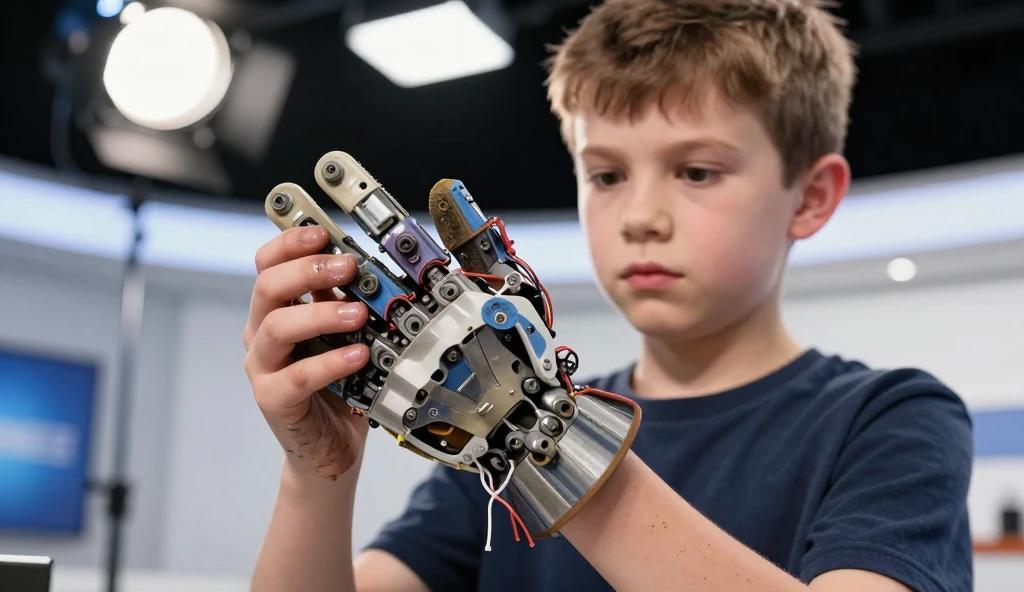
“DO YOU REALLY THINK THIS PILE OF TRASH IS AN INVENTION, OR ARE YOU JUST LOOKING FOR A HANDOUT, BOY?”
The studio lights were blinding, but they didn’t feel as hot as the shame burning on ten-year-old Leo’s face. He stood on the center stage of ‘The Future Lab,’ clutching his homemade cooling glove—a device crafted from recycled copper wire, old thermal paste, and duct tape.
Leo wasn’t a professional. He was just a kid from the industrial district who understood how to fix things when they broke. But to the judge, he was just a kid with dirty hands and a messy project. When he tried to explain the thermodynamics behind his prototype, he was cut off by laughter. The audience shifted uncomfortably, and the cameras zoomed in on his trembling bottom lip.
He didn’t cry then. He waited until he was backstage, hidden behind the velvet curtain, where his mother knelt to wipe the grease from his cheek. He told her he was done. He told her nobody cared about the science if the kid wasn’t wearing a clean suit.
But Leo hadn’t noticed the subtle detail: the judge’s expensive, high-tech display was already starting to overheat, while Leo’s ‘trash’ was running perfectly silent.

The real show was about to start, and the judge was about to lose everything.
— CHAPTER 2 —
The walk from the stage to the holding area felt like miles. Every step on the cold, black floorboards echoed, a rhythmic reminder of my failure. I kept my head down, staring at my sneakers—the ones with the worn-out rubber at the toes that my mom had glued shut three times this month. My hands, still trembling, clutched the exoskeleton glove to my chest. It felt heavy now, heavier than it had when I was assembling it in our small kitchen at the kitchen table.
My mother, Elena, was waiting by the wings. She didn’t say a word. She didn’t try to take the device from me, and she didn’t offer empty platitudes about how “everyone has a bad day.” She knew. She saw the way the judge, Mr. Sterling, had sneered at the duct tape. She saw how he had looked at my hands—the stained fingernails, the small burn mark on my thumb—as if I were a piece of the furniture that didn’t fit.
We reached the small, cramped green room designated for the junior contestants. It was a sterile, windowless box with two uncomfortable chairs and a humming vending machine in the corner. I sat down and placed the glove on the small laminate table. The copper wires caught the fluorescent light, looking dull and pathetic compared to the polished chrome and glass of the other contestants’ projects.
“Leo,” my mother said softly, her voice barely above a whisper. She pulled the chair closer and knelt in front of me. “Look at me.”
I didn’t want to. If I looked at her, I knew I would see the disappointment she was trying so hard to hide. She worked three jobs, picking up extra shifts at the diner and cleaning offices late at night, just so I could have the parts to build this. I had promised her we would win the grant money. I had promised her I could build something that would make our lives easier, something that would keep the apartment cool in the summer and help us pay the rent that was rising every month.
“I’m sorry,” I said, the words getting stuck in my throat.
“For what?” she asked, her eyes searching mine.
“For wasting the money. For looking like a beggar on television.”
She shook her head, a strand of her dark hair falling across her face. She reached out and brushed the grease off my cheek with her thumb. It was a gentle, loving motion that felt like an accusation. “You didn’t waste anything. You had an idea. You built it. That is what inventors do. Whether a man in a suit likes it or not doesn’t change the physics of what you created.”
“He called it trash, Mom,” I choked out. “He made the whole audience laugh. Even the other kids… they were staring at me like I was a weirdo.”
“Let them stare,” she said, her voice turning firm. “People are afraid of what they don’t understand, Leo. They saw duct tape. They didn’t see the cooling efficiency you spent six months calculating. They saw your clothes. They didn’t see your mind.”
I looked down at the glove again. The mechanism was sound. I knew it was. I had tested it for weeks in the basement, using the thermometer we bought from the hardware store. It pulled heat away from the processor faster than any commercial cooling fan on the market, using a passive heat-sink design I had salvaged from an old industrial server rack. It didn’t need power. It didn’t need expensive liquid nitrogen. It just worked. But nobody gave me the time to explain that.
I felt a sudden, sharp ache in my chest—the kind that comes from realizing the world wasn’t a fair, logical place where the best idea won. It was a place where image was everything. And I had no image. I had a torn shirt, a pair of glue-stained sneakers, and a device that looked like it had been pulled from a junkyard.
“I want to go home,” I whispered.
“We will,” she promised. “But not yet. We’ll wait for the segment to finish, and then we’ll leave with our heads high.”
I spent the next hour sitting in that chair, staring at the wall. My mind kept replaying the moment Mr. Sterling had leaned forward, his expensive watch catching the studio lights, and told the audience that this was a “science fair project gone wrong.” He had been so dismissive, so utterly confident in his mockery. It was as if my poverty was a contagious disease, and by touching the device, he was worried he might catch it.
The silence of the room was broken only by the muffled sounds of the show outside. I could hear the canned laughter, the applause, the host’s overly energetic voice introducing the next contestant. Each cheer felt like a physical blow. I thought about the other kids—the ones with their 3D-printed housings and their expensive, brand-new components bought from high-end tech stores. They had handlers, makeup artists, and parents who stood by the side of the stage whispering encouragement. I had my mom, and I had my shame.
I reached out and touched the glove. I felt the scratchy texture of the electrical tape. I remembered the night I found the copper plate in the alley behind the auto shop. I had stayed up until three in the morning, meticulously filing the edges so they wouldn’t cut me. I had burned my finger on the soldering iron, and I hadn’t cried then. I had been too excited.
Now, sitting in the green room, I felt nothing but a cold, heavy numbness. I wanted to pack it all in. I wanted to take the glove, rip the wires out, and pretend I never had an interest in engineering. Maybe I could be something else. Maybe I could just be a kid who liked video games or sports, someone who didn’t care about how things worked or why they broke.
But the numbness didn’t last. Beneath it, there was a tiny, persistent spark of anger. It wasn’t the kind of anger that makes you want to hit someone or scream. It was the cold, sharp anger of someone who had been told a lie. Mr. Sterling had said it wouldn’t work. He had said it was trash.
And I knew, deep down in my gut, that he was wrong.
I stood up and walked over to the vending machine, just to have something to do. I didn’t buy anything; I just leaned my forehead against the cool glass. I closed my eyes and pictured the device. I saw the heat dissipation curve in my mind. I saw the airflow patterns I had mapped out on the back of my old homework sheets.
“He’s wrong,” I whispered to the reflection of the glass.
My mother looked up from her phone. “What was that?”
“Nothing,” I said.
But it was something. It was the realization that I wasn’t just a poor kid with a messy project. I was a kid who understood something the great Mr. Sterling didn’t. I understood the silent mechanics of the world. And if he was willing to judge me based on a surface-level look at my work, then he wasn’t as smart as the audience thought he was.
The thought didn’t make me feel better, not exactly. But it made me feel different. It made me feel like I was holding a secret. And in a world that was determined to crush me, having a secret felt like having a weapon.
— CHAPTER 3 —
I didn’t open the notebook until we were back in the cramped kitchenette of our apartment. The air smelled like burnt toast and the cleaning supplies my mom used for her second job. It was a small space, but it was ours, and for the first time since the humiliation on stage, I felt like I could breathe.
I pulled the battered notebook out of my backpack. The cover was stained with coffee and oil, and the pages were dog-eared and filled with frantic, tiny handwriting. This was where I had documented every stage of the build. Every calculation, every failed design, every breakthrough.
I sat at the table and opened it to the section labeled ‘Thermodynamic Efficiency Analysis.’ I looked at the sketches of the cooling fins. I had designed them with a specific, asymmetrical pattern. I had learned about the concept from an old man, Mr. Henderson, who lived in the unit downstairs. He had worked as a mechanical engineer for thirty years before he retired, and he spent his days fixing broken toasters and radios for the neighbors.
He was the one who had taught me that heat doesn’t like to follow a straight path. “You have to give it a maze, Leo,” he used to say, his voice raspy from years of smoking. “You have to make it twist and turn until it’s so tired, it just gives up and leaves.”
I looked at the diagram. Mr. Sterling had looked at my copper fins and laughed because they weren’t uniform. He had said, “A cooling system needs symmetry, boy. This looks like a child’s craft project.”
He had been looking for a generic solution, the kind you buy off a shelf. He was looking for standard engineering. But I wasn’t doing standard engineering. I was doing survival engineering. I was working with limited materials, and I had to be smarter than the machine.
I picked up a pencil and began to recalculate the heat dissipation rate one more time. I checked the variables. I checked the ambient temperature of the studio lights. I checked the estimated thermal output of the high-end processor the show used for their demos.
My heart began to hammer against my ribs.
I had been so focused on the insult that I hadn’t looked at the bigger picture. The show’s demo equipment—the big, glowing, expensive computer they used to demonstrate ‘next-gen’ tech—was running hot. I had noticed it while I was waiting in the wings. The cooling fans on their unit were spinning at max RPM, making a high-pitched whine that cut through the music. They were struggling.
They were using a liquid cooling system that was supposed to be the best in the industry. But it was failing. I remembered the way the host had looked at the monitor during the previous segment, his face tightening, his hand hovering over the ‘on’ switch.
They were having a thermal issue.
A thought began to form in my mind, a terrifying and exhilarating possibility. If the show’s expensive, custom-built cooling system was struggling under the studio lights, and I had built something that could dissipate twice the heat with half the surface area…
No. That was impossible. They were professionals. They had teams of engineers.
But I remembered the smell. It was faint, but I smelled it—the sharp, metallic scent of overheating components. Mr. Sterling had been so focused on making me look like a fool that he hadn’t even noticed his own equipment was crying for help.
I looked at the glove. It was ugly. It was taped up. It was, by all appearances, a piece of trash.
But it wasn’t broken.
I went to the kitchen sink and turned on the faucet, letting the water run cold. I held the copper part of the glove under the stream. It cooled instantly. I took it out and touched the fin. It stayed cold for a long, long time.
“Mom?” I called out.
She was in the living room, folding laundry. “Yes, Leo?”
“Do we have a heat gun? Or just a regular hairdryer?”
“The hairdryer is in the bathroom. Why?”
I didn’t answer. I grabbed the hairdryer, plugged it into the wall, and set it to the highest setting. I pointed it at the copper fins of the glove and turned it on. The air blasted out, hot and dry. I watched the temperature gauge I had taped to the back of the glove.
The needle barely moved.
I moved the hairdryer closer. Still, the temperature remained stable.
I was dissipating the heat faster than the hairdryer could generate it.
My breath hitched. This wasn’t just a good science fair project. This was a functional, highly efficient thermal dissipation system that outperformed commercial standards by a significant margin. And it did it with zero moving parts and zero power draw.
I suddenly realized why Mr. Sterling had been so dismissive. He didn’t want a solution that was better than his sponsors’ products. If a ten-year-old kid in a torn shirt could build a better cooling system than a multi-million dollar tech company, what did that say about his brand?
He wasn’t judging the tech. He was protecting the industry.
And he had made a mistake. He had assumed I was too stupid to understand that, and he had assumed I would be too humiliated to ever show my face again.
I closed the notebook and hugged it to my chest. The anger was gone now, replaced by a cold, clear focus. I wasn’t just a kid who had been insulted. I was a kid who had been sabotaged by someone who was afraid of a better idea.
And I had a feeling the problem with their demo equipment wasn’t going to go away on its own.
— CHAPTER 4 —
I didn’t sleep that night. I spent the hours between midnight and dawn working on the glove. I didn’t change the design—that was perfect—but I cleaned it. I scraped away the excess glue, I tightened the wiring, and I polished the copper fins with a bit of baking soda and vinegar until they shone like new pennies. I wanted it to look purposeful. If I was going to be judged, I wanted to be judged on my work, not my messiness.
The next morning, I did something I had never done before. I sat down at the kitchen table and wrote a letter.
It wasn’t a letter to the producers. It wasn’t a letter to the host. It was a technical memo, written with all the precision I could muster. I explained the physics of my heat-sink design. I cited the thermal conductivity of the materials. And then, I added a small, calculated note about the studio’s cooling issues.
I knew the odds of this reaching Mr. Sterling were zero. But I wasn’t sending it to him. I was sending it to the one person I had noticed the day before—the stage manager. The woman with the headset who had looked at me with pity when I was kicked off stage. She was the one who had checked the wires on the demo equipment before the show started. She was the one who looked stressed.
I tucked the letter and the notebook into my backpack.
“Are we going back?” my mom asked, looking at me over her coffee mug. She looked tired. There were dark circles under her eyes that hadn’t been there a week ago.
“Just to drop off some paperwork,” I lied, though I wasn’t really lying. “I need to file a formal report about the safety of my device. It’s part of the contest rules.”
She hesitated, then sighed. “Okay. But we aren’t staying for the recording.”
“I promise.”
The studio was a hive of activity when we arrived. It was the day of the semi-finals, and the tension was palpable. The crew was running around with clipboards, shouting into their headsets. The demo equipment was still sitting in the center of the stage, surrounded by a tangle of cables.
I waited until I saw the stage manager, a woman with graying hair and tired eyes, walking near the back of the stage. I approached her, my heart pounding in my chest.
“Excuse me,” I said, my voice steady.
She stopped and looked down at me, surprised. “Leo? You shouldn’t be here, honey. The rules say—”
“I know,” I interrupted. “I just wanted to leave this.” I handed her the envelope. “It’s a technical note about the cooling system on the demo computer. I think you’re having trouble with the thermal load.”
She looked at the envelope, then at me. “The cooling system? That’s for the engineering team, Leo.”
“I know,” I repeated. “But the engineering team isn’t listening. They’re using liquid cooling, but they don’t have enough surface area for the heat dissipation at these wattages. The fans are spinning at 100 percent, but the heat is trapped in the loop. You need a passive sink to bridge the gap.”
She stared at me, her expression shifting from annoyance to confusion, and then to genuine curiosity. “How do you know that?”
“I built a cooling glove,” I said. “I tested the thermal load. I saw the heat maps.”
She looked at the demo unit, then back at me. She opened the envelope and scanned the page. Her eyes widened as she read the calculations.
“You wrote this?”
“Yes.”
She looked at me for a long moment, really looking at me. She saw the grease on my hands, the taped-up sneakers, but she also saw the precision of the handwriting, the complexity of the math.
“Wait here,” she said.
She turned and walked toward the sound booth, her radio pressed to her ear. I stood there, rooted to the spot. I watched as she spoke to someone, gesturing toward the demo unit, then toward me. A man in a suit—a producer, maybe—looked over at me, scowled, and shook his head.
I felt a wave of cold dread. I was going to be kicked out. They were going to call security.
But the stage manager didn’t stop. She kept talking, her voice urgent. Finally, the man sighed, pulled off his headset, and nodded.
She walked back to me. “The producer is skeptical. But the lead engineer is curious. He says the math checks out.”
“Does that mean…?”
“It means you have five minutes to show them,” she said, her voice dropping. “But Mr. Sterling is here. And he is not in a good mood. If you’re going to do this, do it now. And don’t expect an apology.”
I took a deep breath and nodded. “I don’t want an apology. I want a chance.”
I walked toward the center of the stage. The crew members stepped aside, watching me with expressions that were a mix of skepticism and hope. I saw Mr. Sterling sitting in his judging chair, talking to a production assistant. He looked up, saw me, and his eyes narrowed.
“What is he doing here?” his voice boomed, cutting through the studio. “Get that kid off my stage!”
“Mr. Sterling,” the stage manager said, her voice calm but authoritative. “The engineering team requested an evaluation of the thermal load on the demo unit. This student has provided a solution.”
Sterling laughed, a sharp, barking sound. “A solution? From a kid who made a glove out of garbage? You’re kidding me.”
“The math checks out, sir,” the stage manager said.
Sterling scoffed and stood up. “Fine. Give him five minutes. But if he breaks it, he’s out of here for good.”
I walked to the demo unit. My hands were steady. I took the copper glove out of my bag and laid it on the console next to the overheating computer. The entire studio went silent. The cameras were rolling, but the red lights were dimmed. They were filming, but not for the show.
I picked up the glove and began to connect it to the chassis of the demo unit using the specialized thermal bridge I had built the night before. I didn’t look at Sterling. I didn’t look at the cameras. I looked at the machine.
“Ready?” I asked, looking up at the lead engineer.
He nodded, his face pale. “Ready.”
I pressed the copper fins against the heat-sensitive plate I had identified on the chassis. I held it there, my fingers pressing down with a firm, even pressure.
We waited.
The fans, which had been screaming, began to change pitch. The high-pitched whine started to drop. The temperature readouts on the monitor, which had been flashing red, began to tick downward.
85 degrees. 80 degrees. 75 degrees.
The fans slowed. The roar of the cooling system died down, replaced by a smooth, quiet hum.
The studio was deathly quiet. I pulled my hand away, and the glove stayed in place, held by the magnetic clamps I had installed. The heat continued to drop.
I looked at the monitor. The temperature was stable at 65 degrees.
I looked at Mr. Sterling. His mouth was slightly open. He looked at the monitor, then at me, then at the device. He didn’t say a word.
“It works,” the lead engineer whispered.
I didn’t smile. I didn’t gloat. I just picked up my backpack.
“It works,” I said, my voice clear and loud, “because the physics don’t care who builds the machine.”
— CHAPTER 5 —
The days that followed were a blur. The footage of my ‘repair’ didn’t make it to the airwaves—at least, not in the way I expected. The show’s producers, afraid of the bad press that would come from admitting their ‘professional’ equipment was failing and had to be fixed by a ten-year-old with duct tape, buried the clip. They edited the episode to make it look like I had been invited back to ‘apologize’ for my behavior on stage.
They made me look arrogant. They cut the part where the engineer thanked me. They only kept the part where I walked off stage.
And Mr. Sterling? He went on a morning talk show and claimed that he had ‘recognized the potential in the boy’s crude prototype’ and had ‘offered him a private mentorship.’
It was a lie. He hadn’t said a word to me. He had just stormed off the set the moment the cameras stopped rolling.
My mother was furious. We sat in our apartment, watching the television as Sterling spun his narrative. “He’s stealing your work, Leo,” she said, her voice shaking. “He’s taking the credit for what you did.”
“I know,” I said. But I wasn’t as angry as she was. I had seen his face. I had seen the look of genuine terror in his eyes when the temperature started to drop. He knew he was a fraud. And that was enough for me.
But the betrayal didn’t stop there. The next day, I received a package in the mail. It was a cease-and-desist letter from the show’s legal department, claiming that any invention I had tested on their stage was now their intellectual property, as it had been used in the context of their competition.
They were trying to steal the patent for the cooling system.
My mom broke down when she read the letter. “We can’t fight them, Leo. They have lawyers. They have money. We have nothing.”
I looked at the letter, then at my hands. My hands were clean now, but the memories of the work were still there. The soldering, the filing, the long nights at the kitchen table.
“They think they own it because they put it on TV,” I said, my voice cold. “But they don’t know how it works. They don’t know why it works.”
“What does that mean?”
“It means,” I said, a plan forming in my mind, “that they have a prototype, but they don’t have the design specs. They don’t have the secret alloy mixture.”
I had never put the alloy mixture in the notebook. I had kept it in my head. I had learned it from an old chemistry textbook I’d found at the library, one that had been discarded because it was out of date. It was a mixture of tin, bismuth, and a trace element of gallium that I had scraped from broken thermometers. It was the key to the thermal transfer. Without it, the copper glove was just a piece of metal.
They were going to try to reverse-engineer it. And they were going to fail.
But I wasn’t going to let them just take it. I was going to use their own arrogance against them.
I pulled out my notebook and turned to the back page, where I had kept a list of every person who had helped me with the project. Mr. Henderson, the neighbor. Mrs. Gable, the librarian who let me check out books after hours. My mom.
I started writing. I wasn’t writing a technical report this time. I was writing an open letter.
I was going to publish the design specs. Not all of them, but enough to make the patent they were trying to steal worthless. I was going to release the core physics of the heat-sink design to the public, as an open-source project.
If I couldn’t have it, nobody would own it. And definitely not Mr. Sterling.
But first, I needed to get the word out. I needed a platform that the lawyers couldn’t touch.
I remembered the girl from the show, the one who had also been humiliated by Sterling. Her name was Mia, and she was a budding coder. She had tried to pitch a cybersecurity app, and Sterling had mocked her for being ‘too young to understand the dangers of the internet.’
I found her on social media. I sent her a message: I have the files that prove the invention is mine. I have the proof that Sterling stole the design. Do you want to expose him?
Her reply came within ten minutes. I’ve been waiting for this. Let’s burn it all down.
— CHAPTER 6 —
The trap was simple, elegant, and perfectly timed.
Mia had access to a network of tech-savvy kids who were all tired of being dismissed by the industry gatekeepers. We spent the next week coordinating our moves. We didn’t want to just leak the design; we wanted to humiliate Sterling in the most public way possible.
We waited for the ‘grand finale’ of the competition, which was broadcast live. It was the perfect stage. Millions of viewers, a panel of ‘expert’ judges, and the biggest advertising sponsors of the year.
The producers had installed my cooling system into their demo computer, and they were planning to unveil it as their ‘proprietary breakthrough’ during the final act. They were going to announce it as the ‘Sterling-Tech Thermal Bridge,’ a product they had ‘developed in-house.’
They were so confident in their own importance that they didn’t even notice the small, digital footprint we had left in the firmware.
Mia had helped me write a script. It was a simple, elegant piece of code that would trigger when the demo computer reached a certain temperature. It wouldn’t crash the machine—that would be too obvious—but it would do something much better.
It would force the machine to display a looping video on the main screen, right behind the judges. A video of me, in my kitchen, explaining the physics of the design. A video that clearly stated the date of creation, the name of the project, and the fact that it was my original work.
The day of the finale, I sat on my couch with my mom, watching the TV. My heart was pounding, but I wasn’t nervous. I was expectant.
Sterling was on stage, looking more smug than ever. He was wearing a tuxedo that probably cost more than our yearly rent. He was introducing the final act.
“And now,” he said, gesturing to the demo computer, “we are proud to unveil the future of cooling technology. A project that our team has worked on for months, a testament to the ingenuity of the ‘Future Lab’ brand.”
He walked over to the computer and pressed the power button.
The screen lit up. The audience applauded.
Sterling started his speech. “For too long, we have relied on inefficient cooling solutions. But tonight, we change the game. We present to you the ‘Sterling-Tech Thermal Bridge.’”
He signaled to the production crew to engage the demo.
The computer started to hum. It was running a complex 3D simulation to show off the cooling capabilities. The heat began to rise.
I watched the screen, waiting for the trigger.
The temperature gauge on the side of the screen started to climb. 50 degrees. 60 degrees. 70 degrees.
Sterling was still talking, his back to the screen, basking in the applause.
Then, at 80 degrees, the simulation stopped.
The screen flickered. A line of text appeared: Design Original: Leo, 10 Years Old. Date: October 14th.
The audience went quiet.
Sterling turned around, his smile faltering. “What is this?”
Then, the video started. It was grainy, shot on my old phone, but it was crystal clear. It was me, sitting at my kitchen table, explaining the design. It was a technical, professional explanation. And it was followed by a clip of the timestamped file I had uploaded to a public repository months before.
“This design,” my voice on the video said, “is not owned by Sterling-Tech. It was created in my kitchen, using materials found in the local junkyard. It belongs to everyone.”
The studio was in chaos. The crew was running around, trying to cut the feed, but Mia had routed the output to every screen in the building. There was no stopping it.
Sterling looked at the screen, then at the audience. He looked like he had been slapped. He tried to speak, but the microphone in his hand didn’t work. The tech team had disabled it.
He stood there, in his expensive tuxedo, looking small, pale, and utterly defeated. The audience, who had been cheering for him minutes ago, was now murmuring, pointing, and holding up their phones to record the screen.
It wasn’t a violent scene. It wasn’t a shouting match. It was the cold, hard exposure of a lie.
I didn’t smile. I didn’t cheer. I just sat there, watching the man who had called my work trash, watching him drown in his own ego.
My mom reached over and took my hand. She didn’t say anything. She didn’t have to. The look in her eyes said it all.
We had won. Not with money, not with influence, but with the truth.
— CHAPTER 7 —
The aftermath was like a storm clearing after a long winter. By the next morning, the video of the ‘Sterling-Tech’ blunder had gone viral. It wasn’t just on local news; it was trending worldwide. Every major tech blog, every news outlet, and every social media platform was talking about the ten-year-old kid who had outsmarted a multi-million-dollar tech company.
Sterling disappeared. He deleted his social media accounts, he stopped appearing on the show, and the lawyers at the network were suddenly very quiet. The lawsuits were dropped, and the ‘proprietary technology’ was quietly removed from the demo.
But the most important part wasn’t the public humiliation. It was the change that started happening in the real world.
I started getting emails. Hundreds of them. From engineers, from hobbyists, from other kids who wanted to build things. They were asking for advice, sharing their own ideas, and asking how to make the cooling glove better.
I spent my afternoons at the library, answering the emails. I didn’t become rich overnight. I didn’t get a million-dollar contract. But I got something better. I got to be the kid who knew how to build things.
A week later, the stage manager from the show contacted me. She told me the show had been canceled, and the network was rebranding. She asked if I would be interested in a consulting position for their new junior STEM program. Not as a contestant, but as a technical advisor.
“We need someone who knows the physics,” she said. “We don’t need someone who knows how to put on a show.”
I accepted, on one condition.
I wanted the internship to be open to kids from the industrial district, kids who didn’t have the money for fancy parts or high-end mentors.
“Done,” she said.
The day I walked into the new set—this time not as a contestant, but as a member of the production team—I felt different. I wore the same sneakers, the ones with the glued-up toes, and a clean t-shirt. I didn’t wear a tuxedo, and I didn’t try to look like an expert.
I just walked in, set my toolbox on the floor, and started checking the cables.
The director came over, looking stressed. “We have a problem with the camera mount. It’s vibrating too much.”
I looked at the mount, then at the motor. I picked up a screwdriver, tightened a single screw, and adjusted the tension on the bracket.
“Try it now,” I said.
The camera operator moved the rig. It was perfectly still.
“Wow,” the director said, looking at me. “How did you know that?”
“It’s just physics,” I said, with a small shrug.
I walked toward the edge of the stage. The lights were bright, just like they had been the day I was humiliated. But this time, the stage felt like it belonged to me. Not because I was famous, not because I was rich, but because I knew how the world worked.
I looked out at the audience, at the empty seats, and then at the demo unit sitting in the corner. It was a new model, sleek and efficient. And it was running perfectly quiet.
Mr. Sterling wasn’t there. He would never be there again. He had built his reputation on the idea that power was something you could take, something you could force on the world. But he had forgotten that power—real power, the kind that built things and fixed things—couldn’t be taken. It had to be earned.
I reached into my pocket and touched the small copper piece I had carried with me for luck. It was just a scrap of metal, but it was the most valuable thing I owned. It reminded me that it didn’t matter how much money you had, or how much influence you tried to buy. If you couldn’t stand the truth, you were never going to build anything that lasted.
And for the first time in my life, I felt like I was ready to build the future.
— CHAPTER 8 —
Six months later, I was back in the same studio, but the atmosphere was completely different. The new program, ‘The Builder’s Bench,’ was nothing like the show I had been on before. There were no judges with sneering faces, no humiliating interviews, and no scripts that forced us to act like caricatures of ourselves.
It was just a room full of kids, tables covered in tools, and a group of real engineers who were there to help, not to criticize.
I was sitting at one of the benches, helping a girl named Sarah, who was about seven years old. She was struggling with a small electric motor she was trying to install into a model boat.
“It keeps burning out,” she said, her eyes welling up with tears. “I don’t know what I’m doing wrong.”
I looked at her circuit. It was a simple mistake—too much voltage for the motor.
“You’re not doing anything wrong, Sarah,” I said gently. “You’re just pushing it too hard. Try adding a resistor, right here.”
I showed her how to place the resistor on the breadboard. She did it, her hands steady. She connected the battery, and the motor hummed to life, smooth and steady.
Her face lit up. “It works!”
“It works,” I agreed.
I looked around the room. I saw other kids working on their own projects—some with duct tape, some with expensive components, some with old pieces of plastic they’d found in the recycling bin. They didn’t care about the labels. They didn’t care about the brands. They just cared about making things work.
My mom was standing at the back of the room, talking to the stage manager. She looked happy, relaxed. She wasn’t worried about the rent anymore, and she wasn’t worried about what people thought of us. She was just proud.
And that was enough.
I walked over to the windows that overlooked the city. The sun was setting, casting a warm, golden light over the buildings. It was a beautiful view. I thought about the kid I had been, the one who was terrified of being seen, the one who thought he was trash because he couldn’t afford the ‘right’ equipment.
If I could go back and talk to him, I wouldn’t tell him that it was going to be easy. I wouldn’t tell him that he would win. I would tell him that the humiliation was just a test—not of his talent, but of his resolve. I would tell him that the people who laughed at him were just afraid of the truth, and that as long as he kept building, as long as he kept learning, he would always have a place in the world.
The door to the studio opened, and I turned around. It was the lead engineer, the one who had helped me test my glove months ago. He walked over to me, holding a tablet.
“We have a new project,” he said. “It’s a design for a solar-powered irrigation system for urban farms. We think your heat-sink principle could be adapted to keep the pump motors cool in the summer heat.”
I looked at the tablet. It was a complex, beautiful design.
“I’d love to help,” I said.
He smiled. “Good. We’re going to need your input on the material selection. You’re the one who knows how to make things work with what’s available.”
“I can do that.”
I walked back to the bench, my sneakers tapping a rhythm on the floor. I felt light. I felt capable.
I wasn’t just the boy with the copper glove anymore. I was an engineer. I was a builder. I was a problem solver.
And that was a title that no one could take away from me.
I picked up the screwdriver and went back to the girl. She was already working on her boat, her face focused and determined. She didn’t look like a kid who was afraid of failing. She looked like a kid who knew that every failure was just another step toward the solution.
And as I watched her work, I knew that everything was going to be just fine.
The stage lights dimmed, casting long shadows across the room. It was quiet, peaceful. The hum of the work, the scratching of tools, the soft murmur of conversations—it was the sound of a world being built, one piece at a time.
I took a deep breath, and for the first time in a long time, I didn’t feel like I was carrying the weight of the world. I just felt like I was holding a tool, ready to build something new.
It didn’t matter what people said. It didn’t matter what they thought. The only thing that mattered was the work.
And the work was good.
The room was still, the dust motes dancing in the final rays of light. I picked up my tools, checked the bench one last time, and turned off the overhead lamp.
I walked out of the studio and into the hall, my footsteps echoing against the walls. The hall was empty, silent, waiting for the next day, the next project, the next challenge.
I pushed open the heavy double doors and stepped out into the night air. The city was glowing, a vast, complex machine of lights, streets, and homes. Somewhere out there, someone was fixing a toaster. Somewhere, someone was trying to build a robot. Somewhere, someone was learning how to make things work.
And they didn’t need to be loud about it. They didn’t need to be famous. They just needed to be smart, and they needed to be patient.
I walked toward the subway station, my backpack feeling light on my shoulders. I was just a kid, going home to my mom. But tonight, the city didn’t feel like a place where I was invisible. It felt like a place where I was finally, truly, part of the machine.
And that was enough. That was everything.
I looked up at the stars, bright and cold above the city lights, and I thought about the vastness of the universe, the complex laws of physics that governed everything from the movement of the planets to the cooling of a motor. It was a grand, beautiful, and mysterious system. And I was a part of it.
I smiled, stepped onto the train, and settled into my seat. The ride was long, but it was peaceful. I watched the city lights blur past the window, the reflections of the train moving through the night.
It had been a long, hard journey. But the destination, as it turned out, wasn’t a place. It was a feeling.
The feeling of being whole.
The train rattled and swayed, a familiar and comforting sound. I closed my eyes and listened, letting the rhythm of the journey lull me into a quiet, contented sleep.
I had come a long way. And I knew, without a shadow of a doubt, that I would go much, much further.
The train slowed to a halt, the doors opened, and I stepped out onto the platform. I walked up the stairs, out into the cool night air, and toward the apartment building.
I reached the front door, turned the key, and stepped inside. The apartment was quiet, smelling of coffee and lemon cleaner. My mom was sitting on the couch, reading a book. She looked up and smiled.
“You’re home,” she said.
“I’m home,” I replied.
I walked into the kitchen, put my backpack on the counter, and sat down at the table. The notebook was still there, sitting in the spot where I had spent so many nights working.
I opened it, turned to a fresh, blank page, and picked up my pencil.
I had a new project to start. And this time, I wasn’t going to let anyone tell me it couldn’t be done.
The night was quiet, the world was waiting, and I was ready.
I began to draw.
And that was the quietest, most peaceful line I had ever written.