The Man Who Arrived Before Dawn
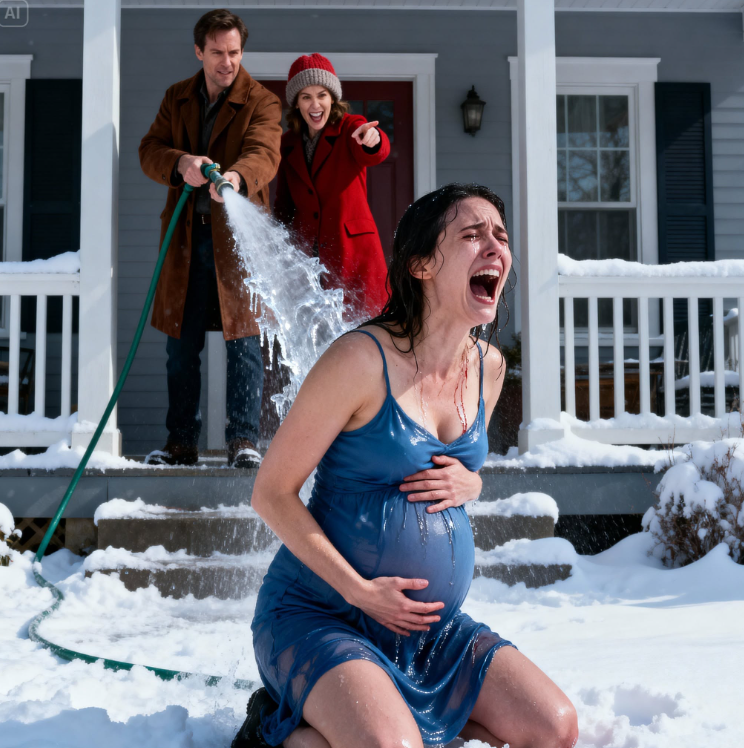
The ambulance doors closed before Mark could reach me.
Through the rear window, I saw him standing barefoot in the snow beside two police officers.
He had thrown on a coat, but his shirt remained open at the collar. His face carried the expression he always wore when someone challenged him—half outrage, half disbelief that the world had failed to obey.
He pointed toward the house.
He gestured toward me.

He spoke rapidly.
Even from inside the ambulance, I knew exactly what he was saying.
My wife is emotional.
Pregnancy has made her unstable.
She misunderstood.
She went outside voluntarily.
It was an argument, not abuse.
The female paramedic covered me with heated blankets while her partner attached monitors to my chest.
“What is your name?” she asked.
“Hannah Reed.”
“How many weeks pregnant are you?”
“Twenty-nine.”
“Any contractions?”
“I don’t know.”
“Bleeding?”
“No.”
“Can you feel the baby moving?”
I placed one hand against my stomach.
The baby kicked weakly beneath my palm.
“Yes.”
The paramedic nodded, but her expression remained serious.
My body would not stop shaking.
The cold had moved beneath my skin and into my bones. Every muscle clenched without my permission. My wet dress had been cut away and placed inside an evidence bag.
The sight of it made me feel exposed.
The thin blue hospital blanket covered my body, but I could still feel Mark’s hose striking my shoulder.
I could hear his voice.
Stand still.
The paramedic inserted an IV.
“You may be experiencing mild hypothermia,” she said. “We’re also concerned about stress on the baby.”
“My baby is going to be all right?”
“We’re doing everything we can.”
That was not an answer.
My phone remained in my hand.
My father was still connected.
“Hannah?” he said.
“I’m here.”
“I have the hospital name.”
“How?”
“The dispatcher provided it to my security director.”
Of course.
My father had spent his life creating systems capable of moving cargo, medicine, equipment, and people across continents before ordinary companies finished holding meetings.
When I was a teenager, I resented how quickly he could solve problems.
Nothing in his world remained uncertain for long.
There were schedules.
Contingency plans.
Backup aircraft.
Emergency teams.
That control was one reason I had run toward Mark.
Mark initially made uncertainty feel romantic.
He forgot reservations.
Changed plans without warning.
Drove through the night because he wanted to see the sunrise from another state.
I mistook unpredictability for freedom.
Later, when unpredictability became anger, punishment, and fear, I was too ashamed to admit my father had been right.
“How far away are you?” I asked.
“My plane is preparing to depart.”
“You don’t have to come.”
“Yes, I do.”
“Dad—”
“I am not coming because I think you are incapable. I am coming because you called.”
The distinction broke something inside me.
For years, I had believed accepting help meant admitting weakness.
Mark encouraged that belief.
He said my father’s protection was control.
He said my family wanted to purchase obedience.
Each time my father offered support, Mark reminded me that returning would prove I had never learned to stand alone.
Now I understood the difference.
My father had asked where I wanted him.
Mark had ordered where I should stand.
The ambulance entered the hospital bay.
“I have to go,” I whispered.
“I’ll be there before morning.”
“Dad?”
“Yes?”
“I’m scared.”
“I know.”
His voice softened.
“But you are no longer alone inside that house.”
The call ended.
Doctors and nurses surrounded me in the emergency department.
They attached a fetal monitor around my stomach.
The baby’s heartbeat filled the room.
Fast.
Uneven.
I stared at the screen as though I could understand the lines.
An obstetrician named Dr. Mara Ellis examined me.
She was a tall woman with tired eyes and a voice that remained calm without becoming cold.
“Hannah, your body temperature is improving, but the baby is showing signs of distress.”
“What does that mean?”
“It may be temporary. Severe cold and emotional stress can affect blood flow and heart rate.”
“Do you have to deliver her?”
“We are not there yet.”
Her.
The word entered me.
Mark and I had chosen not to learn the baby’s sex.
He said he wanted a surprise.
In reality, he became angry whenever I discussed names, clothes, or nursery plans because he believed pregnancy had made everything about me.
“Did you say her?” I asked.
Dr. Ellis glanced at the ultrasound monitor.
“I’m sorry. Would you prefer not to know?”
I began crying.
“No. Tell me.”
“You’re carrying a little girl.”
My daughter.
I placed both hands against my stomach.
“Please save her.”
“That is exactly what we are working to do.”
Hospital security positioned an officer outside the room.
A nurse photographed the bruising on my arm, hip, shoulder, and back.
There were older marks too.
Yellow shadows near my wrist.
A fading bruise beneath my ribs.
A small scar near my hairline from the night Mark threw a glass against the wall and claimed the fragment struck me accidentally.
The nurse documented all of them.
Each photograph felt like betrayal.
Not of Mark.
Of the woman I had been two days earlier, when I still believed hiding the marks kept our marriage alive.
At three in the morning, a detective arrived.
Her name was Andrea Morales.
She asked whether I wanted an advocate present.
I nodded.
A woman from a domestic violence response team sat beside the bed.
Her name was Leah.
She did not ask why I stayed.
She did not ask why I married him.
She asked what happened.
I told them.
Not everything.
Not yet.
I described the dinner.
The grip on my arm.
The back door.
The hose.
The freezing water.
The locked bathroom.
Mark’s attempt to force the door.
Detective Morales listened without interrupting.
“Has Mark ever prevented you from calling anyone before?”
“Yes.”
“How?”
“He took my phone.”
“When?”
“Several times.”
“Has he ever locked you inside the house?”
I hesitated.
“Not exactly.”
“What does not exactly mean?”
“He controlled the garage door through his phone. Once, when I tried to leave, he disabled my car and took the spare keys.”
“How long were you unable to leave?”
“Two days.”
Leah’s face remained neutral.
That helped.
If she had looked shocked, I might have started defending him again.
“Has he threatened the baby?” Detective Morales asked.
“No.”
The answer came quickly.
Then I remembered.
Three weeks earlier, Mark had stood in the nursery doorway while I assembled a crib.
He told me if I ever tried to leave, no judge would allow “an unstable woman controlled by her billionaire father” to raise his child.
At the time, I called it an angry comment.
Now it sounded like preparation.
“He said he would take her from me,” I whispered.
Morales wrote something.
“Did he explain how?”
“He said he had proof that I was emotionally unstable.”
“What proof?”
“I don’t know.”
“Do you take psychiatric medication?”
“No.”
“Have you ever been hospitalized for a mental-health crisis?”
“No.”
“Have you threatened self-harm?”
“Never.”
“Does Mark have access to your medical information?”
“Yes. He insisted we share passwords.”
The detective exchanged a look with Leah.
“What does Mark do for work?” she asked.
“He is vice president of operations at Alpine Meridian Health.”
That answer suddenly felt important.
Alpine Meridian manufactured hospital monitoring systems, infusion equipment, and remote patient-care technology.
My father’s medical technology division was one of its largest competitors.
Mark had joined the company two years after our wedding.
He told me his success had nothing to do with my family.
He was proud of proving he did not need my father.
“Does his company have access to medical databases?” Morales asked.
“Not patient databases. At least, they shouldn’t.”
“Does Mark know hospital administrators?”
“Many.”
She closed her notebook.
“We will investigate.”
At four thirty, Dr. Ellis returned.
“The baby’s heart rate is stabilizing.”
The relief hurt.
It moved through my body so sharply that I began crying again.
“You will remain for observation,” she continued. “You experienced hypothermia and significant physical stress. We also see uterine irritability, which means there is a risk of early labor.”
“Can I keep her inside?”
“That is our goal.”
“What should I do?”
“Rest. Hydration. Monitoring. And you need a safe discharge plan.”
Safe.
The word sounded simple.
It was not.
My house contained my clothes, identification documents, prenatal vitamins, and the nursery furniture I had selected piece by piece.
It also contained Mark.
At five twelve, my father arrived.
I knew before he entered because the activity in the hallway changed.
Security officers spoke into radios.
Hospital administrators appeared.
A man in a dark suit entered first and spoke briefly with the police officer.
Then my father walked into the room.
Grant Reed was sixty-three years old.
His hair had become almost entirely silver since I last saw him.
He wore a charcoal coat over a white shirt without a tie.
He looked as though he had dressed while moving through an airport.
For several seconds, neither of us spoke.
The last time I saw him, we were standing in his library in New York.
I told him Mark was the only person who loved me without conditions.
My father replied that love requiring isolation was not unconditional.
I accused him of trying to control me.
I left before he could answer.
Four years later, he stood beside my hospital bed and looked at the bruises I had hidden from everyone.
His face did not change.
That frightened me.
“Dad.”
He crossed the room.
I expected questions.
Instead, he bent down and placed his forehead against mine.
“I’m here.”
The words broke me.
I clung to his coat and cried like a child.
He held me carefully, avoiding the IV and fetal monitor.
“I’m sorry,” I whispered.
“No.”
“I should have listened.”
“No.”
“I said terrible things.”
“Hannah, look at me.”
I did.
“You called because you were ready. We are not going to spend this morning deciding which version of you should have known better.”
“But you warned me.”
“And then I allowed pride to make my warnings more important than keeping the door open.”
“You sent messages.”
“I should have come sooner.”
I shook my head.
“Mark said you would take over everything.”
My father’s eyes hardened.
“I will not make decisions for you.”
“What are you going to do to him?”
“Legally?”
The question revealed that he understood exactly what I feared.
“Yes.”
“I have already retained local counsel, arranged independent security, preserved the recording of the call, and requested that every company connected to us suspend Mark’s access pending investigation.”
“You can do that?”
“Alpine Meridian uses patents licensed through Reed Biomedical.”
I stared at him.
“Mark told me his company had nothing to do with yours.”
“It purchases sensor technology from three subsidiaries we control.”
“Will you destroy the company?”
“No.”
The answer came immediately.
“Thousands of employees had nothing to do with what he did.”
“Then what happens?”
“The company’s board will receive accurate information about an executive arrested for abusing his pregnant wife and attempting to break into a locked bathroom while police approached. They will make their own decision.”
“And Mark?”
“He will face the consequences of his conduct.”
My father sat beside the bed.
“Hannah, I need to ask something difficult.”
“What?”
“Did Mark ever ask you to sign documents related to Alpine Meridian?”
I thought back.
Mark brought me papers often.
Tax forms.
Insurance updates.
Estate documents.
He said marriage made separate paperwork unnecessary.
“Possibly.”
“What kind?”
“I don’t know.”
His jaw tightened.
“When you are ready, our attorneys will review everything. Not before.”
“Why are you asking?”
“Because six months ago, Alpine Meridian submitted a proposal involving a fetal-monitoring platform originally designed by your mother.”
“My mother?”
My mother, Elena Reed, died when I was fifteen.
She had been a biomedical engineer before becoming ill.
I knew she worked on hospital monitoring systems, but my father rarely discussed the details.
“The patents belong to a family trust,” he explained. “You are the principal beneficiary.”
“I didn’t know.”
“You were supposed to take control at thirty-five.”
“I’m thirty-three.”
“Mark attempted to accelerate the transfer.”
My heart began pounding.
“How?”
“He submitted a spousal authorization bearing your signature.”
“I never signed anything like that.”
“I believe you.”
“Did you know?”
“We discovered it during a licensing audit last month.”
“Why didn’t you call me?”
“I did.”
The missed calls.
The message I had ignored.
“I thought you were trying to interfere again.”
“That is what Mark expected.”
My father removed a folder from his coat.
He did not open it.
“He requested authority to negotiate the sale of your future patent rights to Alpine Meridian.”
“How much are they worth?”
“At least eighty million dollars over the remaining life of the patents.”
The hospital room became unnaturally quiet.
Mark had told me my father disapproved of him because he was not wealthy.
He said our marriage proved I valued love more than money.
Meanwhile, he had attempted to obtain control of technology I did not know I owned.
“Did he marry me for the patents?”
“I don’t know.”
My father’s honesty hurt.
“We will find out.”
Detective Morales returned at six.
She informed us that Mark had been arrested for domestic assault, reckless endangerment, coercion, and attempted unlawful entry into the locked bathroom.
He had requested an attorney.
He denied forcing me outside.
Then police searched the backyard.
They found water frozen across the patio.
My footprints crossed the snow.
The towel remained where he threw it.
The garden hose contained my blood near the metal nozzle, likely from a scrape on my shoulder.
They also recovered video.
“The security camera was disconnected,” I said.
“The camera attached to your house was,” Morales replied. “A neighbor across the drainage path installed a wildlife camera after seeing coyotes.”
The device faced part of our backyard.
Its night vision had captured Mark standing beneath the covered doorway while spraying me with the hose.
My father closed his eyes.
Only for a second.
When he opened them, there was something in his face I had never seen.
Not corporate control.
Not calculation.
Grief.
“May I see it?” I asked.
Morales shook her head.
“Not now.”
“Why?”
“You have already described the event. Watching it immediately can deepen trauma and may affect your ability to rest.”
“I need to know it exists.”
“It exists.”
“That is enough.”
The detective continued.
“Mark’s attorney has requested release on bond. The hearing is at ten.”
“Will he be allowed near me?”
“We are requesting a protection order.”
My father’s attorney, Samuel Price, entered the room.
He carried multiple folders and spoke quietly with Detective Morales.
Then he approached me.
“Mrs. Reed, I represent you only if you want me to.”
I noticed he used my name.
Not Mark’s surname.
“Did my father hire you?”
“Yes.”
“Will you follow his instructions or mine?”
“Yours.”
My father did not react defensively.
That mattered.
“Then represent me.”
At the bond hearing, Mark’s attorney described him as a respected healthcare executive with no criminal record.
He said the incident occurred during a marital disagreement.
He claimed I had voluntarily gone outside after spilling food on myself.
He suggested my father’s sudden involvement had transformed a private misunderstanding into corporate retaliation.
Then the prosecutor submitted the wildlife-camera footage.
The judge watched less than thirty seconds.
Mark was granted bond only after surrendering his passport, agreeing to electronic monitoring, and accepting a strict no-contact order.
He was prohibited from entering the house.
His access to firearms was suspended.
When the judge asked whether he understood, Mark replied, “My wife is being manipulated by her father.”
The judge looked at him.
“Your wife appears to have been manipulated by hypothermia.”
Mark said nothing else.
By afternoon, Alpine Meridian placed him on administrative leave.
The company issued a statement emphasizing that personal conduct inconsistent with its patient-safety mission would be investigated.
Mark called the statement betrayal.
I knew because his sister, Lauren, sent me seventeen messages.
She accused me of destroying his career.
She said pregnancy made women dramatic.
She claimed my father had always wanted revenge.
I did not respond.
Then Mark’s mother, Diane, called the hospital.
She told staff she was my emergency contact.
She was not.
She attempted to enter the maternity floor with a bag of clothes.
Security stopped her.
Inside the bag, officers found one of Mark’s old phones.
It was powered on.
A recording application was running.
Diane claimed she did not know the phone was there.
No one believed her.
Detective Morales examined it.
The device contained messages between Diane and Mark.
Several were about me.
One from the previous month read:
She is getting suspicious about the documents.
Diane replied:
Then remind her what happens if Grant takes the baby away.
Another message appeared two nights before the attack.
Mark wrote:
The anniversary of Elena’s death always makes Hannah weak. I’ll use it.
My mother’s death anniversary had been three days earlier.
I had spent that evening crying in the nursery.
Mark held me.
He told me he understood grief.
Then he used it to pressure me into signing an estate-planning packet.
I thought I signed updated insurance forms.
According to the phone, the packet contained medical power of attorney, temporary management rights over my patent trust, and authorization for Mark to make psychiatric-care decisions if I became “emotionally impaired during pregnancy.”
At the bottom of the message thread, Diane asked:
What if she refuses everything?
Mark responded:
Then I make sure no one believes she is competent to raise the baby.
The hospital monitor continued recording my daughter’s heartbeat.
Strong now.
Steady.
I listened while the truth of my marriage appeared line by line on a police screen.
The garden hose had not been one terrible loss of control.
It had been a step in a plan.
Mark wanted my patents.
My medical authority.
My child.
And before the night was over, Detective Morales discovered that he had already filed the first document needed to take all three.
It was a physician’s statement declaring me mentally unstable.
May you like
MY BEST FRIEND MOVED INTO MY BEDROOM WITH MY HUSBAND, BUT THE TRUST ALERT PROVED THEY HAD TRIED TO STEAL MORE THAN MY MARRIAGE
MY BEST FRIEND MOVED INTO MY BEDROOM WITH MY HUSBAND, BUT THE TRUST ALER…
THE PAPERS HE SIGNED WITHOUT READING
THE PAPERS HE SIGNED WITHOUT READING
THE NIGHT I LEFT MY HUSBAND’S FAMILY IN MY PORSCHE—AND TOOK BACK THE ESTATE THEY CALLED THEIRS
THE NIGHT I LEFT MY HUSBAND’S FAMILY IN MY PORSCHE—AND TOOK BACK THE EST…
The doctor who signed it was my obstetrician’s former partner.
The date on the document was three weeks before Mark forced me into the snow.