My grandmother has this crusty waxy brown patch on her temple that looks like it is stuck right on her skin. We are hours from urgent care out here. Is this serious?
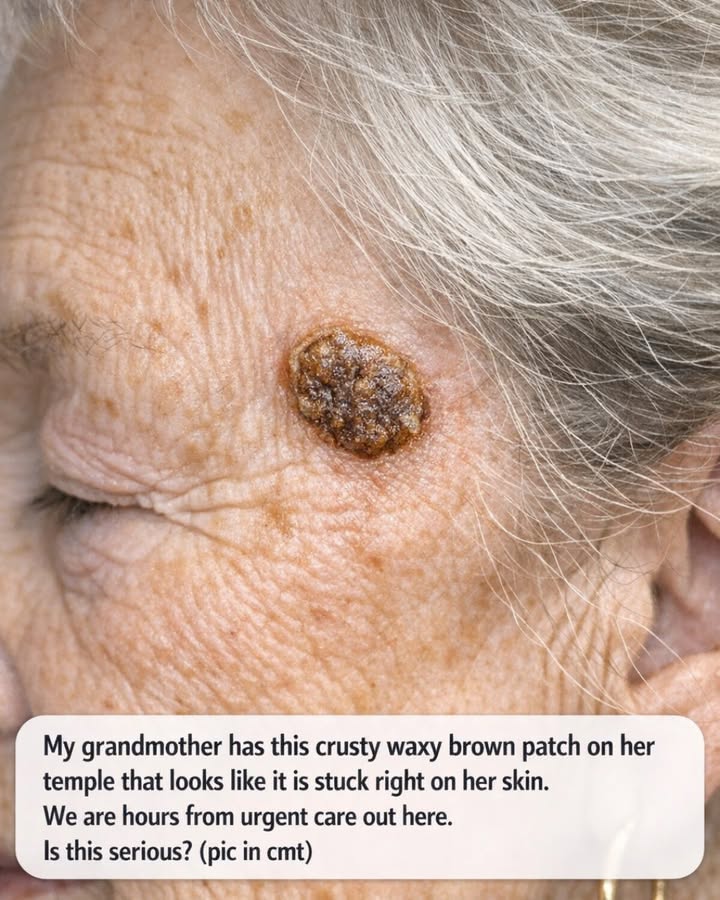
When someone you love suddenly has a new-looking brown patch on the temple, especially one that seems pasted or stuck onto the skin, it is easy to fear the worst. I live in a place where “just run to urgent care” can mean a two-hour drive each way, so I understand the anxiety behind trying to decide whether something can wait, whether it needs a clinic appointment this week, or whether it is a true emergency. The good news is that a crusty, waxy, stuck-on brown patch in an older adult is very often something called a seborrheic keratosis, which is usually harmless.
That said, “usually harmless” is not the same as “ignore everything.” In this piece, I’ll walk you through what seborrheic keratosis commonly looks like, what signs make it less urgent, which red flags mean it should be checked sooner, what you can and should not do at home, and how to tell the difference between a likely nuisance and something that deserves prompt medical attention.
1. What a seborrheic keratosis usually looks like
A seborrheic keratosis is a noncancerous skin growth that often appears in adults over age 50, though it can show up earlier. The classic description is exactly what you wrote: waxy, crusty, brown or tan, and “stuck on” as if someone pressed a thin bit of candle wax or dried mud onto the skin. They may be flat at first, then gradually thicken over months or years.
They can range from about 2 or 3 millimeters, like the size of a sesame seed, to 2 or 3 centimeters across, about the width of a grape or larger. The surface may look rough, crumbly, warty, velvety, or slightly greasy. Color can vary from pale tan to medium brown to nearly black, sometimes with more than one shade in the same spot.
2. Why the temple is a common place to notice one
The temple, hairline, forehead, cheek, back, chest, and shoulders are common locations for seborrheic keratoses. The face gets noticed quickly because the light catches texture there, and family members see it up close. On the temple in particular, a growth can look more dramatic because the skin is thinner and the lesion may stand out against gray hair or lighter skin.
I’ve seen families become alarmed because the patch seemed to “appear overnight,” but often what really happened is that it was flat and faint for months, then became more obvious after it dried out, got rubbed by a pillow, or caught the light differently.
3. Signs that make it sound less like an emergency
If the patch has a clear “stuck-on” look, has fairly defined edges, feels waxy or rough, and has been changing slowly rather than over a few days, that leans more toward a benign seborrheic keratosis. Mild itching is common. It may even crumble a little on the surface, almost like dry debris, without meaning anything dangerous.
It is also somewhat reassuring if there is no significant pain, no rapid swelling, no active bleeding, and no open sore. A lesion that is 5 to 15 millimeters across, has been there for weeks to years, and simply looks like a pasted-on brown plaque is usually not an urgent-care emergency in an otherwise well adult.
4. Signs that mean it should be checked soon, even if it may still be benign
Even harmless lesions deserve a proper look if they are new, changing, or confusing. Arrange a clinic or dermatology visit sooner rather than later if the patch has changed noticeably over 1 to 8 weeks, especially if it has become much darker, developed multiple very uneven colors, or grown quickly in thickness or width.
Also get it checked if it becomes repeatedly irritated by glasses, combing, pillow friction, or scratching; if it itches enough to disturb sleep; or if it starts catching and flaking constantly. A lesion on the temple that is 1 centimeter or larger and new enough that nobody remembers seeing it a few months ago is worth having someone examine, even if it still turns out to be seborrheic keratosis.
5. Red flags that raise concern for skin cancer instead
The main conditions doctors do not want to miss are melanoma, squamous cell carcinoma, and pigmented basal cell carcinoma. Worrisome features include asymmetry, very ragged or blurred borders, several distinct colors mixed together in a chaotic way, a sore that does not heal, repeated spontaneous bleeding, or a spot that is tender and rapidly enlarging.
A simple way to think about it is this: seborrheic keratosis often looks pasted on top of the skin, while some skin cancers look more like the skin itself is changing from within. That is not a perfect rule, but it helps. If the area is bleeding without being picked, forming a persistent sore, or changing fast over days to a few weeks, it should be evaluated promptly.
6. When it is appropriate to seek urgent or emergency help
This is rarely an emergency by itself. A likely seborrheic keratosis does not usually require a same-day urgent care visit just because it is crusty or brown. If you are hours away from care and the patch is stable, not bleeding, and your grandmother otherwise feels fine, it is generally reasonable to monitor it and arrange a non-urgent appointment.
Seek urgent care more quickly if there is heavy bleeding that does not stop after 10 to 15 minutes of steady pressure, rapidly spreading redness around the area, marked swelling, severe pain, fever, confusion, or if the spot was injured and now will not stop oozing. Those situations are less about seborrheic keratosis itself and more about trauma, infection, or another diagnosis.
7. A practical at-home check you can do today
Use bright natural light or a strong lamp and look at the lesion without makeup, lotion, or ointment on it. Measure it with a ruler in millimeters if you can. Take one clear photo from about 12 inches away and one closer photo, then repeat in 2 to 4 weeks if you are monitoring it. A coin in the frame can help with size comparison.