My husband keeps getting this coin shaped red scaly rash on his arms. We are hours from urgent care and he is scratching endlessly. What is this?
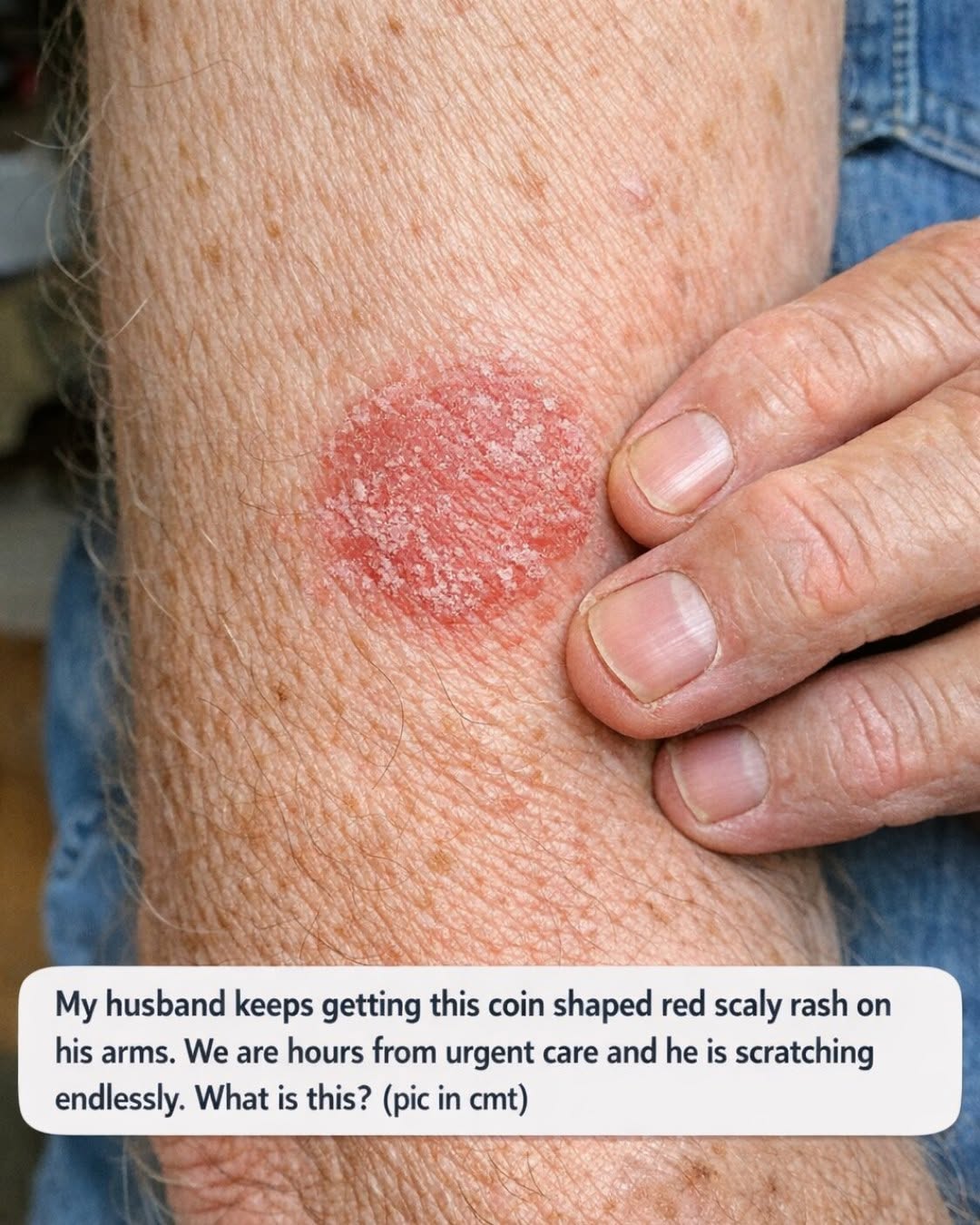
When a rash keeps showing up in round or oval “coin-shaped” patches, especially on the arms, and the itching is bad enough that sleep gets interrupted, one of the most likely culprits is nummular eczema, also called discoid eczema. I’ve seen people describe it exactly the way you did: red, scaly, maddeningly itchy spots that seem to come back in the same general areas, often during dry weather, after hot showers, or when skin has been rubbed, scratched, or exposed to harsh soap. It can look alarming, and because the patches are round, many families first worry about ringworm.
The good news is that nummular eczema is usually not an emergency, and there are practical things you can do at home tonight to calm the itch and protect the skin until you can get proper medical care. That said, there are also a few look-alikes and warning signs that matter. I’ll walk through what nummular eczema tends to look like, why it happens, how it differs from fungal rash and psoriasis, what to do right away, and when the distance to urgent care should stop mattering and it’s time to seek help fast.
1. What nummular eczema usually looks like
Nummular eczema classically shows up as round or oval patches that are roughly 1 to 5 centimeters across, though some grow larger. On the arms, they often appear on the forearms, outer upper arms, backs of the hands, or near the elbows. Early on, a patch may start as a cluster of tiny bumps or dry red skin, then become a more defined coin-shaped plaque with scale on top.
The itching is often the clue people remember most. Many describe it as worse at night, after sweating, after a hot shower, or when clothing rubs the area. The skin may feel dry, tight, and rough like sandpaper. In some cases the spots can crack or sting. On lighter skin, they often look pink-red; on darker skin, they may look deep red, brownish, or gray-violet.
2. Why the “coin shape” matters but does not give the diagnosis by itself
Round rashes make people think of fungus first, and that’s understandable. But “coin-shaped” is not exclusive to ringworm. Nummular eczema often forms circles or ovals simply because inflamed dry skin spreads outward in a fairly even pattern. Unlike classic ringworm, the whole patch in eczema is usually inflamed and scaly, not just the outer border.

Still, shape alone is not enough to be certain. If the patch has a sharply raised border with clearer-looking skin in the center, that leans more toward a fungal infection. If the entire spot is evenly dry, rough, and itchy without a distinct ring edge, eczema becomes more likely. In real life, though, there can be overlap, and sometimes a clinician needs to see it directly.
3. Why it happens in the first place
Nummular eczema is tied to a weakened skin barrier. When the skin barrier is damaged, moisture escapes and irritants get in more easily. That sets up inflammation and itch. Dry winter air, indoor heating, frequent handwashing, long hot showers, fragranced body wash, wool sleeves, and repeated scratching can all contribute.
Some people also have a personal or family history of eczema, allergies, or asthma, though not everyone does. In adults, flare-ups can also follow a scrape, insect bite, poison ivy, or another skin irritation that “starts the fire.” I’ve also seen patches worsen when someone keeps using hydrogen peroxide, alcohol, or heavily scented lotions on what they think is “just dry skin.”
4. Common triggers that make it flare or keep coming back
The biggest trigger is dryness. Relative humidity below about 30%, especially in winter, can be enough to provoke flares. Hot water is another frequent offender. A 15-minute steaming shower feels good in the moment but strips oil from the skin and often makes itching much worse within an hour or two.
Other triggers include scented detergent, dryer sheets, antiseptic washes, rubbing alcohol, lanolin in some products, rough fabrics, sweat trapped under long sleeves, and stress. Even repeated scratching can create a vicious cycle: itch leads to scratching, scratching damages the skin barrier, and the damaged barrier triggers more itch. If he’s “scratching endlessly,” that cycle is probably already underway.
5. How to tell it apart from ringworm
Ringworm, despite the name, is a fungal infection, not a worm. It often forms a ring with a more active outer border and a relatively clearer center. The border may be slightly raised and scaly, while the middle looks less inflamed. It can itch, but many people with ringworm say it is irritating rather than intensely miserable.
Nummular eczema tends to be itchier overall and often looks more evenly inflamed across the entire patch. Instead of one perfect ring, there may be several dry coin-like spots of similar texture on both arms or on the legs too. If over-the-counter steroid cream makes a fungal rash spread or look more dramatic over 1 to 2 weeks, that’s another clue the diagnosis may not be eczema. If there’s any strong doubt, avoid mixing multiple treatments all at once, because it muddies the picture.
6. Other rashes that can mimic it
Psoriasis can also produce scaly plaques, but those are often thicker, with more silvery scale, and frequently show up on elbows, knees, scalp, or lower back. Contact dermatitis can look similar too, especially if a new soap, metal, glove material, or topical product is involved. Insect bite reactions sometimes become round itchy plaques as well.
Less commonly, bacterial infection can complicate eczema and make it look more angry and swollen. If the patches become warm, tender, rapidly enlarging, or start draining yellow fluid, that is no longer a simple “watch it at home” situation. The same goes for widespread blistering, facial swelling, fever, or severe pain.
7. What to do tonight to calm the itching
Start with a short lukewarm rinse or shower, about 5 to 10 minutes, not hot. Pat the skin mostly dry so it stays slightly damp. Within 3 minutes, apply a thick, fragrance-free moisturizer generously over the rash and the surrounding skin. Ointments and thick creams usually work better than thin lotions. Plain petroleum jelly, a ceramide cream in a tub, or a thick fragrance-free cream are all reasonable options.