At the Altar, My Father Saw My Groom’s Face and Froze—Then He Revealed a Secret Buried for 30 Years
The Face at the Altar
I thought the hardest part of my wedding day would be not crying before I reached the altar.
More than anything, I wanted my father to walk me down the aisle.
Dad had raised me on his own since I was four. My mother disappeared from our lives when I was very little, leaving behind only a few photographs, a silver hair comb, and a silence my father never knew how to explain.
But he never spoke badly of her.
He braided my hair before school, worked night shifts, sat beside me when I was sick, and showed up for every school play even when his eyes were red from exhaustion.
Whenever I asked why life had been so hard for him, he would smile and say, “Your life will be better than mine, Emma. I’ll do everything to make sure of it.”
And he did.
So when I met Julian in Europe, I prayed my father would love him too.
Julian was kind, steady, and patient in a way that made the world feel less sharp. We had lived in Europe for three years because of my work, so Dad had only seen him a handful of times through freezing video calls.
Every time Julian’s face appeared on the screen, the internet would blur or the sound would cut out.
Dad always laughed and said, “I’ll meet him properly at the wedding. Some things are better face-to-face.”
The night before the ceremony, Dad caught a fever and missed the rehearsal dinner.
“I’ll see him tomorrow,” he told me over the phone, his voice warm but tired. “When I walk you to him. That’s the right way.”
I had no idea those words would change everything.
The Moment Everything Stopped
The church was full of white roses and soft candlelight.
I could hear the organ playing, the guests shifting in their seats, the quiet whisper of silk as my dress brushed the floor.
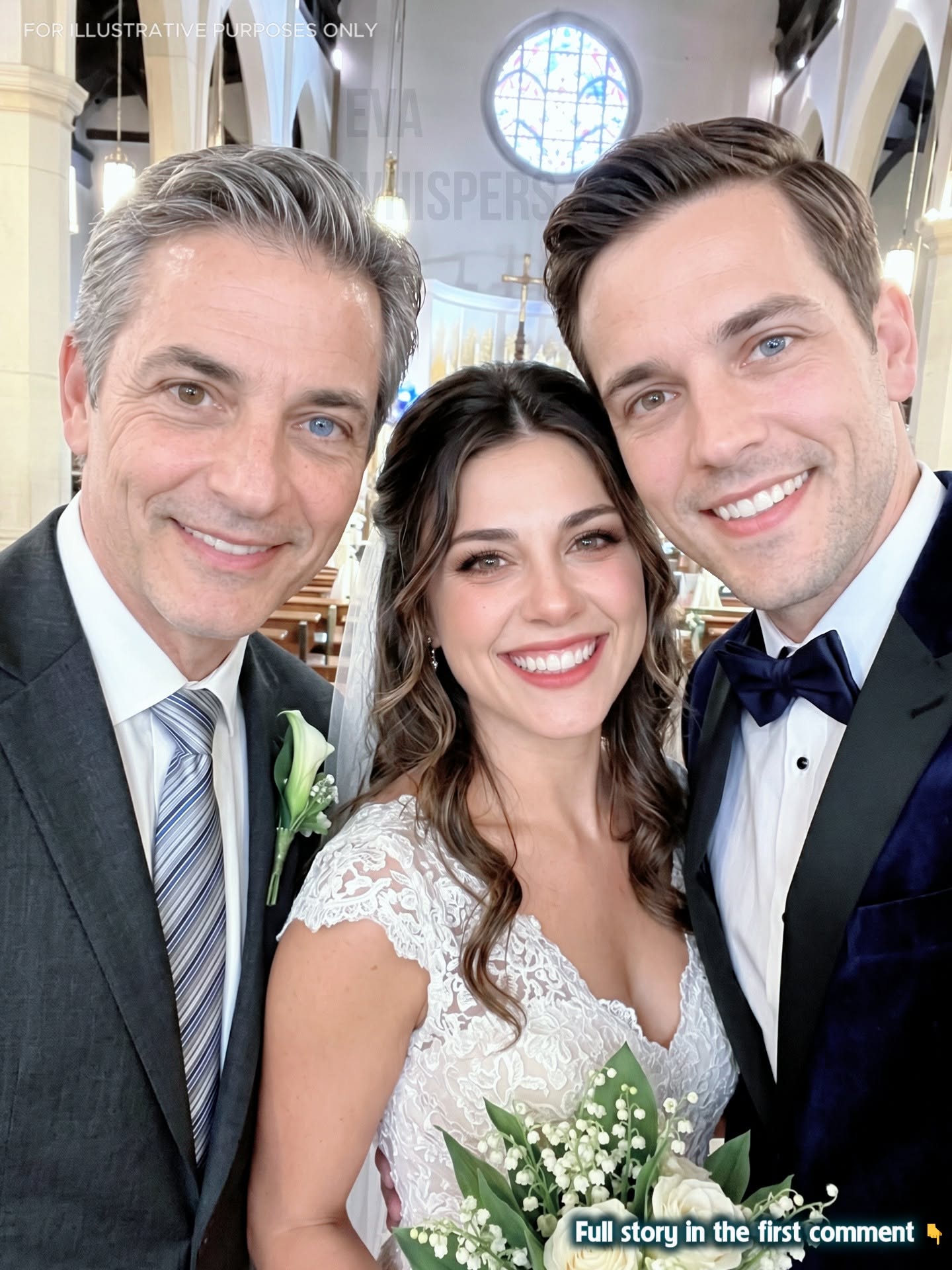
Dad stood beside me in his dark suit, a white rose pinned to his lapel. His hand trembled a little as he tucked mine through his arm.
“Nervous?” I whispered.
He smiled. “Only because my little girl looks too grown up.”
I laughed, trying not to cry.
Then the church doors opened.
Everyone stood.
At the far end of the aisle, Julian waited for me in a black tuxedo, his eyes shining. He looked calm, happy, and impossibly handsome.
For one perfect second, I thought, This is the beginning of my life.
Then Dad stopped walking.
His fingers dug into my arm so hard I gasped.
“Dad?”
He had gone completely pale.
At first I thought he was sick again. I reached for him, ready to call for help, but his eyes were fixed on Julian.
Not surprised.
Terrified.
Julian’s smile faded.
The music kept playing, but somehow the church felt silent.
“No…” Dad breathed. “No, this can’t be.”
I looked from my father to my fiancé. “Do you know each other?”
Dad lifted a trembling hand toward Julian.
“How can it be you?” His voice cracked through the entire church. “I was sure you disappeared thirty years ago!”
A murmur swept through the pews.
My heart dropped.
Dad whispered a name I had never heard before.
“Leo.”
Julian closed his eyes.
When he opened them again, they were full of pain.
Then he looked at me and said, quietly but clearly, “It’s too late to change anything. Now you can finally learn the truth about why I’m marrying you.”
For a moment, I forgot how to breathe.
A Name From the Past
I did not scream. I did not run.
I simply turned to the pastor and said, “Please stop the music.”
The organ faded.
My maid of honor rushed forward, but I raised my hand. “Give us a few minutes.”
Dad looked like he might collapse. Julian looked like a man standing in front of a door he had feared opening for years.
We stepped into the small side chapel beside the sanctuary. My dress filled half the narrow room. Outside, two hundred guests waited, whispering, wondering.
Inside, my whole life seemed to tilt.
“Somebody tell me the truth,” I said.
Dad sat heavily on a wooden bench. He kept staring at Julian like he was seeing a ghost.
Julian reached into the inside pocket of his jacket and pulled out a small object wrapped in a handkerchief.
He placed it in my father’s palm.
It was a tiny wooden lighthouse, worn smooth with age.
Dad covered his mouth.
“Oh my God,” he whispered.
Julian’s voice shook. “You carved it for me. You told me if I ever got lost, I should remember that every lighthouse was built for someone trying to come home.”
Dad began to cry.
I had seen my father tired, worried, even heartbroken. But I had never seen him cry like that.
“Who is Leo?” I asked, softer now.
Dad looked at me, and for the first time in my life, I saw guilt in his eyes.
“Before you were born,” he said, “your mother and I helped at a children’s home on the weekends. There was a little boy there named Leo. He was five. He had no one steady in his life, and we loved him almost immediately.”
Julian lowered his head.
Dad continued, “We wanted to foster him. Maybe adopt him one day. But the paperwork was complicated. Then one morning, they told us he had been placed with relatives overseas. No goodbye. No address. Nothing.”
His voice broke.
“We searched for years. Your mother never stopped blaming herself. She said we should have done more. I told her we had done everything we could, but she couldn’t let it go.”
I looked at Julian.
“You were that boy?”
He nodded. “My name was Leo then. Later, after I was adopted, it became Julian.”
The Truth Julian Carried
Julian took a slow breath.
“I grew up in Portugal with loving adoptive parents,” he said. “They were good to me. But I always had pieces of memories I couldn’t explain. A man with kind eyes. A woman singing while she brushed my hair. A wooden lighthouse. The words, ‘You can always come home.’”
Dad pressed the lighthouse to his chest.
“When my adoptive mother passed away, she left me a box of old papers,” Julian continued. “Inside was my original name, a few documents, and one photograph.”
He pulled out an old photo, folded at the edges.
There was my father, much younger, smiling with his arm around my mother. Between them stood a little boy holding the same wooden lighthouse.
Julian.
Leo.
The lost child my parents had loved before me.
“I started searching,” Julian said. “I found your mother’s name first. Then your father’s. Then… yours.”
My stomach tightened. “You knew who I was when we met?”
“No,” he said quickly. “When we met at the museum, I only knew you as Emma. I didn’t know your last name until weeks later. By then, I was already falling in love with you.”
“Then why didn’t you tell me?”
His eyes filled with tears.
“Because I was afraid. At first, I thought it would sound impossible. Then I thought your father might hate me for reopening old wounds. And then I found something else.”
He reached again into his pocket and pulled out a letter, yellowed with age.
My name was written on the outside.
Emma.
My hands trembled as I took it.
Dad looked stunned. “Where did you get that?”
Julian swallowed. “From my adoptive parents’ box. It was written by Clara.”
My mother.
For years, her name had been a closed door in our house.
Now it was in my hands.
My Mother’s Letter
I unfolded the letter carefully.
The handwriting was delicate and slanted, just like the birthday card Dad kept in his dresser.
My dearest Emma,
If this letter ever reaches you, I pray you will not think your mother left because she did not love you.
I loved you more than my own breath.
But there was a wound in me I did not know how to heal. Before you were born, your father and I loved a little boy named Leo. When he vanished from our lives, something inside me broke. I searched for him because I thought finding him would bring me peace.
Instead, I lost my way.
I was ashamed to come home after being gone so long. I told myself your father had given you a better life without me. That was my greatest mistake.
Please know this: your father was a good man. He loved you enough for both of us. And if Leo ever finds you, do not blame him. He was only a child. He was loved, lost, and carried by life to another shore.
I hope one day you all find each other.
With all the love I failed to show properly,
Mom
By the time I finished, my tears had fallen onto the page.
Dad was crying silently.
For so many years, I had thought my mother’s absence meant I had not been enough.
But the truth was more complicated.
More human.
She had been broken, ashamed, and lost in a grief she never knew how to escape.
That did not erase the pain she caused. But it changed the shape of it.
I looked at Julian.
“So when you said the truth about why you’re marrying me…”
He stepped closer, but not too close.
“I meant that I believe love brought me back to this family,” he said. “Not because I planned it. Not because I wanted to use you. I am marrying you because I love you, Emma. But I also think a part of me recognized the kindness your father and mother once gave me. You felt like home before I knew why.”
His voice cracked.
“I should have told you sooner. I was wrong to wait.”
A Wedding Paused, Not Broken
For a long moment, no one spoke.
Outside the chapel, the guests were still waiting.
Inside, my father held the wooden lighthouse like it was a piece of his younger heart.
I looked at the man who raised me and the man I had planned to marry.
Both of them had carried old wounds into that church.
Both of them had tried, in imperfect ways, to protect me from pain.
But love without truth always becomes heavy.
I turned to Julian.
“I need to ask you one thing,” I said. “If I walked away today, would you let me?”
His face crumpled, but he nodded.
“Yes. I would hate losing you, but I would never trap you with a story.”
Then I turned to Dad.
“Can you walk me down the aisle?”
He wiped his face. “Always.”
I took a breath.
“Then walk slowly,” I said. “Because I’m not just walking toward a husband now. I’m walking through thirty years of truth.”
Dad stood. Julian stepped back toward the sanctuary.
Before he left, Dad caught his hand.
For a second, they simply stared at each other.
Then Dad whispered, “Welcome home, Leo.”
Julian broke.
He hugged my father like a lost child finally finding the porch light still burning.
The Family We Chose
When we returned to the sanctuary, everyone fell silent.
I knew there would be questions later. There would be conversations, tears, perhaps even anger. Healing does not happen in one dramatic moment just because candles are burning and flowers are pretty.
But sometimes truth arrives at the strangest time.
And sometimes it arrives dressed like a groom.
Dad walked me down the aisle with one hand over mine and the other holding that small wooden lighthouse.
When we reached Julian, my father did not give me away.
Instead, he took Julian’s hand and placed it gently over mine.
Then he said, loud enough for the first row to hear, “Take care of each other. Both of you.”
Julian looked at me.
“I promise,” he whispered.
I did not marry him because the secret was beautiful.
It wasn’t.
Secrets rarely are.
I married him because when the truth finally came out, he did not hide from it. He apologized. He gave me a choice. And he stood there, trembling, ready to lose everything rather than lie one more second.
After the ceremony, Dad sat beside Julian at the reception, telling him little memories of the boy he once knew.
Julian laughed through tears when Dad described how he used to refuse soup unless it had “exactly seven crackers.”
Later that night, I found Dad alone near the church steps, staring at the wooden lighthouse.
“Are you okay?” I asked.
He smiled, tired but peaceful.
“For thirty years, I thought I failed that boy,” he said. “Today I got to see he survived. Not only that—he found his way back.”
I leaned my head on his shoulder.
“And Mom?”
Dad looked up at the stars.
“I think,” he said softly, “wherever she is, she knows the door finally opened.”
A year later, Julian and I placed my mother’s letter, the old photograph, and the wooden lighthouse in a glass case in our home.
Not as a shrine to the past.
As a reminder.
Families are not perfect.
People get lost. People make mistakes. People carry grief in ways that hurt others.
But love, when it is brave enough to tell the truth, can still find a way back.
And every time I pass that little lighthouse in our hallway, I think of my father’s words.
Every lighthouse is built for someone trying to come home.