I was still bleeding when my mother-in-law slapped me. The sound didn’t feel real at first. It echoed in the hospital room like something staged, like a scene I wasn’t fully inside of yet.
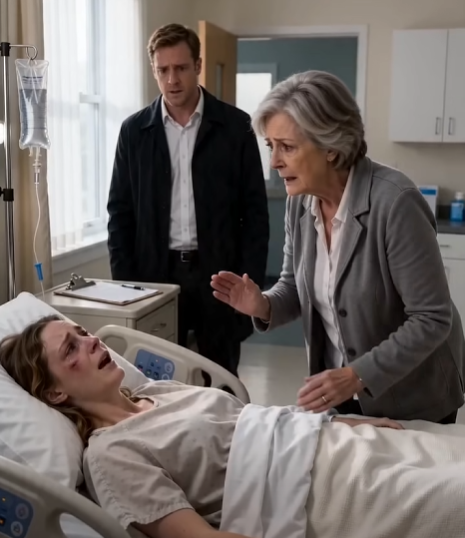
The machines beside me kept their steady rhythm, indifferent, and the fluorescent lights above flickered once, as if even they hesitated to witness it. My body was numb in patches and screaming in others, stitched together after an emergency surgery I barely remembered. Six hours earlier, I had been a mother. Now I was a woman lying in a hospital bed with empty arms.
“My God,” Evelyn said, her voice sharp enough to cut through anesthesia, “you couldn’t even do the one thing a wife is supposed to do.”
I tasted salt before I realized I was crying. Not loud, not dramatic. Just silent tears slipping into the pillow because even that small movement hurt too much. I turned my head slowly, each inch dragging across pain, and looked at my husband. Ethan stood near the window, hands buried deep in his pockets, staring out at the parking garage like it held answers more important than me.
“Ethan,” I whispered, though it came out thinner than I intended. “Please…”
He didn’t move.
That was the moment something inside me shifted, even before the nurse rushed in, even before anyone said another word. It wasn’t anger yet. It wasn’t strength. It was something colder, quieter—a crack forming in a place I hadn’t realized was fragile.
The doctor had called it a placental abruption. Sudden. Violent. Unpredictable. The kind of complication they say “just happens,” like that explanation is supposed to soften the blow of losing a child you had already loved for months. I had been thirty-two weeks pregnant. I had already picked out her name. Lily. I used to say it out loud sometimes when I was alone, just to hear how it sounded in the world.
I never got to hold her.
“You’re a disgrace,” Evelyn said again, louder now, as if volume could turn cruelty into truth. “My son deserved a real woman. Someone who could give him a family.”
Her words landed harder than the slap. I wanted to tell her that I had carried Lily through sleepless nights, through nausea, through quiet conversations whispered into the dark. I wanted to tell her that I had loved that baby with everything I had. But my body wouldn’t cooperate. My arms felt like they belonged to someone else, heavy and useless.
The second strike never came.
A nurse—later I learned her name was Sarah—grabbed Evelyn’s wrist midair, her voice firm and sharp. “That’s enough. Step away from the patient. Now.” There was a moment of resistance, of tension in the room, and then the door opened wider, voices calling for security. Everything became louder and more distant at the same time.
I closed my eyes.
Not to escape, but because I didn’t have the strength to watch anymore.
By the time I opened them again, Evelyn was gone. The room had settled into an uneasy quiet. The nurse adjusted my IV, her movements gentle, careful, like she was trying to repair something she hadn’t broken. Ethan was still by the window. He hadn’t moved. Not toward me. Not away. Just… there.
“Things got emotional,” he said finally, as if offering a summary instead of an apology.
I stared at him.
There are moments when words stop meaning anything, when they float uselessly between people who are no longer speaking the same language. That was one of them. I didn’t respond. I didn’t know how to respond to someone who could reduce everything that had just happened to “emotional.”
So I said nothing.
At noon, my father arrived.
You could always tell when he entered a room, even before you saw him. It was in the way the air changed, the way conversations paused without anyone realizing why. He walked in wearing his worn work boots and a jacket that still smelled faintly of engine oil, completely out of place in the sterile white hospital room.
His eyes went straight to my face.
He didn’t ask what happened. He didn’t need to. The mark on my cheek told him enough. The way I lay there, pale and hollow, told him the rest.
“What happened?” he asked anyway, but his voice wasn’t directed at me.
The nurse spoke. Calm, precise, professional. She explained everything—what she saw, what she stopped, what had almost happened. My father listened without interrupting. When she finished, he nodded once, slowly, like he was filing every word away.
Then he turned to Ethan.
“Things got emotional,” Ethan repeated, weaker this time.
My father stepped closer.
It wasn’t a dramatic movement. He didn’t raise his voice. He didn’t make a scene. But the shift in him was unmistakable. Ethan took a step back without meaning to, his body reacting before his pride could stop it.
“My daughter lost her child this morning,” my father said quietly. “Your mother put her hands on her. And you stood there.”
No one spoke.
Even the machines seemed quieter.
“I—” Ethan started, but the word died in his throat.
My father didn’t let him finish.
“You have until sunset,” he said.
The sentence hung in the air, simple and absolute.
Ethan blinked. “What?”
“By the time the sun goes down,” my father continued, his voice still low, still controlled, “every lock in her house will be changed. Every account with her name on it will be out of your reach. And every lawyer in this county will know exactly what happened in this room.”
For the first time since I had known him, Ethan looked afraid.
Evelyn wasn’t there, but somehow the threat reached her anyway.
“If either of you comes near her again,” my father added, “I will make sure the rest of your lives is spent explaining yourselves in courtrooms.”
Silence followed.
Heavy. Final.
I watched from the bed, my body still aching, my mind still fogged with loss, and yet… something shifted again. Not the cold crack from before. Something else. Something faint, like the first flicker of light after a long night.
Ethan opened his mouth, but no words came out this time.
My father didn’t wait for them.
He turned back to me, and for the first time since morning, his expression softened. He took my hand carefully, as if I might break further under the wrong pressure. His grip was warm, steady, familiar.
“You’re not alone,” he said.
I didn’t realize how much I needed to hear that until the words settled inside me.
Outside, the sky was already beginning to change color, the pale blue deepening toward evening. Time was moving forward whether I was ready or not. Whether I wanted it to or not.
I squeezed his hand back, just slightly.
It was the first movement that felt like mine all day.
And somewhere in the quiet space between grief and exhaustion, I began to understand something I hadn’t allowed myself to see before.
This wasn’t just about one terrible morning.
This wasn’t just about loss.
This was about everything that had been happening long before I ever stepped into that hospital room… everything I had ignored, forgiven, or explained away because I believed in the version of my marriage that no longer existed.
And as the sun dipped lower in the sky, casting long shadows across the room, I realized something else.
My father hadn’t just made a promise.
He had started a war.
And by the time night came, I would learn exactly how much had already been taken from me—far beyond the child I never got to hold.
Part 2
Three days after I was discharged, I walked back into the house I used to call mine, and it felt like stepping into a lie I had been living inside for years.
The front door opened with a new lock—my father had already changed it before I arrived—and the sound echoed too loudly in the quiet. Everything looked the same at first glance. The same couch we picked together on a clearance sale. The same framed photos lining the hallway. The same faint scent of lavender I used to think made the place feel like home. But now it all felt staged, like someone had carefully arranged a life I was no longer part of.
My father stepped in ahead of me, scanning the space like he was walking through a crime scene. Behind me, my cousin Nora carried a box of files and a notebook, already flipping pages, already preparing to turn my life into something that could be documented and defended. I stood in the doorway longer than I should have, one hand pressed lightly against my abdomen, still tender, still reminding me of everything I had lost.
“He’s not here,” my father said, glancing back at me. “His lawyer advised him to stay away.”
I nodded, but his absence didn’t feel like relief. It felt like residue. Ethan was everywhere without being present—in the way the kitchen drawers were organized, in the half-empty bottle of cologne on the dresser, in the quiet assumption that this had always been his space more than mine. And then I saw it.
Her things.
Monogrammed hand towels—Evelyn’s initials embroidered in careful loops—hung neatly in my kitchen. A set of teacups I had never agreed to own sat arranged by the window. And in the corner of the living room, as if it had always belonged there, was a bassinet. White. Pristine. Waiting for a baby who would never come home.
I didn’t cry.
That was the strangest part. I just stood there, staring at it, noticing details with an almost clinical clarity. The stitching along the edges. The soft blanket folded inside. The way it had been placed close enough to the couch that someone could reach it without standing. It wasn’t grief anymore. It was something heavier. Something that settled into my bones and refused to move.
“She planned this,” Nora said quietly behind me.
I didn’t answer. I didn’t need to.
We moved through the house slowly after that. Every room revealed something new, something I had missed before. Documents tucked into drawers that weren’t mine. Bills I didn’t recognize. A folder in Ethan’s desk labeled “Renovation,” filled with loan agreements I had no memory of signing. My name was on every page.
By the time the attorney arrived, the sun was already lowering again, casting long shadows across the dining room table where we spread everything out.
Her name was Victoria Hayes. She didn’t waste time with sympathy. She wore practical shoes, carried a thin briefcase, and spoke in sentences that felt like conclusions rather than suggestions. As she flipped through the documents, her expression didn’t change, but the way she tapped certain pages told me enough.
“This wasn’t impulsive,” she said finally. “These transactions started months ago.”
My chest tightened. “What transactions?”
She turned the papers toward me, pointing to a series of transfers. Large ones. Repeated ones. Money moved from our joint account into another account I didn’t recognize. My eyes tracked the dates, the amounts, the pattern forming in front of me like something I should have seen long ago.
“Who has access to that account?” I asked, though I already knew the answer.
“Ethan,” she said. “And based on what I’m seeing… possibly his mother.”
The room went quiet again.
I thought about the nights Ethan used to rest his hand on my stomach, whispering to the baby, smiling in that soft, private way I thought belonged only to me. I thought about how safe I had felt then. How certain I had been that we were building something together.
“He knew,” I said, the words barely audible. “He knew I’d be vulnerable.”
Victoria didn’t respond immediately. She just nodded once, confirming what I had already realized.
My father swore under his breath, pacing the room like he needed movement to contain his anger. “We go after them,” he said. “All of it. Fraud, assault—everything.”
“We will,” Victoria replied calmly. “But we do it properly. If we rush this, they’ll find a way to twist it.”
I looked at her. “What do I need to do?”
She met my gaze directly. “Decide whether you’re walking away… or fighting.”
The question shouldn’t have been difficult.
But it was.
Because walking away meant letting go of everything I thought my life was supposed to be. It meant admitting that the man I loved had never really been on my side. It meant accepting that the home I built was never truly mine.
Fighting meant something else entirely.
It meant dragging everything into the light. It meant confronting not just what they had done, but what I had allowed myself to ignore. It meant pain—public, prolonged, unavoidable.
That night, I listened to Ethan’s voicemail.
He called from a number I didn’t recognize, his voice softer than I had ever heard it. Carefully broken. Measured. Like he had practiced sounding sorry.
“I didn’t know how to handle everything,” he said. “My mom… she just gets like that sometimes. You know that. We were both hurting. We still are. Don’t let this tear us apart.”
I replayed one line over and over again.
You know how my mom gets.
Not I failed you.
Not I let you be hurt.
Not I betrayed you.
Just the same excuse, wrapped in grief, offered like it should be enough.
The next morning, I handed the phone to Victoria.
She saved the recording without comment, then looked at me again, this time more carefully.
“That helps us,” she said.
By the end of the week, everything began to move.
A protective order was filed. The hospital provided statements. Security footage confirmed what had happened in that room—Evelyn stepping forward, hand raised, while Ethan stood in the corner, doing nothing. The image wasn’t perfect, but it didn’t need to be. It was enough.
I thought that would be the worst of it.
I was wrong.
Because a few days later, Victoria called me with something new in her voice. Not surprise. Not anger.
Something colder.
“They filed a petition,” she said. “Ethan is claiming you’re mentally unstable. That you’re not fit to manage your own finances after… what happened.”
For a moment, I couldn’t breathe.
It wasn’t just betrayal anymore.
It was strategy.
“They’re trying to control everything,” I said slowly.
“Yes,” she replied. “And there’s more.”
She paused, then continued.
“He attempted another withdrawal yesterday. Using an old power-of-attorney document… with a forged date.”
I closed my eyes.
Something inside me settled then. Not breaking. Not collapsing.
Aligning.
“Tell me what to sign,” I said.
And as I picked up the pen, my hand didn’t shake.
Because for the first time since I lost my daughter, I wasn’t just surviving anymore.
I was choosing.
And I was beginning to understand that what was coming next wouldn’t just expose them.
It would destroy them.
Part 3
The courtroom was colder than I expected.
Not in temperature, but in feeling. The kind of cold that comes from too many truths being dragged into a place where no one can pretend anymore. I sat at the front beside Victoria, my hands folded in my lap, my posture steady in a way I didn’t fully recognize as my own.
Across the room, Ethan avoided my eyes.
His mother sat beside him, dressed in soft colors that tried too hard to suggest innocence. Her posture was rigid, her lips pressed thin, as if she believed disapproval alone could shield her from consequence. For a moment, I wondered if she truly believed she had done nothing wrong.
Then the hearing began.
Victoria didn’t start with emotion. She started with facts.
Bank statements. Transfer records. Loan agreements with my name on them, signed under circumstances I hadn’t fully understood. One by one, she laid them out, building something that didn’t rely on sympathy or interpretation. Just evidence.
Ethan’s attorney tried to object. Tried to reframe. Tried to slow the momentum.
It didn’t work.
Because then came the footage.
The hospital hallway. Grainy, silent, but clear enough. Evelyn stepping forward, her arm raised. The nurse intercepting her. Ethan standing in the background, motionless. Watching.
The judge leaned forward slightly.
That was the first shift.
Then came the voicemail.
Victoria played it without commentary. Ethan’s voice filled the room, softer than it had any right to be, carrying that same careful sorrow.
You know how my mom gets.
Silence followed.
Heavy. Unavoidable.
Victoria didn’t let it linger. She introduced the final piece.
Text messages.
Recovered from Ethan’s cloud account. Messages he had forgotten existed, or maybe assumed no one would ever see. Evelyn telling him to secure the money before I could access it. Ethan confirming he had already started moving funds, that I wouldn’t notice until my leave began.
I didn’t look at him while they were read aloud.
I didn’t need to.
Because whatever version of him I had loved no longer existed in that room.
When he took the stand, he tried.
I’ll give him that.
He tried to sound human. Tried to sound regretful. He spoke about grief, about pressure, about wanting to keep peace between me and his mother. He described himself as overwhelmed, as someone who made mistakes in a difficult situation.
For a moment, if you didn’t know the details, you might have believed him.
Then Victoria asked one question.
“Did you or did you not transfer funds from your joint account without your wife’s knowledge while she was pregnant?”
Ethan hesitated.
It was brief. Barely noticeable.
But it was enough.
“Yes,” he said.
The word landed harder than anything else that day.
Because it wasn’t wrapped in excuses.
It wasn’t softened.
It was just truth.
The ruling didn’t come immediately, but when it did, it was decisive.
I was granted exclusive use of the house. The protective order against Evelyn was extended. The claims against my mental stability were dismissed entirely, noted by the judge as “unsupported and strategically concerning.” The financial irregularities were referred for further investigation.
Piece by piece, everything they had tried to take was returned to me.
Not my daughter.
Never that.
But everything else.
Outside the courtroom, Ethan approached me.
Victoria moved slightly, ready to intervene, but I raised a hand. It was okay. I needed to hear what he would say when there was nothing left to hide behind.
“Maya,” he said, his voice cracking—not carefully this time, but genuinely. “I know I failed you.”
I waited.
“I was scared,” he continued. “I didn’t know how to stand up to her. I thought if I kept things calm, it would all settle eventually.”
I studied him then.
Really looked at him.
And for the first time, I saw him clearly. Not as the man I had married. Not as the partner I thought I had. But as someone who had chosen comfort over courage, silence over protection, control over honesty.
“Our daughter died,” I said quietly. “And you watched your mother hit me.”
He flinched.
“Everything after that,” I continued, “was a choice.”
He opened his mouth, but I didn’t let him speak.
“Don’t explain cowardice to me like it’s confusion.”
He stopped.
For once, he had nothing left to say.
I turned away from him, from Evelyn, from everything that had once defined my life, and walked toward the exit where my father was waiting.
He didn’t say anything.
He just stood beside me.
And that was enough.
Two months later, I sold the house.
Not because I couldn’t keep it, but because I didn’t want to live inside something that held too many versions of a life that no longer existed. I kept only what mattered. A small blanket. A few letters I had written during my pregnancy. The name Lily, carried quietly inside me where no one could take it.
I moved into a small place near the river.
It wasn’t grand. It wasn’t permanent.
But it was mine.
On the day my daughter was supposed to be born, I went to a park just outside the city. The trees were bare, the air cold, the world moving forward in that indifferent way it always does.
My father sat beside me on a bench.
We didn’t talk much.
There wasn’t anything left to explain.
After a while, he reached for my hand—not to guide me, not to fix anything, but just to be there.
And this time, I didn’t feel like someone who needed saving.
I felt like someone who had survived.
Not in a way that erased the pain.
Not in a way that made it smaller.
But in a way that made it mine.
If there is anything I learned from all of this, it’s this:
Grief does not make you weak.
Silence does not make someone kind.
And love—real love—does not ask you to endure harm to prove it exists.
I lost my daughter.
I lost my marriage.
But I found something I didn’t even realize I had been missing.
Myself.