Part 2: The Brotherhood Tested — Diner on Route 66
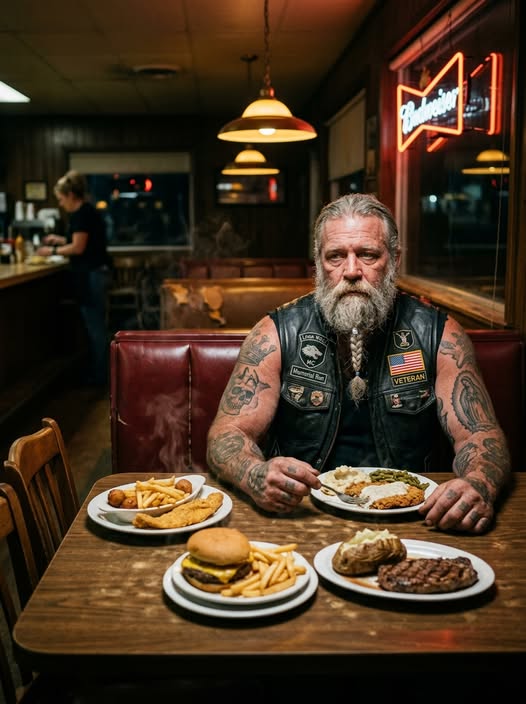
Let me tell you how a man like Decker looks from the outside, because that’s where everyone stays.
His hands were the size of catchers’ mitts — knuckles scarred, two fingers on the left hand crooked at angles God didn’t design. The kind of hands that have hit things harder than they should have, more times than they should have. But here’s the part that didn’t add up: his nails were trimmed clean. Not just short — maintained. Filed smooth. No grease under them, which is damn near impossible for a man who rode a ’98 Harley-Davidson Road King every day of his life.
His beard reached his chest, braided at the end with a small silver bead. The kind of bead you’d find at a craft store, not a biker rally. I noticed it the third Thursday. It caught the fluorescent light when he leaned forward to study the menu he’d already memorized.
He smelled like engine oil and leather and something else — something faint underneath, like soap. Not cologne. Soap. The plain kind. Like he scrubbed before he came.
Nobody sat near booth six when Decker was there. Families moved. Truckers shifted stools. Even Hank Berryman, who’d been drinking coffee at the counter since the Carter administration, would pick up his mug and relocate without a word.
They saw a man to avoid.
I saw a man who wiped the table down with his own napkin before he sat.
It took me four months to learn anything about Decker beyond the patches on his back.
The first crack came on a rainy Thursday in March when the diner was empty except for him and me and the cook, Luis, who was half-asleep over the fryer. I brought his four plates — two chicken-fried steaks, one catfish basket, one cheeseburger with extra pickles, same order every week, never varied — and I set them in front of four place settings. Three on the other side, one in front of him.
That night, I didn’t walk away.
“You waiting on someone?” I asked, even though I already knew the answer.
He looked at me for the first time — not through me, not past me, at me — and his eyes were so pale they looked silver under the lights. He didn’t answer. He cut into his chicken-fried steak and ate in silence.
But the next Thursday, he spoke first.
“Jolene.” That was it. Just my name. Reading it off my tag like he was testing whether his voice still worked. Then: “You got kids?”
“Two,” I said. “Twelve and eight.”
He nodded. Put a twenty on the table next to the ketchup. “For them. Not you.”
That was Decker. Every sentence was a transaction. Efficient. Nothing wasted. Bikers — the real ones, the ones who’ve patched in and ridden through things — don’t talk the way people talk. They don’t explain. They don’t justify. They state.
Over the next year, I learned Decker’s story the way you learn the shape of a canyon from the river — slowly, from the inside, one current at a time.
He’d been Savage Kings for twenty-two years. Prospected at nineteen in Lubbock, patched in before he could legally drink. Rode with a crew that ran the I-40 corridor from Albuquerque to Oklahoma City. Not the kind of club that does toy runs for the cameras, though they did those too. The kind of club where loyalty wasn’t a bumper sticker. It was a scar.
He’d done eighteen months in Huntsville for aggravated assault — a bar fight that went further than it should have, defending a brother who’d already hit the floor. He didn’t talk about prison like it was hard. He talked about it like it was boring. “Worst part wasn’t the walls,” he told me once. “Worst part was no engine noise. Just quiet. All day.”
When he got out, the club took him back without a vote. That’s how deep he was.
But the thing that told me the most about Decker wasn’t any of that. It was a Thursday in July when a family came in — mother, father, two little girls, maybe four and six. The younger one had dropped her shoe in the parking lot and was crying the kind of cry that could shatter glass. Decker stood up from booth six, walked to the front door, went outside, and came back holding a tiny pink sandal. He knelt — this 260-pound man covered in skulls and barbed wire, knelt on the linoleum of Mabel’s Diner — and held the sandal out to the little girl.
She stopped crying.
He didn’t smile. He just set the shoe on the floor in front of her and walked back to booth six. The father stared. The mother grabbed her purse strap. But the little girl waved at his back.
He didn’t wave back. But I saw his hand open and close at his side, just once. Like he was catching something invisible.
It was the silver bead in his beard that finally made sense later. But I didn’t know that yet.
In September, three years into Decker’s Thursdays, something changed.
He came in at the usual time, boots scraping, vest creaking. But he didn’t sit down. He stood at booth six and stared at the three empty seats across from him. His jaw worked like he was chewing words he couldn’t swallow.
Then he pulled out a photograph from the inside pocket of his cut — the pocket right over his heart, the one I later learned bikers call “the chapel” — and laid it face-up on the table.
I didn’t look at it. Not then. He didn’t want me to.
He sat down. He ordered the four meals. But that night, he didn’t eat. He just sat there, both hands flat on the table, staring at the three plates across from him, and I swear to God I saw his lips move. Not words. Not prayer. Just movement. Like his mouth was trying to remember how to say names it hadn’t said out loud in a long time.
At 9:15, he stood up. He left sixty dollars on the table — the food plus the usual thirty percent. He walked to the door, stopped, and said without turning around: “Jolene. You ever had a family you chose?”
“I think so,” I said.
“Don’t think,” he said. “Know.”
The bell rattled when the door closed. Through the window, I watched him throw a leg over the Road King. The V-twin fired up — that deep, uneven rumble that sounds like a heartbeat with a grudge — and he sat there for a full minute before he pulled out. Just sitting in the parking lot, hands on the grips, engine idling.
When he finally rode off down Route 66, his taillight looked like the last ember of a fire nobody was tending.
The next Thursday, the photograph was gone from the table. But there was a new detail I hadn’t noticed before: four names carved into the underside of the table in booth six. Small. Rough. Done with a pocketknife, probably years ago.
DECKER. ROACH. MANNY. PESO.
I ran my fingers over them. The cuts in the wood were deep enough that someone had gone over them more than once.
The twist — the real one, the one that turned everything inside out — came from a woman I’d never seen before.
It was a Thursday in November, year five. Cold enough that the windows of Mabel’s were fogged from the fryer steam. Decker was in his booth, four plates arranged like always: his chicken-fried steak in front of him, catfish at the ten o’clock position, cheeseburger at twelve, second chicken-fried steak at two.
A woman came in. Mid-forties, thin in the way that says she’d been through something that burned the weight off her. Dark hair, no makeup, a denim jacket too light for the weather. She stood in the doorway and stared at Decker like she was looking at a ghost.
He didn’t see her. His eyes were on the catfish plate.
She walked over. Slowly. The whole diner went quiet — Luis stopped the fryer, the trucker at the counter put down his fork, even the jukebox seemed to hold its breath between songs.
She stopped at booth six.
“That’s Manny’s plate,” she said.
Decker’s hands went still. His fork touched the table with a sound like a bone cracking.
He looked up.
“Rosa.”
She was Manny Delgado’s wife. Or widow — except Manny wasn’t dead. Manny was the one who’d gone to prison. Fourteen years, federal, for something connected to the club that Decker never specified and I never asked about. Rosa hadn’t spoken to anyone from the Savage Kings since Manny’s sentencing. She’d moved to Dallas, changed her number, cut every thread.
But she’d driven four hours on a Thursday because a cousin’s friend’s daughter had posted a photo on Instagram of “some scary biker dude sitting alone with four plates at a diner in Amarillo lol” — and Rosa had recognized booth six.
She recognized the booth before she recognized Decker.
She slid into the seat behind the catfish plate — Manny’s seat — and neither of them said anything for a long time. The food got cold. The coffee got cold. The diner got cold.
Then Rosa said: “You’ve been ordering his food for five years?”
“Seven,” Decker said.
Her face broke. Not crying — crumbling. Like a wall that had held for years finally finding its crack.
“He thinks everyone forgot,” she said.
“He’s wrong.”
This is where the four plates make sense. Where the names carved into the wood under the table become something more than vandalism.
Seven years before I started serving Decker, booth six held four men every Thursday night. Decker, Roach, Manny, Peso. Savage Kings, I-40 chapter, the tightest four-man crew in the club. They’d ride in together — four Harleys in formation, loud enough to vibrate the salt shakers off the tables — and they’d order the same meals every week. Chicken-fried steak for Decker and Roach. Catfish for Manny. Cheeseburger, extra pickles, for Peso.
Peso — real name Thomas Pesoto — was the youngest. Twenty-six. The one who laughed loudest, tipped biggest, flirted with every waitress Mabel’s ever hired. He wore the silver bead in his beard — a gift from his daughter, who was four at the time. She’d made it in a preschool art class. He never took it off.
Peso died on Route 66 on a Wednesday — the day before their Thursday dinner. A truck driver fell asleep at the wheel near Conway. Peso’s Softail didn’t have a chance. The Road King behind him — Decker’s Road King — was close enough that Peso’s blood misted the windshield.
Decker carried the silver bead from Peso’s beard in his pocket for two years. Then he braided it into his own. He never told Peso’s daughter. He just wore it. Every day. Every ride. Every Thursday.
Manny went to prison four months after Peso’s funeral. The federal case had been building for years, but the timing — right after burying a brother — made it feel like the universe was picking them off one by one.
And Roach — Michael Roach Henderson, the quietest of the four, the one who always ordered the same thing Decker ordered because he said he “trusted Deck’s gut about everything, even food” — Roach disappeared. Not dramatically. Not violently. He just stopped showing up. Left his bike in his garage, left his cut folded on the seat, left a note on the kitchen table that said three words: Can’t do this.
Nobody found him. Nobody heard from him. He didn’t die — at least, no body ever turned up. He just became a hole in the formation. A gap in the V that no prospect could fill.
So Decker came alone. And he ordered four plates. Because a table set for one is a man eating dinner. A table set for four, with three plates no one touches, is a man saying: I’m still here. Your seat is still here. The meal is still warm. Come back.
The silver bead in his beard was for Peso.
The clean nails were for Rosa — because Manny once told him, “Rosa always said a man’s hands show his character. Keep ’em clean, brother.”
The napkin he used to wipe the table was for Roach, who had a thing about sticky surfaces, who used to wipe down the table the exact same way before he sat.
Every detail that didn’t fit — every contradiction in the big scary biker — was a piece of someone he’d lost, carried forward in motion and ritual because Decker didn’t know how to grieve with words. He grieved with repetition. With presence. With a table set for four in a diner on a highway where everything moves except him.
Rosa came back the next Thursday. And the one after that.
She sat in Manny’s seat and ate Manny’s catfish and told Decker stories about Manny’s daughter, who was fifteen now and had his eyes and his stubbornness and his habit of laughing too loud in quiet rooms.
On the third Thursday, Rosa brought a letter from Manny. She slid it across the table, past the catfish, past the ketchup. Decker held it with both hands. Those massive, scarred, clean-nailed hands. He read it twice. Then he folded it and put it in the chapel pocket, right where the old photograph used to be.
I never read the letter. But I saw Decker’s face after he read it, and it was the face of a man who’d just been told that the thing he’d been doing — the stupid, stubborn, beautiful, unexplainable thing of ordering food for empty chairs for seven years — had mattered.
Rosa told me later what the letter said. One line: Brother, I heard about the plates. Don’t you dare stop.
He didn’t.
Year six. Year seven. Rosa now a regular. Two plates occupied, two still empty. Roach’s chicken-fried steak still ordered, still untouched, still paid for. Peso’s cheeseburger with extra pickles, still placed at twelve o’clock, still growing cold.
One Thursday, a young man came into Mabel’s. Early twenties. Slim. No patches, no leather, no ink. He stood at the door and looked at Decker the way you look at a mountain — not with fear, but with the understanding that you are small.
“Are you Decker?”
“Who’s asking?”
“My name is Thomas. Thomas Pesoto Jr.”
The diner went silent for the second time in its life.
Decker looked at the silver bead hanging from his own beard. Then he looked at the young man who had his father’s jaw and his father’s way of standing with his weight on his left foot.
He reached up, unbraided the bead, and held it out.
“Sit down,” he said. “Your old man’s burger is getting cold.”
Every Thursday, booth six at Mabel’s Diner on Route 66 in Amarillo, Texas, has at least three people in it now.
Decker. Rosa. Thomas Jr.
Three occupied. One empty. Roach’s plate still ordered. Roach’s seat still open.
Sometimes Thomas Jr. asks about his father. Decker tells him one story per Thursday. Never more. Never less. Always ending the same way: “Your dad was good people.” Period. No elaboration. No embellishment. A biker’s highest compliment delivered like a brick — heavy, plain, undeniable.
Sometimes Rosa cries into the catfish. Decker doesn’t comfort her. He just pushes the napkin dispenser closer. That’s how a man like Decker says I see you.
And sometimes, when the diner is empty and Luis has gone home and the neon Budweiser sign flickers once like it’s thinking about coming back to life, Decker sits alone for a few extra minutes after the others leave. He runs his fingers over the four names under the table. He taps each one. Decker. Roach. Manny. Peso. Four taps. Like a heartbeat with a grudge.
Then he stands. He zips his cut. The leather creaks in the quiet.
He walks to the door, and the boots scrape the linoleum one last time for the week.
Outside, the Road King is waiting. He throws a leg over. The V-twin catches — that deep, chest-shaking rumble that sounds less like an engine and more like a promise — and he lets it idle for exactly one minute.
One minute for each brother who isn’t riding beside him.
Then he pulls out onto Route 66, heading west into whatever’s left of the sunset, and the only thing left in the parking lot is the smell of exhaust and the sound of a machine carrying a man who refuses to let an empty chair mean what everyone thinks it means.
Booth six will be ready next Thursday.
It always is.
If this story stayed with you — if it made you think about the people who keep a seat open for you somewhere — follow this page. We tell the stories nobody else will. The ones that ride in loud and leave you quiet.