My Wife Left Me With Our Blind Newborn Triplets — 18 Years Later, She Returned at Their Graduation
The Night She Walked Away
My name is Daniel Harper, and eighteen years ago, I became a father three times in one day.
My daughters, Lily, Nora, and Gabriella, were born just two minutes apart. They were tiny, fragile, and perfect in every way to me. But because of complications during delivery, all three of them were born blind.
The doctors spoke gently when they told us. They explained what tests would come next, what support we would need, and how much life would change. I remember holding Lily in my arms while Nora slept against my chest and Gabriella curled her little fingers around mine.
I looked at them and thought, We will figure this out.
But my wife, Clarissa, looked at them like life had betrayed her.
For one month, I tried to believe she was just scared. I told myself she needed time. She barely held the girls. She barely spoke to me. When they cried at night, she turned her face into the pillow while I stumbled through diapers, bottles, and lullabies with shaking hands.
Then one night, at two in the morning, I was rocking Gabriella near the window when I heard the closet door open.
I turned and saw Clarissa packing two suitcases.
“Where are you going?” I whispered.
She didn’t even look ashamed.
“I’m still young, Daniel,” she said, folding a silk blouse. “I can’t spend my life trapped like this.”
“Trapped?” I repeated, looking down at our daughter.
She sighed as if I were the unreasonable one.
“I want to live life to the fullest. I can’t do that with three blind babies and a husband who can barely pay the bills.”
I begged her not to leave. Not for me, but for them.
She zipped the suitcase, walked past me, and said, “Don’t contact me.”
Then she slammed the door behind her.
Gabriella cried in my arms, and for the first time in my life, I had no idea how to stand up straight.
Learning to Be Everything
A couple of weeks later, mutual friends told me Clarissa had already been seen with a wealthy man. Someone with a luxury car. Someone who took her to expensive restaurants.
I stopped asking about her after that.
I had three daughters who needed me.
So I stayed.
I worked mornings at a hardware store and evenings cleaning offices. Sometimes I slept only three hours. Sometimes I ate cereal for dinner because diapers cost more than I expected. Sometimes I cried quietly in the laundry room so the girls wouldn’t hear my voice break.
But I learned.
I learned Braille along with them. I labeled every drawer, every shelf, every shampoo bottle. I memorized the safest paths through our small apartment and later through our little house.
I learned how to braid hair by watching videos online. My first attempts were terrible. Lily once touched her crooked braid and said, “Daddy, does my hair look like a confused squirrel?”
I laughed so hard I nearly dropped the comb.
Nora was the brave one. She walked into every room like she owned it, tapping her little cane and asking questions faster than anyone could answer.
Gabriella was quieter. She loved music. Before she could read, she could hum melodies perfectly after hearing them once.
Every morning, I packed three lunchboxes. Lily liked apple slices. Nora wanted extra crackers. Gabriella always asked for something sweet, “just in case the day needs saving.”
I never missed a school performance. I was at every parent meeting, every music recital, every awards ceremony. Sometimes I arrived in my work uniform with paint dust on my sleeves, but I was there.
People praised me sometimes, but I never felt like a hero.
I was just their father.
And loving them was the easiest thing I had ever done.
The Three Girls Who Refused to Be Pitied
As the years passed, my daughters became stronger than anyone expected.
Lily loved words. She read Braille faster than most people read printed books. By ten, she was writing poems. By fifteen, she was giving speeches at school assemblies about accessibility and kindness.
Nora loved science. She could take apart a broken radio and put it back together better than before. She said the world was full of systems, and she wanted to understand every one of them.
Gabriella stayed with music. Piano, violin, choir, anything with sound. When she played, people stopped moving. It was like she could take all the pain in a room and turn it into something beautiful.
They were not helpless.
They were not broken.
They were my girls.
Still, there were hard days. Days when strangers stared. Days when teachers underestimated them. Days when the girls asked why their mother never called.
I never lied.
I told them, “Your mother made a choice I will never understand. But her leaving does not mean you were not worth staying for.”
Lily would grow quiet.
Nora would get angry.
Gabriella would ask, “Do you think she remembers our birthdays?”
I would kiss the top of her head and say, “I remember enough for both of us.”
And I did.
Eighteen birthdays. Eighteen Christmas mornings. Eighteen years of scraped knees, school dances, late-night talks, college applications, and laughter echoing through the hallway.
Then came graduation day.
The Woman in the Hat
The ceremony was held on the wide green lawn behind the school. Hundreds of chairs faced the stage. Families took pictures, teachers hurried around with programs, and the graduates stood in their caps and gowns.
I stood near the front, holding three small bouquets.
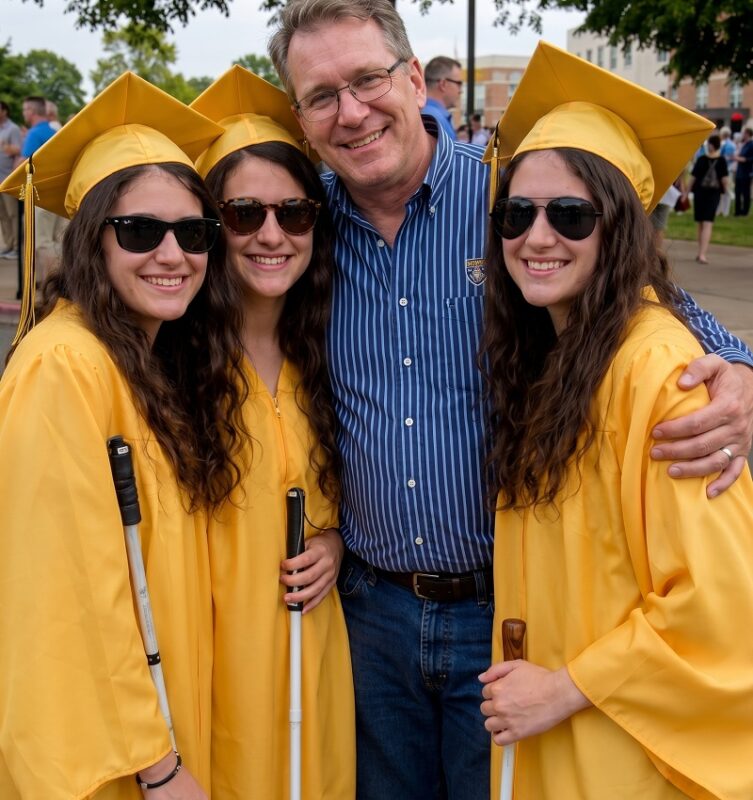
Lily wore a blue ribbon around her wrist. Nora had decorated her cap with tiny raised stars she could feel with her fingers. Gabriella wore dark glasses, as she often did outside, and held her folded cane lightly in one hand.
I was so proud I could barely breathe.
Then I heard heels clicking behind me.
A woman in a wide-brimmed hat stepped toward us. Her designer dress moved softly in the breeze. Diamond earrings sparkled beneath her hair.
At first, I didn’t recognize her.
Then she lifted her face.
Clarissa.
Eighteen years vanished in one second.
My hands tightened around the bouquets.
She looked older, but not worn down. Polished. Expensive. Like life had protected her from every consequence.
She didn’t even greet me.
She turned straight to the girls and smiled.
“My sweet girls,” she said, her voice soft and rehearsed. “You’ve grown into such beautiful young women.”
Lily’s head tilted slightly.
Nora’s jaw tightened.
Gabriella’s fingers wrapped around her cane.
Clarissa continued, “I know things were complicated when you were babies. But I finally have money now. We can be together. You need to understand that your father is the reason I left. He couldn’t give me anything.”
The words hit me harder than I expected.
Not because they were true.
Because after eighteen years, that was the story she had chosen.
I opened my mouth, but nothing came out.
What could I say in front of our daughters on the most important day of their lives?
The girls leaned toward one another. They whispered so quietly I couldn’t hear.
Then Lily smiled.
“Mom,” she said calmly, “it’s nice to see you. But I need to go on stage and receive my diploma.”
Clarissa looked pleased, as if she had been forgiven.
But Nora reached for my hand and squeezed it.
Gabriella had gone pale.
Lily at the Microphone
A few minutes later, the principal called Lily’s name.
She was not only graduating. She was the class speaker.
The crowd applauded as she walked across the stage with steady steps. Her fingers brushed the edge of the podium until she found the microphone.
She unfolded a sheet of Braille notes.
Then she paused.
The lawn grew quiet.
“I had a speech prepared today,” Lily began. “It was about courage, gratitude, and the future. But something happened a few minutes ago that made me realize I need to speak from the heart.”
My stomach tightened.
Clarissa shifted beside us.
Lily took a breath.
“When my sisters and I were born, we were blind. Some people thought that meant our lives would be small. Some people thought we would always need pity. But one person never treated us that way.”
She turned her face toward the crowd.
“Our father raised us alone.”
Applause rose, but Lily lifted one hand gently, and the crowd quieted again.
“He worked two jobs. He learned Braille with us. He burned pancakes, ruined ponytails, cried at school plays, fixed broken toys, and somehow convinced three stubborn girls that the world was still ours to explore.”
People laughed softly.
My eyes blurred.
Lily continued, “Today, our mother is standing here for the first time in eighteen years. She told us our father was the reason she left. She said he couldn’t give her anything.”
Clarissa’s smile disappeared.
Lily’s voice became stronger.
“But Dad gave us everything that mattered. He gave us mornings when we woke up safe. He gave us birthdays with homemade cakes. He gave us courage when the world felt too loud. He gave us love that never asked for applause.”
I pressed my hand over my mouth.
Then Lily said something that made my heart stop.
“And now I need to tell my father the real reason our mother came today.”
A murmur moved through the crowd.
Clarissa whispered, “Lily, don’t.”
But Lily did not stop.
The Real Reason
“Last week,” Lily said, “our story was published in the local paper because my sisters and I received scholarships. Nora received a full scholarship for engineering. I received one for law and advocacy. And Gabriella…”
She paused.
Gabriella’s face turned as pale as paper.
“Gabriella received a national music scholarship and a medical grant connected to a new vision treatment program.”
My breath caught.
I knew about the music scholarship. I knew Gabriella had been seeing a specialist for months.
But she had told me not to hope too much.
She had said, “Dad, I don’t want to disappoint you.”
Lily’s voice softened.
“Our mother contacted the school yesterday. She asked if family representatives could be involved in managing any scholarship funds. She said she wanted to reconnect.”
Gasps spread through the audience.
Clarissa’s face went red.
“That’s not true,” she snapped.
Nora stepped forward from the side of the stage and held up her phone.
“It is,” she said clearly. “We have the message.”
Clarissa looked around, suddenly aware that hundreds of people were staring.
But Lily did not sound cruel. She sounded sad.
“We are not saying this to embarrass her,” Lily said. “We are saying it because children deserve the truth. And our father deserves honor.”
Then Lily turned toward me.
“And Dad,” she said, “there is one more thing.”
My knees felt weak.
Gabriella slowly climbed the steps to the stage. Nora guided her with one hand, though Gabriella knew the way.
When Gabriella reached the microphone, she was trembling.
Lily put an arm around her.
Gabriella removed her dark glasses.
The entire crowd went silent.
Her eyes were wet with tears.
“Dad,” she whispered into the microphone, “I didn’t tell you everything about the treatment because I was scared. I still can’t see the way most people do. But the doctors said the procedure helped more than they expected.”
I stared at her, unable to move.
Gabriella lifted her face toward me.
“I can see light now,” she said. “Colors. Shapes. And today…”
Her voice broke.
“Today I can see you standing there.”
Something tore open inside my chest.
I screamed her name.
“Gabriella!”
The bouquets fell from my hands as I ran toward the stage. The crowd erupted, but I barely heard them. I climbed the steps, reached for my daughter, and she reached for me at the same time.
For the first time in her life, my daughter looked directly into my face.
Her hands touched my cheeks.
“You have more gray hair than I imagined,” she whispered.
I laughed and sobbed at the same time.
“And you are more beautiful than I ever knew how to describe,” I said.
What Clarissa Finally Understood
Clarissa stood below the stage, frozen.
For years, I had imagined what I would say if she ever returned. I imagined anger. Accusations. Questions.
But standing there with my daughters around me, I felt something different.
I felt free.
Clarissa took one step forward.
“Girls,” she said, her voice shaking now. “I made mistakes. But I’m still your mother.”
Nora answered first.
“You gave birth to us,” she said. “But Dad raised us.”
Clarissa’s eyes filled with tears.
Lily added gently, “We’re not here to punish you. But you don’t get to return because our lives finally look successful.”
Gabriella held my hand.
“If you want to know us,” she said, “start with honesty. Not money. Not excuses.”
Clarissa looked smaller then. Not because of her dress or diamonds, but because the truth had stripped away the story she had used to protect herself.
“I’m sorry,” she whispered.
For a moment, no one moved.
Then I said, “Sorry is a beginning, Clarissa. Not a shortcut.”
She nodded, crying quietly.
And somehow, that was enough for that day.
The Graduation We Never Forgot
Lily received her diploma to a standing ovation.
Nora walked next, grinning so widely that she nearly forgot to shake the principal’s hand.
Gabriella received hers last. When her name was called, she walked slowly, proudly, with her cane in one hand and her sisters cheering louder than anyone.
After the ceremony, we took pictures under the oak tree.
Lily stood on my left. Nora leaned against my shoulder. Gabriella kept looking at my face, blinking through tears, as if she was memorizing me in a new way.
Clarissa stayed at a distance.
Before leaving, she approached us one more time.
“I’d like a chance someday,” she said quietly.
Lily looked at her sisters.
Nora said, “Maybe someday. But not today.”
Gabriella added, “Today belongs to Dad.”
Clarissa nodded and walked away.
This time, she did not slam a door.
She simply left.
And I realized I was no longer the broken man she had abandoned in the middle of the night.
I was the father of three extraordinary young women.
That evening, we went home and ate takeout on the living room floor, just like we had done after every big day since they were little. The girls laughed, cried, and argued over who had made me cry the hardest.
Before bed, Gabriella stood in the hallway and looked toward me.
“Dad,” she said, “I always knew your voice. Now I’m learning your face.”
I couldn’t answer for a moment.
Then I said, “And I’ve known your heart since the day you were born.”
Eighteen years earlier, Clarissa said I couldn’t give her anything.
Maybe she was right.
I couldn’t give her diamonds, mansions, or the kind of life she thought she deserved.
But I gave my daughters every piece of myself.
And on graduation day, in front of hundreds of people, they gave it all back to me.
Not in money.
Not in applause.
But in love.
The kind that stays.
Note: This story is a work of fiction inspired by real events. Names, characters, and details have been altered. Any resemblance is coincidental. The author and publisher disclaim accuracy, liability, and responsibility for interpretations or reliance. All images are for illustration purposes only.