Part 2: The Boy Who Rewrote The Balance Beam
— CHAPTER 2 —
The drive home from the television center was always the quietest part of the night, but tonight the silence inside our old station wagon felt like concrete. The rain had started just as we cleared the security gates of Studio Circle, a steady, aggressive downpour that blurred the neon billboards of the city into long, bleeding streaks of yellow and red. Julian sat in the front passenger seat, his small frame almost swallowed by his oversized winter jacket. His carbon-fiber crutch, the one with the reflective blue tape wrapped around the forearm grip, was wedged tightly between his seat and the door, clicking faintly against the plastic paneling every time the car hit a bump on the highway.
He hadn’t looked at me since we left the loading dock. His head was turned completely toward the window, his forehead pressed against the cold, fogged-up glass, watching the streetlights dissolve. His hands, usually so restless, constantly tapping out complex syncopated rhythms on his knees or tracing the invisible outlines of keys in the air, were buried deep inside his pockets, curled into tight, motionless fists.
“Julian,” I said softly, keeping my eyes fixed on the taillights of the semi-truck ahead of us. “You don’t have to look at the internet tonight. In fact, we’re going to keep the tablet off. We’re going to keep the router unplugged for a couple of days.”
He didn’t move. He didn’t blink. “They already uploaded the preview clip, Dad,” he whispered. His voice was small, dry, and stripped of the bright, high-pitched energy that usually filled our house. “I saw the production assistant’s phone in the hallway before they handed us our coats. The title said ‘Heartbreaking Exit.’ It already had forty thousand shares.”

My grip tightened on the steering wheel until my knuckles turned white. The image of Alistair Croft leaning forward over his glossy mahogany judging desk, his heavy gold rings catching the studio lights as his palm slammed down on the giant red plastic button, was burned into the back of my eyelids. The sound of that buzzer hadn’t just been loud; it had been violent. It was a mechanical, synthesized screech designed to cut through music, through applause, through human dignity. And it had hit Julian before his small orthopedic shoe had even cleared the second blue floor-marker on the stage.
“Alistair Croft doesn’t know anything about counterpoint,” I said, my voice thick with a mixture of exhaustion and a fierce, protective anger that felt entirely useless against a multi-billion-dollar media network. “He doesn’t understand what you were doing with the left-hand phrasing. He doesn’t understand the work.”
“He didn’t even let me sit down,” Julian murmured. A single tear, thin and silent, escaped his eye and traced a slow path through the condensation on the glass window, mirroring the rain outside. “The moment the crutch hit the wood, the red light came on. The whole room didn’t even wait for me to reach the bench. They just… they looked at my leg, and then they looked at him to see if it was okay to laugh.”
That was the part that broke my heart the most. It wasn’t just the cruelty of one powerful man with a microphone; it was the immediate, terrifying compliance of the three hundred people sitting in the tiered studio audience. When Julian had first walked out from the velvet curtains, his crutch making a distinct, rhythmic clack-thud, clack-thud against the polished ebony floorboards, there had been a collective intake of breath—a soft, patronizing “aww” that treated my nine-year-old son like a wounded animal rather than a serious musician. But when Croft delivered his line—the loud, performative declaration that the show wasn’t a televised charity drive—the audience had shifted in an instant. The sympathetic sighs turned into uncomfortable, tittering laughter, a submissive wave of noise that signaled to Julian that he was an outsider, an embarrassment, a mistake in the production schedule.
We pulled into the driveway of our small, rented suburban home at half-past midnight. The house was dark, its grey siding looking washed out under the pale yellow glow of the single streetlamp at the corner of our block. I turned off the engine, and the sudden absence of the motor left us with only the heavy, rhythmic drumming of the rain on the aluminum roof of the car.
“Let me carry the bag, buddy,” I said, reaching over to touch his shoulder.
Julian pulled away slightly, not out of anger toward me, but out of a deep, agonizing desire to disappear. He grabbed the handle of his crutch with his right hand, his small fingers locking around the molded rubber grip with a familiarity that always made me ache. He pushed the car door open, the cold wind immediately throwing a spray of rain across his face and chest. He didn’t wait for me to help him down the small incline of the driveway. He moved quickly, his crutch striking the wet asphalt with a sharp, hollow sound, his left leg dragging slightly behind him, a stiff, unresponsive anchor that he had spent his entire short life trying to out-train.
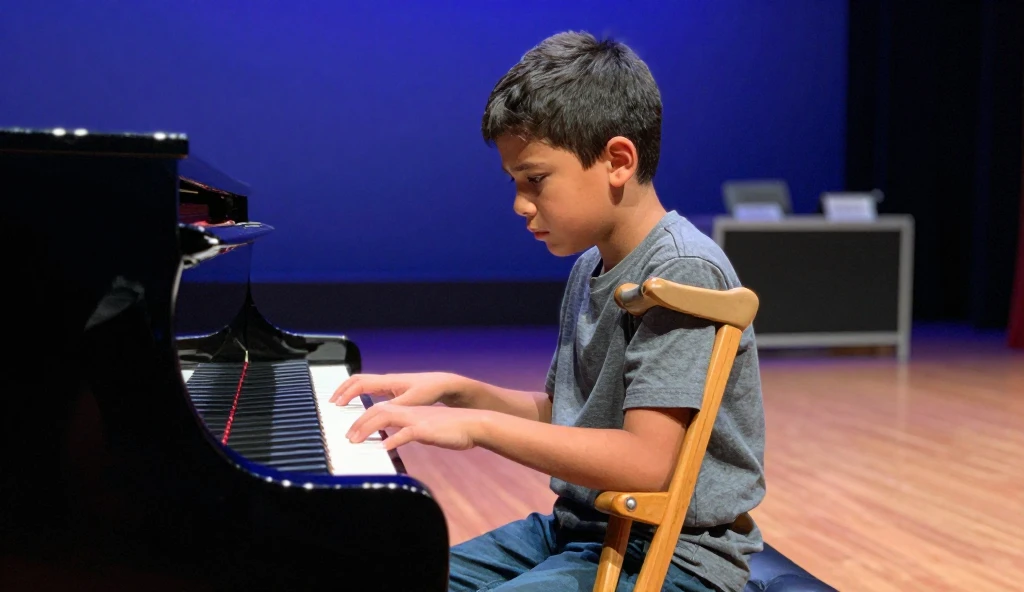
By the time I unlocked the front door, Julian had already kicked off his wet shoes in the hallway. He didn’t go to the kitchen for the hot cocoa I had promised him before the taping. He didn’t go to the piano in the living room—the old, upright Baldwin piano that we had saved for three years to buy, its mahogany casing covered in scratches and its ivory keys slightly yellowed by time. Usually, the moment Julian walked through the front door, regardless of how tired he was, he would gravitate toward that instrument like a compass pointing north. He would lift the fallboard with his thumbs, slide his small body onto the mismatched wooden bench, and let his fingers wander through a Bach prelude or a jazz chord progression just to clear his head.
Tonight, he walked past the Baldwin without even looking at it. He kept his head down, his crutch clicking softly against the worn linoleum of the hallway, and went straight into his bedroom, clicking the door shut behind him with a finality that felt like a door slamming on his childhood.
I stood alone in the dark living room, the smell of damp wool and old carpet rising around me. The Baldwin piano sat in the corner, its shape a heavy, silent silhouette against the pale light filtering through the window blinds. On top of the piano sat Julian’s music books—not the standard children’s method books with colorful illustrations of cartoon animals, but thick, heavy volumes of Chopin Nocturnes and Bach’s Well-Tempered Clavier, their corners dog-eared and their margins filled with my son’s neat, penciled notes about tempo, dynamics, and fingering alterations.
Julian had been diagnosed with a progressive peripheral nerve condition when he was four. The doctors in Chicago had told us, with that flat, clinical neutrality that tears a parent’s world apart, that the signals between his brain and his lower left limb were slowly, permanently degrading. They told us he would likely never play sports, that he would require mobility aids by the time he reached elementary school, and that we should focus on “low-impact, sedentary hobbies.”
But they hadn’t seen him listen to music. When Julian was five, he had sat on the floor of our living room while an old classical music station played a recording of Glenn Gould performing the Goldberg Variations. He hadn’t just listened; his entire body had gone rigid, his eyes wide and completely unfocused, his small fingers twitching against the carpet as if he could feel the physical shape of the counterpoint traveling through the air. The next day, he had climbed up onto the bench of an old electronic keyboard a neighbor had left on the curb for garbage collection, and with one hand, he had perfectly picked out the main theme of the aria.
Music wasn’t a hobby for Julian. It wasn’t an extracurricular activity designed to pad a middle-school resume or a clever trick to show off to relatives at Thanksgiving. It was his language. It was the only place in the entire world where his left leg didn’t matter, where his small frame didn’t invite pity, and where his mind could run at full, terrifying speed without being tripped up by his own nerve endings. When he sat at the piano, his hands moved with an authority and a maturity that made people forget he was a child. He could make an old, out-of-tune upright sound like a concert grand in a European hall simply by the way he controlled the weight of his forearms and the delicate, micro-tonal pressure of his fingertips.
And yet, in less than thirty seconds, a man who didn’t even write his own television scripts had reduced all of that—the thousands of hours of solitary practice, the bleeding blisters on Julian’s fingers from mastering octaves that his small hands could barely reach, the tears of frustration when a nerve block kept his left foot from pressing the damper pedal precisely at the bar line—into a cheap, televised joke about a crutch.
I walked down the short hallway to his bedroom door. I could hear him inside. He wasn’t sobbing loudly; he was making a small, rhythmic, muffled sound, his face clearly buried deep inside his pillow to keep me from hearing him break. It was a controlled, protective kind of crying that broke my heart even more than an open wail would have. He was trying to be strong for me, because he knew how much I worried about him, because he knew how many hours I worked at the logistics yard just to pay for his weekly lessons with Madame Rostova down at the conservatory.
“Julian,” I said softly, leaning my forehead against the cool painted wood of his door. “Can I come in, buddy?”
The muffled sound stopped instantly. There was a long pause, the silence stretched thin by the sound of the rain outside, before his voice came through the wood, thick and strained.
“I’m tired, Dad. Can we just… can we just sleep?”
“Okay,” I said, my throat tightening so much it physically hurt to speak. “Okay, Julian. I love you. We’ll talk in the morning. Everything looks different in the morning.”
But I knew I was lying. In the morning, the internet would still be there. The television network’s social media algorithms would still be pushing the video of his humiliation to millions of screens across the country, using his small, tear-stained face as a thumbnail to generate clicks for the premier episode of The Last Spotlight Round.
I walked back to the living room, sat down on the floor with my back against the wooden panels of the old Baldwin piano, and buried my face in my hands. The house felt incredibly cold, and for the first time since Julian’s diagnosis, I felt an overwhelming, suffocating sense of defeat. I had tried so hard to build a fortress of music around my son, a place where the world couldn’t hurt him for being different. But tonight, the world had breached the walls, walked right up onto the stage, and used his own sanctuary to strike him down in front of millions of witnesses. And the worst part was, there was absolutely nothing I could do to take the sting out of the wound.
— CHAPTER 3 —
The next three weeks were a slow, agonizing exercise in structural survival. Our house, which had once been defined by the constant, nearly non-stop cascade of piano music—ranging from the strict, mathematical architecture of Bach fugues to the wild, tempestuous storms of Rachmaninoff—became completely silent. It was a heavy, dense silence that seemed to collect in the corners of the rooms like dust.
Julian didn’t touch the Baldwin. The fallboard remained closed, its polished wood reflecting the grey morning light like a coffin lid. Every afternoon, when he came home from his fifth-grade classes at Saint Jude’s Academy, he would walk straight past the instrument without a glance. He would place his backpack on the kitchen table, retrieve his homework folders, and sit in absolute silence for hours, filling out vocabulary worksheets and math problems with a robotic, detached focus that terrified me more than any emotional outburst would have.
His crutch seemed to click louder now against the floorboards, a constant, clinical reminder of the physical reality that had been used to humiliate him on national television. At school, things had changed too. He didn’t tell me at first, but I saw the notes from his homeroom teacher, Mrs. Gallagher. She called me on a Tuesday afternoon during my lunch break at the shipping terminal, her voice filled with that gentle, careful diplomacy that always precedes bad news.
“Mr. Miller, I’m just calling to check on Julian,” she said, the background noise of school children shouting in the hallway filtering through the line. “He’s been… remarkably quiet since the winter break. And yesterday during recess, a few of the older boys from the middle-school wing were standing near the benches. They had a smartphone out. They were playing a video, and one of them had an old broomstick under his arm, mimicking… well, mimicking Julian’s walk. Julian didn’t say anything. He didn’t look at them. He just sat on the steps until the bell rang. I stepped in and took the phone away, of course, but the damage was done. He didn’t participate in music class this morning either. He asked to go to the nurse’s office with a headache.”
I sat in my small, metal-walled office at the logistics yard, staring out at the rows of massive shipping containers being hoisted by yellow cranes against a grey Chicago skyline. “Thank you, Mrs. Gallagher,” I managed to say, my teeth clicking together from the sheer force of the rage I was trying to suppress. “I’ll… I’ll talk to him.”
When I got home that evening, I found Julian sitting on our back porch, despite the temperature hovering just above freezing. He was wearing his winter coat, his legs dangling off the edge of the wooden deck, his eyes fixed on the old, weathered tire swing hanging from the oak tree in our small yard. The tire was spinning slowly in the wind, a lonely, geometric circle twisting back and forth against the grey backdrop of the neighborhood.
I opened the screen door and walked out, the wood groaning under my work boots. I sat down next to him, letting my legs hang over the edge too. The air was crisp, carrying the sharp, metallic smell of oncoming snow.
“Madame Rostova called me today, Julian,” I said gently, keeping my hands inside my coat pockets. “She said you missed your Tuesday session at the conservatory. She said she waited for forty-five minutes with the Chopin sheet music you asked for.”
Julian didn’t look at me. He reached down and touched the side of his left knee, his small fingers rubbing the joint through his denim jeans—a habit he had developed whenever the nerve pain began to flare up from the cold air.
“I don’t think I want to go back there, Dad,” he said. His voice was flat, devoid of any inflection. “Madame Rostova is nice, but… she keeps telling me that music is about expression. She keeps telling me that if I put enough feeling into the keys, the audience will see my soul.” He let out a short, bitter sound that was too old, too cynical for a nine-year-old boy. “But they don’t see your soul, Dad. They just see your legs. They see the carbon fiber. They see the blue tape. They see a kid who takes too long to get across the stage.”
“Julian, that was one man,” I said, leaning toward him, desperate to make him look at me. “One man who makes his living by being a bully on a television screen. He doesn’t represent the world. He doesn’t represent the people who actually love music.”
“The video has two million views now, Dad,” Julian said, finally turning his head to look at me. His large brown eyes were completely clear, devoid of tears, but filled with a profound, terrifying emptiness. “The comments… I looked at them on the library computer at school during lunch. People are calling me ‘the crutch kid.’ Some of them are being nice, saying it’s inspiring that I even tried to walk out there, but they aren’t talking about the piano. Nobody talked about the music. They just liked the part where I cried because it made a good video. I was just… I was just a commercial break for them.”
He stood up, using his crutch to stabilize his left side with a swift, practiced motion that looked entirely mechanical. “I’m going to do my science project now,” he said, turning toward the door. “The piano… we can sell it if we need the rent money for next month. I don’t need it anymore.”
The screen door clicked shut behind him, leaving me alone on the freezing porch as the first white flakes of snow began to fall through the bare branches of the oak tree.
I sat there for an hour, the cold seeping through my jeans into my bones. Sell the piano. The words felt like a physical blow to my chest. That old Baldwin was the center of our lives. When my wife, Sarah, had passed away from an illness when Julian was three, the house had been drowned in a similar, suffocating silence. It wasn’t until Julian discovered the keys two years later that the warmth had returned to these rooms. The music had been our bridge back to life, our proof that beauty could exist in a house that had been broken by loss. And now, because of a cynical piece of entertainment television, that bridge had been demolished.
I walked back into the house, my boots leaving wet trails on the carpet. I went into the living room and stood before the silent Baldwin. Out of a sheer, desperate need to feel something, I reached out and lifted the fallboard. The ivory keys gleamed in the dim light, pristine and waiting. I pressed a single middle-C key with my index finger. The note rang out—a pure, resonant, slightly melancholy sound that hung in the quiet air of the room before slowly decaying into nothingness.
As the sound faded, my eyes caught a small, white piece of paper that had been tucked under the bottom corner of the music stand. It was a page torn from an old technical manual—specifically, an archival document from the 1974 international piano technician’s conference that Madame Rostova had given me months ago when we were discussing the mechanical modifications needed to make the pedals more accessible for Julian’s condition.
I pulled the paper out and held it up to the light. It wasn’t about pedals. It was a detailed diagram of the double-escapement action mechanism inside a concert grand piano, written by Sébastien Érard in the nineteenth century. Underneath the intricate drawing of levers, jacks, and repetition springs, Julian had written something in his small, neat print.
He had calculated the exact amount of kinetic force, measured in newtons, required for a human finger to depress a key fully to the bed while maintaining control over the hammer’s velocity. Below that, he had drawn a comparison chart between our upright Baldwin and the massive, 9-foot Steinway Model D concert grands used in professional recording studios.
He hadn’t been practicing just to play pieces, I realized with a sudden, sharp jolt of awareness. He had been studying the physics of the instrument itself. He had been calculating how to manipulate the internal mechanics of a piano to compensate for the fact that his left foot couldn’t sustain notes using the traditional damper pedal. He had been developing a completely secret, self-taught technique to create a seamless legato sound entirely through manual articulation—something that classical pianists spent decades trying to master, and he was doing it with the mind of a nine-year-old engineer.
I looked down at his calculations, then looked toward his bedroom door. The talent hadn’t disappeared. The passion hadn’t been destroyed by Alistair Croft’s buzzer; it had simply been driven underground, buried beneath a thick layer of protective shame and survival instinct. The engine was still running inside my son’s head, but it was running in the dark, trapped behind walls of fear.
I sat down on the wooden bench, my fingers resting lightly on the yellowed keys. I didn’t know how to fix his leg, and I didn’t know how to stop the millions of people online from watching that horrible video. But as I looked at the penciled equations on that technical sheet, I knew one thing with absolute certainty: my son was a master of this machine, and I wasn’t going to let a television bully keep him from claiming the stage he had earned.
— CHAPTER 4 —
The turning point arrived on a rainy Thursday afternoon in late February, exactly six weeks after the disastrous taping at Studio Circle. I was sitting at the kitchen table, surrounded by shipping manifests and late-notice utility bills, when the telephone rang. The caller ID showed a number from the city’s downtown financial district—a region of skyscraper offices entirely removed from our working-class neighborhood.
“Is this Arthur Miller?” a woman’s voice asked. She sounded young, efficient, and slightly out of breath, the background noise of clicking keyboards and hushed telephone conversations suggesting a corporate environment. “My name is Claire Sterling. I’m the senior associate producer for The Proof Round.”
I froze, my hand hovering over a logistics spreadsheet. The Proof Round was the network’s flagship classical and instrumental performance program—a high-brow, prestige show that sat on the opposite end of the cultural spectrum from the cheap, viral sensation of The Last Spotlight Round. While Croft’s show focused on spectacle, comedy, and public humiliation, The Proof Round was known for its strict, un-compromised focus on technical excellence, judged entirely by classical conductors, academy directors, and legendary concert instrumentalists. It was filmed in a massive, historic stone auditorium downtown, and the winners received conservatory scholarships rather than cash prizes.
“If this is about a follow-up interview for the video from Tuesday night,” I said, my voice instantly dropping into a hard, defensive register, “we aren’t interested. My son is finished with television.”
“Please, Mr. Miller, don’t hang up,” Claire Sterling said quickly, her tone turning from professional efficiency to something genuinely urgent. “This isn’t about Alistair’s show. In fact, our entire division was mortified by what happened on that stage. We didn’t even know they had scheduled a child with Julian’s technical background for the audition bracket until the clip went viral.”
“Then why are you calling?” I demanded.
“Because of Madame Rostova,” she explained, pausing to take a breath. “She didn’t let the matter drop. When she saw the broadcast, she bypassed the standard production channels and sent a courier directly to our executive director’s office. She didn’t send a letter of complaint, Mr. Miller. She sent an unedited, high-definition recording of Julian performing Bach’s Chaconne in D minor—arranged for the left hand alone by Johannes Brahms—which he recorded in her studio last October. She also included three pages of technical diagrams Julian had drawn regarding the internal repetition mechanics of a grand piano’s action.”
I looked across the room at the closed Baldwin piano, my throat suddenly dry. “She did?”
“Our executive director is Marcus Vance,” Claire continued, her voice dropping into a tone of quiet respect. “He’s the former principal conductor of the Chicago Symphony. He watched the video, and then he spent two hours studying Julian’s notes. He said he has never seen a child understand the micro-dynamics of piano escapement like that. He doesn’t think Julian is an audition act, Mr. Miller. He thinks Julian was victims of a massive production error by a team that didn’t know the difference between a novelty performance and a prodigy.”
She paused, allowing the weight of her words to settle in the quiet kitchen. “We have a technical slot opening up this Saturday for the live semi-final broadcast of The Proof Round. It’s the ‘Mastery Segment’—a three-minute performance that opens the second half of the show. There are no gimmicks, no introductory videos about his condition, and Alistair Croft won’t be within five miles of the building. The stage is a standard concert layout: one 9-foot Steinway grand, a classical audience, and a judging panel consisting of three conservatory directors who don’t care what a contestant looks like when they walk out. They only care about what happens when the hands touch the keys.”
“Julian doesn’t want to play anymore, Ms. Sterling,” I said, the memory of his empty eyes on the back porch cutting through my sudden surge of hope. “He hasn’t opened the piano cover in six weeks. He wants me to sell it.”
“Show him the sheet music we just emailed you, Mr. Miller,” Claire said softly. “Madame Rostova said he would understand the choice. It’s the original, un-edited manuscript of Scriabin’s Prelude for the Left Hand, Opus 9, Number 1. It was written by a man who had injured his right hand through excessive practice and had to reinvent his entire technique to survive as a musician. If Julian says no after looking at that piece, we will never trouble you again. But please… give him the choice.”
After we hung up, I sat at the computer for a long time, watching the digital file download. When it opened, the screen filled with the complex, dark clusters of notes that formed Alexander Scriabin’s masterpiece—a piece designed to be played entirely by the left hand, creating the illusion of a full, two-handed orchestra through incredible leaps, precise pedaling, and absolute control over inner-voice melodies.
When Julian came home from school an hour later, the rain had turned into a dull, grey mist. He walked into the kitchen, his crutch leaving small, damp rings on the linoleum. He reached for an apple from the counter, his movements slow and mechanical.
I didn’t say a word. I simply turned the computer screen toward him, showing the digital sheet music of Opus 9.
Julian stopped. His hand stayed frozen an inch from the fruit basket. His large brown eyes locked onto the screen, his pupils dilating as he tracked the intricate patterns of the notes on the digital stave. He didn’t speak for two full minutes. His right hand, hanging loosely at his side, began to move—his thumb twitching, his index and middle fingers executing tiny, invisible micro-movements against his thigh as he mentally read the complex chord structures of the Russian prelude.
“This is Scriabin,” he whispered, his voice cracking slightly. “The original Moscow printing. Where did you get this?”
“The producers of The Proof Round sent it to you,” I said, watching his face with an intensity that made my chest ache. “They want you to play it this Saturday. No introduction videos. No talk about charity or inspiration. Just you, a Steinway grand, and three minutes of music on national television. Alistair Croft won’t be there. The judges are all classical musicians from the conservatory.”
Julian’s fingers stopped moving against his thigh. He looked down at his left shoe—the thick, heavy orthopedic sole that had been the target of so much laughter at Studio Circle. “They’ll still see me walk out, Dad,” he said, his voice dropping into that familiar, hollow register of shame. “The stage at the downtown auditorium is sixty feet wide from the wings to the center mark. It will take me twelve seconds to reach the bench. That’s twelve seconds of people watching the crutch.”
“Then don’t let them watch it,” I said, standing up from the table and walking over to him. I knelt down, placing my hands on his shoulders, forcing him to look me in the eyes. “Julian, when you sat at the Baldwin before all this happened, did you care about the sixty feet? Did you care about what the room looked like?”
“No,” he whispered, his lips trembling.
“You are not a video that went viral because you cried, Julian,” I said, my voice thick with emotion. “You are a musician who understands something about that machine that nobody else in that studio can even comprehend. You calculated the newtons of force. You figured out how to make a piano sing without a damper pedal. Don’t let a man who doesn’t know a B-flat from a brake pad take that away from you. Show them the proof.”
Julian looked back at the computer screen, at the dense, beautiful architecture of Scriabin’s music. His breathing began to accelerate, his chest rising and falling beneath his school uniform shirt. He turned around, walked slowly into the dark living room, and stopped in front of the old Baldwin upright.
He reached out his right hand, his fingers slightly trembling, and placed them on the mahogany fallboard. With a slow, deliberate movement, he lifted the cover, exposing the ivory keys to the afternoon light for the first time in forty-two days. He didn’t sit down on the bench. He stood there, leaning on his crutch with his left arm, and pressed a single, deep bass note—the low D-flat that began the Scriabin prelude.
The note exploded into the quiet house, rich, deep, and heavy with a strange, defiant power. Julian closed his eyes, a single tear running down his cheek, but his jaw wasn’t shaking anymore. It was set in that hard, stubborn line I knew so well.
“Bring me the metronome, Dad,” he said softly. “We have forty-eight hours.”
— CHAPTER 5 —
The forty-eight hours that followed were a blur of intense, mathematical obsession. Our small home was no longer a place of quiet defeat; it had been transformed into a high-intensity research lab. Julian didn’t sleep more than four hours a night. He sat at the Baldwin until his fingers were raw, a small desk lamp casting long, dramatic shadows across the ivory keys and the walls of the living room.
He wasn’t just practicing the notes; he was conducting a brutal, precise optimization of his physical limitations. Because the Scriabin piece required immense, rapid leaps across the entire span of the keyboard using only the left hand, and because Julian’s left side lacked the explosive muscular power of a typical child his age, he had to find another way to move. He used the laws of conservation of momentum. He tilted his upper torso at a precise thirty-five-degree angle over the bass strings, using the weight of his shifting shoulders as a counterweight to launch his left arm across the keys like a perfectly calibrated pendulum.
Tick… tick… tick… tick.
The mechanical metronome on top of the piano swung back and forth, its sharp, wooden clicks marking the boundary lines of his effort. Every three hours, I would force him to stop to let me wrap his fingers in cold, damp towels to reduce the swelling in his joints. His left knee was stiff from the cold weather, but he didn’t complain once. He would simply stare at the sheet music, his lips moving silently as he calculated the precise millisecond delays needed between his finger releases to simulate a continuous legato line without using the foot pedal.
On Friday evening, Madame Rostova arrived at our house. She didn’t say hello when I opened the door; she simply walked into the living room, her heavy wool coat still dripping with melted snow, and stood behind Julian as he practiced. She listened to him play the middle section of the prelude—a complex, lyrical melody that floated over a driving, syncopated bass line.
When he finished, his small hand resting heavily on the final chord, Madame Rostova didn’t applaud. She reached down, her wrinkled, spotted hand gently lifting his left elbow.
“You are forcing the weight from the forearm, Julian,” she said, her voice carrying the stern, uncompromising authority of the old Soviet school of piano training. “The Steinway grand downtown is not this Baldwin. The keys are heavier. The hammers are made of dense, high-grade wool felt, and the keybed resistance is nearly four grams greater than this action. If you strike from the forearm like that on the concert stage, your arm will lock with lactic acid before you reach the final page. The power must come from the core of your back—from the latissimus dorsi. You must treat the piano not as something you hit, but as something you lean your entire life into.”
Julian nodded once, his eyes bright with an intense, academic focus. He adjusted his posture, pulling his shoulder blades back, dropping his elbow, and struck the chord again. This time, the sound that came out of the old upright was different—it was rounder, deeper, and filled with a dark, orchestral resonance that made the glass windowpanes in our living room vibrate faintly.
“Good,” Madame Rostova murmured, her stern face finally softening into a look of profound, quiet awe. “Now, do it ten more times at half-tempo. Do not let the rhythm cheat you.”
While they worked, I went into the kitchen to check my email. When I opened the laptop, my heart instantly sank into my stomach. The network’s promotional department had just released the official marketing package for the weekend’s television schedule. Because The Last Spotlight Round and The Proof Round were broadcast on the same corporate network, the marketing team had done something incredibly cynical to generate controversy and drive up viewership for the Saturday night slots.
They had edited a cross-promotional commercial.
The video began with a high-definition clip of Alistair Croft slamming his red buzzer during Julian’s Tuesday audition six weeks ago, followed by Croft’s voice echoing through the speakers: “This is a talent competition, not a televised charity drive!” Then, the screen cut to a graphic image of Julian walking out onto the classical stage of The Proof Round, with a large, flashing question mark over his face and the text: ‘REDEMPTION OR DISASTER? THE CRUTCH KID RETURNS TO FACE THE CONSERVATORY JUDGES NIGHT.’
They were using his humiliation as a circus advertisement. They didn’t care about Scriabin, they didn’t care about classical music, and they certainly didn’t care about Julian’s dignity. To the corporate office, his disability and his public collapse were simply a ‘narrative arc’—a dramatic storyline that they could exploit to keep people from changing the channel during the commercial breaks.
I stood in the kitchen, the laptop screen casting a cold, blue glare across my face, feeling a terrible, suffocating sense of guilt. I had allowed them to pull my son back into the machine. I had let them turn his private, beautiful recovery into another piece of public content for people to argue about in the comment sections.
“Dad?”
I turned around quickly, shutting the laptop lid with a sharp snap. Julian was standing in the kitchen doorway, holding his aluminum practice pole. He had seen the reflection of the video on the kitchen window glass before I closed the screen.
He didn’t look angry. He looked remarkably calm—the kind of calm that comes over a soldier when they realize there is no escape from the battle, and the only choice left is to fight.
“They’re going to play that clip before I walk out, aren’t they?” he asked softly.
“Julian… I can call Claire Sterling right now,” I said, my hand trembling as I reached for my phone on the counter. “I can pull us out of the schedule. We don’t have to do this. We can just stay here. We can sell the Baldwin and move to another town if we have to. We don’t owe these people anything.”
Julian walked over to me, his crutch making that steady, familiar clack-thud against the linoleum. He reached up and placed his small, calloused right hand over my fingers, stopping me from dialing the number.
“Don’t call her, Dad,” Julian said, looking up at me with an expression that looked completely detached from his nine years of life. “Alistair Croft thinks that because I walked off the stage that night, he won the argument. He thinks the red light means he’s right about who I am. But a piano doesn’t have a red button, Dad. It just has eighty-eight keys, and they sound exactly the same whether you have two good legs or none.”
He turned back toward the living room, where the metronome was still ticking on top of the piano. “I don’t need them to stop playing the clip. I just need them to turn on my microphone.”
— CHAPTER 6 —
The historic Auditorium Hall downtown was a world removed from the industrial concrete studio boxes of Studio Circle. Built in 1912, it was a massive, semicircular cavern of white marble, polished brass fittings, and five tiers of velvet-cushioned seats that rose all the way to a spectacular, gold-leaf ceiling. Tonight, the hall was packed to its absolute capacity with two thousand audience members—not the casual, t-shirt-wearing crowds that were bused into Croft’s show for free, but an audience of serious classical enthusiasts, conservatory donors, and music students wearing formal attire.
The atmosphere backstage was defined by a tense, military-like efficiency. Production assistants with headsets moved swiftly through the stone corridors, whispering instructions into their lapel microphones. In the wings of the main stage, the air was cool and carried the distinct, ancient smell of floor wax, dry sheet music, and the faint ozone scent of massive theatrical stage lights.
Julian sat on a small, metal folding chair in the dark corner of the stage-right wing, his hands tucked inside a pair of heated electric mittens Madame Rostova had loaned him to keep his tendons warm until the last possible second. His carbon-fiber crutch was resting against the stone wall beside him, its blue reflective tape catching the dim blue working lights of the backstage area.
On the main monitor above our heads, the first half of The Proof Round was drawing to a close. The judging panel sat at a long, un-adorned walnut table positioned at the front of the orchestra pit, right before the first row of seats. There were no flashing red buttons on their desk; there were only three small desk lamps, neat stacks of technical score sheets, and three glass tumblers of water. The head judge was Marcus Vance, a tall, imposing man with silver hair and sharp, analytical grey eyes that had spent forty years tracking the nuance of orchestral performances. Next to him sat Dr. Evelyn Thorne, the director of the Juilliard piano department, her reading glasses perched on the edge of her nose as she made precise, tiny marks with a fountain pen.
“Two minutes to air, segment seven,” the stage manager whispered, stepping into our corner. He was a tired-looking man in his fifties named Robert, and unlike the young, frantic production assistants at Croft’s studio, he looked at Julian with a quiet, professional respect. He reached down and gently placed a small, green plastic badge on Julian’s lapel. It was the technical clearance marker for the stage crew.
“Julian,” Robert said, kneeling down so he was at eye level with my son. “The piano is a Hamburg Steinway Model D. We had the chief technician regulate the action an hour ago according to Madame Rostova’s specifications. The key repetition springs have been tightened by two millimeters to ensure maximum escapement velocity for the left hand. The stage floor is solid oak; it won’t slip when you set your brace.”
Julian nodded, his face completely pale under the backstage lights, but his eyes were steady. “Thank you, Robert.”
Suddenly, the audio monitor above us cracked to life with the network’s live feed. The commercial break was ending, and the program was transitioning into the second half of the broadcast.
Before the live cameras cut back to the auditorium, the network played the cross-promotional package. The audio echoed through the backstage hallway, clear and brutal: “…NOT A TELEVISED CHARITY DRIVE! SO UNLESS THAT CRUTCH CAN PLAY THE STRINGS BY ITSELF…” The sound of Alistair Croft’s voice, harsh, mocking, and full of performative arrogance, filled the wing. I looked down at Julian, my heart twisting with an instinctive, protective panic. I wanted to reach out and cover his ears, to shield him from the ghost of his humiliation.
But Julian didn’t flinch. He slowly reached down with his right hand, pulled off the heated mittens, and handed them to me. He reached for his crutch, his fingers locking around the rubber grip with absolute certainty.
“Segment seven, cue Julian Miller,” the director’s voice cracked through the stage manager’s headset.
Robert looked at Julian, then looked out at the vast, brightly lit stage. The sixty feet of open oak flooring looked like an endless white desert under the high-intensity spotlights.
“The stage is yours, kid,” Robert said softly. “Go show them what the math looks like.”
Julian stepped out from the curtains.
The moment his crutch hit the polished oak floor—clack-thud, clack-thud—a distinct, complicated wave of sound swept through the two thousand people sitting in the auditorium. It wasn’t the loud, submissive laughter of Croft’s studio; it was a sudden, tense rustle of movement—people leaning forward in their seats, whispers passing through the tiers, programs rustling like dry leaves. They had all seen the promotional video. They knew exactly who he was. They were expecting a tragic, uncomfortable spectacle—a piece of emotional television designed to make them feel pity.
Marcus Vance didn’t move. He sat at his central desk, his silver hair catching the edge of the spotlight, his sharp grey eyes fixed on Julian’s slow, uneven progress across the stage. He didn’t smile, and he didn’t look away. His face remained an un-readable mask of professional scrutiny.
It took Julian twelve long seconds to reach the massive, glossy black silhouette of the Steinway grand. To the audience, those twelve seconds must have felt like an eternity of physical vulnerability. But as I watched him from the darkness of the wings, I saw that his head was held perfectly level. He wasn’t looking at the crowd, and he wasn’t looking at the judges. He was looking at the small brass logo of the piano manufacturer on the side of the instrument casing—his destination point.
He reached the bench. He didn’t wait for a stage hand to assist him. He laid his carbon-fiber crutch flat on the wooden floorboards behind the piano pedal lyre, completely out of sight of the main audience cameras. He slid his body onto the long, leather-cushioned artist bench, adjusting his position until his torso was aligned precisely with the middle-C line of the instrument.
He didn’t touch the keys immediately. He sat perfectly still for five seconds, his left hand resting flat against his thigh, his eyes closed, his breathing deep and visible.
The entire auditorium went so quiet that you could hear the faint, high-pitched hum of the television cameras tracking along their rails in the side aisles. Two thousand people were holding their breath, waiting for the disaster, waiting for the child to break.
Julian opened his eyes. He didn’t look at the cameras. He leaned his upper body forward over the bass section of the piano, his shoulder blades locking into that precise, structural angle he had perfected at midnight in our garage.
Then, his left hand rose into the air, his fingers curved like a claw, and he brought his weight down onto the first chord of Scriabin’s Prelude, Opus 9.
— CHAPTER 7 —
The sound didn’t just play; it detonated.
The low D-flat chord exploded out of the 9-foot Steinway grand with a colossal, orchestral weight that seemed to physically strike the walls of the auditorium. It wasn’t the sound of a nine-year-old child playing an instrument; it was a deep, dark, multi-layered wave of resonance that felt as though a full brass section had suddenly opened up in the center of the stage.
Before the audience could even process the sheer volume of that first note, Julian’s left hand launched itself across the keyboard.
He didn’t use two hands. His right hand remained completely motionless, buried deep inside his right pocket, leaving his left arm to perform the impossible task of playing the melody, the bass accompaniment, and the complex inner-voice harmonies all at once. He moved with a terrifying, liquid speed. To a person watching from the upper tiers, it looked like an optical illusion—it looked as though three separate hands were moving across the ivory keys simultaneously, creating a seamless, rolling tapestry of sound that filled every square inch of the historic hall.
In the first row of the orchestra pit, Dr. Evelyn Thorne’s fountain pen slipped from her fingers, leaving a long, blue streak of ink across her technical score sheet. She didn’t notice. She pulled her reading glasses completely off her face, her eyes widening into an expression of absolute, un-guarded shock as she leaned so far over her desk she almost touched the conductor’s rail.
Marcus Vance didn’t write anything down. He sat completely frozen, his silver pen suspended an inch above his paper, his analytical grey eyes tracking the precise, pendulum-like motion of Julian’s shoulders. He knew exactly what he was looking at. He wasn’t looking at an inspirational child story; he was looking at a revolutionary technical display. He was watching a young pianist who had entirely bypassed the mechanical necessity of a sustain pedal by using a micro-tonal finger-substitution technique—releasing one note a fraction of a millisecond after the next was struck to maintain a perfect legato line through manual articulation alone.
The music grew louder, shifting from the dark, brooding melancholy of the opening theme into a tempestuous, soaring section that required massive, lightning-fast leaps across five octaves. Every time Julian’s hand left the keys to plunge into the deep bass register, his upper body would swing in a perfect, geometric arc, using the weight of his torso to drive the force directly from his back into the keybed, just as Madame Rostova had taught him.
The camera operator on Camera 1, the main jib rig that swung over the audience, stopped his automated program. He overrode the director’s electronic cues and brought the massive lens down, hovering just six feet above the piano casing, locking the shot onto the single, blurred image of Julian’s left hand conquering the keyboard.
Backstage, Robert the stage manager stood next to me, his hands gripping the edge of the master control desk so hard the plastic casing was groaning. “Look at the audio meters,” he whispered, his voice trembling with a wild, ecstatic excitement. “He’s hitting ninety-two decibels on the manual articulation alone. He’s… he’s out-playing the room’s acoustics.”
Julian was no longer a boy on a stage. He was a force of pure, un-compromised physics. His face was pale, beads of sweat running down his temples and dripping onto the black finish of the piano fallboard, but his expression wasn’t one of pain or fear. It was an expression of absolute, supreme authority. In this room, under these lights, he was the master of the machine. The room didn’t look at his legs; they couldn’t. The sheer, overwhelming architecture of the music had completely erased the physical reality of the crutch lying on the floorboards behind him.
He reached the final page—the massive, thunderous climax of the prelude where Scriabin demands that a single hand play a series of rapid, four-note chords that sound like a cathedral organ in a storm. Julian didn’t back down from the force. He leaned his entire life into the keys, his small fingers striking the ivory with a precision that didn’t miss a single note by an eighth of an inch.
The final chord arrived—a massive, resonant, low D-flat that held the entire weight of the piece. Julian brought his hand down with the last of his strength, his fingers locking into the keybed as the hammer struck the strings with a magnificent, final roar.
He didn’t lift his hand immediately. He held the keys down, letting the sound vibrate through the wooden soundboard of the Steinway, letting the massive wave of acoustic energy wash over the audience and rise toward the gold-leaf ceiling, before slowly, gently letting the keys rise back to their beds.
The sound died.
Julian dropped his left arm to his side, his chest heaving as he fought for breath, his head lowered over the keys.
For three seconds, the auditorium was completely dead silent. It was a silence of pure, stunned disbelief—the collective paralysis of two thousand people who had come to watch a viral television gimmick and had instead been forced to witness a miracle of human craft.
Then, the room exploded.
— CHAPTER 8 —
It wasn’t a gradual applause. It was a sudden, violent wall of sound that seemed to shake the very foundations of the historic building. All two thousand people in the auditorium rose to their feet at the exact same instant, a massive, uniform wave of movement that swept from the front row of the orchestra pit all the way to the highest seats in the fifth tier. People were shouting, students were screaming from the balconies, and the sound of clapping hands was so dense it felt like a physical weight pressing against the stage.
In the front row, Dr. Evelyn Thorne was applauding with an intensity that made her jewelry click together sharply, her face flushed with emotion. Next to her, Marcus Vance stood up from his central judging desk. He didn’t look at his technical sheets, and he didn’t look at his colleagues. He walked right out onto the center of the stage, bypassing the production crew, and stopped right next to the Steinway grand.
Julian didn’t reach for his crutch immediately. He sat on the bench, his left hand trembling slightly from the sheer physical exhaustion of the performance, watching the silver-haired conductor approach him.
Marcus Vance reached down, took Julian’s small, sweat-stained left hand in both of his own, and lifted it into the air, turning toward the roaring crowd. He didn’t say anything into a microphone; he didn’t need to. The gesture itself was a declaration of absolute, un-compromised victory. The former principal conductor of the symphony was telling the entire country that this nine-year-old boy was a peer, a master, a true artist.
The production assistants in the wings were scrambling, their headsets buzzing with frantic orders from the network’s executive suite downtown. The ratings for The Proof Round had just spiked to the highest level in the network’s history for a classical segment, and the digital teams were already pulling down the promotional videos that used the word ‘pity’ or ‘charity’ from their websites.
Two days later, the fallout from that Saturday night performance had settled into a new, permanent reality. A formal internal investigation by the network’s compliance division led to the immediate restructuring of The Last Spotlight Round. Alistair Croft’s contract was quietly terminated by the network’s parent company on Monday morning, his seat on the panel replaced by a rotating group of professional instructors who were barred from using viral labels or insults against child contestants.
But we weren’t watching the news.
It was a quiet Tuesday afternoon, and the snow outside had begun to melt, leaving long, clear drips of water falling past our living room window. The old Baldwin piano sat in its familiar corner, its fallboard open, its ivory keys catching the warm, pale yellow light of the winter sun.
Julian sat on the wooden bench, his carbon-fiber crutch leaning quietly against the wall behind him—not a symbol of shame, not a viral thumbnail, just an ordinary piece of equipment that he used to get from one room to another. He wasn’t playing Scriabin today, and he wasn’t practicing for a television crew.
He was playing a simple, light Mozart sonata—a piece filled with bright, clear, and joyful notes that traveled easily through our small house, filling the empty spaces where the silence used to live.
I stood in the kitchen doorway, a warm mug of tea in my hands, watching his fingers dance across the yellowed keys with a lightness that looked entirely effortless.
Julian stopped playing for a second, his hand hovering over a trill in the middle register. He turned his head and looked at me, a tiny, genuine smile finally returning to the corners of his mouth.
“Dad,” he said softly, his voice carrying the bright, high-pitched energy that belonged to a nine-year-old child. “I think the Baldwin needs to be tuned. The middle-F is about two hertz flat.”
I smiled back, the tightness that had been in my chest for two months completely dissolving into the warm air of the room. “I’ll call the technician tomorrow, buddy.”
Julian turned back to the keyboard, his fingers striking the keys with a quiet, private confidence that didn’t need a single television camera to exist.
“Don’t worry,” he whispered, his eyes tracking the light on the music stand. “I can adjust the pressure until he gets here.”