Part 2: The Secret Left Behind in Room 214
— CHAPTER 2 —
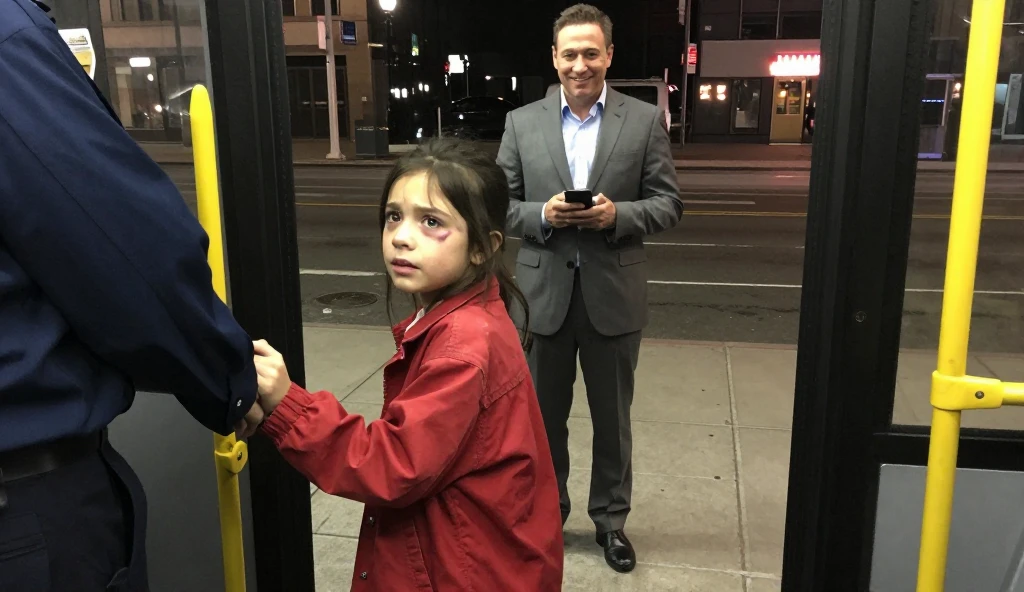
The pneumatic doors of my city transit bus hissed shut with a heavy, definitive thud, cutting off the crisp, exhaust-heavy downtown air and locking the well-dressed stranger out on the concrete sidewalk. Through the thick glass pane of the door, I watched his polite, salesman-like smile instantly evaporate, replaced by a cold, calculating glare that sent a wave of genuine dread through my chest. He didn’t run, he didn’t shout, and he didn’t try to force the doors open; instead, he slowly lifted his modern smartphone, pointed the camera lens directly at me through the window, and snapped a single photo.
Behind my legs, the little girl let out a small, muffled whimper, her tiny fingers digging so deeply into the fabric of my uniform trousers that I could feel her nails pressing against my skin. Her entire body was shaking with a violent, uncontrollable tremor that had nothing to do with the chilly evening air and everything to do with absolute terror. I kept my foot firmly planted on the brake pedal, the heavy diesel engine of the bus rumbling beneath our feet, filling the quiet interior with a low, vibrating hum that seemed to mimic the sudden racing of my own pulse.
“It’s okay, sweetheart,” I whispered, my voice thick and strained as I kept my eyes locked on the well-dressed man who was now casually typing something into his phone just a few feet away on the sidewalk. “You’re safe in here, I promise you. He can’t get to you.”
Slowly, deliberately, I shifted the heavy transmission into drive and pressed my foot down on the accelerator, steering the massive transit vehicle away from the curb and pulling into the sparse evening traffic of the downtown district. I glanced up at my wide rearview mirror, watching the man in the sharp charcoal suit grow smaller and smaller under the yellow glare of the streetlights until he was nothing but a dark silhouette standing motionless against the backdrop of the city. Even though he was gone, the heavy, suffocating sense of danger didn’t leave the bus; it lingered in the aisle, thick and palpable.

I checked the dashboard clock, which glowed a harsh digital green: 8:42 PM. This was my final run of the night, a quiet, low-passenger route that usually ended with me parking the empty bus at the central depot across town by 9:15 PM. Aside from the trembling child standing beside my farebox, there were only three other passengers on board, all scattered toward the dimly lit back rows of the vehicle, seemingly oblivious to the silent drama that had just unfolded at the front doors.
“Come here, sit right here where I can see you,” I said softly, gesturing to the longitudinal courtesy seat located directly behind the driver’s partition.
The little girl didn’t say a word, her lips pressed together in a tight, pale line as she scrambled onto the blue vinyl seat, pulling her knees up tightly against her chest. She looked impossibly small in the oversized, faded red jacket that smelled faintly of stale cigarette smoke and damp basement air, a stark contrast to the clean, polished appearance of the man who had claimed to be her family. Now that she was under the bright interior lights of the bus, the dark purple bruise blooming beneath her left eye looked even more severe, accompanied by a jagged, superficial scrape across her cheekbone that had only recently stopped bleeding.
I reached down to my wrist, looking at the glowing face of my own smartwatch where she had frantically tapped out that desperate, three-letter distress signal just moments prior. It was a rugged, digital watch I’d bought for hiking, and the screen still displayed the erratic touch inputs she had hammered into the glass with her tiny, dirt-stained fingers. The sheer intelligence and presence of mind it took for an eight-year-old child to silently use an adult’s technology to signal for help was staggering, and it told me everything I needed to know about the severity of the situation she was running from.
“What’s your name, honey?” I asked, keeping my eyes alternating between the dark, rain-slicked road ahead and her reflection in my internal rearview mirror.
She didn’t answer, her wide, hollow eyes staring straight ahead at the back of my seat, completely unblinking as she clutched the collar of her oversized jacket around her throat. Her silence wasn’t stubborn; it was the profound, frozen silence of a child who had been thoroughly conditioned to believe that speaking out loud was the most dangerous thing she could possibly do. I noticed her tiny, mismatched shoes—one a worn-out pink sneaker with a broken lace, the other a scuffed black loafer that was clearly several sizes too large—dangling several inches above the rubber-matted floor of the bus.
As I steered the bus through a series of sharp turns, navigating the deteriorating streets of the city’s industrial edge, the interior lights flickered momentarily, casting long, dancing shadows down the empty aisle. My mind was racing, trying to piece together the fragments of the puzzle: the immaculate, wealthy-looking man who knew exactly how to sound convincing, the bruised and neglected child with no belongings, and the heavy, tarnished brass key hanging around her neck on a piece of rough twine. I could see the key now, glinting dully against her collarbone where her jacket had fallen open, the numbers ‘214’ deeply stamped into the metal, its edges blackened by age and frequent use.
I knew I couldn’t just drop her off at the next regular transit stop, nor could I simply drive her back to the central depot without involving the proper authorities immediately. I reached for the standard-issue transit radio mounted to the left of my steering wheel, my fingers wrapping around the heavy plastic microphone as I prepared to call the central dispatcher to report a missing or endangered child.
“Dispatch, this is Unit 412, requesting an immediate patch to city police,” I said, my voice sounding incredibly loud in the quiet cabin of the bus.
Before the dispatcher could even respond through the static-laced speaker, the little girl let out a sharp, terrified gasp, her entire body flinching violently at the sound of my voice over the radio. She lunged forward from her seat, her small hands grabbing my right arm with a surprising, desperate strength, her eyes wide with a frantic, pleading panic that made me instantly freeze.
“No! No phone, no radio, please!” she whispered, her voice cracking, speaking for the very first time since she had boarded my bus. “He hears them. He has the scanner. He knows exactly where the police go.”
Her voice was trembling, a tiny, fragile sound that carried an unimaginable weight of terror, and her words sent a cold shiver straight down my spine. I lowered the microphone back into its cradle without pressing the talk button again, the static fading into a dull, low hiss that felt strangely ominous. I looked down at her hands, which were still tightly wrapped around my forearm; her fingernails were bitten down to the quick, and there were faint, circular red marks around her wrists that looked terrifyingly like restraint bruises.
“Okay, no radio,” I promised her, keeping my voice as calm and steady as possible to keep her from bolting off the bus at the next stop. “I won’t call them on the radio. But we need to get you somewhere safe, sweetheart. Who was that man out there?”
The girl sank back into the blue vinyl seat, her chest heaving as she struggled to catch her breath, her eyes darting toward the passenger windows as if she expected the man in the charcoal suit to materialize out of the darkness outside. She wrapped her arms around her knees again, burying her chin in the worn fabric of her jacket, her voice dropping to a barely audible whisper that forced me to lean back slightly to hear her over the roar of the engine.
“He’s the man from the office,” she whispered, her eyes filling with fresh tears that spilled over her bruised cheek. “He takes the pictures. He told me if I ever ran away, he would find me before the police did, because he owns the city.”
The chill in my stomach deepened into a sickening knot as the implications of her words began to settle in my mind. This wasn’t a simple custody dispute or a case of a child wandering away from a frantic mother; this was something far darker, a coordinated and highly organized nightmare that operated right beneath the surface of our everyday city life. The man’s polished demeanor, his immediate attempt to use an authority figure persona to claim her, and his lack of panic when the doors closed all pointed to a terrifying level of confidence and resources.
I checked my mirrors again, scanning the dark road behind us for any signs of a tail, but the street remained empty except for the occasional delivery truck or distant headlights. We were approaching the edge of the residential district, a neighborhood of older, tightly packed brick apartment buildings and dimly lit convenience stores where the streetlamps were frequently broken or vandalized. I knew this route like the back of my hand, and I knew that just three stops ahead was a small, well-lit precinct station where I could physically walk her inside, bypassing the radio entirely.
“We’re going to a safe place,” I told her, turning the massive steering wheel to guide the bus onto Elm Street, the tires splashing through deep puddles of stagnant rainwater. “There’s a building up here with people who can protect you, where he can’t touch you. You don’t have to be afraid anymore.”
She didn’t look reassured; instead, she reached into the pocket of her oversized jacket and pulled out a small, crumpled piece of paper that had been folded into a tiny, tight square so many times the edges were tearing. With trembling fingers, she smoothed it out against her knee, revealing a crude, handwritten map drawn with a red crayon, showing a series of intersecting lines and a large X next to a word that had been crossed out multiple times.
“He’s already there,” she whispered, pointing a shaking finger at the crumpled paper. “He knows all the places. The key… the key belongs to the door where they keep the others.”
“The others?” I repeated, my breath catching in my throat as the scale of what she was describing began to expand exponentially in my mind. “What others, honey? Where is that key from?”
Before she could answer, a loud, metallic clunk echoed from the back of the bus, followed by the heavy, rhythmic thud of heavy boots walking down the aisle toward the front of the vehicle. I looked up at the interior mirror and saw one of the late-night passengers—a tall, burly man in a greasy canvas jacket who had been sleeping in the very back row—stumbling forward, his eyes bloodshot and fixed on the little girl. My grip on the steering wheel tightened instinctively, my muscles tensing as the man stopped right next to the driver’s partition, leaning heavily against the metal pole.
“Hey, driver,” the man grunted, his breath smelling heavily of cheap alcohol and stale tobacco as he stared down at the trembling child. “Is this bus going all the way to the terminal, or what? And what’s the deal with the kid? She looks like she belongs in a hospital, not on a city line.”
“Just stay in your seat, sir,” I said, my tone intentionally firm and authoritative, using my best professional driver voice to de-escalate the situation. “I’m handling it. We’ll be at the next major junction in less than five minutes.”
The man grumbled something under his breath, his eyes lingering on the dark bruises on the girl’s face for a long, uncomfortable second before he turned around and shambled back toward the middle rows of the bus, slumped into a seat near the rear exit doors. The brief interruption had shattered the fragile trust I was building with the girl; she had withdrawn completely, her tiny hands clutching the brass key around her neck so tightly that her knuckles were completely white.
I turned the bus onto 4th Avenue, the street where the small police precinct was located, expecting to see the familiar blue and red lights of parked patrol cars and the bright, welcoming exterior of the station. But as the bus rumbled past the block, my heart sank into my shoes: the entire front of the precinct building was dark, the large glass windows covered in heavy plywood sheets, and a bright yellow sign chained to the front handrail read: CLOSED FOR RENOVATION – ALL SERVICES TEMPORARILY DIVERTED TO CENTRAL STATION.
A sudden surge of adrenaline hit my system, making my hands shake slightly against the hard plastic of the steering wheel. Central Station was all the way back in the heart of downtown, blocks away from where I had just picked up the girl, and right in the territory where the man in the sharp suit was undoubtedly searching for us. To get there, I would have to turn the bus around, retrace my steps through the same dark streets, and risk running directly into whatever trap or network that man had at his disposal.
I pulled the bus over to the curb at an empty, dimly lit transit stop, letting the engine idle as I stared at the dark, abandoned precinct building across the street, feeling a profound sense of isolation and vulnerability. The city felt massive, cold, and entirely indifferent to the survival of the small child sitting just a few feet away from me.
“The building is closed,” the little girl said, her voice completely devoid of hope, as if she had already expected every avenue of escape to be blocked before she even tried. “I told you. He owns the city. He knows when they change the locks.”
“He doesn’t own me,” I said fiercely, turning around in my seat to face her directly, looking straight into her tear-rimmed eyes with all the conviction I could muster. “And he’s not getting his hands on you. I don’t care who he is or what he thinks he owns.”
I reached into my pocket and pulled out my personal cell phone, bypassing the transit radio entirely just as she had asked, intending to dial 911 directly from my personal line. But as I raised the screen to my face, I froze: the cellular signal indicator at the top of the display was completely gone, replaced by a blinking red icon that read NO SERVICE – SEARCHING. I knew this part of the city had decent coverage, and my phone had been working perfectly just twenty minutes ago when I started my route.
A heavy, creeping realization began to settle in my chest—the digital watch signal she had tapped, the man’s immediate photo of my bus, the closed precinct, and now the sudden loss of cellular service. It wasn’t a coincidence; it was a systematic, deliberate shutdown of our ability to communicate or seek help, executed with a chilling, professional efficiency that meant the man in the suit wasn’t working alone. He had resources, he had technology, and he was likely tracking the exact location of my transit vehicle using the bus’s own automated GPS system.
Suddenly, a pair of bright, high-beam headlights flared to life in my rearview mirror, blinding me momentarily as a large, blacked-out SUV pulled out from a dark alleyway a block behind us and began rolling slowly down the street toward the bus. It didn’t have a front license plate, the windows were tinted pitch-black, and it was moving with a slow, predatory confidence that made every instinct in my body scream in immediate danger.
“He’s here,” the little girl whispered, her voice dropping to a terrified, breathless gasp as she scrambled off the seat and hid herself completely in the narrow footwell beneath my driver’s console. “He found us. Please don’t let him take me back to the room.”
“Get down and stay down,” I commanded, my voice tight as I slammed my foot onto the accelerator, the heavy bus engine roaring to life as the tires screeched against the wet asphalt, pulling the massive vehicle back out into the center of the road just as the black SUV accelerated rapidly to close the distance between us.
The chase was entirely silent, the massive transit bus lumbering through the dark, deserted streets while the sleek black SUV hovered just yards behind our rear bumper like a shadow, its high beams reflecting blindingly off my mirrors. I knew I couldn’t outrun a modern, high-powered vehicle in a forty-foot city bus, but I had one major advantage: I knew every shortcut, every narrow alley, and every weight-restricted bridge in this entire district after ten years of driving these identical routes.
I slammed on the brakes suddenly, throwing the heavy vehicle into a sharp, skidding left turn down a narrow, one-way industrial access road that was lined with deep concrete loading docks and heavy steel dumpsters. The bus’s rear end clipped a plastic trash container, sending a shower of debris across the road, but the maneuver worked—the black SUV was forced to brake hard to avoid slamming into the concrete wall, losing its immediate momentum behind us.
“Hold on back there!” I shouted to the remaining passengers, though I didn’t dare look back to see how they were reacting to the sudden, erratic driving.
I kept my foot pinned to the floor, pushing the old diesel engine to its absolute limit as we tore down the narrow industrial corridor, the buildings on either side passing by in a dark, blurred streak of brick and rusted iron. The road ended in a sharp, blind T-junction that led toward the old shipping canal, an area of town that was completely abandoned after dark and offered very few places to hide a vehicle as massive as a city bus.
As I approached the junction, I saw a heavy, rusted iron security gate that blocked access to the old municipal pier—a gate that was supposed to be padlocked shut at all times by city ordinance. But tonight, the heavy chain was hanging loose, the massive gate pushed open just wide enough for a vehicle to pass through, revealing a dark, fog-shrouded expanse of old wooden planks and crumbling concrete that extended out into the black water of the river.
I didn’t hesitate; I steered the bus straight through the gap in the gate, the heavy steel mirrors scraping against the iron posts with a loud, screeching tear of metal before we bounced violently onto the uneven surface of the old pier. The bus shook violently, the interior ceiling panels rattling as if they were going to fall apart, before I finally brought the massive vehicle to a sudden, dead stop behind a row of abandoned, rusted shipping containers that effectively hid us from the main road.
I killed the master ignition switch, plunging the entire bus into an immediate, profound darkness and silencing the loud roar of the diesel engine, leaving only the sound of our own heavy, frantic breathing filling the empty cabin. Outside, the thick river fog was rolling across the pier, wrapping around the windows of the bus like a gray shroud, obscuring everything more than ten feet away.
“Is everyone okay back there?” I called out into the dark aisle, my heart hammering against my ribs like a trapped bird.
No one answered from the back rows; the other passengers seemed to have been completely silenced by the sheer terror of the sudden flight, or perhaps they were hiding beneath the seats just like the little girl at my feet. I leaned down into the darkness of the footwell, my hand finding her small, cold shoulder through the fabric of her oversized jacket, feeling the rapid, frantic beat of her tiny heart.
“You’re okay, sweetie,” I whispered into the dark. “We’re hidden. He didn’t see us turn in here.”
But even as the words left my mouth, a low, smooth purr of a high-end engine echoed through the fog outside, accompanied by the distinct, rhythmic crunch of gravel and broken glass beneath heavy tires. The high beams of the black SUV cut through the thick mist, two sharp, white lances of light that swept across the rusted shipping containers, slowly searching the darkness for the massive silhouette of my bus.
The child tightened her grip on my arm, her breathing stopping entirely as the white light washed over the side windows of the bus, illuminating the interior for a fraction of a second before moving past. Through the front windshield, I could see the silhouette of the vehicle stopping just twenty yards away, its engine idling with a low, menacing rumble that seemed to vibrate through the very structure of the pier beneath us.
Then, the driver’s side door of the SUV clicked open, and the interior light flickered on, revealing the sharp, unmistakable silhouette of the man in the charcoal suit as he stepped out onto the wet concrete of the pier. He wasn’t carrying a weapon, and he didn’t look angry; he was still wearing that same calm, terrifyingly pleasant smile as he reached into his pocket and pulled out a small, silver flashlight.
He clicked it on, the narrow beam of light cutting through the fog as he began walking slowly toward the row of shipping containers, his heavy leather shoes clicking rhythmically against the ground with a slow, deliberate pace that felt like a countdown. He knew we were here; it was only a matter of minutes before the beam of his flashlight found the reflective stripping on the side of the transit bus.
I looked down at the little girl, then down at the heavy brass key that was still clutched in her hand, the numbers ‘214’ glowing faintly in the reflected light from outside. I realized then that running wasn’t going to save us; this man had the entire city’s infrastructure at his fingertips, and he would never stop hunting this child until she was back in that room, silenced forever.
“The room,” I whispered to her, my voice barely a breath against her ear. “Where is Room 214, honey? Tell me where it is.”
She looked up at me through the darkness, her eyes wide with a sudden, profound understanding that our time had completely run out, her small lips parting to speak as the clicking of the man’s shoes drew closer and closer to the front doors of the bus.
“It’s the old hotel,” she whispered, a single tear cutting a clean path through the dirt on her cheek. “The one by the bridge. The one where the lights never turn off.”
Before I could ask her another question, a heavy, solid knock echoed against the glass of the front passenger doors, making both of us freeze in absolute terror. I looked up, and there, standing just inches away on the other side of the glass, was the man in the charcoal suit, his face pressed slightly against the pane, his wide, unblinking smile illuminated by the silver flashlight he held beneath his chin.
He didn’t try to break the glass; instead, he held up his smartphone once again, the screen facing toward me through the window, displaying a live video feed of a dark, concrete room where three other young children were sitting on the floor, their hands bound, staring into the camera with the exact same hollow, terrified eyes as the girl at my feet.
The man tapped the glass of the door with his silver flashlight, a sharp, metallic sound that sounded like a gunshot in the silent bus, and then he pointed his finger directly at the lock mechanism, his smile widening into a terrifying, triumphant grin.
— CHAPTER 2 —
The thick, laminated safety glass of the transit bus door didn’t just separate me from the freezing night air; it became a transparent barrier between sanity and a highly organized nightmare. The sharp clinking sound of the man’s heavy silver flashlight striking the pane resonated through the structural frame of the entire driver’s cockpit, vibrating directly into my foot on the brake. On his glowing smartphone screen, the live feed remained horrifyingly steady, displaying three small children sitting shoulder-to-shoulder on a cold, unpainted concrete floor in what looked like an abandoned subterranean utility room. They weren’t crying or screaming; they were perfectly motionless, their wrists bound tightly with heavy-duty black zip ties, their expressions completely hollowed out by prolonged, systematic terror.
The man in the charcoal suit smiled wider, his teeth appearing unnaturally white under the harsh beam of his flashlight as he adjusted his grip on the phone to ensure I saw every single detail of the video. He didn’t blink, his eyes wide and completely devoid of any human empathy or hesitation, projecting a terrifying level of absolute authority and absolute certainty. He slowly lowered his left hand from the door, his index finger extending toward the emergency pneumatic release valve housing located just outside the frame of the passenger entry door. My breath caught in my throat as I realized he didn’t just know how the transit system worked—he knew the precise mechanical vulnerabilities of this specific 2018 Gillig transit model.
Down in the dark, cramped footwell beneath my steering column, the eight-year-old girl pulled herself into an impossibly small ball, her small hands clamping over her ears as she pressed her forehead against the heavy rubber floor mat. She was trying to become invisible, her entire body shaking so violently that her mismatched shoes clicked softly against the steel base of the accelerator pedal. I could smell the distinct, pungent odor of old dust, stale tobacco, and damp basement mold radiating from her oversized red jacket, a smell that perfectly matched the bleak industrial room being broadcast on the stranger’s phone. Every protective instinct I had as a father and a public servant surged to the surface, overriding the icy wave of panic that threatened to lock my muscles in place.
“Don’t look up, sweetheart,” I whispered, my voice sounding incredibly thin and raspy within the darkened cabin of the dormant bus. “Keep your head down and stay exactly where you are, no matter what happens next.”
I didn’t wait for her to answer, nor did I waste another second staring at the monstrously calm face on the other side of the glass pane. My right hand slammed downward onto the master ignition override toggle, bypassing the standard cold-start sequence and forcing the massive Cummins diesel engine to roar back to life with a deafening, metallic shriek. The entire forty-foot chassis shuddered violently as the cylinders caught, the heavy vibration tearing through the floorboards and instantly shattering the quiet tension of the dark municipal pier.
The man’s smile didn’t falter, but his eyes narrowed with a sudden, vicious focus as he realized I wasn’t going to comply with his silent demand to unlock the doors. He lunged forward, his heavy leather dress shoes skidding slightly on the wet, moss-covered concrete of the pier as he slammed his palm against the external emergency valve lever. A loud, high-pitched hiss of escaping air pressure erupted from the base of the doors, the thick rubber seals instantly losing their structural integrity and beginning to part.
“Not tonight, you son of a bitch,” I growled, my knuckles turning completely white as I yanked the heavy transmission lever into reverse and mashed the accelerator pedal directly to the floorboards.
The massive dual rear tires spun violently on the slick, rain-soaked wood planks of the pier, throwing up a massive plume of brackish water, rotted splinters, and black exhaust smoke. The sudden, violent backward surge of the bus ripped the door frame right out of the man’s grasp, the half-opened glass panels slamming shut again from the sheer momentum of the vehicle’s regression. Through the front windshield, I watched his silhouette get swallowed instantly by the thick, rolling river fog as the bus rocketed backward into the dark, unsecured expanse of the abandoned industrial waterfront.
I kept my left hand pinned to the steering wheel, using my right hand to throw the interior lighting toggle into the completely off position, plunging the passenger cabin into total darkness. I needed to eliminate our visibility entirely, turning the massive, brightly painted city transit vehicle into a silent, dark shadow moving through the mist. In the wide rearview mirror, I could see the faint silhouettes of the three late-night passengers in the back rows scrambling out of their seats, thrown off balance by the aggressive, non-standard maneuvering of the bus.
“What the hell is going on up there?!” the burly man in the canvas jacket shouted, his voice cracking with a mixture of drunken confusion and sudden, sharp panic as he clutched a metal handrail. “Are you trying to kill us?! Stop this damn bus right now!”
“Get down on the floor between the seats!” I roared back, not bothering to use the public address microphone as I cut the wheel sharply to the left. “We are under immediate threat! Get down and stay away from the windows if you want to stay alive!”
The sheer, raw authority in my voice must have penetrated his alcohol-induced fog, because I heard the heavy thud of his body hitting the floorboards, followed by the terrified whimpers of the two elderly passengers who had been sitting near the rear exit doors. I didn’t have time to check on them or explain the horrific reality of what was happening; my eyes were locked on the side mirrors, watching for the twin white lances of the black SUV’s high beams.
The bus slammed backward through a stack of abandoned plastic shipping pallets, the lightweight material shattering into a hundreds of pieces with a sound like rapid gunfire against the rear bumper. I slammed my foot onto the brake pedal, the heavy air brakes groaning in protest as the forty-foot vehicle skidded to a halt just inches from the rusted iron edge of the seawall. The black, churning water of the shipping canal was visible in my side mirror, less than three feet from my rear tires, a drop that would have swallowed the bus entirely.
Without a fraction of a second of hesitation, I jammed the shifter into drive and accelerated forward, steering the bus along the narrow, unlit perimeter road that ran parallel to the old shipping docks. The thick river fog was getting heavier by the minute, rolling off the water in dense, gray curtains that reduced my forward visibility to less than fifteen feet. I didn’t dare turn on my headlights; doing so would have turned the bus into a massive, glowing lantern in the mist, making us an incredibly easy target for the tracking capabilities of the black SUV.
Down in the footwell, a tiny, cold hand reached up and wrapped around the ankle of my uniform trousers, her grip surprisingly tight and desperate. “He’s not going to stop,” the little girl whispered, her voice trembling so badly it was hard to understand her over the deep hum of the diesel engine. “The man from the office… he told me the city belongs to them after the lights go out. He has people everywhere.”
“He doesn’t have me, sweetie,” I said, trying to force a calmness into my tone that I didn’t remotely feel as I navigated the blind corners of the industrial park. “And he doesn’t know this sector like I do. I’ve driven these roads every single night for a decade. We’re going to get out of here.”
My mind was working at frantic speed, analyzing every single route out of the industrial waterfront that wouldn’t force me onto a major, camera-monitored thoroughfare. If what the girl said was true—if this network had access to city infrastructure, police scanners, and cell-jamming technology—then the standard transit routes were nothing more than a trap. The main avenue out of this sector ran directly under a massive, city-managed traffic camera grid that could easily be monitored by anyone with high-level access or deep pockets.
I needed an alternative, an unmonitored exit point that a forty-foot commercial vehicle could physically traverse without getting wedged or trapped. That was when I remembered the old rail corridor—an abandoned, gravel-paved right-of-way that used to service the old grain silos before the shipping industry moved further down the river. It was narrow, overgrown with heavy brush, and completely unlit, but it connected the industrial waterfront directly to the old residential warehouse district without passing a single traffic camera or police sub-station.
I spun the heavy steering wheel hard to the right, guiding the bus off the paved perimeter road and onto a rough, unmaintained gravel track that disappeared into a thick wall of overgrown willow trees and rusted chain-link fencing. The heavy branches scraped against the sides of the bus with a terrifying, screeching roar, tearing at the paint and shattering the small plastic clearance lights along the roofline. The vehicle bounced and pitched violently over the deeply rutted terrain, the suspension bottoming out with heavy, metallic thuds that felt like they were going to shake the chassis apart.
“Stay low!” I shouted toward the back of the bus as a large tree branch slammed directly into the upper windshield, leaving a spiderweb of fine cracks across the safety glass but thankfully not breaking through.
Through the rear-view mirror, I looked past the darkness of the passenger cabin and out through the back window, searching the foggy gravel track behind us. For a brief, blissful moment, there was nothing but absolute blackness and swirling gray mist, suggesting that we had successfully broken visual contact with the stranger on the pier. But my relief was brutally short-lived; less than three seconds later, two sharp, intensely bright LED headlights cut through the fog at the entrance of the rail corridor, moving with incredible speed.
The black SUV had found us, its advanced all-wheel-drive system allowing it to navigate the rough gravel and overgrown brush with a terrifying agility that my heavy, top-heavy transit bus simply couldn’t match. It was closing the distance with a calculated, predatory smoothness, the high beams reflecting off my side mirrors and filling the driver’s cockpit with a blinding, white glare that made it almost impossible to see the narrow track ahead.
“He’s coming,” the little girl whimpered, her hands tightening around my ankle until it hurt. “The office man… he’s coming for the key.”
“He’s going to have to work for it,” I muttered through gritted teeth, my foot pressing down harder on the accelerator, forcing the old Gillig bus to its absolute mechanical limits as we rocketed down the abandoned rail corridor at over fifty miles per hour.
The terrain was becoming increasingly treacherous, the old wooden railroad ties occasionally protruding from the eroded gravel, causing the heavy front wheels to jump and bounce uncontrollably. I could feel the steering wheel tearing at my grip, trying to rip itself out of my hands with every impact, requiring every ounce of my physical strength to keep the massive vehicle from sliding off the embankment and into the deep, muddy drainage ditches that lined the track.
Up ahead, the dark, monolithic silhouettes of the abandoned grain silos began to loom out of the fog like ancient, concrete giants. The track ran directly between two massive rows of the concrete structures, creating a narrow, canyon-like corridor that was barely wide enough for a single vehicle to pass through. I knew that at the end of this concrete canyon was a heavy, old iron swing gate that had been installed decades ago to prevent illegal dumping—and it was almost certainly locked with a heavy chain.
If the gate was locked, the bus would be trapped in a dead-end alley with a high-powered SUV blocking our only retreat, turning the vehicle into a metal coffin for everyone on board. But if I tried to stop now, the SUV would simply ram our rear bumper, disabling the bus or forcing us off the narrow track into the drainage ditch anyway. I had to make a decision in a fraction of a second, a choice that risked the lives of my passengers but represented our only incredibly slim chance of survival.
“Hold on to something solid!” I screamed into the darkness of the cabin, my voice echoing off the aluminum interior panels. “Hold on tight!”
I didn’t lift my foot from the accelerator; instead, I braced my body against the backrest of my air-ride seat, wrapping my arms tightly around the massive steering wheel and locking my elbows into place. Through the thick mist, the rusted iron bars of the old swing gate materialized less than fifty feet ahead, the heavy, corroded links of a thick steel chain wrapped around the central pillars, glinting dully in the reflected glare of our approach.
The impact was catastrophic. The heavy steel structural bumper of the transit bus slammed into the center of the iron gate at nearly fifty miles per hour with a deafening, explosive crash that sounded like a bomb going off inside the vehicle. The entire front windshield shattered instantly into millions of tiny, granular fragments, a wave of safety glass showering over the driver’s console and raining down into the footwell where the little girl was hiding.
The heavy iron gate buckled under the immense weight and kinetic energy of the twenty-ton bus, the ancient welds snapping with sharp, metallic cracks that sounded like rifle shots. One of the massive iron gate panels swung outward, tearing down the side of the vehicle with a horrific, screeching groan of ripping sheet metal, while the other panel collapsed underneath the chassis, the heavy wheels rolling directly over the twisted metal with a violent, bone-jarring jolt.
The force of the collision threw me forward against the steering wheel, the hard plastic impact bruising my ribs and knocking the breath completely out of my lungs, but I forced myself to keep my hands locked on the wheel. The bus skidded wildly across the broken asphalt of the old warehouse district, the front tires shredded and smoking from the impact, but the engine was still running, its deep diesel roar filled with a ragged, mechanical rattle.
I looked in the side mirror, my vision swimming slightly from the impact, expecting to see the black SUV preparing to rocket through the wreckage of the gate behind us. Instead, I saw a massive cloud of white steam and dark fluid erupting from the front of the tracking vehicle; the lead driver had tried to follow us too closely, and a piece of the shattered iron gate had pierced their radiator and front axle, disabling the vehicle instantly in a hiss of boiling coolant.
The man in the charcoal suit stepped out of the passenger side of the steaming SUV, his sharp clothes now covered in a fine layer of dust and road grime, but his expression remained terrifyingly detached and calm. He didn’t chase after us on foot, nor did he look angry about the destruction of his luxury vehicle; instead, he simply stood next to the wreckage, lifted his smartphone to his ear, and began speaking into it with a cold, rhythmic movement of his jaw.
He wasn’t giving up; he was simply coordinating the next phase of the net, calling in additional assets to cut us off before we could reach the safety of the wider city. I knew our temporary victory was incredibly fragile, and with the front tires of the bus rapidly losing air pressure and the windshield completely gone, I had less than five minutes before this massive vehicle became completely undrivable.
I steered the crippled bus down a dark, empty warehouse street, the shredded rubber of the front tires slapping rhythmically against the asphalt with a loud, wet thudding sound that echoed off the brick buildings. The cold night air rushed through the empty windshield frame, bringing with it the sharp scent of burnt rubber, diesel exhaust, and the bitter, metallic tang of oxidized copper from the shattered front wiring harness.
“Sweetheart, are you okay?” I gasped, leaning over the console while keeping my eyes on the dark road ahead, my chest burning with every breath from the bruised ribs. “Did the glass hit you?”
The little girl slowly pulled her head out from beneath her oversized jacket, her face pale and streaked with dirt and tears, but miraculously uninjured by the shower of granular safety glass. She looked around the ruined cockpit of the bus, her wide eyes fixing on the empty frame where the windshield used to be, then down at the heavy brass key that was still clutched tightly in her small, trembling fist.
“The key… it fits the door in the basement,” she whispered, her voice incredibly small against the rush of the cold wind. “Under the hotel with the broken sign. That’s where he keeps the book with all the names. The names of the people who pay him.”
The weight of her words hit me with a sudden, clarity that made the danger feel even more immediate. This wasn’t just a horrific case of child exploitation; it was a highly organized, high-value criminal enterprise that was protected by people within the very structure of the city itself. If the man in the suit could shut down police precincts and jam cell service, then walking into a standard corporate building or secondary government office would be suicide—we would be handing the child right back to the people who controlled the system.
I needed to find a place that was completely outside the grid, a place where the modern, digital reach of this criminal network couldn’t easily penetrate or track us using automated algorithms or surveillance infrastructure. That was when I looked down at the old, tarnished brass key hanging around her neck, specifically at the deeply stamped numbers: 214.
The girl had mentioned an old hotel by the bridge—the one where the lights never turn off. In this city, there was only one place that fit that exact description: the Riverview Manor, a crumbling, historic eight-story residential hotel located at the base of the old iron suspension bridge on the southern edge of the industrial district. It was a notorious, low-income single-room occupancy building that had been largely abandoned by the city council, operating in a legal gray area and filled with transient tenants who didn’t ask questions and avoided any contact with authority.
If the room being used to hold the other children was located inside that specific building, then going there was an incredible risk—it meant walking directly into the lion’s den without any weapons, backup, or official support. But it also meant that the evidence of their entire operation, the other captive children, and the ledger she described were all concentrated in one physical location that they currently believed was completely secure and undiscovered.
“We’re going to the hotel, sweetheart,” I told her, my voice hardening with a sudden, definitive resolve as I steered the crippled transit bus toward the dark silhouette of the suspension bridge. “We’re going to find Room 214, and we’re going to get those other kids out before that man can coordinate his people.”
She didn’t protest; instead, she simply nodded her head once, her small fingers wrapping tightly around the brass key as if it were a talisman that could protect her from the darkness that was rapidly closing in around us from every corner of the city.
The bus was dying, the steering column vibrating violently as the front rims scraped directly against the asphalt, throwing up a brilliant shower of yellow sparks that illuminated the dark warehouse walls like miniature fireworks. I knew we wouldn’t make it all the way to the hotel doors in this vehicle, but I needed to get us as close as physically possible before we were forced to abandon the twenty-ton transit bus and move into the shadows on foot.
As we approached the wide, industrial approach to the suspension bridge, the massive structural framework of the Riverview Manor began to emerge from the dense river fog, its ancient brick facade looking black and imposing against the gray sky. A single, flickering neon sign on the roof read HOTEL, the first three letters burned out completely, leaving only a harsh, buzzing pink glow that illuminated the upper stories with an unsettling, rhythmic pulse.
I pulled the ruined bus into a dark, recessed loading bay behind an abandoned cold-storage warehouse less than half a block from the hotel entrance, the engine letting out one final, gasping metallic shudder before I cut the fuel line toggle and silenced the vehicle for good. The sudden absence of the diesel hum left a heavy, ringing silence in the cabin, broken only by the rapid clicking of the cooling engine blocks and the distant, low tolling of a foghorn out on the river.
“Alright, everyone out,” I said, turning around to face the three passengers who were slowly pulling themselves up from the floorboards in the dark aisle. “We have to move, right now. This vehicle is dead, and the people tracking us will find it within minutes. Follow me if you want to stay safe.”
The burly man in the canvas jacket didn’t argue this time; his face was completely pale, his previous aggression entirely drained by the sheer violence of our escape through the iron gate. He helped the two elderly passengers toward the front doors, their movements slow and trembling as they stepped over the shattered fragments of safety glass and out into the freezing, fog-laden night air of the waterfront alley.
I reached down into the footwell, gently lifting the little girl out of the cramped space and placing her feet on the rubber-matted steps, her small hand immediately finding mine and latching on with a desperate, crushing intensity. Her skin was freezing, her breath coming in tiny, white plumes of vapor that disappeared instantly into the thick gray mist that filled the narrow alleyway between the warehouses.
“Keep close to the walls,” I whispered to the group, guiding them out of the loading bay and into the deep shadows of the brick facade. “Don’t speak, don’t use your phones if you have them, and keep your heads down. We need to reach the side entrance of that building before anyone sees us.”
The trek across the open street was agonizingly slow, the elderly passengers struggling to maintain a rapid pace on the slick, uneven cobblestones while the low, rhythmic buzzing of the hotel’s broken neon sign pulsed overhead like a ticking time bomb. The air smelled of low tide, wet coal, and the unmistakable, sour odor of chemical exhaust from the nearby industrial plants, a combination that made my lungs burn with every frantic breath.
We reached the heavy, rusted steel fire door on the northern side of the Riverview Manor without attracting any immediate attention from the main avenue, the deep shadows of the architectural alcove shielding our movements from the streetlamps. I reached out and grabbed the old brass handle of the fire door, expecting it to be locked tight against the transient population of the district, but to my surprise, the heavy mechanism clicked open smoothly, the hinges completely silent and well-oiled.
I pulled the door open, revealing a long, unlit concrete corridor that descended sharply into the subterranean basement levels of the old building, the air inside warm, stagnant, and heavy with the scent of damp earth and old grease. The silence within the corridor was absolute, a heavy, suffocating quiet that felt entirely artificial, as if the building itself were holding its breath, waiting for us to step inside.
“Go up the main stairs to the lobby,” I whispered to the three passengers, pointing toward a secondary door that led toward the upper residential floors. “Find the night manager, tell him to lock the main doors, and wait there until the morning. Don’t come down here, no matter what you hear.”
The burly man looked at me for a long, heavy second, his eyes shifting from my bruised face down to the terrified little girl clinging to my uniform sleeve, before he gave me a slow, solemn nod of understanding. He guided the two elderly women through the upper door, the heavy wood frame clicking shut behind them and leaving me completely alone with the child in the dark concrete mouth of the basement corridor.
I looked down at her, the pink glow from the distant neon sign outside casting long, distorted shadows across her bruised face through the open doorway. She reached into her jacket collar, pulling the heavy brass key forward so that the numbers ‘214’ were clearly visible, her small finger pointing directly down into the dark, descending corridor that lay ahead of us.
“The room is at the end of the hall,” she whispered, her voice a fragile breath against the heavy stillness of the basement air. “But you have to be quiet. The man with the keys… he sits in the chair by the boiler, and he never sleeps.”
I gripped her hand tighter, stepped through the threshold, and pulled the heavy steel fire door shut behind us, the solid click of the latch sealing us into the subterranean darkness of the Riverview Manor just as a distant, low rumble of an approaching vehicle echoed from the street outside.
The concrete floor was cold beneath my boots as we moved slowly down the steep incline, the only illumination coming from a series of low-wattage yellow bulbs that hung from exposed conduit along the low ceiling. The walls were covered in thick layers of peeling green paint, damp patches of dark mold blooming in the corners where the old plumbing fixtures were slowly leaking onto the floorboards above.
With every step we took deeper into the basement layout, the ambient noise of the city outside began to fade completely, replaced by the deep, rhythmic thudding of the building’s industrial boiler system somewhere in the distance. It sounded like a massive, mechanical heartbeat, a slow and heavy cadence that seemed to track the passage of our remaining time before the man in the charcoal suit arrived to close the net.
We reached a sharp bend in the corridor, the concrete walls giving way to old, rough-hewn brickwork that dated back to the building’s original foundation in the late nineteenth century. At the end of the long passageway stood a heavy, reinforced steel security door that looked entirely out of place in the old residential hotel, its surface clean, painted a dark industrial gray, and fitted with a modern commercial deadbolt lock.
Mounted directly to the center of the gray steel door was a small, polished brass plate, its surface clean and free of the dust that covered the rest of the corridor, with three numbers deeply engraved into the metal: 214. My chest tightened as I realized this wasn’t an ordinary hotel room at all—it was a secure, hidden subterranean facility built directly beneath the unsuspecting residents of the upper floors.
“This is it,” the little girl whispered, her body freezing completely as she stared at the gray door, her small hand trembling so violently within mine that I could feel her bones clicking against my skin. “The room with the pictures. The other kids are inside.”
I slowly let go of her hand, reaching out to take the heavy brass key that hung from the twine around her neck, my fingers feeling the cold, heavy weight of the metal as I aligned it with the keyhole of the modern deadbolt lock. My palm was slick with sweat, making it difficult to grip the key smoothly, but I forced my hand to remain steady as I inserted the metal teeth into the security mechanism.
The lock turned with a surprisingly loud, heavy click that seemed to echo down the narrow brick corridor like a thunderclap, the internal tumblers releasing their hold on the heavy steel door frame. I placed my hand against the cold metal surface, preparing to push the door open and face whatever horrors were waiting on the other side, my muscles tense and ready for an immediate confrontation.
But before the door could swing inward even an inch, a cold, sharp voice cut through the darkness from the shadows behind us, the tone perfectly calm, smooth, and chillingly familiar.
“I must admit, driver, your knowledge of the old city infrastructure is genuinely impressive,” the voice said, the cadence measured and rhythmic. “But you’ve brought the child right back to the one place she can never leave.”
I spun around instantly, my back slamming against the gray steel door of Room 214 as I reached down to shield the little girl behind my legs, my eyes straining against the dim yellow light of the corridor. Standing at the bend of the brick passageway, blocked from our only exit point, was the man in the charcoal suit, his clothes immaculate once again, his wide, unblinking smile cutting through the darkness like a blade.
He wasn’t alone this time; standing directly behind him were two large, silent men in heavy tactical jackets, their faces obscured by the shadows of their baseball caps, their hands resting loosely near their waistlines. The trap had been perfectly executed, the shutdown of our communication and the closed precinct all designed to funnel us toward the one physical location where they held absolute control over the environment.
The man in the suit took a slow, deliberate step forward, his heavy leather shoes clicking against the concrete floor with that same rhythmic, agonizing pace that had followed us across the entire city. He held his smartphone up between his fingers, the screen still displaying the live feed of the three captive children, but now, a small red digital timer was ticking down in the upper corner of the video display.
“You have exactly sixty seconds to step away from that door and hand over the key, driver,” the man said, his voice dropping to a low, conversational purr that carried an immense weight of absolute violence. “If that timer reaches zero before the door is secured from the inside, the room’s automated ventilation system will vent the carbon monoxide line from the central boiler directly into their chamber. The choice is entirely yours.”
The sheer, calculated cruelty of the ultimatum left me completely breathless, my mind freezing as I looked from the terrifying smile on the man’s face down to the tiny, trembling child who was clutching the fabric of my trousers with a desperate, dying hope. We were trapped in a subterranean corridor with no weapons, no communication, and less than a minute to prevent a catastrophic tragedy that would destroy four innocent lives before the city outside even woke up.
— CHAPTER 3 —
The heavy steel door of Room 214 remained slightly ajar behind me, a tiny sliver of unpainted subterranean concrete visible through the gap, while the modern digital timer on the man’s smartphone screen continued its ruthless, bright red countdown: 54 seconds. The air in the narrow brick corridor felt instantly heavier, thick with the sour stench of old grease, damp earth, and the faint, chemical undertone of the building’s massive, active boiler system. My breath hitched in my throat as I looked at the three silent, bound children displayed on the live feed, their wide, hollow eyes staring directly into the camera lens with a terrifying lack of hope.
“Fifty seconds, driver,” the man in the charcoal suit said, his voice entirely flat, devoid of any anger or excitement, carrying only the smooth, cold precision of a corporate executive delivering a routine project update. “I suggest you take a step backward, pull the child out from behind your legs, and hand over the brass key before the automatic valves engage.”
I felt the little girl’s tiny, freezing fingers digging desperately into the coarse denim of my uniform trousers, her entire body shaking so violently that her mismatched shoes clicked rhythmically against the damp concrete floorboards. She was trying to pull herself completely inside my shadow, her small face pressed against the back of my thigh as she tried to escape the unblinking, wide smile of the well-dressed stranger standing just fifteen feet away. Every protective instinct I possessed as a veteran city transit driver and a father screamed at me that surrendering was a death sentence, not just for the little girl clinging to my leg, but for the three innocent children locked inside the secure room behind me.
“You’re bluffing,” I said, my voice sounding raw and echoing loudly off the ancient, peeling green paint of the basement walls, though my heart was hammering against my ribs with a frantic, suffocating velocity. “The central boiler system doesn’t have an automated carbon monoxide vent line that can be controlled by a standard commercial smartphone application.”
The man’s smile widened slightly, his teeth appearing unnaturally white under the dim, low-wattage yellow lightbulbs hanging from the exposed metal conduit along the low ceiling. “It doesn’t by standard municipal code, no,” he replied smoothly, taking a slow, measured step forward, his polished leather dress shoes crunching softly on a layer of fine grit and dried mortar dust. “But when you spend enough money to completely renovate a subterranean utility sector beneath an abandoned historical building, you can install whatever custom safety modifications your business model requires.”
To my right, the massive industrial boiler let out a deep, rhythmic thudding sound, a heavy mechanical thump that vibrated directly through the soles of my boots and into my knees, sounding terrifyingly like a mechanical countdown clock. I glanced down at my own digital smartwatch, the glass face still smudged with the frantic, erratic touch inputs the little girl had hammered into it at the downtown bus stop just forty minutes ago. The digital timer on the stranger’s screen shifted down to 39 seconds, the bright red numbers casting a faint, crimson glow across his immaculate silk necktie and the sharp lapels of his charcoal suit jacket.
The two large, silent men in the heavy tactical jackets stepped forward in perfect unison with their supervisor, their faces completely obscured by the deep shadows of their black baseball caps, their arms remaining loose and heavy at their sides. They didn’t draw weapons, and they didn’t make any aggressive gestures; their sheer physical bulk and calm, professional posture told me everything I needed to know about their training and their lack of hesitation. They were clean, organized, and entirely confident that an ordinary city bus driver carrying nothing but a plastic route clipboard and a company flashlight was absolutely no threat to their operation.
“Thirty-five seconds, driver,” the man in the suit murmured, his left hand remaining completely steady as he held the smartphone out toward me like a piece of high-value evidence. “Let’s not make this messy. The child is a piece of corporate property that was removed from a secure facility; returning her simply restores the natural balance of the ledger.”
“She’s a human being, you piece of garbage,” I growled, my knuckles turning completely white as I gripped the heavy, ancient brass key tighter in my right hand, its stamped numbers ‘214’ pressing deeply into the skin of my palm.
My mind raced through every possible tactical option, every hidden corner of the basement layout I had memorized during my brief glimpse of the old historical blueprint hanging in the building’s maintenance alcove years ago during a transit union meeting. The Riverview Manor had been built in 1894, an era when large commercial properties were required to have multiple secondary ventilation shafts, coal chutes, and emergency escape tunnels connecting the subterranean cellars directly to the old river shipping docks. If the room behind me was an old converted storage vault, it had to have an original structural air intake shaft that bypassed the modern, modified HVAC system these men had installed.
“Twenty-eight seconds,” the stranger announced, his voice dropping a fraction of an octave, the artificial warmth completely draining away to reveal the cold, mechanical reality beneath his polite demeanor.
I looked down at the little girl, my eyes locking onto the faded red jacket she wore, noticing for the first time a small, triangular tear near the left pocket where a piece of stiff, blue cardboard was sticking out. I reached down with my left hand, my movements quick and deliberate, pulling the cardboard out of her pocket while keeping my body positioned as a solid physical shield between her and the three men in the corridor. It was an official city transit maintenance logbook from 1992, its edges water-damaged and covered in grease stains, its pages detailing the original layout of the subterranean heating tunnels that ran directly beneath the suspension bridge approach.
“The book,” the little girl whispered, her voice a tiny, fragile thread of sound that barely carried over the deep, mechanical rumble of the boiler. “The book shows where the pipes go. The man with the keys left it in the room before I ran away.”
A sudden surge of adrenaline hit my system, clearing away the lingering fog of panic and replacing it with a cold, sharp focus that I hadn’t felt since my time in the municipal rescue corps two decades ago. The man in the charcoal suit thought he controlled the entire environment because he had access to the modern digital infrastructure of the city, but he didn’t know the physical history of the ground he was standing on. He didn’t know that the old coal tunnels were built with reinforced brick arches that could withstand structural collapses, and he didn’t know that the original ventilation grates opened directly into the low-clearance storage bays beneath the old cold-storage warehouse where I had parked the ruined bus.
“Twenty seconds, driver,” the man said, his index finger hovering directly over a green icon on his smartphone screen, his smile turning into a tight, expectant line. “This is your final opportunity to preserve your own life and return home to your family.”
“I’m already home,” I said, a strange, calm certainty settling over me as I slammed my right foot backward against the heavy steel door of Room 214, forcing the massive security mechanism to swing inward with a loud, screeching protest of unlubricated iron hinges.
Before the three men could react to the sudden movement, I grabbed the little girl by the collar of her oversized red jacket, lifted her completely off the concrete floor, and threw her backward into the dark interior of the room. I lunged in right after her, my boots skidding across a floor covered in loose papers, computer cables, and empty plastic binders, my right hand reaching out to grab the internal emergency exit handle of the steel door. The man in the charcoal suit let out a sharp, guttural shout, his polite composure breaking for a fraction of a second as he realized I was locking myself inside the vault instead of surrendering.
The two tactical guards sprang forward with incredible speed, their heavy combat boots pounding against the concrete floor as they covered the fifteen-foot distance in less than two seconds, their hands reaching out to grab the edge of the closing door. But I had the advantage of leverage and momentum; I threw my entire two-hundred-pound frame against the heavy steel interior panel, pulling the reinforced handle toward me with every ounce of physical strength I had left in my bruised torso.
The door slammed shut with a deafening, metallic explosion that echoed through the small concrete room like a bomb going off, the automatic deadbolt mechanism clicking into place with a series of heavy, distinct clunks that locked the external handles completely out of the loop. A split second later, a massive, violent impact shuddered through the steel panel from the outside as the two guards slammed their shoulders against the reinforced metal, followed by the muffled, frantic shouting of the stranger in the charcoal suit.
“Ten seconds!” his voice drifted through the thick steel frame, distorted and high-pitched with a sudden, genuine fury. “You’ve just murdered everyone in that room, driver! Look at the monitors!”
I spun around in the pitch-black darkness of the secure vault, my hands fumbling along the cold concrete wall until my fingers found a heavy industrial toggle switch mounted next to a vertical rack of computer servers. I slammed the switch upward, and a bank of harsh, buzzing fluorescent light tubes flared to life on the low ceiling, instantly illuminating the horrific reality of the subterranean chamber we had just entered.
The room was larger than I had expected, measuring roughly thirty feet square, its walls constructed of thick, unpainted cinder blocks that were damp to the touch and covered in lines of heavy black electrical conduit. In the far corner of the space, sitting shoulder-to-shoulder on a long strip of dirty canvas tarp, were the three children from the live video feed—two young boys who couldn’t have been older than six, and a slightly older girl with long, matted blonde hair. Their hands were bound tightly behind their backs with heavy, commercial-grade black zip ties, their small faces streaked with dried tears and gray dust, their eyes wide with an absolute, paralyzed terror as they stared at me and the little girl.
“Hey, it’s okay, it’s okay,” I gasped, dropping to my knees and scrambling across the concrete floor toward them, my uniform trousers tearing on a loose metal cable staple as I moved. “I’m a bus driver. I’m here to help you. We’re going to get out of here, I promise.”
Suddenly, a loud, metallic click echoed from the ceiling ventilation register, followed by the deep, ominous hiss of high-pressure air rushing through the metal ductwork of the room’s modified climate control system. A faint, sweetish odor began to fill the air, the distinct and terrifying scent of uncombusted exhaust gas from the building’s central boiler system being diverted directly into our sealed environment. The digital countdown had reached zero, and the stranger outside had executed his threat without a single moment of hesitation or remorse.
“The air,” the oldest girl on the floor whispered, her voice cracking with a dry, hollow cough as she tried to pull her knees tighter against her chest. “The air makes us sleepy. He does it when we try to scream.”
“Not tonight,” I said fiercely, pulling a heavy, stainless-steel pocketknife from my uniform utility belt and using the serrated edge to quickly slice through the thick black zip ties binding the children’s wrists.
The plastic straps snapped with sharp clicks, and the children immediately clutched their numb, swollen hands to their chests, their small bodies shaking as the cold, toxic air continued to pour into the room from the ceiling vent. I stood up quickly, ignoring the sharp, stabbing pain in my bruised ribs from the earlier bus crash, and looked around the secure facility for any tool or object that could be used to block the intake register. The room was filled with high-end electronic equipment—rows of expensive digital cameras mounted on heavy tripods, professional lighting umbrellas, and three large computer workstations with dual-monitor displays that were currently glowing with rows of names, dollar amounts, and specific room numbers.
I grabbed a heavy, metal server rack chassis from a nearby table, lifting the heavy steel housing over my head, and hurled it directly at the ceiling ventilation register with all the strength I could muster. The metal chassis struck the thin aluminum grate with a deafening crash, buckling the frame and tearing the register half-off its mounts, but the toxic gas continued to pour out of the gaping hole in the ductwork, the heavy gray vapor beginning to settle into a thick layer near the ceiling.
“The book!” the little girl from the bus stop shouted, pointing a shaking finger toward the center of the room where a massive, ancient brick archway had been bricked over with modern cinder blocks during the facility’s construction. “The book says the old coal chute is right behind the wall! It goes to the river!”
I ran over to the cinder-block wall, my hands tracing the outlines of the modern masonry, noticing that the mortar between the blocks was thin, dry, and poorly applied, likely a rushed job completed by an illegal construction crew working under the radar of city building inspectors. I grabbed a heavy, solid-steel camera tripod from the nearest workstation, its metal legs thick and reinforced with heavy-duty locking clamps, turning the professional piece of equipment into a makeshift battering ram.
“Get down on the floor and cover your mouths with your jackets!” I ordered the four children as I stepped back from the wall, raising the heavy steel tripod to my shoulder like a professional sledgehammer. “Keep your faces as close to the ground as possible! The clean air is down low!”
The children immediately obeyed, curling into tight balls on the canvas tarp and pulling their clothing over their noses, their small eyes locked on me with a desperate, dying hope as the sweet, heavy scent of the carbon monoxide began to make my own head thud with a dull, throbbing ache. I took a deep breath of the remaining clean air near the floor, stepped forward, and slammed the heavy metal tripod directly into the center joint of the modern cinder-block wall.
The impact was incredibly loud, a sharp, bone-jarring shock that traveled straight up my arms and into my shoulders, leaving a deep white scar in the gray concrete but not dislodging the blocks. I didn’t stop; I swung the tripod again and again with a frantic, rhythmic ferocity, my muscles burning and my breath coming in short, painful gasps as the toxic gas continued to accumulate in the upper half of the room. On the third impact, a large, vertical crack developed along the mortar line, a small puff of red brick dust exploding from the joint and suggesting that the space behind the wall was indeed empty.
“Come on, break you piece of junk,” I snarled, my vision beginning to blur slightly at the edges from the lack of clean oxygen as I raised the tripod for a fourth, massive blow.
I threw the entire weight of my body into the swing, the steel legs of the tripod striking the exact same spot on the cracked mortar joint with an incredible amount of kinetic energy. This time, the wall gave way; three of the heavy concrete blocks collapsed inward with a loud, crashing thud, tumbling down into a dark, steep incline filled with old coal dust, dry dirt, and the crisp, cold scent of genuine river air. A sudden, powerful draft of fresh wind rushed through the opening, instantly pushing back the heavy, sweetish vapor of the carbon monoxide gas and filling the secure vault with a blessed, cool oxygen.
The children let out a collective gasp of relief, their small chests heaving as they inhaled the fresh air coming from the dark tunnel, their spirits instantly revived by the sudden appearance of an escape route. I dropped the bent camera tripod onto the floor and reached into the opening, using my bare hands to tear away the remaining loose pieces of concrete and sharp mortar until the hole was wide enough for an adult to climb through safely.
“Alright, one by one, climb through the hole and slide down into the tunnel!” I whispered quickly, helping the smallest boy up from the floor and guiding his feet into the dark incline. “Don’t stop until you reach the bottom, and wait for me there!”
The boy didn’t hesitate; he scrambled through the opening with the agility of a frightened animal, his small body disappearing into the darkness of the old coal chute with a soft sliding sound against the loose dirt. I helped the other two children through the gap in quick succession, leaving only the little girl from the bus stop standing beside me, her small hand reaching up to grab my uniform sleeve once again.
“He’s going to open the door,” she whispered, her eyes turning toward the heavy steel security entrance of Room 214, where the sound of an electric metal saw had suddenly begun to shriek against the reinforced lock mechanism.
The man in the charcoal suit had realized that the carbon monoxide wasn’t going to kill us before we found an exit, and he had ordered his guards to use a portable industrial rescue saw to cut through the deadbolt pins from the corridor. A brilliant shower of white-hot sparks was beginning to shoot through the narrow gap between the steel door and the reinforced frame, the high-pitched scream of the diamond-tipped blade vibrating through the concrete walls like a physical assault.
“Let him cut,” I said, a cold smile crossing my face as I grabbed the little girl around the waist and lifted her through the hole in the cinder-block wall. “By the time he gets that door open, we’ll be halfway across the river district.”
I scrambled through the opening right behind her, my heavy transit boots kicking a loose pile of concrete debris back into the hole to block their view and slow down any immediate pursuit through the narrow chute. The slide down the old coal tunnel was short and steep, my body tumbling over layers of smooth, ancient river silt and dry coal dust before I slammed onto the hard brick floor of a massive, vaulted subterranean passageway that ran beneath the hotel foundation.
The air in the tunnel was freezing and filled with the thick, gray river fog that was rolling in through a series of large, iron-grated drainage arches located less than fifty yards away along the river wall. I stood up quickly, brushing the black dust from my uniform jacket, and gathered the four children around me in the deep shadows of the brick vault, my eyes scanning the dark environment for any signs of immediate danger.
The tunnel was old, its walls constructed of heavy, hand-pressed red bricks that were covered in a thick layer of green river moss and white mineral deposits, the floor covered in a shallow layer of slow-moving rainwater that flowed toward the canal outside. It was a completely unmonitored sector of the city, a hidden piece of nineteenth-century industrial history that had been entirely forgotten by the modern digital mapping systems and surveillance networks these criminals used to track their targets.
“Where does it go?” the oldest boy asked, his voice shaking with the cold as he clutched his oversized denim jacket around his shoulders, his small teeth chattering audibly in the dark.
“It goes to the old shipping docks,” I replied softly, taking the little girl’s hand in mine and gesturing for the other children to follow close behind me as we moved toward the light of the drainage arches. “There’s an old cold-storage warehouse right above the outlet where I parked my bus. If we can reach that building, we can get to the main road and find someone we can actually trust.”
We moved quickly and silently through the shallow water of the tunnel, our footsteps muffled by the soft mud and moss that covered the brick floor, the low hum of the city’s suspension bridge traffic vibrating through the earth above our heads. The fresh river air was getting stronger with every step, clearing away the last remnants of the toxic carbon monoxide from my lungs and replacing it with a sharp, clean energy that kept my muscles moving despite the immense exhaustion.
We reached the end of the tunnel where a massive, arched iron drainage grate blocked access to the open riverfront, the iron bars thick, rusted, and heavily corroded by a century of exposure to the brackish water of the shipping canal. I placed my hands against the center bars of the grate, preparing to use my physical weight to force the corroded structure open, but as my fingers touched the cold metal, I noticed that the entire lower section of the frame had already been cut away by local fishermen or transients using the tunnel for shelter.
I lifted the heavy, rusted grate upward, creating a narrow opening that was just large enough for the children to crawl through onto the narrow concrete ledge that ran along the base of the river wall. One by one, I helped them slide through the gap, their small bodies emerging into the thick, protective gray curtain of the river fog that covered the entire waterfront district in an impenetrable shroud of anonymity.
As I climbed through the grate behind them, my boots splashing onto the wet concrete ledge, a sudden, bright flash of light cut through the fog from the top of the river wall, less than thirty feet above our heads. I froze instantly, my hand reaching out to pull the children back into the deep shadow of the drainage arch as a heavy, high-powered spotlight swept across the black water of the canal, its white beam searching the shoreline with a slow, mechanical precision.
The man in the charcoal suit hadn’t waited for his guards to finish cutting through the steel door of Room 214; he had anticipated our escape route using the city’s historical maps or his own extensive surveillance network, and he had already stationed additional assets along the upper perimeter of the riverfront. The low, heavy rumble of a diesel engine echoed from the street above, followed by the distinct sound of car doors slamming and the sharp, urgent shouting of men moving through the fog toward the entrance of the old cold-storage warehouse.
“He’s at the warehouse,” the little girl from the bus stop whispered, her eyes wide with a sudden, overwhelming despair as she looked up at the bright glare of the spotlight bouncing off the gray mist. “He knew we would come here. There’s nowhere else to go, driver.”
I looked across the narrow shipping canal toward the opposite shore, where the massive, dark silhouettes of the old industrial district’s abandoned manufacturing plants stood like a wall of rusted iron and broken glass against the dark sky. The distance was less than a hundred yards, but the water was deep, freezing, and filled with dangerous undercurrents from the main river channel—an impossible crossing for four young children who were already on the verge of physical collapse from hypothermia and terror.
We were trapped between the deep, freezing water of the canal and the armed security team that was currently searching the warehouse directly above our heads, our temporary avenue of escape completely blocked by a network that seemed to have an infinite amount of resources and eyes. My hand closed tightly around the heavy brass key in my pocket, the numbers ‘214’ feeling like a burning weight against my thigh, a physical reminder of the terrible secrets we carried and the immense price these men were willing to pay to keep them buried.
“We aren’t going to the warehouse,” I whispered to the children, my voice hardening with a sudden, desperate resolve as I looked down at the narrow concrete ledge that ran along the river wall toward the base of the old suspension bridge. “We’re going under the bridge. There’s an old maintenance catwalk that runs directly inside the structural steel frame. If we can reach that catwalk, we can cross the entire river without ever stepping onto a public road or passing a single surveillance camera.”
The children nodded silently, their faith in my ability to protect them completely unbroken despite the terrifying reality of our situation, their small faces turning toward the dark, massive iron pillars of the suspension bridge that loomed out of the fog just fifty yards down the shoreline.
We began to creep along the narrow concrete ledge, our bodies pressed tightly against the rough brickwork of the river wall, our movements hidden from the upper spotlight by the thick, overhanging architectural cornices of the historic buildings above. The water of the canal lapped violently against the edge of the concrete just inches below our feet, the black surface reflecting the distant, pulsing pink light of the hotel’s broken neon sign like a pool of dark oil.
Suddenly, a loud, metallic crash echoed from the entrance of the cold-storage warehouse behind us, followed by the high-pitched shriek of a portable radio transmitter and the heavy, rapid thud of combat boots running down the external steel fire escape stairs toward our position. One of the search teams had found the shattered drainage grate at the end of the coal tunnel, and they were now moving down the river wall with incredible speed, their flashlights cutting through the thick fog like long, white swords that were rapidly closing the distance between us.
“Run!” I shouted, abandoning all attempts at stealth as I grabbed the two smallest children by their jackets and pushed them ahead of me along the narrow ledge toward the massive iron base of the suspension bridge. “Don’t look back! Just run for the pillars!”
The chase was a chaotic, terrifying blur of sound and light, the heavy boots of the pursuit team pounding against the steel stairs behind us while their high-powered flashlights swept across the wet brickwork, the white beams occasionally washing over our backs and illuminating our flight in the gray mist. I could hear the sharp, urgent shouts of the guards as they spotted our silhouettes in the fog, their voices carrying a cold, professional aggression that meant they were closing in for a definitive, violent termination of the chase.
We reached the massive concrete foundation of the bridge pillar, a colossal structure of reinforced stone and iron rivets that extended twenty feet out into the black water of the canal, blocking any further progress along the shoreline ledge. Mounted to the side of the stone structure was a rusted, vertical iron ladder that ascended sharply into the dark, labyrinthine framework of the upper bridge decks, its metal rungs covered in a slick layer of river ice and wet soot.
“Up the ladder! Now!” I gasped, lifting the little girl from the bus stop onto the bottom rung and bracing my shoulder against her feet to push her upward into the dark structural steel above.
The children scrambled up the frozen metal rungs with a frantic, desperate energy, their small hands gripping the cold iron despite the freezing temperature, their bodies disappearing one by one into the dense network of massive steel beams and rivets that formed the internal underbelly of the historic suspension bridge. I climbed up right behind them, my boots skidding violently on the slick metal rungs, my hands burning from the intense cold of the iron as the first flashlight beams from the pursuit team struck the base of the ladder just three feet below my heels.
A sharp, metallic ping echoed through the steel structure as a heavy object struck the iron rung right between my feet, sending a shower of bright orange sparks into the darkness and confirming that the guards below were no longer interested in taking us alive. They were firing suppressed, high-velocity weapons into the dark framework of the bridge, the quiet thud of the discharges completely swallowed by the deep, rhythmic roar of the traffic moving across the upper roadway above our heads.
We reached the old maintenance catwalk, a narrow, two-foot-wide strip of rusted steel grating that extended across the entire width of the shipping canal, suspended forty feet above the black water inside the structural core of the bridge frame. The wind up here was ferocious, howling through the open steel lattice and bringing with it a freezing spray of river water that instantly coated the metal grating in a thin, treacherous layer of black ice.
“Keep your hands on the guide rails and don’t look down!” I shouted to the children over the roar of the wind and traffic, guiding them along the swaying catwalk toward the center of the river channel. “We’re almost across! Just keep moving!”
But as we reached the midpoint of the long structural span, a sudden, blinding flash of white light erupted from the opposite end of the maintenance catwalk, less than forty yards ahead of our position. I froze instantly, my hand reaching out to grab the guide rail as the intense glare of a high-powered tactical flashlight illuminated the narrow steel pathway, revealing two additional men in heavy jackets who were already moving toward us from the northern shore.
The man in the charcoal suit had anticipated every single move; he had used his network to secure both sides of the suspension bridge before we even climbed the ladder, completely cutting off our only remaining avenue of escape and trapping us on a narrow, frozen catwalk forty feet above a freezing river channel.
I turned around quickly, intending to retrace our steps back toward the southern pillar, but my heart sank as I saw the flashlights of the first pursuit team emerging from the utility hatch behind us, their weapons raised and ready as they locked their sights onto my uniform jacket. We were completely surrounded, suspended in the dark, frozen heart of an industrial bridge with no weapons, no help, and no way out, while the little girl from the bus stop looked up at me with an expression of absolute, heartbreaking acceptance.
“I’m sorry, driver,” she whispered, her tiny voice completely steady now, as if the return to the nightmare was something she had always known was inevitable. “He always wins. He owns the city.”
I looked down through the rusted steel grating of the catwalk at the black, churning water of the canal forty feet below, then back at the approaching silhouettes of the guards on both sides of the narrow pathway, my hand closing one final time around the heavy brass key in my pocket as the digital clock on my smartwatch clicked toward the final minutes of our run.
— CHAPTER 4 —
The cold iron framework of the old suspension bridge vibrated beneath the thin rubber soles of my boots, a deep, mechanical hum that matched the frantic racing of my own pulse. Caught in the exact center of the frozen maintenance catwalk, forty feet above the black, swirling vortex of the shipping canal, we were pinned between two tactical search teams closing the distance from opposite ends of the narrow steel pathway. The intense, blinding glare of their high-powered tactical flashlights cut through the swirling gray curtains of the river fog, turning our small group into perfectly exposed targets against the skeletal backdrop of the structural lattice.
Down against my legs, the little girl from the downtown bus stop let out a low, shuddering sob, her tiny hands clutching the coarse fabric of my transit uniform trousers with an absolute, desperate finality. The other three children cowered directly behind her on the narrow, two-foot-wide strip of rusted steel grating, their small bodies shaking uncontrollably from a combination of advanced hypothermia, physical exhaustion, and pure terror. I could see the distinct silhouettes of the guards approaching from the northern shore, their heavy boots crunching rhythmically against the ice-coated metal rungs, their suppressed weapons raised and locked onto my chest.
“There’s nowhere left to run, driver,” a sharp, amplified voice echoed through the open steel lattice from the southern utility hatch behind us, the tone dripping with a cold, triumphant authority.
I spun around slowly, keeping my body positioned as a solid physical shield between the children and the approaching search teams, my eyes adjusting to the brilliant glare of the spotlight that had just been activated from the upper bridge deck. Standing near the southern access portal, surrounded by three heavily armed men in dark tactical jackets, was the unmistakable figure of the man in the charcoal suit, his clothes still pristine despite the chaotic pursuit through the industrial waterfront. He held his modern smartphone up in his left hand, the bright screen casting a pale, cold glow across his wide, unblinking smile as he stared at us through the gray mist.
“You’ve run a very impressive race, public servant,” the man said, his voice carrying clearly over the howling river wind and the distant roar of the upper highway traffic. “But the city’s infrastructure belongs to the people who fund it, and your little detour ends right here on this catwalk.”
“The children are leaving this bridge with me,” I shouted back, my voice sounding raw and desperate against the massive iron pillars, though my mind was frantically calculating the distance to the water below.
The stranger’s laugh was short, sharp, and entirely devoid of any human warmth, a mechanical sound that was instantly swallowed by the foghorn blowing out in the main harbor channel. “Look around you, driver,” he said, gesturing with his flashlight toward the armed men who were now less than twenty yards away from our position on both sides of the narrow pathway. “You are an ordinary city transit employee carrying a plastic route clipboard and a company flashlight; you have no communication, no authority, and absolutely no leverage left in this equation.”
He took a slow, deliberate step forward onto the ice-coated grating, his polished leather shoes clicking softly against the rusted iron bars with that same agonizing, rhythmic pace that had followed us across the entire downtown district. “The heavy brass key in your pocket belongs to a secure corporate facility, and the files you viewed on those servers are encrypted under a protocol you couldn’t begin to understand,” he continued, his tone dropping to a low, conversational purr. “Hand the child over now, and I will ensure that your remaining passengers on the bus are allowed to return to their homes without any further complications.”
I reached into my uniform pocket, my fingers wrapping around the cold, tarnished surface of the brass key stamped with the numbers ‘214’, feeling the sharp metal teeth dig deeply into the skin of my palm. I knew his promises were entirely worthless; a criminal network capable of shutting down local police precincts, jamming cellular networks, and operating a clandestine facility beneath a historic residential hotel would never leave witnesses alive. If I stepped aside and allowed them to take the children, all five of us would disappear into the dark underbelly of the city before the morning shift even began at the transit depot.
“You’re wrong about one thing,” I said, my voice hardening with a sudden, definitive resolve as I looked the well-dressed stranger straight in his cold, unblinking eyes. “I’m not as isolated as you think I am.”
Before the man in the suit or his guards could interpret my movement, I reached down to my wrist and slammed my thumb into the central command button of my rugged digital smartwatch, activating the automated emergency transponder system. It was a secondary, closed-circuit satellite locator that the city transit authority had installed in every driver’s field equipment after the winter blizzards of 2024, a system that operated on a dedicated military-grade frequency completely separate from the standard commercial cellular towers they had jammed. The small digital screen flared to life with a bright, pulsing blue light, sending a continuous, un-jammable distress signal directly to the central transit security matrix and the state police highway patrol division.
The stranger’s smile instantly evaporated, his eyebrows drawing together in a sudden, vicious scowl as his smartphone let out a sharp, high-pitched data alert tone, indicating that a secure emergency beacon had just breached his digital perimeter. “Secure the bridge!” he roared, his previous polite composure completely shattering as he pointed his flashlight directly at my face. “Take the children and drop the driver into the channel! Move!”
The tactical guards lunged forward from both ends of the catwalk, their heavy combat boots skidding violently on the black ice as they rushed to close the remaining distance before the emergency beacon could alert the nearby state highway patrols. But the sudden, violent movement was precisely what I had been waiting for; I reached down and grabbed the heavy, rusted iron maintenance lever that was mounted to the structural frame of the catwalk directly beside my left foot. It was the manual release control for the bridge’s old counterweight drainage system, a mechanical apparatus designed to tilt the central walking sections during heavy winter ice accumulations to prevent structural failure.
I threw my entire two-hundred-pound frame against the rusted iron handle, my muscles screaming in protest as the ancient, unlubricated gears ground together with a deafening, metallic shriek of tearing iron. The central section of the maintenance catwalk suddenly groaned, the heavy steel pins releasing their hold on the structural pillars and causing the narrow grating beneath the guards’ feet to tilt violently at a sharp, forty-five-degree angle.
The sudden mechanical shift completely destroyed the search teams’ momentum; the guards on both sides lost their footing instantly on the ice-coated metal, their heavy bodies sliding sideways against the low safety railings with loud, clattering shouts of panic. One of the guards dropped his suppressed weapon, the black rifle sliding across the slick iron bars and plunging over the edge of the catwalk into the dark, silent void of the shipping canal below.
“Get down! Hold onto the primary structural beams!” I screamed to the four children, reaching out to wrap my arms around the massive, vertical iron support column that anchored the center of the suspension bridge frame.
The children immediately scrambled toward the base of the massive column, their small hands locking onto the heavy iron rivets as the catwalk continued to sway and rattle violently beneath the weight of the shifting counterweights. Through the thick, swirling river fog, a sudden, powerful sound began to echo from the northern approach of the suspension bridge—the sharp, unmistakable wail of multiple high-output police sirens cutting through the dark night air. The automated transit beacon had worked, alerting the state highway patrol units who were currently stationed at the main toll plaza less than a mile away from the river district.
Bright, pulsing red and blue emergency lights flared to life at both ends of the upper bridge roadway, their brilliant colors reflecting off the thick gray mist and turning the entire skeletal structure of the iron bridge into a flashing, chaotic kaleidoscope of authority. The stranger in the charcoal suit spun around toward the southern access hatch, his face completely pale as he realized that his window of clean, unmonitored execution had just slammed shut in a matter of seconds.
“Retreat! Back to the vehicles!” he shouted to his guards, his smooth voice cracking with a sudden, frantic desperation as the sound of heavy police cruisers slamming to a halt on the roadway above echoed through the steel deck.
The tactical guards didn’t hesitate; they scrambled back up the tilted metal grating toward the utility hatches, abandoning their pursuit of the children as the heavy, rhythmic thud of state trooper boots began to pound down the main access stairwells from the upper deck. I watched through the fog as the man in the charcoal suit cast one final, venomous look in my direction, his smartphone disappearing into his pocket as he vanished into the dark mouth of the southern portal just seconds before the first police searchlights swept across the catwalk.
“State Police! Stay exactly where you are and identify yourselves!” a loud, authoritative voice boomed through a megaphone from the upper platform, accompanied by the brilliant, white beams of three heavy tactical spotlights that locked onto our position around the central iron column.
“I’m a city transit driver!” I shouted back, my arms still tightly wrapped around the four trembling children who were huddled against my chest in the cold wind. “I have four missing children down here! We need immediate medical assistance and secure transport!”
Within minutes, a team of six heavily armed state troopers descended the maintenance ladders, their bright flashlights clearing away the remaining shadows of the catwalk as they surrounded our small group with a wall of protective, official authority. They didn’t ask questions or demand explanations; the sight of my torn transit uniform, the shattered safety glass covering my boots, and the deep, purple bruises blooming across the children’s faces told them everything they needed to know about the severity of the situation.
Two paramedics accompanied the troopers, quickly wrapping the four children in thick, thermal space blankets and lifting them gently into secure rescue harnesses to transition them up to the safety of the upper roadway deck. As they lifted the little girl from the bus stop from my arms, she reached out one final time, her small, cold hand brushing against my cheek as a single, clean tear cut a path through the dark soot and coal dust on her face.
“Thank you, driver,” she whispered, her voice a tiny, fragile thread of sound that was completely steady now, filled with a profound sense of safety that she hadn’t known in years. “You saved us from the room.”
“You’re safe now, sweetheart,” I said, my own eyes filling with unexpected tears as I watched her ascend into the bright, flashing sanctuary of the emergency vehicles above. “Nobody is ever going to take you back there again.”
I climbed up the maintenance ladder right behind the rescue team, my legs shaking from pure physical exhaustion as I stepped onto the wide, asphalt surface of the suspension bridge roadway. The entire four-lane thoroughfare had been completely locked down by state police cruisers, their engines idling with a low, heavy rumble while more than a dozen officers secured the perimeters and established a crime scene boundary around the Riverview Manor hotel across the street.
A tall, weathered state police captain wearing a dark winter campaign hat walked toward me, a steaming thermal cup of coffee in his hand and a heavy wool blanket draped over his arm, his eyes taking in the full extent of my injuries with a slow, respectful nod of his head. He handed me the coffee and wrapped the blanket around my shoulders, his expression grave but thoroughly focused as he gestured toward a parked command vehicle nearby.
“Your transit security matrix sent us your satellite coordinates, driver,” the captain said, his voice deep and steady. “But what we found inside that hotel basement after your alert went off… it’s something our major crimes unit has been tracking across three different states for over eighteen months. Who gave you that brass key?”
I reached into my uniform trousers pocket, pulled out the heavy, tarnished piece of metal, and placed it directly into his gloved hand, the stamped numbers ‘214’ glinting dully under the harsh red glare of the police emergency lights. “An eight-year-old girl gave it to me at the downtown bus stop,” I said, taking my first long, deep breath of the cold night air without the suffocating scent of carbon monoxide or diesel smoke. “The files you need are on the server racks inside that room, along with a maintenance logbook from 1992 that shows every hidden connection in this entire district.”
The captain looked down at the key, then back up at the dark, imposing facade of the Riverview Manor where forensic units were already beginning to unload heavy equipment cases from their transport vans. “You did a hell of a job tonight, son,” he said softly, placing a heavy hand on my shoulder. “An ordinary transit driver just broke the back of the most dangerous child exploitation ring this region has seen in a decade. Let’s get you checked out by the medics.”
The next several hours passed in a surreal, exhausting blur of official statements, medical evaluations, and federal interviews inside the warm, brightly lit interior of the state police headquarters downtown. Federal investigators from the Department of Justice arrived by 3:00 AM, their faces grim and intensely focused as they reviewed the digital files and transaction logs that their cyber-crimes division had successfully recovered from the secure servers in Room 214. The ledger that the little girl had described wasn’t just a list of local clients; it was a massive, encrypted database containing the names, banking details, and official titles of high-level individuals who had funded the network’s operations for years, completely insulating them from standard local law enforcement detection.
By the time the first pale yellow streaks of the morning sun began to rise over the eastern industrial skyline, the full scale of our victory was finally beginning to settle into the national news feeds. The man in the charcoal suit had been captured less than three miles from the suspension bridge, his luxury vehicle intercepted at a secondary state line checkpoint by an alert highway patrol unit who recognized his description from the transit beacon alert. His smooth, salesman-like smile was completely gone in his official booking photograph, replaced by the hollow, defeated stare of a criminal who knew that his entire empire of secrets had been dismantled by an ordinary man with a forty-foot city bus.
I stood on the front steps of the downtown precinct building, the crisp morning air filling my lungs as I watched the early shift transit buses rumble out of the central depot down the street, their destination signs glowing a familiar, bright amber. My shift was over, my uniform was ruined, and my body was covered in deep, painful bruises from the violent escape through the iron security gate—but as I looked out at the awakening city, I felt a profound, overwhelming sense of peace that I had never experienced before in my entire life.
The system hadn’t failed this time; the physical history of the city, the hidden resilience of its old infrastructure, and the simple presence of mind of an ordinary public servant had been enough to shatter the digital illusion of control that these monsters had built around themselves. The four children were currently safe inside a secure, high-protection medical facility upstate, surrounded by specialized counselors and federal advocates who would ensure they were returned to their legitimate families without any further interference from the people who had hurt them.
I reached into my pocket and pulled out my personal cell phone, which had finally regained its full network signal after the federal technicians deactivated the jamming devices around the waterfront district. There was a single, unread text message waiting on my screen from the central transit dispatcher, a message that had been sent just minutes after the emergency satellite transponder had been cleared by state police.
Unit 412 is officially cleared from service. Route completed. Good job, driver. Come home.
I smiled softly, slipping the phone back into my pocket as I walked down the concrete steps toward the nearest transit platform, ready to take a seat as a regular passenger for the very first time in ten years. The city was still massive, loud, and entirely indifferent to the individual dramas that unfolded across its streets every single night—but as long as there were people willing to listen to a silent cry for help at a lonely downtown bus stop, the darkness would never truly win.
END