The First Thing You Notice May Reveal Something About Your Personality
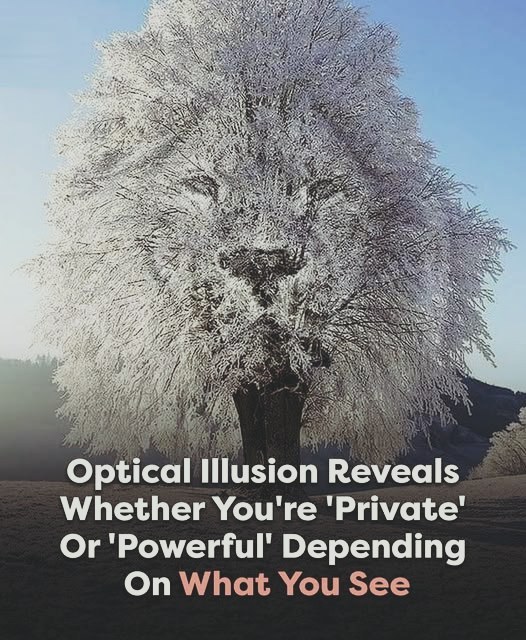
Optical illusions have fascinated people for centuries, not just because they are visually intriguing, but because they expose something fundamental about how the human brain works. They remind us that what we “see” is not a direct recording of reality, but a constructed interpretation shaped by attention, memory, expectation, and context.
At first glance, an optical illusion may seem like a simple trick of the eye. A hidden image. A confusing pattern. A drawing that appears to shift when you stare at it too long. But beneath that surface is something far more complex: the brain actively building meaning out of incomplete information.
Unlike a camera, the human visual system does not passively capture the world. Light enters the eyes, is converted into electrical signals, and then sent to the visual cortex. But what happens next is not straightforward translation—it is interpretation. The brain fills in gaps, predicts shapes, and decides what objects are most likely present based on past experience.
This is why two people can look at the same image and genuinely see different things.
In many optical illusions, especially ambiguous ones, the brain is forced to choose between multiple valid interpretations. A classic example is the so-called “tree and lion” illusion, where overlapping lines and shading can be organized into either a large tree-like structure or the face of a lion. Neither interpretation is incorrect. Instead, the brain is simply prioritizing different visual cues.

Some viewers instinctively focus on vertical structure and branching patterns, leading them toward the perception of a tree. Others pick up on symmetry, shadowing, and facial contours, leading them to see a lion. What feels immediate and obvious is actually the result of rapid subconscious processing.
What makes this even more fascinating is how quickly the brain performs this task. Within fractions of a second, it filters enormous amounts of visual data, discards what it considers irrelevant, and constructs a coherent image. This efficiency is what allows us to navigate the world effortlessly—but it also opens the door to misinterpretation.
Optical illusions take advantage of this system by introducing ambiguity. They disrupt the normal flow of perception just enough to reveal the “behind-the-scenes” process of the mind.
From a scientific perspective, illusions are incredibly valuable. Neuroscientists and psychologists use them to study how attention works, how the brain organizes patterns, and how perception can be influenced by expectation. They reveal that seeing is not just about the eyes—it is about the brain’s constant effort to make sense of the world.
One of the most important insights from this research is that perception is not fixed. It is dynamic. It changes based on focus, emotional state, prior knowledge, and even cultural background. What stands out to one person may be completely overlooked by another.
For example, someone trained to look for detail—like an artist or engineer—may notice small structural elements first. Another person who naturally focuses on overall shape may see the “big picture” immediately. Neither approach is better; they are simply different cognitive styles.
This is also why illusions are often used in education. They are not just entertaining visuals, but tools that help people understand how easily perception can be influenced. They teach critical thinking in a very direct way: what we assume we are seeing may not be the only interpretation.
Beyond science and education, optical illusions also have a philosophical dimension. They quietly challenge the idea that perception equals reality. If two people can look at the same image and see different things, then what does “objective seeing” really mean?
This question extends far beyond visual puzzles. In everyday life, people interpret the same events differently all the time. A conversation, a gesture, a decision—each can be understood in multiple ways depending on perspective. Illusions simply make this process visible in a controlled environment.
The brain’s tendency to “complete” missing information is especially important here. This process, known as perceptual completion, helps us recognize objects quickly. We don’t need to see every detail of a chair or a face to identify it. The brain fills in what is missing based on past experience.
But in illusions, this strength becomes a weakness. When information is deliberately incomplete or contradictory, the brain still tries to force it into something familiar—even if that leads to incorrect or shifting perceptions.
This is why illusions often feel like they “change” when we look at them longer. In reality, the image isn’t changing at all. What changes is our attention. Once we notice a different pattern or reinterpret a shape, the brain reorganizes the visual data accordingly.
Some researchers also study how emotional and cognitive states influence what people see first in an illusion. While popular internet claims often suggest that first impressions of illusions reveal personality traits, science does not support this idea in any reliable way. Instead, initial perception is more closely linked to attention habits, visual sensitivity, and contextual priming.
In other words, what you notice first is not who you are—it is how your brain is currently processing information.
Still, these differences are meaningful. They highlight the diversity of human perception and remind us that no two minds interpret the world in exactly the same way.
Another important concept illustrated by optical illusions is cognitive bias. The brain tends to rely on shortcuts to make fast decisions. These shortcuts are usually helpful, but they can sometimes lead to errors in judgment. Illusions exaggerate these shortcuts, making them easier to observe and understand.
For instance, when the brain expects to see a face, it may interpret vague shapes as facial features even when none exist. This tendency is so strong that humans can recognize faces in clouds, trees, or random patterns. It is an evolutionary advantage—but also a source of illusion.
What makes optical illusions so enduringly popular is that they sit at the intersection of science and experience. You don’t need specialized training to engage with them. You simply look—and then question what you see.
That moment of uncertainty is powerful. It interrupts automatic thinking and encourages curiosity. It reminds us that perception is not always as stable as it feels.
Even in everyday life, this lesson applies. We often believe we are seeing situations clearly, but our interpretation is shaped by context, expectation, and emotion. Just like an illusion, reality can sometimes be more flexible than it appears at first glance
Optical illusions, in this sense, are more than visual tricks. They are tools for reflection. They show us that the mind is not a passive observer, but an active participant in constructing reality.
And perhaps that is their greatest value: they remind us to slow down, look again, and accept that there may always be more than one way to see the world.